Missing a payment can feel stressful, especially if you are trying to protect or rebuild your credit score. A late payment can hurt your credit, but it does not mean your credit is ruined forever. The faster you act, the better chance you have to stop the damage from getting worse.
To rebuild credit after late payments, start by bringing the account current, checking your credit report, contacting your lender, and making every future payment on time. If the late payment is incorrect, you may be able to dispute it. If it is accurate, you can ask for a goodwill adjustment, but there is no guarantee the lender will remove it.
This guide explains how late payments affect your credit score, what to do immediately after a missed payment, how to check whether the late payment appears on your credit report, and how to rebuild positive payment history step by step.
- Quick answer: how to rebuild credit after late payments
- What is considered a late payment?
- Late fee vs. late payment on your credit report
- 30-day, 60-day, 90-day, and 120-day late payments
- How late payments affect your credit score
- Why one late payment can hurt your score
- Why multiple late payments are worse
- Why recent late payments matter more
- What to do immediately after a missed payment
- Pay the past-due amount as soon as possible
- Contact your lender or credit card issuer
- Ask about hardship options if you cannot catch up
- Step 1: Bring the account current
- What does “account current” mean?
- Should you pay the minimum payment or the full balance?
- Do not wait if the account is already past due
- Step 2: Check your credit report
- What to look for on your credit report
- Check more than one credit bureau
- Make notes before you take action
- Step 3: Dispute the late payment if it is wrong
- Examples of incorrect late payments
- Gather documents before you dispute
- Do not dispute accurate late payments as errors
- Check the result after the investigation
- Step 4: Ask for a goodwill adjustment if the late payment is accurate
- What is a goodwill letter?
- When a goodwill adjustment may have a better chance
- When goodwill removal may not work
- What to include in a goodwill request
- Step 5: Set up autopay and payment reminders
- Use autopay for at least the minimum payment
- Add payment reminders before the due date
- Change your due date if the timing is bad
- Keep a simple bill calendar
- Review your accounts every week
- Step 6: Keep all other accounts paid on time
- Prioritize minimum payments
- Do not let another account become past due
- Avoid letting accounts go to collections
- Create a payment priority list
- Contact lenders before you miss another payment
- Step 7: Lower your credit utilization
- What credit utilization means
- Why lower balances can help after a late payment
- Focus on credit card balances first
- Do not max out cards while rebuilding
- Step 8: Build positive payment history again
- Pay every account on time every month
- Keep older accounts in good standing
- Avoid too many new credit applications
- Focus on the full credit recovery plan
- Give your credit profile time to recover
- Can you remove late payments from your credit report?
- If the late payment is incorrect
- If the late payment is accurate
- Do not trust guaranteed removal promises
- What if the late payment stays?
- How long do late payments stay on your credit report?
- Why recent late payments hurt more
- Why older late payments may hurt less
- When the seven-year period matters
- How to recover while you wait
- How long does it take to rebuild credit after late payments?
- If it was one 30-day late payment
- If there are multiple late payments
- If the late payment was 60, 90, or 120 days late
- Why your score may recover slowly
- What can help speed up recovery?
- Why your credit score may not recover right away
- The late payment may still be recent
- Your credit utilization may still be high
- There may be other negative marks on your credit report
- Paying debt does not always create an instant score increase
- What to do if your score is still low
- How to track your progress after late payments
- Check your credit report regularly
- Watch your payment history
- Track your credit utilization
- Look for trends, not daily score changes
- Know what real improvement looks like
- Mistakes to avoid after late payments
- Ignoring the account
- Missing payments on other accounts
- Closing credit cards without a plan
- Opening too many new accounts
- Disputing accurate late payments as errors
- Believing guaranteed removal promises
- Paying debt without understanding the credit impact
- Expecting instant results
- When to get extra help
- If you cannot afford minimum payments
- If you have several past-due accounts
- If your account may go to collections
- If your credit report has several errors
- If you feel overwhelmed by debt
- Get help before the problem grows
- Final thoughts: you can rebuild credit after late payments
- Related guides
- FAQ about rebuilding credit after late payments
- Can one late payment ruin my credit score?
- How long does a late payment stay on your credit report?
- Can I remove a late payment from my credit report?
- Will paying the account current fix my credit score?
- Is a 30-day late payment bad?
- How many on-time payments do I need to rebuild credit?
- Can autopay help rebuild credit after late payments?
- Should I close my credit card after a late payment?
- Why is my credit score still low after paying a late payment?
- What is the best way to rebuild credit after late payments?
Quick answer: how to rebuild credit after late payments
The best way to rebuild credit after late payments is to catch up on the missed payment, bring the account current, avoid any new late payments, lower high credit card balances, and build a consistent record of on-time payments. If the late payment is wrong, dispute it with the credit bureaus. If it is accurate, you can try asking the lender for a goodwill removal.
What is considered a late payment?
A late payment happens when you do not make at least the required minimum payment by the due date. This can happen with a credit card, personal loan, auto loan, mortgage, student loan, or another account that reports to the credit bureaus.
However, not every late payment affects your credit report in the same way. Being a few days late may lead to a late fee from your lender, but it does not always mean the late payment has already been reported to the credit bureaus. A payment that becomes 30 days late is usually more serious because it may appear on your credit report and hurt your credit score.
Late fee vs. late payment on your credit report
A late fee is a charge from your lender for paying after the due date. A late payment on your credit report is different. It means the lender has reported the missed payment to the credit bureaus, and it may become part of your payment history.
This difference matters because a late fee may cost you money right now, while a reported late payment can affect your credit score for much longer. If you missed a payment recently, the first thing to do is bring the account current as soon as possible and check whether the late payment has been reported.
30-day, 60-day, 90-day, and 120-day late payments
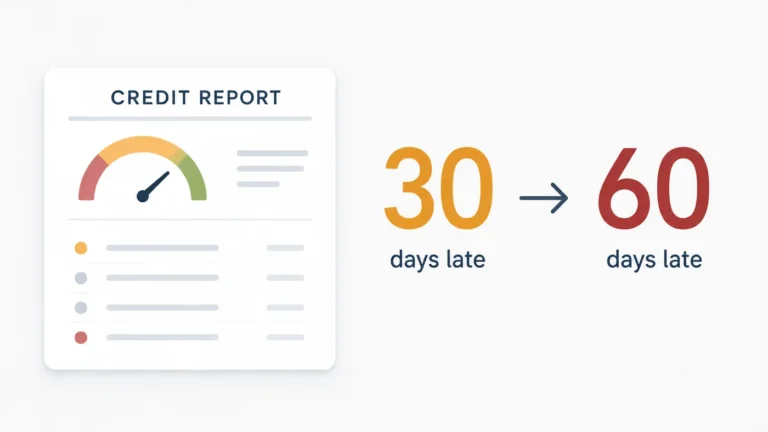
Late payments are often reported in stages. A 30-day late payment means the account was at least 30 days past due. A 60-day late payment means it stayed unpaid longer. A 90-day or 120-day late payment is usually more serious because it shows the account remained delinquent for several months.
In general, the longer the payment stays past due, the more damage it can do. One 30-day late payment can hurt, but repeated late payments or deeper delinquencies can make credit rebuilding harder. That is why the goal is simple: catch up quickly, avoid another missed payment, and start rebuilding positive payment history right away.
How late payments affect your credit score
Late payments can hurt your credit score because payment history is one of the most important parts of your credit profile. Lenders want to see that you can make payments on time. When a missed payment appears on your credit report, it may signal that you are a higher-risk borrower.
The impact depends on several things, including how late the payment was, how recent it is, how many late payments you have, and what the rest of your credit history looks like. A single 30-day late payment can hurt, especially if your credit was clean before. A 60-day or 90-day late payment can be more damaging because it shows the account stayed past due for longer.
Why one late payment can hurt your score
Even one late payment can cause a noticeable credit score drop. This is especially true if you had a strong payment history before the missed payment. When your credit report suddenly changes from clean on-time payments to one reported late payment, credit scoring models may treat that as a serious negative mark.
If your score dropped and you are not sure what caused it, it may help to review the common reasons why your credit score dropped for no reason.
Why multiple late payments are worse
One missed payment may look like a mistake. Multiple late payments can look like a pattern. If you miss payments on several accounts or fall behind for several months, rebuilding credit can take longer because your payment history shows repeated negative activity.
Why recent late payments matter more
A recent late payment usually hurts more than an older late payment. Over time, the impact may become less severe if you keep paying on time and avoid new negative marks. That is why rebuilding credit after late payments is not only about fixing the past. It is also about creating a stronger record of on-time payments going forward.
Paying the account current is important because it can stop the situation from getting worse. However, it does not always erase the credit score impact right away. The real recovery comes from consistent on-time payments, lower balances, and no new missed payments.
What to do immediately after a missed payment
If you missed a payment, the first goal is to stop the situation from getting worse. Do not ignore the account or wait to see what happens. The sooner you act, the better chance you have to limit fees, avoid deeper delinquency, and protect your credit score from additional damage.
Start by checking how late the payment is, how much is past due, and whether the account is still open and active. If you can afford it, pay the past-due amount as soon as possible. If you cannot pay the full amount right now, contact your lender or credit card issuer before the account falls further behind.
Pay the past-due amount as soon as possible
The fastest way to stop a missed payment from becoming a bigger problem is to bring the account current. This usually means paying the amount that is past due, including any required minimum payment and possible late fee.
If the account is only a few days late, paying quickly may help you avoid a more serious credit reporting problem. If the account is already 30 days late or more, catching up still matters because it can prevent the account from becoming 60, 90, or 120 days late.
Contact your lender or credit card issuer
After you make the payment, or even before you can make it, contact your lender. Ask whether the late payment has been reported to the credit bureaus, whether the late fee can be waived, and what you need to do to bring the account current.
If this is your first missed payment and you usually pay on time, the lender may be willing to waive the late fee as a one-time courtesy. This does not guarantee that a reported late payment will be removed from your credit report, but it is still worth asking.
Ask about hardship options if you cannot catch up
If you cannot afford the past-due payment, ask the lender about hardship options before the account becomes more seriously delinquent. Depending on the lender, you may be able to request a payment plan, temporary reduced payment, due date change, or other short-term arrangement.
The worst move is to stay silent and hope the problem disappears. A missed payment can become much harder to fix if the account keeps aging past due. If you are trying to limit the damage while you recover, focus on practical steps that can help you improve your credit score fast without creating new problems.
Step 1: Bring the account current
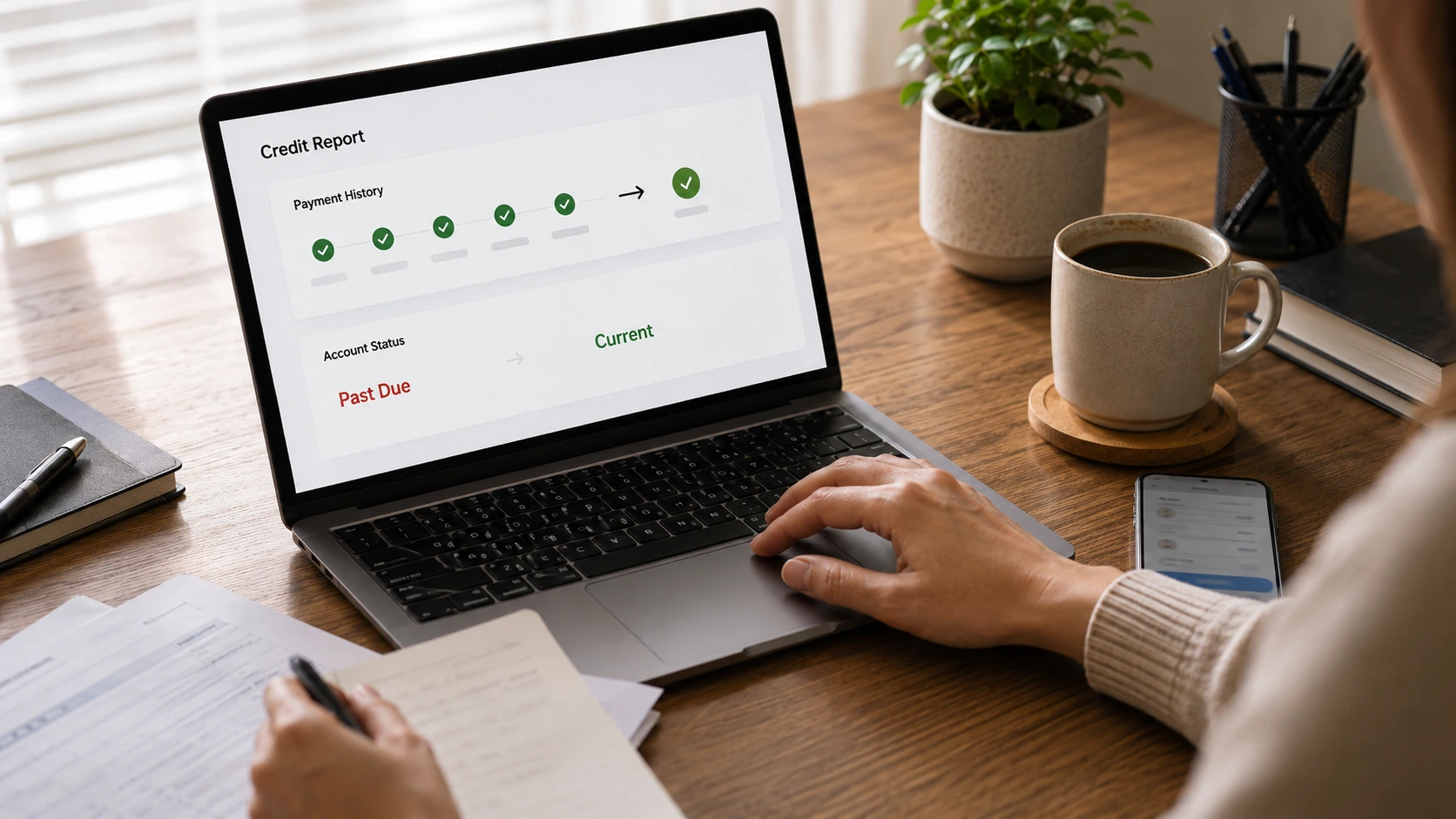
The first real step to rebuild credit after late payments is to bring the account current. This means paying the past-due amount so the account is no longer behind. If the account stays past due, the problem can continue to grow and may lead to more serious negative marks on your credit report.
Bringing the account current does not always make your credit score recover right away. A reported late payment may still affect your payment history. However, catching up is still important because it can help stop the account from becoming 60, 90, or 120 days late.
What does “account current” mean?
An account is current when you have paid the amount required to stop it from being past due. For a credit card, this usually means paying at least the missed minimum payment and any amount required by the card issuer. For a loan, it may mean paying the missed installment or following the lender’s instructions to bring the loan back into good standing.
If you are not sure how much you need to pay, log in to your account or contact your lender directly. Ask for the exact amount needed to bring the account current, not just the regular monthly payment. Sometimes the past-due amount may include missed payments, late fees, or other charges.
Should you pay the minimum payment or the full balance?
If money is tight, your first priority is usually to pay enough to bring the account current. This helps prevent the account from falling further behind. Paying the full balance can be helpful if you can afford it, but avoiding a deeper delinquency should come first.
If the late payment is on a credit card, paying down more than the minimum may also help lower your credit utilization. That can support your credit score recovery over time, especially if your balances are high. But do not use all your available cash on one account if it causes you to miss payments on another account.
Do not wait if the account is already past due
The longer an account stays past due, the harder it can be to recover. A missed payment that is only a few days late is usually easier to manage than an account that is already 30, 60, or 90 days late. If you can catch up now, do it before the account becomes more seriously delinquent.
If you cannot afford the full past-due amount, contact the lender and ask about a payment arrangement, hardship option, or due date change. Staying silent is usually the worst move. A lender may have options, but they cannot help if you do not reach out.
Step 2: Check your credit report
After you bring the account current, the next step is to check your credit report. This helps you see whether the late payment has been reported, which account is affected, and whether the information is accurate. Do not guess what is hurting your credit score. Look at the report and confirm what is actually there.
If you are not sure where to start, use this guide on how to read your credit report before you try to fix anything. Your credit report can show account status, payment history, balances, dates, and negative marks that may be affecting your score.
What to look for on your credit report
When you review your credit report after a missed payment, look closely at the account that was late. Check the account name, payment status, date of the late payment, current balance, past-due balance, and whether the account is listed as open, closed, charged off, or sent to collections.
Pay special attention to the payment history section. This is where late payments may appear as 30 days late, 60 days late, 90 days late, or more. If the late payment is listed incorrectly, the wrong date is reported, or the account does not belong to you, that may be a credit report error you can challenge later.
Check more than one credit bureau
Your credit reports may not always look exactly the same across all credit bureaus. A late payment might appear on one report, two reports, or all three. That is why it can be helpful to review more than one credit report before deciding what to do next.
Checking your reports also helps you avoid wasting time on the wrong problem. Sometimes a credit score drop is not caused only by one late payment. High credit card balances, collections, charge-offs, hard inquiries, or other negative marks may also be affecting your credit score.
Make notes before you take action
Before you dispute anything or contact the lender again, write down what you see. Note the creditor name, account number, reported late payment date, payment status, balance, and any information that looks wrong or outdated.
This simple step can save you time later. If the late payment is accurate, your next move may be a goodwill request. If the late payment is incorrect, your next move may be a credit report dispute with supporting documents.
Step 3: Dispute the late payment if it is wrong
If the late payment on your credit report is incorrect, you may be able to dispute it. This step is only for inaccurate information. If you truly missed the payment and the lender reported it correctly, a dispute may not remove it. But if the date, account, payment status, or balance is wrong, you should take action.
A credit report dispute asks the credit bureau to investigate information that may be inaccurate. If you are not sure how the process works, start with this guide on how to dispute errors on your credit report.
Examples of incorrect late payments
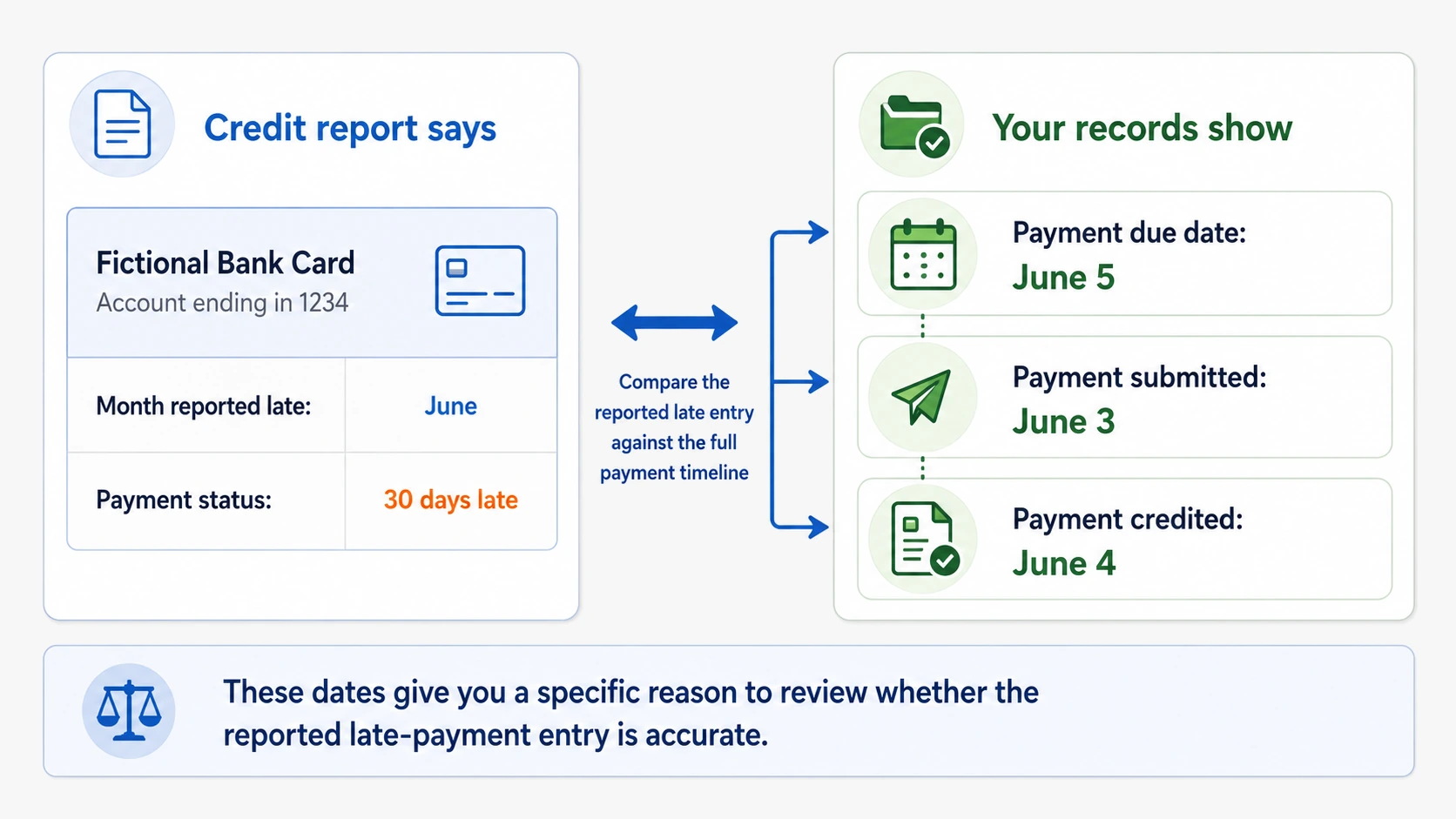
A late payment may be incorrect if you paid on time but the account was still marked late. It may also be wrong if the late payment date is incorrect, the account does not belong to you, the same account appears twice, the balance is inaccurate, or the payment status does not match your records.
You should also look for accounts that were already paid, closed, transferred, or included in another arrangement but still show the wrong payment history. Even small reporting mistakes can make your credit profile look worse than it really is.
Gather documents before you dispute
Before you send a dispute, collect proof that supports your claim. Useful documents may include payment confirmations, bank statements, account statements, emails from the lender, screenshots from your online account, or letters showing the correct payment status.
Strong documentation can make your dispute clearer and easier to review. If you need help organizing proof, use this guide on what documents help support a credit report dispute.
Do not dispute accurate late payments as errors
If the late payment is accurate, disputing it as an error is usually not the best strategy. Credit bureaus investigate whether the information is correct. If the lender verifies that the late payment is accurate, it may stay on your credit report.
In that case, your better option may be to ask the lender for a goodwill adjustment, especially if the missed payment was a one-time mistake and you usually pay on time. That is different from a dispute because you are asking for a courtesy removal, not claiming the information is wrong.
Check the result after the investigation
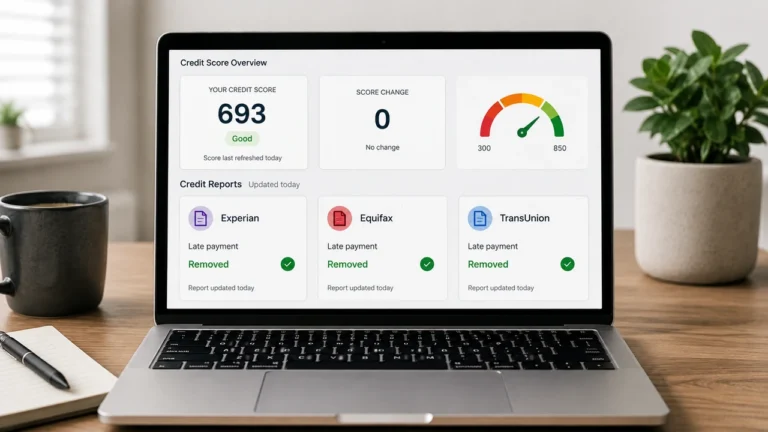
After you submit a dispute, review the result carefully. If the credit bureau updates or removes the late payment, check your credit report again to make sure the correction appears properly. If the late payment remains, read the explanation and compare it with your documents.
If the information is still wrong after the dispute, you may need to contact the lender directly, send more supporting documents, or file another dispute with clearer evidence. The goal is not to dispute randomly. The goal is to correct inaccurate information that is hurting your credit score.
Step 4: Ask for a goodwill adjustment if the late payment is accurate
If the late payment is accurate, disputing it as an error may not help. A credit bureau dispute is meant to correct inaccurate information, not remove a real missed payment simply because it hurts your credit score. If the lender reported the late payment correctly, the credit bureau may keep it on your credit report.
However, you may still have one option: asking the lender for a goodwill adjustment. A goodwill adjustment is a request to remove a late payment as a courtesy, usually when the missed payment was a one-time mistake and you have a history of paying on time.
What is a goodwill letter?
A goodwill letter is a polite message you send to your lender or credit card issuer asking them to remove a late payment from your credit report. In the letter, you explain what happened, take responsibility, and ask whether they would consider removing the late payment as a goodwill gesture.
This is different from a dispute. With a dispute, you are saying the information is wrong. With a goodwill letter, you are saying the late payment happened, but you are asking the lender for a courtesy adjustment because of your overall payment history or the circumstances around the missed payment.
When a goodwill adjustment may have a better chance
A goodwill request may have a better chance if the late payment was your first mistake, you had a long record of on-time payments before it happened, and the account is now current. Lenders may also be more willing to review your request if the missed payment was connected to a temporary hardship, medical issue, job loss, family emergency, bank error, or autopay problem.
Your request should be honest, calm, and specific. Do not blame everyone else or write a dramatic essay. Explain what happened, show that the account has been brought current, and make it clear that you are trying to rebuild a strong payment history.
When goodwill removal may not work
A goodwill adjustment is never guaranteed. Lenders are not required to remove accurate late payments from your credit report. Some lenders may say no, some may not respond, and some may have strict reporting policies that do not allow them to make this type of change.
If your goodwill request is denied, do not panic. You can still rebuild credit after late payments by keeping every account current, avoiding new missed payments, lowering high balances, and building positive payment history over time.
What to include in a goodwill request
A simple goodwill request should include your name, account information, the date of the late payment, a short explanation of what happened, confirmation that the account is now current, and a polite request for the lender to consider removing the late payment from your credit report.
Keep the tone respectful and realistic. You are not demanding removal. You are asking for help. That difference matters because goodwill removal is based on lender discretion, not a legal requirement.
Step 5: Set up autopay and payment reminders
After a late payment, your next goal is simple: do not let it happen again. You may not be able to erase an old late payment right away, but you can protect your credit score by building a stronger pattern of on-time payments going forward.
Autopay and payment reminders can help you avoid missed payments, late fees, and new negative marks on your credit report. This step may sound basic, but it is one of the most powerful habits for rebuilding credit after late payments.
Use autopay for at least the minimum payment
If you have credit cards, consider setting up autopay for at least the minimum payment. This can help keep the account from becoming late, even if you plan to make an extra manual payment later.
Autopay does not mean you should stop checking your accounts. You still need to make sure there is enough money in your bank account before the payment date. A failed autopay can create another problem, so check your balance before the payment is scheduled to process.
Add payment reminders before the due date
Payment reminders give you a second layer of protection. You can set reminders on your phone, calendar, banking app, or budgeting app. The goal is to see the bill before it becomes a problem.
A simple reminder system can look like this: one reminder 7 days before the due date, one reminder 3 days before the due date, and one reminder on the due date. This gives you time to move money, check the balance, and make the payment before it becomes late.
Change your due date if the timing is bad
If your bills are due before your paycheck arrives, ask your lender or credit card issuer whether you can change the due date. Many lenders allow customers to move a payment due date to a better time of the month.
This can make your payment system easier to manage. For example, if you get paid at the beginning of the month, setting major bills shortly after payday may help you pay them before the money gets spent somewhere else.
Keep a simple bill calendar
A bill calendar can help you see all due dates in one place. You do not need anything fancy. A notes app, spreadsheet, paper planner, or calendar app can work.
Write down each account, the due date, the minimum payment, the lender name, and whether autopay is turned on. This makes it easier to spot problems before they become missed payments.
Review your accounts every week
Even with autopay, it is smart to review your accounts once a week. Check upcoming due dates, recent payments, balances, and available cash. This small habit can prevent a lot of credit damage.
Rebuilding credit after late payments is not only about fixing the past. It is about creating a system that protects your future payment history. The fewer missed payments you have going forward, the stronger your credit profile can become over time.
Step 6: Keep all other accounts paid on time
After one late payment, it is important to protect every other account you have. Do not focus so much on one missed payment that you accidentally fall behind on another credit card, loan, or bill. New late payments can make credit rebuilding much harder.
Rebuilding credit after late payments is not only about fixing one account. It is about showing a stronger payment pattern across your full credit profile. Every on-time payment helps you move in the right direction, while every new missed payment can slow your progress down.
Prioritize minimum payments
If money is tight, your first goal should usually be to make at least the minimum payment on every account before you pay extra on one account. Paying extra toward one balance may feel productive, but it can backfire if it causes another account to become past due.
Minimum payments are not perfect, and they may not reduce debt quickly. However, they can help protect your payment history while you stabilize your finances. Once all accounts are current and protected from late payments, you can create a stronger payoff plan.
Do not let another account become past due
One late payment can hurt your credit score, but several late payments can create a bigger problem. If multiple accounts become past due, lenders may see a pattern of financial stress instead of one isolated mistake.
Check your due dates, balances, and available cash before each payment cycle. If you see that you may not be able to pay an account on time, contact the lender before the due date and ask about your options.
Avoid letting accounts go to collections
If an account stays unpaid for too long, it may be charged off or sent to collections. That can create a separate negative mark on your credit report and make the recovery process more complicated.
If your account has already been sent to collections, read this guide on how to rebuild credit after collections so you can understand the next steps.
Create a payment priority list
A simple payment priority list can help you stay organized. Write down every account, the due date, the minimum payment, the current balance, and whether the account is current or past due.
Start by protecting accounts that are still current. Then work on catching up past-due accounts before they become more seriously delinquent. This approach helps you avoid turning one late payment into several credit problems.
Contact lenders before you miss another payment
If you cannot afford all of your payments, do not wait until the account is already late. Contact your lender or credit card issuer and explain the situation. Ask whether they offer a hardship plan, payment arrangement, due date change, or temporary reduced payment option.
Reaching out does not guarantee approval, but it is usually better than staying silent. The goal is to prevent new late payments, protect your payment history, and keep your credit recovery plan from falling apart.
Step 7: Lower your credit utilization
Late payments can hurt your payment history, but high credit utilization can also slow down your credit recovery. If your credit cards are close to their limits, your credit score may stay lower even after you bring a late account current and start paying on time again.
Credit utilization is the percentage of your available credit that you are using. For example, if you have a credit card with a $1,000 limit and a $700 balance, your utilization on that card is 70%. The higher your utilization is, the riskier your credit profile may look to lenders.
What credit utilization means
Credit utilization usually applies to revolving credit, such as credit cards and lines of credit. It compares your current balance to your credit limit. Lower utilization can help make your credit profile look healthier, especially when you are trying to rebuild credit after late payments.
This does not mean you need to pay every card to zero immediately. The first priority is still to avoid new missed payments. But once your accounts are current, lowering high balances can support your credit score recovery over time.
Why lower balances can help after a late payment
A late payment is a negative mark in your payment history, and you may not be able to erase it quickly. But credit utilization is something you may be able to improve faster than old payment history. Paying down credit card balances can help reduce the amount of available credit you are using.
If you are wondering what kind of score change to expect, remember that the result depends on your full credit profile. You can learn more in this guide on how much your credit score may increase if you pay off debt.
Focus on credit card balances first
If you have several debts, credit card balances are often a smart place to focus because they affect utilization directly. Paying down a high credit card balance may help more than paying extra toward an installment loan, especially if your cards are close to their limits.
A simple strategy is to keep making at least the minimum payment on every account, then use extra money to reduce the credit card with the highest utilization. This helps you protect your payment history while also improving your balance-to-limit ratio.
Do not max out cards while rebuilding
After a late payment, avoid adding new balances if you can. Maxing out credit cards can make your credit profile look more stressed and may cancel out some of the progress you are making with on-time payments.
The goal is not perfection overnight. The goal is progress: fewer missed payments, lower balances, and a more stable credit profile month by month. When your payment history and credit utilization both start improving, your credit recovery has a stronger foundation.
Step 8: Build positive payment history again
After a late payment, the most important thing you can do is build positive payment history again. You may not be able to remove the old late payment right away, but you can start adding new on-time payments to your credit profile every month.
Credit rebuilding is not about one perfect move. It is about consistency. Every month you pay your accounts on time, you show lenders that the missed payment was not the beginning of a pattern. Over time, this can help your credit profile look stronger and more stable.
Pay every account on time every month
The main rule is simple: do not miss another payment. One late payment can hurt, but repeated late payments can make recovery much harder. If you are rebuilding credit after late payments, your first priority should be protecting your payment history from new negative marks.
Use autopay, reminders, a bill calendar, or a budgeting app if needed. The system does not have to be fancy. It just has to work. A boring payment system that keeps you on time is better than a beautiful spreadsheet you forget to open.
Keep older accounts in good standing
If you have older accounts that are still open and in good standing, protect them. Older positive accounts can help show stability in your credit history, especially when you are recovering from a missed payment.
This does not mean you need to carry a balance or pay interest. It means keeping the account active, making payments on time, and avoiding new problems. A clean account that continues to report positive activity can support your credit recovery over time.
Avoid too many new credit applications
After a late payment, it may be tempting to open new credit accounts to “fix” your score quickly. Be careful. Too many new applications can add hard inquiries, lower your average account age, and make your credit profile look riskier.
New credit is not always bad, but it should be used carefully. Before applying for another credit card or loan, make sure your current accounts are stable, your payments are on time, and your balances are under control.
Focus on the full credit recovery plan
Rebuilding credit after late payments works best when you combine several habits: pay on time, keep accounts current, lower high credit card balances, check your credit report, and avoid new negative marks.
If you want a broader plan beyond late payments, read this guide on how to improve your credit score step by step.
Give your credit profile time to recover
Your credit score may not bounce back immediately after one or two on-time payments. That does not mean your efforts are not working. Credit recovery often takes time because your report needs to show a stronger pattern of responsible behavior.
The goal is to make your recent history look better than your past mistake. Keep paying on time, avoid new missed payments, and let your positive payment history build month by month.
Can you remove late payments from your credit report?
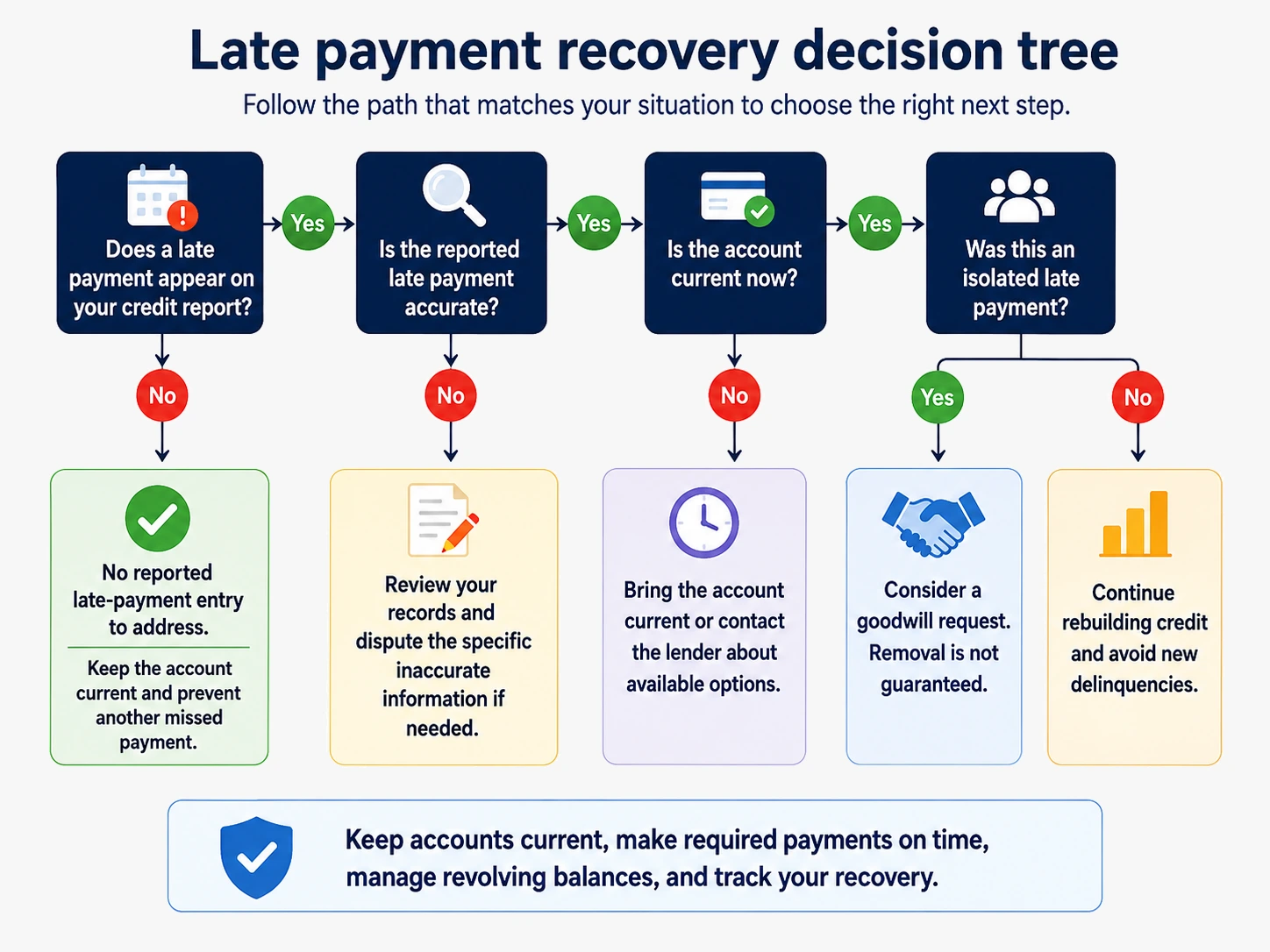
In some cases, you may be able to remove a late payment from your credit report, but it depends on whether the late payment is accurate. If the late payment is wrong, you can dispute it with the credit bureaus. If the late payment is accurate, removing it is harder because lenders are generally allowed to report correct negative information.
This is why it is important to separate two different situations: an incorrect late payment and an accurate late payment. They require different strategies. Treating both the same way can waste time and make the credit repair process more frustrating than it needs to be.
If the late payment is incorrect
If the late payment is incorrect, you should dispute it. This may apply if you paid on time, the wrong date was reported, the account does not belong to you, the account appears twice, or the payment status does not match your records.
Before you file a dispute, gather proof such as payment confirmations, bank statements, account statements, emails from the lender, or screenshots from your online account. If you need a full process, read this guide on how to dispute errors on your credit report.
If the late payment is accurate
If the late payment is accurate, a dispute may not remove it. The credit bureau may contact the lender, the lender may verify the information, and the late payment may stay on your credit report.
In this case, your better option may be a goodwill request. A goodwill request asks the lender to remove the late payment as a courtesy. This may have a better chance if the missed payment was a one-time mistake, the account is now current, and you had a strong history of on-time payments before the issue happened.
Do not trust guaranteed removal promises
Be careful with companies or services that promise to remove accurate late payments from your credit report. No one can honestly guarantee that a real late payment will be deleted if the lender reported it correctly.
A better strategy is to focus on what you can control: correct real errors, ask politely for goodwill when appropriate, avoid new missed payments, lower high balances, and keep building positive payment history month after month.
What if the late payment stays?
If the late payment stays on your credit report, that does not mean your credit score can never recover. Older negative marks may matter less over time, especially if your newer credit history shows consistent on-time payments and lower balances.
The goal is not to panic over one negative mark forever. The goal is to make your recent credit behavior stronger than the mistake in the past.
How long do late payments stay on your credit report?
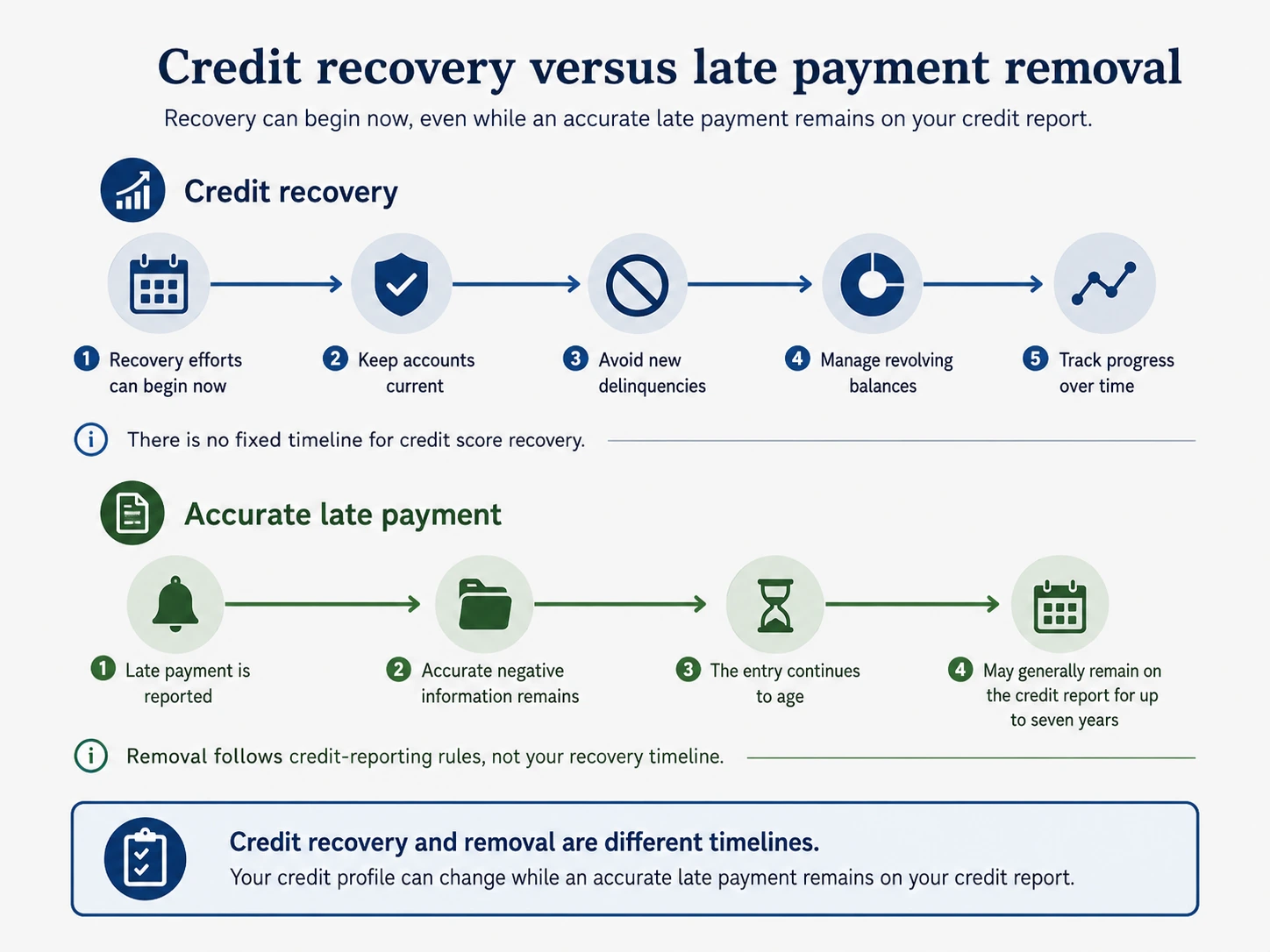
Late payments can generally stay on your credit report for up to seven years. That does not mean your credit score will be frozen for seven years, but it does mean the late payment may remain visible to lenders during that reporting period.
The good news is that the impact of a late payment may become less severe over time, especially if you keep all accounts current and build a stronger record of on-time payments. A recent late payment usually matters more than an older one.
Why recent late payments hurt more
A fresh late payment can hurt because it shows recent payment trouble. Credit scoring models often pay close attention to recent credit behavior, so a missed payment from last month may affect your score more than a late payment from several years ago.
This is why your first few months after a late payment are important. You want your credit report to start showing stability again: no new missed payments, lower balances, and accounts staying current.
Why older late payments may hurt less
As time passes, an older late payment may have less influence if your newer credit history looks stronger. If you keep paying on time month after month, your recent payment history can help show lenders that the late payment was not part of an ongoing pattern.
Older late payments can still matter, especially if they were serious or if you have several of them. But they do not have to control your credit future forever. The goal is to make your newest credit behavior better than your past mistake.
When the seven-year period matters
The seven-year reporting period matters because it tells you how long a late payment may remain on your credit report. If the late payment is accurate, it may stay until it ages off naturally. If it is still showing after it should have been removed, you may need to dispute it as outdated information.
Do not confuse “stays on your report” with “hurts your score the same way forever.” Those are not the same thing. A late payment may remain visible for years, but its impact can change as your overall credit profile changes.
How to recover while you wait
You do not have to sit and wait doing nothing. While the late payment remains on your credit report, focus on actions you can control: pay every account on time, keep balances lower, avoid new late payments, check your credit report, and correct any errors you find.
If you want a broader timeline for recovery, read this guide on how long it takes to fix your credit score.
How long does it take to rebuild credit after late payments?
There is no single timeline for rebuilding credit after late payments. Some people may start seeing improvement within a few months, while others may need much longer. The timeline depends on how late the payment was, how many late payments you have, how recent they are, and what the rest of your credit profile looks like.
A single 30-day late payment may be easier to recover from than several 60-day or 90-day late payments. Your recovery may also be faster if your accounts are now current, your balances are lower, and you keep making every payment on time going forward.
If it was one 30-day late payment
If you only had one 30-day late payment and your credit history was strong before, your credit may recover more easily over time. The late payment can still hurt, especially when it is recent, but a clean pattern of on-time payments after the mistake can help your profile look more stable.
The key is to avoid turning one mistake into a pattern. Bring the account current, keep your balances under control, and make sure every future payment is made on time.
If there are multiple late payments
If you have several late payments, recovery may take longer. Multiple missed payments can make lenders see a pattern of payment problems instead of one isolated mistake. This is especially true if the late payments happened across different accounts or continued for several months.
In this situation, the most important step is to stop new damage. Focus on keeping every account current, making at least the minimum payment on time, and avoiding any new late payments while your credit profile stabilizes.
If the late payment was 60, 90, or 120 days late
A deeper delinquency can be harder to recover from because it shows the account stayed unpaid for longer. A 60-day, 90-day, or 120-day late payment may have a stronger negative effect than a single 30-day late payment.
That does not mean your credit is impossible to rebuild. It means you may need more time and more consistent positive payment history before your credit score starts to look stronger again.
Why your score may recover slowly
Your credit score may not improve right away even after you catch up. The late payment may still be recent, your credit card balances may still be high, or there may be other negative marks on your credit report.
If your score feels stuck after several months of better habits, read this guide on why your credit score is not increasing.
What can help speed up recovery?
You cannot force an old late payment to stop mattering overnight, but you can support your recovery with smart habits. Pay every account on time, keep accounts current, lower high credit card balances, avoid new hard inquiries when possible, and check your credit report for errors.
The strongest recovery signal is consistency. Month after month, your credit report needs to show that the missed payment was in the past and your current financial behavior is more stable.
Why your credit score may not recover right away
Your credit score may not recover right away after a late payment, even if you bring the account current. This can feel frustrating, but it is normal. Paying the past-due amount is an important step because it can stop the account from falling further behind, but it does not automatically erase the late payment from your credit report.
Credit recovery takes time because your score is based on your full credit profile. A recent late payment, high credit card balances, other negative marks, and the age of your accounts can all affect how quickly your score starts to improve.
The late payment may still be recent
A recent late payment usually has a stronger impact than an older one. If the missed payment was reported recently, your credit score may stay lower for a while, even after you catch up.
This does not mean your recovery is not working. It means your credit report needs time to show a stronger pattern of on-time payments after the mistake.
Your credit utilization may still be high
If your credit card balances are still high, your credit score may not improve as quickly as you expect. A late payment hurts your payment history, but high credit utilization can also hold your score down.
That is why paying the account current is only one part of the process. You may also need to lower balances, avoid new charges, and keep your available credit from being heavily used.
There may be other negative marks on your credit report
Sometimes a late payment is not the only problem. Your credit report may also show collections, charge-offs, hard inquiries, high balances, or other negative marks that continue to affect your score.
This is why checking your credit report matters. If you only focus on one late payment, you may miss other issues that are slowing down your credit recovery.
Paying debt does not always create an instant score increase
Many people expect their score to jump as soon as they pay a past-due account or reduce debt. Sometimes that happens, but not always. Your score can move slowly, stay flat, or even drop temporarily depending on what changed in your credit profile.
If you recently paid debt and your score moved in the wrong direction, read this guide on why your credit score dropped after paying off debt.
What to do if your score is still low
If your credit score is still low after a late payment, stay focused on the basics. Keep every account current, make payments on time, lower high balances, avoid new missed payments, and check your credit report for errors.
The goal is not to force your score to recover overnight. The goal is to make your recent credit behavior stronger than the late payment in your past. That is how real credit rebuilding works.
How to track your progress after late payments
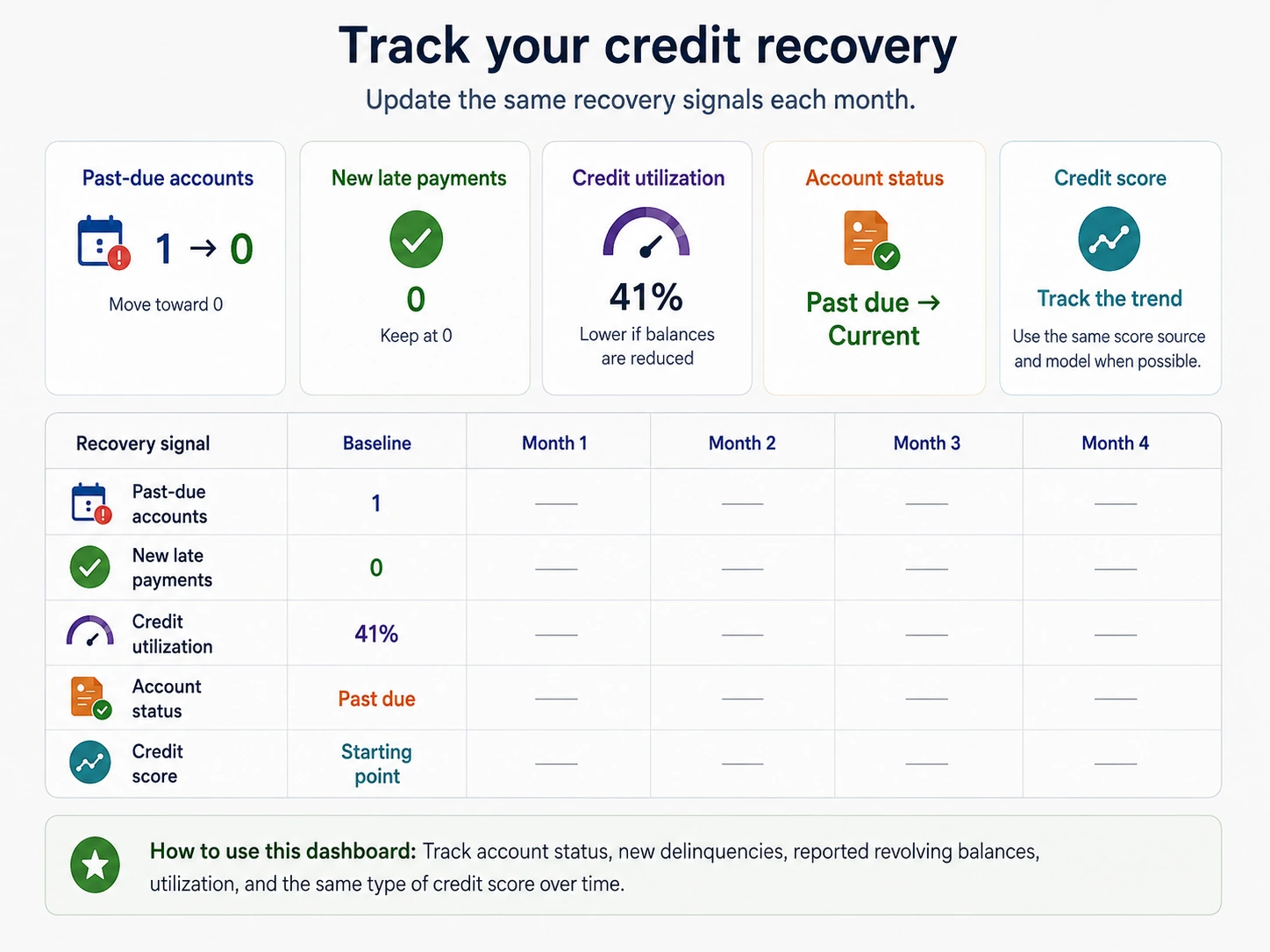
After late payments, it is easy to check your credit score every day and panic over every small change. But daily score movement does not always tell the full story. Credit rebuilding works better when you track bigger trends over several months instead of reacting to every small update.
Your goal is to see whether your credit profile is becoming more stable. That means fewer negative changes, more on-time payments, lower balances, and account statuses that show your accounts are current instead of past due.
Check your credit report regularly
Your credit report shows the details behind your score. Review your report to make sure your accounts are reporting correctly, your balances are updating, and your payment history is accurate. If you brought an account current, check that the account status eventually reflects that change.
You do not need to check your full credit report every single day. A monthly review is usually enough for most people. The goal is to catch errors, confirm updates, and understand what is actually affecting your credit score.
Watch your payment history
Payment history is one of the most important things to track after late payments. Each new month with on-time payments helps you build a stronger recent pattern. This does not erase the old late payment immediately, but it can help your credit profile look healthier over time.
Make sure every open account is paid on time. If you see a new late payment appear, act quickly. One old mistake is easier to recover from than a fresh pattern of repeated missed payments.
Track your credit utilization
Credit utilization is another important progress signal. If your credit card balances are going down compared with your credit limits, that may support your credit recovery. High balances can keep your score lower, even when you are making payments on time.
When you track progress, look at both payment history and balances. A person can pay on time but still feel stuck if their credit cards are close to the limit.
Look for trends, not daily score changes
Your credit score can move up or down for many reasons, including balance updates, new reporting dates, hard inquiries, account changes, or credit model differences. One small drop does not always mean your recovery plan is failing.
Instead of obsessing over one score update, look at the bigger picture. Are you making every payment on time? Are your balances going down? Are your accounts current? Are there fewer negative surprises on your credit report? Those signs matter.
Know what real improvement looks like
Real credit improvement after late payments usually looks like steady progress, not instant perfection. Your score may move slowly at first, especially if the late payment is recent. But if your newer credit behavior is clean, your profile can become stronger month by month.
If you want a deeper checklist, read this guide on how to know if your credit score is improving.
Mistakes to avoid after late payments
After a late payment, the worst thing you can do is panic and start making random credit decisions. One missed payment can hurt your credit score, but the wrong moves after it can make the recovery process even harder.
The goal is to stay calm, protect your payment history, keep your accounts current, and avoid creating new problems while you rebuild credit after late payments.
Ignoring the account
Do not ignore the account after a missed payment. If the account stays past due, it can become more seriously delinquent and may lead to additional late payments, fees, charge-off, or collections.
Even if you cannot pay the full past-due amount right away, contact the lender. Ask what options are available and what you need to do to stop the account from falling further behind.
Missing payments on other accounts
Another common mistake is focusing only on the late account while accidentally missing payments on other accounts. This can turn one credit problem into several credit problems.
If money is tight, prioritize making at least the minimum payment on every account before paying extra on one balance. Protecting your payment history should come first.
Closing credit cards without a plan
Some people want to close a credit card immediately after a late payment because they feel frustrated or embarrassed. But closing a credit card without a plan can affect your available credit and may increase your credit utilization if you still carry balances on other cards.
Before closing any account, look at your full credit profile. If the card has no annual fee and you can manage it responsibly, keeping it open may sometimes be better than closing it in a panic.
Opening too many new accounts
After a credit score drop, it may be tempting to apply for new credit cards or loans to “fix” your score quickly. Be careful. Too many new applications can add hard inquiries and make your credit profile look riskier.
New credit should be used carefully, especially when you are recovering from late payments. Focus first on stabilizing your current accounts, paying on time, and lowering high balances.
Disputing accurate late payments as errors
If the late payment is accurate, disputing it as an error may not work. Credit bureaus can verify the information with the lender, and the late payment may stay on your credit report.
Disputes are for inaccurate information. If the late payment is real, a goodwill request may be a better option, but even that is not guaranteed.
Believing guaranteed removal promises
Be careful with anyone who promises to remove accurate late payments from your credit report. No credit repair company can honestly guarantee that a real late payment will disappear if it was reported correctly.
A better strategy is to correct real errors, avoid new missed payments, lower credit utilization, and build positive payment history over time.
Paying debt without understanding the credit impact
Paying debt is usually a smart financial move, but it does not always create an instant credit score increase. Sometimes your score may move slowly, stay flat, or change in a way you did not expect.
If paying debt is part of your recovery plan, read this guide on how to fix your credit score after paying off debt so you understand what to do next.
Expecting instant results
Credit recovery after late payments takes time. One on-time payment after a missed payment is a good start, but it may not be enough to make your score recover immediately.
Do not quit your plan just because your score does not jump right away. Keep paying on time, keep balances under control, and let your newer credit behavior become stronger than the old mistake.
When to get extra help
Sometimes rebuilding credit after late payments is not just about one missed payment. If you are behind on several accounts, cannot afford minimum payments, or feel like every bill is becoming a problem, it may be time to get extra help before the situation gets worse.
Getting help early does not mean you failed. It means you are trying to stop one credit problem from turning into several bigger problems. The sooner you understand your options, the easier it may be to protect your payment history and avoid deeper damage.
If you cannot afford minimum payments
If you cannot afford the minimum payments on your credit cards or loans, contact your lenders before the due date if possible. Ask whether they offer hardship options, payment arrangements, temporary reduced payments, due date changes, or other programs for customers going through financial difficulty.
Do not wait until every account is already past due. A lender may have more options before the account becomes seriously delinquent. Even if they cannot approve your request, asking early is usually better than staying silent.
If you have several past-due accounts
If more than one account is past due, you need a clear payment priority plan. Start by listing every account, the amount past due, the minimum payment, the due date, the current balance, and the account status.
Your first goal is to stop new late payments. Then you can decide which accounts need immediate attention, which lenders should be contacted first, and which balances can be paid down over time. Without a plan, it is easy to pay randomly and still fall further behind.
If your account may go to collections
If an account has been unpaid for a long time, it may be charged off or sent to collections. This can create another negative mark on your credit report and make rebuilding more complicated.
If you think an account may go to collections, contact the lender as soon as possible. Ask about the current account status, the amount needed to bring it current, and whether any payment arrangement is available. The goal is to understand your position before the account becomes a bigger credit problem.
If your credit report has several errors
If your credit report shows several incorrect late payments, wrong balances, duplicate accounts, or accounts that do not belong to you, you may need to slow down and organize everything before taking action.
Create a simple folder with payment confirmations, bank statements, account statements, lender emails, and screenshots from online accounts. Then review each error one by one. Trying to fix everything at once without documents can make the process confusing.
If you feel overwhelmed by debt
If you feel overwhelmed by debt, consider speaking with a reputable nonprofit credit counselor or a trusted financial professional. They may help you review your budget, understand repayment options, and create a plan for catching up without making the credit damage worse.
Be careful with companies that promise instant credit repair, guaranteed removals, or miracle results. Real credit rebuilding after late payments usually takes time, organization, and consistent action.
Get help before the problem grows
The best time to get help is before late payments become repeated late payments, charge-offs, or collections. If you already know you cannot keep up, do not wait for the situation to explode.
Rebuilding credit after late payments is easier when you act early, communicate with lenders, protect your current accounts, and avoid new negative marks. You may not be able to fix everything overnight, but you can stop the damage from growing and start moving in the right direction.
Final thoughts: you can rebuild credit after late payments
A late payment can hurt your credit score, but it does not have to define your financial future. What matters most is how quickly you respond and what you do next. Bring the account current, check your credit report, correct any errors, and avoid adding new missed payments to your payment history.
If the late payment is incorrect, dispute it with supporting documents. If the late payment is accurate, you can try asking the lender for a goodwill adjustment, but there is no guaranteed removal. Either way, the strongest long-term strategy is to build a new pattern of on-time payments.
Rebuilding credit after late payments takes time. Your score may not recover overnight, and that can feel frustrating. But every on-time payment, lower balance, and current account helps your credit profile move in a better direction.
Do not panic over one mistake. Focus on what you can control now: pay on time, keep balances manageable, check your credit report regularly, avoid new negative marks, and stay consistent. If you want a broader recovery plan, read this guide on how to improve your credit score step by step.
The goal is simple: make your recent credit behavior stronger than your past mistake. That is how real credit recovery starts.
Related guides
If you are rebuilding credit after late payments, these guides can help you understand your credit report, fix possible errors, track your progress, and continue improving your credit score step by step.
- How to read your credit report
- How to dispute errors on your credit report
- What documents help support a credit report dispute?
- How long does it take to fix your credit score?
- How to know if your credit score is improving
- Why is my credit score not increasing?
- How to rebuild credit after collections
FAQ about rebuilding credit after late payments
Can one late payment ruin my credit score?
One late payment can hurt your credit score, especially if your credit history was clean before. However, it does not ruin your credit forever. You can rebuild by bringing the account current, avoiding new missed payments, lowering high balances, and building positive payment history over time.
How long does a late payment stay on your credit report?
A late payment can generally stay on your credit report for up to seven years. Its impact may become less severe over time if you keep paying on time and avoid new negative marks. A recent late payment usually hurts more than an older one.
Can I remove a late payment from my credit report?
You may be able to remove a late payment if it is inaccurate. In that case, you can dispute it with the credit bureaus and provide supporting documents. If the late payment is accurate, removal is harder. You can try a goodwill request, but the lender is not required to remove correct information.
Will paying the account current fix my credit score?
Paying the account current can help stop the damage from getting worse, but it may not fix your credit score immediately. The late payment may still remain on your credit report. Real recovery usually comes from consistent on-time payments, lower credit utilization, and no new missed payments.
Is a 30-day late payment bad?
Yes, a 30-day late payment can hurt your credit score. It is usually less severe than a 60-day, 90-day, or 120-day late payment, but it is still a negative mark in your payment history. The faster you catch up, the better.
How many on-time payments do I need to rebuild credit?
There is no exact number of on-time payments that guarantees a specific score increase. The goal is to build a consistent pattern over several months. Each on-time payment helps show that the late payment was not part of an ongoing pattern.
Can autopay help rebuild credit after late payments?
Autopay can help prevent future missed payments, especially if you set it up for at least the minimum payment. It will not remove old late payments from your credit report, but it can help protect your payment history going forward.
Should I close my credit card after a late payment?
Not automatically. Closing a credit card can reduce your available credit and may increase your credit utilization if you still have balances on other cards. Before closing an account, make sure you understand how it may affect your credit score.
Why is my credit score still low after paying a late payment?
Your credit score may stay low because the late payment is still recent, your credit utilization is still high, or there are other negative marks on your credit report. Paying the past-due amount is important, but credit recovery usually takes time and consistent positive behavior.
What is the best way to rebuild credit after late payments?
The best way to rebuild credit after late payments is to bring all accounts current, make every future payment on time, check your credit report for errors, lower high credit card balances, avoid new missed payments, and build positive payment history month by month.