In this guide
- How long after a dispute does your credit score update?
- How long can the dispute investigation take?
- What actually causes the score to change?
- Why your score may not change after a successful dispute
- Use this 7-step post-dispute check
- What if the result says “verified as accurate”?
- What if the disputed item was removed but your score stayed the same?
- What if the score drops after the dispute?
- What if only one bureau updates?
- What if the item disappears and later comes back?
- Before-and-after dispute worksheet
- When should you check the score again?
- Frequently asked questions
- Bottom line
- Sources
- Financial disclaimer
After a successful credit dispute, your credit score can reflect the correction once the updated information is actually on the credit report used to calculate the score. There is no separate federal rule that says your score must wait another 30 days after the dispute closes. In practical terms, first confirm the corrected tradeline or deleted item on the bureau report, then check a score calculated from that newer report.
The part that can take time is the dispute investigation, the correction reaching the bureau, and the score service you use refreshing its data. A successful dispute also does not guarantee a score increase. The result depends on what changed, which bureau was corrected, which scoring model you are viewing, and what else is on the file.
Quick rule: Check the corrected credit report first and the score second. If the report has not changed yet, the score has no corrected data to evaluate.
How long after a dispute does your credit score update?
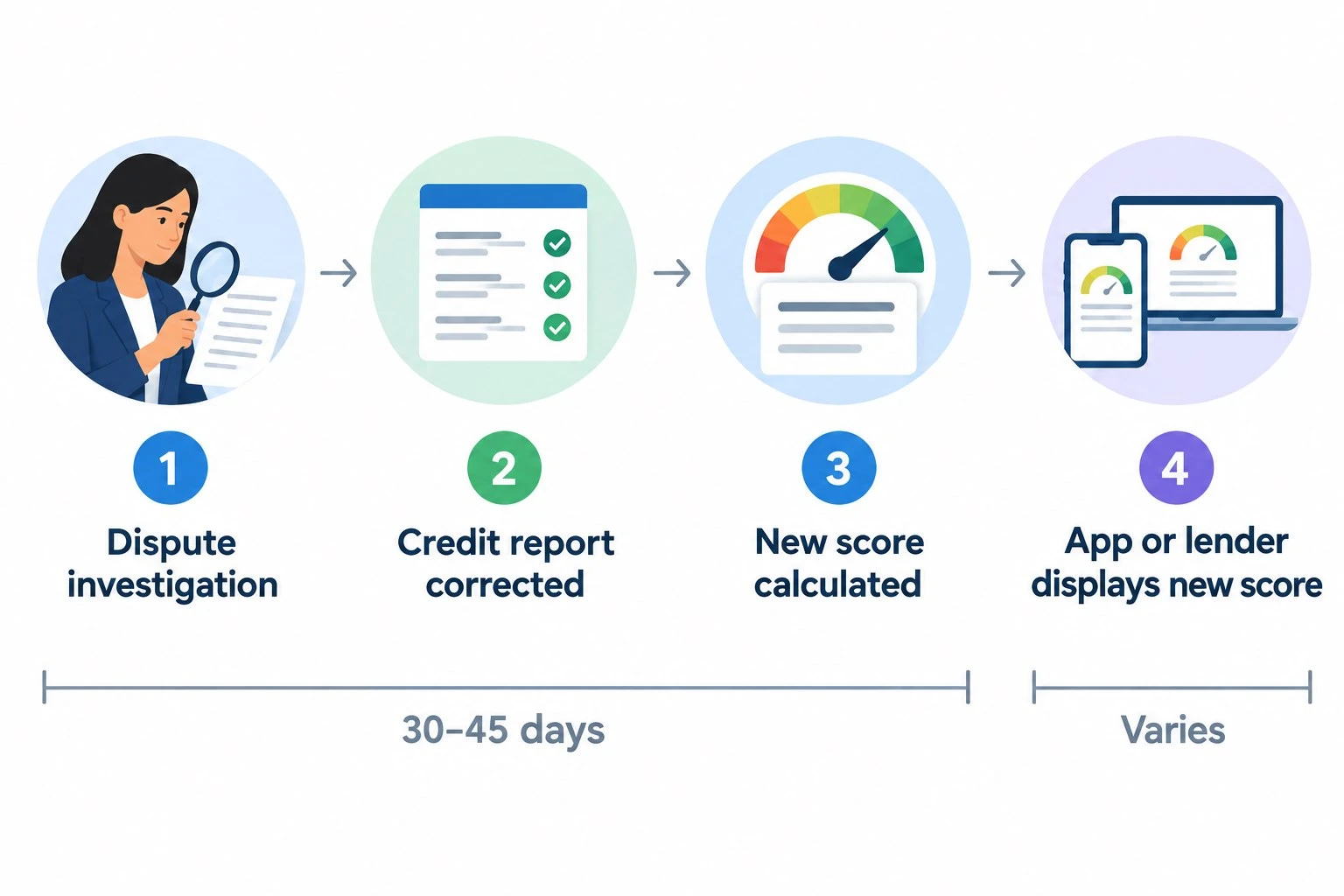
There is no universal number of days. The useful sequence is:
- You file a dispute.
- The credit reporting company investigates it.
- The item is verified, corrected, updated, or deleted.
- The corrected information appears on the relevant credit report.
- A newly calculated score using that report can reflect the newer information.
- Your bank, monitoring app, or lender shows the score according to its own refresh schedule.
This is why a dispute can be completed while the score in an app still looks unchanged. The app may be showing an older score calculated before the correction appeared.
How long can the dispute investigation take?
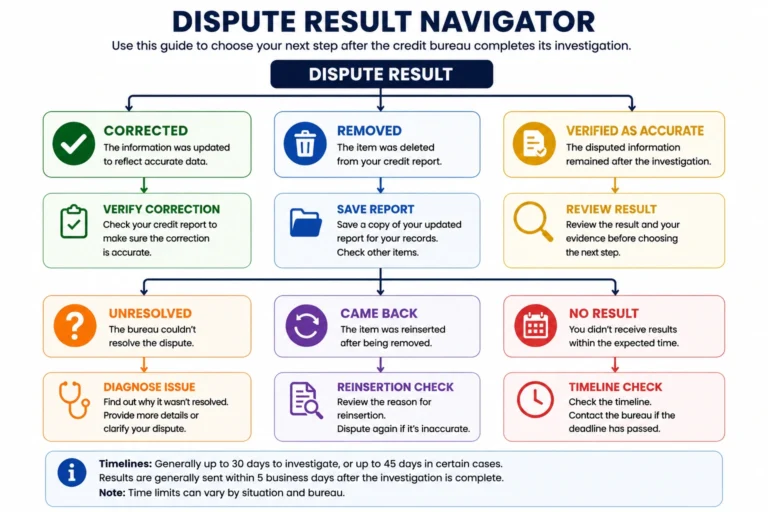
CFPB guidance says a credit reporting company generally must investigate a credit-report dispute within 30 days after receiving it. In certain situations, the investigation can take up to 45 days. The bureau generally has five business days after completing the investigation to notify you of the results.
Those deadlines apply to the dispute process. They are not a score-refresh schedule.
If you are still waiting for the dispute itself to finish, use our guide on what to do when a credit bureau does not respond within 30 days.
What actually causes the score to change?
The words dispute completed do not cause a score change by themselves. The important question is whether score-relevant information on the report changed.
If a dispute comment still appears after the investigation ends, see how to interpret an “account in dispute” remark. The wording on the report and the timing of a credit score update are separate questions.
| Dispute result | Could it affect a score? | What to verify |
|---|---|---|
| Incorrect late payment corrected | Potentially | Payment history now shows the correct status |
| Wrong credit-card balance corrected | Potentially | Reported balance and utilization-related data |
| Duplicate account removed | Potentially | Account, balance, history and limits no longer duplicated |
| Collection that was not yours deleted | Potentially | The collection is actually absent from the corrected report |
| Address or employer corrected | Usually not a normal scoring factor | Accuracy matters, but do not expect a score change solely from this |
| Item verified with no change | No dispute-related change to evaluate | Review whether the verification result is accurate |
TransUnion states that submitting a dispute does not directly lower a credit score. However, if information is changed or removed as a result of the dispute, the score may change because the underlying report changed.
Why your score may not change after a successful dispute
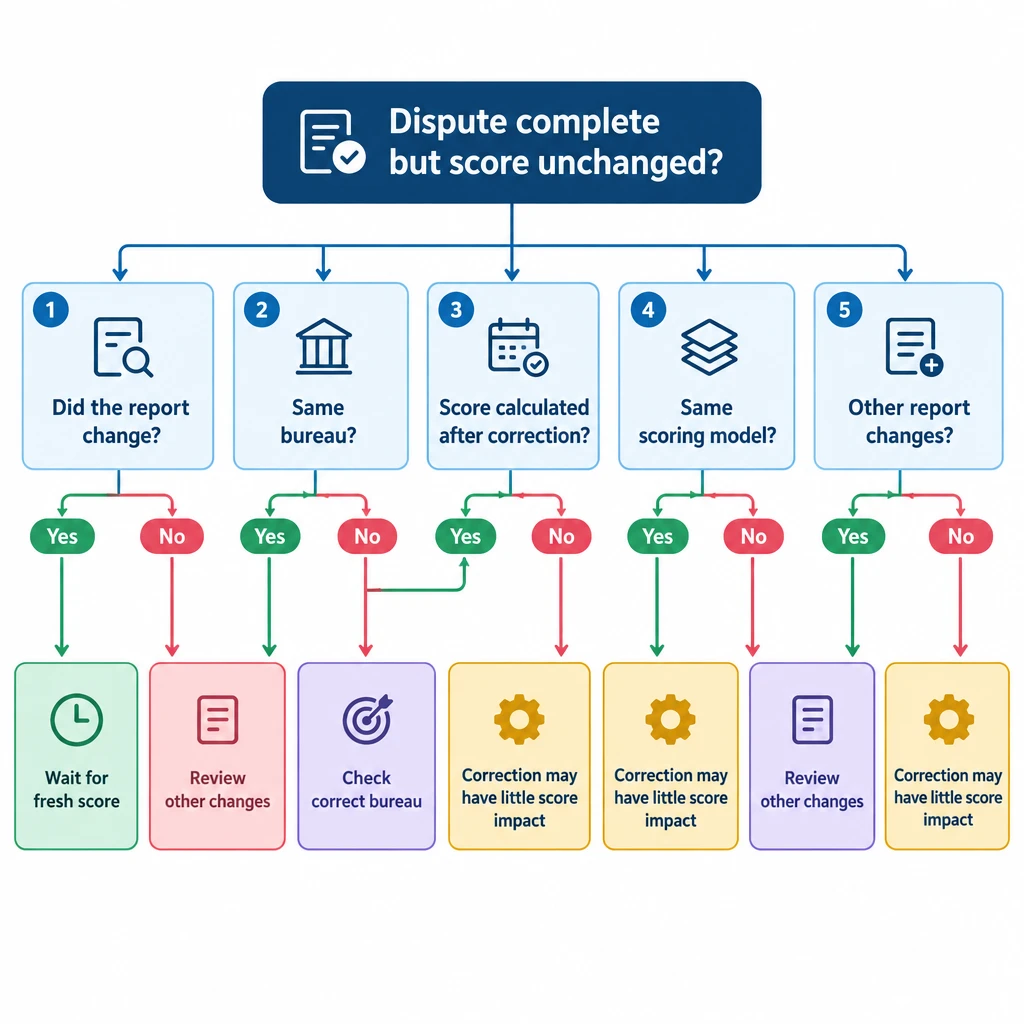
The score is based on a different bureau
If Experian corrected the item but the score you are viewing uses TransUnion data, that score may not reflect the Experian correction. Check which bureau is behind the score.
The score was calculated before the correction
Look for the score date, report date, or “last updated” date in the app. If the score predates the corrected report, it is an old snapshot.
Another scoring model is being used
You can have multiple legitimate credit scores. Different lenders and consumer apps may use different models and versions. Compare the same bureau and the same scoring model when possible.
The corrected item had little scoring impact
Correcting an inaccurate employer or address improves report accuracy but normally does not create the same scoring effect as correcting a late payment or a major revolving-balance error.
Other negative information is still present
A removed collection may be only one part of the file. Recent late payments, high revolving balances, charge-offs, other collections, or new credit can still affect the score.
Other report information changed at the same time
A positive correction can happen during the same period that a card balance rises or a new inquiry appears. The score reflects the entire file, not just the disputed item.
Use this 7-step post-dispute check
- Read the investigation result. Was the item deleted, corrected, updated, or verified?
- Open the actual updated credit report. Do not rely only on a dispute-status email.
- Confirm the exact field changed. Check the balance, payment history, status, ownership, date, or other disputed field.
- Identify the corrected bureau. Experian, Equifax, TransUnion, or more than one?
- Identify the bureau behind the score you are checking.
- Check the score date. It should be later than the report correction if you are testing the effect.
- Compare the same scoring model when possible. Do not use a different bureau/model comparison to judge the dispute.
What if the result says “verified as accurate”?
If the item was verified and nothing changed on the report, there may be no dispute-related score change. Do not keep submitting the same unsupported dispute.
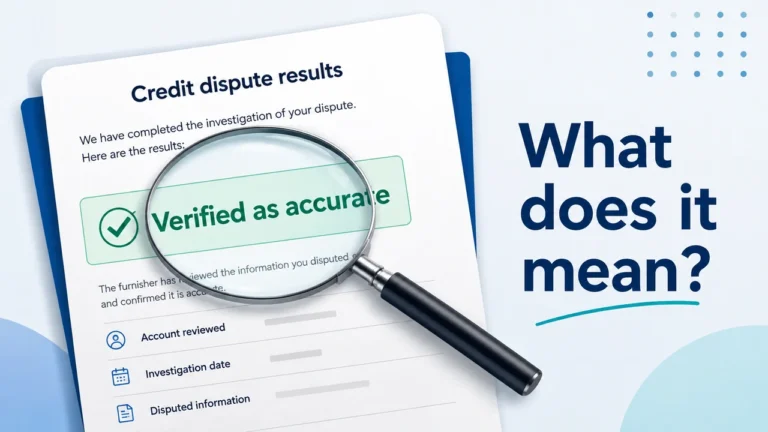
Review the evidence you sent, compare it with the field that remains, and decide whether you have new relevant documentation or whether the reported information is actually accurate. See what “verified as accurate” means after a credit dispute.
What if the disputed item was removed but your score stayed the same?
That can happen. Removal makes the report more accurate, but no specific point increase is guaranteed.
Check whether:
- the removed item was score-relevant;
- other negative information remains;
- the score uses the same bureau;
- the score was calculated after the deletion;
- you are comparing the same model;
- other balances, inquiries, or accounts changed during the same period.
If the removed item was a late payment, see why a late payment can be removed without an immediate score increase. For a collection, see why a removed collection may not raise your score.
What if the score drops after the dispute?
Do not assume the dispute itself caused the drop. Compare the before-and-after reports.
Possible explanations include a higher card balance, a new inquiry or account, another late payment, a change to an account that had both positive and negative characteristics, or simply comparing different score sources.
The correct goal of a dispute is accurate reporting. An inaccurate account should be corrected even if the score does not move in the direction you expected.
What if only one bureau updates?
Treat each bureau as a separate file. If the same inaccurate information remains on another report, save the corrected result from the bureau that fixed it and dispute the remaining inaccurate information with the bureau still reporting it.
CFPB guidance says that when a furnisher determines information it provided was wrong, it must update or remove the information and notify the credit reporting companies after correcting it. Still, verify each report rather than assuming every file updated perfectly.
What if the item disappears and later comes back?
Save the original report, dispute confirmation, investigation result, corrected report, and later report showing the item again. Then determine whether the same information was reinserted or whether new information was furnished.
Use our guide on what to do when a disputed item is removed and then comes back.
Before-and-after dispute worksheet
| What to record | Before | After |
|---|---|---|
| Disputed field | ____________ | ____________ |
| Account status | ____________ | ____________ |
| Balance / limit | ____________ | ____________ |
| Payment history | ____________ | ____________ |
| Bureau | EX / EQ / TU | EX / EQ / TU |
| Report date | ____________ | ____________ |
| Score source and model | ____________ | ____________ |
| Score date | ____________ | ____________ |
| Other report changes | ____________ | ____________ |
This makes it much easier to separate the effect of the dispute from unrelated changes.
When should you check the score again?
Do not use a fixed “wait 30 more days” rule. Instead:
- wait for the dispute result;
- confirm the correction on the actual credit report;
- then check a score that uses that bureau and is dated after the correction.
If your monitoring service refreshes monthly, you may need to wait for its next refresh even though the corrected report is already available.
More on this topic: Browse the credit reports and disputes hub for related guides on report errors, disputes, and updates.
Frequently asked questions
Can a credit score update the same day a dispute closes?
It is possible if the bureau has already posted the correction and a new score is calculated from that corrected report. A visible same-day change is not guaranteed because the app or monitoring service may refresh later.
Does a score take another 30 days after the dispute closes?
No general federal rule requires another 30-day wait. A longer delay may come from a lender’s reporting cycle or the score service’s refresh schedule, not from a universal scoring rule.
Does filing a dispute hurt your credit score?
TransUnion states that starting a dispute does not directly affect the score. If the dispute changes or removes information on the report, the score may change because the underlying data changed.
How much will a successful dispute raise my score?
There is no reliable universal points estimate. It depends on what was corrected, the rest of the file, the bureau, and the scoring model.
What if my dispute was denied?
Review the reason, compare the result with your evidence, and decide whether you have new relevant documentation or another legitimate next step. See what to do after a credit dispute is denied.
Bottom line
How long after a dispute your credit score updates depends less on the day the dispute closes and more on when the corrected information appears on the report used for the score. Once the report is corrected, a newly calculated score can evaluate the new information. Your app may display that new score later according to its own refresh schedule.
Judge the dispute first by whether the credit report became accurate. Then compare the same bureau, the same scoring model when possible, and a score calculated after the correction. Do not expect a guaranteed number of points.
If a credit report contains inaccurate information, follow our step-by-step guide to disputing credit report errors for evidence, deadlines, and follow-up.
Sources
- Consumer Financial Protection Bureau — Credit-report dispute timing
- Consumer Financial Protection Bureau — How to dispute a credit-report error
- Consumer Financial Protection Bureau — Accurate negative information
- TransUnion — How to read dispute investigation results
- TransUnion — Credit disputes
Financial disclaimer
This article provides general U.S. credit and financial information, not individualized legal, financial, lending, mortgage, or credit-repair advice. Credit-score results vary by bureau data, scoring model, lender, and the rest of the credit profile. No dispute outcome or score increase is guaranteed.