Collection removed but credit score did not increase

Credit score

Collection removed but credit score did not increase? This can happen even when the deletion was processed correctly.

Contents
  1. Quick answer: Why didn’t your score increase?
  2. Why your score may still be unchanged
  3. First, confirm the collection was actually removed
  4. How to verify the deletion
  5. Check whether the collection was removed from all three credit bureaus
  6. How to compare the reports correctly
  7. Check whether the score was calculated after the deletion
  8. How to check the timing
  9. Check which credit scoring model you are viewing
  10. Why the scoring model matters
  11. Check whether other negative accounts are still reporting
  12. Check the original creditor account
  13. Review the complete credit file
  14. Check whether another credit change affected the result
  15. Compare the complete before-and-after reports
  16. Example
  17. Consider whether the collection was already old
  18. Example
  19. Understand why deletion does not create positive credit history
  20. Thin credit files may need more positive information
  21. Example
  22. How much can your credit score increase after a collection is removed?
  23. What CFPB research found about medical collections
  24. Examples of why a collection deletion may not change the score
  25. Scenario 1: The score uses a different credit bureau
  26. Scenario 2: The scoring model may have already disregarded the collection
  27. Scenario 3: The original creditor charge-off remains
  28. Scenario 4: Higher utilization affected the same score calculation
  29. Scenario 5: The credit file has limited positive history
  30. What to do when a collection was removed but your score did not increase
  31. Follow this diagnostic sequence
  32. Steps to take after the collection returns
  33. Frequently asked questions
  34. Does deleting a collection guarantee a credit score increase?
  35. How long after collection removal does a credit score update?
  36. Why did one credit score increase while another stayed the same?
  37. Can a credit score drop after collection removal?
  38. Will removing the last collection increase my score more?
  39. Should I dispute again if my score did not increase?
  40. Can a deleted collection reappear on a credit report?
  41. Why did my score stay low after a medical collection was removed?
  42. Final thoughts

Quick answer: Why didn’t your score increase?

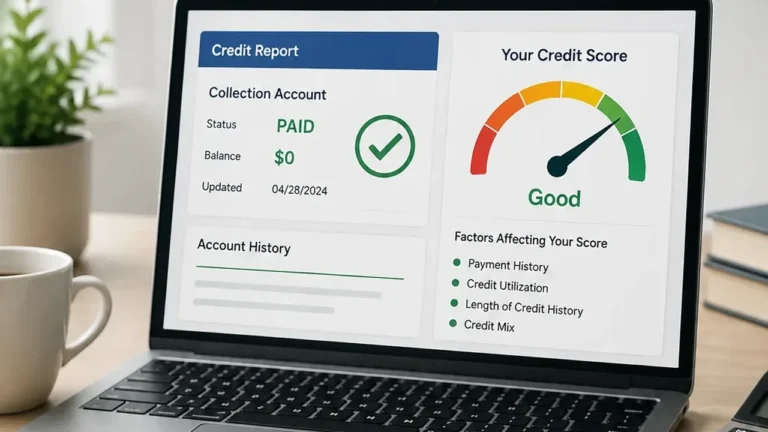
If a collection was removed but your credit score did not increase, the deletion may have been processed correctly. You may be viewing a score calculated before the deletion, checking a score based on a different credit bureau, or using a scoring model that already disregarded the collection.

Another collection, an original charge-off, recent late payments, high credit utilization, higher reported balances, a new account, or a hard inquiry may also be limiting the result. First, confirm that the entire collection tradeline was deleted from the same credit report used to calculate the score you are viewing.

If the account still appears as paid, settled, closed, or with a zero balance, it was updated rather than deleted. Review what happens after paying off a collection before taking the next step.

Why your score may still be unchanged

If a collection was removed but your score did not go up, use this table to identify a possible reason and the next detail to verify.

What you see Possible explanation What to check
The collection is gone, but the score date predates the deletion The displayed score may not have refreshed Check the score’s “last updated” or calculation date
The collection was removed from only one credit bureau The score may be based on data from another bureau Compare your Experian, Equifax, and TransUnion reports
A paid collection was deleted, but the score stayed the same The scoring model may already have disregarded the account Identify the scoring model and version
The collection was deleted, but other negative accounts remain Another collection, charge-off, or late payment may still be affecting the score Review all remaining derogatory accounts
The collection is gone, but the score remains unchanged Another credit change may have offset any scoring benefit Check card balances, hard inquiries, new accounts, and recent late payments
The report is cleaner, but the score remains low The credit file may contain limited recent positive account activity Review active accounts, payment history, and credit utilization

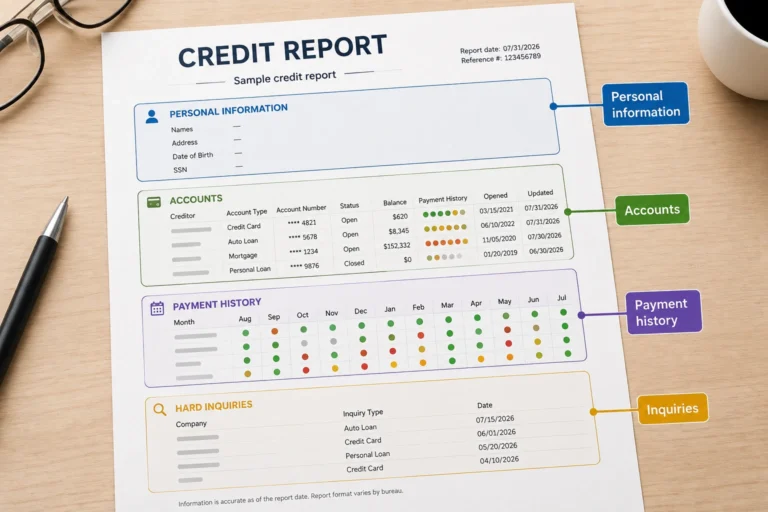
Before comparing scores, make sure you know how to read your credit report and identify which bureau supplied the data used to calculate the score.

First, confirm the collection was actually removed

If a collection was truly deleted, the entire collection tradeline should be absent from that credit bureau’s current report. A paid, settled, closed, or zero-balance status shows that the account was updated, but it does not confirm that the collection was removed.

What appears on the report What it means Does it confirm deletion?
No collection tradeline appears The collection account is absent from that bureau’s current report Yes, for that report
Paid The debt was paid, but the collection tradeline remains No
Settled The collector accepted an agreed amount, which may have been less than the full balance No
Closed The account is no longer active, but its history may still be reported No
Zero balance The report shows no remaining balance, but the collection tradeline is still present No

How to verify the deletion

  1. Open a current credit report rather than an older saved copy.
  2. Search for the collection agency’s name and masked account number.
  3. Review the collections, closed accounts, and other account sections.
  4. Confirm that the entire collection tradeline is absent.
  5. Repeat the check on every credit bureau report where the collection previously appeared.

If the collection remains and reports an amount you already paid, follow these steps when a paid collection still shows a balance.

Check whether the collection was removed from all three credit bureausCredit score remains unchanged because a collection is still reporting on another credit bureau

A collection removed from one credit bureau but not another can explain why your credit score did not change. Experian, Equifax, and TransUnion maintain separate credit reports, and removing an account from one report does not automatically remove it from the other two.

Match the score you are viewing to the bureau that supplied the underlying report. For example, if the collection was removed from Experian but your score is based on a TransUnion report that still lists the account, the TransUnion-based score may remain unchanged.

Collection status Score source Why the score may not change
Deleted from Experian only TransUnion-based score TransUnion may still report the collection
Deleted from Equifax only Experian-based score Experian may still include the account
Deleted from TransUnion only Equifax-based score Equifax may still report the collection
Deleted from all three bureaus Score calculated before the deletions The displayed score may not have refreshed

How to compare the reports correctly

  1. Download current reports from Experian, Equifax, and TransUnion.
  2. Search each report for the collection agency’s name and masked account number.
  3. Confirm which bureau supplied the data used to calculate the score.
  4. Verify that the collection is absent from that bureau’s current report.
  5. Compare scores from the same bureau, scoring model, version, and provider whenever possible.

If the collection is absent from all three current reports but the score remains unchanged, check whether the displayed score was calculated after the deletion.

Check whether the score was calculated after the deletion

Timeline showing a credit score calculated before the updated credit report became available

If the displayed credit score did not change after a collection deletion, compare the dates associated with the credit report and the score. A collection can be absent from a current report while a credit monitoring service still displays a score based on older report data.

Date to check What it tells you
Collection deletion date When the bureau or monitoring service indicates that the collection was removed
Credit report date Whether the report was created after the collection disappeared
Score calculation date Whether the score could have been calculated from the updated report
App update date When the service last refreshed the score or account information it displays

How to check the timing

  1. Confirm that the collection is absent from a current credit report.
  2. Note the date of the report showing the deletion.
  3. Check the score’s calculation date or the service’s “last updated” date.
  4. Confirm that the score is based on data from the same credit bureau.
  5. Compare the dates before deciding that the deletion had no effect.

If the score predates the report showing the deletion, the unchanged number does not reflect how a newly calculated score may respond to the updated file. Credit bureaus, lenders, and monitoring services do not all update on the same schedule, so there is no universal rule that every score will change within exactly 30 days.

If the score was calculated after the deletion and still did not increase, waiting longer does not guarantee a future gain. Check the scoring model and the rest of the credit report for other factors. For a broader timeline, see how long it takes to fix your credit score.

Check which credit scoring model you are viewing

FICO Score 8 and VantageScore models treating the same paid collection differently

If a deleted collection leaves your FICO Score unchanged, the model may have already disregarded that account before it was removed. Credit scoring models do not treat every paid, unpaid, medical, or small-balance collection the same way.

Scoring model How it may treat the collection Possible result after deletion
FICO Score 8 Paid third-party collections may still be considered, but third-party collections with an original amount under $100 are disregarded The score may increase or remain unchanged
FICO Score 9 Third-party collections reported as paid in full are disregarded Deleting a paid collection may produce little or no additional change
FICO Score 10 suite Third-party collections reported as paid in full are disregarded Deleting a paid collection may produce little or no additional change
VantageScore 3.0 or 4.0 Paid collections and all medical collection information are disregarded, but unpaid nonmedical collections may still be considered The model may have already ignored the deleted account

Why the scoring model matters

A credit monitoring service may show a VantageScore, while a lender may use a different FICO Score or another scoring model. Scores can also differ when they are calculated from different credit bureau reports or on different dates.

For a valid comparison, use scores from the same credit bureau, scoring model, version, and provider before and after the deletion. Do not compare a FICO Score 8 from one source with a VantageScore 3.0 from another source and assume the collection removal caused the difference.

  1. Open the score details in the app or monitoring service.
  2. Identify the scoring model and version.
  3. Identify the credit bureau that supplied the report data.
  4. Confirm that the score was calculated after the collection was deleted.
  5. Compare it with an earlier score from the same model, bureau, and provider.

If the model already disregarded the collection, deleting the tradeline may not produce an additional increase in that score. The deletion can still make the credit report more accurate and easier to review.

Check whether other negative accounts are still reporting

If your last collection was removed but your score did not increase, review the rest of the credit report before deciding that the deletion had no effect. Another collection, an original creditor charge-off, a recent late payment, high revolving utilization, or other derogatory information may still be affecting the score.

What remains on the report Why it may matter What to check
Another collection account The deleted account was not the only collection in the credit file Review every collection tradeline on all three reports
Original creditor charge-off The collection agency’s tradeline may be gone while the original creditor’s negative account remains Check the balance, status, payment history, and account dates
Recent late payment The recency, severity, and frequency of late payments may continue to affect the score Verify whether the payment was reported 30, 60, 90, or more days late
High revolving utilization High reported card balances relative to credit limits may limit score improvement Review utilization on each card and across all revolving accounts
Other serious derogatory information A bankruptcy, foreclosure, or repossession may continue to affect the overall credit profile Confirm that the information is accurate and belongs to you
Recent hard inquiry or new account Recent credit activity may affect the newly calculated score, although an inquiry alone is rarely the main reason for a low score Compare inquiry and account opening dates with the collection deletion date

Check the original creditor account

A collection agency tradeline and the original creditor’s account are separate credit report entries. Deleting the collection does not automatically remove the original creditor’s charge-off status or late-payment history. If the debt was sold, the original creditor may report a zero balance while the negative account history remains.

Review the difference between a charge-off and a collection before deciding which tradeline may still be affecting the score.

Review the complete credit file

  1. Search each report for additional collection accounts.
  2. Locate the original creditor account connected to the deleted collection.
  3. Review the status, balance, payment history, and dates on that account.
  4. Check other late payments and note how recent and severe they are.
  5. Compare current credit card balances with reported credit limits.
  6. Look for recent inquiries, newly opened accounts, and other derogatory information.

Removing one collection does not erase the rest of the information in a credit file. Even when no collections remain, an original creditor charge-off, recent delinquency, high utilization, or another serious negative item may help explain why the score remains low.

Check whether another credit change affected the result

If a collection was removed but your score stayed the same, another change may have appeared on the credit report before the next score was calculated. The deletion may improve one part of the credit file while higher card balances, a new late payment, or recent credit activity affects the newly calculated score in the opposite direction.

Change reported around the deletion How it may affect the result What to compare
Higher credit card balances Higher reported balances may increase utilization on one card or across all revolving accounts Reported balances before and after the deletion
Lower credit limit A reduced limit may increase utilization even if the balance did not change Previous and current limits on the affected account
New hard inquiry A recent credit application may affect the score, although inquiries are generally a less influential scoring factor The inquiry date and the credit bureau where it appears
New credit account A newly opened account may affect recent credit activity and the age of the credit file The opening date and the bureau reporting the account
Closed credit card Losing the card’s available credit may increase utilization if balances remain on other cards The closed card’s limit and balances on the remaining revolving accounts
New late payment A recent delinquency may add new payment-history damage The delinquency date, severity, and account status
Newly reported or more negative account information A new derogatory account or a worsening status may affect the same score calculation The account status, payment history, and date first reported

Compare the complete before-and-after reports

  1. Use reports from the same credit bureau whenever possible.
  2. Confirm that the later report reflects the collection deletion.
  3. Compare reported credit card balances and limits.
  4. Look for new inquiries, accounts, late payments, or derogatory information.
  5. Check whether a revolving account was closed or had its limit reduced.
  6. Compare scores from the same bureau, scoring model, and provider.
  7. Do not assign a fixed number of points to any individual change.

Example

“`

A collection disappears from Maya’s report, but one of her credit cards reports a much higher balance during the same reporting period. The deletion removes one negative tradeline, while the higher utilization may affect the newly calculated score in the opposite direction. Her score can remain unchanged even though the collection is no longer included in the report.

“`

An unchanged score does not prove that the deletion had no effect. It means the score reflects all information in the credit report at the time it was calculated. Review why your credit score may drop without an obvious reason to identify report changes that are easy to overlook.

Consider whether the collection was already old

If an old collection was removed but your score did not increase, the account may have had less influence immediately before deletion than a more recent derogatory item. Negative information generally may have less effect as it ages, but the result depends on the scoring model and the complete credit file.

Removing an older collection can still make the credit report more accurate and easier to review. However, the deletion may produce little visible score movement when a newer late payment, another collection, an original creditor charge-off, or high credit utilization remains.

Collection detail Why it may matter What to check
Newer collection A more recent collection may reflect newer credit problems Review the collection date, payment status, and related original creditor account
Older collection The account may have had less influence immediately before deletion Compare its age with the dates of other negative information
Older collection and a recent late payment The newer delinquency may have more influence on the current credit profile Compare the recency and severity of both items
Older paid collection The scoring model may already have disregarded the paid third-party collection Confirm the payment status and identify the scoring model and version

Example

“`

A six-year-old collection is deleted, but a 60-day late payment from the previous year remains. The report is cleaner after the deletion, but the newer delinquency may continue to have more influence on the score.

“`

There is no fixed number of points assigned to a collection based only on its age. The result depends on the scoring model, the collection’s status, the age and severity of all negative information, and the strength of the remaining positive credit history.

Understand why deletion does not create positive credit history

If you are wondering why your score is still low with no collections, remember that deleting a collection removes one negative tradeline but does not add positive information to your credit report.

What deletion changes What deletion does not change
Removes the collection tradeline from the affected credit report Does not add on-time payments
Removes one negative account from the report Does not lower credit card balances or utilization
May improve the information evaluated by a scoring model Does not make existing accounts older
May help some credit scores Does not remove charge-offs, late payments, or other negative accounts
Makes the credit report easier to review Does not guarantee a specific score increase

Thin credit files may need more positive information

A thin credit file contains only a small number of credit accounts or limited information about how those accounts have been managed over time. When a collection is removed from a thin file, the report may contain less negative information while still lacking enough positive history to support a higher score.

Example

“`

Emma’s only collection is deleted, but she has no open credit cards and little recent payment history. Her report no longer contains the collection, yet it still contains limited positive account activity. The deletion improves the report without guaranteeing an immediate score increase.

“`

Once you confirm that the deletion was processed correctly and the remaining information is accurate, focus on consistent on-time payments, manageable reported balances, and responsible account management. Follow this guide to rebuild credit after collections without opening unnecessary accounts solely to pursue credit score points.

How much can your credit score increase after a collection is removed?

If you are asking, “How many points will my score increase after collection removal?” there is no fixed or guaranteed number. Some consumers may see a noticeable increase, while others may see a small change or no immediate movement.

The result can depend on the collection’s age, type, payment status, the scoring model and credit bureau being used, and the other information in the credit report. Because a credit score evaluates the entire file, it is usually not possible to assign an exact number of points to the deletion alone.

Credit file situation Possible result after deletion
The scoring model already disregarded the collection Little or no additional score change may occur
Other collections, charge-offs, or late payments remain Any increase may be limited or difficult to isolate
The collection was the only major derogatory account A more noticeable increase may be possible, but it is not guaranteed
The collection was already old The change may be smaller because the account may have had less influence before deletion
The credit file contains limited positive history The report may improve while the score remains relatively low
Other credit changes occurred around the same time Higher balances, a new late payment, or recent credit activity may make the deletion’s effect difficult to identify

What CFPB research found about medical collections

A Consumer Financial Protection Bureau study examined medical collection removals that occurred between 2012 and 2020. It found that consumers’ credit scores increased by an average of approximately 25 points during the first quarter after their last medical collection was removed.

This finding applies to the medical collection removals and consumers included in that study. It is not a guaranteed result, an estimate for nonmedical collections, or a prediction for an individual credit file.

To measure your result, compare scores from the same credit bureau, scoring model, version, and provider before and after the deletion. Confirm that the later score was calculated after the collection disappeared. Remember that any change still reflects the complete credit report, not only the deleted collection.

Examples of why a collection deletion may not change the score

If a collection was deleted but your score remained unchanged, one of these scenarios may explain the result. Compare the credit bureau, score calculation date, scoring model, and remaining report information before deciding that the deletion had no effect.

Scenario 1: The score uses a different credit bureau

Rachel’s collection was removed from her Experian report, but her credit monitoring app displays a score based on TransUnion data. The collection is still listed on her current TransUnion report, so the TransUnion-based score does not change. Rachel should confirm which bureau supplied the score and whether the collection was deleted from that bureau’s report.

Scenario 2: The scoring model may have already disregarded the collection

Marcus had a paid third-party collection removed from his credit report. The score he checks uses a model that disregards paid third-party collections, so deleting the tradeline may produce little or no additional change. His report contains one fewer negative account, but that particular score may remain unchanged because the model may have already excluded the collection from its calculation.

Scenario 3: The original creditor charge-off remains

Olivia’s collection agency tradeline disappears, but the original creditor still reports a charge-off and several late payments. The deletion removes the collection agency’s account, while the original creditor’s separate derogatory history remains. Olivia should review the original account’s balance, status, payment history, and reporting dates before assuming that all information connected to the debt was removed.

Scenario 4: Higher utilization affected the same score calculation

Daniel’s collection is deleted during the same reporting period that his credit cards report substantially higher balances. The deletion removes one negative tradeline, while the higher utilization may affect the newly calculated score in the opposite direction. The final score can remain unchanged even though the collection is no longer included in the report.

Scenario 5: The credit file has limited positive history

Sophia’s only collection is removed, but she has few active accounts and limited recent payment history. Her report no longer contains the collection, yet it may still lack enough positive information to support a higher score. Removing a negative tradeline does not add on-time payments, reduce card balances, or make existing accounts older.

These examples show why a collection removal may produce little or no immediate score increase. The result depends on the complete credit report and the scoring model, not on the deleted account alone.

What to do when a collection was removed but your score did not increase

If a collection was removed but your credit score did not increase, verify the deletion, credit bureau, score calculation date, scoring model, and remaining report information before filing a dispute or assuming that the score should have changed.

Follow this diagnostic sequence

  1. Review current reports from all three credit bureaus.
    Check Experian, Equifax, and TransUnion separately instead of relying only on a credit monitoring alert.
  2. Confirm that the entire collection tradeline is absent.
    A collection listed as paid, settled, closed, or with a zero balance was updated but was not necessarily deleted.
  3. Match the score to the correct credit bureau.
    Identify which bureau supplied the report data used to calculate the displayed score.
  4. Check the report and score dates.
    Confirm that the score was calculated from report information that already reflected the collection deletion.
  5. Identify the scoring model and version.
    Determine whether you are viewing a FICO Score, VantageScore, or another model. Compare scores from the same model, version, bureau, and provider.
  6. Compare the before-and-after credit reports.
    Look for higher card balances, lower credit limits, new inquiries, recently opened accounts, late payments, or newly reported derogatory information.
  7. Choose the next step based on what you find.
    Dispute a specific reporting error, check when the monitoring service will provide a score based on updated report data, or focus on strengthening an accurate credit file.
What you find What to do next
The collection remains on one credit report Verify whether the deletion applied to that bureau and dispute the specific tradeline if it is inaccurate or should have been removed
The score is based on another credit bureau Review the report that supplied the score data and confirm whether the collection remains there
The score predates the report showing the deletion Check when the service will provide a score based on updated report data, without assuming that the new score will increase
The original creditor charge-off remains Review that account’s balance, status, payment history, and reporting dates separately
Another credit report item is inaccurate or incomplete Dispute the specific information, explain what is wrong, and include relevant supporting documents
The reports are accurate, but the score remains low Focus on consistent on-time payments, manageable reported balances, and responsible account management

Do not dispute a credit score simply because the number did not increase. A credit report dispute should identify specific information that is inaccurate, incomplete, duplicated, or belongs to someone else. Follow these steps to dispute errors on your credit report only after identifying a specific reporting problem.

What to do if a deleted collection reappears

If a deleted collection reappeared on your credit report, do not assume that the account is automatically accurate or that the bureau violated the law. Compare the new tradeline with the previous deletion notice, dispute results, and current account records before deciding what to do next.

When information was deleted after a credit bureau reinvestigation, the Fair Credit Reporting Act generally allows reinsertion only if the furnisher certifies that the information is complete and accurate. The bureau must notify you in writing within five business days after the reinsertion.

What you find What it may mean What to do
The same account returned with the same incorrect details The original reporting error may have returned Save the new report and dispute the specific inaccurate information
The same debt appears under a different collection agency The debt may have been transferred or reassigned Verify the current owner, balance, account number, and reporting dates
The account returned with corrected information The furnisher may have certified updated data Compare every field with your records before disputing again
You did not receive a reinsertion notice The required notice may be missing if the information was reinserted after a dispute deletion Save the report and contact the credit bureau for an explanation
The account does not belong to you The report may contain a mixed-file or identity-related error Dispute the account promptly and review your other reports for similar errors

Steps to take after the collection returns

  1. Save a current copy of the report showing the reappeared collection.
  2. Locate the previous deletion notice and investigation results.
  3. Compare the collector, original creditor, account number, balance, status, and reporting dates.
  4. Check your mail and online bureau account for a reinsertion notice.
  5. Ask the bureau for the furnisher’s name, address, and telephone number.
  6. Dispute only the information that is inaccurate, incomplete, or unverifiable.
  7. Keep copies of every report, notice, letter, supporting document, and delivery confirmation.

Federal law also gives you the right to request a description of the bureau’s reinvestigation procedure and to add a brief statement to your file if the dispute remains unresolved. Review the official requirements in 15 U.S.C. § 1681i.

Frequently asked questions

Does deleting a collection guarantee a credit score increase?

No. Deleting a collection removes the tradeline from the affected credit report, but it does not guarantee a higher score. The result depends on the credit bureau, scoring model and version, collection type and status, other negative information, credit utilization, and the strength of the remaining positive credit history.

How long after collection removal does a credit score update?

There is no universal update period. First, confirm that the collection is absent from a current credit report. Then compare the report date with the score calculation or update date and verify that the score uses data from the same credit bureau. A monitoring service may still display a score calculated from older report data. Even after the score is recalculated, an increase is not guaranteed.

Why did one credit score increase while another stayed the same?

Different scores may use separate credit bureau reports, scoring models, model versions, providers, and calculation dates. A collection may be deleted from Experian while remaining on Equifax or TransUnion. A FICO Score may also respond differently from a VantageScore, even when both are calculated from data supplied by the same credit bureau.

Can a credit score drop after collection removal?

A score can decline around the same time that a collection is removed, but that does not mean the deletion caused the decline. Check for higher reported card balances, a lower credit limit, a new inquiry, a recently opened account, a new late payment, or newly reported derogatory information.

Will removing the last collection increase my score more?

Removing the last collection may produce a more noticeable change than deleting one of several collection accounts, but an increase is not guaranteed. An original creditor charge-off, late-payment history, high utilization, limited positive credit activity, or a scoring model that already disregarded the collection may keep the score unchanged.

Should I dispute again if my score did not increase?

Do not file another dispute solely because the score stayed the same. A credit report dispute should identify specific information that you believe is inaccurate, incomplete, duplicated, or does not belong to you. The credit score itself is not the report item being disputed, and an unchanged score is not evidence that the deletion was processed incorrectly.

Can a deleted collection reappear on a credit report?

Yes, in some circumstances. If information was deleted after a credit bureau reinvestigation, it may be reinserted when the furnisher certifies that the information is complete and accurate. The credit bureau must generally notify you no later than five business days after the reinsertion. Compare the reappeared tradeline with the previous deletion notice, investigation results, and current account records.

Why did my score stay low after a medical collection was removed?

The scoring model may have already disregarded the medical collection before it was removed. VantageScore 3.0 and 4.0 exclude medical collection information from score calculations, while the treatment of medical collections under FICO models depends on the score version and the information reported. Other negative accounts, recent late payments, high utilization, or limited positive history may also explain why the score remained low.

Final thoughts

If a collection was removed but your credit score did not increase, that does not mean the deletion was processed incorrectly. Confirm that the entire tradeline is absent from the relevant credit bureau report, the score was calculated after the deletion, and you are comparing scores from the same bureau, scoring model, version, and provider.

Then review the report for an original creditor charge-off, other negative accounts, higher reported credit card balances, high utilization, or recent credit activity that may have affected the same score calculation. Dispute only specific information that is inaccurate, incomplete, duplicated, or does not belong to you. If the reports are accurate, focus on consistent on-time payments, manageable reported balances, and responsible account management rather than expecting a guaranteed increase from one deletion.

Rate article
Fix My Money Life