In this guide
- Does disputing your credit report hurt your credit score?
- What is the difference between filing a dispute and changing your score?
- Is filing a credit report dispute a hard inquiry?
- Can your score change while a dispute is still open?
- How do FICO scores treat disputed accounts?
- Why can your credit score go up, down, or stay the same after a dispute?
- Which types of disputes are most likely to affect a score?
- Does disputing multiple items hurt your credit score?
- What if the dispute does not go the way you expected?
- Can a pending dispute affect a mortgage even if it does not hurt your score?
- Should you dispute accurate negative information?
- How can you tell whether a score change was actually caused by the dispute?
- Score-change diagnostic worksheet
- Decision tree: your score dropped after you filed a dispute
- How should you interpret an unexpected score change after a dispute?
- What should you do before, during, and after a credit dispute?
- Illustrative dispute scenarios
- Five-minute dispute-impact audit
- Common myths about disputes and credit scores
- Frequently asked questions
- Bottom line
- Sources
- About this guide
- Financial and legal disclaimer
Quick answer: Disputing inaccurate or incomplete information on your credit report does not directly hurt your credit score and does not create a hard inquiry. Filing the dispute itself is not a negative scoring event.
Your score can still rise, fall, or stay the same while a dispute is open or after it is resolved because the underlying credit-report information may be corrected, deleted, verified, or updated, and different scoring models can treat disputed information differently. A successful dispute does not guarantee a score increase, and an unsuccessful dispute does not create a separate score penalty.
The most useful way to understand a credit dispute is to separate the act of filing from the data that a score is calculated from. Experian and TransUnion both state that starting a dispute does not directly lower a credit score. What can change the number is what happens to the report information during or after the investigation.
That distinction matters because people often see a score move during the same week they file a dispute and assume the credit bureau penalized them. The timing alone does not prove that. Credit-card balances, payment history, account status, inquiries, new accounts, closed accounts, collections, and other report data can continue changing while a dispute is pending. You may also be comparing a different bureau or scoring model.
Does disputing your credit report hurt your credit score?
No. Filing a legitimate credit-report dispute does not directly lower your credit score. TransUnion says there is no score impact simply because you start a dispute, and Experian likewise explains that filing a dispute does not directly affect credit scores. The score may change only because the information in the credit file changes or because a model treats the disputed information differently during the process.
A dispute is also not a late payment, collection, charge-off, or application for new credit. It is a request to investigate whether information in your credit file is inaccurate or incomplete.
The right question is therefore not “Will filing the dispute cost me points?” The better question is “What report data may change if this dispute is resolved?”
What is the difference between filing a dispute and changing your score?
A credit score is calculated from information in a credit report. Filing a dispute is a request to investigate some of that information. Those are related events, but they are not the same event.
| Event | Does the event itself hurt your score? | What may happen next? |
|---|---|---|
| You file a dispute | No automatic score penalty | The bureau investigates the disputed information |
| An inaccurate late payment is corrected | The filing itself did not add or subtract points | A newly calculated score may change because payment-history data changed |
| An incorrect credit-card balance is corrected | No penalty for disputing | Revolving utilization may change |
| An account is deleted | No penalty for disputing | Account age, available revolving credit, and other file characteristics may change |
| Personal information is corrected | No direct scoring penalty | The report becomes more accurate even if the score does not move |
| The information is verified as accurate | No separate penalty for losing the dispute | The information remains and can continue to affect the score normally |
Concrete example: Suppose a credit card has a $5,000 limit. Your report incorrectly shows a $4,500 balance, but the balance that should have been reported is $500. Filing the dispute does not increase your score. If the bureau corrects the balance from $4,500 to $500, the report data used in utilization calculations changes. A newly generated score may then change because the data changed, not because the system “rewarded” you for filing a dispute.

Is filing a credit report dispute a hard inquiry?
No. A credit-report dispute is not a hard inquiry. A hard inquiry is generally associated with an application for credit or another transaction in which a lender reviews your report for a lending decision. A dispute is a request to investigate information already in your credit file.
Checking your own credit reports does not create a hard inquiry that lowers your score either. If you are reviewing your reports before disputing an error, use the reports themselves as evidence and save copies before you submit anything.
If an unfamiliar hard inquiry appears around the same time you file a dispute, investigate that inquiry separately. Do not assume the dispute caused it.
Can your score change while a dispute is still open?
Yes. A score can change while a dispute is pending without the dispute itself being a penalty.
One reason is that disputed information can be treated differently depending on the scoring context. The Consumer Financial Protection Bureau says that when a consumer disputes the validity of a debt, a credit reporting company generally will not use that disputed debt to calculate credit scores until the investigation is completed. FICO, however, says ongoing disputed accounts are considered by FICO Scores, while some older FICO versions may bypass certain disputed accounts from particular characteristic calculations.
Those two statements should not be turned into a universal rule such as “every disputed account disappears from every score.” CFPB is giving broad consumer guidance about disputed debt, while FICO is describing how FICO models handle disputed accounts. The practical result is that treatment can depend on the type of dispute, the score model, the model version, the bureau file, and the lender’s process.
If your question is about an “account in dispute” remark rather than a score change, read what an account in dispute means on your credit report to distinguish an open investigation from a completed dispute or personal statement.
A second reason is simpler: other credit-report information keeps moving while the investigation is open. Your card balances can update. A new payment can post. A loan can close. A new inquiry can appear. A creditor can report a late payment. A collection can update. Any of those changes can move a score independently of the dispute.
How do FICO scores treat disputed accounts?
Do not assume that every disputed account is automatically ignored by FICO. Current myFICO guidance states that disputed accounts are considered by the FICO Score, although some older versions may bypass certain disputed accounts from particular characteristic calculations.
This is one of the most important reasons to compare scores carefully. A consumer app may show one model while a lender uses another. A score based on Experian data can differ from a score based on TransUnion or Equifax data. A score calculated today can differ from one calculated last week even if the model name is the same, because the underlying report changed.
When a score moves during a dispute, record four facts before drawing a conclusion:
- Which credit bureau file was used?
- Which scoring model was used?
- What date was the score calculated?
- What report data changed between the two dates?
Why can your credit score go up, down, or stay the same after a dispute?
The dispute itself is not the scoring event. The outcome depends on what information changes and what that information contributed to your credit profile.
Your score may go up
A score may improve when a dispute removes or corrects inaccurate negative information that a scoring model uses. Examples include an inaccurate late payment, an incorrectly high revolving balance, an account that does not belong to you, or an incorrect collection.
No one can responsibly promise a specific number of points. Score impact depends on the rest of the file, the age and severity of the information, the bureau, and the model.
Your score may go down
A lower score after a dispute does not mean the bureau punished you for filing it. The report may have changed in a way that affects several scoring characteristics at once.
For example, if an entire credit-card account is deleted when only one field needed correction, the deletion may remove an old account and reduce total available revolving credit. If the accurate corrected balance is higher than the incorrect balance, the score can also move lower because the new data is less favorable even though it is more accurate.
Your score may stay the same
A successful dispute can improve report accuracy without producing a visible score change. Personal information such as a name, address, or employer generally is not a FICO scoring factor. Even a change to credit-related information may have little visible effect if the particular model gives it limited weight or if other report changes offset it.
The goal of a dispute is an accurate credit report, not a guaranteed score increase.
Which types of disputes are most likely to affect a score?
| Disputed information | Could a correction affect the score? | Why? |
|---|---|---|
| Late payment | Yes | Payment history is a major credit-scoring input |
| Credit-card balance | Yes | It can change revolving utilization and debt-related calculations |
| Credit limit | Yes | An incorrect limit can distort utilization |
| Collection account | Possibly | Effect depends on the model, status, age, and rest of the file |
| Charge-off information | Possibly | Status, balance, dates, and payment history may matter |
| Account ownership | Yes, if an account that is not yours is removed | The account and its history may no longer be part of the file |
| Duplicate account | Possibly | A true duplicate can distort balances or other report characteristics |
| Hard inquiry | Possibly | Scoring inquiries can affect some scores for a limited period |
| Name, address, employer | Usually not from the personal-data correction itself | These are identifying fields rather than core scoring factors |
Inaccurate late payment
If a late payment is truly inaccurate and is corrected or removed, a score may improve because payment-history data changed. The size of the change cannot be predicted from the statement “one late payment was removed.” The age, severity, number of other late payments, balances, and the scoring model all matter.
Incorrect credit-card balance
A balance correction can have a meaningful effect when it changes utilization. A card reported at $4,500 on a $5,000 limit is very different from the same card reported at $500 on a $5,000 limit. The direction of the change still depends on the rest of the revolving profile.
Account deletion
Deleting an account does not automatically help. Removal can eliminate inaccurate negative information, but it can also remove account age, payment history, or available credit. If one field is wrong but the account itself belongs to you, correcting the field may be more accurate than requesting deletion of the whole tradeline.
Personal information
Correcting a wrong address, employer, or name can be important for accuracy and can help uncover a mixed-file or identity-theft problem, even if the score does not change.
Does disputing multiple items hurt your credit score?
There is no separate automatic scoring penalty simply because you file more than one legitimate dispute. But multiple disputes can make the outcome harder to interpret because several report fields may change at the same time.
If you have multiple genuine errors, organize them rather than sending a vague “remove all negative items” request. A simple evidence table works well:
| Account | Field disputed | What the report says | What it should say | Evidence |
|---|---|---|---|---|
| Card A | Payment history | 30 days late in March | Paid on time | Bank statement + lender receipt |
| Card B | Balance | $3,800 | $380 | Statement |
| Collection C | Ownership | Reported as yours | Not your account | Identity documentation + account mismatch evidence |
What if the dispute does not go the way you expected?
Does losing a credit dispute hurt your score?
No separate score penalty is added because a bureau or furnisher verifies the information as accurate. If the item remains, it can continue affecting the score according to the applicable scoring model.
The score shown after the dispute closes may differ from the one shown while the dispute was pending. That can happen because the disputed information is again treated normally, other report data changed, or you are comparing a different bureau or model.
If your result says the item was verified and you still believe the report is wrong, use the dedicated guide on what “verified as accurate” means after a credit dispute.
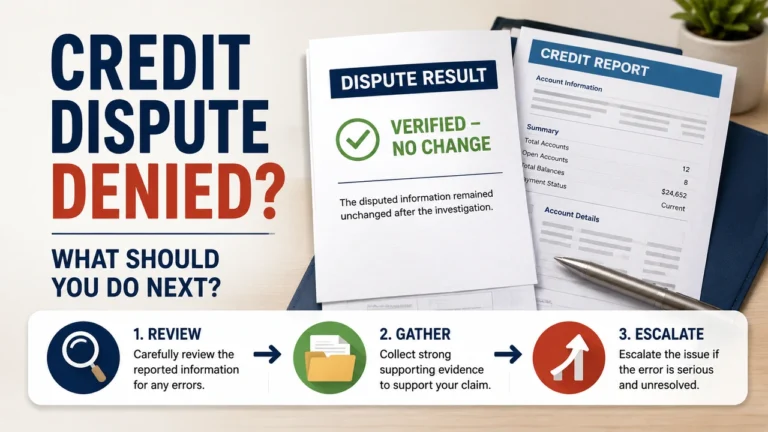
Does a denied dispute hurt your credit score?
A denied or unsuccessful dispute does not create a new negative score factor merely because your claim did not succeed. The underlying credit-report information is what matters.
If a documented error remains after the dispute, focus on the evidence and the investigation result. Do not keep sending the same unsupported wording over and over. Review whether the bureau misunderstood the disputed field, whether the furnisher has conflicting records, or whether you have additional evidence.
For the separate next-step process, see what to do when a credit dispute is denied.
Does a dispute notation on your credit report hurt your score?
A dispute notation is not the same thing as a late payment, collection, charge-off, or hard inquiry, and it should not be described as an automatic scoring penalty.
However, a lender may still care that an account is disputed. Underwriting is broader than the score alone. A lender may review the tradeline, the disputed balance, payment history, account ownership, and supporting documents.
If a dispute is not resolved to your satisfaction, federal law can allow you to add a brief statement of dispute to your file. A statement does not erase the account and does not require lenders to ignore the underlying information.
Can a pending dispute affect a mortgage even if it does not hurt your score?
Yes. A pending dispute can affect mortgage underwriting even though filing it is not a scoring penalty.
Current Fannie Mae Desktop Underwriter guidance says DU first assesses the casefile using all tradelines, including disputed tradelines. If the file does not receive an Approve recommendation with the disputed tradelines but does receive one when they are excluded, the lender may have to investigate whether the borrower is responsible for the accounts and whether the reported information is accurate or complete.
For manually underwritten loans, disputed information can also require additional review. Multiple disputed tradelines or a dispute involving a mortgage tradeline can attract particular attention.
The practical lesson is not “never dispute before a mortgage.” It is: review your credit reports early, dispute genuine errors as early as possible, save your evidence, and coordinate with your loan professional if underwriting is already underway.
Should you dispute accurate negative information?
No. The dispute process is for inaccurate or incomplete information. CFPB guidance says accurate negative information generally cannot be removed simply because it is negative.
A real late payment, legitimate charge-off, accurate collection, or other correctly reported negative item does not become an error because it hurts your score or makes a loan application harder.
Be specific. Instead of writing “this account is bad, delete it,” identify the exact field that is wrong: ownership, balance, payment status, date, credit limit, payment history, or another specific data point.
How can you tell whether a score change was actually caused by the dispute?
Use a before-and-after audit instead of guessing from the number.
- Record the score source. Save the provider, bureau, model if shown, and calculation date.
- Save the pre-dispute report. Without a baseline, you cannot prove what changed.
- Identify the exact disputed field. Track the field, not just the creditor name.
- Save the investigation result. Note whether the item was deleted, updated, verified, or otherwise changed.
- Save the post-dispute report. Compare the actual fields line by line.
- Look for unrelated changes. Check card balances, new inquiries, payments, new accounts, closures, collections, and loan balances.
- Compare like with like. A FICO Score based on Experian is not directly comparable with a VantageScore based on TransUnion.
Score-change diagnostic worksheet
| Check | Before dispute | After dispute | What changed? |
|---|---|---|---|
| Score provider | ________ | ________ | Same / Different |
| Scoring model | ________ | ________ | Same / Different / Unknown |
| Credit bureau | ________ | ________ | Same / Different |
| Score date | ________ | ________ | ________ |
| Disputed field | ________ | ________ | ________ |
| Account balance | ________ | ________ | ________ |
| Payment history | ________ | ________ | ________ |
| Account status | ________ | ________ | ________ |
| Credit limit | ________ | ________ | ________ |
| Other card balances | ________ | ________ | ________ |
| New inquiries or accounts | ________ | ________ | ________ |
This worksheet is more useful than asking “Why did my score lose 18 points after I disputed?” without identifying which score changed or what report data changed.

Decision tree: your score dropped after you filed a dispute
- Did the underlying report data change?
If yes, identify the exact field. If no, continue. - Are you comparing the same bureau and scoring model?
If no, the two scores are not a clean before-and-after comparison. - Was an account deleted instead of corrected?
If yes, check account age, available revolving credit, utilization, and the remaining credit profile. - Did another account update?
Look for new balances, late payments, collections, inquiries, new accounts, closures, or loan balance changes. - Did the dispute recently close?
The disputed item may now be handled differently than it was while the investigation was pending. - Is the credit report accurate now?
If yes, focus on understanding the score rather than reopening a valid dispute. If no, focus on the remaining reporting error and evidence.
How should you interpret an unexpected score change after a dispute?
What if your score went up during the dispute and fell after it closed?
This can happen without any punishment for filing the dispute. One possible explanation is that the disputed item was treated differently while the investigation was pending and then returned to normal treatment when it was verified. Another possibility is that unrelated report data changed between the two score calculations.
Do not assume the temporary higher number is a score you were guaranteed to keep. Compare the same bureau, the same model, and the report data at each stage.
What if your score did not increase after an error was removed?
A corrected report does not guarantee immediate visible movement in every score. You may be looking at an old score, a different bureau, a different model, or a score provider that has not refreshed yet.
The rest of the credit file also matters. If several other negative items remain, fixing one error may not produce the change you expected. If an entire account was deleted, the deletion can affect account age or available credit as well as remove the inaccurate information.
The separate timing question is covered in how long after a dispute your credit score updates.
What if your credit app shows one score and a lender shows another?
That does not prove one system handled the dispute incorrectly. Consumers can have many credit scores. Different products may use different model families, different model versions, different bureau files, and different report dates.
Before comparing numbers, match four things: bureau, scoring model, model version if available, and calculation date. If any of those differ, the numbers are not directly comparable.
A lender can also evaluate the credit report itself rather than relying only on the score. A disputed tradeline can therefore matter to underwriting even if your consumer-facing score looks unchanged.
How long does it take for a dispute to affect your score?
There is no universal score-update countdown that starts the moment you submit a dispute. The investigation and score calculation are separate processes.
A credit reporting company generally investigates within the applicable dispute period, commonly 30 days and in some circumstances up to 45 days. If the report changes, a newly generated score based on the updated report may reflect the corrected data, but the app or lender you use can refresh on its own schedule.
Do not confuse the dispute investigation deadline with a guaranteed score-update date. That timing question belongs to the dedicated guide linked above.
What should you do before, during, and after a credit dispute?
Before filing
- Pull the relevant credit report.
- Identify the exact account and field that is inaccurate or incomplete.
- Check whether the same error appears at more than one bureau.
- Gather documents that directly support the correction.
- Write the correct value or status you believe should appear.
- Save a dated copy of the report before filing.
- Save a copy of everything you submit.
If you need the filing workflow, use how to dispute errors on your credit report. For evidence planning, see what documents you need to dispute a credit report.
While the dispute is pending
- Save the confirmation and case number.
- Keep emails, portal messages, and mailed delivery proof.
- Do not repeatedly submit duplicate disputes without a reason.
- Continue making legitimate account payments on time.
- If a mortgage application is underway, tell the loan professional about a material pending dispute when relevant.
- Do not obsessively refresh your score. Track the report data instead.
After the investigation
- Read the result before watching the score.
- Confirm whether the item was deleted, updated, verified, or otherwise changed.
- Save the updated credit report.
- Compare the exact disputed fields with your original copy.
- Check other bureaus if the same error appeared in more than one file.
- Then compare the score source, bureau, model, and date.
If the bureau appears to have missed the applicable investigation deadline, use what to do when a credit bureau did not respond within 30 days.
Illustrative dispute scenarios
The scenarios below are hypothetical teaching examples, not verified customer cases or promises of a particular investigation or credit-score result.
Scenario 1: an inaccurate late payment is corrected
Emma’s report shows a 30-day late payment for a month in which her bank statement and lender records show the payment was received on time. She disputes the specific month and supplies the records.
The late-payment field is corrected. A newly generated score may improve because payment-history data changed. Emma should not expect a guaranteed number of points; she should compare the same bureau and model before and after the correction.
Scenario 2: an incorrect card balance is corrected
Noah’s report shows a $7,000 balance on a card with a $10,000 limit, but the balance that should have been reported is $700. He disputes the balance and provides a statement.
If the bureau updates the balance to $700, the revolving utilization reflected in the file changes substantially. A score may move, but the size of the movement depends on other balances and the scoring model.
Scenario 3: an old address is removed
Sophia sees an address where she never lived. She disputes it because she is concerned about a mixed file.
The address is removed and her score does not move. The dispute was still useful because the report is more accurate and she now has a cleaner basis for checking whether any unfamiliar accounts are connected to the same error.
Scenario 4: a collection is verified
Liam disputes a collection because he believes it is not his. The furnisher verifies the account and the bureau leaves it on the report.
Liam does not receive a separate scoring penalty because he lost the dispute. The collection remains in the report and can continue to affect applicable scores. If he has strong evidence that the result is wrong, the next step is an accuracy problem, not a score-penalty problem.
Scenario 5: the whole account is deleted
Ava disputes one payment-history field on a credit card, but the entire tradeline is deleted. The card was also one of her oldest accounts and had a large limit.
Her score falls after deletion. That does not mean she was punished for disputing. The whole tradeline changed the file. Ava should determine whether full deletion was appropriate or whether the account should instead be restored with the inaccurate field corrected.
Scenario 6: the score rises while the dispute is open, then falls
Ethan files a debt-validity dispute. His consumer score rises during the investigation and later falls after the account is verified.
The pattern does not prove the bureau added a penalty when the dispute closed. The account may have been treated differently during the investigation, or unrelated report information may have changed. Ethan should compare the report data, bureau, model, and dates.
Scenario 7: a mortgage lender asks for dispute documents
Mia has a legitimate dispute open on an auto-loan tradeline while applying for a mortgage. Her score does not fall, but the lender asks for documentation.
This is an underwriting issue, not proof that the dispute hurt her score. She should provide the requested records and explain the exact disputed field.
Scenario 8: generic disputes are filed on every negative account
Lucas sends generic disputes on every negative account because a video told him to challenge everything. The accounts are verified.
There is no automatic score penalty for filing, but Lucas has not corrected any inaccurate data. He has created unnecessary case files and made it harder to focus on genuine errors. A better strategy is to dispute only information he reasonably believes is inaccurate or incomplete.
Five-minute dispute-impact audit
- □ I know which bureau contains the disputed information.
- □ I saved the report before filing.
- □ I know the exact field I disputed.
- □ I have the dispute confirmation or delivery proof.
- □ I know whether the item was deleted, updated, or verified.
- □ I saved the report after the result.
- □ I know which score model I am comparing.
- □ I checked whether other balances or accounts changed.
- □ I am not expecting a guaranteed number of points.
- □ My next action is based on report accuracy, not score anxiety.
Common myths about disputes and credit scores
Myth: filing any dispute lowers your score
False. Filing a dispute does not create an automatic score penalty.
Myth: every disputed account is ignored by every score
False as a universal statement. CFPB and FICO guidance shows that treatment can differ by context and scoring model.
Myth: a successful dispute always raises your score
False. A report can become more accurate without a measurable score increase.
Myth: a denied dispute subtracts points
False. There is no separate score penalty just because the information was verified or the dispute was unsuccessful.
Myth: deleting any negative-looking account helps
False. Removing an account can change account age, available credit, utilization, and other characteristics of the file.
Myth: you should dispute accurate negative accounts before applying for a mortgage
False. A dispute should address inaccurate or incomplete information, not be used as a tactic to hide accurate history.
Frequently asked questions
Does disputing your credit report lower your score?
No. Filing the dispute does not directly lower the score. Your score can still change if the underlying report data changes or the disputed account is handled differently while the investigation is pending.
Is filing a credit dispute a hard inquiry?
No. A dispute is not an application for new credit and does not create a hard inquiry merely because you ask a bureau to investigate an error.
Can your credit score go down after a successful dispute?
Yes. A score can fall after a correction or deletion if that change also affects other characteristics of the credit file. The dispute itself is not the penalty.
Can your credit score go up after a dispute?
Yes. A score may rise if inaccurate negative information used by the scoring model is corrected or removed. No specific increase is guaranteed.
Does a dispute show on your credit report?
A disputed account can carry a dispute notation. The notation is not the same as a late payment or hard inquiry, but lenders may review the account and dispute during underwriting.
Does losing a dispute hurt your credit?
No separate score penalty is added because the dispute was unsuccessful. If the information is verified as accurate, it remains and can continue affecting the score normally.
Does disputing multiple items hurt your score?
There is no automatic penalty based only on the number of legitimate disputes. Multiple simultaneous report changes can, however, make score movement harder to diagnose.
Can a lender deny you because an account is disputed?
A lender can consider more than the score, and a disputed tradeline may require additional underwriting review. A dispute does not automatically mean denial, but it can affect the documentation and analysis required.
Why did my score increase during a dispute?
The disputed account may have been treated differently by the applicable scoring process, report data may have changed, or you may be viewing a different score or bureau. Compare the underlying report and model before drawing a conclusion.
Why did my score drop when the dispute ended?
The disputed information may have been verified and returned to normal treatment, another account may have updated, or the score may come from a different model or bureau. Closing the dispute itself is not a new negative scoring event.
Should I dispute an accurate collection because it hurts my score?
No. The dispute process is for inaccurate or incomplete information. Accurate negative information generally cannot be removed simply because it lowers a score.
What if the credit bureau does not answer my dispute?
Document the bureau’s receipt date and determine which investigation period applies. If the applicable deadline passes without a proper result, use the dedicated missed-deadline guide linked earlier.
Bottom line
Disputing inaccurate or incomplete information on your credit report does not directly hurt your credit score. Filing the dispute is not a hard inquiry and is not a negative payment event. What can change the score is the treatment of disputed information while the investigation is open, a correction or deletion to the report data, the end of temporary dispute treatment, unrelated account updates, or the fact that you are comparing different scores.
Use disputes to make the credit report accurate, not to chase a temporary number. Save the report before filing, dispute a specific factual error, keep evidence, review the result, and compare the same bureau and scoring model when evaluating score movement.
If the report is correct after the dispute, do not reopen a valid account merely because the score did not move the way you expected. If the report remains inaccurate, focus on the evidence and the next dispute step.
Sources
- Consumer Financial Protection Bureau — If I dispute a debt, how does that show up on my credit report?
- Consumer Financial Protection Bureau — How do I dispute an error on my credit report?
- Consumer Financial Protection Bureau — Is it possible to remove accurate but negative information?
- myFICO — Fixing errors on your credit report and disputed-account treatment
- myFICO — FICO Score FAQ, including disputed accounts
- Experian — Can credit report disputes lower credit scores?
- TransUnion — Credit disputes and score impact
- Fannie Mae Selling Guide — DU credit report analysis and disputed tradelines
- AnnualCreditReport.com — federally authorized credit-report source
About this guide
Source review: September 16, 2026
This guide is written for U.S. consumers who are considering a credit-report dispute or trying to understand a score change while a dispute is pending or after it closes. It separates the act of filing a dispute from changes to report data and from lender underwriting decisions.
More on this topic: Browse all credit report and dispute guides.
Financial and legal disclaimer
This article is for general educational purposes only and is not legal, financial, lending, or credit-repair advice. Credit-score outcomes vary by credit profile, credit bureau, scoring model, model version, lender, and reporting date. Dispute only information you reasonably believe is inaccurate or incomplete, and consider qualified professional advice when a credit-report problem is materially affecting a mortgage, housing, employment, or other high-stakes decision.