In this guide
- Can you dispute a late payment on your credit report?
- How to identify an incorrect late payment on your credit report
- What proof do you need to dispute a late payment?
- How to dispute a late payment step by step
- How to dispute a late payment with Equifax
- What should you write in a late payment dispute?
- Should you dispute a late payment online, by mail, or by phone?
- How long does a late payment dispute take?
- What happens after you dispute a late payment?
- Can you dispute the same late payment again?
- Does disputing a late payment hurt your credit score?
- Frequently asked questions about late payment disputes
- Sources
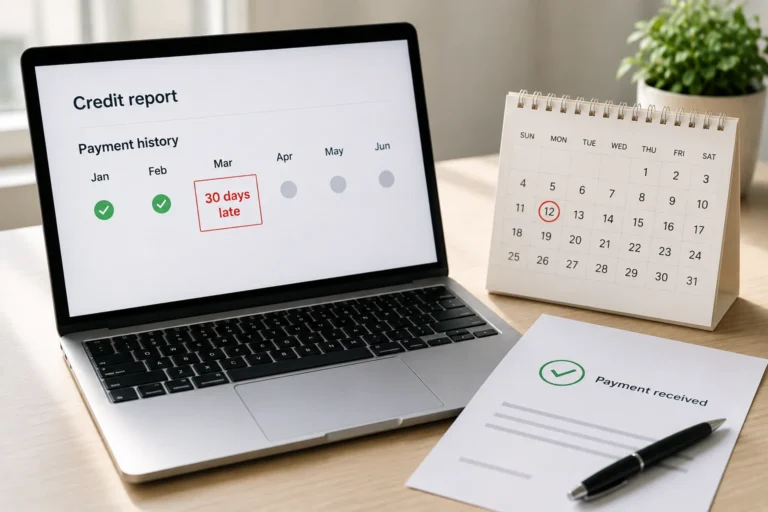
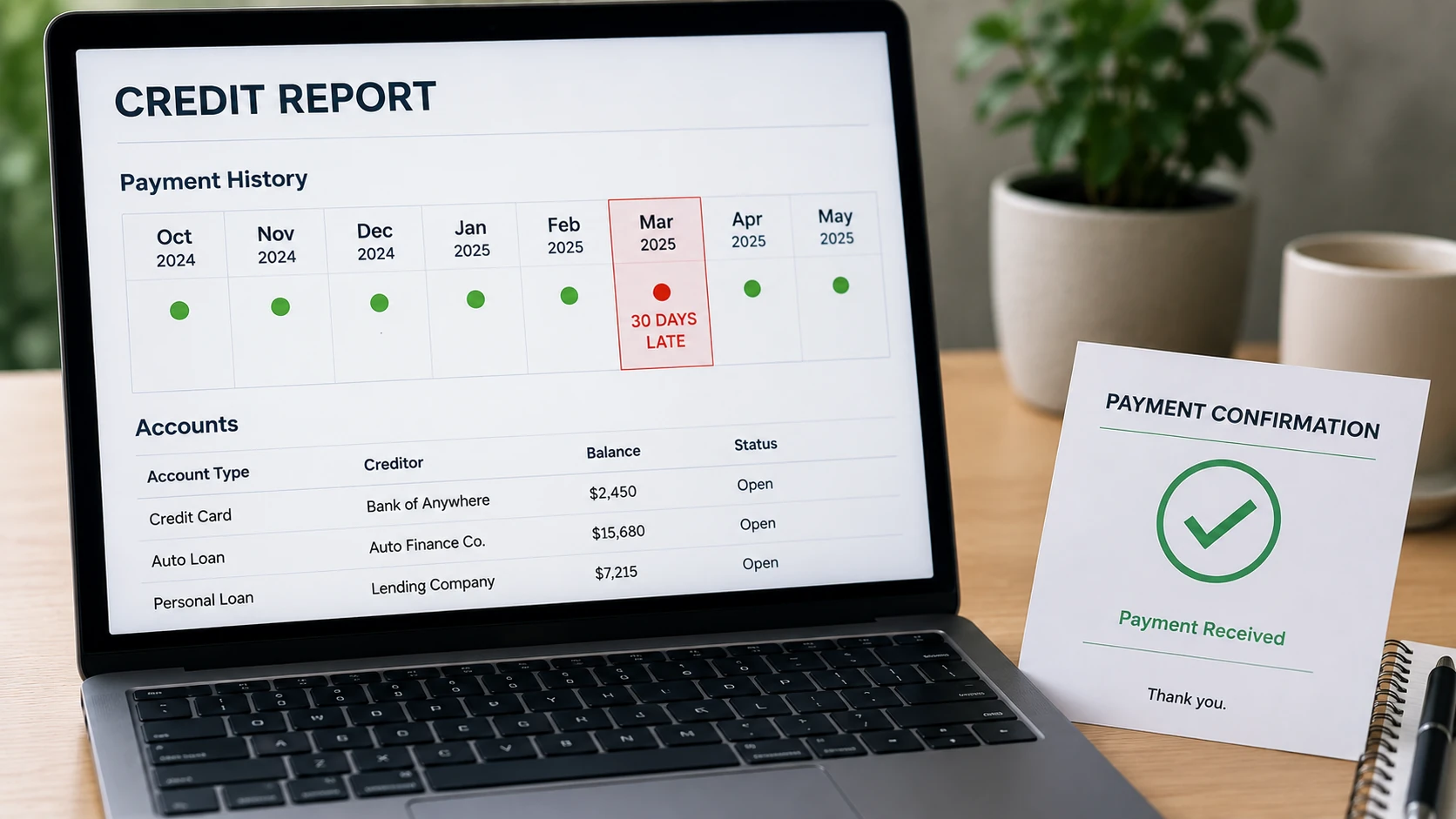
If a late payment on your credit report is inaccurate, dispute the specific account, month, and payment status that are wrong. Compare the report with the lender’s records, gather evidence that supports the correction, and dispute the error with each credit bureau reporting it. You can also dispute inaccurate information directly with the lender or other furnisher.
If the payment really was late and the report accurately reflects what happened, an accuracy dispute is not the right way to seek removal. In that situation, see our guide to a goodwill letter for an accurate late payment. For a comparison of correction, removal, and goodwill, start with your late-payment removal options.
Can you dispute a late payment on your credit report?
Yes, if you have a good-faith reason to believe the late-payment information is inaccurate or incomplete. The dispute should identify the exact factual problem rather than ask for removal simply because the information is negative.
| Your situation | What it may mean | What to do next |
|---|---|---|
| You paid on time, but the report shows 30 days late | Possible incorrect payment status | Verify the due date and lender payment history, then dispute the specific month if your records support a correction |
| The wrong month is marked late | Possible month-specific reporting error | Identify the exact month that conflicts with your records |
| The report shows 60 or 90 days late, but lender records show a less severe status | Possible incorrect delinquency level | Compare the full payment history covering the delinquency period |
| A late payment appears during an approved deferment, forbearance, or payment arrangement | Possible mismatch between account terms and reporting | Compare the written agreement with the lender’s payment history and the reported month |
| The lender acknowledged a reporting error | Potentially strong supporting evidence | Get the correction in writing and preserve it |
| The payment was actually late and is reported accurately | Accurate negative information | Do not characterize it as an accuracy error |
| You do not recognize the account | Possible ownership, mixed-file, or identity issue | Investigate the account itself rather than treating it only as a late-payment problem |
Before filing, make sure you can answer four questions: What does the report show? What is correct? What evidence supports you? What exact correction are you requesting?
How to identify an incorrect late payment on your credit report
Reduce the problem to one specific payment-history entry. Write down the credit bureau, creditor, account identifier, disputed month, reported status, due date, credited payment date, and what you believe the correct information should be.
Late payment error check
| Field | What to record |
|---|---|
| Credit bureau | Equifax, Experian, or TransUnion |
| Creditor | Exact lender or card issuer name |
| Account | Last four digits or other safe identifier |
| Disputed month | Exact month and year |
| Reported status | 30, 60, 90, or more days late |
| Due date | Date shown by the lender’s records |
| Payment credited date | Date the lender says the payment was credited |
| Correct information | Status or date your records support |
| Last updated | Date shown on the credit report, if available |
Example: Your credit report says 30 days late, but you paid on time
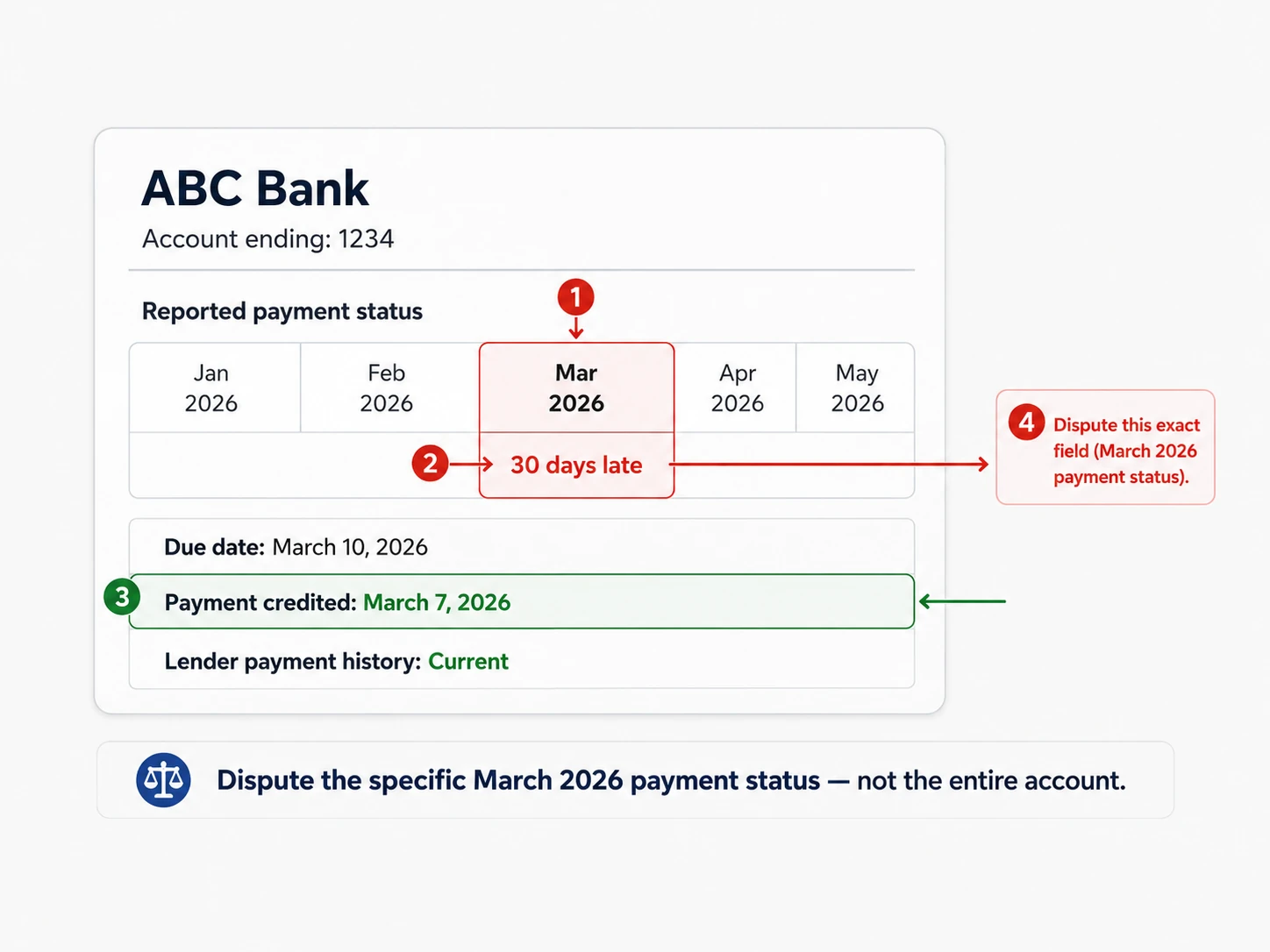
Suppose your report shows ABC Bank account ending in 1234 as 30 days late for March 2026. Your lender records show a due date of March 10, 2026, the payment was credited March 7, 2026, and the lender’s own payment history shows the account as current.
The dispute should focus on the March 2026 payment status. It should not automatically ask for deletion of the entire ABC Bank account.
Before you move on
- Confirm that you are looking at the correct account.
- Identify one exact month or payment-history field that appears wrong.
- Separate the date you sent a payment from the date the lender says it was received or credited.
- Write down the correction your records support.
What proof do you need to dispute a late payment?
The best evidence directly addresses the specific fact you are challenging. Sending more pages does not automatically make a dispute stronger.
Late payment evidence matcher
| Reporting problem | Evidence that may help | What it may establish |
|---|---|---|
| You paid on time but were reported late | Account statement plus lender payment history or payment confirmation | Due date and how the lender recorded the payment |
| Wrong month marked late | Statements and payment history covering the disputed month and nearby months | Which month actually had the reported delinquency |
| 60 or 90 days late instead of a less severe status | Complete lender payment history covering the delinquency period | Correct delinquency progression |
| Wrong payment date | Payment confirmation or receipt plus lender account history | The date recorded by the lender |
| Autopay-related error | Autopay enrollment, scheduled-payment records, and lender payment history | What was scheduled and what the lender actually recorded |
| Approved deferment or forbearance | Written agreement plus statements and payment history for the same period | The terms that applied during the disputed months |
| Lender acknowledged an error | Letter, email, or secure message from the lender | What the lender says should be corrected |
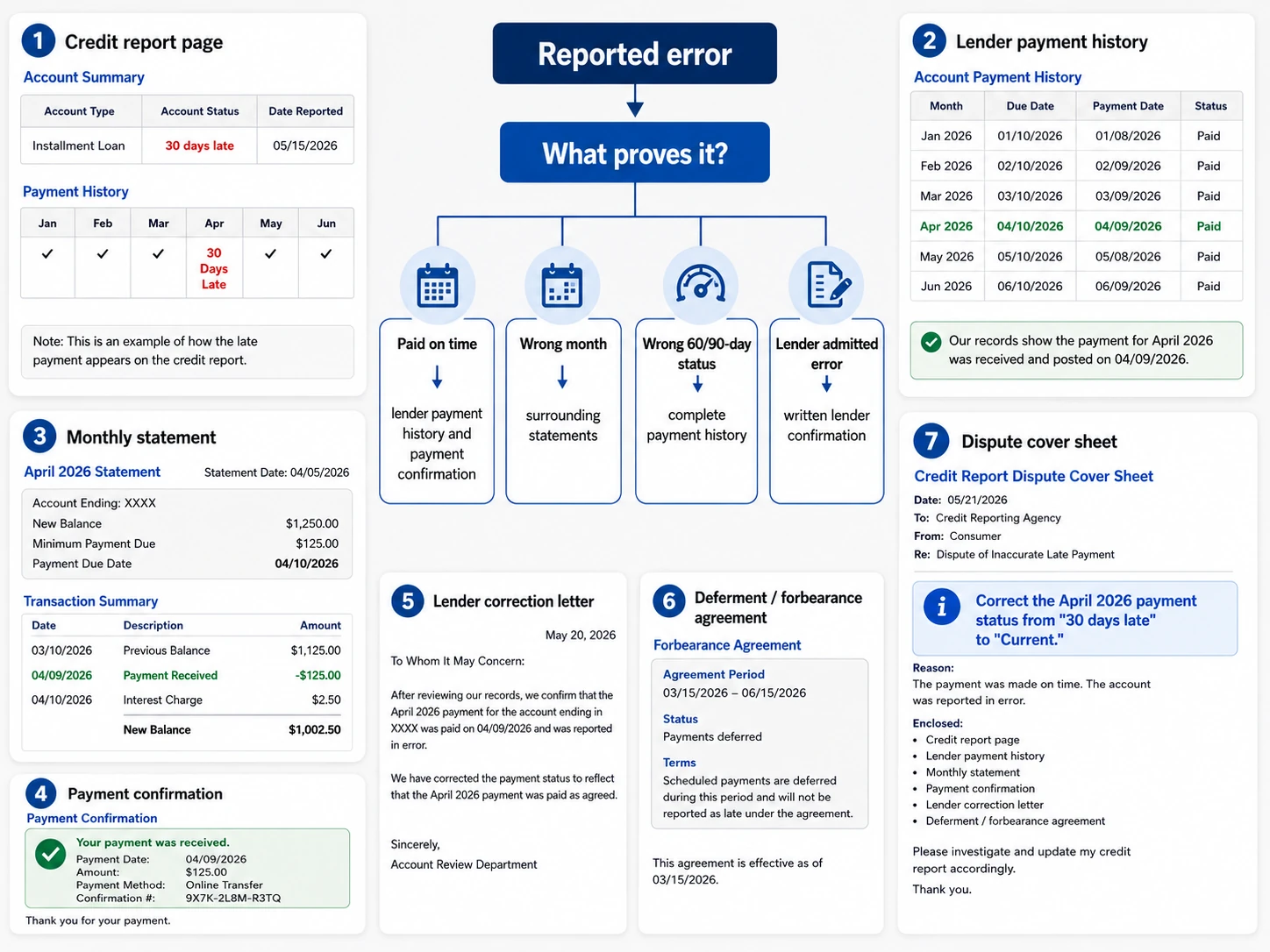
Build a focused evidence packet
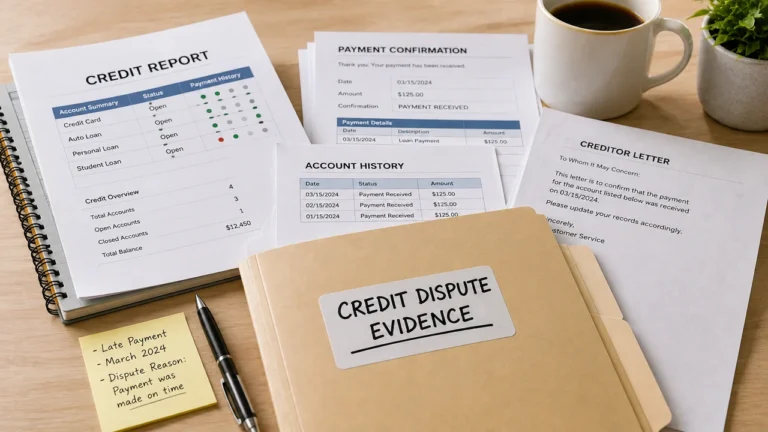
- Save the credit-report page showing the disputed late payment.
- Mark the exact account, month, and payment status.
- Add the document that establishes the relevant due date.
- Add the lender record showing when the payment was received or credited.
- Add any written lender correction, deferment, or forbearance agreement that directly affects the disputed period.
- Keep the originals and submit copies when filing by mail.
A bank statement can help show when money left your account, but it may not establish when the lender credited the payment. When that timing matters, the lender’s own payment history or written confirmation can be especially useful.
For a broader evidence guide, see documents that can support a credit report dispute.
How to dispute a late payment step by step
Work from the specific reporting error outward: confirm where the late payment appears, identify the exact field, gather evidence, file with the correct parties, and preserve a complete record of what you submitted.
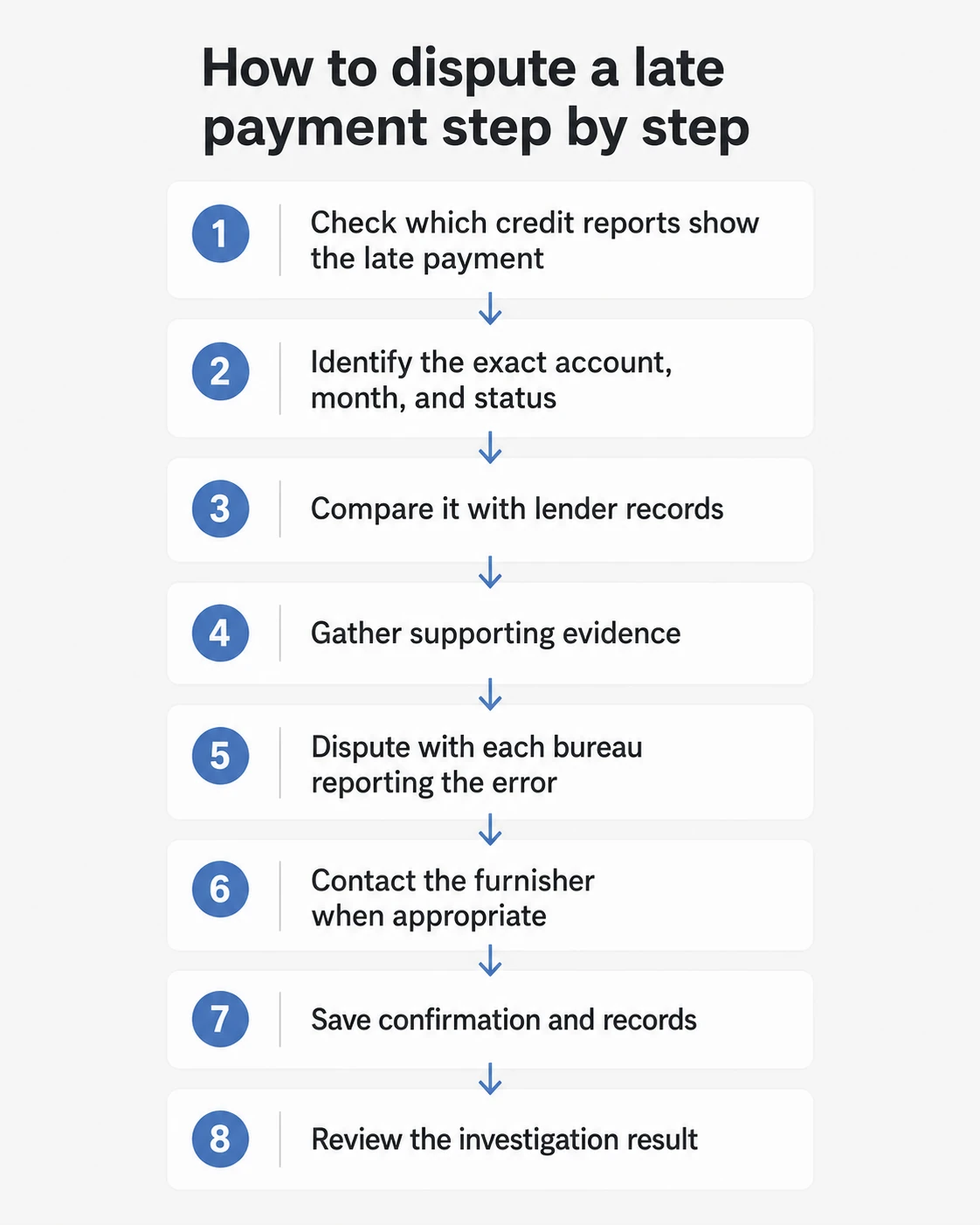
Step 1: Check which credit reports show the late payment
Compare the account across the reports you have. Record which bureau shows the late payment and whether the same month and status appear elsewhere.
Step 2: Identify the exact information you are disputing
Write down the creditor, account identifier, disputed month, reported status, and the specific correction you believe is supported by the records.
Step 3: Attach evidence that addresses that exact issue
Use relevant documents only. A pile of unrelated statements can make the factual question harder to see.
Step 4: Submit the dispute to each bureau reporting the error
A dispute with one credit bureau does not automatically file a dispute with another bureau. If the same inaccurate entry appears on more than one report, address each report that contains it.
If you need to choose a filing method, compare disputing a credit report online or by mail.
Step 5: Dispute with the lender or other furnisher
CFPB guidance recommends addressing inaccurate credit-report information with both the credit reporting company and the company that supplied the information. A direct furnisher dispute should identify the account, the exact information you believe is wrong, why it is wrong, and the records supporting your position.
A simple factual explanation can be:
I am disputing the payment status reported for [month/year] on my [creditor] account ending in [last four digits]. The credit report shows [reported status]. My records show [correct information]. I have attached [document] supporting that information. Please investigate the disputed payment-history entry and correct it if it is inaccurate.
Step 6: Ask for a specific correction
“Please fix my credit” is too vague. State the exact month, current reported status, and what your records indicate should be reported instead.
Step 7: Create a dispute record
| Record | What to save |
|---|---|
| Submission | Exact dispute explanation and documents submitted |
| Date | Date filed and, when known, date received |
| Confirmation | Portal confirmation, reference number, or mailing proof |
| Lender contact | Letters, secure messages, or call notes |
| Result | Investigation notice and updated report |
Step 8: Compare the result with the exact entry you disputed
Do not stop at a portal message saying the investigation is complete. Compare the updated account, month, payment status, and relevant dates with your original report and lender records.
How to dispute a late payment with Equifax
If a late payment appears on your Equifax credit report and you believe the reporting is inaccurate, dispute the specific error rather than the account in general. Identify the exact creditor, account, month, and payment status you believe is wrong, and support that claim with records that address the same issue. Accurate negative information generally cannot be removed simply because it hurts your credit.
- Confirm the entry on your Equifax report. Note the creditor name, account identifier, exact month, and whether the report shows 30, 60, or 90 days late.
- Gather focused evidence. Useful records can include a payment confirmation, bank statement, lender payment history, account statement, or written message from the lender acknowledging an error.
- File through the official Equifax dispute channel. Use the Equifax credit dispute center and dispute only the information you believe is inaccurate.
- Request a precise correction. State which month or status is wrong, why, and what your records show instead.
- Save your dispute record. Keep the confirmation or reference number, the date you filed, the explanation you submitted, and copies of the documents you provided.
- Contact the furnisher when appropriate. CFPB guidance recommends disputing inaccurate credit-report information with both the credit reporting company and the company that supplied the information.
Example: “My Equifax report shows this account as 30 days late for March 2026. The attached lender payment history shows the payment was credited before the due date. Please investigate the March 2026 payment status and correct it if it is inaccurate.”
For the federal dispute process and documentation guidance, see the Consumer Financial Protection Bureau’s credit-report dispute guidance.
What should you write in a late payment dispute?
Your dispute should state the exact information you believe is wrong, why you believe it is wrong, what evidence supports your position, and the correction you are requesting.
Late payment dispute letter template
I am disputing the payment status reported for [month/year] on my [creditor] account ending in [last four digits]. My credit report shows [reported status]. I believe this information is inaccurate because [specific factual reason]. The attached [document] shows [relevant fact]. Please investigate this payment-history entry and correct it if it is inaccurate.
Example: You paid on time but were reported late
I am disputing the 30-day late payment reported for March 2026 on my ABC Bank account ending in 1234. The payment was due March 10, 2026, and the attached lender payment history shows it was credited March 7, 2026. Please investigate the March 2026 payment status and correct it if it is inaccurate.
Example: The wrong month is marked late
I am not disputing the entire account. I am disputing only the payment status reported for [month/year]. The report shows this month as [30/60/90] days late, while the attached account records show [correct information]. Please investigate and correct the payment history for this specific month if it is inaccurate.
Example: The report shows 60 days late instead of 30
The report shows the payment status for [month/year] as 60 days late. I believe the delinquency level is inaccurate. The attached lender payment history shows [relevant account history]. Please investigate the payment status for this period and correct it if necessary.
Example: The lender already acknowledged the error
I am disputing the late-payment status reported for [month/year] on my [creditor] account ending in [last four digits]. The creditor has confirmed in writing that the reported payment information was incorrect. I have attached that confirmation. Please investigate and update the payment history to reflect accurate information.
What not to write in a late payment dispute
- Do not claim you paid on time if your records do not support that statement.
- Do not ask for deletion of accurate negative information simply because it hurts your score.
- Do not make vague claims such as “my credit is wrong” without identifying the disputed field.
- Do not threaten legal action as a substitute for stating the factual error.
- Do not dispute an entire accurate account when only one payment-history field appears wrong.
Should you dispute a late payment online, by mail, or by phone?
There is no single filing method that guarantees a better result. Choose the method that lets you clearly identify the error, provide relevant evidence, and preserve a record of what you submitted.
Compare online, mail, and phone disputes
| Method | Useful when | Record to keep |
|---|---|---|
| Online | The issue is straightforward and the portal accepts the documents you need | Confirmation page, reference number, screenshots, and copies of uploads |
| You want to organize a detailed evidence packet or preserve postal delivery documentation | Exact letter, copies of enclosures, and mailing or delivery proof | |
| Phone | The bureau accepts phone disputes and the issue can be stated clearly | Date, time, representative or reference number, and notes describing what was disputed |
When to dispute a late payment online
Online filing can be convenient when one account, one month, and a small number of supporting documents explain the issue clearly. Save screenshots or PDFs of what you submitted whenever the portal allows it.
When to dispute a late payment by mail
Mail can be useful when the dispute depends on several documents that need to be presented in a clear order. Keep copies rather than sending original evidence.
Can you dispute a late payment by phone?
The nationwide credit reporting companies provide phone dispute options. If the issue depends on documents or a detailed payment timeline, consider whether an online or mailed submission would make the evidence easier to provide and preserve.
Keep a phone dispute log
- Date and time of the call
- Credit bureau
- Reference or confirmation number
- Exact account and month disputed
- What correction you requested
- Any instructions for submitting documents
How long does a late payment dispute take?
A credit reporting company generally must investigate a credit-report dispute within 30 days after receiving it. In certain circumstances, the investigation can take up to 45 days. After the investigation is completed, the credit reporting company generally must notify you of the results within five business days.
The 30-day period is an investigation timeline, not a guarantee that an incorrect late payment will be removed within exactly 30 days.
Late payment dispute timeline
| Stage | What may happen | What you should do |
|---|---|---|
| Dispute received | The credit bureau receives your dispute and supporting information | Save the received date, confirmation number, or delivery record |
| Investigation begins | The disputed information is reviewed and relevant information is sent to the furnisher as appropriate | Keep your original report, explanation, and evidence |
| During the first 30 days | The disputed payment history is investigated | Save any new lender correspondence or account records |
| Up to 45 days in certain cases | A longer investigation period may apply | Check whether an applicable extension applies to your dispute |
| Investigation completed | The bureau reaches a result on the disputed information | Save the result and compare it with the exact entry you disputed |
| Within five business days after completion | The bureau generally sends notice of the investigation results | Keep the notice with your dispute records |
Can a credit dispute take 45 days?
Yes. CFPB guidance identifies circumstances that can allow up to 45 days, including a dispute submitted after receiving a free annual credit report and a case where relevant additional information is submitted during the initial investigation period.
What should you do while the dispute is pending?
- Keep the original credit report showing the late payment.
- Save the date the bureau received the dispute.
- Keep the confirmation or reference number.
- Save the exact explanation and supporting documents submitted.
- Preserve lender correspondence and any meaningful new evidence.
Avoid repeatedly submitting the same unsupported dispute while the first investigation is still pending.
What if 30 days have passed and you have no result?
First confirm when the bureau actually received your dispute and whether a longer investigation period may apply. Reaching 30 days does not automatically mean the bureau is late if an applicable 45-day timeline applies. Preserve your submission and delivery records if the expected period has passed.
What happens after you dispute a late payment?
After the investigation, the late-payment information may be corrected, removed, left unchanged, or partially updated. Do not judge the outcome only by whether the dispute is marked “completed.” Compare the result with the exact account, month, payment status, and correction you requested.
Late payment dispute result decoder
| Result | What it may mean | What to check next |
|---|---|---|
| Payment status corrected | The disputed payment history was changed | Check whether the corrected month and status now match the lender’s records |
| Late payment removed | The disputed late-payment information no longer appears in the same form | Save the updated report and make sure the rest of the account remains accurate |
| Verified as accurate | The disputed information remained after the investigation | Review your evidence and the lender’s underlying payment history before deciding on another step |
| Partial update | Something changed, but the specific problem may not be fully resolved | Compare the old and new reports field by field |
| Frivolous or irrelevant | The bureau determined that it was not required to investigate the dispute as submitted | Read the notice and identify what information or specificity may have been missing |
| Removed and later reported again | Previously disputed information has reappeared | Preserve the original report, result, corrected report, and new report showing the information again |
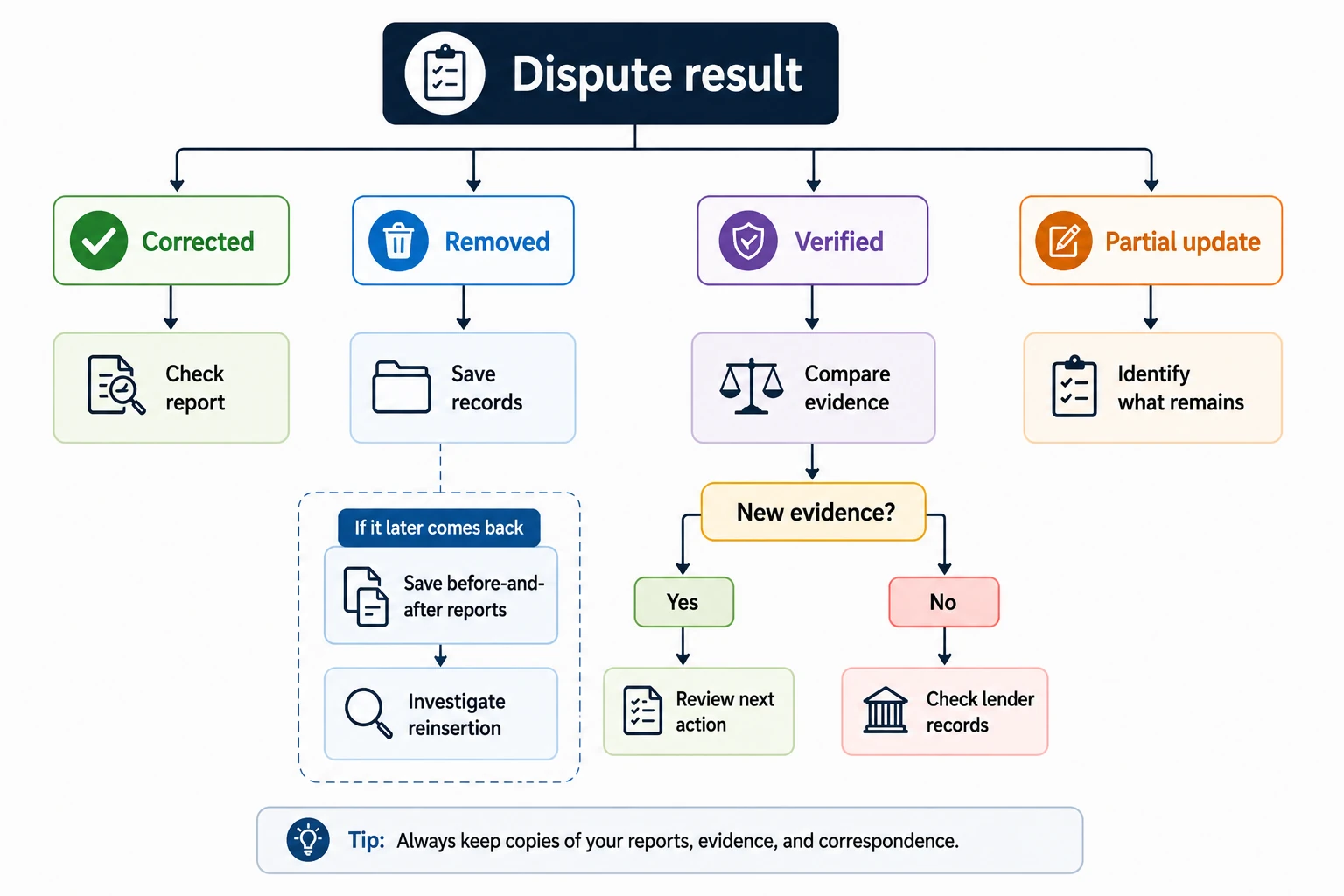
What if the late payment was corrected or removed?
Compare the updated account with the report you saved before filing. Check the exact month, the 30-, 60-, or 90-day status, any disputed payment date, surrounding months, and whether another account field changed unexpectedly.
If the correction is complete but your score has not risen, follow the late-payment removal and unchanged-score checklist. It helps you match the score to the corrected bureau and date and check for other changes before opening another dispute.
What if the late payment was verified as accurate?
If the bureau says the late payment was verified as accurate and it remains on your report, do not automatically submit the same dispute again. Check whether you disputed the correct account and month, whether your evidence addressed the disputed fact, what the lender’s records show, and whether you now have meaningful new evidence.
For a full decision process, see what “verified as accurate” means after a credit dispute.
What if the dispute did not fix the late-payment error?
Identify exactly what remains unresolved. Compare the creditor name, account identifier, disputed month, reported status, lender payment history, evidence submitted, and any new evidence you now have. If the lender’s records confirm the payment really was late, continuing to characterize it as an inaccurate reporting error may not be appropriate.
What if the dispute was called frivolous or irrelevant?
Read the notice before filing anything else. Check whether your original dispute clearly identified the creditor, account, disputed month, payment status, reason for the dispute, requested correction, and information needed to investigate the claim.
What if a late payment was removed and then came back?
Keep the original report, original dispute, investigation result, report showing the correction or removal, later report showing the information again, and relevant lender correspondence. Then compare the reappearing entry with the information previously disputed.
If previously disputed information reappears, see what to do if a disputed item was removed and then came back.
What if only one credit bureau corrected the late payment?
A correction by one bureau does not automatically prove another bureau’s version is inaccurate. Compare each report with the lender’s underlying records and identify the exact factual discrepancy that remains.
Can you dispute the same late payment again?
You may have a reason to dispute the same late payment again if the first dispute targeted the wrong information or you obtain meaningful new evidence. Simply resubmitting the same claim with the same facts and documents does not create new evidence and may not lead to a different result.
Should you dispute the late payment again?
| What changed since the first dispute? | What to do next |
|---|---|
| You disputed the wrong month | Correct the month and make sure your evidence covers the actual disputed period |
| You challenged the wrong payment status | Identify the status that actually conflicts with the lender’s records |
| You now have the lender’s complete payment history | Compare it with the credit-report entry and determine whether it materially supports your claim |
| You found a statement showing the relevant due date | Check whether the documented due date changes the factual basis of the dispute |
| The lender acknowledged a reporting error in writing | Preserve the written confirmation and identify exactly what should be corrected |
| Your first dispute omitted evidence that directly supports the disputed fact | Determine whether the missing evidence materially strengthens your position |
| Nothing has changed and you have the same evidence | Do not automatically resend the same dispute |
| The lender’s records confirm the payment was actually late | You may no longer be dealing with an inaccurate-information dispute |
What counts as meaningful new evidence?
- A complete lender payment history
- A monthly statement establishing the relevant due date
- A lender payment confirmation
- Written confirmation that the lender reported information incorrectly
- An approved deferment, forbearance, or payment-arrangement agreement covering the disputed period
- Records showing that the first dispute identified the wrong month, date, or payment status
How many times can you dispute a late payment?
There is no simple rule that gives a specific number of times you can dispute the same late payment. What matters is whether the dispute identifies information you genuinely believe is inaccurate or incomplete and provides enough information for the issue to be investigated.
For direct disputes sent to a furnisher, Regulation V allows a furnisher to determine that a dispute is frivolous or irrelevant in certain circumstances, including when it is substantially the same as a previous direct dispute and the consumer provides no new information.
Late payment re-dispute decision tree
Did the first dispute identify the correct account and month?
No → Correct the factual mistake before filing another dispute.
Yes → Continue.
Do you have meaningful new evidence?
Yes → Compare it with the exact payment-history entry and determine whether it materially supports another dispute.
No → Continue.
Do the lender’s records contradict the credit report?
Yes → Ask the lender to review the information it furnished and preserve any written response or correction.
No → Continue.
Do the lender’s records confirm that the payment was actually late?
Yes → You may no longer have an accuracy dispute.
Not sure → Obtain the lender’s payment history before filing again.
Audit the first dispute before filing another one
| Question | First dispute | What you know now |
|---|---|---|
| Account disputed | ________ | ________ |
| Month disputed | ________ | ________ |
| Status reported | ________ | ________ |
| Status you believe is correct | ________ | ________ |
| Due date established by | ________ | ________ |
| Payment or credited date established by | ________ | ________ |
| Lender payment history available? | Yes / No | Yes / No |
| Evidence submitted | ________ | ________ |
| New evidence obtained | ________ | ________ |
| Lender’s position | ________ | ________ |
Does disputing a late payment hurt your credit score?
Filing a dispute over an inaccurate late payment does not, by itself, lower your credit score. Your score may change if the information in your credit report changes as a result of the dispute, but the direction and size of any change depend on the updated information, the rest of your credit file, and the scoring model being used.
For a broader explanation beyond late payments, see how a credit report dispute can affect your credit score.
What can happen to your score after a late payment dispute?
| What happens | What it means |
|---|---|
| The late payment stays unchanged | The same payment-history information remains on your report. Filing the dispute itself does not create a separate scoring penalty. |
| The inaccurate late payment is corrected | Your score may change after the corrected information is reflected in the report used to calculate the score. |
| The late payment is removed | Your score may increase, stay similar, or change differently depending on the rest of your credit file and the scoring model. |
| Another account field changes | Any score effect depends on which information changed and how the scoring model treats it. |
| No credit-report information changes | The dispute itself does not create a score change simply because an investigation took place. |
There is no reliable formula for how many points your score will gain if an inaccurate late payment is corrected or removed.
Should you avoid a valid dispute because you are worried about your score?
No. If you have a legitimate reason to believe a late payment is inaccurate or incomplete, concern about filing the dispute should not be the reason you leave incorrect information unchallenged. If the lender’s records confirm that the late payment was accurately reported, disputing it solely because it hurts your score is not an accuracy dispute.
What if your score changes while the dispute is pending?
Do not assume that a score increase or decrease while the investigation is open tells you whether the dispute succeeded. Instead, compare the updated report with the exact late-payment entry you challenged.
Frequently asked questions about late payment disputes
Can you dispute a 30-day late payment?
Yes, if the 30-day late payment is inaccurate or incomplete. The fact that it hurts your credit is not, by itself, a valid reason to dispute it.
Can you dispute a 60-day or 90-day late payment?
Yes, if the reported 60-day or 90-day status is inaccurate or incomplete. The error can be the severity of the delinquency rather than whether you were late at all. Compare the disputed month, delinquency level, surrounding payment history, due date, and credited payment date.
What if your credit report says you were late but you paid on time?
Confirm the contractual due date, find the lender’s payment confirmation or account history, identify when the lender says the payment was received or credited, and compare that date with the month and status on your credit report. A bank statement can help, but it may not establish when the lender credited the payment.
What if the lender corrected the late payment but the credit bureau still shows it?
Get written evidence of what the lender corrected. Then check the report that still contains the late payment and make sure it was generated after the lender made the correction. Preserve the lender’s correction, disputed month, corrected status, correction date, report date, and the bureau still showing the error.
What if the late payment appears on only one credit report?
Focus on the bureau that actually shows the questionable information. Another bureau’s report can help you spot a difference, but it does not prove which version is correct. Use the lender’s underlying records to determine whether the entry on the affected report is inaccurate.
Can you dispute an accurate late payment?
An accuracy dispute is not the appropriate way to remove a late payment that is correctly reported. If the correct account, month, payment status, and payment history are being reported, do not describe the information as inaccurate simply because it hurts your credit.
Explore related guides on late payments.
Sources
- Consumer Financial Protection Bureau — How do I dispute an error on my credit report?
- Consumer Financial Protection Bureau — How long does it take to repair an error on a credit report?
- Consumer Financial Protection Bureau — Is it possible to remove accurate but negative information from my credit report?
- Federal Trade Commission — Disputing errors on your credit reports
- Consumer Financial Protection Bureau — Regulation V, 12 CFR § 1022.43: Direct disputes
- Experian — Can credit report disputes lower credit scores?
Last reviewed: September 29, 2026
Written by: Claire Bennett, Founder & Editor of Fix My Money Life
Financial disclaimer
This article is for general educational purposes and is not legal, financial, or credit-repair advice. Credit reporting situations vary, and the information in your credit reports, lender records, and dispute results determines what action may be appropriate.