Quick answer: If your charge-off balance is increasing every month, interest or fees may still be accruing when the original agreement and applicable law allow them. A charge-off does not erase the debt or automatically stop interest. However, the increase may also result from a missing payment or credit, an incorrect balance transfer, inconsistent reporting, or another credit reporting error. Before paying or disputing the account, identify who currently owns the debt, confirm which company is reporting the balance, and request a written explanation of the principal, interest, fees, payments, and credits. If a debt collector is involved, its validation information generally should include an itemization of those amounts.
- Why a charge-off balance may keep increasing
- Interest may continue after the charge-off
- Fees or collection costs may have been added
- A payment, refund, or credit may be missing
- The debt may have been assigned or sold
- The reported balance may be inaccurate
- Is it legal for a charge-off balance to keep increasing?
- The original agreement and applicable law control what may be added
- Ask for a written explanation of the current balance
- Warning signs that the increase may be incorrect
- How to find out why your charge-off balance increased
- Step 1. Check all three credit reports
- Step 2. Compare the balance month by month
- Step 3. Identify who currently owns or collects the debt
- Step 4. Request a written balance calculation
- Step 5. Compare the calculation with your records
- Step 6. Separate a balance increase from a monthly account update
- What to do if the balance increase is accurate
- Request the current payoff amount in writing
- Compare payment, settlement, and payment plan options
- Get the complete agreement in writing before paying
- Keep proof of payment and review your credit reports
- Consider possible tax consequences of a settlement
- Be careful before paying an old debt
- What to do if the charge-off balance is wrong
- Identify the exact error
- Gather documents supporting the correct information
- Dispute the error with each credit bureau reporting it
- Send a direct dispute to the company furnishing the information
- Review the investigation results
- Escalate the issue if the error remains
- The charge-off itself is already a serious negative item
- A higher reported balance may affect some scoring calculations
- Lenders may consider the unpaid balance separately
- Paying the balance does not guarantee an immediate score increase
- Does an increasing balance restart the seven-year reporting period?
- The reporting period is tied to the delinquency that led to the charge-off
- A monthly update is not the same as re-aging
- The credit reporting period and statute of limitations are different
- What to check on your credit reports
- What if the balance keeps increasing after you already paid?
- Confirm what the payment agreement required
- Check whether the payment was processed and applied correctly
- Compare the account balance with the credit report
- Dispute the balance if it remains inaccurate
- When should you consider getting legal help?
- The balance cannot be documented or explained
- Ownership of the debt or payment authority is unclear
- You received a summons or other court papers
- Your disputes did not correct a documented reporting error
- The debt may be too old for a collection lawsuit
- How to find appropriate legal assistance
- Frequently asked questions
- Can a charge-off balance increase every month?
- Does interest automatically stop after a charge-off?
- Can a debt collector add interest to a charged-off debt?
- Why is my charge-off increasing by only a few dollars each month?
- Why is my charge-off updated every month?
- Can the original creditor and collection agency both report the debt?
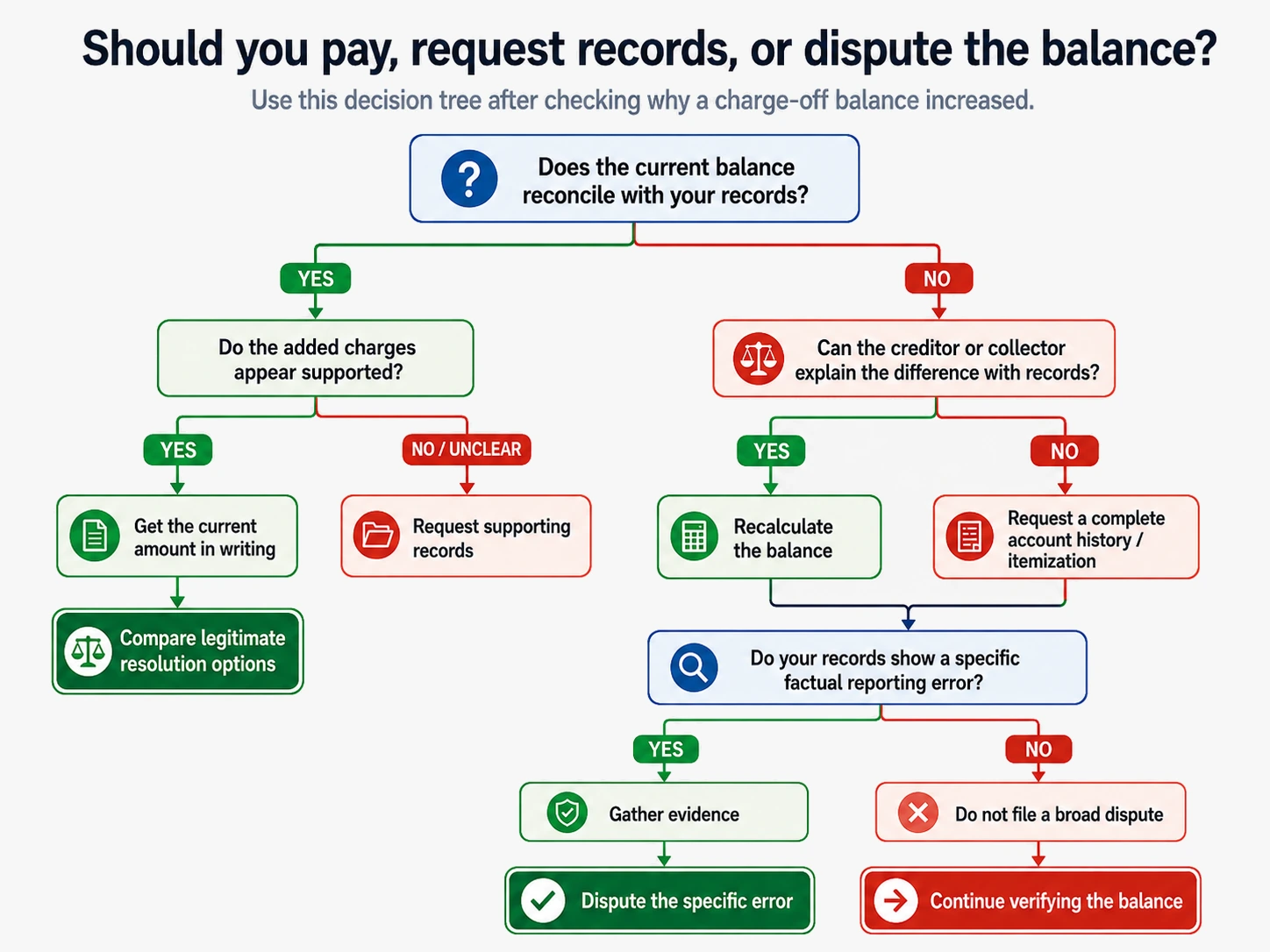
- Should I pay or dispute an increasing charge-off balance?
- Does an increasing charge-off balance restart the seven-year period?
- Final thoughts
Why a charge-off balance may keep increasing
If your charge-off balance increases every month, interest or fees may still be accruing when the original credit agreement and applicable law allow them. The balance may also be wrong because a payment or credit was not applied, information was carried over incorrectly when the debt changed hands, or the account was reported inconsistently to the credit bureaus.
A charge-off is an accounting action taken by a creditor after an account has remained seriously delinquent. It does not erase the debt or automatically freeze the amount owed. Learn more about what a charge-off means on your credit report.
| Possible reason | What may be happening | What to check |
|---|---|---|
| Continued interest | Interest is still accruing under the original credit agreement and applicable law. | Review the interest rate, account terms, and monthly calculation. |
| Authorized fees or costs | Fees, collection costs, court costs, or other charges may have been added when permitted by the agreement or applicable law. | Ask for the type, amount, and contractual or legal basis of each charge. |
| Missing payment or credit | A payment, refund, settlement payment, or account credit was not applied correctly. | Compare payment receipts, bank statements, settlement documents, and account records. |
| Transfer-related discrepancy | The balance changed after the debt was assigned or sold because of accrued charges, different reporting dates, or an incorrect transfer of account data. | Confirm who owns the debt, who is authorized to collect it, and how the current balance was calculated. |
| Reporting error | The creditor or debt collector reported an incorrect balance, payment history, or account status. | Compare the full account details across Equifax, Experian, and TransUnion. |
| Ownership or reporting mismatch | The original creditor and a collection company both appear on the credit report, but the ownership or balances are unclear. | Determine whether the debt was sold or only assigned and which company currently claims the amount owed. |
Interest may continue after the charge-off
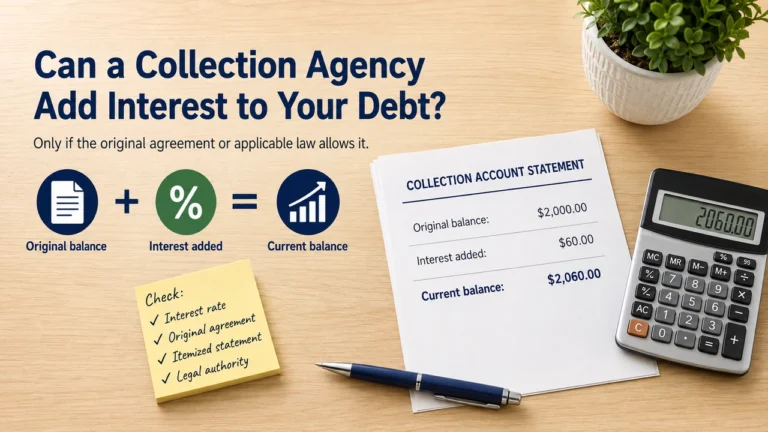
Charging off an account does not always stop interest from accruing. Interest may continue when the original credit agreement and applicable law allow it. The Consumer Financial Protection Bureau explains that a debt collector cannot collect interest or fees unless the increase is permitted by the original agreement and not prohibited by law, or is otherwise expressly permitted by applicable law.
If the balance rises by a similar amount each month, compare the increase with the interest rate stated in the original agreement. A recurring increase may represent monthly interest, but the company claiming the debt should still be able to explain how it calculated the current amount.
Fees or collection costs may have been added
The balance may also increase because of authorized collection costs, attorney’s fees, court costs, post-judgment interest, or other permitted charges. These amounts are not automatically valid simply because the account was charged off. Each added amount should have a basis in the original agreement, a court judgment, or applicable law.
Ask the company claiming the debt to identify each charge separately. If you are dealing with the original creditor, request a written account history or payoff statement showing how the balance was calculated. If a debt collector is involved, request and review its validation information.
A payment, refund, or credit may be missing
A charge-off balance may be inaccurate if a payment was not credited correctly. This can happen when a payment was sent to a previous account owner, processed after the debt was transferred, or applied to the wrong account. A refund, settlement payment, or other account adjustment may also be missing.
Compare the reported balance with your bank statements, payment confirmations, settlement letters, and previous account statements. Keep copies of every document showing the payment date, amount, recipient, and confirmation number.
The debt may have been assigned or sold
A creditor may assign a charged-off debt to a collection agency while continuing to own it, or it may sell the debt to a debt buyer. Selling or assigning the debt does not automatically justify an increase in the balance. Any difference should be traceable to documented interest, authorized charges, payments, credits, or a reporting correction.
Confirm which company currently owns the debt, which company is authorized to collect it, and which company is reporting the balance to the credit bureaus. The original account and a separate collection account may both appear on a credit report, but that does not automatically mean the debt is being reported twice. Read more about the difference between a charge-off and a collection.
The reported balance may be inaccurate
The balance may be incorrect because of a data-entry error, unsupported interest or fees, a missing payment, an incorrect transfer of account information, or inconsistent reporting among the three credit bureaus. Review the full account details on your Equifax, Experian, and TransUnion reports instead of relying only on a credit-monitoring alert.
If the amount cannot be explained, request a written breakdown showing the principal, interest, fees, payments, credits, and current balance. If a debt collector is involved, its validation information generally must show the amount owed on the itemization date and an itemization of interest, fees, payments, and credits applied since that date.
Is it legal for a charge-off balance to keep increasing?
Sometimes. A charge-off balance may legally continue to increase when interest, fees, or other amounts are authorized by the agreement creating the debt and permitted under applicable law. For a debt collector, federal law generally prohibits collecting any amount unless it is expressly authorized by the agreement or permitted by law.
The rules that apply to an original creditor may differ because the federal Fair Debt Collection Practices Act and Regulation F generally do not apply in the same way when a creditor collects its own debt. However, any added interest or charges should still have a valid contractual or legal basis.
The original agreement and applicable law control what may be added
A charge-off does not erase the debt or automatically stop interest from accruing. Whether interest, collection costs, or other charges may continue depends on the original credit agreement, applicable state law, and, when relevant, the terms of a court judgment.
According to the Consumer Financial Protection Bureau, a debt collector cannot collect interest, fees, charges, or expenses unless the amount is expressly authorized by the agreement creating the debt or permitted by law. State law may also limit the type or amount of interest and fees that can be charged.
Review the original agreement, the stated interest rate, the last account statement issued before the charge-off, and any collection notices you received. If a court judgment has been entered, review the judgment and applicable law to determine whether court costs or post-judgment interest may be included.
Ask for a written explanation of the current balance
Ask the company claiming the debt to explain in writing how it calculated the current amount. The explanation should identify the principal balance and any interest, fees, payments, refunds, settlements, or credits used in the calculation.
If you are dealing directly with the original creditor, request a complete account history, payoff statement, or other written balance calculation. If a debt collector is involved, review its validation information. A validation notice generally must show the amount owed on the itemization date, an itemization of interest, fees, payments, and credits since that date, and the current amount of the debt.
Warning signs that the increase may be incorrect
- The company refuses or is unable to explain how the current balance was calculated.
- The interest rate does not match the original agreement, applicable law, or a court judgment.
- Payments, refunds, settlement amounts, or account credits are missing.
- The balance increased after the debt was assigned or sold without a documented explanation.
- Two companies are demanding payment of the full balance, and ownership of the debt is unclear.
- Interest, fees, or collection costs were added without a clear contractual or legal basis.
- The balance continued increasing after a completed payoff or settlement.
- The amount in a collection notice does not match the amount on your credit report, and the difference cannot be explained by reporting dates or recent account activity.
An increasing balance is not automatically valid or invalid. The key question is whether each added amount can be supported by the original agreement, applicable law, a court judgment when relevant, and an accurate account history.
How to find out why your charge-off balance increased
To determine why your charge-off balance increased, compare your credit reports, identify the company that currently owns or collects the debt, and request a written explanation of the amount claimed. Do not assume that the increase is correct or incorrect until you can trace the balance, interest, fees, payments, credits, and other adjustments.
Step 1. Check all three credit reports
Review your complete credit reports from Equifax, Experian, and TransUnion. You can request them through AnnualCreditReport.com, the official federally authorized website for free credit reports.
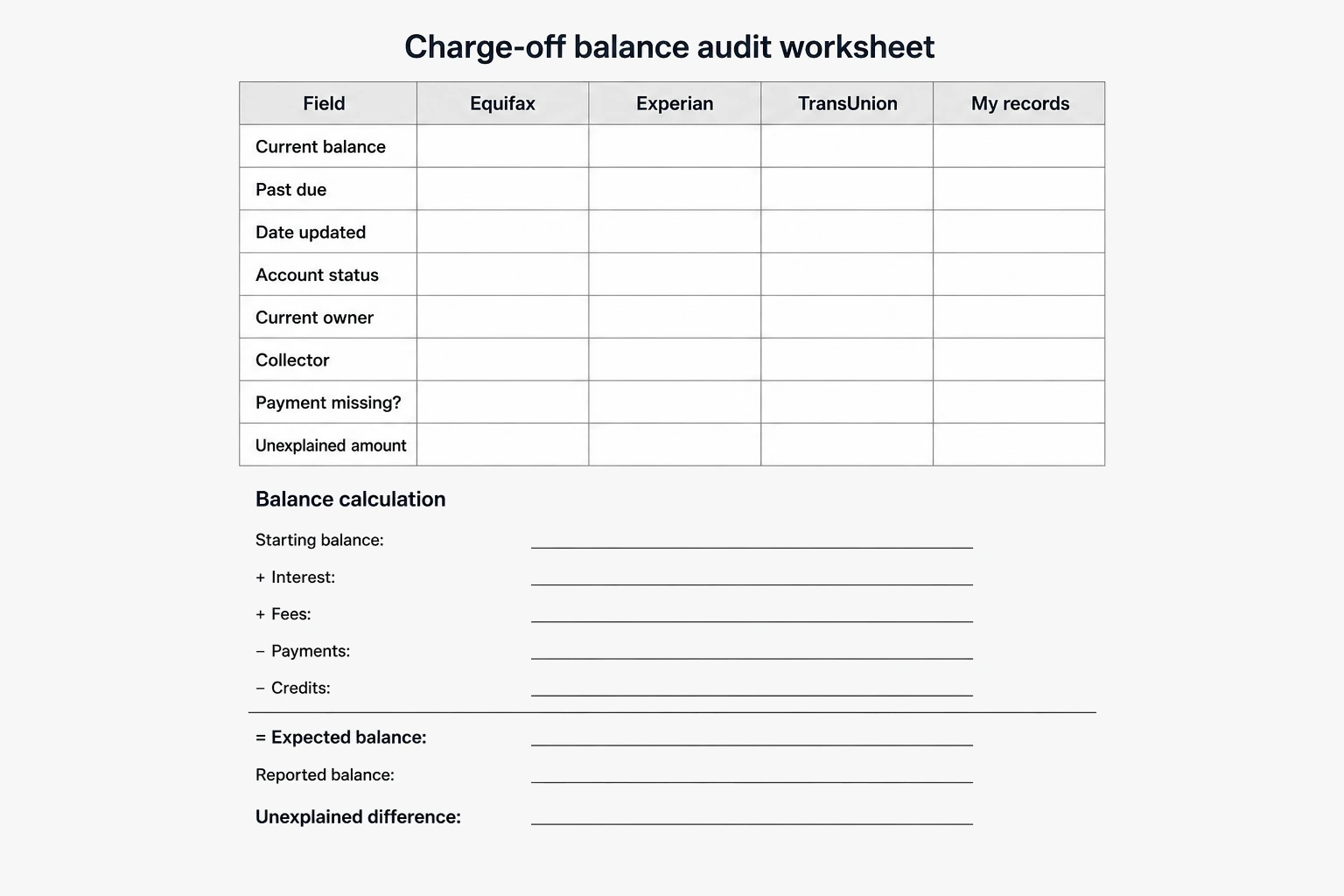
Do not rely only on a credit-monitoring alert or score-tracking app. Open the complete account entry on each report and compare the following details:
- Current balance
- Past-due amount, when reported
- Account status
- Date updated
- Original creditor
- Collection company or debt buyer, when applicable
- Payment history
- Account remarks
- Sold or transferred notation
- Date of first delinquency, when shown
The information may differ among the three reports because furnishers may report to different credit bureaus or update them on different dates. Use the complete account details to identify which company is reporting the increasing balance. See how to read your credit report before comparing the entries.
Step 2. Compare the balance month by month
Write down the balance shown for each reporting period. A month-by-month comparison can reveal whether the amount is increasing consistently, changed only once, or remained the same despite receiving a new account alert.
| Reporting month | Reported balance | Increase | Possible explanation |
|---|---|---|---|
| January | $3,000 | — | Starting balance |
| February | $3,045 | $45 | Possible monthly interest or authorized charge |
| March | $3,090 | $45 | Possible recurring interest or charge |
A similar increase each month may indicate recurring interest or another regular charge. A sudden increase may point to a one-time fee, court cost, missing payment or credit, a difference between reporting dates, an incorrect transfer of account data, or another reporting error.
The pattern alone does not prove that the amount is valid. It only helps you identify which part of the calculation requires further review.
Step 3. Identify who currently owns or collects the debt
Determine whether the original creditor still owns the debt, assigned it to a collection agency, or sold it to a debt buyer. The company contacting you may be collecting the debt for another company rather than owning it.
Ask the company these questions in writing:
- Do you currently own this debt?
- Are you collecting it for another company?
- Who is the current creditor?
- What was the balance when you received the account?
- Who is authorized to accept payment?
- Which company is reporting the balance to the credit bureaus?
- When was the debt assigned, transferred, or sold?
Before sending a payment, verify that the company owns the debt or is authorized to collect it, and confirm how the payment will be applied to the account.
Step 4. Request a written balance calculation
Ask the company claiming the debt to provide a written explanation showing how it calculated the current amount. A total balance by itself may not give you enough information to determine why the charge-off balance increased.
If you are dealing directly with the original creditor, request a complete account history, payoff statement, or written balance calculation. If a debt collector is involved, review its validation information, including the itemization of interest, fees, payments, and credits since the stated itemization date.
| Balance component | Information to request |
|---|---|
| Starting amount | The balance on the charge-off date, transfer date, or stated itemization date |
| Interest | The interest rate, applicable dates, and amount added |
| Fees and costs | The type, amount, and contractual or legal basis of each charge |
| Payments | The dates and amounts of payments received and how they were applied |
| Credits | Refunds, settlements, adjustments, or other credits applied |
| Current amount | The total amount claimed as of the date of the statement or notice |
The written calculation should allow you to trace the balance from the earlier amount to the amount currently claimed. Ask for clarification if it does not explain a particular increase or adjustment.
Step 5. Compare the calculation with your records
Compare the written explanation with every relevant document you have, including:
- The original credit agreement
- The last statement issued before the charge-off
- Previous credit reports
- Collection and validation notices
- Payment confirmations
- Bank statements
- Settlement letters
- Refund or account-credit records
- Any court judgment related to the debt
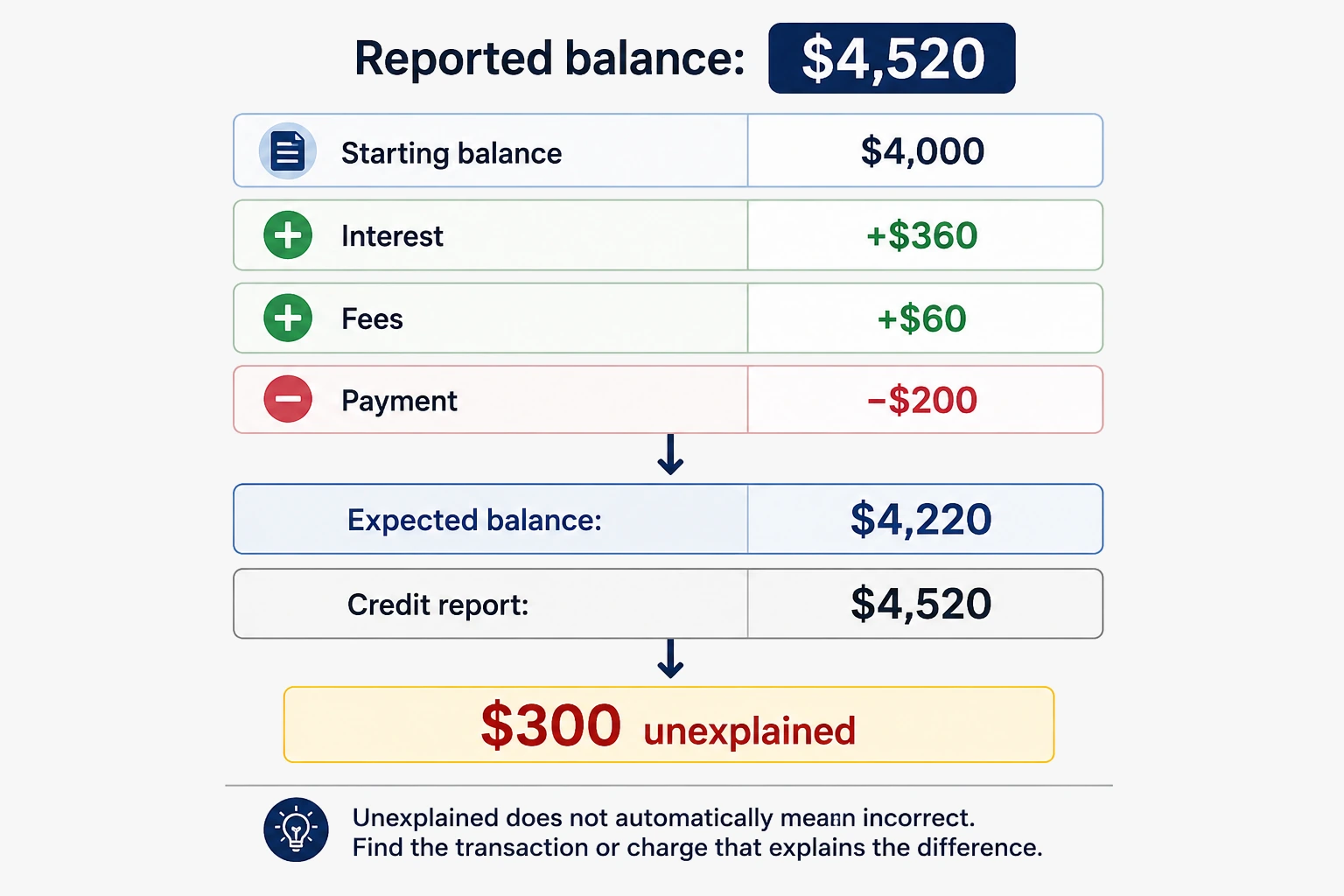
For example, suppose an account was charged off with a reported balance of $4,000 and later appeared with a balance of $4,520. The additional $520 should be explainable through documented interest, authorized fees or costs, account adjustments, or differences in the relevant reporting dates.
If the company cannot explain the difference, or if its calculation conflicts with your records, the amount may require further investigation or a credit report dispute.
Step 6. Separate a balance increase from a monthly account update
A monthly account update does not always mean that the balance increased. A company may send updated account information to a credit bureau even when the amount owed remains unchanged.
| Type of change | Example | What it means |
|---|---|---|
| Balance increase | $4,000 → $4,080 → $4,160 | The amount reported as owed is increasing. |
| Monthly update | $4,000 → $4,000 → $4,000 | The account information was updated, but the reported balance did not change. |
A new date updated, recent account activity notice, or fresh credit-monitoring alert does not automatically mean that interest or fees were added. Compare the actual balance, past-due amount, account status, and payment history before deciding what changed.
After completing these steps, you should be able to determine whether the increase appears to come from documented interest or authorized charges, a missing payment or credit, a transfer-related discrepancy, different reporting dates, or inaccurate credit reporting.
What to do if the balance increase is accurate
If the higher charge-off balance is accurate, compare your options before sending money. Depending on your finances and the company’s policies, you may be able to pay the verified amount in full, negotiate a settlement, or arrange a payment plan.
First, confirm who currently owns the debt or is authorized to collect it. Then choose an option you can realistically afford without falling behind on rent, utilities, secured debts, or other essential obligations. Get all payment and settlement terms in writing before making the first payment.
Request the current payoff amount in writing
Contact the company that currently owns the debt or is authorized to collect it and request a written payoff amount or balance confirmation. The balance shown on your credit report may not be the exact amount required to resolve the account on the date you pay because interest or authorized charges may continue to accrue.
The written confirmation should identify:
- The name of the current creditor or debt owner
- The name of the company authorized to collect the debt
- The account or reference number
- The total amount due through a specific date
- Whether interest or fees will continue to accrue
- Where and how the payment must be sent
- How the payment will be applied
- The amount, if any, that will remain after the payment
- How the account is expected to be reported after the agreement is completed
If a debt collector is involved, review its validation information as well. The validation information generally identifies the current creditor, the amount of the debt on the itemization date, subsequent interest, fees, payments and credits, and the current amount claimed.
Compare payment, settlement, and payment plan options
| Option | What it means | What to confirm |
|---|---|---|
| Pay in full | You pay the entire verified amount required to resolve the debt. | Confirm the payoff amount, payment deadline, and that no amount will remain due after the payment is processed. |
| Settlement | The creditor or collector agrees to accept less than the full balance to resolve the debt. | Confirm the settlement amount, deadline, whether the remaining amount will be forgiven, and how the resolved account will be reported. |
| Payment plan | You make scheduled payments over an agreed period. | Confirm the payment schedule, how payments will be applied, whether interest or fees will continue, and what happens if a payment is late or missed. |
Do not agree to a payment plan that you are unlikely to complete. Missing a required payment may cancel the agreement, allow interest or fees to continue, or cause the company to resume collection activity, depending on the written terms and applicable law.
Paying or settling an accurate charge-off does not automatically remove the account from your credit report or guarantee an immediate credit score increase. However, when the agreement resolves the entire debt, the amount still owed should generally be updated to $0. The account may still show that it was charged off and may indicate whether it was paid in full or settled for less than the full amount. Learn more about how paying a charge-off may affect your credit score.
Get the complete agreement in writing before paying
Do not rely only on a phone conversation or a verbal promise. Before making a payment, request a written agreement that clearly states:
- The name of the current creditor or debt owner
- The agreed payoff or settlement amount
- The payment deadline
- The number, amount, and due dates of scheduled payments, if applicable
- Whether interest or fees will continue to accrue
- How each payment will be applied
- What happens if a payment is late or missed
- The amount that will remain after the agreement is completed
- Whether completing the agreement will resolve the entire debt
- How the account is expected to be reported to the credit bureaus
- Whether collection activity will stop while you comply with the agreement
Review the company name, account number, payment instructions, deadlines, and all conditions before sending money. Make sure the agreement comes from the company that owns the debt or is authorized to collect it.
Keep proof of payment and review your credit reports
Save copies of the payoff or settlement agreement, payment confirmations, bank statements, correspondence, and final account statement. Keep the original documents and send only copies when documentation is requested.
After completing the agreement, request written confirmation that the debt has been resolved and that no further amount is due under the agreement. Then review your credit reports after the company has had reasonable time to process the payment and submit its regular reporting update.
Check whether the balance, account status, payment information, and remarks were updated accurately. If the account still shows an incorrect amount after the reporting update, gather your documents and dispute the specific error with the credit bureau and the company furnishing the information.
Consider possible tax consequences of a settlement
If part of the debt is forgiven through a settlement, the canceled amount may be treated as taxable income under federal tax rules. The creditor may send Form 1099-C when the reporting requirements apply.
Exceptions and exclusions may apply, including certain insolvency and bankruptcy situations. Consider reviewing the current IRS guidance or consulting a qualified tax professional before assuming that the forgiven amount is or is not taxable.
Be careful before paying an old debt
The credit reporting period and the statute of limitations for filing a debt collection lawsuit are separate. The statute of limitations varies by state, type of debt, the terms of the agreement, and the law that applies to the account.
In some states, making a partial payment or acknowledging an old debt may restart or otherwise affect the statute of limitations, even when the previous period has expired. Moving to another state or agreeing to new payment terms may also affect which rules apply.
Before making a partial payment, accepting a settlement, or entering a payment plan on an old debt, determine whether the debt may be time-barred and whether the proposed action could affect your legal rights. Consider consulting a qualified consumer attorney when the debt is old, the amount is substantial, a lawsuit has been threatened, or you are unsure which state law applies.
What to do if the charge-off balance is wrong
If the charge-off balance is inaccurate, identify the specific error, gather documents supporting the correct information, and dispute the error with each credit bureau reporting it and with the company that furnished the information.
Do not dispute the account only because it is negative. Accurate negative information generally cannot be removed simply because it damages your credit. Your dispute should identify the exact information that is wrong, explain why it is inaccurate, and state what correction you are requesting.
Identify the exact error
Review the complete account entry, any available balance calculation or validation information, your payment history, and your own records. Possible charge-off balance errors include:
- An incorrect current balance or past-due amount
- Interest that is unsupported by the agreement or applicable law
- Fees or collection costs without a clear contractual or legal basis
- A payment that was not credited or was applied incorrectly
- A missing refund, settlement payment, or account adjustment
- The same debt listed more than once in a way that overstates the amount owed
- An incorrect current creditor, debt owner, or collection company
- A paid or settled account still reported as fully unpaid
- A balance that does not reflect the completed payoff or settlement agreement
- An incorrect date of first delinquency
The appearance of both an original charged-off account and a separate collection account does not automatically prove duplicate reporting. Review the ownership, balances, account status, and remarks to determine whether the same amount is being reported inaccurately more than once.
Be precise when describing the error. For example, suppose your credit report shows a current balance of $4,800. The account records also show a $4,800 balance before a documented $500 payment, but that payment was never applied. Dispute the missing payment and request that the current balance be corrected to $4,300.
Do not simply request removal of the entire charge-off unless the entire account is inaccurate, unverifiable, or does not belong to you.
Gather documents supporting the correct information
Collect copies of records showing the correct balance, payments you made, or the terms of any payoff or settlement. Useful supporting documents may include:
- Account statements
- Payment receipts and confirmation numbers
- Bank or credit card statements showing the payment
- A payoff or settlement agreement
- A final balance or satisfaction letter
- A debt collector’s validation notice
- Collection letters and account correspondence
- Relevant portions of your credit reports
- Emails or letters from the creditor, collector, or debt buyer
- Court documents, when relevant
Send copies rather than original documents. Highlight the dates, amounts, account numbers, and agreement terms that support your requested correction. Keep the original records in a secure place.
Dispute the error with each credit bureau reporting it
Submit a separate dispute to each credit bureau whose report contains the inaccurate balance. An error appearing on one report may not appear on the other two.
Your dispute should include:
- Your identifying information
- The name of the company reporting the account
- The account number or the identifying digits shown on the report
- The specific balance, payment, date, status, or remark you are disputing
- A clear explanation of why the information is inaccurate
- The correction you are requesting
- Copies of the documents supporting your position
- A copy of the relevant credit report page with the disputed item highlighted
Avoid vague statements such as “this account is wrong” or “remove this charge-off.” Explain the exact factual problem, such as a missing $500 payment, an unsupported $120 fee, or an incorrect current balance.
Keep a complete copy of the dispute, all attachments, the submission confirmation, and any mailing or tracking information. Follow the complete process for disputing errors on your credit report.
Send a direct dispute to the company furnishing the information
Send a separate written dispute to the company that supplied the disputed information to the credit bureau. The furnisher may be the original creditor, a debt buyer, a collection agency, or another company reporting the account.
Send the dispute to the address shown on your credit report for disputes or to another address specifically designated by the company for direct credit reporting disputes.
Ask the furnisher to:
- Investigate the specific balance error
- Review all documents submitted with your dispute
- Explain in writing how the current balance was calculated
- Apply any missing payments, refunds, settlements, or credits
- Remove interest, fees, or costs that cannot be supported
- Correct the balance, account status, or payment information
- Notify every credit bureau to which it supplied the inaccurate information
If the company is a debt collector, compare the reported amount with its validation information, including the amount on the itemization date and any interest, fees, payments, and credits shown since that date.
Use the same core evidence for the credit bureau and furnisher disputes, but address each letter to the correct company and identify the information that company reported.
Review the investigation results
A credit bureau generally must complete its investigation within 30 days. In certain circumstances, the investigation period may extend to 45 days. After the investigation, you should receive written results and, when the report changes, an updated copy of your credit report.
Review the results carefully and confirm that:
- The current balance was corrected
- Missing payments, refunds, or credits were applied
- Unsupported interest or fees were removed
- The correct creditor, debt owner, or collection company is listed
- The account status accurately reflects a payoff or settlement
- The correction was sent to every affected credit bureau
- The date of first delinquency was not changed incorrectly
Do not look only at whether the account was “verified.” Read the complete explanation and compare the updated account entry with the correction you requested.
Escalate the issue if the error remains
If the balance remains inaccurate, compare the investigation results with your original dispute and supporting documents. A second dispute should contain new evidence, a more precise explanation, or information that appears to have been overlooked. Repeating the same unsupported dispute may be treated as frivolous or irrelevant.
If the credit bureau continues reporting the information as accurate, you may ask it to add a brief statement of dispute to your credit file. This does not correct the balance, but it allows future report users to see that you disagree with the information.
You may also submit a complaint to the Consumer Financial Protection Bureau. For a complaint against a credit reporting company concerning inaccurate or incomplete information, first submit the dispute directly to that company and wait until the dispute is no longer pending or 45 days have passed.
Consider contacting a qualified consumer attorney if a company continues reporting a documented error, repeatedly fails to investigate relevant evidence, attempts to collect unsupported interest or fees, or threatens legal action based on an inaccurate amount.
Does an increasing charge-off balance hurt your credit score?
An increasing charge-off balance may affect your credit profile, but there is no universal number of points you will lose. The impact depends on the credit scoring model, the type of account, and the rest of the information in your credit history.
The charge-off itself is already a serious negative item
A charge-off indicates that the account became seriously delinquent before the creditor classified it as a loss. The increasing balance does not create a new charge-off each month, but the account may continue to be reported with an unpaid balance and updated information.
Credit scoring models evaluate the entire credit report. The effect of a charged-off account may vary based on factors such as how recently the delinquency occurred, whether the balance remains unpaid, and what other positive or negative information appears in the credit file.
A higher reported balance may affect some scoring calculations
A growing reported balance may affect some credit scoring calculations, particularly when the charged-off account is a revolving account such as a credit card. However, scoring models do not all treat charged-off balances in exactly the same way.
Do not assume that every monthly increase will cause a specific credit score drop. Your score may also change because of new payments, higher balances on other accounts, new credit inquiries, account closures, or updates to your payment history.
Lenders may consider the unpaid balance separately
Lenders may review the unpaid charge-off even when its exact effect on your credit score is unclear. During a manual review, a lender may consider the amount owed, the age of the account, whether the debt has been paid or settled, and whether collection activity is ongoing.
An unresolved charge-off may affect an application for a mortgage, auto loan, credit card, or other financing. Some lenders may require the debt to be paid or resolved before approval, while others may apply different underwriting requirements.
Paying the balance does not guarantee an immediate score increase
After you pay or settle a charge-off, the reported balance should be updated according to the completed agreement. However, paying the account does not automatically remove an accurate charge-off from your credit report or guarantee an immediate credit score increase.
Your score may increase, remain unchanged, or change only after other parts of your credit profile improve. Learn more about how paying a charge-off may affect your credit score.
Does an increasing balance restart the seven-year reporting period?
No. An increasing balance, continued interest, monthly account updates, collection activity, or the sale of the debt does not restart the credit reporting period. For a charged-off account, the timeline is tied to the delinquency that immediately preceded the charge-off, not to later balance changes, transfers, or reporting updates.
The reporting period is tied to the delinquency that led to the charge-off
Most negative information can generally remain on a credit report for seven years. For an account that was charged off or placed for collection, federal law uses the delinquency that immediately preceded that action to determine when the reporting period begins.
Technically, the seven-year period begins after a 180-day period measured from the start of that delinquency. In practical terms, a charge-off generally falls off a credit report about seven years after the account first became delinquent and was never brought current again.
Additional interest, authorized fees, collection activity, monthly reporting, or the sale or assignment of the debt does not create a new reporting period. A debt buyer or collection agency should use the delinquency date associated with the original account rather than creating a later date based on when it received the debt.
A monthly update is not the same as re-aging
The date updated field may change whenever a creditor, debt buyer, or debt collector sends new information to a credit bureau. A recent update does not necessarily mean that the date of first delinquency changed or that the seven-year reporting period started again.
Improper re-aging occurs when the delinquency date connected to the charge-off or collection is changed to a later date, causing the account to appear newer and remain on the credit report longer than permitted. Companies furnishing information about charged-off or collection accounts must report the relevant delinquency date accurately.
Do not dispute an account only because the date updated is recent. First compare the date of first delinquency, payment history, account status, and estimated removal date to determine whether the underlying reporting timeline actually changed.
The credit reporting period and statute of limitations are different
The credit reporting period determines how long information may appear on your credit reports. The statute of limitations determines how long a creditor or debt collector may have to file a lawsuit to collect a debt.
These timelines are governed by different rules. The statute of limitations varies by state, type of debt, the terms of the agreement, and the applicable law. The expiration of the credit reporting period does not erase the debt, and the expiration of the statute of limitations does not automatically remove the account from your credit reports.
An old debt may therefore stop appearing on your credit reports while still existing. A debt may also become time-barred for filing a collection lawsuit before it reaches the end of its credit reporting period.
What to check on your credit reports
- The date of first delinquency, when shown
- The payment history leading up to the charge-off
- The estimated removal date, when provided
- The current account status
- The date the account was last updated
- The name of the original creditor
- The name of any debt buyer or collection company
- Any collection account connected to the original debt
- Whether the account dates are consistent across Equifax, Experian, and TransUnion
If the delinquency date or estimated removal date appears incorrect, dispute that specific information with each credit bureau reporting the error and with the company that furnished it. Include account statements, payment history, previous credit reports, or other documents showing when the continuous delinquency began. Follow the complete process for disputing errors on your credit report.
What if the balance keeps increasing after you already paid?
If the balance continues increasing after you paid or completed a settlement, first confirm what the written agreement required and whether the payment was processed correctly. A remaining balance may result from a processing delay, interest or authorized charges that accrued before the payment was received, a returned or misapplied payment, unmet settlement terms, or inaccurate credit reporting.
Confirm what the payment agreement required
Review the written payoff or settlement agreement and confirm:
- The amount you were required to pay
- The deadline by which the payment had to be received
- Whether the quoted amount was valid through a specific date
- Whether interest or authorized charges could continue before payment
- Whether the agreement required one payment or several scheduled payments
- What balance, if any, would remain after you completed the agreement
- Whether completing the agreement would resolve the entire debt
A payment in full and a settlement are not the same. A full payoff should satisfy the entire verified amount due. A settlement resolves the debt according to the written terms, even though the account may later be described as settled rather than paid in full.
If you missed a deadline, paid less than the required amount, or failed to complete every scheduled payment, the company may claim that the payoff quote or settlement agreement is no longer valid. Ask for a written explanation before sending additional money.
Check whether the payment was processed and applied correctly
Compare your payment confirmation, bank statement, payoff or settlement agreement, final account statement, and current credit reports. Confirm that:
- The payment cleared your bank account
- The payment was not returned, reversed, or canceled
- The correct company received it
- It was applied to the correct account
- It was applied on the correct date
- Every payment required by the agreement was completed
- The remaining balance matches the written agreement
Contact the company that accepted the payment and request a complete payment history and written explanation of any remaining amount. If the agreement resolved the entire debt, also request written confirmation that no further amount is due under the agreement.
Compare the account balance with the credit report
The company’s internal account balance and the balance shown on your credit report may not update on the same day. After the payment has been processed, review the account again after the company has submitted its next regular reporting update.
If the completed payoff or settlement resolved the entire debt, the reported current balance should accurately reflect that no additional amount remains due under the agreement. The charge-off itself may still remain on the credit report, and the account may be reported as paid or settled rather than removed.
Dispute the balance if it remains inaccurate
If the reported balance remains incorrect after the payment has been processed and the account information has been updated, dispute the specific error with each credit bureau reporting it and with the company that furnished the information.
Include copies of:
- The payoff or settlement agreement
- Payment confirmations
- Bank statements showing the completed payment
- Any final balance or satisfaction letter
- Relevant account statements
- The credit report page showing the incorrect balance
State exactly what is wrong and what correction you are requesting. For example, explain that you completed a written settlement requiring a $2,500 payment to resolve the account, provide proof that the payment cleared, and request correction of the remaining reported balance.
Do not dispute the charge-off merely because it remains on the report. Focus on the inaccurate balance, payment status, account status, or other specific information. Follow these steps if a paid charge-off is still showing a balance.
When should you consider getting legal help?
Consider speaking with a qualified consumer attorney if the balance cannot be documented, conflicting companies claim the debt, you receive court papers, or a well-supported credit reporting dispute does not correct the error. Legal advice may also be important before paying an old debt when you are unsure whether the statute of limitations has expired.
The balance cannot be documented or explained
Legal help may be appropriate when the company claiming the debt cannot reconcile the current balance with the account history, continues adding unsupported interest or fees, or repeatedly fails to credit documented payments, refunds, or settlement amounts.
If a debt collector is involved, review its validation information. It generally should identify the current creditor, the amount owed on the itemization date, subsequent interest, fees, payments, and credits, and the current amount claimed.
If you are dealing directly with the original creditor, request a complete account history, payoff statement, or written balance calculation. The federal validation notice requirements that apply to debt collectors may not apply to the original creditor in the same way.
Ownership of the debt or payment authority is unclear
The involvement of more than one company does not automatically mean that something is wrong. A collection agency may be authorized to collect the debt for the original creditor or another debt owner.
Consider consulting an attorney when two companies separately claim ownership, both demand payment of the full balance, provide conflicting payment instructions, or cannot explain which company is legally entitled to receive the money. Paying a company that does not own the debt or have authority to collect it may not resolve the account.
You received a summons or other court papers
Do not ignore a summons, complaint, notice of hearing, or other court document. Respond by the deadline stated in the papers, even if you believe the balance is wrong, the debt was paid, or the statute of limitations has expired.
A credit bureau dispute, CFPB complaint, or written request for debt validation does not replace a formal response to a lawsuit. Failing to respond may allow the court to enter a default judgment, which can give the creditor or collector additional collection remedies under applicable law.
Seek legal assistance promptly from an attorney experienced in consumer law or debt collection defense, and follow all instructions issued by the court.
Your disputes did not correct a documented reporting error
Consider legal assistance if a credit bureau or furnisher continues reporting a balance that your statements, payment records, payoff documents, or settlement agreement clearly show is inaccurate.
Before contacting an attorney, organize copies of:
- Your credit reports showing the disputed information
- Your disputes and supporting documents
- Submission confirmations and mailing records
- The investigation results
- Correspondence from the furnisher
- Payment, payoff, or settlement records
- Any denial, higher interest rate, or other adverse action connected to the error
Legal advice may be especially valuable when the company repeatedly fails to investigate relevant evidence or the unresolved error causes measurable financial harm.
The debt may be too old for a collection lawsuit
The statute of limitations determines how long a lawsuit may be filed to collect a debt. It varies by state, debt type, agreement terms, and applicable law, and it is separate from the credit reporting period.
A debt collector generally may not sue or threaten to sue to collect a time-barred debt. However, determining whether the limitations period has expired can be complicated, particularly when payments, written acknowledgments, judgments, or more than one state are involved.
In some states, making a partial payment or acknowledging an old debt may restart or otherwise affect the statute of limitations. Before paying, settling, or entering a payment plan on an old debt, consider asking a consumer attorney how the proposed action may affect your rights.
How to find appropriate legal assistance
Look for an attorney with experience in consumer law, debt collection defense, the Fair Debt Collection Practices Act, or the Fair Credit Reporting Act. Depending on your income and location, nonprofit legal aid organizations may also provide free or reduced-cost assistance.
This article is for educational purposes only and does not provide individualized legal, credit, tax, or financial advice. Debt collection laws, interest rules, court procedures, and statutes of limitations vary by state and individual circumstances.
Frequently asked questions
Can a charge-off balance increase every month?
Yes. A charge-off balance may continue increasing when interest or fees are authorized by the original agreement and permitted under applicable law. The balance may also rise because of a missing payment or credit, an incorrect account adjustment, or inaccurate reporting.
If you are dealing with the original creditor, request a written account history or balance calculation. If a debt collector is involved, review its validation information, including the itemized interest, fees, payments, and credits.
Does interest automatically stop after a charge-off?
No. A charge-off does not automatically cancel the debt or stop interest from accruing. Whether interest may continue depends on the original agreement and applicable law.
Ask the company claiming the debt to identify the interest rate, the period covered by the calculation, and the amount of interest added. If a debt collector is involved, any interest included in the amount claimed must be authorized by the agreement creating the debt or permitted by law.
Can a debt collector add interest to a charged-off debt?
A debt collector may include or collect interest only when it is expressly authorized by the agreement creating the debt or permitted by applicable law. The collector cannot impose interest or fees merely because the account was charged off or transferred for collection.
Review the collector’s validation information and request clarification if the interest rate, dates, or calculation cannot be traced to the agreement or applicable law.
Why is my charge-off increasing by only a few dollars each month?
A small recurring increase may represent accrued interest or another regular authorized charge. The amount may vary slightly when interest is calculated daily because months contain different numbers of days.
Compare the increase with the stated interest rate and starting balance. If the calculation does not match or the company cannot explain it, request a written balance calculation and check for missing payments, unsupported charges, or reporting errors.
Why is my charge-off updated every month?
A creditor, debt buyer, or debt collector may periodically send updated account information to the credit bureaus. A new date updated or credit-monitoring alert does not necessarily mean that the balance increased or that the reporting period restarted.
Compare the actual balance, past-due amount, account status, payment history, and date of first delinquency, when shown, to determine what changed.
Can the original creditor and collection agency both report the debt?
Yes. The original charged-off account and a separate collection account may both appear on your credit reports. Their presence does not automatically mean that the debt was duplicated.
However, the ownership, balances, account statuses, and delinquency information must be accurate. If the same debt is listed multiple times in a way that overstates the amount owed or misrepresents who owns it, dispute the specific error with the credit bureau and the company furnishing the information.
Should I pay or dispute an increasing charge-off balance?
Verify the balance before choosing either option. If the balance calculation, interest, fees, payments, and credits are accurate, compare paying in full, settling the debt, or arranging a payment plan.
If you identify a missing payment, unsupported charge, incorrect balance, ownership error, or other inaccurate information, dispute that specific error with supporting documents. Do not dispute the account only because it is negative.
Does an increasing charge-off balance restart the seven-year period?
No. Continued interest, authorized fees, monthly updates, collection activity, or the sale or assignment of the debt does not restart the credit reporting period.
For a charged-off account, the reporting timeline is generally tied to the delinquency that immediately preceded the charge-off, not to later balance changes, transfers, or account updates.
Final thoughts
A charge-off balance that increases every month is not automatically accurate or inaccurate. Interest, fees, or other charges may continue when they are authorized by the original agreement and permitted under applicable law, but each increase should be supported by a clear and verifiable calculation.
Review all three credit reports, confirm who currently owns or collects the debt, and compare the reported amount with your agreement, account statements, payment records, and collection notices. If you are dealing with the original creditor, request a written account history or balance calculation. If a debt collector is involved, review its validation information, including any listed interest, fees, payments, and credits.
If the balance is accurate, compare paying in full, settling the debt, and arranging a payment plan, and get every term in writing before sending money. If the amount is inaccurate or unsupported, dispute the specific error with each affected credit bureau and with the company furnishing the information. An increasing balance, monthly account update, collection activity, or sale of the debt does not restart the credit reporting period.