If you are wondering, “How much will my credit score increase if I pay off debt?” there is no fixed number of points. The result depends on the type of debt you pay, what changes on your credit reports, the rest of your credit profile, and the scoring model being used.
For example, suppose you have a credit card with a $10,000 limit and an $8,000 reported balance. That card is using 80% of its available credit. If you pay $6,000 and the issuer later reports a $2,000 balance, the utilization on that card falls to 20%. That is a substantial change in your credit profile, but it still cannot be converted into a guaranteed number of credit-score points.
If credit cards are the debt you are paying down, see how credit utilization affects your credit score. Lowering high reported card balances can reduce revolving utilization, which is one factor considered in credit scoring. Paying off an auto loan, personal loan, or another installment account can affect your credit profile differently because the final payment can also close an active account.
The more useful question is not simply, “How many points will I get?” It is, “What will change on my credit report after I make this payment?” Use the Debt Payoff Credit Impact Estimator below to compare your situation before and after the payment and identify which credit factors may actually change.
Estimate What Paying Off Debt Could Change
You can’t reliably turn a debt payment into a specific number of credit-score points, but you can measure what will change on your credit report. Start with the type of debt you’re paying, because a $5,000 payment on a credit card can affect your credit profile differently from a $5,000 payment that pays off an installment loan.
Debt Payoff Credit Impact Estimator
Step 1: Identify the type of debt you’re paying.
| Debt type | What to check | What the payment may change |
|---|---|---|
| Credit card | Reported balance, credit limit, planned payment | Balance and revolving utilization |
| Multiple credit cards | Balance and limit on each card, plus planned payments | Overall utilization and utilization on individual cards |
| Personal or auto loan | Current balance, planned payment, and whether the loan will be paid off | Installment balance and possibly account status |
| Collection | Current balance and how the collection is reported | Collection balance or status; score treatment depends on the scoring model |
If You’re Paying Down a Credit Card, Calculate Utilization Before and After
Use this calculation:
Reported balance ÷ credit limit × 100 = utilization
If you’re not sure why this percentage matters, see how credit utilization affects your credit score.
For example, suppose a card currently reports:
- Credit limit: $10,000
- Reported balance: $8,000
- Planned payment: $6,000
Before the payment:
$8,000 ÷ $10,000 × 100 = 80% utilization
If the issuer later reports a $2,000 balance and the credit limit remains $10,000:
$2,000 ÷ $10,000 × 100 = 20% utilization
That’s a substantial change in the credit information a scoring model can evaluate. It does not mean the payment will produce a predictable number of points. FICO considers revolving balances and utilization when calculating scores, but the effect of any one change depends on the rest of the credit file.
How to Read Your Result
| What changes after your payment | What that tells you |
|---|---|
| High credit card utilization drops substantially | You changed a credit factor that can affect FICO scores, so there may be more potential for a positive score change. |
| A card balance falls, but utilization was already low | The scoring effect may be less noticeable because the underlying utilization factor changed less. |
| An installment-loan balance falls but the loan stays open | Your outstanding installment balance decreases, but the account remains active. |
| Your only active installment loan is paid off | The loan becomes paid and closed. Some FICO profiles can lose points after the last active installment loan is paid off. |
| The old balance is still showing on your credit report | Wait until the creditor reports the updated balance before judging the score effect of the payment. |
Do a Before-and-After Check
Write down these numbers before you make the payment, then compare them after the creditor updates the account:
- Reported balance before: $_____
- Credit limit, if applicable: $_____
- Planned payment: $_____
- Reported balance after: $_____
- Utilization before → after: _____% → _____%
The goal isn’t to guess an exact score increase. It’s to identify which part of your credit profile actually changed after the payment. That gives you a much better way to judge whether the payoff addressed a factor that may affect your score.
How Much Does Your Credit Score Go Up When You Pay Off Debt?
The biggest credit-score changes are more likely when paying debt substantially changes a factor that was hurting your credit profile. Paying $5,000 doesn’t have the same scoring effect for everyone because the dollar amount itself isn’t what determines the result.
For example, paying $5,000 toward heavily used credit cards may sharply reduce revolving utilization. Paying the same $5,000 to finish an auto loan removes debt but also closes an installment account. Those two payments change different information on your credit report, so they can affect your score differently.
| Your situation | What changes after you pay | What it may mean for your score |
|---|---|---|
| You pay down a credit card with high utilization | The reported revolving balance and utilization fall | There may be more potential for improvement because a meaningful scoring factor changed |
| You pay off a card that already had a very low balance | Utilization falls only slightly | The score change may be less noticeable because the underlying factor changed less |
| You pay down a personal or auto loan but keep it open | The outstanding installment balance decreases | The effect can vary depending on the rest of your credit file |
| You pay off your only active installment loan | The loan reports a $0 balance and becomes a closed account | Some FICO profiles may lose points after the last active installment loan closes |
| You pay a collection | The collection balance or status may update | The scoring effect depends on the scoring model and the rest of your credit file |
| You pay a debt that isn’t reported to the credit bureaus | Nothing about that debt changes on your credit reports | The payment may have no direct effect on a score calculated from those reports |
Find Your Situation
Paying down a credit card?
Compare the reported balance and utilization before and after the payment. A large drop in utilization is more meaningful to your credit profile than the dollar amount of the payment by itself.
Paying off a personal or auto loan?
Check whether you’re making a partial payment or paying the balance to $0. If the loan closes, especially if it is your only active installment loan, don’t assume your score will automatically increase.
Paying a collection?
Don’t estimate the result using credit-card payoff examples. Collections can be treated differently by different credit-scoring models, so the effect needs to be evaluated separately.
Paying off all your debt?
Look at what will still be on your credit reports after the balances reach $0. Old late payments, collections, charge-offs, recent inquiries, and other reported information do not automatically disappear when you pay other debts.
A $5,000 payoff matters most when it changes something meaningful on your credit report—such as sharply reducing high revolving utilization. Before expecting a score increase, identify exactly which balance, utilization ratio, or account status will change when your payment is reported.
Does Paying Off Debt Increase Your Credit Score?
Paying off debt can increase your credit score, but only if the payment changes information that matters to the scoring model. A lower balance can help, especially when it reduces high revolving credit utilization, but simply paying a large dollar amount does not guarantee a higher score.
The most useful way to judge the effect is to compare your credit profile before and after the payment. Focus on what changed on your credit report rather than the size of the payment itself.
Before You Expect a Score Increase, Check These 3 Things
1. Is the lower balance showing on your credit report?
Suppose you pay a credit card from $6,000 down to $1,000, but your credit report still shows the old $6,000 balance. A credit score calculated from that report cannot yet reflect the lower reported balance.
What to check: Look at the account’s reported balance and most recent update date. If the old balance is still showing, wait until the account information updates before deciding whether the payoff affected your score.
2. Did the payment meaningfully improve a scoring factor?
Two people can each pay $5,000 and see very different results.
- Person A: A credit card balance falls from $9,000 to $4,000 on a $10,000 limit. Utilization drops from 90% to 40%.
- Person B: Total card balances fall from $5,000 to $0 across $100,000 in available credit. Overall utilization drops from 5% to 0%.
Both people eliminated $5,000 of debt, but Person A made a much larger change to an already high utilization ratio. That is why the amount you pay by itself is not a reliable way to predict the score effect.
What to check: Compare your reported balances, credit limits, and utilization before and after the payment. If those numbers barely changed, a large score increase may be less likely.
3. Did anything else on your credit report change?
Your debt payoff may not be the only update affecting your score. Another credit card could report a higher balance, a new inquiry could appear, a late payment could be added, or another account could change at the same time.
What to check: Compare the same credit report and, when possible, the same type of credit score before and after the payoff. Consumers can have multiple credit scores, and different lenders may use different scoring models and credit bureau data.
Quick Decision Check
- Old balance still showing? Wait until the updated balance appears before judging the result.
- Balance updated and high credit card utilization dropped substantially? You changed a factor that may help your score.
- Balance updated, but the rest of your credit profile changed very little? The score effect may be limited.
- You paid off a loan completely? Treat that as a separate situation. Closing an installment loan can affect a credit profile differently from paying down revolving debt.
The key question is not simply, “Did I pay off debt?” It is, “What changed in the credit-report data used to calculate my score?” That is the information that helps you judge whether the payoff is likely to improve your credit profile.
Will Paying Off Credit Cards Raise Your Credit Score?
Paying off credit card debt can raise your credit score when it meaningfully lowers your reported credit utilization, but there is no guaranteed point increase. A payoff is more likely to change your credit profile when a card is using a large share of its limit than when the balance was already very low.
FICO considers revolving credit utilization, including overall utilization and utilization on individual revolving accounts. That means the same payment amount can have a very different effect depending on your balances and credit limits.
Compare These Credit Card Payoff Scenarios
| Situation | Before | After Payment | What Changed |
|---|---|---|---|
| Nearly maxed-out card | $4,500 balance on a $5,000 limit = 90% | Pay $3,500 → $1,000 balance = 20% | Utilization on the card falls sharply |
| Card already has a low balance | $500 balance on a $10,000 limit = 5% | Pay $500 → $0 balance = 0% | The debt disappears, but utilization was already low |
| Several cards carry balances | One card is at 96%, another at 30%, another at 10% | Depends on where you apply the payment | Both overall utilization and utilization on individual cards may change |
The first example changes a heavily used revolving account from 90% utilization to 20%. The second moves an already-low ratio from 5% to 0%. Both borrowers paid off debt, but the underlying credit-report data changed much more dramatically in the first case. That is why you cannot estimate your score increase from the dollar amount of the payment alone.
FICO explains that high revolving utilization can indicate greater credit risk and that both overall utilization and high utilization on individual revolving accounts can matter to FICO Scores. See FICO’s explanation of revolving credit utilization.
If You Have Several Cards, Where Should You Put the Payment?
Suppose you have three cards and $2,000 available to pay down debt:
| Card | Credit Limit | Reported Balance | Utilization |
|---|---|---|---|
| Card A | $5,000 | $4,800 | 96% |
| Card B | $10,000 | $3,000 | 30% |
| Card C | $5,000 | $500 | 10% |
If you put the entire $2,000 toward Card A, its reported balance would fall from $4,800 to $2,800 and its utilization would fall from 96% to 56%. Your total card debt would also fall from $8,300 to $6,300.
If you spread the same $2,000 among several cards, your total debt still falls by $2,000, but Card A may remain much closer to its limit. Because FICO considers utilization on individual revolving accounts as well as overall revolving utilization, a nearly maxed-out card is one factor to consider when choosing where to direct a payment.
Don’t choose a payoff strategy based only on credit scoring. If the cards have different APRs, also compare the interest cost. Paying the highest-rate debt first may save you more money even if another payment would create a larger change in an individual card’s utilization.
What If You Pay Off the Card and Close It?
Paying a credit card to $0 and closing the account are separate decisions. Closing a card can reduce the amount of revolving credit available to you, which can increase your overall utilization if you still have balances on other cards.
For example, assume you have $3,000 in balances across cards with $20,000 in total available limits:
$3,000 ÷ $20,000 × 100 = 15% utilization
Now suppose you close a paid-off card with a $10,000 limit. If the remaining open cards provide only $10,000 in total limits while your other balances remain $3,000:
$3,000 ÷ $10,000 × 100 = 30% utilization
You did not add new debt, but your utilization doubled because your available revolving credit fell. The CFPB warns that closing an existing credit card can increase your utilization ratio and may lower your score. See the CFPB’s guidance on closing credit cards.
Before closing a paid-off card, run the numbers using only the credit limits that would remain open. Then weigh the utilization effect against practical reasons to close the account, such as an annual fee or difficulty controlling spending.
You also do not need to carry an interest-bearing balance just to build credit. The CFPB says paying your credit card balance in full each month is one factor that can help your scores while keeping you from getting too close to your credit limit. See the CFPB’s guidance on paying credit card balances in full.
How Fast Does Your Credit Score Increase After Paying Debt?
Your credit score can reflect a debt payoff only after the creditor reports the new balance or account status to the credit bureaus and a new score is calculated from that updated report. That may happen within days or weeks, but there is no single reporting date that applies to every lender or account.
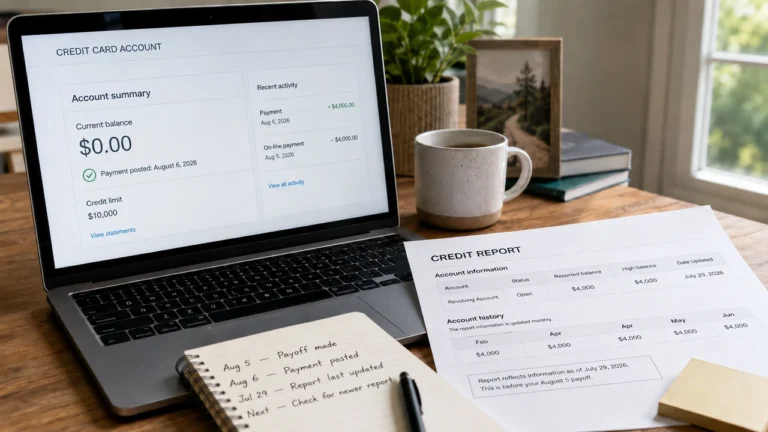
A payment showing as posted in your bank or card app does not necessarily mean the new balance is already showing on your credit reports.
What Happens Between Your Payment and a Score Change
| Stage | What Happens |
|---|---|
| 1. You make the payment | The lender records the payment and updates the balance in its own system. |
| 2. The lender reports the account | The new balance or paid-off status is sent to one or more credit bureaus. |
| 3. Your credit report updates | The lower balance or new account status becomes part of the report data used by scoring models. |
| 4. A new score is calculated | A score based on the updated report can reflect the new information. When you actually see that score also depends on how often your score provider refreshes it. |
Creditors often report account information on a monthly cycle, but the exact timing varies. TransUnion recommends checking the account’s Date Updated field to see when the information was most recently reported.
See TransUnion’s explanation of credit report update timing.
If I Pay Off a Credit Card, When Will My Score Go Up?
If you pay off a credit card, the lower balance generally needs to appear on the credit report before a score calculated from that report can react to it. Depending on where you are in the card issuer’s reporting cycle, that can take several weeks.
For example, suppose your card reports a $7,500 balance and you pay it down to $1,500 on August 5. Your card issuer’s app may show the new $1,500 balance right away. But if your credit report still shows $7,500, a score based on that report has not yet had a chance to reflect the lower reported balance.
Experian notes that credit card issuers generally report account information monthly, so the timing of a score change depends partly on when the new balance is reported.
See Experian’s guidance on credit card payoff timing.
How to Check Whether Your Payoff Has Been Reported
Find the account on your credit reports and check four details:
- Reported balance: Does it show the lower balance or $0?
- Account status: If you paid off a loan, does it now show as paid or closed?
- Date updated: Was the account updated after you made the payment?
- Bureau differences: Do Experian, Equifax, and TransUnion all show the same updated information?
You can review your official credit reports through AnnualCreditReport.com, the federally authorized source for free credit reports from the three nationwide credit bureaus.
What to Do Based on What You Find
The old balance is still showing.
Wait until the account updates before judging whether the payoff affected your score.
One bureau shows the new balance, but another still shows the old one.
Credit-report data can temporarily differ across bureaus. A score based on one bureau’s file may therefore differ from a score based on another.
The new balance is showing, but your score barely changed.
The reporting delay is probably no longer the main issue. The next step is to look at how much the payoff changed utilization or another scoring factor rather than continuing to wait for the same balance update.
The reported balance is wrong.
Verify the balance and update date with the creditor first. If the information on your credit report is inaccurate, address the reporting error itself rather than disputing the account simply because your score did not increase.
The key date is not when you sent the payment. It is when the updated account information reaches the credit report used to calculate the score you are checking.
Does Your Credit Score Go Up When You Pay Off a Loan?
Paying off a personal loan, auto loan, or other installment loan does not guarantee that your credit score will go up. Paying the balance down can help some credit profiles, but paying the loan all the way to $0 closes an active installment account and can sometimes cause a score decrease—especially if it was your only active installment loan.
FICO specifically says paying off the last active installment loan can result in a loss of points for some consumers. That is why a loan payoff can affect your credit differently from paying down a credit card.
Paying Down a Loan and Paying It Off Are Different
| What You Do | Before | After | What Changes on Your Credit Report |
|---|---|---|---|
| Make a large extra payment | $10,000 balance | $5,000 balance | The balance falls, but the loan remains active |
| Pay off the remaining loan | $800 balance | $0 balance | The loan becomes paid and closed after the lender reports the payoff |
A lower installment-loan balance and a fully paid-off installment loan are not the same credit event. When the loan remains open, the balance drops while the active account stays on your file. When you make the final payment, the balance reaches $0 and the account closes.
Example: Paying Off Your Only Auto Loan
Suppose your credit file shows:
- Original auto loan: $25,000
- Remaining balance: $800
- Payment history: on time
- Other active installment loans: none
- Credit cards: still open
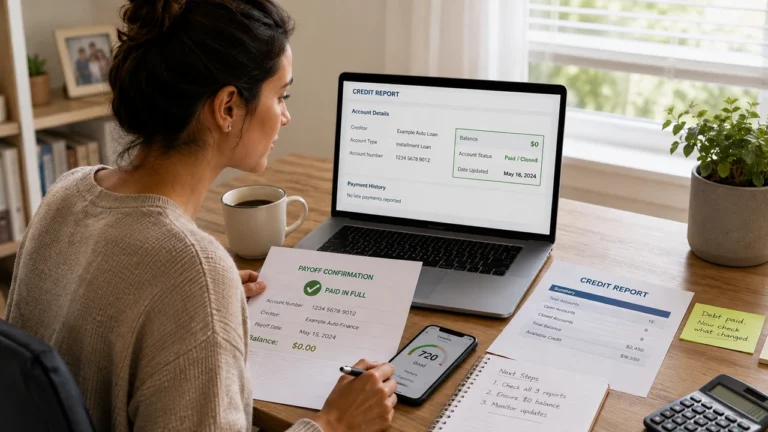
You pay the final $800. After the lender reports the payoff, the loan should show a $0 balance and a paid or closed status.
You now owe less money, which is financially positive. But your credit profile also no longer has an active installment loan. Depending on the rest of your credit file and the scoring model being used, your score could rise, barely change, or decline.
Check This Before Paying Off a Loan for the Score Alone
Are you only paying the balance down?
The loan remains active and the outstanding installment balance decreases.
Are you paying the loan completely to $0?
Expect the account to become paid and closed after the lender reports the payoff.
Is it your only active installment loan?
Don’t assume paying it off will automatically raise your score. Closing the last active installment account can affect some FICO profiles differently from simply reducing the balance.
Are you keeping the loan open only because you are worried about your credit score?
Don’t pay unnecessary interest just to preserve an active loan. Compare the remaining interest cost, your cash needs, and your other financial goals before keeping debt you could otherwise repay.
What If Your Score Drops After the Loan Is Paid Off?
First, check that the loan is reporting correctly: the balance should be $0 and the account should show as paid or closed. Then compare the rest of your credit report for other changes that happened around the same time.
If the payoff is correctly reported but your score fell, see why your credit score can drop after paying off a loan and what to check next.
Also remember that paying off a loan does not erase accurate late-payment history that was already reported. A paid-off account can still show older negative payment history for the period allowed under federal credit-reporting rules.
The practical distinction is simple: paying a loan down reduces the balance; paying it off can also change the account from active to closed. Check which of those two things you are about to do before assuming a loan payoff will raise your credit score.
Will Paying Off All Your Debt Raise Your Credit Score?
If you pay off all your debt, your credit score may go up, but a higher score is not guaranteed. Paying off credit cards can sharply reduce revolving utilization, while paying off installment loans can close active accounts. Accurate late payments, collections, charge-offs, and other negative history do not automatically disappear just because you no longer owe a balance.
The key is to separate what becomes $0 from what remains on your credit reports. FICO considers revolving balances and utilization when calculating scores, and paying off the last active installment loan can affect some credit profiles differently from simply paying the balance down.
Example: Before and After Paying Off All Your Debt
Suppose your credit profile looks like this before you make the final payments:
| Credit Report Item | Before Payoff | After Payoff | What Actually Changed |
|---|---|---|---|
| Credit card balances | $12,000 | $0 | Revolving debt is eliminated |
| Total credit card limits | $20,000 | $20,000 if the cards stay open | Overall utilization falls from 60% to 0% |
| Auto loan | $1,200 balance, active | $0, paid/closed | The installment balance is eliminated and the loan closes |
| Older late payment | Reported | Still reported if accurate and still within its reporting period | Paying other balances does not erase the past payment history |
| Collection or charge-off | Reported | May still appear even if the balance is resolved | Paying a balance does not automatically delete accurate historical information |
In this example, the borrower eliminates $13,200 of current debt and reduces overall credit card utilization from 60% to 0%. Those are major changes to the current balances on the credit report.
But the payoff does not turn the report into a blank slate. Accurate negative payment history can generally remain on a credit report for up to seven years, even after the debt itself has been paid.
What Can Improve After You Pay Everything Off?
High revolving utilization can fall sharply. If credit cards make up most of your debt and they are using a large share of your available limits, paying them down can make a significant change to the balances and utilization shown on your reports.
Outstanding loan balances can reach $0. A fully repaid auto loan, personal loan, or other installment account should eventually reflect a $0 balance and paid or closed status after the lender reports the payoff.
You eliminate the debt itself. That can reduce interest costs and monthly obligations even if your credit score does not immediately move in the direction or by the amount you expected.
What Does Not Automatically Disappear?
Paying off all your current balances does not automatically remove accurate:
- late-payment history;
- collections;
- charge-offs;
- other negative account history that is still legally reportable.
It also does not guarantee that every credit score you check will respond the same way. Consumers can have multiple credit scores, and different scoring models may weigh the same credit-report information differently.
Before You Pay Everything Off, Run This 3-Part Check
1. How much of your debt is on credit cards?
Write down each card’s reported balance and credit limit. If your revolving utilization is high, paying those balances down may substantially change that part of your credit profile.
2. Which installment loans will close?
Mark every auto loan, personal loan, or other installment account that will reach $0. If you are paying off your last active installment loan, don’t assume the final payment must produce an immediate score increase.
3. What negative information will remain?
Review your credit reports and separate current balances from historical problems. A late payment from two years ago, for example, does not disappear simply because the account now has a $0 balance.
Use This Payoff Worksheet
| Account | Balance Now | Balance After Payoff | Will It Close? | Negative History Will Remain? |
|---|---|---|---|---|
| Credit Card 1 | $_____ | $_____ | Yes / No | Yes / No |
| Credit Card 2 | $_____ | $_____ | Yes / No | Yes / No |
| Auto Loan | $_____ | $0 | Yes | Yes / No |
| Personal Loan | $_____ | $0 | Yes | Yes / No |
If most of your credit problem is high revolving balances, paying everything off may make a large positive change to that part of your credit profile. If your balances are already low and the main problems are older negative items, reaching $0 debt can still be financially valuable, but the score change may be much smaller than you expected.
Don’t keep interest-bearing debt just because you are afraid that becoming debt-free will hurt your credit score. The better approach is to understand which credit-report factors will change, pay debt according to your financial priorities, and then evaluate the updated report rather than trying to preserve unnecessary debt for scoring purposes.
What If the Debt You Pay Off Is a Collection?
Paying a collection can improve how the account is reported, but it does not guarantee that your credit score will increase. After a collection is paid or settled, the first thing to check is whether your credit report now shows a $0 balance. The CFPB says a reported collection that has been paid or settled should generally be reflected with a zero balance.
See the CFPB’s guidance on paid collections.
Check These 3 Things After Paying a Collection
1. Is the balance now $0?
If the old balance is still showing, check the account’s most recent update date before assuming the reporting is wrong.
2. Is the collection still listed?
A paid collection can remain on your credit report. Paying it does not automatically require an accurate collection account to be deleted.
3. Did your score stay the same?
That does not necessarily mean the payment had no effect. Credit-scoring models can treat paid collections differently. For example, FICO Score 9 and the FICO Score 10 suite disregard third-party collections reported as paid in full, while other FICO versions may treat them differently.
See FICO’s explanation of how collections can affect FICO Scores.
If a collection is the specific debt you paid, see what happens to your credit score after paying off collections for the full breakdown of paid status, scoring models, reporting updates, and what to check next.
Why Didn’t My Credit Score Increase After Paying Off Debt?
If the lower balance is already showing on your credit report but your credit score did not increase, the payoff may not have changed enough of the factors affecting the score you are checking. High utilization on other cards, older negative history, a recently closed loan, or another account update can all affect the result.
FICO Scores are based on several parts of your credit report, including payment history, amounts owed, length of credit history, credit mix, and new credit. Paying off one balance improves only the parts of your profile that the payment actually changes.
5-Minute “Why Didn’t My Score Move?” Check
| Check | What to Look For | What It Means |
|---|---|---|
| Paid account | Is the new balance or $0 balance showing? | If not, the payoff has not reached that credit report yet. |
| Credit utilization | Compare card balances and limits before and after the payoff. | A small utilization change may produce less score movement than a large drop from high utilization. |
| Negative history | Look for late payments, collections, charge-offs, or other negative information that remains. | Paying another debt does not automatically remove accurate negative history. |
| Other account changes | Check for higher card balances, a newly closed loan, a late payment, or a new hard inquiry. | Another update may offset some of the positive effect of the payoff. |
| Score comparison | Are you comparing the same score provider, bureau, and scoring model? | Two different credit scores are not a clean before-and-after comparison. |
What Your Result Means
The old balance is still showing.
The reporting update is not complete. Wait until the lower balance appears before deciding that the payoff did not affect your score.
The balance updated, but utilization barely changed.
The payment may have changed your debt more than it changed your credit profile. For example, moving overall card utilization from 6% to 2% is a much smaller change than moving it from 80% to 30%.
The balance updated, but negative information remains.
A $0 balance does not erase accurate late payments, collections, charge-offs, or other historical information that can still be reported. Do not dispute accurate negative information simply because your score did not rise.
Something else changed at the same time.
Compare the rest of the report. A higher balance on another card, a newly reported late payment, a hard inquiry, or the closure of an installment loan can affect the score at the same time as your payoff.
You are comparing different scores.
A FICO Score from one service and a different score from another provider may use different bureau data or scoring models. When possible, compare the same type of score from the same source before and after the payoff.
If the payoff is already reporting correctly but your score is still stuck, use the step-by-step guide on how to fix your credit score after paying off debt to identify the next factor to work on.
What If Your Credit Score Drops After Paying Off Debt?
A credit score can drop after you pay off debt even when the payoff was reported correctly. The drop may happen because the payment changed another part of your credit profile at the same time—for example, your last active installment loan closed, a paid-off credit card was also closed, or another account reported new information.
Check What Changed at the Same Time
| What Happened | What to Check | Why It Matters |
|---|---|---|
| An auto or personal loan reached $0 | Check whether it was your only active installment loan | Paying off the last active installment loan can affect some FICO profiles differently from simply reducing the balance |
| A paid-off credit card was also closed | Recalculate utilization using only the credit limits that remain open | Closing a card can reduce available revolving credit and raise utilization if other balances remain |
| Another card reported a higher balance | Compare all reported card balances before and after the payoff | A higher balance elsewhere can offset part of the positive change from the debt you paid |
| A late payment, inquiry, or other account update appeared | Compare the rest of the credit report, not just the paid account | Another change may be affecting the score at the same time |
| You checked a different credit score | Confirm the bureau, scoring model, and score provider | Different scores are not a clean before-and-after comparison |
Quick Diagnostic
Did an installment loan close?
Check whether it was your last active installment account.
Did you close a credit card after paying it off?
Recalculate your utilization using the credit limits that remain open. If utilization increased, that may help explain the drop.
Neither account closed?
Compare the rest of your credit report for a higher card balance, new late payment, hard inquiry, or another account-status change.
Everything looks correct but the score still fell?
Use the full guide to why your credit score dropped after paying off debt to work through the possible causes step by step.
A lower score after payoff does not automatically mean paying the debt was a mistake. It means the information in your credit profile changed in a way the scoring model evaluated differently than you expected.
Before-and-After Credit Report Audit: What Actually Changed?
Don’t judge a debt payoff by your credit score alone. Compare the credit-report data before and after the payment to see exactly what changed. Check the balance, credit limit, account status, payment history, and reporting date so you can separate a normal payoff update from a reporting problem or another change elsewhere in your file.
You can review your reports from Experian, Equifax, and TransUnion through AnnualCreditReport.com, the official site authorized by federal law for obtaining your free credit reports.
Run This Before-and-After Payoff Audit
| What to Check | Before Payoff | After Payoff | What to Look For |
|---|---|---|---|
| Reported balance | $_____ | $_____ | Did it fall to the amount you expected? |
| Credit limit, if applicable | $_____ | $_____ | Did the limit remain available if the card stayed open? |
| Credit card utilization | _____% | _____% | Did utilization actually fall after the payment? |
| Account status | Open / Active | Open / Paid / Closed | Did the payoff also close the account? |
| Last reported or updated date | _____ | _____ | Was the account updated after you made the payment? |
| Payment history | _____ | _____ | Did any unexpected late payment appear? |
| Other card balances | $_____ | $_____ | Did another account report a higher balance at the same time? |
The CFPB recommends checking credit reports for incorrect current balances, credit limits, account status, payment dates, delinquency dates, and debts listed more than once. If one of those fields changed unexpectedly after your payoff, investigate that specific field instead of assuming the score itself is the problem.
How to Read Your Result
The balance changed exactly as expected.
The payoff appears to have reached that credit report. If your score did not move as expected, look at the other rows in the audit rather than continuing to wait for the same balance update.
The old balance is still showing.
Check the account’s most recent reporting or update date, if shown. If the account has not been updated since your payment, the report may simply not reflect the payoff yet.
The balance fell, but the credit limit also disappeared.
Check whether the credit card was closed. If it was, recalculate your overall utilization using only the limits that remain available on your open cards.
A loan now shows a $0 balance and paid or closed status.
The payoff changed both the balance and the account’s active status. That is different from making a large payment while leaving the installment loan open.
Another card reported a higher balance.
Compare the entire revolving picture. A lower balance on one account can appear during the same period that another card reports a higher balance.
You found information that appears inaccurate or incomplete.
Verify the account against your statements, payoff confirmation, or lender records. Consumers have the right to dispute inaccurate or incomplete credit-report information, but accurate negative information should not be disputed simply because it hurts a credit score.
If you’re not sure where to find the balance, account status, payment history, credit limit, or other account details, use our step-by-step guide to how to read your credit report before deciding whether anything was reported incorrectly.
Does “Paid in Full” Increase Your Credit Score?
No. A “Paid in Full” status does not by itself guarantee that your credit score will increase. What matters is what changed in your credit report when the debt was paid—such as the reported balance, revolving utilization, or whether an installment account closed.
What to Check After Paying an Account in Full
| Debt You Paid | What May Change | What to Check |
|---|---|---|
| Credit card | Your reported balance may fall, which can lower revolving utilization | Compare the new reported balance and your total utilization; also check whether the card remained open |
| Auto, personal, or other installment loan | The balance reaches $0 and the loan is reported as paid or closed | Check whether it was your last active installment loan, because paying off the last one can affect some FICO profiles differently |
| Collection account | A paid or settled collection that is reported should generally show a $0 balance | Confirm that the balance updated correctly; a $0 balance does not guarantee a particular score increase |
Paid-in-Full Check
- Check the reported balance. Did it change to the amount you expected after the payoff?
- Check the account status. Did the account remain open, or did paying it off also close it?
- Check what else changed. For credit cards, recalculate utilization. For installment debt, note whether an active loan disappeared from your current credit mix.
The words “Paid in Full” are not a credit-score bonus by themselves. Use the updated balance, account status, and other credit-report changes to judge what the payoff actually changed in your credit profile.
60-Second Debt Payoff Decision Tree
First, check whether the payoff is already reflected on your credit report. If the old balance is still showing, do not judge the payoff by your current score yet. If the balance has updated, use the path below.
Step 1: What Did You Pay?
Credit card →
- The balance fell and the card stayed open: Recalculate your overall revolving utilization using the new reported balance.
- The balance fell but the card also closed: Recalculate utilization using only the credit limits that remain available. Closing a card can raise utilization if you still have balances on other cards.
- The balance has not changed: Check the account’s latest reporting date before evaluating the score.
Auto, personal, or other installment loan →
- The loan now shows $0 and closed: A score increase is not guaranteed. Paying off your last active installment loan can cause a FICO Score decrease in some credit profiles.
- The old balance is still showing: Check whether the lender has reported the payoff yet.
Collection →
- The reported balance is now $0: The payment or settlement appears to be reflected, but that does not guarantee a particular score increase.
- A balance is still showing: Check the latest update date. A reported collection that has been paid or settled should generally be reflected with a $0 balance once updated.
Several debts or all your debt →
Check each account separately. Paying down cards may reduce utilization while paying off installment loans may close active accounts, so several parts of your credit profile can change at the same time.
Step 2: What Happened to Your Score?
| What You See | What to Check Next |
|---|---|
| Score increased | Confirm the new balances are reporting correctly and keep comparing the same type of score over time. |
| Score stayed the same | Check whether utilization changed enough to matter, whether negative history remains, and whether another account changed at the same time. |
| Score dropped | Check for a closed installment loan, a closed credit card, reduced available credit, a higher balance elsewhere, or another recent credit-report change. |
| Score has not changed because the payoff is not reporting yet | Wait until the updated balance appears on the credit report before making a before-and-after comparison. |
Final check: When possible, compare the same score source, bureau data, and scoring model before and after the payoff. You can have multiple credit scores, and different models or credit-report data can produce different results.
Bottom Line: What to Expect After Paying Off Debt
There is no fixed number of points your credit score will increase after you pay off debt. The result depends on what changes on your credit report, the type of debt you paid, the rest of your credit profile, and the scoring model being used.
If you paid down credit cards, the key change may be lower revolving utilization. If you paid off an installment loan, the balance reaches $0 and the account closes; paying off your last active installment loan can cause a FICO Score decrease in some credit profiles. :contentReference[oaicite:0]{index=0}
Before judging the result, confirm that the new balance and account status are showing on your credit report. Then, when possible, compare the same type of credit score from the same source. Consumers can have multiple credit scores because different scoring formulas and credit-report data may be used.
Focus on what changed in your credit report, not simply on how many dollars you paid. A large payoff does not guarantee a large score increase, and reaching a $0 balance does not automatically remove other factors that may still affect your score.
If the payoff is already reporting correctly and you want to work on the factors still affecting your credit profile, follow our step-by-step guide on how to improve your credit score fast.
Sources
FICO — Amounts Owed and Your FICO Scores
FICO — Paying Off an Installment Loan and Your FICO Score
Consumer Financial Protection Bureau — Does It Hurt My Credit to Close a Credit Card?
Consumer Financial Protection Bureau — What Is a Paid Collection?
Consumer Financial Protection Bureau — What Is a Credit Score?
Consumer Financial Protection Bureau — Common Credit Report Errors to Look For
AnnualCreditReport.com — Official Site for Free Credit Reports