In this guide
- Can this paid collection be removed?
- When can a paid collection be removed?
- What if the paid collection is accurate?
- What if the paid collection still shows a balance?
- Paid medical collections are different
- How long after payment will the collection update?
- How long do paid collections stay on your credit report?
- What if the account is duplicate, too old, or not yours?
- What evidence should you save?
- Build your paid-collection removal plan
- How to dispute the collection correctly
- Will removing a paid collection raise your credit score?
- Your next step
- Frequently asked questions
- Bottom line
- Sources
Paying a collection does not automatically remove it from your credit report. If a paid non-medical collection is accurate and still within the allowed reporting period, it can remain after the balance updates. Removal is more likely to be appropriate when the entry is inaccurate, duplicated in error, not yours, too old to report, or covered by a current credit-bureau policy such as paid medical collections.
The best first step is not “How do I delete this?” It is: Why is this paid collection still here? If the balance is not $0 after payment, start with what to check when a paid collection still shows a balance. If the collection was removed and you want to understand the possible score effect, see how much a credit score may increase after collection removal. If the collection was removed but your score did not improve, use the collection-removal score checklist.
Can this paid collection be removed?
When can a paid collection be removed?
| What you see | What it may mean | Best next step |
|---|---|---|
| Paid non-medical collection, $0 balance, accurate details | May still be reportable | Check the timeline; optional courtesy deletion request |
| Paid but balance or status is wrong | Possible reporting error | Document and dispute the exact field |
| Paid medical collection still appears | May conflict with current bureau policy | Confirm payment and challenge continued reporting |
| Not yours or duplicated incorrectly | Possible ownership or duplicate-reporting error | Dispute with supporting evidence |
| Reporting timeline appears too old or re-aged | Possible obsolete or inaccurate dating | Compare older reports and delinquency records |

What if the paid collection is accurate?
If the account belongs to you, the balance is $0, the status is correct, and the entry is still within the reporting period, there may be no factual basis for a dispute. The CFPB explains that accurate negative information generally cannot be removed simply because it is negative.
You can still ask the collection agency whether it will voluntarily request deletion. Treat that as a courtesy request, not a legal claim that the report is wrong.
Simple courtesy request: “The account is paid and reporting a $0 balance. I understand the reporting may be accurate. Would your company be willing to request deletion of this paid collection from the credit bureaus as a courtesy? If so, please confirm the request in writing.”
If the collector declines and the report is accurate, do not turn the courtesy request into a false dispute.
If the incorrect balance belongs to the original creditor’s charged-off account, use the paid charge-off balance worksheet. The collection checklist below is for the collection entry itself.
What if the paid collection still shows a balance?
This is a different problem. If you paid the account in full, or completed a settlement that resolved the debt, but the report still shows a current balance or unpaid status, compare the report with your receipt, final statement, or written settlement agreement.
Hypothetical example:
Your records: collection paid in full on July 8; confirmation shows $0 due.
Credit report: current balance $740; status unpaid.
That gives you a specific issue to investigate: current balance and payment status. See what to do when a paid collection still shows a balance.
Paid medical collections are different
Under the current policies of Equifax, Experian, and TransUnion, paid medical collection debt is excluded from consumer credit reports. Medical collections paid in full qualify for this treatment. TransUnion also confirms that medical collections with an initial reported balance under $500 are excluded. Paying a larger balance down below $500 is not the same as having an initial reported balance under $500.
If a paid medical collection still appears, verify that the account is actually medical, confirm the payment date and $0 balance, identify which bureau still shows it, and keep proof of payment. Then challenge the continued reporting with the bureau that still lists the account.
A credit-card collection does not become a medical collection because the card paid a hospital bill. Also distinguish these bureau policies from the CFPB’s broader 2025 medical-debt rule: the CFPB confirms that rule was vacated on July 11, 2025. Do not assume every unpaid medical debt is subject to a nationwide reporting ban.
How long after payment will the collection update?
Experian says a collection’s paid status can take one to two months to appear. This is a typical reporting timeframe, not a deletion deadline or a required waiting period before disputing an error. Check the report’s update date against your cleared payment. A courtesy deletion request has no universal approval timetable; if the collector agrees, ask when it will send the request and which bureaus it will notify.
How long do paid collections stay on your credit report?
A paid non-medical collection can generally remain for about seven years. Paying or settling it does not restart the reporting clock. For accounts placed for collection, the federal calculation in 15 U.S.C. § 1681c(a)(4) and (c) runs seven years after the end of a 180-day period beginning with the delinquency that immediately preceded collection or a similar action. That is a technical ceiling of seven years plus 180 days from that delinquency under the standard rule, not seven new years from payment.
Hypothetical timeline: The delinquency leading to collection began in 2021 and the debt was paid in 2026. The payment updates the balance and status; it does not move the starting year to 2026. Compare the bureau’s estimated removal date with the underlying account history before disputing an old entry. The federal statute also contains exceptions for certain high-value credit, life-insurance, and employment reports.
State protections may shorten the period. For example, New York’s reporting law, § 380-j(f)(1)(iv), has a five-year rule for paid collection accounts, with exceptions in subsection (f)(2). This is not a nationwide five-year rule. Ask the bureau to identify the date and rule it used if the removal estimate appears inconsistent with your records.
What if the account is duplicate, too old, or not yours?
These are separate factual problems and should be handled separately.
- Not yours: compare the collector, original creditor, partial account number, and notices. If it truly is not yours, dispute the ownership problem.
- Duplicate: two entries are not automatically duplicates. An original creditor account and a collection tradeline can both appear for the same debt. See charge-off vs. collection before calling the entries duplicates.
- Too old: the reporting timeline is tied to the delinquency that led to collection, not the date you paid the collector. Paying does not create a new seven-year reporting period. See whether paying a collection restarts the reporting period.
What evidence should you save?

- current credit report from each affected bureau;
- payment receipt or bank record;
- paid-in-full confirmation or final statement;
- settlement agreement, if applicable;
- older credit reports when dates are in question;
- collection notices showing the original creditor and account reference;
- written deletion commitment, if the collector made one.
A useful dispute sentence is: “My report shows ___, but my attached records show ___.”
Build your paid-collection removal plan
Open the situation that matches your report. Use the relevant documents to support one specific factual issue. The number of documents you have does not prove an error or determine whether a dispute will succeed.
Paid medical collection still appears
Records to locate or confirm: Current bureau report and proof that the same medical collection was paid.
Your next step: Identify each bureau that still reports it. Compare the collection with the payment record, then dispute continued reporting with the bureau and furnisher. Save the response.
The paid balance or status is wrong
Records to locate or confirm: Current report, payment confirmation, and final statement or completed settlement records.
Your next step: Write the exact mismatch: what the bureau shows, what your records show, and which field should change. You can dispute an evidence-supported error without waiting for a phone call.
The account may not be mine
Records to locate or confirm: Current report and creditor or collector details that identify the account.
Your next step: Compare the creditor name and partial account number with your records. If identity theft is suspected, use IdentityTheft.gov for an official recovery plan. Do not pay an unfamiliar debt just to make it disappear.
I may have a duplicate collection
Records to locate or confirm: Both disputed entries and documents identifying the underlying debt and current owner.
Your next step: Compare balances, status, ownership, and identifiers. An original creditor and a separate collection are not automatically an error. If the obligation is inaccurately duplicated, explain the specific duplication.
The dates or removal timeline look wrong
Records to locate or confirm: Current report plus older reports or dated account records.
Your next step: Compare delinquency-related dates and estimated removal information. The payment date or collection opening date alone does not establish the reporting deadline. Identify the incorrect date or obsolete entry.
The paid non-medical collection is accurate
Records to locate or confirm: Current report and final payment or settlement records.
Your next step: Confirm a $0 balance, accurate status, and the reporting period. Payment does not automatically require deletion. Do not invent an accuracy dispute; a voluntary deletion request has no guaranteed result.
This organizer is not a legal filing requirement. For official dispute instructions and sample letters, use the CFPB credit-report dispute guide.
How to dispute the collection correctly
When you find a specific inaccurate or incomplete field, dispute that field with the credit reporting company. CFPB guidance also recommends disputing with the company that furnished the information.
- Identify the exact field that is wrong.
- State what the report currently shows.
- State what your records show instead.
- Attach copies of supporting documents.
- Request the specific correction or removal that matches the problem.
- Save the dispute, confirmation, and investigation result.
For the complete process, use how to dispute errors on your credit report.
Track the investigation and check the resulting report
The CFPB’s dispute-timing guidance gives a general investigation period of 30 days after the bureau receives a dispute, with up to 45 days in specified circumstances, including certain disputes after a free annual report or relevant additional information received during the investigation. Results generally must be sent within five business days after completion. This is an investigation deadline, not a promise of deletion.
Read the result against the correction you requested. A balance corrected to $0 is different from an account being deleted. If the same error remains, identify what evidence was missed or what new documentation supports the correction; do not simply resend a blanket deletion demand.
Will removing a paid collection raise your credit score?
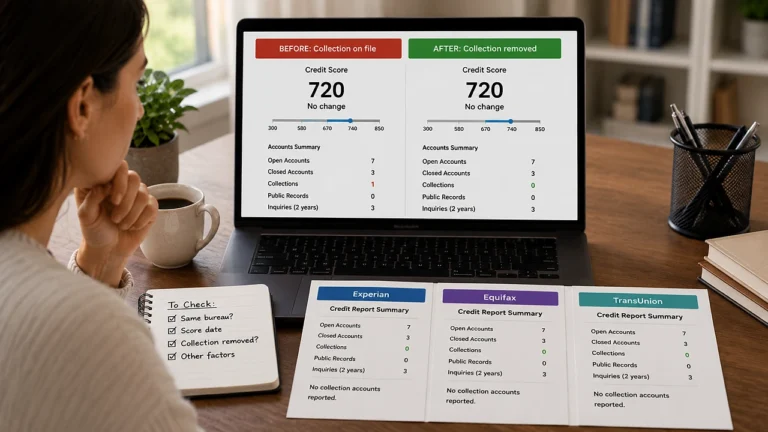
It may, but there is no guaranteed point increase. Different scoring models can treat paid collections differently, and the result depends on the rest of the credit file. The correct goal is an accurate report, not a promised number of points.
If your main question is what happens after payment, read what happens to your credit score after paying off collections.
Removal and scoring are separate: FICO says FICO Score 9 and the FICO Score 10 suite disregard paid third-party collections; settled third-party collections reported with a $0 balance are also treated as paid. The entry can still be visible on a report. Other score versions may treat it differently, and these special rules do not apply to first-party collections. Removing an entry that a model already ignores does not establish a guaranteed score gain.
Your next step
Accurate paid non-medical collection
Check the reporting timeline. A courtesy deletion request is optional; a false dispute is not.
Wrong balance or status
Use payment or settlement records to document the exact mismatch.
Paid medical collection
Confirm payment and challenge the bureau that still reports it.
Duplicate, too old, or not yours
Gather evidence and dispute the specific factual problem.
Frequently asked questions
Does paying a collection automatically remove it from my credit report?
No. Payment normally changes the balance or status, but an accurate non-medical collection may remain until it ages off under the applicable reporting rules.
Can a paid collection be disputed?
Yes, when a specific part of the reporting is inaccurate, incomplete, duplicated, too old, or not yours. The dispute should identify the exact problem and include relevant evidence.
What if a paid collection still shows a balance?
Compare the report with your payment, settlement, or payoff records. If the reported balance is wrong, document the discrepancy and request correction.
Will removal of a paid collection raise my score?
It can, but there is no guaranteed point increase. The result depends on the scoring model and the rest of the credit file.
Bottom line
You can sometimes remove a paid collection, but payment by itself does not automatically require deletion. Start with the reason the collection is still on the report. If it is accurate, non-medical, and still reportable, it may remain. If the balance, status, ownership, duplication, or dates are wrong, dispute that exact issue. If it is a paid medical collection, check the current bureau policy and challenge continued reporting when appropriate.
Explore related guides on collections.
Sources
Sources checked October 9, 2026.
- Consumer Financial Protection Bureau — Removing accurate negative information
- Consumer Financial Protection Bureau — How to dispute a credit-report error
- Federal Trade Commission — Disputing errors on your credit reports
- Equifax, Experian, and TransUnion — Paid medical collection reporting policy
- TransUnion — How long collections stay on your credit report
- AnnualCreditReport.com — Official site for free credit reports
Educational note: This article provides general U.S. credit-reporting information and is not individualized legal, financial, debt-settlement, or credit-repair advice.