- Quick answer: how to improve your credit score step by step
- Why fixing a low credit score feels confusing and overwhelming
- A simple overview of the process
- Can you improve your credit score if it’s really bad
- Why your credit score is low (what actually hurts it most)
- Late payments
- High credit utilization
- Too many hard inquiries
- Collections and charge-offs
- What to fix first when your credit score is low
- What most people misunderstand about fixing a credit score
- Before you start, check these 4 things
- Step 1: check what is damaging your credit score
- Check your full credit report
- Identify the biggest problems first
- Look for errors or inaccurate information
- Separate short-term issues from long-term damage
- Step 2: pay every bill on time (the biggest factor)
- Why payment history is so important
- How to stop missing payments
- What to do if you are already behind
- Why consistency beats speed
- Step 3: lower your credit card balances fast
- What credit utilization means
- Why high balances hurt your score
- How much of your credit limit you should actually use
- Statement date vs due date (what actually affects your score)
- Example
- How to lower your balances step by step
- Small changes can have a quick effect
- What helps your credit score faster vs what takes more time
- What can help faster
- What usually takes longer
- Step 4: stop applying for new credit
- Why too many applications can hurt your score
- When opening new credit can backfire
- When it actually makes sense to apply
- Focus on repairing, not expanding
- Step 5: dispute errors on your credit report
- What kinds of errors to look for
- Why accuracy matters more than effort
- How to approach disputes carefully
- What to expect after fixing errors
- Step 6: keep old accounts open
- Why account age matters
- How closing accounts can hurt your score
- When it still makes sense to close an account
- Keep your credit profile stable
- Step 7: handle collections and past debt correctly
- Understand what is in collections
- Do not rush to pay everything blindly
- Focus on stopping new damage
- Take a strategic approach
- How to increase your credit score quickly (what actually works)
- Lower high credit card balances
- Bring past-due accounts current
- Fix inaccurate information
- Keep your activity consistent
- What does not work fast
- Can you boost your credit score overnight or raise it 100 points
- When your score can improve faster
- Why 100-point jumps are rare
- What actually slows you down
- Focus on what is realistic
- How to improve a really bad credit score step by step
- Step one: stop the damage
- Step two: reduce the biggest risk signals
- Step three: clean up your credit report
- Step four: build positive history over time
- Step five: stay consistent
- How to build credit fast for beginners
- Start with simple, controlled credit
- Keep your usage low
- Make every payment on time
- Avoid unnecessary applications
- Be patient with the process
- How to improve your credit score if you have no debt
- Why no debt does not always help your score
- Use credit in a controlled way
- Keep balances low and stable
- Maintain consistency over time
- Avoid overcorrecting
- What not to do when trying to fix your credit score
- Common mistakes that slow down your progress
- Mistakes people make out of panic
- Fastest ways to improve a bad credit score (comparison)
- What to do based on your situation
- If your credit score dropped suddenly
- If your credit cards are maxed out
- If you have missed payments
- If you have collections or past-due debt
- If you have little or no credit history
- Real-life scenarios: what to focus on first
- Scenario 1
- Scenario 2
- Scenario 3
- Best tools and strategies to rebuild your credit faster
- Secured credit cards
- Credit builder loans
- Credit monitoring tools
- Automatic payment systems
- Simple, repeatable habits
- How long does it take to improve your credit score
- What can improve relatively quickly
- What takes more time
- Why progress is not always linear
- What affects your timeline
- Signs your credit score is moving in the right direction
- What is considered a bad credit score (real examples)
- Excellent credit score
- Good credit score
- Fair credit score
- Bad credit score
- Very low credit score
- What credit score do you need for real-life situations
- Renting an apartment
- Getting a car loan
- Applying for credit cards
- Access to better financial options
- Step-by-step plan to improve your credit score
- Week 1: understand and stabilize
- Week 2: reduce pressure
- Month 1: correct and organize
- Month 2 and beyond: build consistency
- Stay consistent with your actions
- FAQ: improving your credit score step by step
- Can I improve my credit score if it’s bad
- How to improve a really bad credit score
- How to get a 700 credit score in 30 days fast
- What is a bad credit score for renting
- How rare is an 830 credit score
- Why did my credit score drop for no reason
- How long does it take to fix a bad credit score
- Does checking your own credit score lower it
- Should I pay off one card first or all cards evenly
- Is it better to pay before the due date or before the statement date
- Final thoughts: fixing your credit score is about strategy, not panic
Quick answer: how to improve your credit score step by step
If you want to improve your credit score step by step, start by identifying what is hurting it most. The fastest way to see progress is to pay every bill on time, lower your credit card balances, and stop applying for new credit. If your score is really bad, focus on fixing the biggest issues first — missed payments, high utilization, or errors on your credit report.
To improve your credit score fast, keep your balances below 30%, set up automatic payments, and dispute any inaccurate information. Avoid closing old accounts and give your score time to rebuild through consistent, positive activity.
Even if your score is low, you can fix a bad credit score by following a clear plan: reduce debt, stay consistent with payments, and rebuild trust with lenders over time.

Why fixing a low credit score feels confusing and overwhelming
A low credit score can feel stressful fast. You check the number, see that it is worse than you hoped, and suddenly everything feels unclear. What is actually hurting it? What should you fix first? And which advice is real — not just recycled financial fluff that says the same thing in ten different ways?
That is where many people get stuck. They know their score is low, but they do not know what to do in the right order. So they start guessing — paying random balances, thinking about new credit, closing old accounts, or trying quick fixes that sound smart but do not solve the real problem.
This guide breaks the process down step by step. Instead of vague tips, you will see what usually damages a credit score, what to fix first, what can help faster, and what takes more time. If your score is really bad, that does not mean it is permanent. It means you need a clear plan that makes sense from the start.
A simple overview of the process
If you want to improve your credit score without confusion, follow a clear order. This is the structure that turns random actions into real progress.
- Check what is hurting your score — review your credit report and identify the main problems.
- Bring payments current — stop ongoing damage by making sure no accounts are past due.
- Lower high balances — reduce credit card utilization to remove pressure from your score.
- Stop new applications — avoid adding new risk signals while you are rebuilding.
- Fix report errors — correct any inaccurate information that may be lowering your score.
- Build positive history — maintain on-time payments and stable credit usage over time.
This simple roadmap gives you direction. Instead of guessing what to do next, you move step by step — and that is what leads to consistent improvement.
Can you improve your credit score if it’s really bad
If you’re asking can I improve my credit score if it’s bad, the answer is yes — but not instantly and not by doing random things. A really low credit score usually comes from a few key problems: missed payments, high credit card balances, collections, or too many recent applications. The good news is that these issues can be fixed step by step.
What matters most is focusing on the right actions in the right order. Many people try to fix everything at once — closing accounts, applying for new credit, or paying things off without a plan — and that often makes the situation worse. Improving a bad credit score is not about speed alone. It’s about stopping the damage first, then rebuilding slowly and consistently.
If your score is very low, expect progress to come in stages. Some changes, like lowering high balances or fixing reporting errors, can help relatively quickly. Other factors, like payment history and account age, take more time to improve. That’s normal.
The key is simple: once negative patterns stop and positive ones begin, your credit score can recover. It may not feel fast at first, but consistent actions always move the score in the right direction.
Why your credit score is low (what actually hurts it most)

Before you try to fix anything, you need to understand why your credit score is so low. This is where most people make a mistake — they start taking action without knowing what is actually causing the problem. And if you fix the wrong thing, your score may not improve at all.
Your credit score is not random. It reacts to specific signals that lenders use to measure risk. Most credit scores are influenced by a few core factors: payment history, amounts owed (credit utilization), length of credit history, new credit activity, and credit mix. If your score dropped or has been low for a while, it usually means one or more of these areas is sending a negative signal.
In real life, that often shows up in a few key patterns that have the strongest impact.
Late payments
Missing payments is one of the most damaging things for your credit score. Even one late payment can lower your score and stay on your credit report for years. Multiple missed payments make recovery slower and harder.
High credit utilization
If your credit cards are close to their limits, your score can drop quickly. High utilization tells lenders that you may be relying too much on credit, even if you are making payments on time.
Too many hard inquiries
Applying for multiple credit cards or loans in a short period can signal financial stress. Each hard inquiry may slightly lower your score, but too many in a short time can have a stronger impact.
Collections and charge-offs
If an account goes into collections or is written off, it can significantly damage your credit score. These marks show lenders that a debt was not repaid as agreed.
Once you clearly see what is hurting your score, everything becomes simpler. Instead of guessing, you can focus on fixing the exact issues that matter most.
What to fix first when your credit score is low
When your credit score is low, the biggest mistake is trying to fix everything at once. Not all problems have the same impact. If you want to see real progress, you need to focus on the right things in the right order.
This priority list helps you stop guessing and start acting with a clear strategy.
- Active late payments
If any accounts are currently past due, this is your first priority. Ongoing missed payments continue to damage your score every month. Bring all accounts current as quickly as possible to stop new negative signals. - Maxed-out credit cards
High utilization is one of the strongest factors pulling your score down. Focus on lowering balances, especially on cards that are close to their limits. - Errors on your credit report
If there is inaccurate information, it can hold your score down even if you are doing everything right. Correcting errors removes negative signals that should not be there. - Collections and old debt
Once active damage is under control, take a strategic approach to older negative accounts. Do not rush — understand what you are dealing with before taking action. - Thin or inactive credit profile
If you have little or no credit history, your focus should be on building consistent, positive activity over time.
When you follow this order, your actions become more effective. Instead of spreading your efforts too thin, you fix the issues that actually move your credit score forward.
What most people misunderstand about fixing a credit score
There is no instant fix when it comes to improving your credit score. If there were, everyone would have perfect credit. Real improvement comes from understanding what is actually affecting your profile and addressing it step by step.
Not every strategy works for every situation. What helps one person may not work the same way for another. Your progress depends on what is damaging your credit score right now — not on generic advice.
Your credit report matters more than your panic. The score you see is just a result. The real answers are inside your report — in your balances, payment history, and account activity.
Once you focus on the actual cause instead of reacting emotionally, everything becomes clearer. You stop guessing and start making decisions that actually move your credit score in the right direction.
Before you start, check these 4 things
Before you begin fixing your credit score, take a moment to check the basics. This quick self-check helps you understand where the real problem is and what to fix first.
- Are any accounts currently past due — active missed payments are one of the strongest negative signals.
- Are your cards over 30% utilization — high balances can pull your score down even if you pay on time.
- Are there any collection accounts — unpaid debts in collections can significantly affect your credit profile.
- Is there anything inaccurate on your report — errors can lower your score without reflecting your real behavior.
This quick check gives you clarity. Instead of guessing what might be wrong, you can immediately see where to focus your efforts.
Step 1: check what is damaging your credit score
This is where most people go wrong. They try to fix their credit score without knowing what is actually causing the damage. If you skip this step, you risk wasting time on actions that do not move your score at all.
To fix a bad credit score, you first need a clear picture of what is happening inside your credit report. Your score is built from real data — not assumptions — so your job is to find the exact issues behind it.
Check your full credit report
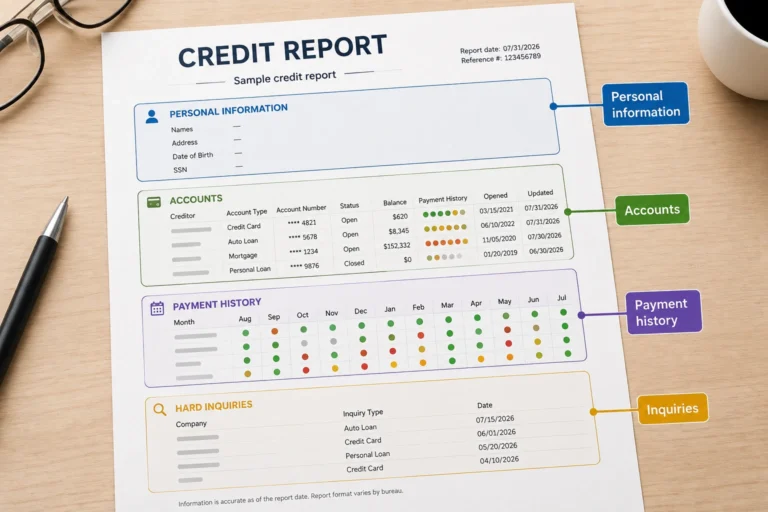
Start by reviewing your credit report carefully. Look at all accounts, payment history, balances, and any negative marks. Do not just look at the number — look at the details behind it.
Identify the biggest problems first
Focus on the issues that have the strongest impact. These usually include missed payments, high credit card balances, collections, or accounts in default. Not all problems are equal — some affect your score much more than others.
Look for errors or inaccurate information
Credit reports are not always perfect. Sometimes accounts are reported incorrectly, payments are marked late when they were not, or balances are outdated. Even small errors can affect your score more than you think.
Separate short-term issues from long-term damage
Some problems can be fixed relatively quickly, like lowering balances or correcting errors. Others, like late payments or collections, take longer to recover from. Understanding this difference helps you set realistic expectations.
Once you know exactly what is damaging your credit score, you can stop guessing and start fixing the right things in the right order. This is what turns random effort into real progress.
Step 2: pay every bill on time (the biggest factor)
This matters more than people think. If you want to improve your credit score step by step, nothing has a bigger long-term impact than your payment history. Even if everything else is perfect, missed payments can keep your score low.
The good news is that this is also one of the simplest things to fix. You cannot change the past, but you can start building a clean payment history from today. And over time, that consistency is what rebuilds your score.
Why payment history is so important
Your credit score is heavily influenced by whether you pay your bills on time. Late payments signal risk to lenders. On the other hand, consistent on-time payments show stability and reliability.
How to stop missing payments
If you’ve missed payments before, the goal now is to make sure it never happens again. Set up automatic payments, calendar reminders, or minimum payment alerts. Even paying the minimum on time is better than missing a due date.
What to do if you are already behind
If you have past-due accounts, bring them current as soon as possible. The sooner you stop the negative pattern, the sooner your credit profile can start improving.
Why consistency beats speed
Many people look for quick fixes, but your credit score improves through repeated positive behavior. Each on-time payment builds trust over time. It may not feel instant, but it is one of the most reliable ways to fix a bad credit score.
Once your payments are under control, the next step is to focus on reducing the pressure from your existing debt — especially your credit card balances.
Step 3: lower your credit card balances fast

This is one of the fastest ways to see movement in your score. If your cards are close to their limits, your credit score may stay low even if you pay on time. To improve your credit score fast, you need to reduce the pressure created by high revolving balances.
Your credit score looks closely at how much of your available credit you are using. This is called credit utilization, and it plays a major role in how lenders evaluate risk. If your utilization is too high, it can hold your score down even when the rest of your profile looks relatively stable.
What credit utilization means
Credit utilization is the percentage of your credit limit that you are using. For example, if your credit limit is $1,000 and your balance is $800, your utilization is 80%. That is considered high and can send a strong risk signal to lenders.
Why high balances hurt your score
Even if you never miss a payment, maxed-out or near-maxed cards can still damage your credit score. High balances suggest that you may be depending too heavily on credit, and lenders usually view that as a warning sign. This is why someone can be “paying on time” and still have a score that feels stuck.
How much of your credit limit you should actually use
In general, under 30% utilization is better than high usage, and under 10% is often even stronger. That does not mean you need to use zero credit. It means you want to show controlled, low-risk usage rather than constant pressure on your limits.
Maxed-out cards can hurt your score even if payments are on time. That is why lowering balances often helps faster than people expect — especially when utilization is the main issue holding the score back.
Statement date vs due date (what actually affects your score)
Many people think paying on time is enough — but timing also matters. There is an important difference between your due date and your statement date.
The due date affects your payment history. As long as you pay at least the minimum on time, you avoid late payment marks.
The statement date affects what balance gets reported to the credit bureaus. This is the number that impacts your credit utilization.
This means you can pay on time — but still show a high balance if your card reports before your payment is made.
In many cases, paying part of your balance before the statement closes can help your utilization look lower and reduce pressure on your score.
Example
If your limit is $2,000 and your balance is $1,600, your utilization is 80%. If you lower that balance to $400, your utilization drops to 20%. That kind of change can make your credit profile look much less risky.
How to lower your balances step by step
Start by focusing on the cards with the highest utilization first. Bringing balances below 30% of the limit can already make a noticeable difference. If possible, aim lower over time, especially on cards that are close to maxed out.
You do not need to pay everything off overnight. What matters is reducing the strongest pressure points first and staying consistent with the progress you make.
Small changes can have a quick effect
Unlike some other factors, lowering balances can sometimes reflect in your score relatively quickly. This is why utilization is often one of the first things to focus on when trying to fix a bad credit score. It does not erase deeper issues like late payments, but it can reduce one of the biggest active negative signals.
Once your balances are under control, the next step is to avoid actions that can slow down your progress — especially applying for new credit too often.
What helps your credit score faster vs what takes more time

One of the biggest mistakes people make is expecting everything to improve at the same speed. In reality, some changes can help your credit score relatively quickly, while others take longer because they depend on time and consistent behavior.
Understanding this difference helps you stay focused and avoid frustration when results are not instant.
What can help faster
- Lowering high credit card balances — reduces utilization and removes one of the strongest negative signals.
- Correcting errors on your credit report — removes inaccurate negative data that may be lowering your score.
- Bringing past-due accounts current — stops ongoing damage and stabilizes your credit profile.
What usually takes longer
- Recovering from late payments — negative marks remain and gradually lose impact over time.
- Rebuilding account age — length of credit history improves slowly as time passes.
- Improving after collections — requires consistent positive behavior and time to rebuild trust.
Fast improvements usually come from reducing active risk signals. Long-term improvement comes from stability and consistency. When you understand this balance, your expectations become realistic — and your strategy becomes much more effective.
Step 4: stop applying for new credit
At this stage, your goal is not to add more credit — it is to stabilize what you already have. Many people try to fix a low score by opening new accounts, but this often has the opposite effect. Too many applications in a short time can slow down your progress.
Every time you apply for credit, a hard inquiry may appear on your report. One inquiry is not a big problem, but several in a short period can signal financial pressure and increase perceived risk.
Why too many applications can hurt your score
When lenders see multiple recent applications, they may assume you are trying to access more credit because of financial difficulty. This can lower your score and make approvals harder.
When opening new credit can backfire
If your score is already low, opening new accounts can reduce your average credit age and add new inquiries at the same time. This combination can slow down recovery instead of helping it.
When it actually makes sense to apply
In some cases, new credit can help — but only when your situation is stable and you have a clear strategy. If you are still fixing missed payments or high balances, it is better to wait.
Focus on repairing, not expanding
Instead of adding new accounts, concentrate on improving your current profile. Lower balances, consistent payments, and stability will do more for your score than any new application.
Once you stop adding new pressure to your credit profile, the next step is to make sure your report is accurate and does not contain mistakes that are holding your score back.
Step 5: dispute errors on your credit report
This is where some people miss an easy opportunity. Your credit score is based on the data in your credit report — and that data is not always accurate. If there are mistakes, they can drag your score down without you even realizing it.
Fixing errors does not require years of waiting. In some cases, correcting inaccurate information can lead to noticeable improvements faster than expected.
What kinds of errors to look for
Check for accounts that do not belong to you, incorrect late payments, wrong balances, or duplicate entries. Even small inaccuracies can affect your score more than they should.
Why accuracy matters more than effort
You can do everything right — pay on time, lower balances — but if your report contains incorrect negative marks, your score may still stay lower than it should be.
How to approach disputes carefully
Before taking action, make sure you clearly understand what is wrong. Look at the details, compare dates, and review account histories. The goal is not to remove valid information, but to correct what is inaccurate.
What to expect after fixing errors
Once incorrect data is corrected, your credit profile becomes more accurate. This can remove unnecessary negative signals and allow your score to reflect your real behavior.
After making sure your credit report is accurate, the next step is to protect the positive history you already have — especially your older accounts.
Step 6: keep old accounts open
This is one of the most misunderstood parts of improving a credit score. Many people think closing old accounts will help clean up their profile, but in reality, it can sometimes make things worse.
Your credit history is not just about what you owe — it is also about how long you have been using credit. Older accounts can add stability to your profile and show a longer track record of behavior.
Why account age matters
The length of your credit history plays a role in your score. Older accounts help increase your average account age, which signals experience and consistency to lenders.
How closing accounts can hurt your score
When you close an old account, you may reduce your overall available credit. This can increase your credit utilization and put more pressure on your score. You also lose the benefit of that account’s age over time.
When it still makes sense to close an account
In some cases, closing an account is reasonable — for example, if it has high fees or creates financial risk. But it should be a decision based on strategy, not frustration.
Keep your credit profile stable
Instead of removing accounts, focus on maintaining a stable and consistent credit profile. Stability is what helps your score recover and grow over time.
Once your existing accounts are stable, the next step is to deal with any serious negative marks, such as collections or past-due debt.
Step 7: handle collections and past debt correctly
This is where things can feel overwhelming. Collections and past-due accounts are some of the most damaging factors for a credit score, but reacting emotionally or rushing into decisions can make the situation worse.
If you want to fix a bad credit score, you need a clear approach. Not all debt should be handled the same way, and the goal is not just to pay — it is to improve your overall credit profile.
Understand what is in collections
Start by identifying which accounts are in collections and how old they are. Some debts may already be several years old, while others are recent. This difference matters when deciding what to do next.
Do not rush to pay everything blindly
Paying a collection does not always remove it from your credit report. In some cases, it may still remain as a negative mark. That is why it is important to understand the situation before taking action.
Focus on stopping new damage
If you have accounts that are currently past due, bringing them up to date is often more important than dealing with older collections. Preventing new negative marks helps stabilize your credit profile.
Take a strategic approach
Instead of reacting under pressure, look at your situation as a whole. Decide which accounts to prioritize, how to handle them, and what will have the most impact on your score over time.
Once the major negative factors are under control, you can start focusing on actions that help your credit score move upward faster.
How to increase your credit score quickly (what actually works)
At this point, you’ve stopped the damage and started fixing the main problems. Now the question becomes: how do you increase your credit score quickly without making mistakes?
The truth is, not everything works fast. Some factors take time no matter what you do. But there are specific actions that can create noticeable movement in a shorter period.
Lower high credit card balances
If your balances are high, reducing them can sometimes have a relatively quick effect. Bringing your utilization down removes one of the strongest negative signals in your profile.
Bring past-due accounts current
If any accounts are behind, catching up stops ongoing damage. Once accounts are current, your profile begins to stabilize and improve over time.
Fix inaccurate information
Correcting errors can remove negative signals that should not be there in the first place. This can allow your score to reflect your real financial behavior more accurately.
Keep your activity consistent
Even when looking for faster results, consistency matters. On-time payments and stable balances build momentum and help your score move in the right direction.
What does not work fast
Opening new accounts, closing old ones, or trying random strategies usually slows things down. Quick improvement comes from reducing risk signals — not from adding new variables.
Now that you understand what can help faster, it’s important to separate realistic expectations from common myths — especially when it comes to “overnight” results.
Can you boost your credit score overnight or raise it 100 points
This is where expectations often go wrong. Many people search for ways to boost your credit score overnight or raise it by 100 points instantly. In most cases, that does not happen. Credit scores are built over time, and most changes require consistent behavior.
However, there are situations where your score can move faster than expected. The key is understanding what actually drives quick changes — and what is just a myth.
When your score can improve faster
If your credit card balances are very high and you lower them significantly, your utilization drops — and that can have a relatively quick impact. The same applies if inaccurate negative information is corrected.
Why 100-point jumps are rare
Large jumps in a very short time are uncommon because most scoring factors do not change instantly. Payment history, account age, and long-term patterns take time to rebuild.
What actually slows you down
Trying to rush the process often leads to mistakes — opening new accounts, closing old ones, or applying for multiple credit lines. These actions can create new negative signals and delay progress.
Focus on what is realistic
Instead of chasing overnight results, focus on actions that reduce risk signals and build positive history. This approach may not feel instant, but it leads to steady and lasting improvement.
Once expectations are clear, the next step is to understand how to rebuild your score even if it is very low and feels difficult to recover.
How to improve a really bad credit score step by step
If your score is very low, it can feel like nothing works. But even a really bad credit score can be improved when you follow a clear, structured approach. The key is not doing everything at once — it is fixing the most important problems in the right order.
When your credit is damaged, you are not starting from zero. You are rebuilding. That means your focus should be on stopping negative patterns first, then adding consistent positive behavior.
Step one: stop the damage
Bring all active accounts current and avoid any new missed payments. This prevents your situation from getting worse and stabilizes your credit profile.
Step two: reduce the biggest risk signals
Lower high credit card balances and avoid using too much of your available credit. This helps reduce pressure on your score and shows improved financial control.
Step three: clean up your credit report
Make sure all information is accurate and up to date. Removing or correcting errors ensures your score reflects your real behavior.
Step four: build positive history over time
Use credit responsibly, make payments on time, and keep balances low. These patterns rebuild trust and gradually improve your score.
Step five: stay consistent
Improving a bad credit score is not about one action — it is about repeated behavior. The more consistent your actions are, the stronger your credit profile becomes.
Once you understand how to rebuild from a low point, the next step is to look at how credit can be built from the ground up — especially if you are starting with little or no history.
How to build credit fast for beginners
If you are starting from scratch or have very little credit history, the challenge is different. You are not fixing damage — you are building a profile from the ground up. To build credit fast for beginners, you need to create positive activity that lenders can see and evaluate.
Without any credit history, lenders have no data to work with. That is why the goal is to start small, stay consistent, and build trust over time.
Start with simple, controlled credit
Using a basic credit product responsibly is often the first step. The key is not how much you use, but how consistently you manage it.
Keep your usage low
Even with a new account, it is important to avoid high balances. Using a small portion of your available credit and paying it on time shows stability.
Make every payment on time
When building credit, your payment history becomes your foundation. Each on-time payment adds positive data to your profile.
Avoid unnecessary applications
Applying for multiple accounts too quickly can slow down your progress. Focus on building a clean and simple credit history first.
Be patient with the process
Even when you do everything right, building credit takes time. What matters is consistency — not speed alone.
Once you have some credit activity, the next step is understanding how to improve your score in situations where you may not have debt but still want to increase your rating.
How to improve your credit score if you have no debt
This situation confuses many people. If you have no debt, it may seem like your credit score should be high — but that is not always the case. Credit scores are based on activity, not just the absence of problems. To improve your credit score if you have no debt, you still need to show consistent, positive credit behavior.
In simple terms, no debt does not always mean strong credit. It can also mean there is not enough information to evaluate your reliability.
Why no debt does not always help your score
If you are not using credit at all, there is little or no activity being reported. Without recent data, your credit profile may appear inactive or thin.
Use credit in a controlled way
Even small, regular usage can help. Using a small portion of available credit and paying it off on time creates the kind of activity that improves your score.
Keep balances low and stable
The goal is not to carry debt, but to show responsible usage. Low balances that are paid on time signal financial stability.
Maintain consistency over time
Regular, predictable behavior builds trust in your credit profile. Even small actions, repeated over time, can strengthen your score.
Avoid overcorrecting
Trying to “force” improvement by opening multiple accounts or increasing usage too quickly can backfire. Slow, steady activity is more effective.
Once you understand how different situations affect your score, the next step is to avoid common mistakes that can undo your progress.
What not to do when trying to fix your credit score

Most people do not fail because they do nothing. They fail because they take the wrong actions at the wrong time. When your credit score is low, it is easy to panic — and that is exactly when mistakes happen.
To fix a bad credit score, it is just as important to avoid the wrong moves as it is to take the right ones. Strategy matters more than urgency.
Common mistakes that slow down your progress
Applying for multiple credit accounts at once is one of the fastest ways to make things worse. Each application adds a hard inquiry and can reduce your average account age. Too many applications in a short time signal financial instability.
Closing old accounts in frustration can also backfire. It may reduce your available credit and increase your utilization, while also weakening your credit history over time.
Another common mistake is ignoring your credit report details. Your score is based on specific data, and if you do not review it carefully, you may miss errors or important issues that are holding your score back.
Expecting instant results is another trap. Some improvements take time, and trying to rush the process often leads to decisions that slow your progress instead of helping it.
Finally, reacting emotionally to your score can lead to poor decisions. A low score feels stressful, but progress comes from calm, consistent actions — not quick reactions.
Mistakes people make out of panic
Many people start paying collections blindly, hoping it will immediately fix everything. But not every situation is the same, and paying without understanding the details may not have the effect you expect.
Others apply for “easy approval” credit cards out of panic. These offers seem like a quick solution, but multiple applications can add more negative signals and reduce stability.
Closing unused accounts too early can also hurt your score by reducing your available credit and increasing your utilization.
Ignoring statement dates is another hidden mistake. Your balance is often reported before your payment is made, which means your score can still reflect a high balance even if you pay on time.
And one of the biggest issues — focusing only on the score instead of the report. Your credit score is just a result. If you do not understand what is inside your report, you cannot fix the real problem.
Most credit score problems are not caused by lack of effort — they are caused by the wrong strategy.
If you avoid these mistakes, your progress becomes much more predictable. Instead of guessing, you move forward with clarity and control.
Fastest ways to improve a bad credit score (comparison)
Not all actions affect your credit score at the same speed. Some changes can create noticeable movement relatively quickly, while others take longer but have a stronger long-term impact. This comparison helps you focus on what actually matters for your situation.
| Action | Speed | Impact | Best for |
|---|---|---|---|
| Paying down high credit card balances | Fast | High | High utilization / maxed-out cards |
| Correcting errors on your credit report | Medium | High | Inaccurate negative marks |
| Making consistent on-time payments | Slow | Very high | Missed payment recovery |
| Avoiding new credit applications | Medium | Medium | Too many recent inquiries |
| Building credit with controlled usage | Slow | High | Thin or inactive credit profile |
The fastest improvements usually come from lowering high balances and removing incorrect information. Long-term growth comes from stable habits like paying on time and maintaining low utilization.
What to do based on your situation
Not every credit score problem is the same. The fastest way to make progress is to focus on the issue that is actually holding your score back. Instead of trying to fix everything at once, adjust your strategy based on your specific situation.
If your credit score dropped suddenly
Look for recent changes. This could be a missed payment, a high balance reported, or a new account. Identifying what changed helps you reverse the impact more effectively.
If your credit cards are maxed out
Focus on lowering your balances as a priority. High utilization is one of the strongest negative signals, and reducing it can help your score stabilize faster.
If you have missed payments
Bring all accounts current and make sure no new payments are missed. From this point forward, consistency becomes the most important factor.
If you have collections or past-due debt
Take a strategic approach. Understand which accounts matter most and focus on stopping ongoing damage before addressing older issues.
If you have little or no credit history
Start building activity slowly. Use credit in a controlled way, keep balances low, and make every payment on time to establish a positive record.
When your actions match your situation, progress becomes clearer and more consistent. The next step is to look at tools and strategies that can support your credit rebuilding process.
Real-life scenarios: what to focus on first

Sometimes it is easier to understand your situation through real examples. If you are not sure where to start, see which scenario feels closest to yours.
Scenario 1
You have a 580 credit score, two maxed-out credit cards, and no missed payments.
Your first priority is lowering your credit utilization. Even though you pay on time, high balances are the main factor holding your score down.
Scenario 2
You have a 610 credit score and one recent late payment.
Your first priority is preventing another missed payment and rebuilding consistency. Over time, stable on-time payments will reduce the impact of the late mark.
Scenario 3
You have no debt but a thin credit profile.
Your first priority is building positive credit activity. Without consistent usage, there is not enough data to strengthen your score.
When you clearly identify your situation, your next steps become much easier. Instead of trying everything at once, you focus on what actually matters.
Best tools and strategies to rebuild your credit faster
Once you understand what is affecting your score and how to fix it, the next step is using the right tools to support your progress. These tools are not magic solutions, but they can make the process more structured and effective.
To rebuild your credit faster, you need consistent activity, clear tracking, and controlled use of credit.
Secured credit cards
These cards are backed by a deposit and are often easier to get with a low score. They allow you to build positive payment history and show responsible usage over time.
Credit builder loans
These are designed to help you create a payment history. Instead of borrowing money upfront, you make fixed payments that are reported as positive activity.
Credit monitoring tools
Tracking your credit helps you stay aware of changes, detect errors, and see how your actions affect your score over time. This keeps your strategy focused and intentional.
Automatic payment systems
Setting up autopay or reminders reduces the risk of missed payments. This ensures that your most important factor — payment history — stays consistent.
Simple, repeatable habits
Even the best tools will not help without consistent behavior. Low balances, on-time payments, and controlled usage remain the foundation of long-term improvement.
With the right tools in place, your progress becomes easier to manage. The next step is understanding how long it takes for your credit score to improve and what kind of timeline to expect.
How long does it take to improve your credit score
This is one of the most common questions. If you are working to improve your credit score, it is important to understand that results do not happen all at once. Different factors change at different speeds, and your timeline depends on what is affecting your score.
Some improvements can happen relatively quickly, while others require consistent behavior over time. Knowing what to expect helps you stay focused and avoid frustration.
What can improve relatively quickly
Lowering high credit card balances or correcting inaccurate information can sometimes lead to faster changes. These actions reduce strong negative signals in your credit profile.
What takes more time
Payment history and long-term patterns do not change instantly. If you have missed payments or collections, recovery happens gradually as new positive activity is added.
Why progress is not always linear
Your score may not increase in a straight line. It can stay the same for a while, then improve as more positive data is reported. This is a normal part of the process.
What affects your timeline
The severity of past issues, your current behavior, and how consistently you follow your plan all influence how quickly your score improves.
Instead of focusing only on speed, focus on stability and consistency. That is what leads to long-term improvement. The next step is understanding what credit scores mean in real-life situations and how they are evaluated.
Signs your credit score is moving in the right direction
Improving your credit score does not always feel obvious at first. Sometimes progress happens gradually, and it is easy to think nothing is changing. But there are clear signs that your strategy is working — even before you see big jumps in your score.
- Your balances are lower month to month — this reduces pressure from credit utilization.
- No new late payments appear — your payment history becomes stable and reliable.
- Your utilization stays controlled — you are no longer using most of your available credit.
- Errors on your credit report are corrected — your profile becomes more accurate.
- Your score becomes more stable over time — fewer sudden drops and more gradual improvement.
Even if your score is not rising quickly yet, these signs show that your credit profile is becoming stronger. Progress is not always instant — but it becomes predictable when you follow the right strategy.
What is considered a bad credit score (real examples)
To understand your situation clearly, you need to know what is actually considered a bad credit score. The number itself matters, but what matters more is how lenders interpret it in real life.
Credit scores are usually grouped into ranges, and each range reflects a different level of risk. Knowing where you stand helps you understand what actions to prioritize.
Excellent credit score
Scores in the highest range are seen as very low risk. Lenders are more likely to offer better terms, lower interest rates, and higher approval chances.
Good credit score
This range is generally considered reliable. You may qualify for most credit products, though not always with the best terms available.
Fair credit score
This is a middle range where some risk is present. Approvals are still possible, but conditions may be less favorable, and lenders may be more cautious.
Bad credit score
Lower scores are considered higher risk. This can make approvals more difficult and limit your options. Higher interest rates and stricter conditions are common.
Very low credit score
In this range, credit access becomes limited. Most lenders will see this as a high-risk profile, and rebuilding becomes the main focus.
Understanding these ranges helps you see where you are and what direction you need to move. The next step is to connect your credit score to real-life goals and requirements.
What credit score do you need for real-life situations
Your credit score is not just a number — it directly affects what you can access in real life. Lenders, landlords, and financial institutions use it to decide whether to approve you and on what terms.
Understanding what is considered acceptable in different situations helps you set realistic goals and focus on what matters most.
Renting an apartment
For renting, many landlords look for a stable credit profile rather than a perfect score. A higher score can make approvals easier, while a lower score may require additional conditions such as a deposit.
Getting a car loan
When applying for a car loan, your credit score affects both approval and interest rates. A stronger score can lead to better financing terms, while a lower score may result in higher costs.
Applying for credit cards
Different cards have different requirements. Basic or secured options may be available with lower scores, while premium products usually require stronger credit history.
Access to better financial options
As your score improves, your options expand. You may qualify for better rates, higher limits, and more flexible terms.
Your goal is not just to increase your score, but to reach a level that supports your real-life needs. The next step is to turn everything you’ve learned into a simple, structured plan you can follow.
Step-by-step plan to improve your credit score
By now, you understand what affects your score and what actions matter most. The next step is turning that knowledge into a clear plan. Instead of guessing what to do next, follow a structured approach that builds progress step by step.
Week 1: understand and stabilize
Review your credit report carefully and identify the biggest problems. Bring any past-due accounts current and make sure no new payments are missed. Set up automatic payments or reminders to prevent future issues.
Week 2: reduce pressure
Focus on lowering your credit card balances, especially those close to their limits. Even small reductions can begin to improve your utilization and reduce risk signals.
Month 1: correct and organize
Check for any inaccurate information and take steps to correct it. Keep your accounts stable, avoid new applications, and continue making all payments on time.
Month 2 and beyond: build consistency
Maintain low balances, use credit responsibly, and continue building a positive payment history. This is where long-term improvement starts to take shape.
Stay consistent with your actions
Progress comes from repeated behavior, not one-time fixes. The more consistent your actions are, the stronger your credit profile becomes over time.
With a clear plan in place, you are no longer guessing — you are moving forward with structure and direction. The next step is answering the most common questions people have when trying to improve their credit score.
FAQ: improving your credit score step by step
Here are some of the most common and practical questions people ask when trying to fix or improve their credit score.
Can I improve my credit score if it’s bad
Yes, you can improve your credit score even if it is bad. Most low scores are caused by a few key issues — missed payments, high balances, or negative marks. Once you stop ongoing damage and start building consistent positive behavior, your score can recover over time.
How to improve a really bad credit score
Start by bringing all accounts current, lowering your balances, and making every payment on time. Focus on the biggest problems first, then maintain stable habits. Recovery happens step by step — not all at once.
How to get a 700 credit score in 30 days fast
In most cases, reaching 700 in 30 days is not realistic. However, if your score is low due to high balances or reporting errors, lowering utilization or correcting mistakes can sometimes lead to faster improvement. Large jumps usually require more time.
What is a bad credit score for renting
A lower score can make renting more difficult, but it is not the only factor. Many landlords also consider income, employment stability, and overall financial behavior. In some cases, a deposit or guarantor can offset a lower score.
How rare is an 830 credit score
Very high scores like 830 are less common because they require long-term consistency, low utilization, and a strong, stable credit history. Most people do not need a perfect score to access good financial options.
Why did my credit score drop for no reason
There is usually a reason, even if it is not obvious. Common causes include higher reported balances, missed payments, new accounts, or recent inquiries. Reviewing your credit report is the fastest way to identify what changed.
How long does it take to fix a bad credit score
The timeline depends on the issues involved. Lowering balances or correcting errors can help relatively quickly, while rebuilding after late payments or collections takes longer. Consistency is what drives long-term improvement.
Does checking your own credit score lower it
No, checking your own credit score does not lower it. This is a soft inquiry and has no impact. Only hard inquiries from credit applications can affect your score.
Should I pay off one card first or all cards evenly
In most cases, it is more effective to focus on the card with the highest utilization first. Reducing the biggest pressure point can improve your credit profile faster, while still keeping other accounts stable.
Is it better to pay before the due date or before the statement date
Both matter, but for different reasons. Paying before the due date protects your payment history. Paying before the statement date can lower the balance that gets reported, which helps your utilization and can improve your score.
Improving your credit score is not about one perfect move — it is about consistent, informed decisions over time.
Final thoughts: fixing your credit score is about strategy, not panic
If your credit score is low, it can feel overwhelming. You look at the number and it feels like everything is broken. But a bad score is not permanent — it is the result of patterns. And patterns can be changed.
What matters most is not how fast you try to fix everything, but how clearly you understand what is actually wrong. Most people stay stuck not because they do nothing, but because they take random actions without a plan.
Real progress starts when you stop reacting and start acting with intention. Lower your balances, make every payment on time, avoid unnecessary applications, and focus on what is actually affecting your credit report — not just the score.
You do not need perfect finances to start improving your credit score. You need consistency. Small, repeated actions create stability, and stability is what lenders trust over time.
Some changes will take time, and that is normal. But once negative patterns stop and positive ones begin, your credit profile starts shifting. It may not feel dramatic at first — but it becomes predictable.
Your credit score does not improve because of one smart move. It improves because of consistent behavior that reduces risk and builds trust.
Step by step, your score can recover — not through quick tricks, but through clear decisions that you repeat over time.