In this guide
- What should you do with a collection account?
- Can you rebuild credit after collections?
- How paid and settled collections affect your credit score
- Step 1: Read your credit report carefully
- Step 2: Confirm whether the collection is accurate
- Step 3: Dispute collection errors if something is wrong
- Step 4: Handle an unpaid collection carefully
- Step 5: What to do if the collection is already paid
- Your situation → your next move
- Step 6: Build positive payment history
- Step 7: Lower your credit utilization
- Step 8: Consider a secured credit card or credit-builder loan
- Step 9: Avoid applying for too much new credit at once
- Step 10: Track your progress monthly
- Example: How credit rebuilding can look after a collection
- How long does it take to rebuild credit after collections?
- Why your credit score may not improve right away
- Mistakes that can slow down credit rebuilding after collections
- Your first 90 days: a credit rebuilding action plan
- Frequently asked questions about rebuilding credit after collections
- Sources & editorial information
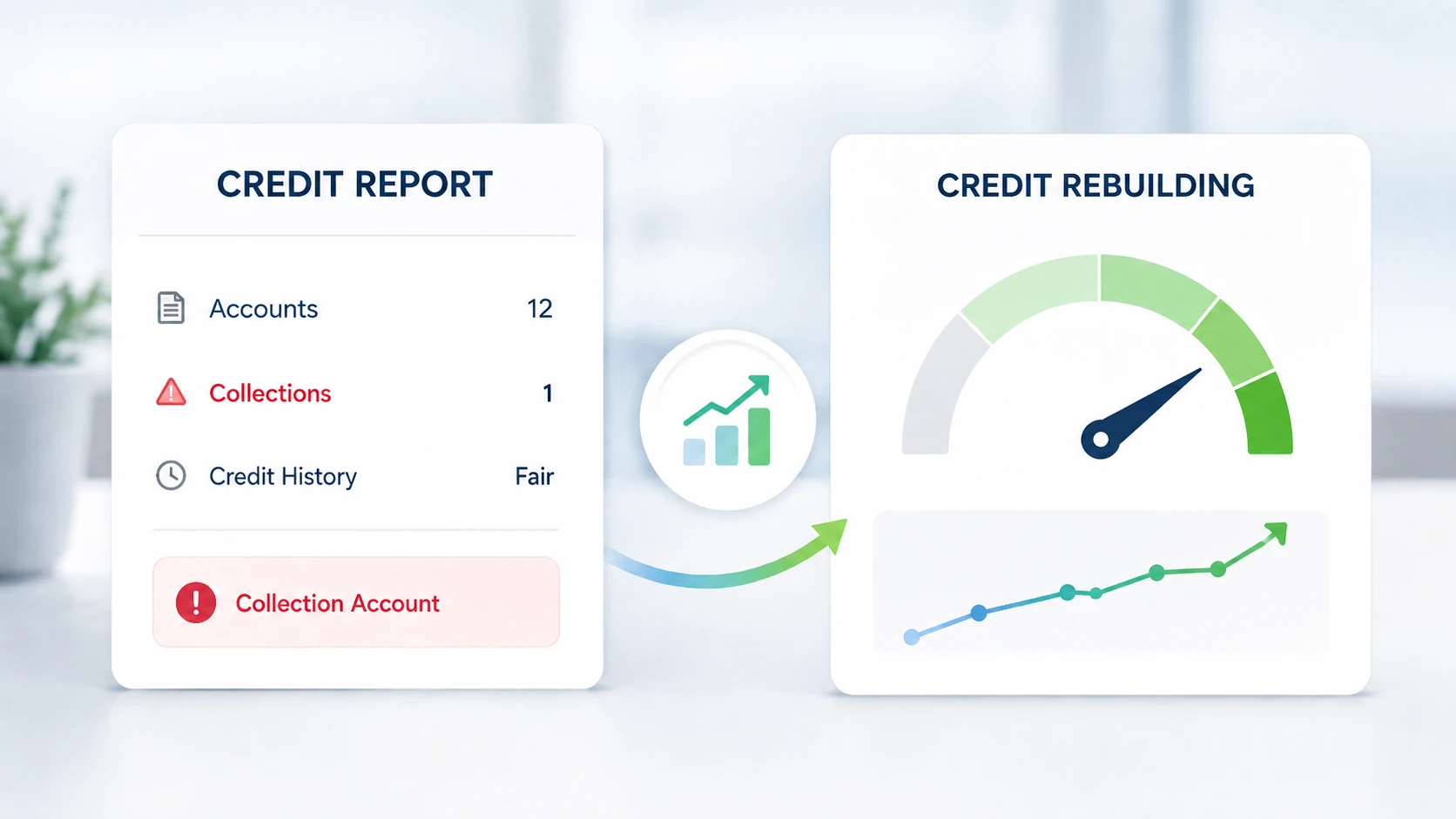
You can rebuild credit after collections while the account is still on your credit reports. Start by protecting current payments, checking all three reports, and correcting specific errors. For a valid unpaid debt, review its age, legal deadlines, and affordable resolution options before paying. Then work on high card balances and consistent on-time payments.
Paying a collection, removing it from a report, and improving a credit score are different outcomes. This guide helps you choose your next action and track what changes, without assuming that one payment will restore your score.
In this guide: Choose your next step · Paid vs. settled collections · Your first 90 days · Recovery timeline
What should you do with a collection account?
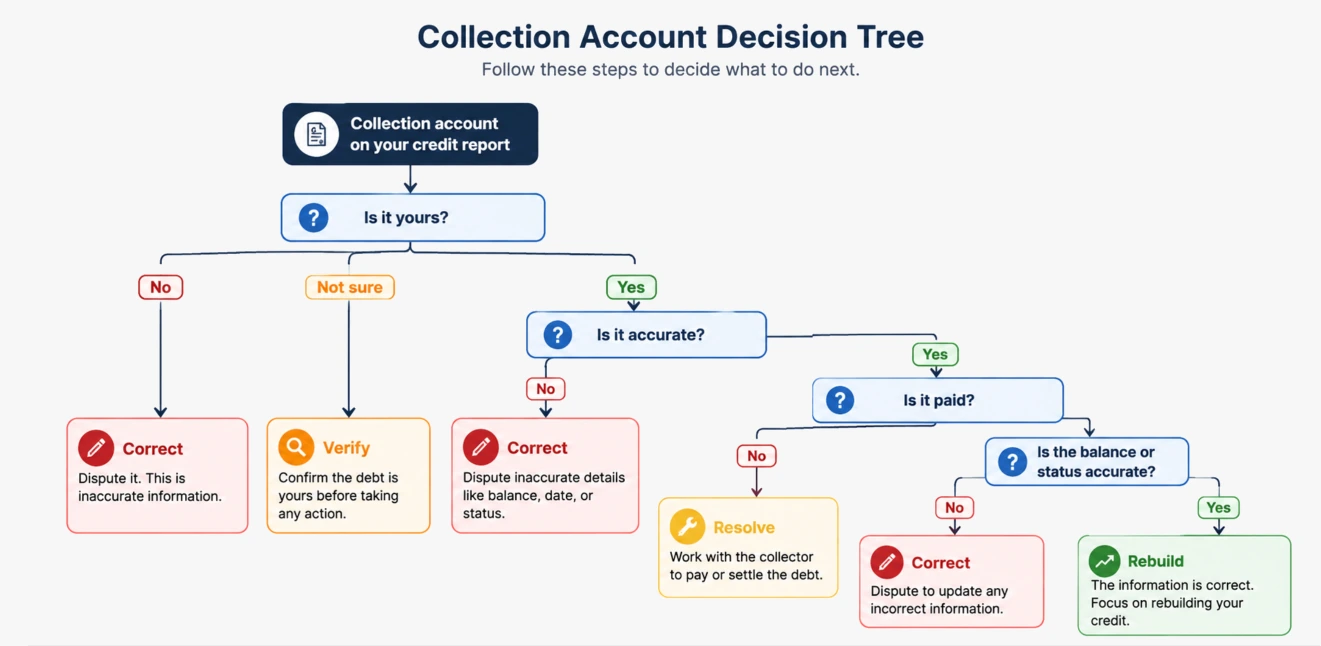
Choose the row that matches the account. Continue protecting your current payments in every situation.
| What you find | Next action | What to keep |
|---|---|---|
| Not yours, unfamiliar, or inaccurate | Verify the collector and account. Identify the exact error and use the appropriate validation or reporting-dispute process. | Reports, notices, statements, and evidence of the discrepancy. |
| Accurate and unpaid | Check legal deadlines and your budget before choosing a payment, settlement, or other response. Get agreed terms in writing. | Validation information, budget, and written terms. |
| Already paid or settled | Check that the balance and status match the completed agreement. Payment does not automatically erase the history. | Settlement or payoff confirmation and proof of payment. |
| Old debt or court papers | Seek state-specific legal help promptly. A dispute or negotiation does not replace a court response. | Original delinquency records, payment history, notices, and court deadlines. |
Can you rebuild credit after collections?
Yes. An accurate collection does not prevent you from protecting current payments, correcting other reporting errors, or reducing expensive card debt. These actions improve identifiable parts of your finances and credit file; they do not promise a recovery date or a number of points. The CFPB’s rebuilding guidance emphasizes paying on time, avoiding unnecessary borrowing, and reviewing the information being reported.
How paid and settled collections affect your credit score
The scoring model matters. A collection may still be visible even when a particular model ignores it.
| Situation | How it is treated |
|---|---|
| Collection reported as paid in full | FICO Score 9 and the FICO Score 10 suite disregard it. Do not assume every older version does. |
| Settled collection reported with a $0 balance | FICO Score 9 and FICO Score 10 treat it as paid and exclude it. |
| Original collection amount under $100 | FICO Scores 8, 9, and the 10 suite disregard these small third-party collections. Paying a larger debt down below $100 is different. |
| Original creditor’s charge-off | These special collection rules do not apply to first-party accounts. |
Third-party collection balances do not enter FICO credit-utilization calculations. Lowering revolving card balances addresses a separate factor. Payment alone does not guarantee a higher score.
Source: FICO’s collection scoring explanation.
Medical collections have separate reporting rules
According to TransUnion’s reporting guidance, paid medical collections and medical collections with an initial reported balance under $500 do not appear on credit reports. Unpaid medical collections have a one-year waiting period from the original delinquency. The initial-balance rule is not a promise that paying a larger account down below $500 removes it. Some states provide additional protections.
Step 1: Read your credit report carefully
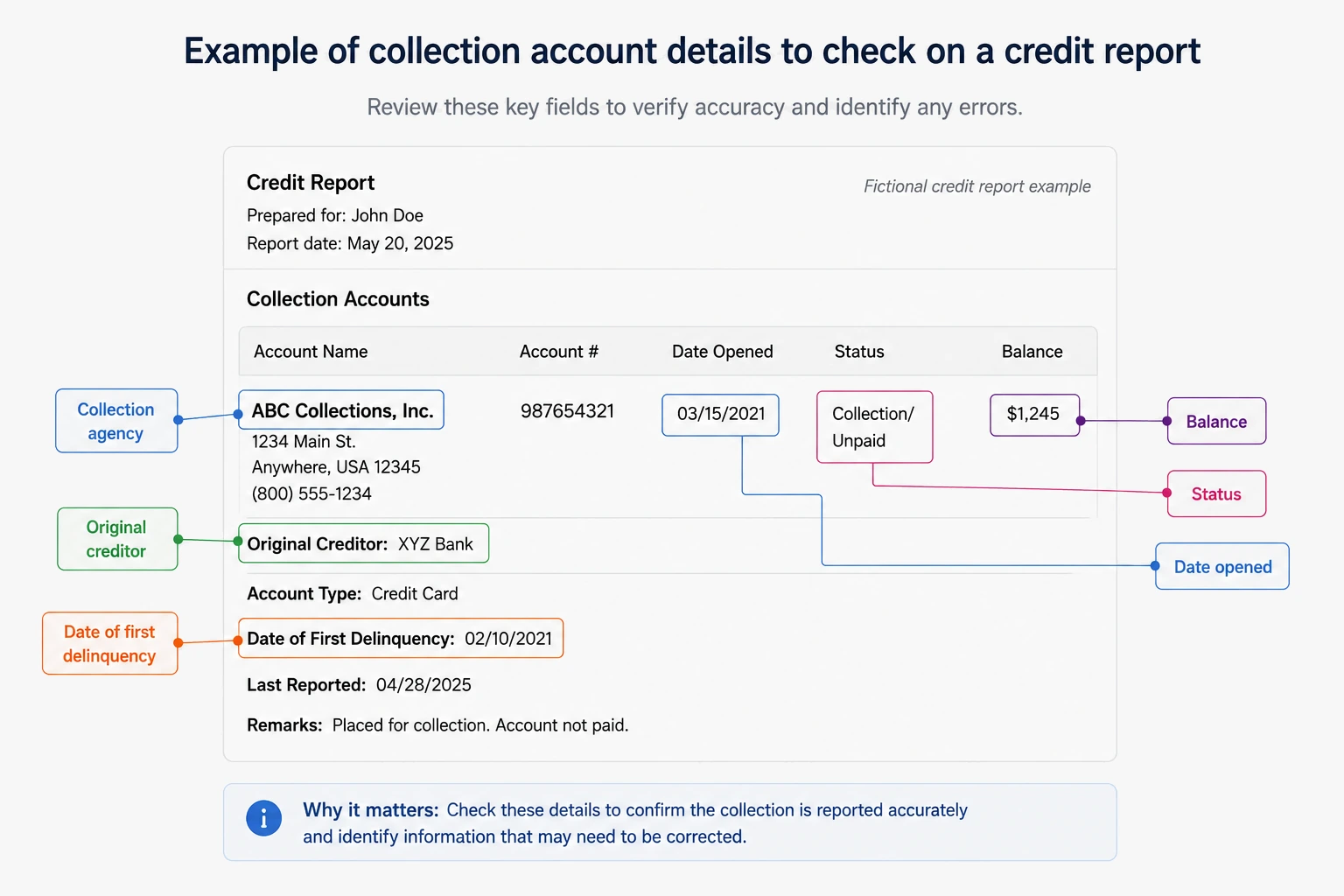
Before you pay, settle, or dispute a collection, check your credit reports and find the collection entry on each one. You can request free weekly credit reports from Equifax, Experian, and TransUnion through AnnualCreditReport.com.
For each collection account, write down these details:
- Collection agency: Note the company reporting the collection.
- Original creditor: Identify the creditor connected to the original account or debt, if it is listed.
- Balance: Record the amount currently reported.
- Account status: Check whether the collection is reported as paid, unpaid, settled, closed, or with a remaining balance.
- Dates: Record relevant dates shown on the report, such as the date opened, date of last payment, and date of first delinquency when available.
- Account ownership: Make sure the collection actually belongs to you.
- Duplicate reporting: Check whether the same debt appears more than once.
Compare the collection across all three credit reports. The bureaus may not have identical information, so look for differences in the balance, payment status, dates, collector name, or whether the account appears at all. CFPB identifies incorrect balances, incorrect account status, incorrect dates, accounts that do not belong to the consumer, and the same debt listed more than once as examples of credit report errors.
If you are not sure how to interpret the account fields, first learn how to read your credit report before deciding whether the collection needs to be corrected or handled another way.
Sources: AnnualCreditReport.com and Consumer Financial Protection Bureau: Common Credit Report Errors.
Collection account audit checklist
Use this checklist to compare the collection information on your Equifax, Experian, and TransUnion credit reports with your own records. A difference between reports does not automatically prove that one bureau is wrong. Record the difference first, then compare it with statements, payment confirmations, settlement letters, or correspondence from the collector.
| What to check | Equifax | Experian | TransUnion | Your records | Match? |
|---|---|---|---|---|---|
| Collection agency | ________ | ________ | ________ | ________ | Yes / No |
| Original creditor | ________ | ________ | ________ | ________ | Yes / No |
| Current balance | $________ | $________ | $________ | $________ | Yes / No |
| Payment status | ________ | ________ | ________ | ________ | Yes / No |
| Date opened | ________ | ________ | ________ | ________ | Yes / No |
| Date of last payment, if shown | ________ | ________ | ________ | ________ | Yes / No |
| Date of first delinquency, if shown | ________ | ________ | ________ | ________ | Yes / No |
| Account belongs to you | Yes / No | Yes / No | Yes / No | Yes / No | Yes / No |
| Same debt appears more than once | Yes / No | Yes / No | Yes / No | — | Review |
How to use the checklist
- Everything matches your records → The collection may be reporting accurately. Continue to Step 2 before deciding what to do with the account.
- The balance does not match → Compare the reported balance with your most recent statement, payment confirmation, settlement agreement, or other records showing what you owe or paid.
- The payment status does not match → Save documentation showing whether the account is unpaid, paid, settled, or has a remaining balance.
- A date does not match → Compare the reported date with your account statements and other records. Do not assume that the date shown by another credit bureau is automatically correct.
- The account does not belong to you → Do not pay it simply because it appears on a credit report. Save records that support why you believe the account is not yours.
- The same debt appears more than once → Record each listing separately, including the company name, balance, account details, and which credit bureau reports it.
- Only one credit bureau reports different information → Treat the difference as something to investigate, not automatic proof that the bureau is wrong. Compare that entry with your underlying records first.
Source: Consumer Financial Protection Bureau: Common Credit Report Errors.
Step 2: Confirm whether the collection is accurate
Use the worksheet above to write one testable discrepancy: which bureau, which account, which field, what it says, and which record conflicts with it. A difference between bureaus is a clue, not proof that the most favorable version is correct. The CFPB’s error checklist identifies balances, status, ownership, and dates among the fields to review.
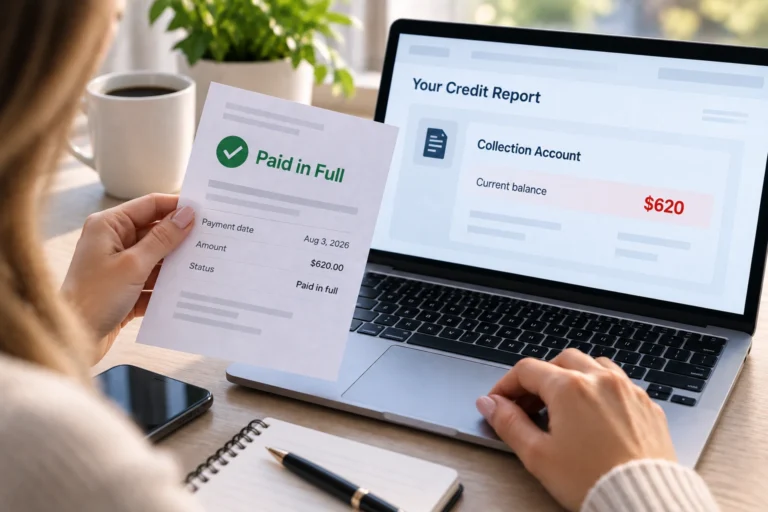
Hypothetical example: the report shows $900 due, while a completed settlement and matching payment record support no remaining balance. The question is whether the current balance and status reflect that agreement, not why a historical collection is still visible. Use the paid-collection balance guide to separate a partial payment from final settlement.
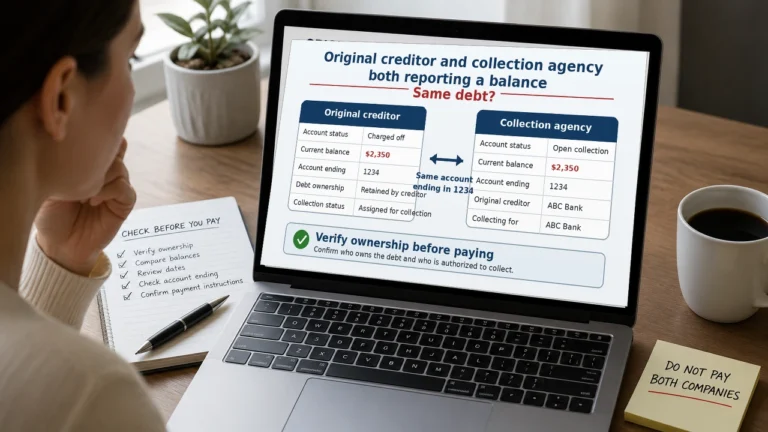
If the account is unfamiliar, investigate identity theft or a mixed file rather than sending money to make it disappear. The CFPB directs identity-theft concerns to IdentityTheft.gov and explains the reporting-error process. Two entries also do not automatically mean two debts: compare the original creditor and collector in the ownership and balance guide.
Take a specific inaccuracy to Step 3. For an accurate unpaid collection, evaluate Step 4; for a resolved collection, verify Step 5. Keep protecting current payments throughout. Accurate negative information generally cannot be removed just because it is unfavorable.
Debt validation and credit report disputes are separate
A written dispute sent to a covered debt collector within the validation period, generally 30 days after receiving the validation notice, requires it to pause collection until it provides verification. That is different from asking a credit bureau to investigate a reporting error. Missing the validation period does not remove your ability to dispute inaccurate credit reporting.
Check the deadline on the notice now. For the correct recipient and process, use our debt validation vs. credit report dispute guide. See the CFPB explanation of the collection pause.
Step 3: Dispute collection errors if something is wrong
If you found a specific inaccurate or incomplete item in the collection entry, dispute that information—not the entire account simply because the collection is hurting your credit. You can dispute inaccurate or incomplete information with the credit reporting company and with the company that furnished the information.
A dispute may be appropriate if the collection does not belong to you, the balance or payment status is wrong, a reported date is inaccurate, the same debt appears more than once, or other information is inaccurate or incomplete. If the collection is accurate, a dispute should not be used simply to try to remove legitimate negative information.
What to include in your dispute
| What to include | Example | Why it helps |
|---|---|---|
| The collection entry | Collection agency name and account number, if available | Identifies the exact account you are challenging. |
| The specific information you believe is wrong | “The report shows a $620 balance, but my records show the agreed amount was paid.” | Gives the credit bureau or furnisher a specific issue to investigate. |
| Why you believe it is inaccurate or incomplete | “The attached payment confirmation shows that I completed the settlement agreement.” | Explains the basis for the dispute instead of making a general removal request. |
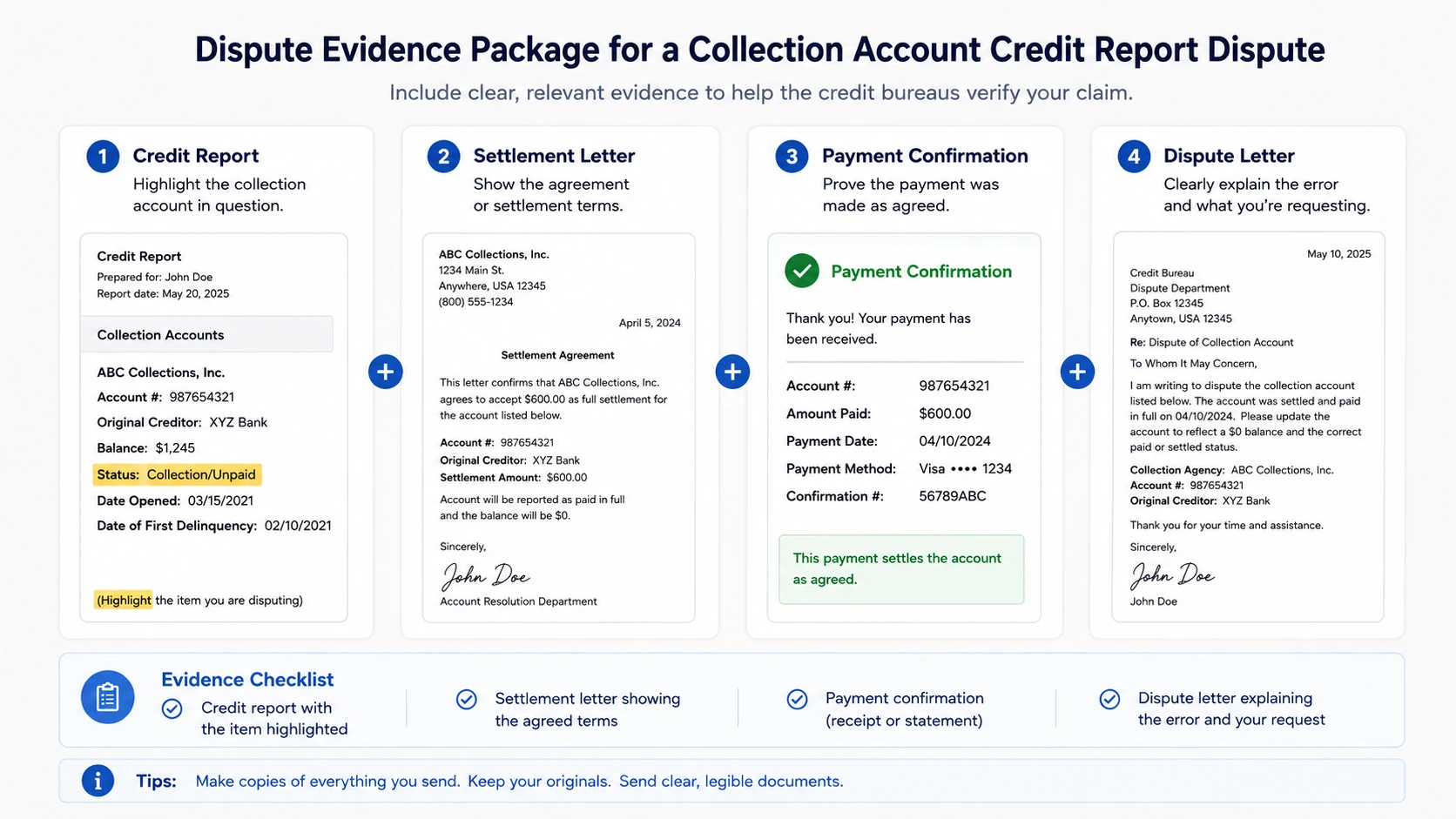
| Supporting documents | Payment confirmation, settlement letter, account statement, or collector correspondence | Provides evidence that can support the correction you are requesting. |
| The correction you are requesting | “Please update the reported balance and payment status to reflect the attached records.” | Makes clear what information you believe should be corrected. |
If you need the complete filing process, follow this guide on how to dispute errors on your credit report. Before submitting a dispute, review the documents you may need for a credit report dispute so you can match your evidence to the specific information you are challenging.
What if the dispute does not fix the problem?
Read the investigation result and compare the updated credit report with the evidence you submitted. If information you still believe is inaccurate remains, check whether the dispute clearly identified the problem and whether additional or missing documentation could support your position. You may also follow up with the credit reporting company or the furnisher that supplied the information.
If a dispute with a credit reporting company remains unresolved, federal law generally allows you to ask the credit reporting company to include a brief statement explaining the dispute in your credit file. Keep copies of your dispute, supporting documents, investigation results, and any later correspondence.
Sources: Consumer Financial Protection Bureau: Disputing Credit Report Errors, Consumer Financial Protection Bureau: If You Disagree With a Dispute Result, and Federal Trade Commission: Disputing Errors on Your Credit Reports.
Step 4: Handle an unpaid collection carefully
A collection can originate from an unpaid checkout installment plan. If that is the source of the account, review BNPL payment and collection risks and match the collector’s information with the original purchase and payment records.
Check an older debt’s legal timeline before paying or promising to pay. The CFPB explains that a partial payment or acknowledgment can restart the time limit for a lawsuit in some states. That deadline is different from the federal credit-reporting period. Get state-specific legal advice when the debt’s age or enforceability is unclear; do not make a small payment merely to improve a score. If you receive court papers, respond by the court’s deadline even when you believe the debt is too old. A dispute or negotiation does not replace a court response.
If the collection is accurate and unpaid, decide how to handle the debt based on what you actually owe and what you can realistically afford. Before sending money, confirm the debt, the collector, the current balance, and the terms of any payment or settlement agreement. If you are considering a reduced payoff, use the step-by-step guide to a written collection settlement to set an affordable limit, prepare an offer, and check the agreement before paying.
Review the debt collector’s validation information first. It can help you confirm the creditor, account details, current amount owed, and whether the debt appears to be yours before you negotiate or pay.
Choose the option that fits your situation
| Your situation | What to do | What to keep |
|---|---|---|
| You can pay the full balance | Confirm the current amount owed and where the payment should be sent. Ask for written confirmation of the amount you are agreeing to pay and what will remain after payment, if anything. | Written payment terms, payment confirmation, receipts, and any letter confirming the debt was satisfied. |
| You are considering a settlement | Decide what amount you can realistically afford, negotiate the terms, and get the settlement agreement in writing before making a payment. | The agreed settlement amount, payment deadline or schedule, what happens to any remaining balance, and proof of payment. |
| You need a payment plan | Choose a payment amount that fits your budget without causing you to miss current bills. Confirm the payment amount, due dates, total amount to be paid, and what happens when the plan is completed. | The written payment plan, due dates, payment amounts, and receipts for every payment. |
| You cannot afford to resolve the collection now | Do not create new missed payments just to resolve an old collection. Protect essential expenses and current accounts while you determine what repayment amount, if any, fits your budget. | Your budget, collector correspondence, and any repayment proposals or agreements. |
What to confirm before you pay
- The collector: Verify the debt collector’s name and contact information.
- The creditor: Confirm who the debt is currently owed to.
- The balance: Check the current amount owed and any itemization provided for interest, fees, payments, or credits. If the balance keeps increasing, review when a collection agency can charge interest and how to verify whether the added amount is authorized and calculated correctly.
- The payment terms: Know whether you are paying in full, settling for less, or entering a payment plan.
- The remaining balance: Confirm whether any amount will still be owed after you complete the agreement.
- The payment schedule: Record the amount and due date of every payment you agree to make.
- The written agreement: Keep the collector’s promises and repayment or settlement terms in writing before you pay.
Simple script before agreeing to payment:“Before I make a payment, please send me the agreement in writing showing the amount I am agreeing to pay, the payment due date or schedule, and whether completing the agreement will satisfy the debt or leave a remaining balance.”
Do not pay an unpaid collection solely because you expect an immediate credit score increase. FICO says paying a third-party collection may increase, decrease, or have no immediate effect on a FICO Score depending on the information reported, the rest of the credit file, and the scoring model being used.
Sources: Consumer Financial Protection Bureau: Negotiating With a Debt Collector, Consumer Financial Protection Bureau: Debt Validation Information, and FICO: How Collections Affect Your Credit.
Step 5: What to do if the collection is already paid
Confirm that the payment satisfied the entire debt, rather than one installment. The CFPB explains that a paid collection generally should show a zero balance, including when the collector accepted a smaller amount to settle the whole debt. Match the reporting date and current balance to the agreement and payment record.
If a balance or status remains wrong, use the paid-collection balance guide for the evidence and request wording. If both the original creditor and collector show money due, use the two-tradeline comparison. Those are specific reporting questions, not reasons to postpone current payments.
When the balance and status are correct, keep the resolution records and continue the rebuilding work below. Payment, deletion, and treatment by a scoring model are different outcomes. To understand what a paid collection may or may not do to a score, see what happens to your credit score after paying off collections. For a possible removal basis, use the paid-collection removal guide; do not repeatedly dispute accurate information just because it remains visible.
Your situation → your next move
Use two parallel tracks: investigate or resolve the collection using Steps 1–5, while protecting ongoing payments with Steps 6–10. You do not need to finish the collection track before starting the payment-protection track.
Budget check, not a payment recommendation: suppose $250 is available before your next income, $150 must cover essentials, and $60 covers required payments not already counted. That leaves $40 before any emergency buffer, other due bills, or agreed debt payments. A $100 collection proposal would already exceed this remainder by $60. Count each expense once and check actual due dates; the $40 is not automatically safe to promise. The CFPB recommends a realistic plan that leaves room for unexpected expenses.
Step 6: Build positive payment history
Keep current accounts on time while you investigate or resolve the collection, not only afterward. Protect essential expenses and required payments before committing money to an older debt. Consistent on-time payments help you build positive credit history while you work on other parts of your credit profile.
Set up a payment protection system
| Account | Due date | Required payment | Autopay | Backup reminder |
|---|---|---|---|---|
| Credit card 1 | ________ | $________ | Yes / No | ________ |
| Credit card 2 | ________ | $________ | Yes / No | ________ |
| Auto loan | ________ | $________ | Yes / No | ________ |
| Student or personal loan | ________ | $________ | Yes / No | ________ |
| Other account | ________ | $________ | Yes / No | ________ |
How to protect your current accounts
- Confirm every due date. Check the billing statement or account portal.
- Record the required payment. Write down the minimum or scheduled payment.
- Use autopay when it fits your budget. Make sure the linked account has enough money.
- Add a backup reminder. Set an alert several days before the due date.
- Verify that the payment posted. Do not assume an automatic payment succeeded.
- Address any current past-due account first. Prevent additional missed payments.
Sources: Consumer Financial Protection Bureau: How to Rebuild Your Credit and FICO: Payment History and Your FICO Score.
Step 7: Lower your credit utilization
If you have revolving credit card balances, lowering your credit utilization can strengthen a part of your credit profile that is separate from the collection account.
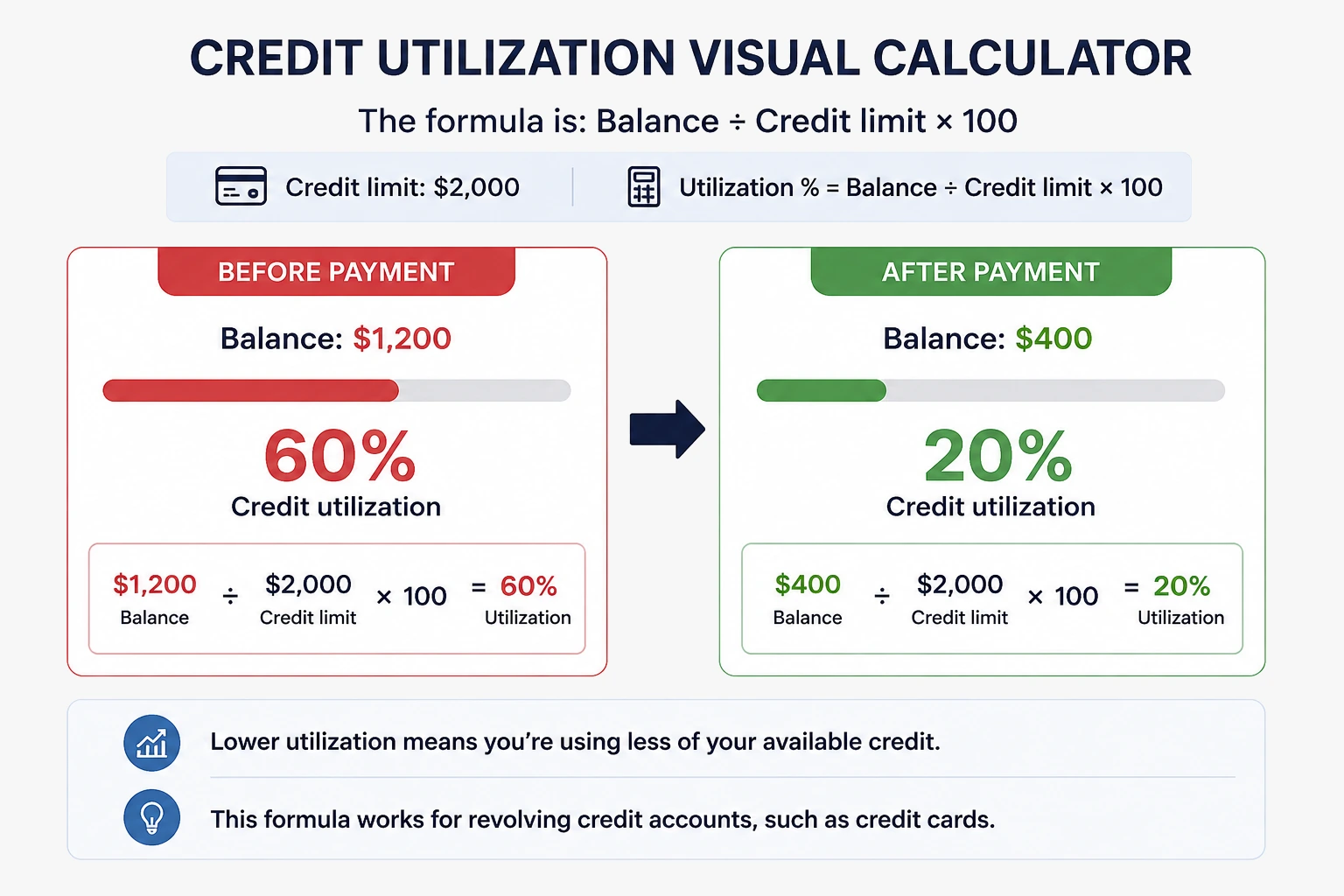
Example:$1,200 balance ÷ $2,000 limit × 100 = 60% utilization
$400 balance ÷ $2,000 limit × 100 = 20% utilization
A lower utilization ratio does not guarantee a specific credit score increase.
Calculate your credit utilization
| Card | Reported balance | Credit limit | Utilization |
|---|---|---|---|
| Card 1 | $________ | $________ | ________% |
| Card 2 | $________ | $________ | ________% |
| Card 3 | $________ | $________ | ________% |
| Total | $________ | $________ | ________% |
To calculate overall utilization, add your reported revolving balances, add the corresponding credit limits, and divide the total balance by the total limit. Do not average the individual percentages.
- Check each card’s reported balance and credit limit.
- Calculate utilization for each card and overall.
- Reduce high revolving balances when your budget allows.
- Keep new charges under control.
- Do not carry a balance just to build credit.
If you need a deeper explanation, see how credit utilization affects your credit score.
Sources: Consumer Financial Protection Bureau: How to Rebuild Your Credit and FICO: Amount of Debt and Credit Utilization.
Step 8: Consider a secured credit card or credit-builder loan
You do not automatically need a new account to rebuild your credit. If you already have active accounts reporting positive payment history, focus on managing those well.
| Option | May fit when | What to check | Main risk |
|---|---|---|---|
| Secured credit card | You want a revolving account and can afford the security deposit. | Deposit, limit, fees, APR, and credit-bureau reporting. | Overspending, high balances, missed payments, or unnecessary fees. |
| Credit-builder loan | You prefer fixed scheduled payments. | Payment, APR, fees, term, release of funds, and reporting. | Adding a payment that becomes difficult to afford. |
| No new account | Your existing accounts already provide positive payment history. | Whether current accounts are reporting as expected. | Opening unnecessary credit. |
Check these five things before you apply
- Confirm that payments are reported.
- Calculate the total cost.
- Make sure the payment fits your budget.
- Understand how the product works.
- Open only what you actually need.
Sources: Consumer Financial Protection Bureau: Ways to Start or Rebuild a Good Credit History and Consumer Financial Protection Bureau: How to Rebuild Your Credit.
Step 9: Avoid applying for too much new credit at once
Apply for new credit only when you have a clear reason for the account. Several applications or newly opened accounts in a short period can affect your rebuilding efforts because applications may create hard inquiries and new accounts can change your credit profile.
| Question | If yes | If no |
|---|---|---|
| Does this account solve a specific need? | Continue evaluating it. | Wait. |
| Can you comfortably afford the costs? | Continue. | Do not apply. |
| Have you compared the important terms? | Narrow your choice. | Compare APRs, fees, deposits, and reporting first. |
| Have you recently applied for other credit? | Ask whether another application is necessary. | Consider one carefully chosen application if needed. |
Sources: Consumer Financial Protection Bureau: How to Rebuild Your Credit, Consumer Financial Protection Bureau: What Is a Credit Inquiry?, and FICO: How New Credit Impacts Your Credit Score.
Step 10: Track your progress monthly
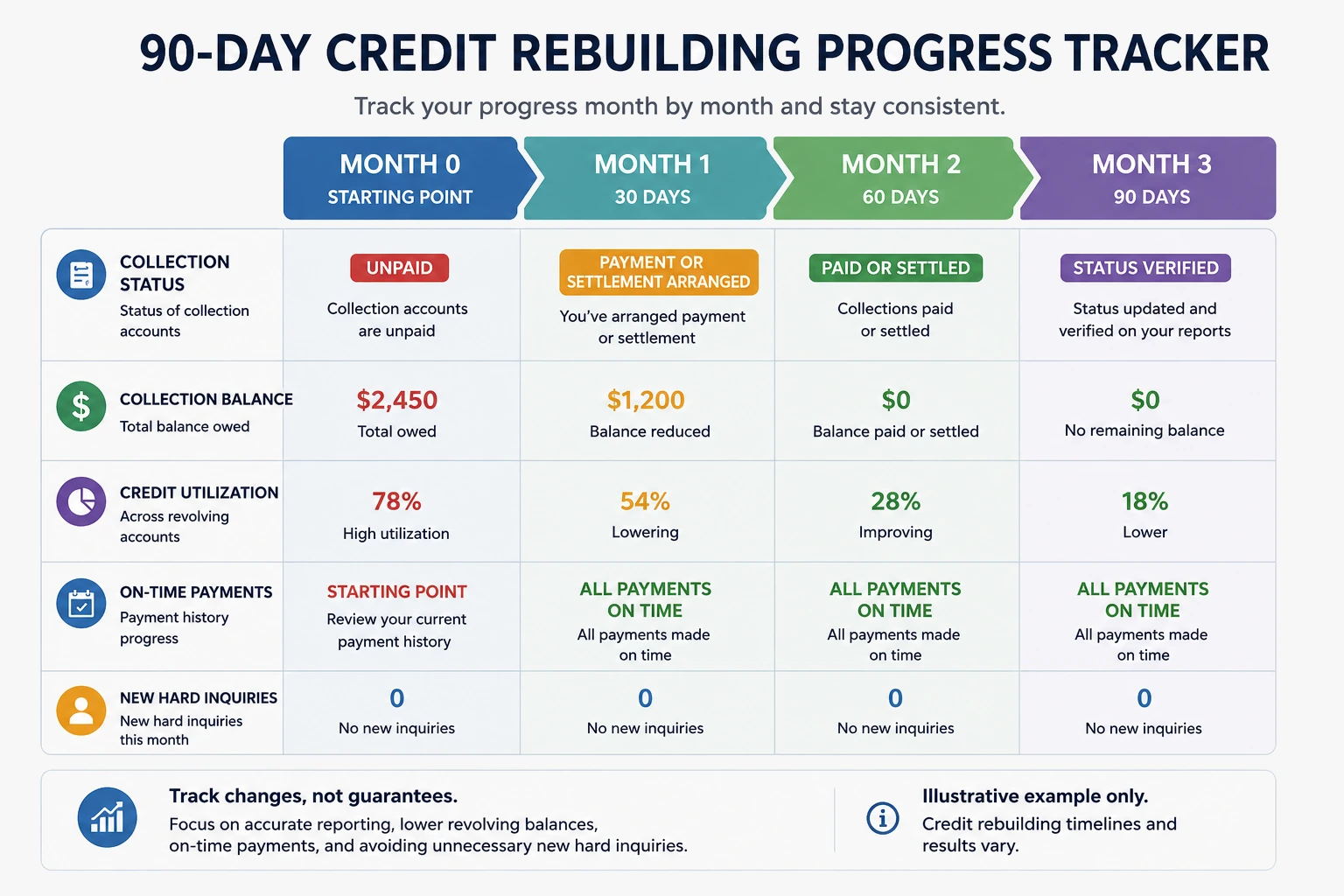
Track the information in your credit reports each month instead of judging your progress by one credit score alone.
| What to track | Starting point | Month 1 | Month 2 | Month 3 |
|---|---|---|---|---|
| Collection balance | $________ | $________ | $________ | $________ |
| Collection status | ________ | ________ | ________ | ________ |
| Total revolving balances | $________ | $________ | $________ | $________ |
| Total revolving limits | $________ | $________ | $________ | $________ |
| Overall utilization | ________% | ________% | ________% | ________% |
| Payments made on time? | — | Yes / No | Yes / No | Yes / No |
| New credit applications | ________ | ________ | ________ | ________ |
| New accounts opened | ________ | ________ | ________ | ________ |
| Credit score, optional | ________ | ________ | ________ | ________ |
Example: How credit rebuilding can look after a collection
Hypothetical starting point:
- Collection: paid and reporting $0.
- Card 1: $1,500 balance on a $2,000 limit.
- Card 2: $300 balance on a $1,000 limit.
- Current accounts: all current.
- No new credit needed.
Overall revolving utilization is:
If the balances later fall to $800 and $200, overall utilization becomes:
This is a measurable improvement in the underlying credit file, but 33.3% is not a guaranteed score threshold and no specific score increase can be promised.
How long does it take to rebuild credit after collections?
Separate the reporting timeline from score recovery. A credit bureau generally has 30 days to investigate a dispute; some cases allow up to 45 days. That is an investigation window, not a deadline for your score to improve. The CFPB explains those exceptions.
Collections generally remain for about seven years from the original delinquency that led to collection. Paying does not start a fresh credit-reporting period, although an old debt’s lawsuit deadline is a separate state-law question. See which collection timeline a payment can affect. You can work on current accounts during this time.
There is no fixed timeline for rebuilding credit after collections. How quickly your credit changes depends on what is reported, the rest of your credit file, and the scoring model being used.
| What changes | What to watch for | What it may mean |
|---|---|---|
| An inaccurate collection is corrected | Check whether the corrected information appears on your reports. | A score calculated from the updated report may change, but the result varies. |
| A lower card balance is reported | Check whether utilization falls. | Lower utilization can improve one part of the credit profile. |
| Current accounts stay on time | Confirm payments continue to report accurately. | Positive payment history can strengthen the file over time. |
| A paid collection updates | Check the balance and status. | Do not assume the payment will automatically increase your score. |
| Negative information gets older | Continue monitoring your report. | Older negative information generally has less impact than newer negative information in FICO scoring. |
Why your credit score may not improve right away
Your credit score may not increase right away after paying a collection, correcting an error, or lowering balances. Check the underlying report before taking another action.
| What you see | Possible reason | What to check next |
|---|---|---|
| Collection paid, score barely changed | Paying a collection does not guarantee a score increase. | Confirm balance and status and review the rest of the file. |
| Collection corrected, score did not increase | Other negative information may remain. | Check other collections, late payments, charge-offs, balances, and inquiries. |
| Cards paid down, old balances still show | The new balances may not yet appear in the report being scored. | Compare current account balances with reported balances. |
| Two score services show different results | Different bureaus, models, versions, or data may be used. | Compare the same score type from the same source over time. |
Example: A paid collection correctly shows $0, but your reports show $2,700 in revolving balances on $3,500 of limits.$2,700 ÷ $3,500 × 100 = about 77% utilization
Repeatedly disputing the accurate collection would not address the high revolving utilization.
Mistakes that can slow down credit rebuilding after collections
| Mistake | Why it can slow progress | Better move |
|---|---|---|
| Repeatedly disputing an accurate collection | It does not address a real reporting error. | Dispute only specific inaccurate or incomplete information. |
| Missing current payments | New late payments can add fresh negative information. | Protect current accounts first. |
| Paying only for an expected score increase | A score increase is not guaranteed. | Handle valid debt based on your financial situation. |
| Ignoring high card balances | Revolving utilization can affect credit separately. | Reduce high balances when affordable. |
| Applying for several accounts | Applications and new accounts can change the credit profile. | Apply only when a specific account is needed. |
| Carrying a balance to “build credit” | You may pay unnecessary interest. | Carrying interest-bearing debt is not required to build payment history. |
| Watching only the score | The score does not show which underlying data changed. | Track the credit report itself. |
Your first 90 days: a credit rebuilding action plan
Use this schedule to organize the work, not to predict a score. Actual payment, validation, and court deadlines always come first. Do not delay a time-sensitive response to fit a week in the table.
| When | Action | Evidence of progress |
|---|---|---|
| Today | List essential expenses, current payments, and all notice or court deadlines. Contact a current creditor if a payment is unaffordable. | A due-date calendar and a budget that does not count the same money twice. |
| First week | Compare the collection across all three reports. Match balances, ownership, status, and dates to your records. | A completed account audit and copies of supporting documents. |
| First month | Submit supported disputes promptly where needed. For valid debt, evaluate affordable options and obtain written terms before committing. | Delivery records or submission confirmations; a documented decision about repayment. |
| Second month | Review responses as they arrive. Check whether payments and corrections appear accurately. Reduce card balances when affordable. | Updated balances and statuses; recalculated utilization; current accounts kept on time. |
| Third month | Compare the reports with your starting records. Follow up on unresolved errors with evidence. Consider a new account only if it serves a clear, affordable need. | A list of resolved issues, remaining questions, and next due dates. |
If you track scores, record the bureau, model, version, and date each time. Comparing different score types can make an unchanged report look like progress or a setback.
Frequently asked questions about rebuilding credit after collections
Can you still build credit with collections?
Yes. You can still build positive credit history while an accurate collection remains on your credit reports. Keep current accounts on time, reduce high revolving balances when affordable, and avoid unnecessary new credit applications.
Does paying a collection improve your credit score?
It may, but an increase is not guaranteed. FICO says paying a third-party collection can result in an increase, a decrease, or no score change depending on the information reported, the rest of the credit file, and the FICO Score version being used.
How can I repair credit with collections?
Confirm that the collection belongs to you and that the balance, status, dates, creditor, and collection agency are accurate. Correct legitimate errors, handle valid debt carefully, keep current accounts on time, reduce high revolving balances, and monitor your reports.
Should I dispute a collection to improve my credit?
Dispute a collection only when you identify inaccurate or incomplete information. Do not dispute accurate negative information simply because you want it removed.
How long does it take to rebuild credit after collections?
There is no fixed timeline. The pace depends on the rest of your credit history, current payment history, revolving balances, new credit activity, the age of negative information, and the scoring model being used.
Can a paid collection stay on your credit report?
Yes. Paying or settling a collection does not automatically require accurate negative information to disappear from your credit report. Check that the balance and payment status are accurate.
What should I do if my collection is paid but my credit score did not increase?
Confirm that the collection is reporting correctly, then check for high utilization, other negative accounts, recent inquiries, newly opened accounts, or balances that have not yet updated.
Explore related guides on collections.
Sources & editorial information
Sources
- Consumer Financial Protection Bureau: How to Rebuild Your Credit
- Consumer Financial Protection Bureau: How to Dispute an Error on Your Credit Report
- Consumer Financial Protection Bureau: Accurate Negative Information on Credit Reports
- FICO: How Collections Affect Your Credit
- FICO: Amounts Owed and Credit Utilization
- FICO: How New Credit Impacts Your Credit Score
Written by: Claire Bennett
Editorial note: This article was updated using the linked guidance from the Consumer Financial Protection Bureau, FICO, the Federal Trade Commission, and TransUnion. The 90-day schedule is an organizational example, not a tested score forecast or a promise of recovery within 90 days. Credit-report information and scoring models can change, so verify important details using your current credit reports and the latest guidance from the relevant source.