In this guide
- Do late payments on closed accounts affect your credit score?
- Quick check: can the new late payment be valid?
- Why can a closed account still report a late payment?
- Could residual interest cause a late payment after you thought the card was paid off?
- Example: when a late payment after account closure may be valid
- Example: when a new late payment on a closed account should be investigated
- Is it really a new late payment — or just a recent account update?
- Does closing an account remove old late payments?
- Build your closed-account payment timeline
- Compare the account across Equifax, Experian, and TransUnion
- Decision tree: should you investigate or dispute the late payment?
- Evidence checklist for a new late payment on a closed account
- How strong is your evidence?
- Ask the lender which payment was due
- When should you dispute a late payment on a closed account?
- Targeted dispute wording for this specific problem
- Should you dispute your credit report online or by mail?
- What if the credit bureau verifies the late payment as accurate?
- Can a new late payment on a closed account affect your credit score?
- Frequently asked questions
- How long before a closed account shows up on your credit report?
- How long can a closed account stay on your credit report?
- Bottom line
- Sources
Yes. A closed account can sometimes report a new late payment if you still owed money and a payment remained due after the account was closed. Closing an account does not necessarily erase an outstanding balance or end an existing payment obligation. But if a paid-off closed account suddenly shows a new late payment even though the balance was $0 and no payment was due, the reporting deserves investigation.
Before disputing it, check six facts: the date the account closed, balance after closure, next payment due date, date of your last payment, exact month marked late, and date the account was updated. Those details can help you distinguish a legitimate delinquency from an old late payment, a recent account update, or a possible credit-reporting error. For related scenarios, browse the Late payments guide hub.
If your main issue is only that a closed account still shows a balance—not that a new late-payment month appeared—use our closed-account balance guide. If you are asking how long a paid or closed account can remain on your credit report, use the paid-off debt reporting timeline. This page is specifically about whether a new late-payment entry after closure can be valid.
Do late payments on closed accounts affect your credit score?
Yes, a legitimately reported late payment on a closed account can still affect a credit score because closing the account does not erase accurate payment history. The key question is whether a payment was actually due for the month reported late. If the account had already been paid off, showed a $0 balance, and no payment was due, investigate the new late mark rather than assuming it is valid.
Quick answer
Closed + balance remaining + another payment still due
→ A later delinquency may be legitimate.
Closed + paid in full + $0 balance + no payment due
→ A new post-payoff late payment should be investigated.
The key question:
“What payment was actually due during the month you reported me late?”
Quick check: can the new late payment be valid?
Use this table before assuming that a closed account reporting a new late payment must be wrong.
| What your records show | What it may mean | What to check next |
|---|---|---|
| Account closed with a balance remaining | A later delinquency may be valid | Check whether another payment was required |
| Account paid in full before the month marked late | Possible reporting error | Find your payoff confirmation and final statement |
| Closed account shows $0 and no payment was due | A later late-payment entry deserves investigation | Ask what payment supposedly became overdue |
| An older late payment appears with a recent “date updated” | It may not be a new delinquency | Check the actual payment-history month |
| The account was closed while already delinquent | The existing delinquency may have continued | Reconstruct the payment timeline |
| A credit card was paid, but a later statement shows interest | Residual interest may have remained | Check the final payoff and subsequent statement |
| Only one credit bureau shows the new late payment | There may be a reporting discrepancy | Compare that bureau with lender records and the other reports |
Why can a closed account still report a late payment?

The most important distinction is that closed does not always mean paid off.
For example, the Consumer Financial Protection Bureau explains that if you close a credit card while a balance remains, you are still responsible for paying the balance on schedule. The issuer can also continue charging interest on the amount you still owe.
That means a credit card can be closed to new purchases while the underlying debt remains outstanding.
If another required payment becomes due after closure and is not paid, the account can become delinquent even though it is already labeled closed.
Consumer Financial Protection Bureau: closing a credit card with a remaining balance
If the main problem is a balance that still appears after closure, use our closed-account balance checklist before treating the entry as a genuinely new late payment.
Could residual interest cause a late payment after you thought the card was paid off?
Use our residual-interest timeline and payoff call script to reconcile the statement date, payment date, and any final charge before deciding whether there is an error.
Yes, in some credit card situations. If you were carrying a balance, interest may continue accruing between the date a statement is issued and the date the issuer receives your payment. This is often called residual interest or trailing interest.
Experian explains that residual interest can appear on a later statement even when you believed you had already paid your credit card balance. Many issuers calculate interest daily, so paying the statement balance is not always the same as obtaining and paying an exact payoff amount when interest is still accruing.
This does not mean residual interest automatically creates a credit-report late payment. But if a legitimate residual balance appears on a later statement, a payment becomes due, and that required payment eventually becomes delinquent, it can help explain why a supposedly paid or closed card later shows a problem.
Before disputing the late payment, check:
- the balance on your final statement;
- the date your payoff payment posted;
- whether another statement was generated afterward;
- whether residual or trailing interest remained;
- whether a minimum payment was subsequently due;
- the date that later payment was due;
- whether the account actually reached a reportable delinquency.
Important: If you intended to pay a credit card completely, ask the issuer when the balance actually reached $0 rather than relying only on the prior statement balance.
Experian: What is residual interest?
Consumer Financial Protection Bureau: how credit card interest is calculated
Example: when a late payment after account closure may be valid
Suppose you close a credit card on March 5 while owing $2,400.
The card can no longer be used for new purchases, but your April minimum payment is still due.
You do not make the required payment, and the unpaid obligation later reaches the level reported by the lender as delinquent.
In that situation, the closing date did not eliminate the outstanding balance or payment schedule. A later late-payment entry may therefore be accurate.
The important question is not:
“How can I be late if the account was closed?”
It is:
“Was a payment still required after the account closed, and did that payment become delinquent?”
Example: when a new late payment on a closed account should be investigated
Now consider the opposite situation.
You pay an auto loan in full on May 3. The lender closes the account on May 6. Your final statement shows a $0 balance, and no June payment is scheduled.
Your credit report later shows:
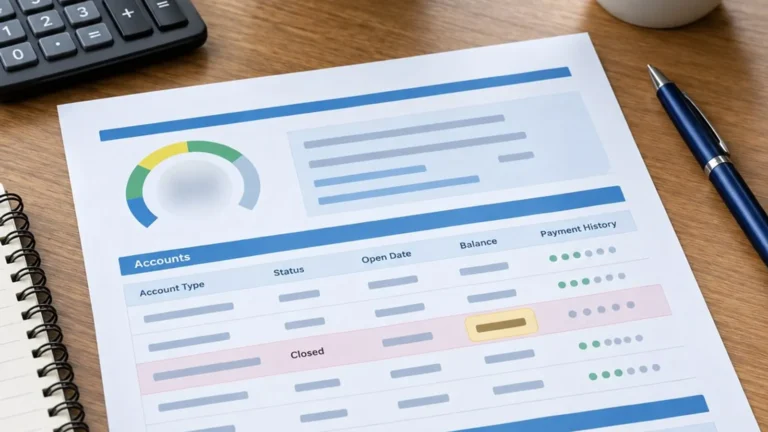
ACCOUNT TYPE: Auto loan
ACCOUNT STATUS: Closed / Paid
DATE CLOSED: May 6, 2026
BALANCE: $0
AMOUNT PAST DUE: $0
LAST PAYMENT: May 3, 2026
PAYMENT HISTORY:
March — OK
April — OK
May — OK
June — 30 days late
DATE UPDATED: July 14, 2026
The first question should be:
What payment was due in June?
If the lender’s records show that the loan had already been fully satisfied and no June payment existed, the June delinquency may be inaccurate.
The CFPB specifically lists accounts incorrectly reported as late or delinquent, incorrect dates of last payment, and incorrect balances among common credit-report errors.
Consumer Financial Protection Bureau: common credit report errors
Is it really a new late payment — or just a recent account update?

A recent date updated does not automatically mean a recent missed payment.
For example:
ACCOUNT STATUS: Closed
DATE CLOSED: January 2026
BALANCE: $0
LATE PAYMENT: October 2025
DATE UPDATED: July 2026
This example shows an October 2025 late payment on an account that received a later update. It does not automatically show a new July 2026 late payment.
This distinction matters because a credit-monitoring alert can summarize recent account activity differently from the detailed payment history in the underlying credit report.
If fields such as date updated, payment history, amount past due, and account status are unclear, review how to read your credit report before concluding that a new late payment was added.
Does closing an account remove old late payments?
No. Closing or paying off an account does not automatically remove accurate late payments that occurred earlier.
The CFPB says negative information about account payment history can generally remain on a credit report for up to seven years. So if you were legitimately late before the account closed, a later $0 balance or closed status does not by itself make the historical late payment inaccurate.
This is different from a new late-payment month appearing after payoff. If the debt was already satisfied and no payment was due during the later month, investigate that specific entry rather than assuming it is simply old negative history.
For the separate question of how long this type of information may continue affecting your credit, see how long a late payment affects your credit score.
Consumer Financial Protection Bureau: how long information stays on a credit report
Build your closed-account payment timeline
Before disputing a closed account showing a new late payment, reconstruct what actually happened in chronological order.
Closed-account payment timeline
Last scheduled payment before closure:
____________________________
Date I made my last payment:
____________________________
Date lender received or credited it:
____________________________
Payoff date, if applicable:
____________________________
Date account closed:
____________________________
Balance immediately after closure:
____________________________
Any later interest or charge:
____________________________
Next payment allegedly due:
____________________________
Month reported late:
____________________________
Date account was last updated:
____________________________
How to interpret your timeline
Pattern A: Account closed → balance remained → another payment became due → payment was missed.
The late payment may be accurate.
Pattern B: Account paid off → balance reached $0 → no further payment was due → a later month appears as late.
That creates a specific inconsistency worth investigating.
Pattern C: Late payment occurred before closure → account later closed → creditor updated the account months afterward.
You may be seeing older payment history rather than a genuinely new late payment.
Pattern D: Credit card statement balance paid → residual interest appeared → later payment became due.
Check whether the later balance was legitimate and whether a required payment actually became delinquent before disputing the credit reporting.
Compare the account across Equifax, Experian, and TransUnion
Do not rely only on a credit-score app or monitoring alert. Compare the underlying credit reports when possible.
AnnualCreditReport.com is the federally authorized website for obtaining reports from Equifax, Experian, and TransUnion.
| Field | Equifax | Experian | TransUnion |
|---|---|---|---|
| Account status | ________ | ________ | ________ |
| Date closed | ________ | ________ | ________ |
| Balance | ________ | ________ | ________ |
| Amount past due | ________ | ________ | ________ |
| Date of last payment | ________ | ________ | ________ |
| Month marked late | ________ | ________ | ________ |
| Late status shown | ________ | ________ | ________ |
| Date updated | ________ | ________ | ________ |
If one bureau reports a new late payment while the others do not, the difference is useful information, but it does not automatically prove which report is correct. Compare each version with the lender’s underlying records.
Decision tree: should you investigate or dispute the late payment?

STEP 1 — Did a balance remain after the account closed?
→ Yes: Go to Step 2.
→ No: Go to Step 3.
STEP 2 — Was another payment required?
→ Yes: Determine whether you made it on time.
→ No: Ask the lender what payment supposedly became delinquent.
STEP 3 — Was the account paid in full before the month marked late?
→ Yes: Find the payoff statement, final statement, and payment records.
→ No: Verify whether another payment obligation remained.
STEP 4 — For a credit card, did residual interest or another legitimate charge appear afterward?
→ Yes: Determine whether another payment became due and whether it was paid.
→ No: Continue.
STEP 5 — Is the “new” date only the date the account was updated?
→ Yes: Check whether the actual late-payment month is older.
→ No: Continue.
STEP 6 — Do your documents contradict a specific reported fact?
→ Yes: You may have a factual basis for a targeted dispute.
→ No: Gather more information before submitting a generic dispute.
Evidence checklist for a new late payment on a closed account
Use the printable credit report checklist alongside your account timeline to track each bureau, the exact disputed month, and your supporting records. Keep completed worksheets private.
Gather records that directly address the specific payment, date, balance, or status you believe is wrong.
☐ Credit report showing the disputed late-payment month
☐ Final account statement
☐ Payoff statement or payoff confirmation
☐ Bank statement showing the payment
☐ Lender payment receipt or confirmation
☐ Statement covering the month allegedly reported late
☐ Account-closing confirmation
☐ Any statement issued after payoff
☐ Any residual-interest or finance-charge entry
☐ Relevant emails or secure messages from the lender
If you need a broader documentation guide, see what documents can help support a credit report dispute.
How strong is your evidence?
Different records answer different questions. Prioritize evidence that directly addresses the specific information being reported.
| Evidence | Practical value | What it may help establish |
|---|---|---|
| Final payoff statement showing $0 | Very useful | That the debt was satisfied as of a particular date |
| Statement showing no payment due | Very useful | Whether a payment obligation existed during the reported late month |
| Statement issued after payoff | Very useful | Whether residual interest or another balance remained |
| Lender payment receipt | Very useful | When the lender recorded or credited the payment |
| Bank statement | Useful | When and how much money left your bank account |
| Account-closing confirmation | Useful | The account’s closing date and sometimes account status |
| Different history on another credit report | Supporting | That a reporting discrepancy exists |
| Credit-monitoring app screenshot | Limited alone | What the monitoring service displayed |
| Phone-call notes | Supporting | What a lender representative told you |
This is a practical comparison, not a legal ranking of evidence. The strongest evidence for your situation is usually the record that directly addresses the specific fact being disputed.
Ask the lender which payment was due
If the payment history is unclear, this call can help identify the alleged obligation. It is not a legal prerequisite to a credit-report dispute, and you do not need the lender to agree with you first. When you reasonably believe a specific reported fact is inaccurate or incomplete, follow the CFPB instructions for disputing with the bureau and furnisher. Keep the explanation focused on the disputed month and supporting records.
Lender call script
“I’m reviewing the payment history for account ending in [XXXX]. My credit report shows that the account was closed on [date], but it reports a [30/60/90]-day late payment for [month/year].
My records show [the account was paid in full / the balance was $0 / I made the payment on date].
Can you tell me what payment was due during [month/year], the due date, the amount due, and what account records support the late-payment reporting?”
Six questions to ask the lender
- What exact payment became delinquent?
- What was its due date?
- What balance remained after the account closed?
- When did you receive or credit my last payment?
- Was any interest or other charge added after my final payment?
- Can you provide a statement or written record supporting the payment history?
When should you dispute a late payment on a closed account?
A dispute may make sense when you can identify a specific factual problem—for example, the wrong month is marked late, the payment date is incorrect, the reported balance conflicts with payoff records, or a new delinquency appears after the debt was fully satisfied and no payment remained due.
The CFPB recommends explaining what you believe is wrong, why you believe it is wrong, and providing copies of relevant supporting documents.
The FTC’s guidance for companies that furnish information to credit reporting agencies specifically covers disputes involving payment status, the date or amount of a payment, scheduled payment information, and the date an account was opened or closed.
If your records support an error, follow the complete process in how to dispute a late payment on your credit report.
Do not dispute an accurate late payment simply because the account is closed or because the information hurts your credit.
Consumer Financial Protection Bureau: how to dispute a credit-report error
Federal Trade Commission: what information furnishers need to know
Targeted dispute wording for this specific problem
If the account was already paid in full before the month reported late, focus on the specific payment-history inconsistency rather than arguing only that the account was closed.
Re: Dispute of late payment reported after account payoff
To Whom It May Concern:
I am disputing the payment status reported for [creditor name], account ending in [XXXX].
My credit report shows a [30/60/90]-day late payment for [month/year].
My records show that the account was paid in full on [date], before the reported delinquency. My [final statement/payoff confirmation] shows a balance of $0, and my records show that no payment was due during [month/year].
I have enclosed copies of [supporting documents].
Please investigate the payment status reported for [month/year] and correct or remove the late-payment notation if the information is inaccurate or cannot be verified.
Sincerely,
[Your name]
Customize this wording to your actual records. Do not state that the balance was $0 or that no payment was due unless your documents support those facts.
Should you dispute your credit report online or by mail?
This is a separate decision from determining whether the late payment is actually wrong. The better filing method may depend on the evidence you need to submit and the record you want to preserve.
Compare both methods in should you dispute a credit report online or by mail?
What if the credit bureau verifies the late payment as accurate?
Read the investigation results carefully and compare them with the records you submitted.
If the lender can substantiate that a balance remained, another payment was due, and that payment became delinquent, the closing date alone does not make the reporting inaccurate.
If you still believe a specific field is wrong, determine whether you have new and relevant evidence rather than simply submitting the same unsupported dispute again.
See what to do if your credit dispute is verified as accurate.
Can a new late payment on a closed account affect your credit score?
Yes. Payment history is an important part of FICO scoring. FICO says payment history represents 35% of a typical FICO Score calculation, although the importance of individual factors can vary by credit profile.
FICO also considers characteristics such as how recent, severe, and frequent late payments are. That means there is no reliable universal number of points that a new late payment will cost, and correcting an inaccurate late payment does not guarantee a specific score increase.
FICO: how payment history impacts your credit score
Frequently asked questions
Can a closed account still report late payments?
Yes. Accurate late payments from before closure can remain in the account history. A later delinquency may also be legitimate if a balance and payment obligation continued after the account closed.
Can a paid-off closed account report a new late payment?
A paid-off account can continue displaying accurate historical late payments. But if a new late-payment month appears after the debt was fully paid and no payment was due, compare the entry with your payoff records and lender statements.
Can a closed account with a zero balance show a late payment?
Yes. A $0 balance can coexist with accurate historical late-payment information. The key issue is whether the late payment occurred before payoff or whether a new delinquency was reported for a later period when no payment obligation existed.
Can creditors add late payments after an account is closed?
Potentially. If a balance remains and required payments continue after closure, a later delinquency can be legitimate. The word “closed” by itself does not prove that the late-payment reporting is inaccurate.
Can residual interest appear after I paid off a closed credit card?
Yes. If you were carrying a balance, residual or trailing interest may accrue between the statement date and the date your payment is received. Check the next statement and confirm the date the balance actually reached $0.
Can a closed account report as late every month?
An unpaid account can remain delinquent, and the reported level of delinquency can change as time passes. But a new update date each month does not automatically mean each update represents a separate new missed payment.
Why is my closed account still updating?
A lender or other furnisher can continue updating information about a closed account. Check which field actually changed. A recent update date does not automatically mean a new payment became late.
How long before a closed account shows up on your credit report?
A lender can report a closure on its normal reporting cycle, so the status may not change on every bureau immediately. If you recently closed or paid an account, compare the closure date with the account’s last-reported or last-updated date before treating the old status as an error.
How long can a closed account stay on your credit report?
A closed account can remain for years after closure. Positive closed accounts may remain longer than most negative information. The fact that an account is still visible does not by itself mean the reporting is wrong. For a paid account timeline, see how long paid-off debt stays on a credit report.
If the account was closed by the lender rather than by you, see what “canceled by credit grantor” means and how to separate the closure reason from the payment-history issue.
Bottom line
A closed account can report a later late payment when a balance and payment obligation continue after closure. A credit card may even have residual interest after you thought you had paid the balance. But if the account was already fully satisfied, had a $0 balance, and no payment was due during the month now reported late, investigate the entry rather than assuming it is correct.
Do not base your conclusion on the word closed alone. Reconstruct the payment timeline, check for any remaining balance or residual interest, identify the payment that supposedly became delinquent, distinguish an old late payment from a recent account update, compare your reports with lender records, and gather evidence addressing the exact reported problem.
The key question:
“What payment was actually due during the month you reported me late?”
For a broader look at your options, read how to address late or missed payments on a credit report. Disputing inaccurate reporting and asking for goodwill on accurate history are different processes.
Sources
Consumer Financial Protection Bureau — I want to close my credit card account. What should I do?
Consumer Financial Protection Bureau — Can my credit card company charge interest after I close my account?
Consumer Financial Protection Bureau — How does my credit card company calculate interest?
Experian — What is residual interest?
Consumer Financial Protection Bureau — Common credit report errors
Consumer Financial Protection Bureau — How do I dispute an error on my credit report?
Consumer Financial Protection Bureau — How long does information stay on my credit report?
Federal Trade Commission — Consumer Reports: What Information Furnishers Need to Know
AnnualCreditReport.com — Federally authorized credit report website
FICO — How Payment History Impacts Your Credit Score
Written by Claire Bennett, Founder & Editor of Fix My Money Life
Reviewed against official source material
Last reviewed: August 8, 2026
Fix My Money Life provides educational information only. This article is not legal, financial, or credit-repair advice. Credit reporting can vary based on the lender, account agreement, credit bureau, reporting practices, and individual circumstances. Dispute information only when you have a good-faith reason to believe it is inaccurate or incomplete.