In this guide
- Why didn’t my credit score go up after a late payment was removed?
- Quick diagnosis: what should you check first?
- Confirm that the late payment was actually removed
- Save the evidence before comparing scores
- Why didn’t your credit score increase after a late payment was removed?
- Compare your credit report before and after the correction
- How long after a late payment is removed will your score update?
- Why didn’t I get back all the points I lost?
- What should you do next?
- Should you dispute the late payment again?
- What if the reports are accurate but the score stays the same?
- Late payment removal checklist
- Frequently asked questions
- Final takeaway
- Related guides
- Sources
Why didn’t my credit score go up after a late payment was removed?
If a late payment was removed but your credit score did not increase, the score may use an older report or a different bureau, other negative items may remain, or another account change may offset the correction. An old late payment may also have had little remaining impact. Removal does not guarantee a specific point increase.
Start with three details: the bureau that corrected the report, the exact payment month removed, and the date and model of the score you are checking. Then compare the rest of the report before assuming the correction failed.
Important: An unchanged score does not prove that the late-payment correction failed. It means only that the score you are viewing did not increase after the scoring model evaluated all the information in the credit report it used.
Quick diagnosis: what should you check first?
Before filing another dispute or assuming the removal did not help, identify which of the following situations applies to you.
| What you found | Possible explanation | What to check first |
|---|---|---|
| The dispute or correction is still pending | The final account update may not have been completed | Investigation status and final result |
| The late payment is gone, but the score date is older than the correction | The displayed score may still use older report data | Score calculation or refresh date |
| The late payment was removed from only one bureau | The score may be based on another bureau’s report | Credit bureau connected to the score |
| One late month was corrected, but other late months remain | The account still contains negative payment history | Every month in the payment-history grid |
| The entire account disappeared | Credit limits, account history, or utilization may also have changed | The complete tradeline before and after the correction |
| The report was corrected, but balances increased | Another report change may have offset the correction | Reported credit card balances and limits |
| Everything appears accurate, but the score stayed the same | The complete file may still produce the same displayed score | Remaining negative items and score-comparison details |
Confirm that the late payment was actually removed
A dispute result marked “updated” or an account marked “current” does not always mean the historical late payment you challenged has disappeared. You need to confirm that the investigation is complete and compare the exact account, exact month, and exact credit report.
Was a late fee waived, or was the credit report corrected?
A refunded late fee does not by itself remove a late-payment mark from your credit report. Chase distinguishes a fee waiver from credit-report removal. A card payment can incur a fee before it becomes a reported 30-day delinquency.
Ask the creditor whether it waived a charge, corrected a specific reported payment month, or did both. Then check that month on the affected credit report. If no late payment was ever reported, there is no late-payment mark to delete.
Confirm that the dispute or correction is complete
Before comparing credit scores, confirm that the credit bureau or creditor has completed the investigation or account update. A status such as “pending,” “in dispute,” or “under investigation” does not necessarily mean that the final correction has been made.
Review the investigation result for wording such as:
- Updated
- Deleted
- Removed
- Verified as accurate
- Remains unchanged
Then open the new credit report provided with or after the result and inspect the account itself. Do not rely only on an alert from a credit-monitoring app. A notification may tell you that an investigation ended without showing exactly which field, month, status, or account detail changed.
Do not compare scores while the dispute is still pending. First confirm the final result and review the updated credit report.
Check the exact account and payment month
Locate the account on every report where the late payment previously appeared. Verify the following details:
- Creditor or lender name
- Partial account number
- Month and year of the disputed payment
- Previous delinquency status, such as 30, 60, 90, or 120 days late
- New payment status for that month
- Date the account was last updated
- Date of the credit report you are reviewing
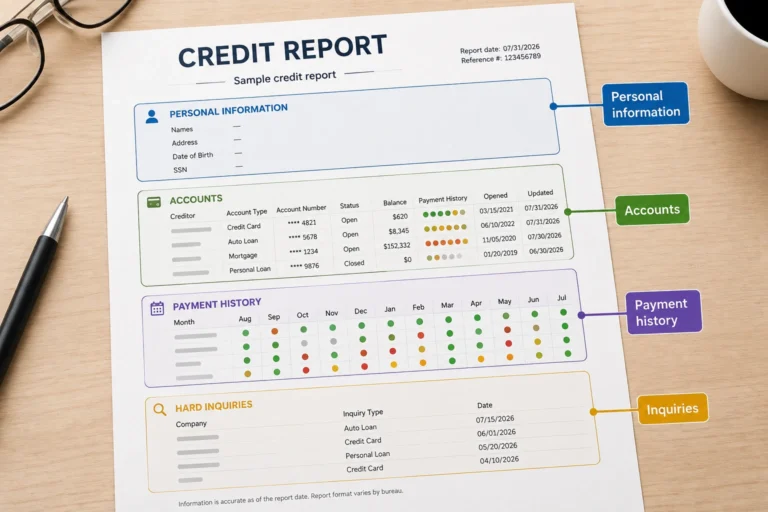
Late payments may appear in the monthly payment-history grid as 30, 60, 90, or 120 days past due. An on-time month may be marked “OK” or displayed through another bureau-specific notation. The relevant question is not simply whether the account now says “current.” The question is whether the specific historical month that was reported incorrectly has been corrected.
Do not confuse current status with historical payment history
The current account status and the historical payment grid describe different parts of the account. An account can be current today while still showing an older late payment.
| What changed | What it may mean |
|---|---|
| Current status changed to “current” | The account is not currently reported as past due |
| Past-due balance changed to $0 | No amount is currently reported as past due |
| A monthly status changed from 30 days late to on time | The specific late-payment month appears to have been corrected |
| A dispute comment disappeared | The investigation or dispute notation may have changed |
| The entire tradeline disappeared | The full account may have been removed, not just one late-payment mark |
If the account layout is confusing, review this step-by-step guide to how to read your credit report before comparing the old and new versions.
Check every bureau where the late payment appeared
Experian, Equifax, and TransUnion do not always contain identical information. A lender may report to one, two, or all three bureaus, and updates may reach the bureaus at different times.

Use AnnualCreditReport.com, the federally authorized source for free credit reports, to review the relevant reports. The service currently allows consumers to check each of the three reports free every week, and checking your own reports through the site does not affect your credit scores.
Do not assume that a successful correction with Experian proves that the same change appears on Equifax or TransUnion.
Save the evidence before comparing scores
Keep the old report, the corrected report, and the final dispute or creditor response. For each bureau that showed the late payment, record the account, payment month, old status, new status, and correction date. This gives you a record you can use if the update is missing or the information reappears.
Save the score screen separately, including its bureau, model, version, and calculation date. A report correction and a score notification are different records; an alert alone does not establish which change produced a score movement.
Why didn’t your credit score increase after a late payment was removed?
If a late payment was deleted but your credit score stayed the same, one or more of the following explanations may apply.
1. The displayed score was calculated before the corrected report
Credit reports and credit scores are not updated on one universal calendar date. Lenders submit account information according to their own reporting schedules, and credit-monitoring services may refresh the score they display according to separate schedules.
There is no standard day of the month when every credit report or score must update. A score generally reflects the information in the credit report used when that score was calculated. That means the dates matter.
How to confirm it:
- Find the date of the corrected credit report.
- Find the score calculation, “last updated,” or refresh date.
- Check whether the displayed score predates the corrected report.
Example: The late payment was corrected on July 18, but the score in your banking app was last refreshed on July 12. That displayed score cannot reflect a correction added six days later.

What to do next: Check when the service will provide a fresh score. Do not file another dispute solely because an older displayed score has not changed. For a fuller explanation of the timing, read how long after a dispute your credit score may update.
2. The score uses a different credit bureau
You may have confirmed that the late payment is gone from Experian while checking a score based on TransUnion or Equifax data.
The Consumer Financial Protection Bureau explains why you can have multiple credit scores: lenders use different formulas, credit products, and credit-reporting sources. A correction in one file cannot directly change a score calculated from a different file that still contains the late payment.
How to confirm it: Look for the bureau name next to the score. It may appear as “based on Experian data,” “TransUnion credit file,” or similar wording.
Example: Experian removed a reported 30-day late payment. Your bank displays a TransUnion-based score, and the TransUnion report still shows the late month. The score you are watching may therefore stay the same.
What to do next: Compare the score with the report from the same bureau. If another report contains an actual error, address that specific report rather than disputing the already-corrected Experian file again.
3. You are comparing different scoring models or versions
FICO and VantageScore are different scoring systems, and multiple versions exist within those systems. A lender may also use a score designed for a particular type of credit product.
Two scores can respond differently even when they are based on similar information. You cannot reliably attribute the difference to the removed late payment if the bureau, model, version, provider, or calculation date also changed.
| Score detail | Before correction | After correction |
|---|---|---|
| Score provider | Same monitoring service | Same monitoring service |
| Model and version | FICO Score 8 | FICO Score 8 |
| Credit bureau | Experian | Experian |
| Calculation date | July 12 | July 22 |
This pair uses the same score source. The July 22 calculation can reflect a July 18 correction; the July 12 calculation cannot. The later score is still not guaranteed to be higher. Replacing either score with a different bureau or model would make the comparison less useful.
Comparison rule: Whenever possible, compare scores from the same provider, scoring model, model version, credit bureau, and reporting period.
4. Only one late-payment month was removed
An account may contain several consecutive late-payment marks. Correcting one month does not automatically remove the others.
- February: 30 days late — removed
- March: 60 days late — still reported
- April: 90 days late — still reported
The February correction may be valid, but the account still shows more serious delinquencies in March and April.
FICO evaluates late payments by recency, severity, and frequency. A recent 90-day delinquency may therefore continue to matter after an earlier 30-day late payment is corrected.
How to confirm it: Review the entire monthly payment-history grid, not only the disputed month or current account status.
What to do next: Determine whether every remaining late month is accurate. Do not dispute accurate late payments merely because they are negative. You can learn more about how long a late payment can affect your credit score.
5. The removed late payment was already old
An older late payment may have had less influence immediately before removal than a recent delinquency. FICO specifically explains that a late payment falling off after seven years may produce no noticeable score change because its remaining impact was already small. Other changes in the file also matter.
A late payment aging off after years of recovery is different from correcting a recent reporting error. Neither situation comes with a fixed number of points, and a correct report is still worth pursuing even when the displayed score stays the same.
| Removed information | Other report information | Why the outcome may differ |
|---|---|---|
| Recent 30-day late payment | Otherwise clean payment history | The correction may be more meaningful to the complete file |
| Six-year-old 30-day late payment | No recent delinquencies | The older mark may already have had less influence |
| Old 30-day late payment | A recent 90-day late remains | The newer and more severe delinquency may remain more important |
| One late month removed | Several other late months remain | The pattern of delinquency is still present |
Official scoring information does not provide a guaranteed number of points for removing one late payment. FICO states that the effect of a credit action depends heavily on the consumer’s starting credit profile and the complete file before and after the change.
6. The entire account was removed instead of one late-payment mark
If the entire tradeline disappeared after the dispute, more changed than the late payment. The report may also have lost:
- The account’s credit limit
- Its opening date
- Its remaining positive payment history
- Its balance and account status
- Its contribution to your total available revolving credit

This possibility is particularly important when the removed account was a credit card. Losing the account’s credit limit can increase overall revolving utilization if other card balances remain.
Utilization formula:
Total reported credit card balances ÷ total reported credit card limits × 100
Before the account disappeared:
- Total card balances: $2,000
- Total card limits: $15,000
- Overall utilization: 13.3%
After a $5,000-limit card with a $0 reported balance disappeared:
- Total card balances: $2,000
- Total card limits: $10,000
- Overall utilization: 20%
This example does not prove that utilization caused a particular score result. It shows why you must compare the entire file rather than looking at the removed late payment in isolation. The CFPB identifies both closeness to credit limits and length of credit history as factors that can affect a credit score.
7. Other credit information changed at the same time
While the dispute was being investigated, lenders may have submitted other updates. The late-payment correction may therefore appear in the same reporting period as one or more of the following:
- Higher reported credit card balances
- Lower credit limits
- A newly opened account
- A newly closed account
- A recent hard inquiry
- Another late payment
- A newly reported collection or charge-off
How to confirm it: Compare the old and new reports line by line. Do not compare only the disputed account.
Example: A 30-day late payment was removed, but total reported card balances increased from $1,500 to $4,200 before the next score was generated. The score reflects the complete updated report, not just the correction you were watching.
What to do next: Identify every report change that occurred between the two score dates. FICO recommends considering the complete file before and after an action because the effect of one change depends on the starting profile.
8. Other negative information still remains
Removing one inaccurate late payment does not erase unrelated negative or higher-risk information. Your report may still show:
- Another late payment
- A collection account
- A charge-off
- A repossession
- A foreclosure
- A bankruptcy
- High revolving utilization
- Several recent credit applications
This does not mean the late-payment removal was useless. An accurate report is valuable even when the score does not immediately increase. It means only that the removed mark was not the only information considered by the scoring model.
Compare your credit report before and after the correction
The most reliable way to investigate a credit score that did not increase after late payment removal is to create a complete before-and-after change log.
| Report item | Before correction | After correction | Could affect the result? |
|---|---|---|---|
| Investigation status | Pending | Completed | Confirms whether the result is final |
| Disputed payment month | 30 days late | On time | Positive correction |
| Other late months | 0 | 0 | No remaining late months found |
| Account still present | Yes | Yes | No full-account deletion |
| Account credit limit | $5,000 | $5,000 | No change |
| Total card balances | $1,200 | $2,000 | Possible offsetting change |
| Total card limits | $15,000 | $15,000 | No change |
| Hard inquiries | 1 | 2 | Another report change occurred |
| Other derogatory accounts | 0 | 0 | None found |
| Score source | Experian FICO Score 8 | Experian FICO Score 8 | Comparable source |
| Score date | June 1 | July 1 | Compare with the correction date |
Your own numbers will be different. The purpose of the table is to prevent a common mistake: attributing the entire score outcome to one deleted late payment while overlooking an incomplete investigation or several other report changes.
How long after a late payment is removed will your score update?
There is no universal waiting period after removal. Separate the date the report is corrected from the date your score service calculates and displays a new score. A fresh score based on the corrected file can reflect the change; a previously calculated score cannot.
TransUnion explains that reports and scores do not update on one standard day. Routine lender reporting schedules also differ. That does not create a guaranteed 30-day wait or a guaranteed increase after a correction.
| Stage | What to verify | Next step |
|---|---|---|
| The creditor says it approved a correction | The affected bureau’s report still shows the late month | Ask when the correction was sent and which bureaus received it; keep the written response |
| The report is corrected | The score date is earlier than the correction | Check the provider’s next score refresh |
| The report and score are both fresh | The same bureau, model, and version were used | Review other changes and remaining negative information instead of waiting for a promised jump |
If you are applying for a mortgage soon, ask your lender whether documented corrections can be considered through its report-update or rapid-rescore process. A rapid rescore is lender initiated and does not guarantee a higher score.
Why didn’t I get back all the points I lost?
The original score drop is not a guaranteed refund amount. If you lost 60 points when a late payment appeared, deleting it later does not automatically mean your current score must rise by 60 points. The two calculations may involve different balances, account ages, inquiries, remaining late payments, or scoring models.
FICO explains that the effect of a credit action depends on the starting credit profile. Its examples of point losses for a missed payment cannot simply be reversed into a prediction for deletion.
Illustrative example: A late payment appears in May. By October, when it is removed, your reported card balances are higher and you have opened another account. The October score evaluates the October file; it is not a replay of the May calculation. This example explains why comparisons can differ, not how many points those changes would cost.
If you believe the late payment was the only change, first verify that you are comparing the same bureau and score version after the correction. A before-and-after report comparison can narrow the possibilities, but it cannot isolate an exact point value for each factor.
What should you do next?
Your next action should be based on the error or mismatch you actually find—not on the number of points you expected.
| What you found | What to do next |
|---|---|
| The investigation is still pending | Wait for the final result and review the updated report |
| The result says updated, but the disputed month is still late | Identify exactly which field changed and whether an error remains |
| The disputed month still shows 30, 60, 90, or 120 days late | Review the dispute result and identify the exact remaining error |
| The late payment was removed from one bureau but not another | Review the report and dispute history for each affected bureau separately |
| The score predates the corrected report | Check the monitoring service’s next score refresh |
| The score uses a different bureau or scoring model | Compare a score based on the corrected report whenever possible |
| Other late months remain | Confirm whether those months are accurate |
| The entire tradeline disappeared | Review credit limits, account dates, and utilization |
| Another report item is inaccurate | Dispute that specific error and include supporting evidence |
| Everything is accurate, but the score is unchanged | Continue building positive history instead of filing an unsupported dispute |
If the same payment month is still reported inaccurately, follow the proper steps to dispute an inaccurate late payment. Clearly identify the account, month, incorrect status, requested correction, and reason the reporting is wrong.
The CFPB and FTC recommend explaining the specific error and including copies of documents that support your position. Review the types of documents that may support a credit report dispute before sending a follow-up.
Should you dispute the late payment again?
Do not file another dispute only because your credit score did not increase. A follow-up dispute should identify a specific inaccurate or incomplete item, such as the wrong payment month, an incorrect delinquency status, a payment that was made on time, or a correction that is still missing from the updated report.
| Situation | Dispute again? |
|---|---|
| The dispute is still pending | No—wait for the final result |
| The score stayed the same, but the report is accurate | No |
| The corrected month still shows an inaccurate late status | Possibly, with specific evidence |
| Another accurate late payment remains | No |
| The wrong account or wrong month is reporting | Dispute the specific error |
| The entire account disappeared unexpectedly | First ask the bureau or furnisher what was changed |
| The displayed score uses older data | No credit-report dispute is needed |
Filing a dispute does not affect a credit score by itself. The score may increase, decrease, or stay the same depending on whether the investigation changes information used by the scoring model.
The Federal Trade Commission also explains that accurate negative information may remain on a credit report. Disputes are intended to correct inaccurate or incomplete information, not to remove an accurate late payment simply because it hurts a score.
What if the reports are accurate but the score stays the same?
If the late payment has been correctly removed, the relevant reports are accurate, and you are comparing the same type of score, there may be no additional reporting error to fix.
Your practical next steps are:
- Make every required payment on time.
- Review reported credit card balances and limits.
- Avoid unnecessary credit applications.
- Monitor the same bureau and scoring model whenever possible.
- Keep copies of the corrected reports and dispute results.
Credit improvement is generally built through accurate reporting and consistent financial behavior over time. Use this structured plan to rebuild your credit after late payments once there is no remaining error to dispute.
Late payment removal checklist
- ☐ I confirmed that the dispute or correction is complete.
- ☐ I reviewed the final investigation result.
- ☐ I downloaded a new credit report instead of reviewing an old screenshot.
- ☐ I checked every bureau where the late payment previously appeared.
- ☐ I verified the exact creditor, account, month, and delinquency status.
- ☐ I confirmed that the historical month changed—not only the current status.
- ☐ I know which bureau is connected to the score I am viewing.
- ☐ I know whether the score is FICO, VantageScore, or another model.
- ☐ The score was calculated or refreshed after the corrected report.
- ☐ The full account is still present on the report.
- ☐ I compared credit limits and balances before and after the correction.
- ☐ I checked for other late payments, collections, charge-offs, and inquiries.
- ☐ I identified a specific reporting error before considering another dispute.
- ☐ I saved the dispute result, reports, and supporting documents.
Frequently asked questions
Does removing a late payment always increase your credit score?
No. Correcting an inaccurate late payment changes the information in the credit report, but it does not guarantee a visible score increase. The outcome depends on the complete credit file, the bureau, the scoring model, the model version, and other information present when the score is calculated.
How do I know whether the late-payment correction is complete?
Review the final investigation result from the credit bureau or creditor. Look for wording such as “updated,” “deleted,” “removed,” “verified,” or “remains unchanged.” Then open the new credit report and inspect the exact account and month. A pending dispute status or app notification alone does not confirm the final correction.
How long after a late payment is removed will the score update?
There is no universal number of days that guarantees an update or an increase. Credit reports update when furnishers and bureaus process new information, while a monitoring service may refresh its displayed score on a separate schedule. Compare the corrected report date with the score’s calculation or refresh date.
Can a late payment be removed with no change in the score?
Yes. A score can increase, decrease, or stay the same after a dispute, depending on what information changed and what else appears in the credit report used for the calculation. An unchanged score does not by itself prove that the correction failed.
Why did one credit score increase while another stayed the same?
The scores may use different credit bureaus, scoring models, versions, providers, or calculation dates. Verify all five details before treating the two numbers as a direct before-and-after comparison.
Why did my score drop after a late payment was removed?
Check whether the entire account disappeared and whether balances, limits, inquiries, or other negative information changed during the same period. The score reflects the full report used in the calculation, not only the removed late payment.
Does removing an old late payment improve your score?
It may, but the result cannot be predicted from the age of the item alone. FICO considers the recency, severity, and frequency of late payments, as well as the rest of the credit file. An older late payment may have had less influence immediately before removal than a recent one.
Should I dispute again if my score stayed the same?
Not unless a specific inaccurate or incomplete item remains on the report. A score that did not increase is not itself a credit-report error. Identify the exact account, month, status, balance, limit, or date that is wrong before filing another dispute.
How can I tell whether the late payment or the whole account was deleted?
Compare the entire tradeline before and after the correction. Check whether the creditor name, account number, opening date, account status, credit limit, balance, and monthly payment history are still present. If all account information disappeared, the full tradeline may have been removed.
Final takeaway
A late payment can be removed correctly without producing an immediate or visible credit score increase. First confirm that the dispute or correction is complete. Then verify the corrected month on every relevant report, identify the bureau and scoring model behind the score, compare the report and score dates, and check whether the entire account or other credit data changed. If a specific reporting error remains, dispute that error with evidence. If the reports are accurate, focus on consistent on-time payments, manageable reported balances, and comparable score tracking over time.
Related guides
- Late payments hub — reporting, removal, disputes, recovery, and prevention.
- How often does your credit score update? — understand why a correction may not change a score immediately.
- Can you remove late payments from your credit report? — review correction and goodwill options.
Sources
Source check: October 4, 2026. The scenarios and arithmetic in this guide are illustrative; they are not results from a credit-scoring simulation.
- Consumer Financial Protection Bureau: Understand your credit score
- Consumer Financial Protection Bureau: How to dispute an error on your credit report
- AnnualCreditReport.com: Free weekly credit reports
- FICO: How FICO Scores consider late payments
- FICO: How credit actions affect FICO Scores
- Experian: How credit report disputes affect your credit
- TransUnion: How to read your dispute investigation results
- TransUnion: How often credit reports and scores update
- Federal Trade Commission: Disputing errors on your credit reports
Financial disclaimer: This article is for general educational purposes and is not financial, legal, or credit-repair advice. Credit reports, scoring models, and individual credit profiles vary. Fix My Money Life does not guarantee the removal of accurate information or any particular credit score change. Review your own reports and consider speaking with a qualified professional about your specific situation.