In this guide
- How much interest can a collection agency charge?
- Reconstruct the balance before disputing it
- Quick decision tree: is the added interest worth disputing?
- Dispute unsupported interest in writing
- Check the underlying bill when the debt is medical
- Get interest terms in writing before agreeing to pay
- Correct inaccurate credit reporting separately
- What to do if the collector will not explain the charges
- Frequently asked questions
- Sources
Can a collection agency charge interest on a debt? Yes, but not automatically. The Consumer Financial Protection Bureau explains that a debt collector may not collect interest or fees unless the amount is authorized by the agreement creating the debt or permitted by law. A collection agency does not gain a new right to add interest merely because the account was assigned or sold to it.
- What contract term or law authorizes the interest?
- What rate, dates, and balance were used?
- Did payments and credits reduce the balance correctly?
- Does state law or a court judgment change the permitted rate?
If your collection balance has increased, check two things separately: whether each added charge is allowed and whether the calculation is correct. A total can add up perfectly and still include an unauthorized fee. For related ownership, balance, payment, and reporting questions, browse the Collections hub.
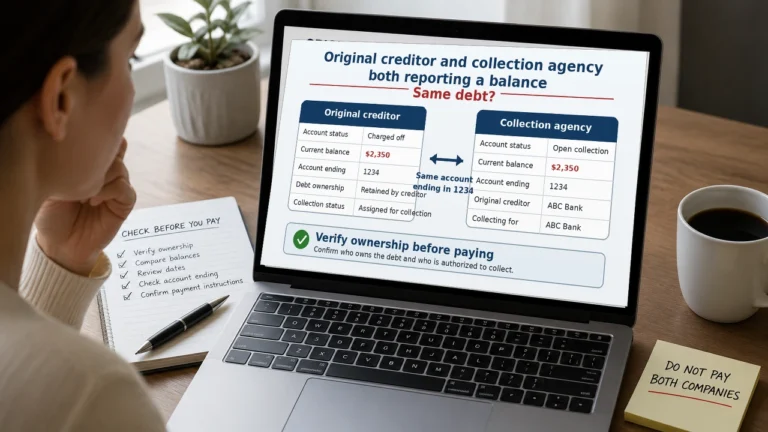
If the original creditor and a collection agency show different amounts for the same account, compare ownership and reporting dates before attributing the difference to interest. Use our guide to an original creditor and collection agency both reporting a balance to separate a sold account, an assigned collection, and a missing payment.
The federal rules discussed here generally cover collection of personal, family, or household debts by third-party collectors, including many debt buyers. They generally do not cover business debts or collection by the original creditor. State laws may provide additional protections.
Sources checked: September 16, 2026.
How much interest can a collection agency charge?
There is no single interest rate that applies to every collection account. The permitted rate depends on the agreement and applicable law. A contract clause does not override a legal restriction, and an agreement that says nothing about interest does not settle the question if a law separately permits it.
Ask the collector to identify the rate, the period it covers, and the contract provision or law it relies on. If the rate changed, request the previous rate, the new rate, the effective date, and the basis for the change.
Keep interest separate from collection fees, late fees, and payment-processing charges. Permission to charge interest is not a blanket authorization for every other fee. Each added amount needs a basis in the agreement or law.
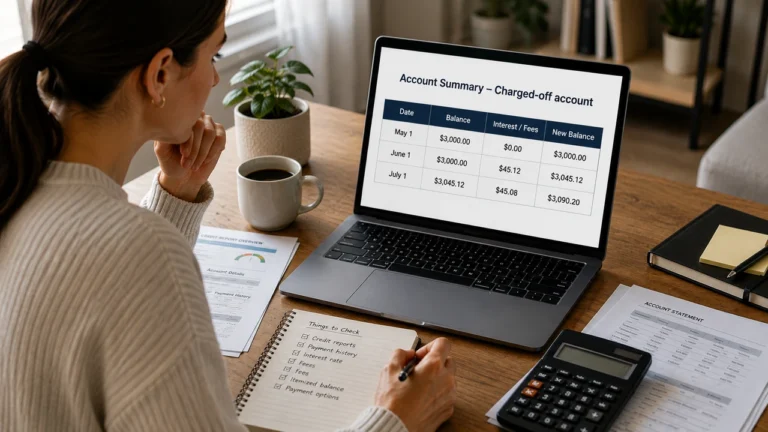
If the increase appears on the original creditor’s charged-off account rather than a collection agency’s account, see why a charge-off balance may be increasing.
Check for a court judgment before using the original rate
If a court has entered a judgment, post-judgment interest rules may apply. Federal judgments and state judgments do not necessarily use the same rate or calculation. Ask for the court name, case number, judgment date, and a copy of the judgment, then check the rules for that court. Do not automatically use your old credit card rate or a federal judgment rate for a state-court judgment.
Reconstruct the balance before disputing it
Start with the collector’s validation notice. It generally must show a reference date, the amount owed on that date, subsequent interest and fees, payments and credits, and the current amount claimed. Check any accompanying itemization pages as well.
The starting amount is not necessarily your original principal. It can already contain earlier interest or fees. A notice showing $0 in new interest therefore does not prove that the balance contains no interest.
Example: separate the interest from a questionable fee
Suppose a collector provides this breakdown. These figures are hypothetical, not an estimate of what your account should show.
| Balance component | Example amount | What to check |
|---|---|---|
| Amount on the reference date | $1,200.00 | Does a statement or account history support this starting amount? |
| Interest added afterward | +$35.51 | What rate, dates, and calculation produced it? |
| Collection fee | +$60.00 | What contract provision or law authorizes this particular fee? |
| Payments and credits | $0.00 | Do your receipts and payment records agree? |
| Current amount claimed | $1,295.51 | Does the arithmetic match the listed components? |
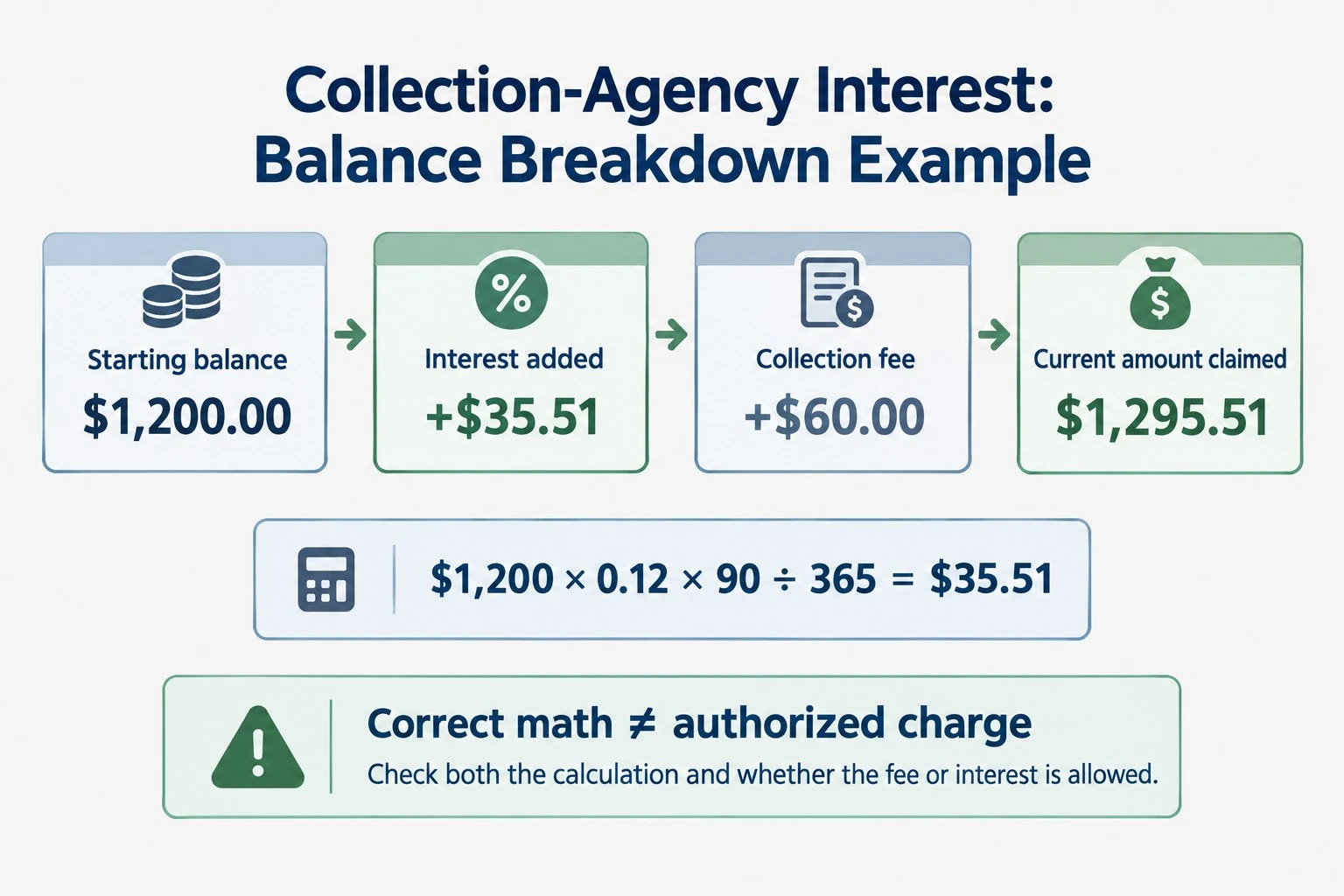
The arithmetic works: $1,200 + $35.51 + $60 = $1,295.51. That does not establish that either added charge is lawful.
Now suppose the $1,200 is entirely principal, the permitted rate is 12% annual simple interest, and interest runs for exactly 90 days. Assume a 365-day calculation, no payments, and no compounding:
$1,200 × 0.12 × 90 ÷ 365 = $35.51 in interest, rounded to the nearest cent.
Under those assumptions, the interest matches. The $60 fee still needs its own justification. If neither the agreement nor applicable law authorizes it, that is the specific charge to challenge.
Do not apply this shortcut to an account with changing balances, different day-count rules, multiple rates, or compound interest. Request the collector’s calculation and payment history instead. Compare the same dates and find out when each payment was credited.
Quick decision tree: is the added interest worth disputing?
Use this sequence before you send a dispute. It helps separate a real balance problem from a charge that is authorized and correctly calculated.
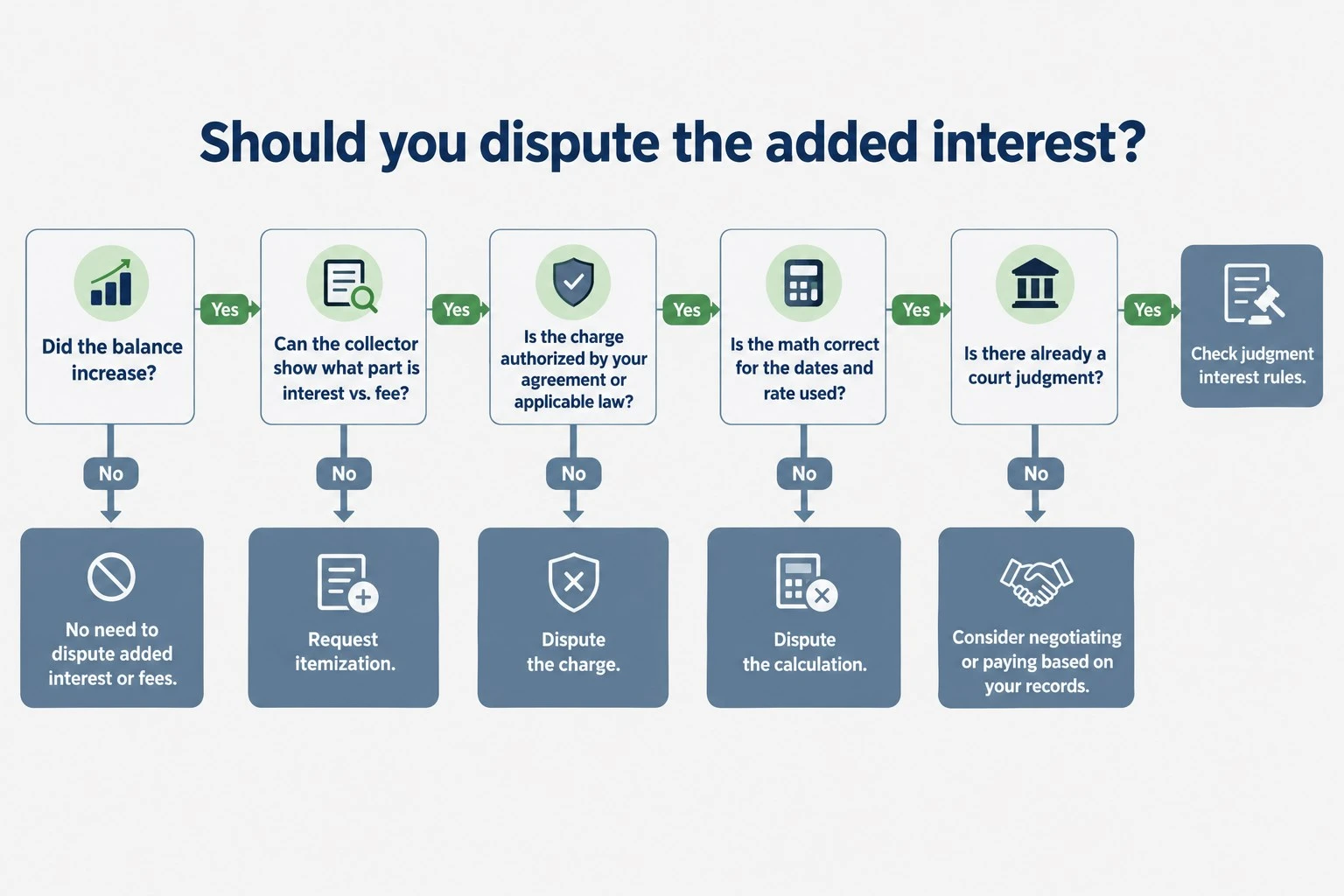
- Can the collector show the starting balance? Compare the validation notice with statements, account records, and any payment history you have. If you cannot tell how the collector reached the starting amount, request an itemization before trying to recalculate the balance yourself.
- Is the increase actually interest? Separate interest from collection fees, late fees, convenience fees, court costs, and other additions. Each type of charge may have a different legal or contractual basis.
- What authorizes the charge? Ask the collector to identify the agreement provision or law that permits the interest or fee. A collector generally may not collect an added amount unless the agreement creating the debt expressly authorizes it or applicable law permits it.
- Does the math match the stated terms? Check the rate, dates, balance used for the calculation, payments and credits, and whether the collector used simple or compound interest. A lawful rate can still produce a wrong balance if the collector used the wrong dates or failed to credit a payment.
- Are you still within the validation period? If the notice gives you time to dispute and you believe part of the amount is wrong, a timely written dispute can trigger important federal protections for the disputed amount while the collector verifies it.
- Is the debt old or has a court judgment been entered? Do not assume the original contract rules still answer every question. State limitation periods and judgment-interest rules may change what you should check before paying or acknowledging the debt.
If you find a calculation error, dispute the specific amount and show your math. If the calculation works but the collector cannot identify authority for the charge, dispute the unsupported interest or fee. If both the authority and the calculation check out, you may get more value from negotiating the payoff terms than from alleging an error that the records do not support.
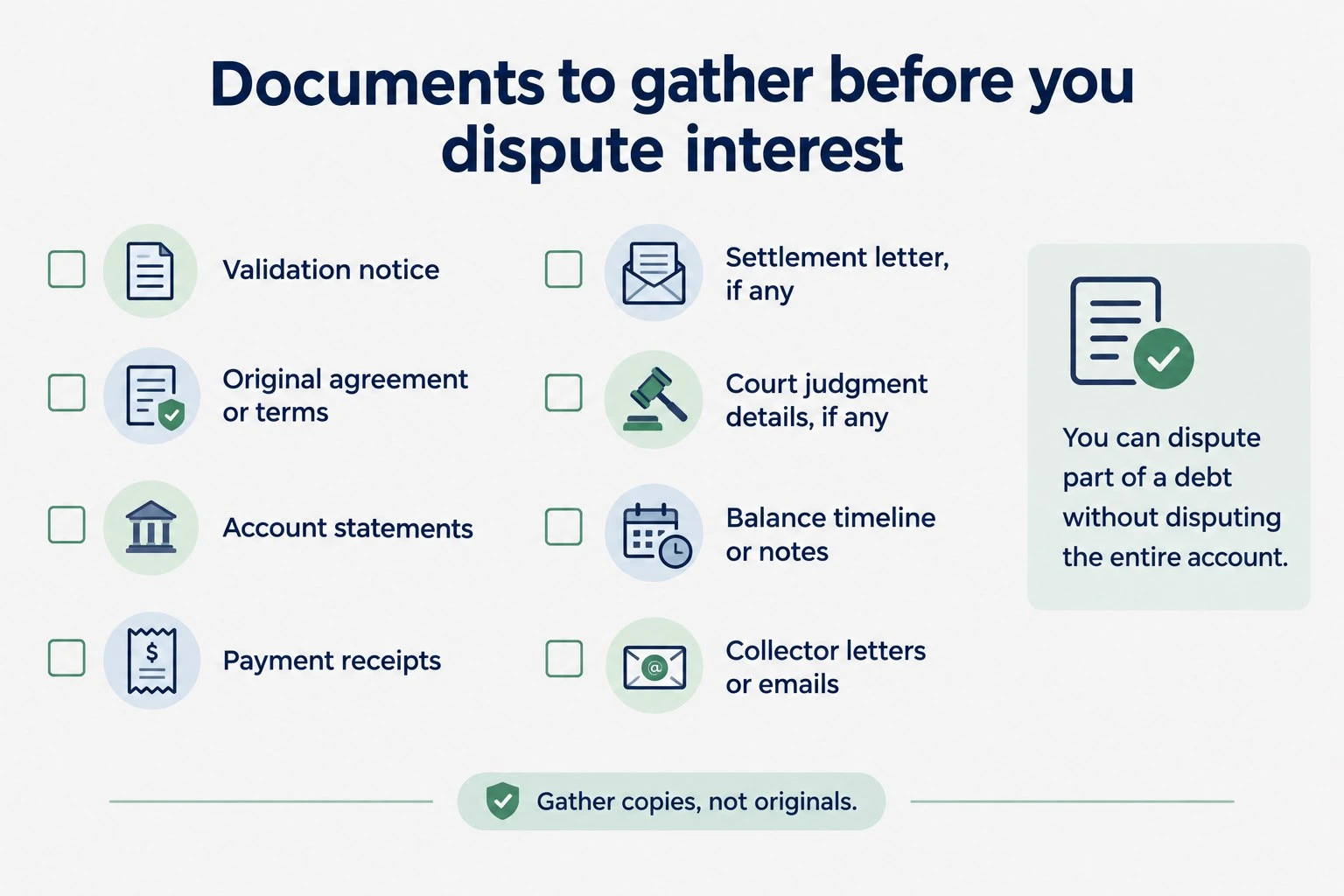
Documents to gather before you write
- The collector’s validation notice and any balance itemization.
- The original agreement or the most relevant account terms you can obtain.
- Statements showing the balance before collection.
- Receipts, bank records, or confirmations for payments and credits.
- Any prior settlement, payment-plan, or payoff agreement.
- A court judgment or case information if the debt went to court.
Keep a simple timeline with the date of each notice, payment, balance change, and dispute. That makes it easier to identify exactly when the balance changed and to explain the problem without disputing accurate parts of the account.
Dispute unsupported interest in writing
If you believe an added amount is wrong, identify the disputed charge and explain why. You can dispute part of a debt without claiming that the entire account is not yours.
Check the response deadline on the validation notice. Generally, a written dispute submitted within the 30-day validation period requires the collector to stop collecting the disputed debt or disputed portion after receiving it, until it sends verification or a copy of a judgment. Do not wait for a phone representative to investigate while that deadline passes.
Send your dispute to the address on the notice or through an electronic channel the collector accepts for consumer communications. Save the message, attachments, and submission confirmation. For mail, consider certified mail with a return receipt, and keep copies of what you sent.
For a printable starting point and a submission tracker, use our debt validation letter template. Adapt the request to the exact interest or fee you dispute; do not claim the entire debt is wrong if that is not your concern.
Check the age of the debt before making promises
For an old debt, get state-specific legal advice before making a payment, promising to pay, or acknowledging the debt in writing. Depending on state law, those actions can restart the period for suing to collect. A collector cannot sue or threaten to sue over a time-barred debt.
That lawsuit deadline is a different issue from how long information can appear on a credit report. See whether paying a collection restarts the seven-year reporting period.
Template: dispute an added amount and request the calculation
Use only statements that are true for your situation. Replace the brackets and attach copies of relevant records, not originals.
Date: [Date]
From: [Your name and mailing address]
To: [Collector’s name and dispute address]
Re: [Account or reference number from the notice]I am writing about your notice dated [date], which lists a balance of [amount]. I dispute [identify the interest, fee, or other amount] because [briefly explain the specific issue].
Please verify the disputed amount and provide a written explanation of how you calculated it. To help me review the balance, please provide:
- The starting balance and reference date, with a breakdown of any earlier interest or fees included in that balance.
- The interest rate or rates, the dates covered, the balance used, and the calculation method.
- Each added fee, each payment or credit, and the date it was applied.
- The agreement provision or applicable law relied on for the disputed interest or fee.
I have attached [describe supporting documents, if any]. Please send your response to the mailing address above. This letter disputes the stated amount and requests information; it is not a promise to pay.
[Your name]
The template requests records that can help you evaluate the charge. It does not mean federal verification rules require every listed document, including an original signed contract, in every case. The rule requires verification before the collector resumes the covered collection activity.
What the dispute does not do
A collection pause is not an automatic interest freeze. The verification requirement does not itself change lawful interest terms or erase the balance. Ask whether interest is continuing to accrue while the dispute is reviewed.
The federal validation rule also does not give collectors a universal 30-day deadline to answer your dispute. Do not confuse your response window with a deadline that automatically cancels the debt if the collector stays silent.
You can still dispute an incorrect amount after the validation period, but the same automatic collection pause generally does not follow from a late dispute.
Check the underlying bill when the debt is medical
For a medical collection, verify the amount owed to the provider before analyzing added interest. Request an itemized bill and compare it with insurance payments, adjustments, your payment receipts, and any financial assistance already applied. Ask the provider’s billing office to explain discrepancies.
For example, suppose an $800 bill received a $600 insurance payment and a $50 payment from you, with no other adjustments. That leaves $150. If a collector asks for $250, the extra $100 needs an explanation. It might reflect an added charge or a payment that was not credited; the larger total alone does not tell you which.
Ask the collector to separate the provider’s remaining balance from any interest and fees. Then request the authority for each addition. Medical debt is not automatically interest-free, but the collector must still have a basis in the agreement or law for added charges. State protections may also apply.
Get interest terms in writing before agreeing to pay
Once you have verified the debt and considered any age-related legal issues, you can ask the collector to waive accrued interest, stop future interest, or accept a fixed settlement. These are requests to negotiate, not guaranteed rights. Get any agreement and the collector’s promises in writing before making the agreed payment.
A useful request is:
Please send the proposed agreement in writing. Specify the total amount I would pay, the due dates, whether existing interest and fees are included or waived, and whether additional interest will accrue. Confirm whether completing the agreed payments will satisfy the debt with no remaining balance, and explain what happens if a payment is late.
For a lump-sum payoff, request a quote that states how long the amount remains valid and when payment must be received. For installments, ask how payments will be applied and whether waived charges can return after a missed payment.
Do not assume that paying only the original principal settles the entire account. If lawful interest or fees remain, the payment may leave a balance. An agreement to accept less should clearly state that completing its terms settles the entire debt.
Correct inaccurate credit reporting separately
If the disputed amount also appears on your credit report, address that reporting error with each bureau showing it and with the company that supplied the information. Explain the specific balance error and include supporting records. A request to verify a collection balance and a credit-report dispute serve different purposes.
Compare the report’s balance and update date with the collector’s dated records. In your dispute, identify the exact entry, the amount you believe is wrong, and the correction your evidence supports. These documents that support a credit-report dispute can help you organize the submission.
If you already completed a payoff or settlement, attach the written agreement and payment confirmation. For that situation, follow the steps for a paid collection still showing a balance.
Challenge actual inaccuracies. An objection to one fee is not a reason to falsely dispute ownership of the account or demand removal of otherwise accurate information.
What to do if the collector will not explain the charges
Follow up with the unresolved issue, rather than repeating a general request. For example:
Your response lists $60 in collection fees but does not identify the agreement provision or law supporting that fee. Please address this specific charge.
If the issue remains unresolved, you can submit a debt-collection complaint to the CFPB and contact your state attorney general’s office. Include the collection notice, your written dispute, delivery evidence, the response, and the calculation or records showing the problem. State clearly what resolution you are requesting.
If you receive court papers, respond by the court’s deadline and seek legal help promptly. A letter to the collector or a complaint to a regulator is not a substitute for responding to a lawsuit.
Frequently asked questions
Can a collection agency keep adding interest after it gets the debt?
Sometimes. Interest or fees may continue only when the amount is permitted by the agreement creating the debt or by applicable law. Ask the collector to identify the basis for each added charge.
Does disputing the amount stop interest from accruing?
Not automatically. A timely validation dispute can pause certain collection activity until verification is provided, but that does not itself freeze lawful interest or fees.
Can I negotiate to stop future interest?
Yes. You can ask the collector to waive accrued charges, stop future interest, or accept a fixed settlement, but those terms are voluntary. Get any agreement in writing before paying.
What if the collector cannot explain the added charges?
Request an itemized explanation and the agreement provision or law supporting the charge. If a documented discrepancy remains unresolved, preserve the records and consider a CFPB complaint, your state attorney general, or qualified legal advice.
Sources
- CFPB Regulation F: interest, fees, and other added amounts
- CFPB Regulation F: validation information
- CFPB Regulation F: disputes and verification
- FTC: Fair Debt Collection Practices Act text
- FTC: Debt Collection FAQs
- CFPB complaint portal
This article provides general U.S. financial and legal information, not individualized advice. Applicable rules depend on the debt, agreement, state law, and any court judgment. Consult a qualified attorney about your specific rights and deadlines.