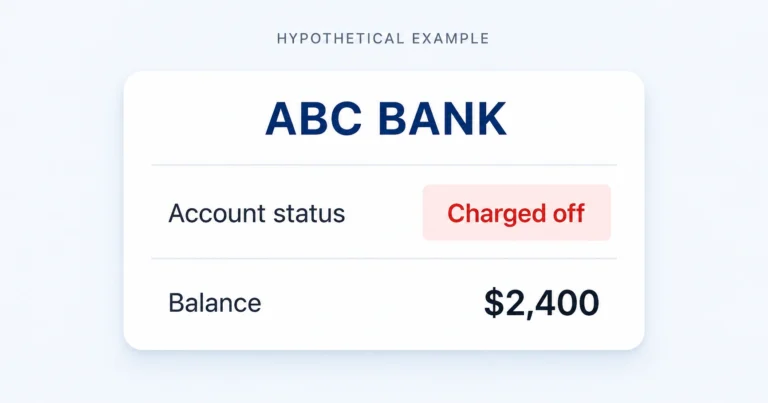
A charged-off account and a sold account are not the same thing. A charge-off means the original creditor treated a seriously delinquent account as a loss for accounting purposes. It does not mean the debt was forgiven, and it does not automatically mean the debt was sold. A sold account means ownership of the debt was transferred to another company.
After a charge-off, the original creditor may keep the debt, hire a collection agency to collect it, or sell it to a debt buyer. That is why seeing “charged off” on your credit report does not tell you, by itself, who owns the debt now.
If you are trying to identify the current owner, check the original creditor’s balance and account remarks, any related collection account, and the current creditor identified in debt collection information you received. A $0 balance or a “sold” or “transferred” remark can be a useful clue, but neither should be treated as proof on its own.
If you need to understand the account status first, see what a charge-off means on your credit report.
Quick comparison: charged off, assigned for collection, or sold
The key difference is ownership. A charge-off describes how a creditor treated a seriously delinquent account for accounting purposes. Assigning a debt for collection means another company is collecting it on behalf of the creditor that owns it. Selling a debt means ownership was transferred to a new company.
| What to compare | Charged-off account | Assigned for collection | Sold account |
|---|---|---|---|
| What does it mean? | The creditor treated the seriously delinquent account as a loss for accounting purposes. | A collection company is collecting the debt for the creditor that owns it. | Ownership of the debt was transferred to a new owner. |
| Who owns the debt? | The original creditor may still own it, or the debt may later be sold. | The creditor that assigned the account for collection still owns the debt. | The debt buyer or other company that purchased the debt owns it. |
| Does this event erase the debt? | No. | No. | No. |
| Does this mean the debt was sold? | No. | No. | Yes. A sale involves a transfer of ownership. |
| Can a collection company contact you? | Yes. The creditor may use a third-party collector. | Yes. The collector is acting on behalf of the creditor. | Yes. The new owner may collect directly or use another collection company. |
| What should you verify? | Who currently owns the debt and who is authorized to collect it. | The current creditor and whether the collector is working on its behalf. | The current creditor, account details, amount claimed, and who is authorized to collect. |
A collection company contacting you does not automatically mean it bought the debt. It may simply be collecting for another creditor. If you need to separate those situations, see charge-off vs. collection.
Before deciding who to contact or pay, verify the current creditor using more than one piece of information. A charge-off status, a $0 balance, a “sold” or “transferred” remark, or a collection account can provide useful clues, but none should be treated as proof of ownership on its own.
Does a charge-off mean the debt was sold?
No. A charge-off does not automatically mean the debt was sold. After charging off an account, the original creditor may keep the debt, assign collection activity to another company, or sell the debt to a debt buyer.
The original creditor keeps the debt
A creditor can charge off an account and still own the debt. In that situation, the creditor may continue collecting the balance itself. The “charged off” status describes what happened to the delinquent account for accounting purposes; it does not tell you that ownership changed.
The creditor assigns the debt for collection
The original creditor may keep ownership but hire a collection agency to collect the debt. If a collector contacts you, that alone does not mean the collector bought the account. Check who is identified as the current creditor and whether the collection company says it is collecting on that creditor’s behalf.
The creditor sells the debt to a debt buyer
The creditor may also sell the charged-off debt. When an outright sale occurs, ownership transfers to the buyer. The debt buyer may collect the account itself or hire another collection company.
What the account details may tell you
| What you see | What it may mean | What to verify next |
|---|---|---|
| Charged off and the original creditor still reports a balance | The original creditor may still own the debt. | Check who is identified as the current creditor and whether another company is collecting on its behalf. |
| Charged off and a collection company contacts you | The debt may have been assigned for collection or sold. | Ask whether the collection company owns the debt or is collecting for another creditor. |
| Charged off, the original creditor reports a $0 balance, and the account says “sold” or “transferred” | The debt may have been sold or transferred. | Confirm the current creditor using collection information and matching account records. |
Bottom line: “Charged off” tells you what happened to the account, not who owns the debt now. Determine ownership by verifying the current creditor and matching account information instead of relying on a single credit-report field.
Sold debt vs. assigned debt: how to tell the difference
If a debt is assigned for collection, another company collects it while the creditor keeps ownership. If the debt is sold, ownership transfers to the buyer. A collection company contacting you does not, by itself, tell you which situation applies.
When a debt is assigned for collection
A creditor may hire a collection agency without selling the account. In that situation, the agency collects the debt on the creditor’s behalf but does not become the owner simply because it is contacting you.
Check the collection information for the current creditor. If the collector identifies another company as the creditor to whom the debt is owed, the collector may be acting on that company’s behalf rather than collecting a debt it owns.
When a debt is sold
When a debt is sold outright, ownership transfers to the buyer. The buyer may collect the debt directly or hire another collection company, so the company contacting you may still be different from the company that owns the debt.
Debt buyer vs. collection agency
| What to compare | Debt buyer | Collection agency working for another creditor |
|---|---|---|
| Owns the debt? | Yes, if it purchased the debt. | No, if it was hired only to collect for another creditor. |
| Can it collect the debt? | Yes. It may collect directly or use another collector. | Yes. It collects on behalf of the creditor it represents. |
| Does the company contacting you prove ownership? | No. Another collector may be working for the debt buyer. | No. Contact from a collection agency does not mean it purchased the debt. |
| What should you verify? | That it is identified as the current creditor and the account details match your records. | Which creditor it represents and whether the account details match your records. |
Quick check: sold or assigned?
| What you find | What it may mean |
|---|---|
| The collector says it is collecting for the original creditor | The debt may have been assigned for collection rather than sold. |
| A different company is identified as the current creditor | The debt may have been sold or otherwise transferred to that company. |
| The company contacting you is different from the current creditor | The collector may be working on behalf of the current creditor. |
| You cannot identify the current creditor | You do not yet have enough information to determine ownership. Verify the creditor and account details before deciding who to pay. |
Bottom line: assignment changes who is collecting the debt; a sale changes who owns it.
How to tell if your charged-off debt was sold
You usually cannot tell whether a charged-off debt was sold from the “charged off” status alone. Compare the original account, any related collection account, the current creditor named in the debt collector’s validation information, and the account details in your own records.
Who owns my debt? Follow this decision path
| What to check | What you find | What it may mean | What to do next |
|---|---|---|---|
| Collection or validation information | The original creditor is listed as the current creditor | The original creditor may still own the debt while another company collects it. | Confirm that the collector is working for that creditor and match the account details. |
| Collection or validation information | A different company is listed as the current creditor | The debt may have been sold or otherwise transferred. | Compare the original creditor, account or reference number, and amount claimed. |
| Original creditor’s credit-report entry | The original creditor still reports a balance | The original creditor may still own the debt. | Check whether any collector says it is collecting on behalf of the original creditor. |
| Original creditor’s credit-report entry | The balance is $0 and the account includes a “sold” or “transferred” remark | The debt may have been sold or transferred. | Identify the current creditor and compare the new account information with your records. |
| Collection account or collection notice | A new company is reporting or collecting the balance | The company may own the debt or may be collecting for another creditor. | Check who is identified as the current creditor instead of assuming the collector owns it. |
| Your records | Creditor names, balances, or account details do not match | You do not have enough consistent information to determine ownership. | Resolve the discrepancy before deciding who to pay or negotiate with. |
What to check on your credit reports
Review your reports from Experian, Equifax, and TransUnion because the information may not be identical across all three. For the original account and any related collection account, check:
- the original creditor’s name;
- the account status;
- the current balance and past-due balance;
- any “sold” or “transferred” remarks;
- the name of any collection company or debt buyer;
- the original creditor identified on a collection account;
- account or reference numbers that help you match the records;
- the reported dates; and
- whether the same debt appears under more than one company name.
If you are not sure where to find these fields, use our guide to how to read your credit report while comparing the accounts.
Check the current creditor in the collection notice
If a debt collector sent you validation information, look for the creditor to whom the debt is currently owed. Compare the original creditor, account or reference number, and amount claimed with your credit reports and other account records.
Do not rely on one clue as proof of ownership. A $0 balance, a “sold” or “transferred” remark, a collection account, or the name of the company contacting you can help you investigate what happened, but each should be checked against current-creditor information and matching account details.
What charged-off and sold accounts can look like on your credit report
A charged-off debt can look different on your credit report depending on whether the original creditor still owns it, assigned it for collection, or sold it to another company. The examples below are hypothetical and show what different patterns may indicate.
Example 1: Charged off but not sold
| Record | What it shows |
|---|---|
| ABC Bank credit-report entry | Status: Charged off Balance: $3,240 |
| XYZ Collections validation notice | Current creditor: ABC Bank Amount: $3,240 |
What this may mean: ABC Bank may still own the debt while XYZ Collections collects on the bank’s behalf.
What to verify: Check that ABC Bank is identified as the current creditor and that the account or reference number and amount in the collection notice match your records.
Example 2: Charged off and sold
| Record | What it shows |
|---|---|
| ABC Bank credit-report entry | Status: Charged off Balance: $0 Remarks: Sold/transferred |
| XYZ Debt Buyer validation notice | Current creditor: XYZ Debt Buyer Original creditor: ABC Bank Amount: $3,240 |
| XYZ Debt Buyer credit-report entry, if reported | Original creditor: ABC Bank Balance: $3,240 |
What this may mean: This pattern may be consistent with ABC Bank having sold or transferred the debt and XYZ Debt Buyer becoming the current creditor. A $0 balance or a “sold” or “transferred” remark is useful evidence, but it should not be treated as proof of ownership by itself.
What to verify: Confirm that XYZ Debt Buyer is identified as the current creditor and match the original creditor, account details, and amount claimed with your records.
Example 3: The original creditor and collector both report a balance
| Record | What it shows |
|---|---|
| ABC Bank credit-report entry | Status: Charged off Balance: $3,240 |
| XYZ Collections credit-report entry | Balance: $3,240 Original creditor: ABC Bank |
What this does not tell you: Seeing the same balance under two company names does not automatically tell you whether the debt was sold, assigned for collection, or reported incorrectly. It also does not mean both companies own the debt.
What to do next: Identify the current creditor, determine whether XYZ Collections owns the debt or is collecting for another company, and compare the balances and account details. If the original creditor and collection agency are both reporting a balance, check that issue separately before deciding who to pay.
Who owns my debt? Verification checklist
Before you contact, negotiate with, or pay anyone, compare the creditor information, account details, balances, and collection records below. No single credit-report field should be used by itself to determine who currently owns a charged-off debt.
Check these details
- Original creditor: Write down the company that originally issued the account.
- Current creditor: If a debt collector sent you validation information, identify the creditor to whom the debt is currently owed.
- Collection company: Note the company contacting you and whether it says it owns the debt or is collecting for another creditor.
- Account or reference number: Compare identifying information with your statements and other records.
- Original creditor’s balance: Check whether the account shows a balance or $0.
- Amount claimed: Compare the collector’s amount with the validation information and your records.
- Account status: Note whether the original account is reported as charged off, closed, sold, transferred, or with another status.
- Sold or transferred remarks: Record the wording, but do not treat it alone as proof of current ownership.
- Original creditor on a collection account: Make sure it matches the account you are trying to identify.
- Reported dates: Compare relevant dates across your credit reports, collection notices, and account records.
- Company names: Check whether the debt appears under the original creditor, a debt buyer, a collection agency, or more than one company.
- Conflicting information: Flag balances, creditor names, account details, or dates that do not match.
What your results may mean
| What you find | What it may indicate | What to do next |
|---|---|---|
| The original creditor is listed as the current creditor | The original creditor may still own the debt. | Confirm whether the collection company is collecting on that creditor’s behalf and match the account details. |
| A different company is listed as the current creditor | The debt may have been sold or otherwise transferred. | Match the original creditor, account information, and amount claimed with your records. |
| The collector identifies another company as the current creditor | The collector may be working for that company rather than owning the debt. | Confirm the collector’s role before deciding who to contact or pay. |
| The creditor names, balances, or account details conflict | The records are not consistent enough to determine ownership confidently. | Resolve the discrepancy before making a payment or entering a settlement. |
| You cannot identify the current creditor | You do not yet have enough information to determine who currently owns the debt. | Review or request additional creditor and account information before discussing payment. |
Bottom line: look for a consistent chain connecting the original creditor, current creditor, account or reference number, and amount claimed.
Who should you pay if the debt was sold?
If the debt was sold, do not automatically send payment to the original creditor. First confirm who is identified as the current creditor and whether the company asking for payment owns the debt or is authorized to collect for that creditor.
| Your situation | What it may mean | What to do before paying |
|---|---|---|
| A debt buyer is identified as the current creditor | The debt may have been sold to that company. | Match the original creditor, account information, and amount claimed with your records. |
| A collection company contacts you, but a debt buyer is listed as the current creditor | The collector may be working for the debt buyer rather than owning the debt itself. | Confirm that the collector is authorized to collect for the current creditor and verify the payment instructions. |
| The original creditor reports a $0 balance and another company is identified as the current creditor | The debt may have been sold or otherwise transferred. | Verify the current creditor and account details before deciding where to send payment. |
| The original creditor still asks you to pay even though another company is identified as the current creditor | The available information may be inconsistent or may not clearly reflect current ownership. | Clarify who currently owns the debt and who is authorized to accept payment. |
| Two different companies appear to claim the same debt | Ownership or account information may be unclear. | Compare creditor names, account or reference numbers, balances, and collection notices before paying either company. |
| You cannot identify the current creditor | You do not have enough information to determine who should receive payment. | Request additional creditor and account information before making a payment or entering a settlement. |
Do not assume the original creditor can still accept payment
After an outright sale, the original creditor is no longer the owner of the debt. An old statement, account name, or credit-report entry from the original creditor is therefore not enough to decide where payment should go. Verify the current creditor and the company authorized to collect before sending money.
Confirm these four details before paying
- Current creditor: Identify the company to whom the debt is currently owed.
- Payment recipient: Confirm whether the company requesting payment owns the debt or is collecting for the current creditor.
- Account match: Compare the original creditor, account or reference number, and amount claimed with your records.
- Payment instructions: Make sure the creditor name, account details, and payment instructions are consistent.
What to verify before paying or negotiating
Before you pay a debt buyer or negotiate a settlement, confirm that the debt matches your records, the current creditor is clear, the amount being claimed can be reconciled with the information you have, and the company requesting payment is authorized to collect. If any of those details conflict, resolve the discrepancy first.
1. Confirm the current creditor
Start with the creditor identified in the debt collector’s validation information. Compare that name with the original creditor, any related collection account, and your other records.
2. Match the debt to your records
Compare the original creditor, account or reference number, and other identifying details with your statements or account records. A matching balance alone is not enough to confirm that two records refer to the same debt.
3. Verify the amount being claimed
Compare the amount in the validation information with the amount the collector is asking you to pay. Review any itemization provided for interest, fees, payments, or credits that may explain why the balance differs from an older statement or credit-report entry.
If you cannot reconcile the amount, ask for clarification before agreeing to pay or settle. A balance difference is something to investigate; it is not automatically proof that the debt is inaccurate.
4. Confirm who is authorized to collect
If the company requesting payment is different from the current creditor, determine whom it is collecting for. Confirm that it is collecting the same account and is acting for the creditor identified in the information you reviewed.
5. Get payment or settlement terms in writing
If you negotiate a settlement or payment arrangement, ask for the agreed terms in writing before sending payment. Check the creditor and account covered by the agreement, the amount you agreed to pay, any payment schedule, where payment should be sent, and what the agreement says the payment will satisfy.
Do not assume that paying or settling the debt will automatically remove accurate negative information from your credit reports or produce a specific credit-score increase.
6. Keep proof of the agreement and payment
Save the validation notice, written agreement, letters or emails, payment confirmations, and relevant account records. These records can help if a question later arises about the balance, payment, or ownership of the account.
Stop and verify first if something does not match
- you cannot identify the current creditor;
- the account or reference number does not match your records;
- the amount claimed cannot be reconciled with the information you have;
- two companies appear to be requesting payment for the same debt;
- the company requesting payment cannot clearly explain whom it represents; or
- you do not recognize the debt.
What to ask a debt collector before paying
Before discussing payment, use the call to verify four things: who the current creditor is, whether the company contacting you owns the debt or collects for someone else, which account it is contacting you about, and how much it says you owe.
Use this phone script to verify the debt
“I’m reviewing my records before discussing payment, and I want to confirm the account information.
What is the name of your company?
Who is the current creditor for this account?
Does your company own the debt, or are you collecting on behalf of another creditor?
Who was the original creditor?
What account or reference number identifies the debt?
What is the current amount you say is owed?
Can you explain any interest, fees, payments, or credits included in that amount?
How can I review the creditor, account, and balance information in writing?”
Write down these details during the call
- the date and time of the call;
- the collection company’s name;
- the representative’s name or ID, if provided;
- the current creditor’s name;
- the original creditor’s name;
- the account or reference number;
- the amount the collector says is owed;
- whether the collector says it owns the debt or is collecting for another company; and
- what written account information the collector says it can provide.
What to do if the answers do not match your records
| What happens on the call | What to do next |
|---|---|
| The current creditor and account details match your records | Compare the balance and written account information before moving on to payment or settlement terms. |
| The collector says it is working for another company | Write down that company’s name and confirm that it is identified as the current creditor. |
| The collector cannot clearly identify the current creditor | Ask for creditor and account information in writing before deciding who to pay. |
| The balance does not match your records | Ask for written balance details and compare them with your records before negotiating payment. |
| You do not recognize the creditor or account | Do not move directly into a payment discussion. Verify the debt and account information first. |
Protect your financial information
Do not provide bank-account, debit-card, credit-card, or other sensitive financial information simply because the caller knows details about the debt. Verify the company, current creditor, and account before providing payment information.
If you discuss a payment plan or settlement by phone, ask to review the agreed terms in writing before sending payment.
How to ask for debt and creditor information in writing
If the current creditor, account details, or balance are still unclear, ask the debt collector for the information in writing before you pay or negotiate. Keep the request focused on identifying the debt, the company to which it is currently owed, the amount being collected, and the collector’s role.
Copyable request for account and creditor information
Subject: Request for account and creditor information
I am reviewing my records regarding the account referenced in your communication.
Please provide the information needed to identify and review this account, including:
- the name of the current creditor;
- the name of the original creditor, if different;
- the account or reference number used to identify the debt;
- the current amount being claimed;
- any available information showing how the current amount was calculated; and
- whether your company owns the debt or is collecting on behalf of another creditor.
I am requesting this information so I can compare it with my records before discussing payment.
Sincerely,
[Your name]
[Date]
What to check when you receive a response
| Information received | What to compare | What to do if it does not match |
|---|---|---|
| Current creditor | Compare the name with your collection notice and other account records. | Ask for clarification before deciding who should receive payment. |
| Original creditor | Compare it with your original statements or account records. | Make sure the response refers to the debt you are trying to identify. |
| Account or reference number | Match the identifying information with your records. | Do not assume two records refer to the same account if the details do not line up. |
| Current amount claimed | Compare it with previous notices, account records, and other balance information. | Ask about unexplained differences before discussing payment or settlement. |
| Collector’s role | Check whether the company says it owns the debt or is collecting for another creditor. | Confirm the current creditor and collector’s role before sending payment. |
Keep this request separate from a formal dispute
This template is designed to help you clarify creditor, account, balance, and collector information. It is not a substitute for a formal debt dispute or another request that may carry specific rights or deadlines under applicable federal or state law.
If you believe the debt, balance, ownership information, or other details are inaccurate, decide separately whether you need to use the applicable dispute or validation process rather than relying only on this general information request.
What if the credit-report information is wrong?
If the creditor name, balance, account details, or collection information on your credit report appears inaccurate or incomplete, identify the exact problem before taking action. Dispute information only when you have a specific reason to believe it is inaccurate, incomplete, duplicated, outdated, or not yours—not simply because it is negative.
Identify exactly what does not match
Compare the credit-report entry with your collection notices, account statements, payment records, and other documents. Look for a specific discrepancy, such as:
- an incorrect current balance;
- the wrong creditor or original creditor;
- an account or collection that does not belong to you;
- account numbers or identifying details that do not match your records;
- an incorrect account status or reported date;
- the same debt appearing more than once; or
- conflicting information between the original creditor, debt buyer, and collection company.
Choose the next step based on the problem
| What you find | What to check | What to do next |
|---|---|---|
| The reported balance appears wrong | Compare the balance with collection notices, payment records, settlement documents, and any available balance itemization. | Identify the specific amount you believe is incorrect and save supporting records. |
| The creditor or account details do not match | Compare the current creditor, original creditor, account or reference number, and other identifying information. | Verify that the entry refers to the debt you are reviewing before disputing it. |
| The same collection appears more than once | Compare collector names, original creditor, balances, account details, and dates. | Determine whether the entries represent different companies in the collection chain or a possible duplicate. |
| The original creditor and another company both show balances | Determine who currently owns the debt and what each company is reporting. | Do not assume the reporting is wrong simply because both companies appear. |
| You do not recognize the account | Compare the creditor, account details, dates, and identifying information with your records. | Do not assume the debt belongs to you. Use the appropriate credit-report error or identity-theft process if the account is not yours. |
Save evidence before disputing an error
- a copy of the credit report showing the disputed entry;
- original account statements;
- collection or validation notices;
- written information identifying the current creditor;
- payment confirmations or receipts;
- settlement agreements, if applicable;
- letters or emails from the creditor or collector; and
- a note identifying the exact field you believe is inaccurate and why.
If you have evidence that information is inaccurate or incomplete, follow the appropriate steps to dispute errors on your credit report. Focus the dispute on the specific information you believe is wrong and include supporting records when available.
If the same debt appears more than once
An original creditor account and a separate collection account do not automatically mean the same debt has been reported incorrectly twice. First determine what each entry represents. If two collection entries appear to describe the same debt, see what to check when the same collection appears twice on your credit report.
Do not dispute accurate negative information just because it hurts your credit
A charge-off, debt sale, or collection account is not automatically an error. If the information is accurate, disputing it simply because you want it removed is not an appropriate use of the dispute process. Focus on information you have a legitimate reason to believe is inaccurate, incomplete, duplicated, outdated, or not yours.
Do not confuse these terms
Charge-off status, debt ownership, and collection activity are separate issues. One does not automatically prove another.
Charged off does not mean forgiven
A charge-off does not erase the debt. It means the creditor treated the seriously delinquent account as a loss for accounting purposes.
Charged off does not mean sold
A creditor can charge off an account and still own the debt. It may continue collecting, hire another company to collect, or sell the debt later.
Sold does not mean assigned for collection
If a debt is sold, ownership changes. If it is assigned for collection, another company may collect while the creditor keeps ownership.
A collection agency does not necessarily own the debt
A collection agency may own a debt it purchased, or it may be collecting for another creditor. The company contacting you and the company that owns the debt are not always the same.
A $0 balance does not prove the debt was sold
A $0 balance reported by the original creditor may be consistent with a sale or transfer, but it is not proof by itself. Compare it with account remarks, collection information, and the identity of the current creditor.
A collection account does not prove the collector owns the debt
A collection account can show that a company is reporting a debt in collection, but it does not, by itself, establish whether that company purchased the debt or is collecting for someone else.
Frequently asked questions
Can a debt be charged off without being sold?
Yes. A creditor can charge off an account and continue to own the debt. It may collect the debt itself, hire another company to collect on its behalf, or sell the debt later.
Why does the original creditor show a $0 balance after a charge-off?
A $0 balance can appear when the original creditor no longer reports an amount owed to it, including in some situations after a debt has been sold or transferred. A $0 balance by itself does not prove that the debt was sold or forgiven. Check the account remarks, related collection information, and current creditor.
Can the original creditor and a debt buyer both appear on my credit report?
Yes. The original creditor’s account may remain on your credit report after the debt is sold, and a debt buyer may also report information if it furnishes account data to the credit bureaus. Two entries do not automatically mean you owe the debt twice. Compare the balances, creditor names, account details, and status of each entry.
Does selling the debt remove the original charge-off from my credit report?
No. Selling the debt does not automatically remove an accurate charge-off reported by the original creditor. The original account can remain on your credit report even though another company now owns or collects the debt.
Can a charged-off debt be sold more than once?
Yes. Ownership of a debt can be transferred from one debt buyer to another. If a new company contacts you, compare the account details and confirm which company is identified as the current creditor before discussing payment.
Sources
- Consumer Financial Protection Bureau — Debt collection key terms
- Consumer Financial Protection Bureau — What information does a debt collector have to give me about a debt?
- Consumer Financial Protection Bureau — Regulation F, § 1006.34: Notice for validation of debts
- Federal Trade Commission — How to get out of debt
- Consumer Financial Protection Bureau — How do I dispute an error on my credit report?
Last reviewed: August 30, 2026
Financial disclaimer: This content is for educational purposes only and is not financial or legal advice. Debt collection rights, payment obligations, and available options can depend on the facts of your situation and applicable federal and state law.