Can you remove late payments from your credit report?

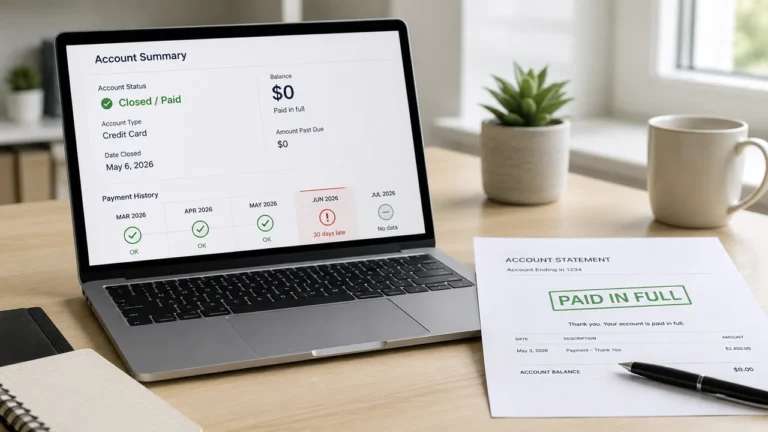
Person reviewing a credit report with a highlighted late payment while checking payment history on a laptop Credit score

If you want to remove late payments from your credit report, the first thing to understand is whether the late payment is accurate or incorrect. An incorrect late payment may be disputed, while an accurate late payment is usually harder to remove and may require a goodwill request.

Late payments can sometimes be removed from your credit report, but it depends on one important thing: whether the late payment is accurate or incorrect. If the late payment was reported by mistake, you may be able to dispute it and ask for the information to be corrected or removed. If the late payment is accurate, removing it is usually much harder.

An incorrect late payment may happen if you paid on time, the lender applied your payment incorrectly, the account does not belong to you, or the payment status was reported wrong. In that case, the next step is to dispute errors on your credit report with clear proof.

If the late payment is accurate, you usually cannot remove it just because it hurts your credit score. However, you may still be able to ask the lender for a goodwill adjustment, especially if it was a one-time mistake, your account is now current, and you had a good payment history before the missed payment.

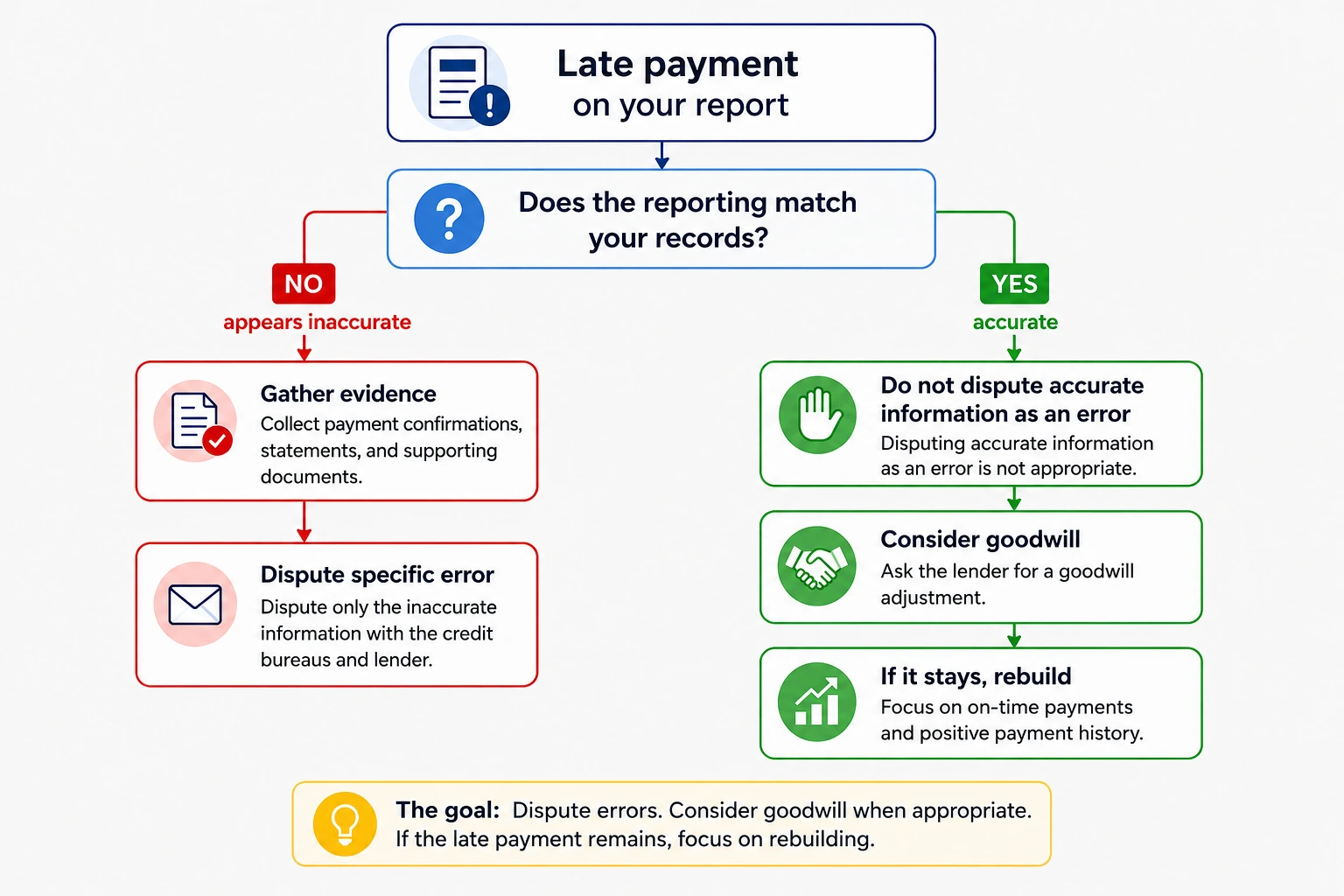
The most important step is to understand which situation you are dealing with first. If the late payment is wrong, you need a dispute. If it is accurate, you may try a goodwill letter. If neither option works, the best next step is to rebuild your credit after late payments with consistent on-time payments.

What counts as a late payment on your credit report?

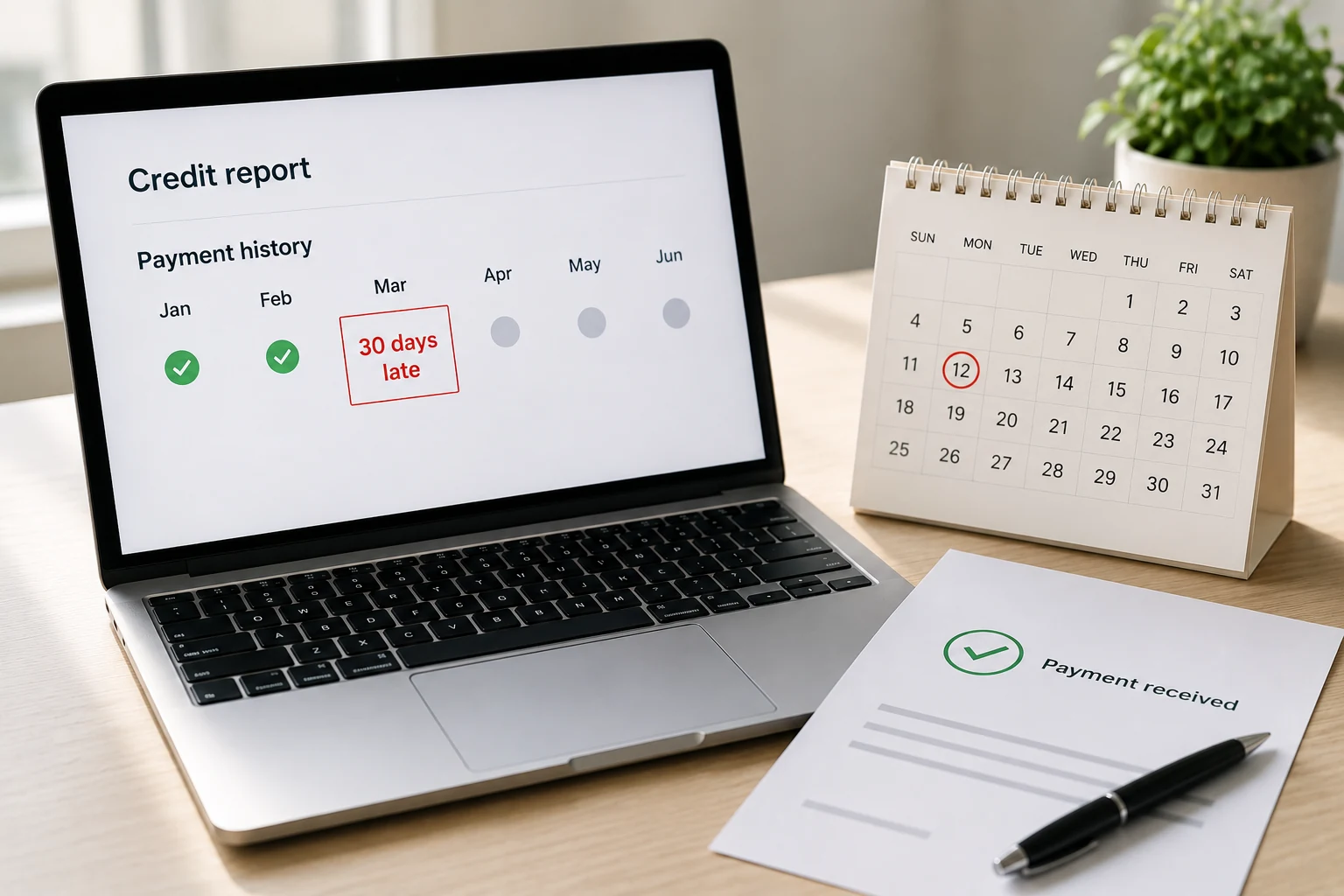
Laptop showing payment history with a highlighted 30-day late payment on a credit report

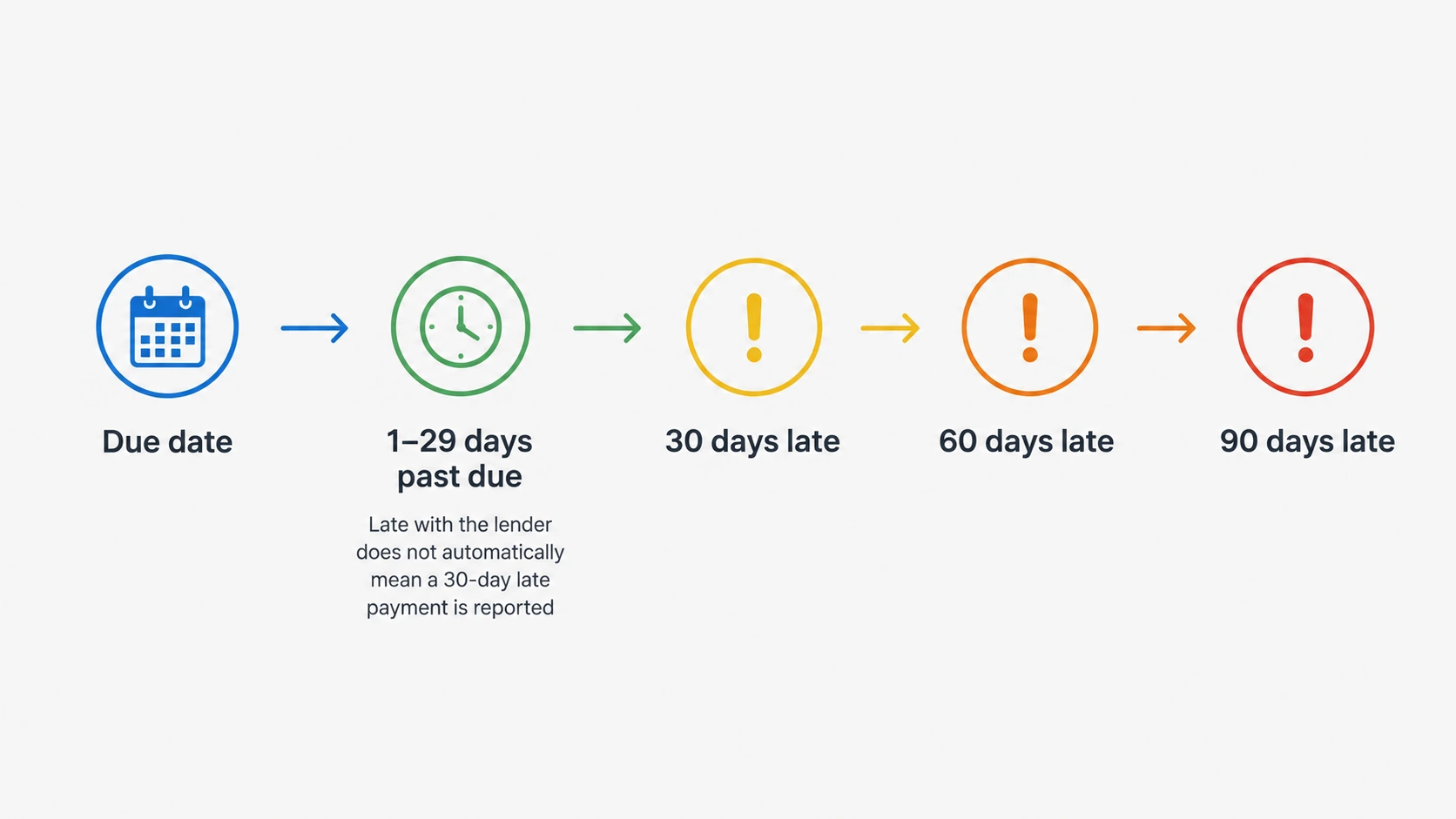
A late payment usually appears on your credit report when you miss at least the minimum payment and the account becomes 30 days or more past due. Being a few days late may lead to a late fee from your lender, but it does not always mean the payment will be reported to the credit bureaus.

Credit reports often show late payments in stages, such as a 30-day late payment, 60-day late payment, 90-day late payment, or worse. The longer the account stays unpaid, the more serious the mark can become. A 30-day late payment is usually less severe than a 90-day late payment, but both can hurt your credit score.

This is why it is important to check the exact payment history on your credit report before you try to remove anything. Look at the account name, the reported month, the payment status, and whether the late payment appears on one, two, or all three credit reports. If you are not sure where to start, first learn how to read your credit report so you can understand what is actually being reported.

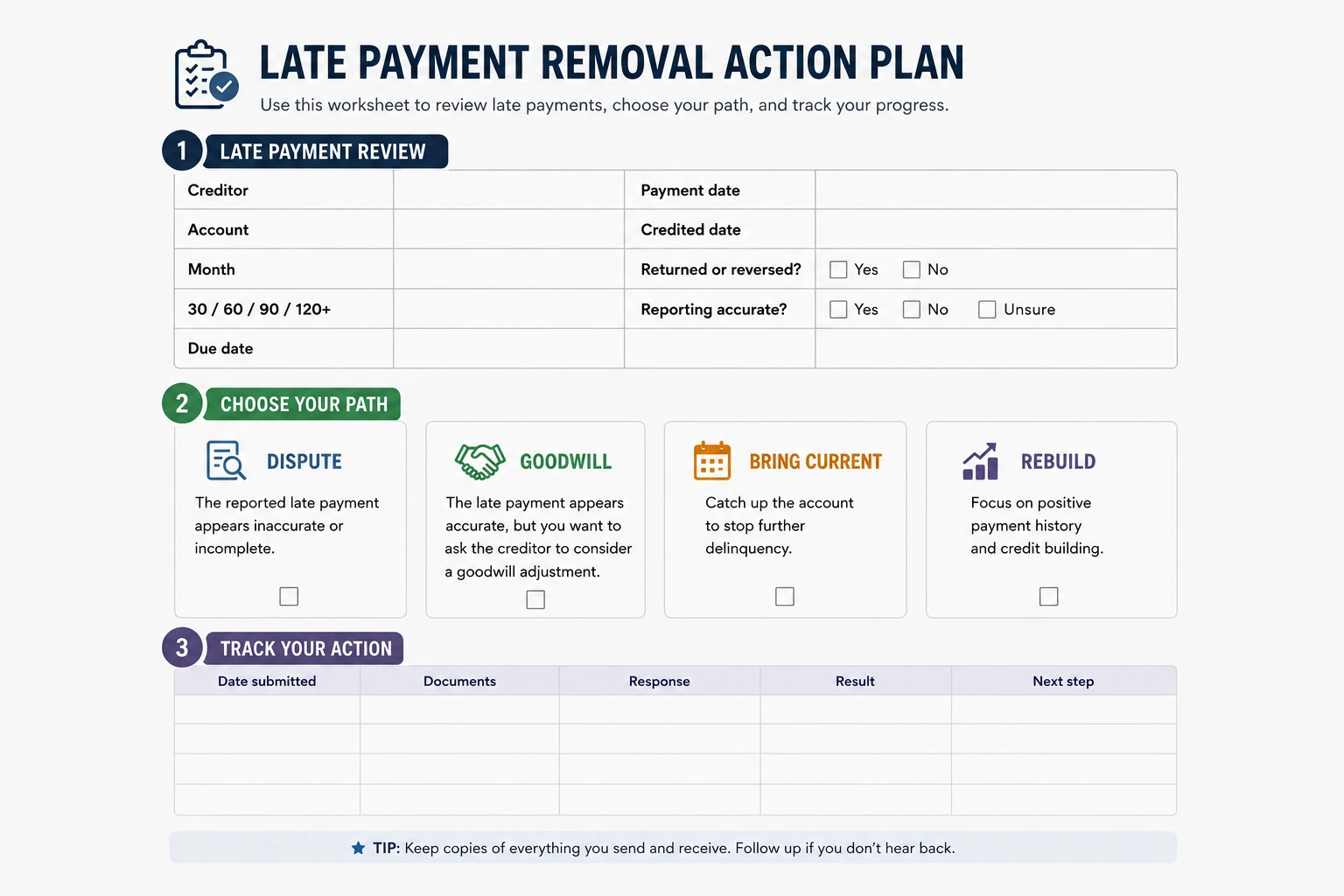
Once you know whether the late payment is listed as 30, 60, 90, or 120 days late, you can decide your next step. If the information looks wrong, you may need to dispute it. If it is accurate, you may need to focus on a goodwill request or a credit rebuilding plan.

When you can dispute a late payment

You can dispute a late payment when you believe the information on your credit report is wrong, incomplete, outdated, duplicated, or reported under the wrong account. A dispute is meant to fix inaccurate credit reporting, not to remove a late payment simply because it hurts your credit score.

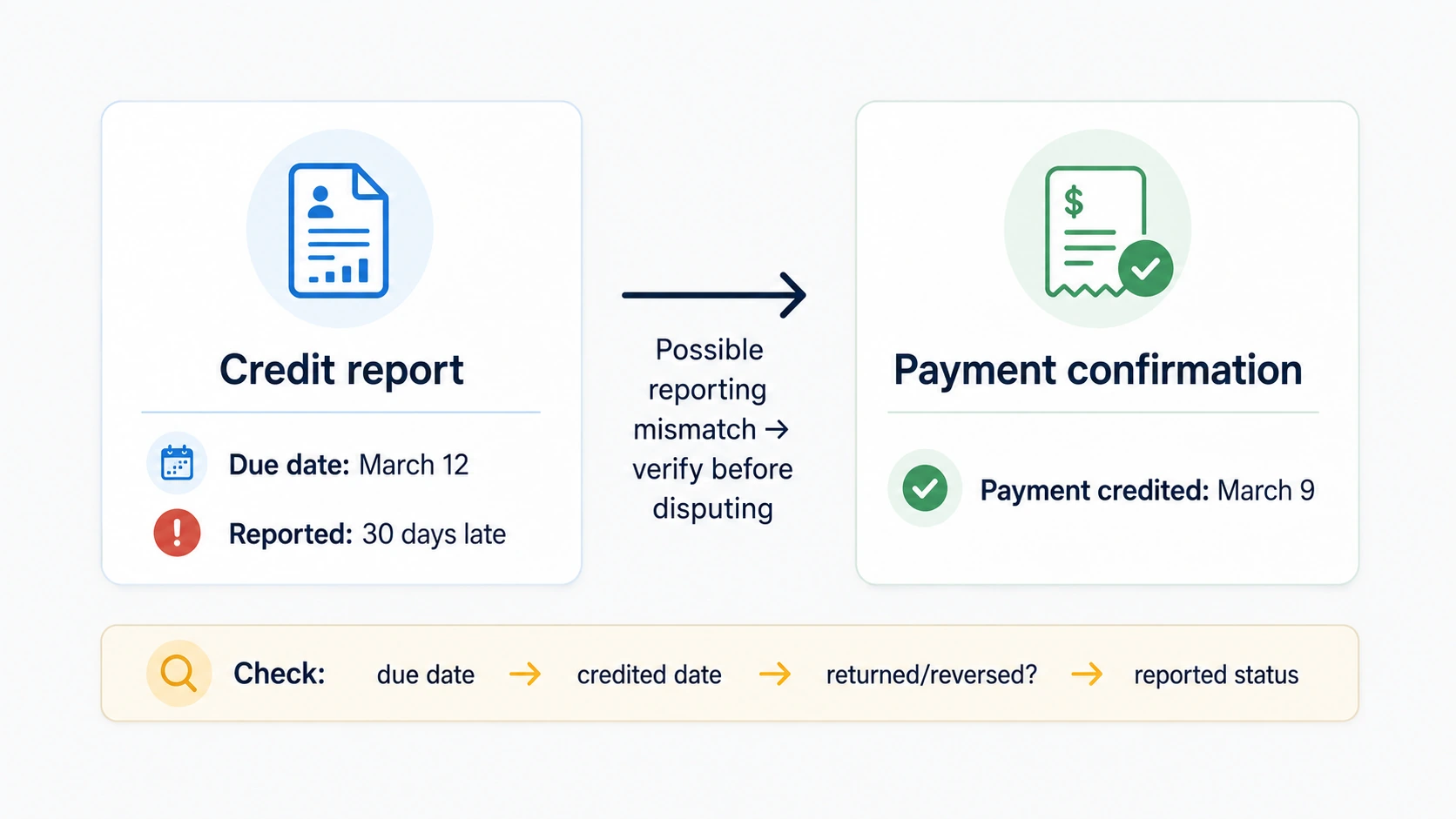
An incorrect late payment may be worth disputing if you paid on time but the account was still reported late, the lender applied your payment to the wrong balance, your autopay failed because of a lender error, or the payment status does not match your account records. You may also have a valid reason to dispute if the account does not belong to you, the late payment appears more than once, or the reported date is wrong.

You may also need to dispute a late payment if your account was supposed to be protected by a deferment, forbearance, hardship plan, or payment arrangement, but the lender still reported the account as late. In this case, your strongest move is to compare your credit report with your lender statements and any written agreement you received.

Before you file a dispute, collect proof that supports your claim. This may include bank statements, payment confirmations, account statements, emails from the lender, or documents showing that your payment arrangement was approved. If you are not sure what to include, review the documents that help support a credit report dispute before you send your request.

If the late payment is truly incorrect, a dispute may help you get the information corrected or removed. If the late payment is accurate, a dispute is less likely to work, and you may need to consider a goodwill request instead.

When a late payment is considered accurate

A late payment is usually considered accurate when you missed at least the minimum payment, the account became 30 days or more past due, and the lender reported that payment history correctly to the credit bureaus. In simple words, if the payment was truly late and the reported date, account, and status are correct, the late payment may be valid.

An accurate late payment can happen even if you later paid the account current. Paying the balance, catching up on missed payments, or closing the account does not automatically erase the late payment from your credit report. It may update the account status, but the old missed payment can still remain in the payment history.

This is why it is important not to treat every negative mark as a credit report error. If the late payment is accurate, a dispute may not remove it. Credit disputes are designed to correct wrong, incomplete, outdated, or unverifiable information, not to delete a real missed payment simply because it is hurting your credit score.

If your late payment is accurate, your next option may be to ask the lender for a goodwill adjustment. This is different from a dispute because you are not saying the information is wrong. You are asking the lender to remove the late payment as a courtesy, usually because it was a one-time mistake and your account is now in good standing.

If the lender does not remove the mark, your best move is to focus on recovery. You can still rebuild your credit after late payments by making every future payment on time, keeping balances low, and avoiding new negative marks.

Can you remove an accurate late payment?

Removing an accurate late payment from your credit report is much harder than removing an incorrect one. If the payment was truly late and the lender reported it correctly, you usually cannot force the credit bureau to delete it just because it is hurting your credit score.

However, that does not always mean you have no options. You may be able to ask the lender for a goodwill adjustment. A goodwill adjustment is a request for the lender to remove a late payment as a courtesy, even though the information may be accurate.

This may have a better chance of working if the late payment was a one-time mistake, your account is now current, you had a strong payment history before the missed payment, and you can explain what happened in a calm and respectful way. For example, a short emergency, a banking issue, or a temporary hardship may be worth mentioning if it is true.

Still, a goodwill request is never guaranteed. Some lenders may refuse to remove accurate payment history because they are expected to report credit information consistently. That is why it is important not to rely only on removal. If the lender says no, your next goal is to prevent new late payments and rebuild positive credit history over time.

An accurate late payment may stay on your report for a while, but its impact does not have to control your credit forever. If you keep paying on time and avoid new negative marks, your score may recover gradually. To understand the recovery timeline better, read this guide on how long it takes to fix your credit score.

How to remove an incorrect late payment from your credit report

Organizing payment proof to dispute an incorrect late payment on a credit report

If a late payment was reported incorrectly, the best way to try to remove it from your credit report is to file a dispute with the credit bureau that shows the error. Before you start, check whether the late payment appears on Equifax, Experian, TransUnion, or more than one report. The error may appear on only one credit report, so do not assume all three reports show the same information.

Start by reviewing the account details carefully. Look at the lender name, account number, reported month, payment status, balance, and whether the mark is listed as 30, 60, 90, or 120 days late. Then compare that information with your own records, such as bank statements, payment confirmations, lender emails, or account statements.

If the credit report shows a late payment that does not match your records, explain the problem clearly in your dispute. For example, you can state that the payment was made on time, the reported date is wrong, the account does not belong to you, or the payment status was reported incorrectly. If you need a full process, follow this guide on how to dispute errors on your credit report.

Do not send a vague dispute that only says the late payment is unfair. Be specific. Identify the account, explain what is wrong, ask for the late payment to be corrected or removed, and attach proof that supports your claim. Strong evidence can make your dispute easier to understand and harder to ignore.

Useful proof may include payment receipts, bank statements, autopay confirmations, account statements, deferment letters, forbearance approvals, hardship plan documents, or written messages from the lender. If you are not sure what to collect, review these documents that help support a credit report dispute before sending your request.

After you submit the dispute, keep copies of everything you send and every response you receive. If the credit bureau or lender agrees that the late payment was incorrect, the information may be corrected or removed from your credit report. If they verify the late payment as accurate, your next option may be to contact the lender directly or consider a goodwill request.

What documents can support your dispute?

If you want to dispute a late payment, your proof matters. A credit bureau or lender needs to understand why the late payment may be wrong, incomplete, or reported incorrectly. The stronger your documents are, the easier it is to explain what should be corrected on your credit report.

Useful documents may include bank statements showing the payment date, payment confirmation emails, screenshots from your lender account, autopay confirmations, account statements, or receipts showing that the payment was made on time. If the issue involved a hardship plan, deferment, forbearance, or payment arrangement, include written proof that the lender approved it.

You should also save anything that shows the reported late payment does not match your actual account history. This may include lender messages, billing statements, transaction records, or previous dispute results. If the account does not belong to you, you may need identity-related documents and a clear explanation of why the account is not yours.

Do not send random documents just to make the dispute look bigger. Send documents that directly support your claim. For example, if you are saying the payment was made on time, include proof of the payment date. If you are saying the wrong month was reported late, include statements that show the correct payment history for that month.

Before you submit anything, organize your dispute so it is easy to understand. Identify the account, explain the error, attach the proof, and ask for the late payment to be corrected or removed. If you need the full step-by-step process, read this guide on how to dispute errors on your credit report.

Can a goodwill letter remove a late payment?

A goodwill letter may help you remove a late payment from your credit report, but it is never guaranteed. A goodwill letter is a polite request asking the lender to remove a late payment as a courtesy, even if the late payment was reported accurately.

This is different from a credit dispute. With a dispute, you are saying the information is wrong, incomplete, or reported incorrectly. With a goodwill letter, you are not saying the late payment is an error. You are asking the lender to make a goodwill adjustment because of your overall payment history, your current account status, or the reason the missed payment happened.

A goodwill letter may have a better chance of working if the late payment was a one-time mistake, your account is now current, you paid soon after the missed due date, and you had a strong payment history before the late payment. It may also help if you can explain a real temporary hardship, such as a medical issue, job loss, family emergency, banking problem, or another short-term situation that affected your ability to pay on time.

Your letter should be short, respectful, and honest. Explain what happened, take responsibility if the payment was truly late, mention that the account is now current, and politely ask whether the lender would consider removing the late payment from your credit report as a goodwill adjustment.

Do not use aggressive language, blame the lender without proof, or demand removal as if it is your legal right. A lender may choose to say no, especially if the late payment was accurate or if there were multiple missed payments. But if the late payment was rare and your account is in good standing now, a goodwill letter may still be worth trying.

Goodwill letter vs. credit dispute

Goodwill letter and credit dispute options for removing a late payment from a credit report

A goodwill letter and a credit dispute are not the same thing. They may both be used when you want to remove a late payment from your credit report, but they work in very different situations.

A credit dispute is the right option when the late payment is wrong, incomplete, duplicated, outdated, or reported under the wrong account. In this case, you are telling the credit bureau or lender that the information on your credit report is inaccurate and should be corrected or removed.

A goodwill letter is different. It is used when the late payment may be accurate, but you are asking the lender to remove it as a courtesy. You are not saying the lender made a reporting mistake. You are asking for a goodwill adjustment because the late payment was a one-time issue, your account is now current, or your overall payment history has been strong.

The easiest way to understand the difference is this: if the late payment is incorrect, dispute it. If the late payment is accurate, consider a goodwill letter. If you are not sure whether the information is wrong, review your credit report, compare it with your payment records, and then decide which path makes sense.

You should not use a credit dispute just to remove an accurate late payment because it hurts your credit score. A dispute is meant to fix credit report errors, not erase real missed payments. If you believe the late payment was reported incorrectly, follow the full process for how to dispute errors on your credit report and include proof that supports your claim.

Choosing the right option matters. A weak dispute without proof may be rejected, and a goodwill letter may be ignored if it sounds angry or demanding. The stronger move is to match your strategy to the situation: dispute errors, request goodwill for accurate one-time mistakes, and keep rebuilding your credit if the late payment stays on your report.

What to do if the lender refuses to remove the late payment

Credit recovery plan after a lender refuses to remove a late payment

If the lender refuses to remove the late payment, do not panic. A denial does not mean your credit is ruined forever. It usually means the lender is not willing to change the reported payment history, especially if the late payment was accurate or if there is not enough proof to support removal.

First, read the response carefully. If the lender or credit bureau says the late payment was verified as accurate, look at the reason they gave. If you have new evidence that was not included in your first request, you may be able to send a stronger follow-up. But if you do not have new proof, sending the same dispute again and again may not help.

If the late payment was accurate and your goodwill request was denied, your next move is credit rebuilding. Focus on the things you can control now: make every future payment on time, keep your credit card balances low, avoid unnecessary hard inquiries, and do not let another account become past due.

You can also set up autopay, payment reminders, or calendar alerts so one missed due date does not turn into another late payment. A clean payment history after the missed payment is one of the strongest ways to show that the problem was temporary and that your credit habits have improved.

If the late payment stays on your credit report, use it as a starting point for recovery instead of treating it as the end of the road. This guide on how to rebuild credit after late payments can help you create a more complete plan.

After that, track your progress every month. Your score may not bounce back overnight, but you can watch for signs that your credit is moving in the right direction, such as fewer new negative marks, lower balances, and a longer record of on-time payments. To understand what progress actually looks like, read this guide on how to know if your credit score is improving.

How long late payments stay on your credit report

Late payments can stay on your credit report for up to seven years from the original missed payment date. This does not mean your credit score will be damaged in the same way for the entire seven years, but the late payment may remain visible in your payment history during that time.

The exact impact can depend on how recent the late payment is, how severe it was, and what the rest of your credit profile looks like. A recent 60-day or 90-day late payment may hurt more than an older 30-day late payment, especially if you had a strong credit score before the missed payment.

As time passes, an older late payment may become less important if you keep adding positive information to your credit history. On-time payments, lower credit card balances, fewer new negative marks, and stable accounts can all help your credit profile look stronger again.

This is why removal is not the only path forward. If the late payment is accurate and the lender will not remove it, your goal is to make the rest of your credit report stronger while the negative mark gets older. Credit recovery is usually a process, not one magic update.

If you want to understand the bigger timeline, read this guide on how long it takes to fix your credit score.

Will paying the account current remove the late payment?

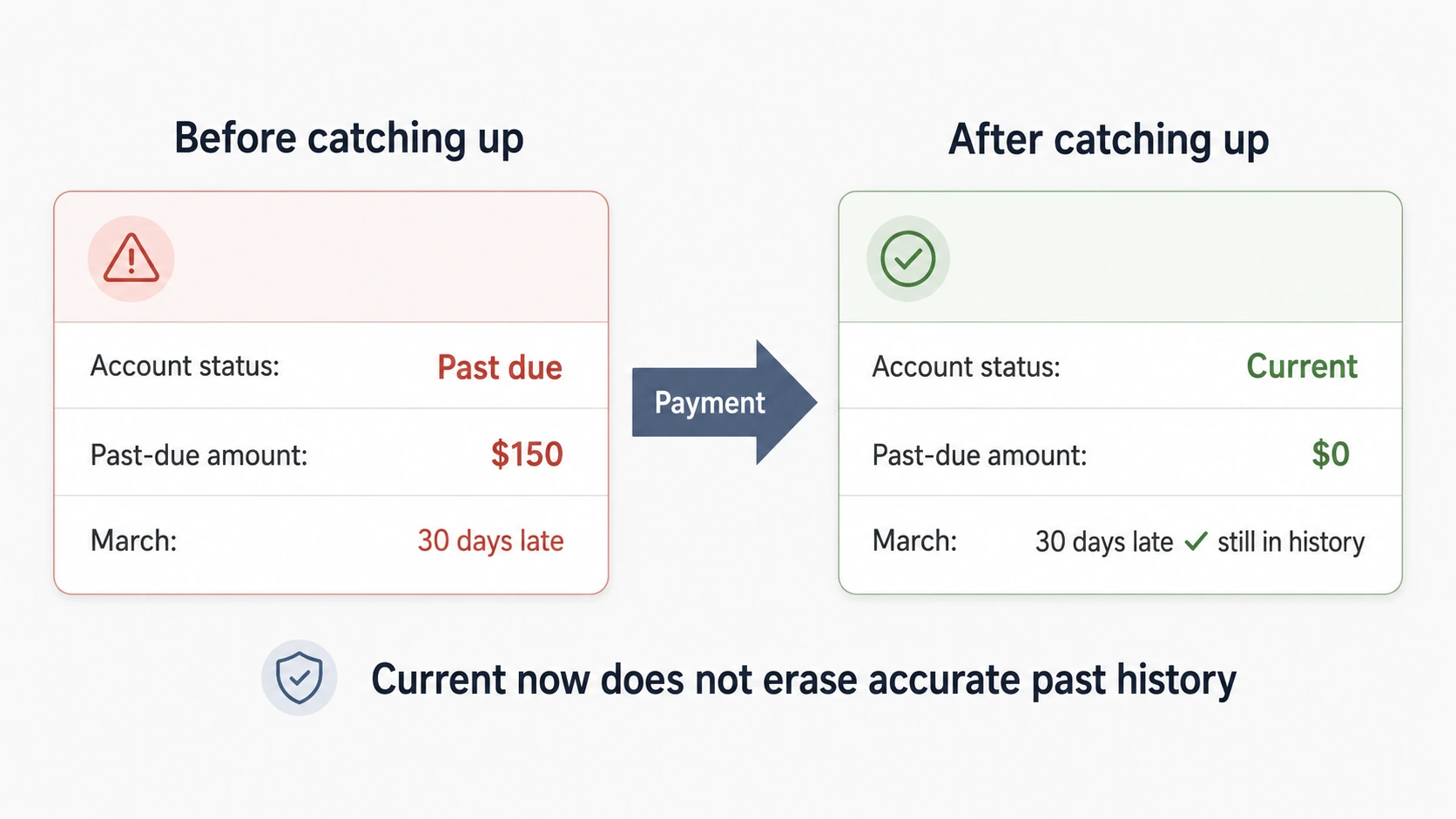
Paying the account current is important, but it usually does not automatically remove the late payment from your credit report. If the payment was truly late and the lender reported it accurately, the old late payment may still remain in your payment history even after you catch up.

This can feel frustrating because you may think, “I paid it, so why is it still there?” The reason is simple: paying the account current updates your present account status, but it does not always erase the fact that a payment was missed in the past.

For example, if your account was 30 days late in March and you paid it current in April, your credit report may show that the account is current now while still showing the March late payment in the payment history. That does not always mean the report is wrong. It may simply mean the lender updated the account status without removing the old late mark.

Paying current can still help your credit recovery. It may stop the account from becoming more delinquent, prevent additional late payments, reduce the risk of collections or charge-off, and help you start building a clean payment history again.

If your score did not improve right after paying the account current, that does not always mean something went wrong. Credit scores can react differently depending on the rest of your credit profile, balances, payment history, and reporting timing. To understand what may happen after paying debt, read this guide on how to fix your credit score after paying off debt.

Does one late payment ruin your credit forever?

One late payment can hurt your credit score, especially if it is recent, but it does not ruin your credit forever. A missed payment can feel stressful when you first see it on your credit report, but one mistake does not have to define your entire credit future.

The impact of one late payment can depend on several things: how late the payment was, how recently it happened, what your credit score looked like before the missed payment, and whether the rest of your credit report is strong. A 30-day late payment may affect your score differently than a 60-day or 90-day late payment.

If your credit history was clean before the missed payment, the score drop may feel more dramatic at first. That does not mean your score cannot recover. It means your next steps matter. New on-time payments, lower balances, and no new negative marks can help your credit profile look stronger again over time.

The biggest mistake is letting one late payment turn into a pattern. If you miss one payment, focus on stopping the damage quickly. Bring the account current, set up reminders or autopay, and make sure every future payment is made on time.

If you want a bigger recovery plan, start with this guide on how to improve your credit score step by step. A late payment may be a setback, but it does not have to be the end of your credit progress.

Mistakes to avoid when trying to remove late payments

When you are trying to remove late payments from your credit report, it is easy to make decisions out of stress. But rushing the process can waste time and may not help your credit score. The goal is not to send as many requests as possible. The goal is to choose the right strategy for your situation.

One common mistake is disputing an accurate late payment without a real reason. If the payment was truly late and the lender reported it correctly, a dispute may not remove it. Credit disputes are meant to correct wrong, incomplete, outdated, duplicated, or unverifiable information, not to erase accurate payment history just because it hurts your score.

Another mistake is sending a weak dispute with no proof. If you believe the late payment is incorrect, explain exactly what is wrong and include documents that support your claim. A vague message like “this late payment is not fair” is much weaker than a clear explanation with payment confirmations, bank statements, or lender records.

You should also avoid sending the same dispute over and over without adding new information. If the credit bureau or lender already verified the late payment and you have no new evidence, repeating the same request may not change the result. A stronger follow-up should include new proof, a clearer explanation, or corrected details.

Be careful with credit repair companies that promise guaranteed late payment removal. No company can honestly promise that an accurate late payment will be deleted from your credit report. Some companies may only send disputes you could send yourself, so always understand what they are actually doing before you pay.

Another mistake is focusing only on removal while ignoring your current credit habits. Even if you are trying to remove an old late payment, you still need to make every current payment on time, keep balances low, and avoid new negative marks. If your credit score is still stuck, this guide on why your credit score is not increasing can help you spot what may be holding you back.

Best next steps if you want to fix your credit

If you want to remove a late payment from your credit report or recover from one, the best next step depends on whether the late payment is wrong or accurate. Do not start with panic. Start with your credit report, your payment records, and a clear plan.

First, review the late payment carefully. Check the account name, reported month, payment status, balance, and whether the mark appears as 30, 60, 90, or 120 days late. If you are not sure how to read the details, start with this guide on how to read your credit report.

Next, decide whether the late payment is incorrect or accurate. If it is incorrect, your best option is usually a credit dispute. Explain what is wrong, include proof, and ask for the late payment to be corrected or removed. You can follow the full process in this guide on how to dispute errors on your credit report.

If the late payment is accurate, a dispute may not remove it. In that case, you may try a goodwill letter and ask the lender for a goodwill adjustment. This works best when the late payment was a one-time mistake, the account is now current, and your payment history was strong before the missed payment.

If the late payment stays on your report, focus on rebuilding your credit instead of getting stuck on one negative mark. Make every future payment on time, keep credit card balances low, avoid unnecessary hard inquiries, and prevent any new accounts from becoming past due. For a deeper plan, read this guide on how to rebuild credit after late payments.

Finally, track your progress month by month. Credit recovery is not always instant, but you can look for signs that your credit is moving in the right direction. If you want to know what real progress looks like, read this guide on how to know if your credit score is improving.

Final thoughts

You may be able to remove late payments from your credit report, but it depends on why the late payment is there. If the late payment is incorrect, outdated, duplicated, or reported under the wrong account, a credit dispute may help you get it corrected or removed.

If the late payment is accurate, removing it is much harder. In that case, you usually cannot force the credit bureau to delete it just because it hurts your credit score. However, you may still be able to ask the lender for a goodwill adjustment, especially if the late payment was a one-time mistake and your account is now current.

If the lender refuses to remove the late payment, do not treat it as the end of your credit progress. Focus on what you can control now: pay every bill on time, keep your balances low, avoid new negative marks, and build a stronger payment history from this point forward.

The simple rule is this: dispute the late payment if it is wrong, ask for goodwill if it is accurate, and rebuild your credit if it stays on your report. If you want a complete recovery plan, read this guide on how to improve your credit score step by step.

FAQ

Can I remove a late payment from my credit report?

You may be able to remove a late payment from your credit report if it is inaccurate, duplicated, outdated, or reported under the wrong account. If the late payment is accurate, removal is usually harder and may depend on whether the lender is willing to make a goodwill adjustment.

Can I dispute a late payment if it was my fault?

You can dispute a late payment if the information on your credit report is wrong or incomplete. But if the payment was truly late and the lender reported it correctly, a dispute may not remove it. In that case, a goodwill letter may be a better option than a credit dispute.

Can a goodwill letter remove a late payment?

A goodwill letter may help remove a late payment, but it is not guaranteed. It is a polite request asking the lender to remove the late payment as a courtesy, usually because it was a one-time mistake and your account is now current.

How long does a late payment stay on your credit report?

A late payment can stay on your credit report for up to seven years from the original missed payment date. However, its impact on your credit score may become weaker over time if you keep making on-time payments and avoid new negative marks.

Will paying the account current remove the late payment?

Paying the account current is important, but it does not automatically remove the late payment from your credit report. It can update your current account status and help stop further damage, but the old late payment may still remain in your payment history.

What if the late payment was reported incorrectly?

If the late payment was reported incorrectly, collect proof such as bank statements, payment confirmations, account statements, or lender messages. Then follow the process to dispute errors on your credit report and ask for the incorrect information to be corrected or removed.

Can a creditor remove a late payment?

A creditor may be able to update, correct, or remove a late payment if the information was reported incorrectly. If the late payment is accurate, the creditor is not required to remove it, but you may still ask for a goodwill adjustment.

Can credit repair companies remove late payments?

Be careful with any company that promises guaranteed late payment removal. A credit repair company cannot honestly guarantee that an accurate late payment will be deleted from your credit report. Many dispute steps can be done by the consumer directly.

What should I do if I cannot remove the late payment?

If you cannot remove the late payment, focus on rebuilding your credit. Make every future payment on time, keep credit card balances low, avoid new negative marks, and track your progress. This guide on how to rebuild credit after late payments can help you create a stronger recovery plan.


Rate article
Fix My Money Life
Add a comment