In this guide
- When do auto loans report late payments to credit bureaus?
- When is a late payment reported to the credit bureaus?
- Before the reporting threshold
- How do you estimate when the account reaches 30 days past due?
- Scheduled, pending, received, and credited are not the same
- Can a late payment show up after you already paid?
- Why can the late mark appear days or weeks after day 30?
- What if only one bureau shows the late payment?
- What if autopay failed or a payment was returned?
- What if you paid on time but the creditor posted it late?
- Federal student loans use a different reporting timeline
- Build a missed-payment reporting timeline
- What to ask the creditor if you are close to day 30
- Can your credit score drop before a late payment appears?
- Frequently asked questions
- Bottom line
- Sources
- Financial disclaimer
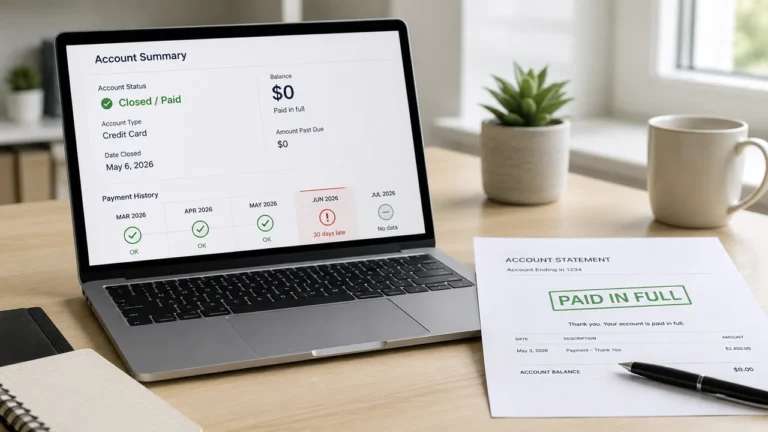
A missed payment usually does not appear on a credit report as a standard 30-day late payment until the account is at least 30 days past due. Even then, the late mark may not become visible immediately because the creditor has to furnish the update and the credit bureau has to process it.
Thirty days is a reporting threshold, not a guarantee that every lender reports on day 30. Creditors are not generally required to report account information to the credit bureaus at all. If they do report, a standard 30-day delinquency can be furnished once the account reaches that level; the bureau may display it later after processing. CFPB notes that creditors may choose not to report information, while Experian explains that creditors typically do not report a late payment until it is at least 30 days past due.
If you are still under 30 days late, focus on paying the full amount required to bring the account current and confirming when the payment will be credited. If the account has already crossed 30 days, paying can still prevent a worse delinquency, but it may not erase an accurate 30-day late payment that already occurred. If a closed account is suddenly showing a new late mark, use the closed-account late-payment guide. Browse the Late payments hub for the next step based on how late the account became.
When do auto loans report late payments to credit bureaus?
For an auto loan, a standard 30-day late payment generally becomes possible once the account reaches about 30 days past due, but it may not appear on a credit report that exact day. The lender still has to furnish its account update and the bureau has to process it. Check the original due date, the lender’s current days-past-due status, and the report’s latest update date.
Reviewed against CFPB, FICO, and Federal Student Aid guidance. Source review: September 17, 2026.
Quick rule: Becoming late with the creditor, reaching a reportable delinquency level, and seeing the late payment on your credit report are three different events.
When is a late payment reported to the credit bureaus?
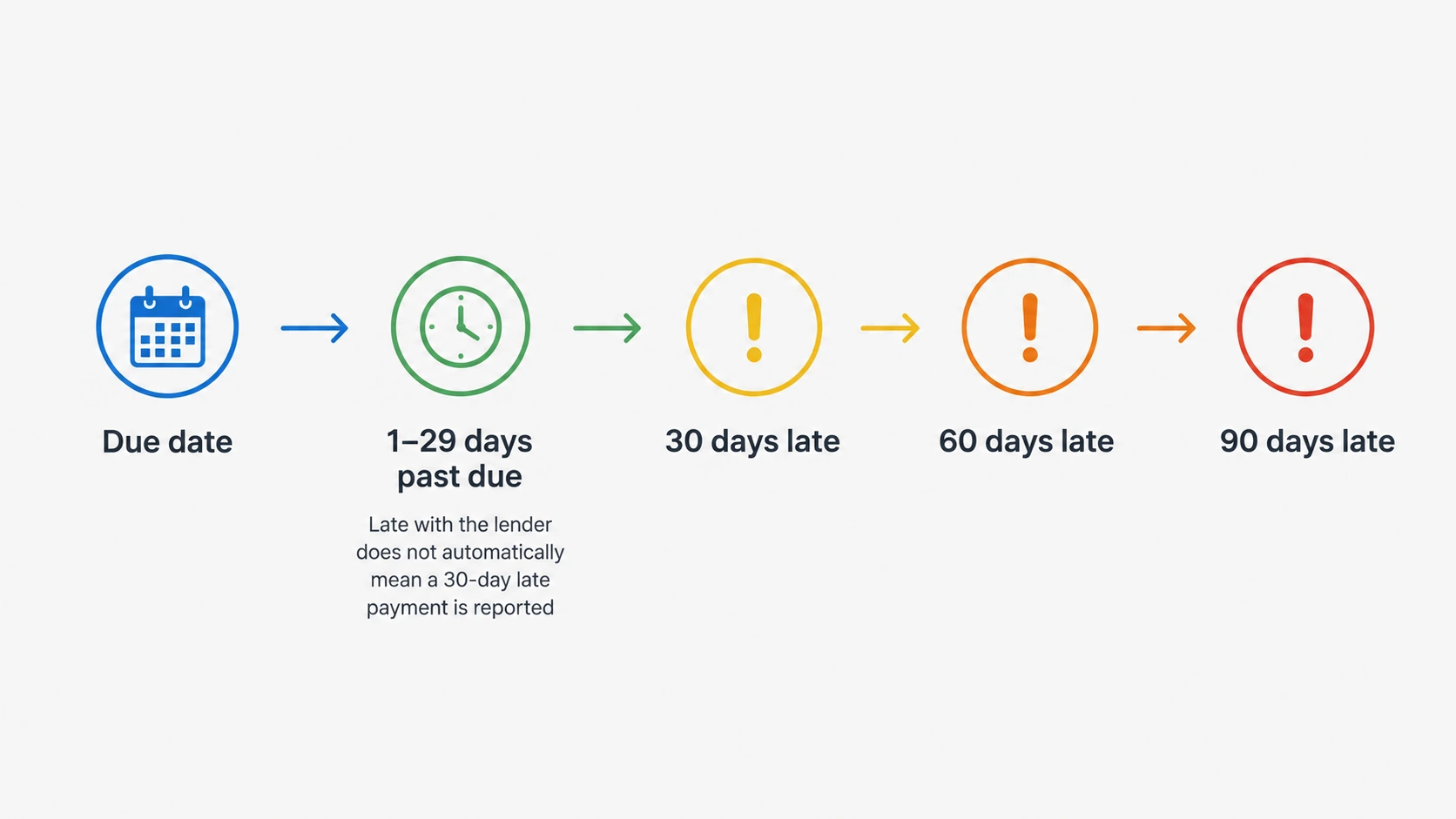
For many credit cards, auto loans, mortgages, and personal loans, the first commonly reported delinquency category is 30 days late. FICO says late payments are commonly reported in categories such as 30, 60, 90, 120, and 150 days late.
But reaching day 30 does not mean the late mark appears on your report that same day. A typical sequence is:
- The payment due date passes.
- The account becomes past due with the creditor.
- The delinquency continues aging.
- The account reaches the applicable reporting threshold.
- The creditor furnishes an update to one or more bureaus.
- The bureau processes the data.
- Your monitoring app refreshes on its own schedule.
Before the reporting threshold
Account-level consequences can occur before a standard 30-day late mark appears. If you are still less than 30 days past due, use the under-30-day action worksheet to confirm the amount and payment method needed to become current. The timeline below focuses on when delinquency information becomes visible, rather than repeating that catch-up process.
How do you estimate when the account reaches 30 days past due?
For a simple estimate, count forward 30 calendar days from the original due date. If a payment was due June 10, June 11 is approximately day 1 past due and July 10 is approximately day 30.
That is only a working estimate. Payment cutoff times, returned payments, weekends, payment channels, and how the creditor applies payments can matter. If the account is close to day 30, ask the creditor what its system shows as the current days-past-due status.
Scheduled, pending, received, and credited are not the same
Near day 30, do not rely on the word scheduled or pending. Confirm:
- the payment completed successfully;
- the creditor credited it;
- no amount remains past due;
- the account now shows current.
A partial payment may reduce the balance while leaving the account delinquent. Ask, “What exact amount must I pay today to bring the account current?”
Can a late payment show up after you already paid?
Yes. If the account had already reached a reportable delinquency level before you brought it current, the historical late payment can still appear later.
For example, an account reaches 30 days late on July 31, you bring it current on August 3, and the lender furnishes its next update on August 10. The report can correctly show the account as current now while still showing a 30-day late payment in the prior month’s history.
Why can the late mark appear days or weeks after day 30?
Creditors commonly furnish account data on a periodic cycle rather than sending a new bureau update every day. The bureau then needs time to process the information, and a monitoring app may refresh later still.
That means reportable and visible are not the same thing. The absence of a late mark today does not prove the lender will never report it.
What if only one bureau shows the late payment?
Experian, Equifax, and TransUnion do not always update at the same time, and not every creditor reports to all three. Compare the month marked late, current status, balance, and last-updated date before deciding there is an error.
If you need help locating those fields, use our step-by-step guide to reading your credit report.
What if autopay failed or a payment was returned?
An autopay failure or returned payment can allow the delinquency clock to keep running even if you thought the bill had been paid.
Save the autopay enrollment, payment confirmation, bank transaction history, return code, and any error messages. If autopay caused the problem, see what to do when autopay fails and causes a late payment.
What if you paid on time but the creditor posted it late?
Collect the statement showing the due date, payment confirmation, bank record, and creditor payment history. Ask the creditor to identify the date it received and credited the payment.
If your records show the account never reached the reported delinquency level, that may be a credit-report accuracy issue. Use our guide on how to dispute an inaccurate late payment. Do not dispute an accurate late payment simply because it hurts your score. If you are deciding between a dispute and a voluntary goodwill request, first check whether your late payment can be removed.
Federal student loans use a different reporting timeline
Federal Student Aid states that a federal student loan becomes delinquent after a missed payment, but the servicer reports the delinquency to the major national credit bureaus once the loan is 90 days or more past due. Do not use that longer reporting window as permission to wait. Contact the servicer as soon as you miss a payment.
Build a missed-payment reporting timeline
Use one row for each event. This separates the creditor’s account history from the date you first saw a bureau entry or an app alert. Copy the table into your private notes; do not send account identifiers to this website.
| Event | Date to record | Evidence |
|---|---|---|
| Original payment due | ________ | Statement and account terms |
| Creditor-confirmed delinquency stage | ________ | Account history or creditor confirmation; identify whether this account uses the ordinary 30-day framework |
| Catch-up payment credited | ________ | Creditor payment record, not only the bank withdrawal |
| Account brought current | ________ | Confirmation that the required past-due amount was satisfied |
| Latest account update on the bureau report | ________ | Dated report from the bureau you are checking |
| Month and severity reported late | ________ | The actual payment-history entry |
| Monitoring alert or score refreshed | ________ | App alert and the score calculation date, if disclosed |
Interpret the sequence: a later alert can describe an earlier delinquency. If a historical late entry conflicts with the creditor’s payment records, identify the disputed month and severity. If the account became current only after reaching the reported stage, a current status and an earlier late mark can coexist.
What to ask the creditor if you are close to day 30
“My account is past due and close to 30 days late. What exact amount must I pay today to bring it current, and which payment method will be credited soonest?”
Also ask what date the creditor currently shows as the first day the account would reach 30 days past due. Save the confirmation number and verify the account status after the payment posts.
Can your credit score drop before a late payment appears?
Yes, but another credit-report change may be the reason. If no 30-day late mark appears, check for higher card balances, higher utilization, a new inquiry, a new account, a collection, an account closure, or a different bureau or scoring model.
If the timing is confusing, see other reasons a credit score may drop unexpectedly.
Frequently asked questions
Can a late payment appear before 30 days?
For ordinary credit reporting, a payment only a few days or a couple of weeks late generally is not reported as a standard 30-day delinquency. The creditor can still treat it as late and charge fees or take other account-level actions.
Will paying on day 29 guarantee no 30-day late mark?
No. A pending payment, cutoff time, returned payment, or insufficient cure amount can still allow the account to cross day 30. Pay earlier whenever possible.
Does a partial payment stop the 30-day clock?
Not necessarily. If an amount remains past due, the delinquency can continue aging. Confirm whether the payment will make the account current.
Can a 30-day late payment affect your score as soon as it appears?
Yes. Once a scoring system uses a report containing the newly reported delinquency, the late payment can affect the result. There is no universal point loss.
How long can an accurate late payment stay on a credit report?
CFPB guidance says most negative information, including late-payment history, can generally remain on a credit report for seven years.
Bottom line
A missed payment usually becomes reportable at the 30-day delinquency level for many ordinary consumer credit accounts, but it may become visible on your credit report later. If you are still under 30 days late, pay the amount needed to bring the account current and confirm the credited date. If you are already past 30 days, pay to stop the delinquency from becoming more severe and verify what was actually reported.
If a late mark appears and your records show the account did not reach the reported level, dispute only the specific inaccurate information.
Sources
- Consumer Financial Protection Bureau — When is my credit card payment considered late?
- Consumer Financial Protection Bureau — How long information stays on a credit report
- FICO — How FICO considers late payments
- Federal Student Aid — What happens after a missed federal student loan payment
Financial disclaimer
This article provides general U.S. credit and financial information, not individualized legal, financial, lending, or credit-repair advice. Account terms and reporting practices vary by creditor and product. No action described here guarantees a specific credit-score result.