How to improve your credit score fast (what actually works right now)

Credit report and action plan showing what to check first to improve your credit score fast Credit score
Contents

Quick answer: how to improve your credit score fast

If you want to improve your credit score fast, start with the information on your credit reports that you may be able to change or protect first. Check for high reported credit card balances, an active past-due account, a payment that is coming due, or specific information you can document as inaccurate or incomplete.

The fastest legitimate action depends on what is actually affecting your credit profile. Protect every required payment first, then address high revolving balances, bring past-due accounts current when financially possible, and dispute only factual reporting errors you can support with evidence.

Important: “Fast” does not mean overnight. No legitimate strategy can guarantee a specific credit score increase, a fixed number of points, or an exact update date.

What is the fastest way to improve your credit?

The fastest way to improve your credit depends on which information is currently affecting your credit profile. If you are trying to improve your credit score quickly, use the table below to identify the issue that deserves attention first instead of making several credit changes at once.

What you see What to check first Action to consider What may change What is not guaranteed
A payment is due soon Due date, minimum payment, and available funds Make the required payment by the due date You may avoid a new delinquency An immediate credit score increase
An account is currently past due Past-due amount and the amount required to bring the account current Contact the creditor and confirm the catch-up amount and deadline The account may later report a current status after the creditor updates it Removal of accurate past late-payment history
One or more credit cards show high reported balances Reported balance, credit limit, and utilization Consider an affordable balance reduction before the issuer reports again A lower reported balance and lower utilization may appear A specific number of credit score points
Your credit report contains information that appears wrong The exact balance, status, date, payment history, or ownership detail Gather supporting evidence and dispute only information that is inaccurate or incomplete The disputed information may be corrected, deleted, or verified Removal of accurate negative information or a score increase
Your main problem is old accurate negative history How recent and severe the negative information is Prevent new problems and build positive history over time Your overall credit profile can improve over time A legitimate overnight fix
You have a thin or recently established credit file Account age and amount of reported payment history Build a consistent record over time rather than opening several accounts at once Your credit history can become more established A shortcut that creates account age instantly
Start here: If more than one problem applies, protect every required payment first. Then address an active delinquency, high reported revolving balances, or a documented reporting error based on your situation.

Fast Credit Action Finder: what should you do first?

If you want to improve your credit fast, do not try every strategy at once. Start with the issue that creates the greatest immediate risk or the clearest opportunity to change the information being reported. Follow the decision tree below to find your first step.

1. Do you have a required payment due soon?

Yes → Protect that payment first.

Make at least the required payment by the creditor’s due date. Avoid using money needed for another required payment simply to lower one credit card balance.

No → Go to question 2.

2. Is any account currently past due?

Yes → Find out exactly what is required to bring the account current.

Contact the creditor and ask for the current past-due amount, the deadline, and whether paying that amount will restore the account to current status. Bringing an account current does not erase accurate late-payment history that has already been reported.

No → Go to question 3.

3. Are one or more credit cards reporting high balances?

Yes → Review the reported balances and utilization.

Compare each reported balance with the credit limit and your available budget. If you can safely reduce a high revolving balance before the issuer reports again, the lower balance may later appear on your credit reports.

A lower reported balance can reduce credit utilization, but it does not guarantee a specific credit score increase.

No → Go to question 4.

4. Does your credit report contain information that appears inaccurate or incomplete?

Yes → Verify the error and gather evidence before disputing it.

Identify the exact balance, payment status, date, credit limit, account ownership detail, or other field that appears wrong. Compare it with statements, payment confirmations, creditor records, or other supporting documents.

Dispute only information you have a specific reason to believe is inaccurate or incomplete. A negative item is not inaccurate simply because it lowers your score.

No → Go to question 5.

5. Is the main problem old accurate negative information or a thin credit file?

Yes → You may not have a legitimate fast credit-score lever.

Recent late payments, serious accurate negative history, limited account age, and a thin credit file generally require time and consistent account management. Focus on preventing new problems, reducing debt at a sustainable pace, and building a longer record of on-time payments.

No → Review your credit reports again before making new credit changes.

Your priority order:

  1. Protect payments that are due now.
  2. Stop an active delinquency from becoming more severe.
  3. Address high reported revolving balances when financially safe.
  4. Correct specific reporting errors you can document.
  5. Use a longer-term rebuilding plan when the problem cannot realistically change quickly.

Step 1: check what your credit reports actually show

Credit report audit showing high utilization, a past-due account and what to review first

Before trying another tactic to improve your credit, check the information that is actually being reported. A credit score is calculated from information in a credit report, so the first practical step is to identify which reported balance, account status, payment history entry, or possible error needs attention.

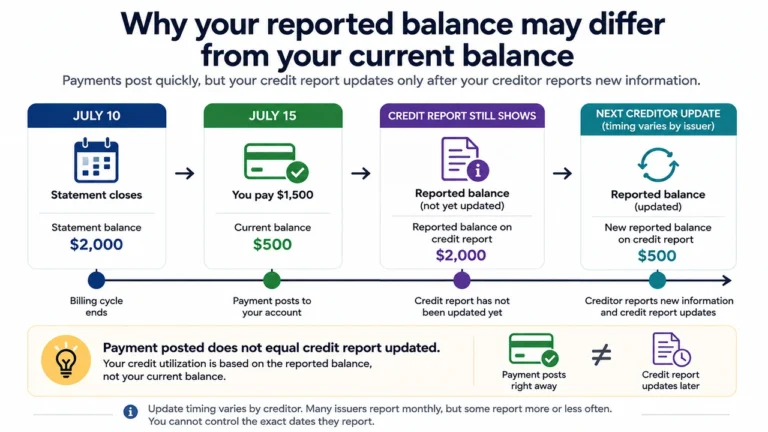
Review your Equifax, Experian, and TransUnion credit reports and compare the same accounts across all three. Do not assume that the balance shown in your credit card app is the same balance currently appearing on your credit report.

Use this fast credit report audit

For each open account, record the information below. This worksheet helps you separate something you may be able to address now from something that will require more time.

Account Credit bureau Reported balance Credit limit Account status Last updated Problem to review Next action
Card A Experian $4,200 $5,000 Current July 28 High reported balance Review utilization and affordable payoff amount
Card B Equifax $450 $4,000 Current August 2 None identified Keep required payments current
Auto loan TransUnion $12,400 30 days late July 31 Active delinquency Confirm the amount required to bring the account current
Credit card C Experian $1,900 $3,000 Current July 25 Balance does not match creditor records Verify the amount and collect supporting records if it is inaccurate

What should you look for?

  • Reported balances: compare each credit report balance with recent creditor records.
  • Credit limits: check whether the reported limit matches the issuer’s current limit.
  • Account status: note whether the account is current, past due, late, closed, or charged off.
  • Payment history: identify any reported late payment you do not recognize or believe may be inaccurate.
  • Last-updated date: check how recent the reported account information is.
  • Account ownership: look for unfamiliar accounts, duplicate accounts, or accounts that do not belong to you.
Do not assume every negative item is an error. A high balance, an accurate late payment, or other legitimate negative information may be hurting your credit without being disputable. File a dispute only when you have a specific reason to believe reported information is inaccurate or incomplete.

If you are not sure where to find balances, payment history, account status, or update dates, see our guide on how to read your credit report.

Step 2: lower high reported credit card balances when you can

Credit utilization example comparing three cards and showing which balance to review first

If high revolving balances are one of the main problems you found in your credit report audit, reducing those balances may be one of the more immediate changes you can make to the information used in a later credit score calculation.

Do not choose a payment amount based on a promised number of credit score points. First protect every required payment and essential expense, then decide whether you can safely reduce one or more high reported credit card balances.

Check the reported balance, not just the balance in your banking app

The balance currently shown by your card issuer may not be the same balance that appears on your credit report. For each card, compare the reported balance, credit limit, and last-updated date before deciding what to pay down first.

Amount What it means Why it matters
Current balance The amount currently shown on the card account, including newer transactions It may be different from the balance already reported to the credit bureaus
Statement balance The amount shown when the billing cycle closed Some issuers may report around this point, but reporting schedules vary
Reported balance The most recent balance appearing on the credit report This is the balance currently available for a utilization calculation based on that report
Credit limit The reported maximum credit line for the card The balance and limit are used to calculate utilization for that account

Use this credit utilization calculator

To calculate the utilization shown by a reported credit card balance, use:

Reported balance ÷ credit limit × 100 = credit utilization

Example:

Credit limit: $5,000
Reported balance: $4,000

$4,000 ÷ $5,000 × 100 = 80% utilization

If the card later reports a balance of $1,500:

$1,500 ÷ $5,000 × 100 = 30% utilization

Important: A lower utilization percentage does not guarantee a specific credit score increase. The example shows how the reported data can change, not how many points a particular credit score will gain.

Example: which card should you review first?

Card Credit limit Reported balance Utilization What to review
Card A $5,000 $4,000 80% High priority for review if an affordable payment is possible
Card B $3,000 $600 20% Lower priority if Card A is the main utilization problem
Card C $6,000 $300 5% Usually not the first balance to target solely for utilization

This comparison does not mean you should send all available cash to Card A. First make sure every required payment, housing cost, utility bill, insurance payment, tax obligation, food expense, and other essential cost is covered.

If you want to understand the calculation in more detail, see how credit utilization affects your credit score.

What to ask your card issuer before expecting an update

If you recently made a payment and want to understand when newer account information may be reported, you can ask:

“I recently made a payment on this account. Could you tell me my statement closing date and when you normally report account information to the credit bureaus?”

You can also ask:

“Does your reporting schedule usually follow the statement closing date, or do you report at another time?”

Reporting practices vary by issuer, so do not assume every credit card company reports on the same day or uses the same schedule.

Step 3: protect every payment and stop an active delinquency from getting worse

If you are trying to improve your credit rating fast, protecting payments that are due now should generally come before chasing a small change in credit utilization. A new late payment can create another negative item to deal with, while an account that is already past due may become more seriously delinquent if it is not brought current.

Start by checking every required payment due before your next paycheck or expected source of income. If an account is already behind, do not guess how much you need to pay. Contact the creditor and confirm the amount and deadline required to bring the account current.

What should you do based on how late the account is?

Your situation What to do first What to confirm Main goal
The due date has not passed Make at least the required payment by the due date Payment amount, due date, and any payment-processing cutoff Avoid creating a new late payment
The payment is past due but has not reached 30 days late Contact the creditor and pay the required amount as soon as financially possible The amount needed to bring the account current and whether any late fee applies Resolve the delinquency before it becomes more severe
The account is already reported 30 days late Ask for the exact catch-up amount and deadline Whether the payment will restore current status Prevent the account from progressing to a more serious delinquency
The account is 60 or more days past due Contact the creditor immediately about the amount required to catch up and any available options Current past-due amount, account status, deadlines, and any assistance options Stop additional delinquency when possible
You already paid, but the account still shows past due Confirm that the payment posted to the account Current creditor records and the account status Determine whether the issue is processing, reporting timing, or inaccurate information

Do not assume the normal minimum payment will bring a past-due account current

Once an account falls behind, the amount required to restore current status may be more than the regular monthly payment. Check the creditor’s current account records or speak with the creditor before deciding how much to send.

Example:

Suppose a borrower normally owes $75 each month but misses one required payment. The next statement may show $150 due. Sending only the usual $75 may leave part of the past-due amount unpaid.

Before making the catch-up payment, the borrower should confirm the exact amount required to bring the account current and the deadline for doing so.

Use this creditor call script

If an account is past due, you can ask:

“My account is currently past due, and I want to bring it current. What is the exact amount I need to pay, and by what date, to restore the account to current status?”

Then ask:

“If I pay that amount, will any additional payment become due before the next billing date?”

If you cannot afford the full catch-up amount, ask:

“I may not be able to pay the entire past-due amount today. Are there any hardship, repayment, or other account-assistance options available to me?”

Bringing an account current does not erase an accurate late payment

Paying the amount required to bring an account current can stop the account from remaining past due, but it does not automatically remove accurate late-payment history that has already been reported.

If a reported late payment is factually incorrect, handle that as a credit-report accuracy issue. Do not dispute an accurate late payment simply because it is hurting your credit score.

Priority rule: Do not use money needed for housing, food, utilities, insurance, taxes, or another required payment solely to chase a faster credit score increase. Preventing a new financial problem is more important than reaching a particular score or utilization target.

Step 4: correct credit report information you can document as inaccurate or incomplete

If you are trying to improve credit fast, do not dispute every negative item on your credit reports. A dispute is appropriate when you can identify a specific piece of information that you believe is inaccurate or incomplete and explain what should be corrected.

Start with the exact field that appears wrong. Compare the credit report with account statements, payment confirmations, creditor records, closure letters, or other documents before submitting a dispute.

Is it a real credit report error?

Credit report error example comparing a reported late payment with payment records and accurate negative information

What you see on the credit report What to verify Possible evidence Next step
Balance appears incorrect Reported balance versus the creditor’s account records Statements, payment records, payoff confirmation, or account history Document the correct balance before disputing
Credit limit appears incorrect Reported limit versus the issuer’s current limit Recent statement, account screenshot, or issuer correspondence Identify the exact limit that should be reported
Late payment appears incorrect Due date, payment date, and when the payment was received or posted Bank records, payment confirmation, receipts, or statements Document why the reported late status is inaccurate
Closed account is reported as open Account closure date and current status Closure confirmation, final statement, or creditor correspondence Request correction of the account status
The same account appears more than once Creditor name, account number, balance, dates, and ownership Credit reports from the bureaus and creditor records Determine whether it is truly a duplicate before disputing
An account does not belong to you Account ownership and identifying details Credit report, creditor correspondence, and relevant identity-theft records if applicable Investigate the account and use the appropriate dispute or identity-theft process
An account date appears wrong The specific date shown and what event that date represents Statements, opening or closing records, payment history, or creditor correspondence Identify the exact date you believe should be corrected

Dispute evidence checklist

Before filing a dispute, make sure you can answer each question below:

  • ☐ Which credit bureau report contains the problem?
  • ☐ Which account or entry are you disputing?
  • ☐ What exact field is inaccurate or incomplete?
  • ☐ What does the credit report currently show?
  • ☐ What should the information show instead?
  • ☐ What documents support your position?
  • ☐ Have you saved a copy of the credit report showing the disputed information?
  • ☐ Have you saved copies of your supporting records?
  • ☐ Can you explain the error clearly without disputing unrelated information?
Important: A negative item is not automatically an error. An accurate late payment, collection, charge-off, high balance, or other unfavorable information should not be disputed simply because it is lowering your credit score.

Example: inaccurate late payment versus an accurate late payment

Situation Dispute? Why
Your statement shows a payment due May 15. Your bank and creditor records show it was received May 12, but the credit report shows a late payment. Potentially yes You have a specific factual discrepancy to investigate and supporting records to compare.
Your payment was actually late and the credit report accurately reflects the delinquency. No, not just because it hurts your score The information is negative, but that alone does not make it inaccurate.

What to do if you confirm an error

If your records support a specific reporting error, prepare a focused dispute that identifies the account, explains exactly what is wrong, states what should be corrected, and includes copies of relevant supporting documents.

Use our step-by-step guide to dispute errors on your credit report.

If you are unsure which records to include, see what documents can help support a credit report dispute.

Step 5: avoid quick-fix credit moves that can backfire

If you are looking for how to improve your credit fast, avoid making several new credit changes simply because they sound like shortcuts. Opening or closing accounts, requesting new credit, carrying a balance, or disputing accurate information can change more than one part of your credit profile and may make it harder to tell whether your original strategy worked.

Before taking a new action, ask what information it could add, remove, or change on your credit reports. A move that helps one factor may affect another factor at the same time.

Quick-Fix Risk Check

Tempting quick fix What may actually happen What to check first Better approach
Open several new credit cards to lower utilization New applications may add hard inquiries, and new accounts can change the age and structure of your credit profile Whether reducing existing reported balances is affordable before adding new accounts Review existing balances and limits first
Close an unused credit card to improve your score Closing the card may reduce your available revolving credit and can affect utilization if balances remain Annual fee, account terms, fraud risk, spending behavior, and available credit Do not close an account solely because you expect an automatic score increase
Request a credit limit increase just to improve utilization The higher limit may affect utilization, but some issuers may use a hard inquiry for the request Whether the issuer uses a hard or soft credit check Ask about the credit check before submitting the request
Carry a credit card balance because you think it builds credit faster Carrying debt may create interest charges and can keep reported balances higher Whether you can pay the statement balance according to the account terms Do not carry interest-bearing debt solely to try to improve a credit score
Dispute every negative item on your credit reports Accurate negative information is not automatically removable simply because it hurts your score Whether you can identify a specific factual error or incomplete information Dispute only information you have a legitimate reason to believe is inaccurate or incomplete
Apply for several credit products at once You may add multiple inquiries and potentially several new accounts Whether each application serves a real financial need Avoid unnecessary applications while you are working on the problems already identified

Use this three-question test before making a new credit move

  1. What specific problem am I trying to solve? High utilization, an active delinquency, inaccurate information, or something else?
  2. Will this action change only that problem? Or could it also create a new inquiry, new account, lower available credit, added interest, or another variable?
  3. Is there a simpler action using my existing accounts? For example, protecting a due payment, reducing an affordable reported balance, or correcting a documented error.

Example:

Suppose a borrower has one credit card reporting an 80% utilization rate. Opening two new cards might increase total available credit, but the borrower could also add new applications and new accounts.

If the borrower can safely reduce the existing balance instead, that may address the original utilization problem without introducing as many new variables.

This does not mean paying down the balance will produce a specific credit score increase. It simply addresses the identified problem more directly.

Ask before requesting a credit limit increase

If you are considering a higher credit limit, contact the issuer first and ask:

“If I request a credit limit increase, will you use a hard credit inquiry or a soft credit inquiry?”

If the answer is unclear, ask what type of credit check will appear in your credit file before completing the request.

Fast-credit rule: Do not create several new variables while trying to fix one known problem. If your audit identified a high balance, active delinquency, or documented reporting error, address that issue first before making unrelated credit changes.

Your one-cycle fast credit action plan

Once you know what is affecting your credit profile, use this action plan to focus on one reporting cycle at a time. The goal is not to chase a guaranteed score increase. It is to address the most important issue you identified, protect your existing accounts, and then verify whether the underlying credit report information changed.

Use one priority at a time: If several problems appear on your credit reports, protect required payments first. Then address an active delinquency, high reported revolving balances, or a documented reporting error based on your situation.

Step 1: record your starting point

Before making a payment, filing a dispute, or changing an account, record what your credit reports currently show. This gives you a before-and-after reference instead of relying only on changes in a credit score.

Account Bureau Reported balance Credit limit Status Last updated Problem identified
Card A Experian $4,000 $5,000 Current July 28 High reported utilization
Auto loan TransUnion $12,400 30 days late July 31 Active delinquency
Card B Equifax $1,900 $3,000 Current July 25 Possible incorrect balance

Step 2: protect every required payment

  • ☐ List every payment due before your next expected income.
  • ☐ Confirm the required amount and due date.
  • ☐ Make sure essential expenses are covered.
  • ☐ Do not use money needed for another required payment solely to lower utilization.

Step 3: choose one primary credit problem to address

If your main problem is… Your first action What to track
High reported credit card balances Choose an affordable balance reduction New reported balance, credit limit, and utilization
An active past-due account Confirm the amount and deadline required to bring it current Account status and past-due amount
A documented reporting error Gather evidence and file a focused dispute The exact disputed field and investigation result
No short-term problem you can realistically change Protect payments and move to a longer-term rebuilding plan Balances, payment history, and account age over time

Step 4: document the action you took

Record the action and keep supporting records until you confirm what appears on the affected credit report.

Action Date Amount or request Evidence saved Expected item to recheck
Paid down Card A August 12 $2,000 payment Payment confirmation Reported balance
Contacted auto lender August 12 Confirmed catch-up amount Secure message / confirmation Account status
Filed supported dispute August 13 Incorrect Card B balance Dispute copy + statements Reported balance and dispute result

Step 5: avoid adding unnecessary new variables

  • Do not apply for new credit solely to chase a quick score change.
  • Do not close an account solely because you expect your score to increase.
  • Do not submit unrelated disputes.
  • Do not carry interest-bearing debt just because you believe it will build credit.
  • Continue making every newly required payment while you wait.

Step 6: check the report before judging the score

After a meaningful account update, compare the same information you recorded at the beginning: reported balance, credit limit, account status, payment history, and last-updated date.

Do not judge the result only by whether one consumer credit score moved up or down. First confirm whether the information you were trying to change actually changed on the credit report used for the comparison.

One-cycle fast credit action plan worksheet showing problem, action, evidence, recheck and next decision

One-cycle credit worksheet

My priority Starting information Action taken Date New report information Next decision
________________ ________________ ________________ ________________ ________________ ________________
________________ ________________ ________________ ________________ ________________ ________________
________________ ________________ ________________ ________________ ________________ ________________
Success is not defined by a guaranteed number of points. At the end of the cycle, first ask whether the targeted balance, status, or inaccurate information changed. If it did not, investigate why before repeating the same action or making additional credit changes.

When should you check for results?

After you take a credit-improvement action, do not judge the result only by checking your credit score the next day. First confirm whether the information you were trying to change has actually changed on the relevant credit report.

A payment, lower credit card balance, updated account status, or corrected reporting error can affect a score calculated from that information only after the newer data is reflected in the credit report being used.

Follow the information, not just the score

  1. You take an action. For example, you pay down a credit card, bring an account current, or submit a supported dispute.
  2. The account information changes with the creditor or furnisher.
  3. Updated information may be furnished to one or more credit bureaus.
  4. The relevant credit report reflects the newer information.
  5. A credit score calculated from that report can then evaluate the updated data.

What should you verify before comparing scores?

Action you took What to check on the credit report What you are trying to confirm
Paid down a credit card Reported balance, credit limit, and last-updated date Whether the lower balance now appears on the report
Brought a past-due account current Current status, past-due amount, and last-updated date Whether the newer account status has been reported
Disputed inaccurate information Dispute result and the specific disputed field Whether the information was corrected, deleted, or verified
Expected a lower utilization rate Reported card balance and credit limit Whether the data needed for the newer utilization calculation has changed
Do not compare scores too early: If the targeted information still appears unchanged on the credit report, a score calculated from that report cannot reflect the newer account information you expected to see.

Do not expect every credit report or score to look identical

Your credit reports may not contain exactly the same information at the same time, and different credit scores may use different bureau data, scoring models, or calculation dates. When checking progress, compare the same report information and, when possible, the same type of credit score.

If you want a broader explanation of the timeline, see how long credit score improvement can take.

What cannot improve your credit score quickly

Some strategies are marketed as shortcuts to a better credit score, but they may not solve the problem affecting your credit report — and some can create new costs, new credit activity, or unnecessary risk. A legitimate credit-improvement strategy should address the specific information affecting your credit profile rather than rely on guaranteed deletions, promised point increases, or tactics that do not change the underlying credit report data.

Quick-fix claims: what they really mean

Quick-fix claim What is actually true Main risk Better approach
“Dispute every negative item and see what gets removed” A dispute should identify information you have a specific reason to believe is inaccurate or incomplete Unfocused disputes, wasted time, and false expectations about removing accurate information Identify the exact factual problem and support your dispute with relevant records
“Paying a debt will erase the negative history” Payment may update the balance or current account status without deleting accurate past history Expecting an account or previous late-payment history to disappear automatically Verify exactly what changed on your credit report after the payment is reported
“Carry a balance because it builds credit faster” You do not need to carry interest-bearing credit card debt from one billing cycle to the next solely to build credit Interest charges and potentially higher reported revolving balances Make required payments on time and manage balances according to your budget
“Open several credit cards to lower utilization immediately” Additional credit limits may affect utilization, but applications and new accounts can also change other parts of your credit profile Hard inquiries, new accounts, additional debt, and more payments to manage Review existing balances and available credit before opening accounts solely for score purposes
“Close old cards to clean up your credit” Closing a credit card does not automatically improve your credit score and may reduce your available revolving credit Higher utilization if reported balances remain while total available credit decreases Consider fees, account terms, fraud risk, spending behavior, and available credit before closing an account
“We can remove every negative account” Accurate negative information generally cannot be removed simply because it hurts your credit Fees, misleading credit-repair promises, and unrealistic expectations Correct documented reporting errors and address legitimate account problems directly
“We guarantee a 100-point increase” No legitimate strategy can guarantee the same number of credit score points for every credit profile Paying for a result that cannot be promised Track changes in the underlying credit report instead of chasing a guaranteed score increase
“Use a new credit identity” Using false identifying information to hide an existing credit history is not legitimate credit repair Identity problems, fraud exposure, and possible legal consequences Work with the credit file that actually belongs to you and correct genuine reporting errors through legitimate processes

Use the “show me the mechanism” test

Before following any strategy that promises a fast credit-score increase, ask these four questions:

  1. What exact information on my credit report is this supposed to change?
  2. Why should that information legitimately change?
  3. How will I verify the change on my credit report afterward?
  4. Is anyone promising a guaranteed deletion, a specific number of points, or an exact deadline?

If a strategy cannot explain which underlying credit-report information is expected to change and why, be cautious about treating it as a legitimate way to improve your credit.

Example: paying a collection does not automatically mean deletion

Suppose a collection account shows a $900 balance. The consumer pays the debt, and the account later reports a $0 balance.

The balance change may be important, but paying the collection does not automatically mean the collection account must disappear from the credit report. It also does not guarantee that a particular credit score will increase by a specific number of points.

The practical next step is to check how the collection is actually reported after the payment rather than assume that payment automatically caused deletion.

Red flags to watch for

  • ☐ A company guarantees a specific credit score increase.
  • ☐ You are promised that every negative account can be deleted.
  • ☐ You are told to dispute information you know is accurate.
  • ☐ Someone suggests creating a new credit identity or using identifying information that is not yours.
  • ☐ The strategy cannot explain what information on your credit report is supposed to change.
  • ☐ You are pressured to make several new credit moves at once without reviewing your existing reports first.
Fast-credit rule: A legitimate strategy starts with a real problem in your credit profile and a specific action that addresses that problem. Be especially cautious with guaranteed deletions, promised point increases, or tactics that depend on hiding accurate credit history.

If the factor holding your score back cannot realistically change quickly, continuing to search for another shortcut may not help. In that situation, the better next step is to focus on rebuilding your credit through accurate reporting, manageable debt, protected payment due dates, and consistent account management over time.

Other fast-credit options that may help in specific situations

Most people should start with the problems already identified in their credit reports: protect required payments, address an active delinquency, review high revolving balances, and correct documented reporting errors. However, a few additional strategies may be relevant in specific situations.

These options are not universal shortcuts. Before using one, ask whether it solves a real problem in your credit profile and whether it introduces a new account, inquiry, fee, or other risk.

Which special-case option fits your situation?

Option When it may be relevant What to check first Main limitation or risk Best next step
Become an authorized user You have a thin or limited credit history and a trusted person is willing to add you to a well-managed credit card account Whether the issuer reports authorized-user information to the credit bureaus and whether the account has a strong payment history and manageable utilization Authorized-user accounts can include both positive and negative information. High utilization or missed payments on the primary account may work against the authorized user Review the primary account carefully before being added, and do not treat authorized-user status as a substitute for eventually building credit in your own name
Request a credit limit increase Your main problem is high revolving utilization and you already have a credit card you manage responsibly Whether the issuer will use a hard inquiry or a soft inquiry, whether you qualify, and whether a higher limit could encourage additional spending Approval is not guaranteed, and some requests may involve a hard inquiry Ask the issuer what type of credit check will be used before submitting the request
Add eligible rent or bill-payment data Your credit file is thin and you have eligible on-time rent or other qualifying payments that are not currently part of the credit report being used Which credit bureau will receive the information, which payments qualify, whether there is a fee, and whether the credit score or lender you care about uses that data Not every payment qualifies, not every service reports to every bureau, and not every lender or scoring model uses the added information Verify exactly where the information will be reported and what the service costs before enrolling
Open a secured credit card or another credit-building account You have little or no usable credit history and need a primary account in your own name Fees, deposit requirements, APR, reporting practices, and whether you can manage the account without carrying unnecessary debt A new account does not create an established credit history overnight and may introduce a new inquiry or other account-opening effects Use this primarily as a credit-building strategy rather than as an emergency score shortcut
Ask a mortgage lender about a rapid rescore You are already in an active mortgage or other time-sensitive lending process and recent legitimate changes to your credit information have not yet been reflected in the report being used Whether your lender offers rapid rescoring, what documentation is required, and which specific account information needs to be updated You generally cannot order a rapid rescore yourself, and it does not guarantee that your credit score will increase Ask the lender handling your application whether a documented recent balance or account-status change may qualify for its rescore process

Special-case decision check

Before using any of these strategies, answer the following questions:

  1. What problem did my credit-report audit identify?
  2. Does this option directly address that problem?
  3. Will it add a new account, inquiry, fee, or other variable?
  4. Which credit bureau or credit report will receive the new information?
  5. Will the lender or scoring model I care about actually use that information?

Example: a thin credit file versus high utilization

Suppose Person A has very little credit history but no major revolving balances. Becoming an authorized user on a well-managed account or opening an appropriate primary credit-building account may be worth evaluating.

Person B already has several established credit cards, but one card is reporting an 85% utilization rate. Opening another account simply because it appears on a list of “fast credit” strategies may not address the problem as directly as reviewing whether the existing balance can be reduced safely.

The same strategy can therefore make sense for one credit profile and be unnecessary for another.

Questions to ask before paying for rent or bill reporting

If you are considering a service that adds payment information to a credit file, ask:

  • ☐ Which credit bureau or bureaus will receive my information?
  • ☐ Which types of payments are eligible?
  • ☐ Is there an enrollment, monthly, or reporting fee?
  • ☐ How much historical payment information can be reported, if any?
  • ☐ Can negative or missed-payment information also be reported?
  • ☐ Will the lender or score I am trying to improve use this type of reported data?

Questions to ask about a rapid rescore

If you are already working with a mortgage lender and recently made a documented credit-account change, you can ask:

“The balance or status on this account has recently changed. Do you offer a rapid rescore or another process for documenting updated credit information during this application?”

You can also ask:

“What documentation would you need, and which credit report or account information would the process update?”

Special-case rule: Do not add a new account or pay for a reporting service simply because it appears on a list of ways to improve credit quickly. First identify the problem in your existing credit profile, then use an additional strategy only when it directly addresses that problem.

If none of these options solves the issue identified in your credit reports, the limiting factor may simply require more time. In that case, the next step is a longer-term rebuilding strategy rather than another quick fix.

When improving your credit will take longer

If you are searching for ways to rebuild your credit score fast, first determine whether the factor holding your credit back can realistically change within one reporting cycle. Some problems can be addressed relatively quickly, such as a high reported revolving balance or a documented reporting error. Other factors depend on time, consistent account management, and a longer record of positive information.

When the main problem is recent accurate late payments, serious negative history, a thin credit file, or debt that cannot safely be reduced quickly, there may be no legitimate shortcut. In that situation, the goal shifts from trying to improve credit fast to preventing new damage and building a stronger credit profile over time.

Fast-action problem or rebuilding problem?

Credit situation Can you address the underlying issue quickly? What you can do now What requires time
High reported credit card balance Potentially Reduce the balance when financially safe and verify what is later reported The overall score result still depends on the rest of the credit profile
Documented credit report error Potentially Gather evidence and file a focused dispute The investigation and any resulting reporting change still take time
Active past-due account You may be able to stop further delinquency Confirm the amount required to bring the account current Accurate late-payment history already reported does not disappear simply because the account becomes current
Recent accurate late payments Usually not fully Prevent additional late payments and keep current accounts current A longer record of on-time payments and the aging of older negative information
Thin or recently established credit file No instant shortcut Manage existing accounts responsibly and avoid unnecessary applications Account age and a longer reported payment history
Collection, charge-off, or other serious accurate negative history Usually not through a simple quick fix Address legitimate account obligations and keep the rest of the credit file stable The effect of the negative history and the development of newer positive information
Several credit problems at the same time Usually not all at once Prioritize the issue most likely to create additional damage first Improving the complete credit profile across multiple reporting cycles

Use this test before chasing another quick fix

If none of the fast-action paths earlier in this guide clearly applies, ask:

  • ☐ Are all required payments currently protected?
  • ☐ Is any account actively becoming more delinquent?
  • ☐ Are high revolving balances the main problem?
  • ☐ Is there a specific reporting error I can document?
  • ☐ Or is the main issue simply that my credit file needs more time and positive history?

If the last answer is the best description of your situation, repeatedly opening accounts, filing unsupported disputes, or moving money needed for essential expenses is unlikely to create a legitimate shortcut.

What to focus on when rebuilding takes time

Priority Action How to measure progress
Prevent new late payments Make every required payment by the applicable due date Accounts continue reporting as current
Reduce revolving debt sustainably Keep balances from growing and make affordable reductions Reported balances decline over time
Keep credit reports accurate Review balances, statuses, dates, limits, and account ownership Reported information matches your account records
Avoid unnecessary new credit Apply only when new credit serves a real financial purpose No unnecessary inquiries or new accounts
Build positive history Manage existing accounts consistently over time A longer record of current, accurately reported accounts
Rebuilding rule: If the main factors hurting your credit depend on time, the goal is not to force a fast score change. The goal is to prevent new negative information, reduce manageable debt, keep your reports accurate, and give positive account history time to develop.

For a broader long-term plan, follow our step-by-step plan to improve your credit score.

Frequently asked questions about improving your credit fast

How do I improve my credit rating fast?

If you want to improve your credit rating fast, start with the issue that can realistically be addressed first. Protect every required payment, check whether any account is currently past due, review reported credit card balances and utilization, and look for specific credit report information that may be inaccurate or incomplete.

The best first action depends on what your credit reports actually show. There is no legitimate method that can guarantee a particular score increase or an exact date when your score will change.

Can I fix my credit score fast?

You may be able to address some credit-report problems relatively quickly, but you cannot reliably fix your credit score fast by using one universal trick. A high reported revolving balance, an active delinquency, or a documented reporting error may give you something specific to work on. Accurate negative history, a thin credit file, and account age generally require more time.

Focus on changing the underlying problem rather than chasing a promised number of credit score points.

How to improve credit fast: what should you do first?

If you are trying to figure out how to improve credit fast, use this priority order:

  1. Protect payments that are due now.
  2. Stop an active delinquency from becoming more severe when possible.
  3. Review high reported revolving balances and reduce them when financially safe.
  4. Correct specific inaccurate or incomplete credit report information you can document.
  5. Move to a longer-term rebuilding plan if none of the faster-action problems applies.

Do not sacrifice essential expenses or another required payment simply to pursue a short-term credit score change.

How can I improve my credit score quickly?

To improve your credit score quickly, first identify information that may reasonably change on your credit reports. For example, you may be able to reduce a high reported card balance, bring a currently past-due account up to date, or correct documented inaccurate information.

Whether your score changes, how much it changes, and when it changes depend on the information in the credit report used and the scoring model. A specific result cannot be guaranteed.

What is the fastest legitimate way to improve your credit score?

The fastest legitimate way to improve your credit score is not the same for everyone. The fastest useful action is the one that addresses the most important changeable problem in your own credit profile.

For one person, that may be reducing a very high reported credit card balance. For another, it may be stopping an active delinquency or correcting a factual reporting error. If the main issue is accurate negative history or a short credit history, improvement may require more time.

Can you improve your credit score in 30 days?

It is possible for credit report information and credit scores to change within a relatively short period, but a 30-day improvement is not guaranteed. The result depends on what information changes, when that information appears on the relevant credit report, and which scoring model is used.

A better goal is to identify a specific underlying problem, take the appropriate action, and then verify whether the report data changed.

Can paying down a credit card improve your score quickly?

Paying down a credit card can reduce reported revolving utilization after the lower balance is reflected on the credit report. That can be relevant to credit scoring, but it does not guarantee a specific number of points or an immediate increase.

Before making an extra payment solely for utilization, make sure required payments and essential expenses are protected.

Should I open a new credit card to improve my score faster?

Do not open a new credit card solely because you expect an automatic credit score increase. A new account may increase available credit, but the application may also involve a hard inquiry, and the new account can change other characteristics of your credit profile.

Consider whether the account serves a genuine financial purpose before applying for new credit.

Bottom line: Fast credit improvement should start with a specific problem you can identify on your credit reports. Protect payments first, address active problems, correct documented errors, and avoid anyone promising guaranteed deletions or a guaranteed number of credit score points.

Bottom line: how to improve credit score fast

If you are trying to understand how to improve credit score fast, do not start with a promised number of points. Start with the information that is actually affecting your credit profile and identify the problem you can address first.

For most readers, the practical order is:

  1. Protect every required payment that is due now.
  2. Stop an active delinquency from becoming more severe when possible.
  3. Review high reported revolving balances and reduce them when financially safe.
  4. Correct specific credit report information you can document as inaccurate or incomplete.
  5. Avoid unnecessary applications, account changes, unsupported disputes, and guaranteed-score promises.
  6. Check whether the targeted credit report information actually changed before judging the result.
  7. Move to a longer-term rebuilding plan when the main problem cannot realistically change quickly.

Not sure what to do first?

Go back to the Fast Credit Action Finder near the beginning of this guide and follow the decision tree based on what your credit reports currently show.

Your first question should be:

“What specific information in my credit profile can I legitimately protect, change, correct, or prevent from getting worse?”

Remember: Credit scores are calculated from information in your credit report, and the effect of any one change depends on the rest of your credit profile. No legitimate strategy can guarantee a specific number of points or the same result for every person.

If there is no clear short-term issue to address, use our step-by-step plan to improve your credit score for the longer-term rebuilding process.

Bottom line: how to improve credit score fast

If you are trying to understand how to improve credit score fast, do not start with a promised number of points. Start with the information that is actually affecting your credit profile and identify the problem you can address first.

For most readers, the practical order is:

  1. Protect every required payment that is due now.
  2. Stop an active delinquency from becoming more severe when possible.
  3. Review high reported revolving balances and reduce them when financially safe.
  4. Correct specific credit report information you can document as inaccurate or incomplete.
  5. Avoid unnecessary applications, account changes, unsupported disputes, and guaranteed-score promises.
  6. Check whether the targeted credit report information actually changed before judging the result.
  7. Move to a longer-term rebuilding plan when the main problem cannot realistically change quickly.

Not sure what to do first?

Go back to the Fast Credit Action Finder near the beginning of this guide and follow the decision tree based on what your credit reports currently show.

Your first question should be:

“What specific information in my credit profile can I legitimately protect, change, correct, or prevent from getting worse?”

Remember: Credit scores are calculated from information in your credit report, and the effect of any single change depends on the rest of your credit profile. No legitimate strategy can guarantee a specific number of points, an exact update date, or the same result for every person.

If there is no clear short-term issue to address, use our step-by-step plan to improve your credit score for the longer-term rebuilding process.

Sources

This guide was researched using primary and official consumer-credit sources. Credit scoring and credit reporting practices can change, so readers should verify current requirements directly with the relevant credit bureau, creditor, scoring company, or government agency.

Financial disclaimer

For educational purposes only. The information in this article is general educational information and is not individualized financial, legal, credit-repair, or tax advice.

Credit scores can vary because different lenders and services may use different credit bureaus, scoring models, versions of those models, and report data. No action described in this guide can guarantee a specific credit score increase, a fixed number of points, removal of accurate negative information, or an exact date when a score will change.

Before making a financial decision, consider your own budget, required payments, account agreements, and financial circumstances. If you need advice for your specific situation, consider consulting an appropriately qualified professional.

About this guide


Rate article
Fix My Money Life
Add a comment