Reviewed and updated:
Dispute a credit report online or by mail based on how simple the error is, how much documentation you need, and how clearly each method lets you explain the problem. Online filing is often practical for straightforward errors when the bureau’s portal includes the correct dispute reason and allows you to upload supporting documents. Mail may be the better choice when the issue is complex, requires a detailed written explanation, or you want independent proof of delivery for the complete dispute package.
Neither option automatically gives your dispute more weight. Choose the method that helps you identify the exact error, explain why the information is inaccurate or incomplete, submit relevant evidence, and keep a complete copy of everything you sent.
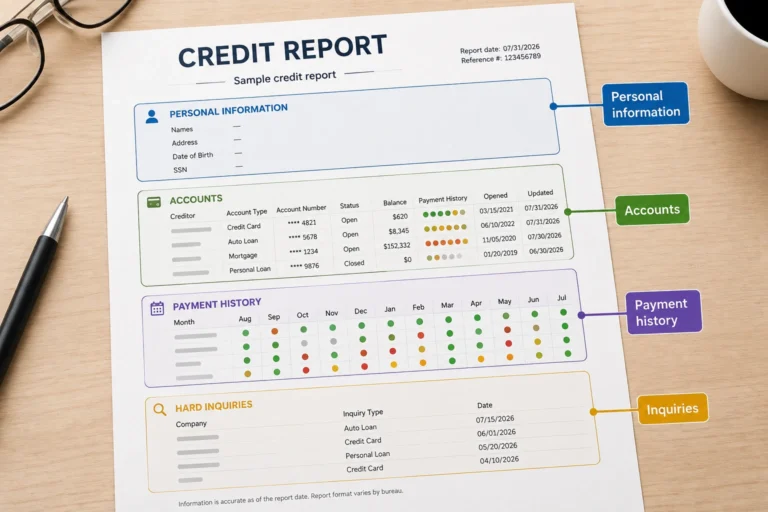
Before choosing a method, review your credit report for inaccurate information and confirm which credit bureau is reporting the error. An item may appear on one credit report but not the other two.
- Online vs. mail credit disputes: quick comparison
- Does the dispute method change your legal rights?
- Does disputing online waive your FCRA rights?
- When should you dispute a credit report online?
- Online filing may work well for a straightforward error
- Advantages of disputing a credit report online
- Possible limitations of an online dispute
- When should you dispute a credit report by mail?
- Mail may provide more control for a complicated dispute
- Advantages of mailing a credit dispute letter
- Possible disadvantages of disputing by mail
- Does certified mail make a credit dispute stronger?
- Which dispute method fits your credit report error?
- Online or mail? Use this decision tree
- What should you include no matter how you file?
- Can you use different methods with different credit bureaus?
- Should you dispute the information with the furnisher too?
- What happens after you submit the dispute?
- Common mistakes when choosing a dispute method
- Believing that mail is automatically stronger
- Submitting an online dispute before collecting evidence
- Selecting a reason that does not accurately fit the error
- Failing to save the online submission
- Mailing original evidence
- Failing to keep an identical copy of the mailed package
- Sending several identical disputes at the same time
- Disputing accurate negative information
- Expecting a guaranteed deletion or score increase
- Bottom line: should you dispute online or by mail?
- Frequently asked questions
- Is it better to dispute a credit report online or by mail?
- Are online credit disputes effective?
- Does disputing a credit report online waive your rights?
- Should I send a credit dispute by certified mail?
- Can I upload documents with an online credit dispute?
- Can I dispute online first and then send a letter?
- Should I dispute a collection online or by mail?
- Should I dispute a late payment online or by mail?
- Do I need to dispute separately with all three credit bureaus?
- How long does a mailed credit dispute take?
- Official sources
Online vs. mail credit disputes: quick comparison
There is no universal winner in the online vs. mail credit dispute debate. Online filing is generally more convenient, while mail may provide more control over how a complicated dispute is explained and documented.
| Comparison | Online dispute | Mail dispute |
|---|---|---|
| Submission speed | Usually submitted immediately | Requires mailing and delivery time |
| Convenience | Can usually be completed from a computer or phone | Requires preparing, printing, and mailing a package |
| Supporting documents | Can generally be uploaded, subject to the portal’s requirements | Copies can be included with the letter |
| Detailed explanation | May depend on the portal’s available options | You control the wording and organization of the letter |
| Proof of submission | Portal confirmation, email, or confirmation number | Mailing receipt and, when used, delivery tracking |
| Status tracking | Often available through the bureau’s online system | Usually less immediate |
| Certified mail required? | Not applicable | No, but it may document delivery |
| Best fit | Simple, clearly documented errors | Complicated or document-heavy disputes |
| Automatic legal advantage | No | No |
| Guaranteed correction or deletion | No | No |
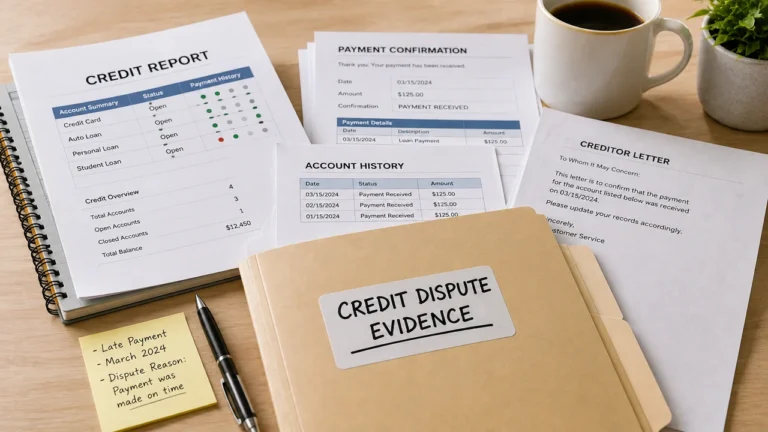
AnnualCreditReport explains that consumers may submit disputes to a credit reporting company online or by mail. Supporting documents may be uploaded for an online dispute or included as copies with a mailed dispute. Original documents should not be mailed because they may not be returned.
Does the dispute method change your legal rights?
An online credit dispute is a recognized way to notify a credit reporting company that information in your file may be inaccurate or incomplete. The Consumer Financial Protection Bureau, Federal Trade Commission, AnnualCreditReport, Experian, Equifax, and TransUnion all provide information about online dispute options.
The Fair Credit Reporting Act does not give a mailed dispute an automatic legal advantage over an online dispute. Under 15 U.S.C. § 1681i, a credit reporting agency that receives a qualifying dispute generally must conduct a free reasonable reinvestigation to determine whether the disputed information is inaccurate.
The law generally requires the agency to complete the reinvestigation before the end of the 30-day period beginning on the date it receives notice of the dispute. That period may be extended by no more than 15 additional days if the consumer provides relevant information during the original 30-day period, subject to the limitations stated in the law.
A credit reporting agency may determine that a dispute is frivolous or irrelevant when it does not provide enough information to identify and investigate the disputed item. That is why the clarity of your claim matters more than whether it arrived through a website or inside an envelope.
Filing a dispute itself does not directly lower a credit score. However, a change made to the underlying credit report after the investigation may affect a score. Read more about whether disputing your credit report can hurt your credit score.
Does disputing online waive your FCRA rights?
Official federal guidance does not state that filing a credit report dispute online automatically waives your rights under the FCRA. Online disputes are offered by all three nationwide credit reporting companies and are recognized as a submission option by federal consumer agencies.
You should still read the instructions and terms displayed by the particular portal before submitting. More importantly, save a copy of the dispute reason you selected, the explanation you entered, the documents you uploaded, and the confirmation number you received.
Do not rely on a vague statement such as “this account is wrong.” Identify the particular balance, date, payment status, ownership issue, or other field you believe is inaccurate and explain the correction you want.
When should you dispute a credit report online?
An online credit report dispute is often a reasonable starting point when the problem is simple enough to explain through the bureau’s available options and all relevant evidence can be uploaded.
Online filing may work well for a straightforward error
Examples may include:
- One balance that does not match a recent account statement.
- A clearly duplicated account or collection entry.
- An account status that appears inconsistent with the creditor’s records.
- One incorrectly reported payment month.
- An account you do not recognize, when the situation does not require a separate identity theft procedure.
- A specific date that can be disproved with a clear document.
For example, suppose your credit report shows a $600 balance on a collection account, but you have a letter from the collector confirming that the account was paid and now has a zero balance. If the online portal lets you select an accurate reason, identify the account, request a balance correction, and upload the letter, filing online may be sufficient.
Advantages of disputing a credit report online
- You can submit the dispute without waiting for postal delivery.
- You may be able to upload supporting documents during the process.
- You will usually receive an electronic confirmation or case number.
- You may be able to track the investigation through an online account.
- Results may be delivered electronically, depending on the bureau.
Experian, Equifax, and TransUnion each provide an online dispute process. Available document-upload features and procedures can vary, so check the current instructions shown by the bureau before submitting.
Possible limitations of an online dispute
An online portal may be less convenient when the available dispute reasons do not accurately describe your situation. A complicated payment history, several conflicting dates, or multiple connected reporting errors may require more explanation than a standard menu option provides.
Online filing can also make it tempting to submit a dispute before gathering the right evidence. Convenience is useful, but speed does not replace preparation.
When should you dispute a credit report by mail?
A credit bureau dispute by mail may be easier to organize when the issue involves several facts, several documents, or a customized explanation that does not fit neatly into an online form.
Mailing a dispute does not force the credit bureau to accept your position. Its practical advantage is that you control the wording, layout, exhibits, and delivery method.
Mail may provide more control for a complicated dispute
Consider mail when:
- Several payment-history entries are inaccurate.
- The same account contains multiple incorrect balances, dates, or statuses.
- The online portal does not provide a dispute reason that accurately fits the error.
- You need to explain how several documents support different parts of your claim.
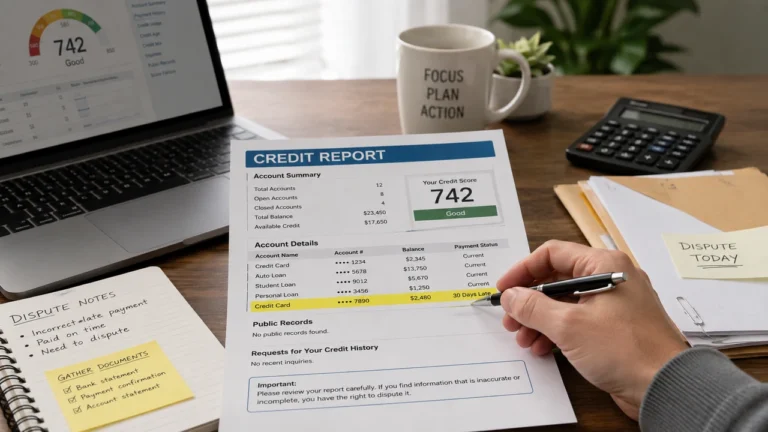
- You want to include a marked copy of the relevant portion of your credit report.
- You want a separate postal delivery record.
- The bureau’s instructions require supporting documents to be mailed for that type of update.
For example, imagine a charged-off account showing an incorrect balance, an incorrect last-payment date, and several months of payment history you believe belong to another account. A mailed dispute may make it easier to list each claimed error separately and match each one to a numbered supporting document.
Advantages of mailing a credit dispute letter
- You can write a customized explanation in your own words.
- You can identify each disputed field separately.
- You can organize supporting documents as numbered exhibits.
- You can include a copy of the report with the relevant entries highlighted.
- You can keep an identical copy of the entire package.
- You can use trackable mail to document delivery.
Possible disadvantages of disputing by mail
- The bureau cannot receive the dispute until the package is delivered.
- Printing, copying, and trackable mailing may cost money.
- You will not receive an immediate online confirmation number.
- A poorly organized letter can still be difficult to investigate.
- Mailing original documents creates a risk because they may not be returned.
- A mailing address found on an old website or template may be outdated.
Always verify the current dispute address through the credit bureau’s official website or the instructions supplied with your credit report before mailing sensitive documents.
Does certified mail make a credit dispute stronger?
No. A certified mail credit dispute does not make inaccurate information more likely to be corrected merely because certified mail was used. It also does not guarantee deletion.
The main benefit of certified mail is documentation. The CFPB explains that consumers may choose certified mail and request a return receipt to create a record showing that the dispute letter was received.
Certified mail is not the only acceptable mailing method. TransUnion, for example, states that it accepts either standard or certified mail for mailed disputes.
A mailing receipt shows that you sent a package. Delivery tracking can show that a package reached the destination. Neither document independently proves exactly what was inside the envelope, so keep a complete copy of the letter, credit report pages, identification documents, and supporting evidence you mailed.
The 30-day investigation period generally begins when the credit reporting agency receives notice of the dispute, not when you write or mail the letter. Postal delivery time may therefore affect when the investigation begins.
Which dispute method fits your credit report error?
The best way to dispute a credit report depends on the complexity of the error and the evidence available. The following scenarios provide practical starting points rather than absolute rules.
| Situation | Reasonable starting method | Why |
|---|---|---|
| One incorrect balance with a clear statement | Online | The error and supporting document are usually easy to identify and match. |
| One incorrectly reported late-payment month | Online or mail | Either may work if you can identify the exact month and provide reliable payment evidence. |
| Several incorrect late payments | Mail may be easier | Each payment month may need a separate explanation and document. |
| Account does not belong to you | Online may be practical | A separate identity theft process may be appropriate if fraud is involved. |
| Duplicate collection account | Online or mail | The better method depends on how clearly the duplicate can be demonstrated. |
| Paid collection still shows a balance | Online or mail | The payment evidence and requested balance correction matter more than the channel. |
| Complicated charge-off reporting | Mail may provide more control | Several balances, statuses, or dates may need to be addressed separately. |
| Incorrect name, address, or identification information | Check the bureau’s instructions | Some personal-information changes require mailed supporting documents. |
| Previous dispute was verified as accurate | Depends on the new evidence | Repeating the same unsupported dispute through a different channel may not change the outcome. |
| You need independent proof of delivery | Trackable delivery may document when the package arrived. |
Online or mail? Use this decision tree
- Can you accurately describe the error using the online portal’s available options?
- Yes: Continue to question 2.
- No: A mailed dispute may give you more control over the explanation.
- Can you upload every document that is relevant to your claim?
- Yes: Continue to question 3.
- No: Check the bureau’s instructions and consider filing by mail.
- Does the dispute involve several dates, balances, payment entries, or account statuses?
- Yes: Mail may make the evidence easier to organize.
- No: Online filing may be the more convenient option.
- Do you want an independent postal delivery record?
- Yes: Use a trackable mailing method and keep copies.
- No: An online confirmation may be sufficient for your records.
- Does the error appear to involve identity theft?
- Yes: Follow the official identity theft recovery process through IdentityTheft.gov and the credit bureau.
- No: Choose the channel that presents your claim and evidence most clearly.
What should you include no matter how you file?
Whether you file online or send a letter, your dispute should be specific enough for the credit reporting company to identify the item and understand the correction you are requesting.
- Your identifying information as required by the bureau.
- The name of the company reporting the disputed item.
- The partial account number shown on your credit report.
- The exact balance, date, status, payment entry, or other field you believe is inaccurate.
- A clear explanation of why the information is inaccurate or incomplete.
- The specific correction or removal you are requesting.
- Copies of relevant supporting documents.
- A marked copy of the relevant credit report section when helpful.
- A copy or screenshot of the complete submission.
- The online confirmation number or postal delivery record.
The right evidence depends on the type of reporting error. Review the separate guide to documents that can support a credit report dispute before submitting your claim.
Can you use different methods with different credit bureaus?
Yes. You can choose the submission method separately for Experian, Equifax, and TransUnion.
For example, you might file online with Experian and Equifax but use mail for TransUnion because the TransUnion error requires a document or personal-information update that cannot be completed through the online process.
The important point is that you must dispute with each credit reporting company whose report contains the inaccurate information. Filing with one bureau does not necessarily correct the reports maintained by the other two.
Keep separate records for each bureau, including:
- The report and account involved.
- The date the dispute was submitted or delivered.
- The explanation and documents provided.
- The confirmation or tracking number.
- The bureau’s investigation result.
Should you dispute the information with the furnisher too?
In many cases, you can dispute the information with both the credit reporting company and the business that supplied it. The business may be a lender, credit card issuer, loan servicer, collection agency, landlord, or another data furnisher.
CFPB and FTC guidance explains that both the credit bureau and the business that provided inaccurate or incomplete information have responsibilities under federal law.
The furnisher’s dispute address may appear on your credit report, billing statement, or official website. Follow the company’s instructions and keep a complete record of what you send.
This does not mean that submitting more disputes always produces a better result. Contact the parties that actually maintain or report the disputed information, and make each claim specific and evidence-based.
What happens after you submit the dispute?
Save your confirmation number, delivery record, dispute explanation, and supporting documents. Watch for messages through the bureau’s portal, email, or U.S. mail.
A credit reporting company generally must complete its reinvestigation within 30 days after receiving the dispute. The FCRA permits an extension of no more than 15 additional days in certain circumstances when relevant information is submitted during the original investigation period.
After receiving the decision:
- Read the investigation result carefully.
- Compare the original report with any updated report.
- Check whether the item was corrected, deleted, updated, or left unchanged.
- Confirm that the requested field, rather than an unrelated field, was changed.
- Decide whether the result resolves the specific inaccuracy.
If the bureau does not make the correction you requested, read what to do if your credit dispute is denied.
If the investigation result says that the information was confirmed, see what “verified as accurate” means after a credit dispute.
Common mistakes when choosing a dispute method
Believing that mail is automatically stronger
Mail can provide more control and a postal delivery record. It does not automatically produce a more thorough investigation or a better result.
Submitting an online dispute before collecting evidence
The ability to file quickly does not mean you should file immediately. Review the disputed field, requested correction, and supporting documents first.
Selecting a reason that does not accurately fit the error
Do not force a complicated reporting problem into an unrelated portal category merely because it is the closest available option.
Failing to save the online submission
Take screenshots or save copies showing the account, dispute reason, explanation, documents, and confirmation number.
Mailing original evidence
Send copies unless an official instruction specifically requires otherwise. Keep the original records in your files.
Failing to keep an identical copy of the mailed package
A certified mail receipt alone does not show every document that was included. Copy or scan the complete package before mailing it.
Sending several identical disputes at the same time
Multiple overlapping submissions can make your records harder to follow. Do not assume that filing the same unsupported claim through several channels will create a different result.
Disputing accurate negative information
A credit dispute is intended to correct inaccurate or incomplete information. Accurate negative information generally cannot be removed merely because it is damaging to your credit.
Expecting a guaranteed deletion or score increase
Neither online nor mail guarantees that an account will be deleted. A score change also depends on what information changes and on the scoring model evaluating the report.
Bottom line: should you dispute online or by mail?
Use an online dispute when the error is simple, the portal accurately captures your reason, and you can upload the necessary documents. Consider mail when the issue requires a customized explanation, several organized exhibits, or an independent postal delivery record.
Neither method guarantees removal. When deciding whether to dispute a credit report online or by mail, focus on the method that lets you present the clearest claim and preserve the most complete record.
Once you choose a submission method, follow the complete process in how to dispute errors on your credit report step by step.
Frequently asked questions
Is it better to dispute a credit report online or by mail?
Online is usually more convenient for a simple, well-documented error. Mail may be more practical when the issue requires a detailed explanation, several documents, or a separate delivery record. Neither method has an automatic advantage in proving that the information is inaccurate.
Are online credit disputes effective?
Online disputes can be effective when they clearly identify an inaccurate or incomplete item and include relevant supporting evidence. The result depends on the facts and documentation, not merely on the submission channel.
Does disputing a credit report online waive your rights?
Official federal guidance does not say that an online dispute automatically waives FCRA rights. Read the portal instructions, provide a specific claim, and save a complete record of the submission.
Should I send a credit dispute by certified mail?
Certified mail is optional, but it may help document when the credit reporting company received the package. It does not make your evidence stronger or guarantee deletion.
Can I upload documents with an online credit dispute?
Experian, Equifax, and TransUnion provide online dispute systems, but available upload features and document requirements can vary by bureau and type of dispute. Check the bureau’s current instructions before filing.
Can I dispute online first and then send a letter?
You may provide new or additional relevant information, but avoid creating two identical overlapping disputes without a clear reason. Keep the original result and explain what new evidence or issue the later submission adds.
Should I dispute a collection online or by mail?
Online may be sufficient for one clear collection error supported by a payment letter or account statement. Mail may be easier when the collection contains several incorrect balances, dates, ownership issues, or reporting entries.
Should I dispute a late payment online or by mail?
Either method may work for one specific late-payment error. Mail may provide more room when several payment months are disputed or when multiple records must be matched to individual months.
Do I need to dispute separately with all three credit bureaus?
Dispute with every credit bureau whose report contains the error. If the item appears on only one report, you generally do not need to dispute that item with the other two bureaus.
How long does a mailed credit dispute take?
The credit reporting agency generally has 30 days beginning when it receives notice of the dispute, subject to limited exceptions and a possible extension allowed by the FCRA. Mailing time occurs before the bureau receives the dispute.
Official sources
- Consumer Financial Protection Bureau: How do I dispute an error on my credit report?
- Federal Trade Commission: Disputing errors on your credit reports
- Federal Trade Commission: Sample letter for disputing credit report errors
- AnnualCreditReport: Fixing mistakes on your credit report
- 15 U.S.C. § 1681i: Procedure in case of disputed accuracy
- Experian: Dispute credit report information
- Equifax: File a dispute on your Equifax credit report
- TransUnion: Credit disputes
- TransUnion: Dispute your credit report by mail or phone