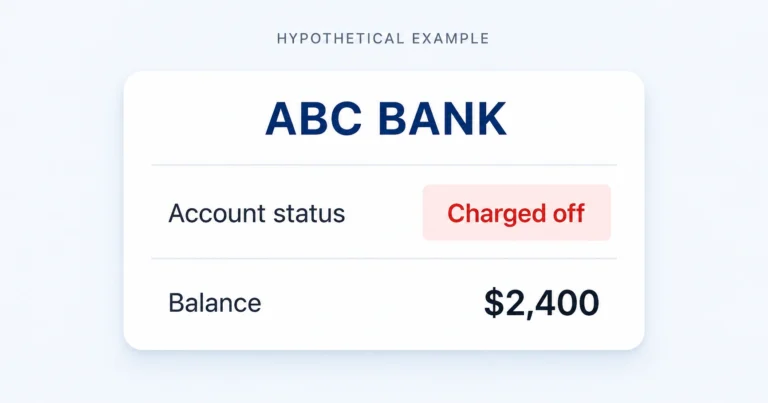
When comparing charge-off vs collection, one distinction matters most: they are not the same thing, although they may be connected to the same unpaid debt. A charge-off is reported by the original creditor after an account has remained seriously past due. A collection may appear when the creditor assigns or sells the debt to a collection agency or debt buyer.
This means you may see both the original charged-off account and a separate collection account on your credit report. In most cases, these two entries represent one underlying debt, not two separate debts.
However, you should not send payment to either company until you confirm who currently owns the debt or is authorized to collect it. You should also check whether the balances, dates, and account details are being reported accurately.
- Quick answer
- Charge-off vs collection: the key differences
- What is a charge-off?
- What is a collection account?
- How does a charge-off become a collection?
- The original creditor keeps the debt
- The debt is assigned to a collection agency
- The debt is sold to a debt buyer
- Why can a charge-off and a collection both appear on your credit report?
- One debt can create two credit report entries
- When both entries may be accurate
- When the reporting may need closer review
- Do a charge-off and a collection mean you owe two debts?
- Example of one debt appearing as two accounts
- How to confirm that the entries are connected
- Who owns the debt after a charge-off?
- The original creditor still owns the debt
- The debt was sold to a debt buyer
- The debt owner and collector may be different companies
- How to identify the current owner
- Should you pay the charge-off or the collection agency?
- Pay the original creditor if it still owns the debt
- Pay the debt buyer if the debt was sold
- Pay an authorized collection agency
- What to do before making a payment
- What to get in writing
- Can the original creditor and a collection agency both report a balance?
- When the original creditor may report a balance
- When the original creditor may show a zero balance
- When two balances may indicate a reporting problem
- How do charge-offs and collections affect your credit?
- Late payments may affect your credit first
- A charge-off is a serious negative account status
- A collection may add another negative entry
- The impact of paying depends on the scoring model
- How long do charge-offs and collections stay on your credit report?
- Does paying the collection remove the charge-off?
- What happens to the collection account after payment?
- What happens to the original charge-off?
- Can you ask for the collection to be removed?
- What should you check when both accounts appear?
- Check the original creditor
- Compare the account numbers
- Review the balances
- Check the delinquency dates
- Identify the current creditor
- Review the payment status
- Look for duplicate collection accounts
- Credit report checklist
- When should you dispute a charge-off or collection?
- The account does not belong to you
- The balance is incorrect
- The debt is reported more than once
- The dates are inaccurate
- The ownership information is inconsistent
- The payment status was not updated
- Documents that may support your dispute
- Charge-off and collection example
- How the accounts may appear on your credit report
- If the original creditor still owns the debt
- What should you do next?
- 1. Review all three credit reports
- 2. Match the charge-off to the collection account
- 3. Identify the current owner of the debt
- 4. Review the debt validation information
- 5. Dispute inaccurate information
- 6. Get any payment agreement in writing
- 7. Review your credit reports after payment
- 8. Begin rebuilding positive credit history
- Frequently asked questions
- Is a charge-off the same as a collection?
- Can a charge-off and a collection both appear on your credit report?
- Do you have to pay both the charge-off and the collection account?
- Is a charge-off worse than a collection?
- Does paying a collection remove the charge-off?
- Should the original creditor show a zero balance?
- Can you have a charge-off without a collection?
- Can you have a collection without a charge-off?
- How long do charge-offs and collections stay on your credit report?
- The bottom line
- Sources
- Editorial disclaimer
Quick answer
A charge-off means that the original creditor has classified a seriously delinquent account as a financial loss for accounting purposes. A collection means that the unpaid debt is being pursued by the original creditor, a collection agency, or a debt buyer.
Both entries may appear on your credit report without necessarily indicating an error because they describe different stages of the same debt. You generally do not owe both companies separately. Before making a payment, verify the current creditor, the correct balance, and which company is authorized to accept payment.
Charge-off vs collection: the key differences
The main difference between a charge-off and a collection is who reports the account and which stage of the debt each entry represents. A charge-off usually appears under the original creditor, while a collection account may be reported by a collection agency or debt buyer. Both entries may be connected to the same unpaid balance.
| Feature | Charge-off | Collection |
|---|---|---|
| What it means | The original creditor classified the unpaid account as a financial loss. | The debt is being pursued for payment. |
| Who reports it | Usually the original creditor. | A collection agency or debt buyer may report it. |
| Does the debt disappear? | No. A charge-off does not cancel the debt. | No. The debt may still be legally owed. |
| Does it create a second debt? | No. | No. A collection account usually represents the same underlying debt. |
| Who may own the debt? | The original creditor may still own it, or the debt may have been sold. | The original creditor, a collection agency, or a debt buyer may own or service it. |
| Where it appears | Under the original credit account. | Usually as a separate collection account. |
| Who should receive payment? | The current owner of the debt or a company authorized to collect it. | |
| Does payment remove the account? | Usually not automatically. | Usually not automatically. |
The presence of both entries does not usually mean that you owe the balance twice. It generally means the original account became seriously delinquent and the debt later moved into the collection process.
What is a charge-off?
A charge-off occurs when an original creditor determines that an account is unlikely to be repaid and records the unpaid balance as a financial loss. This usually happens after the account has remained seriously delinquent for several months.
A charge-off does not mean the debt has been forgiven, canceled, or erased. You may still be legally responsible for paying the balance, and the creditor may continue collection efforts even after the account has been charged off.
The original account will usually remain on your credit report with a charge-off status. The creditor may keep the debt and attempt to collect it directly, assign it to a collection agency, or sell it to a debt buyer. If another company begins reporting the debt, a separate collection account may also appear on your credit report.
For a more detailed explanation of the reporting timeline and the steps you can take, read our guide to what a charge-off means on your credit report.
After an account is charged off, the next stage depends on what the original creditor decides to do with the unpaid balance.
What is a collection account?
A collection account may appear when an unpaid debt is assigned or sold to a company that attempts to recover the balance. The company may contact the consumer, request payment, and report the account to one or more credit bureaus.
A collection agency may collect the debt on behalf of the original creditor without owning it. In other cases, a debt buyer may purchase the account and become the new owner of the debt. This distinction matters because it determines which company is authorized to accept payment and update the account after the balance is paid or settled.
A separate collection account does not usually mean that a new debt has been created. It generally represents the same unpaid balance that began with the original account. As a result, you may see both the original charged-off account and a separate collection account on your credit report.
Before making a payment, verify the name of the current creditor, the amount owed, and whether the company contacting you is authorized to collect the debt. You should also compare the account numbers, balances, and dates listed on your credit reports.
Understanding who owns the debt helps explain why both a charge-off and a collection may appear on the same credit report.
How does a charge-off become a collection?
An unpaid account does not usually move directly from one missed payment to collections. It typically passes through several stages of delinquency before the original creditor charges off the account and decides what to do with the remaining balance.
Missed payment → 30 days late → 60 days late → 90 days late → serious delinquency → charge-off → collection or debt sale
As payments remain overdue, the creditor may continue contacting the borrower, reporting late payments, and attempting to collect the balance. To understand what may happen during this stage, read our guide to what happens when an account reaches 90 days late.
The original creditor keeps the debt
After charging off the account, the original creditor may continue to own the debt and attempt to collect it directly. In this situation, the charged-off account may remain on the credit report without a separate collection account.
The debt is assigned to a collection agency
The original creditor may hire a collection agency to recover the balance on its behalf. The collection agency may contact the borrower and accept payments, but the original creditor may still own the debt. Depending on how the account is reported, a separate collection account may appear on the credit report.
The debt is sold to a debt buyer
The original creditor may sell the unpaid account to a debt buyer. The debt buyer then becomes the new owner of the debt and may collect the balance directly or hire another collection agency. The original account may continue to show its charge-off history, while the new owner may report a separate collection account.
Assigning or selling the debt does not create a second debt. It changes who owns the balance or who is authorized to collect it. This process explains why the original charge-off and a separate collection account may both appear on the same credit report.
Why can a charge-off and a collection both appear on your credit report?
A charge-off and a collection can both appear on your credit report because they describe different stages of the same unpaid debt. The original creditor reports what happened to the original account, while a collection agency or debt buyer may report a separate collection account related to the remaining balance.
One debt can create two credit report entries
The charged-off account shows the payment history and status of the original account. A separate collection account may show that another company is collecting or now owns the unpaid debt. Although the two entries may be connected, they generally do not represent two separate debts.
For example, the original creditor may continue reporting the account as charged off even after assigning or selling the debt. A collection agency or debt buyer may then report a separate collection account related to the same underlying balance.
When both entries may be accurate
Both entries may be accurate when the original account shows the payment history that led to the charge-off and the collection account shows that the debt is now being collected or is owned by another company. If the original creditor sold the debt, the original account may show a zero balance, while the collection account shows the current unpaid balance.
The entries should also reflect a consistent delinquency timeline. Assigning or selling the debt should not make it appear newer or restart the credit reporting period.
When the reporting may need closer review
You should review the accounts carefully if both companies report the full outstanding balance, two collection agencies report the same debt, the dates do not match, or an account you paid still appears unpaid. You should also investigate if the original creditor and another company both claim to own the debt.
If you are unsure whether the entries are connected, compare the creditor names, partial account numbers, balances, payment statuses, and delinquency dates shown under both accounts.
Seeing both entries does not usually mean that you owe the debt twice. The next step is to determine whether the accounts represent one underlying balance and which company currently owns the debt or is authorized to collect it.
Do a charge-off and a collection mean you owe two debts?
No. If a charge-off and a collection are connected to the same original account, they normally represent one underlying debt. The two credit report entries describe different stages of the account’s history, but they do not usually create two separate payment obligations.
The original creditor may continue reporting the account’s payment history and charge-off status, while a collection agency or debt buyer reports its involvement with the unpaid balance. You should not automatically add the balances from both entries together or assume that you owe each company separately.
Example of one debt appearing as two accounts
Suppose a credit card issuer charges off a $3,000 balance and later sells the debt to a debt buyer. Your credit report may show the original charged-off account and a separate collection account. This does not normally mean that you owe $3,000 to each company or $6,000 in total. You still have one underlying debt, although the current balance may change because of payments, interest, fees, or settlement activity allowed under the account agreement and applicable law.
How to confirm that the entries are connected
Compare the information listed under both accounts, including:
- The name of the original creditor
- The partial account number
- The original and current balances
- The date of first delinquency
- The name of the current creditor
- The collection reference number
- Remarks such as “sold,” “transferred,” or “assigned”
Important: Do not send payments to both companies simply because both accounts appear on your credit report. First, verify who currently owns the debt or which company is authorized to accept payment.
Once you confirm that the two entries relate to the same debt, the next step is to determine who currently owns the account and which company has the right to collect payment.
Who owns the debt after a charge-off?
After a charge-off, the original creditor may still own the debt, assign it to a collection agency, or sell it to a debt buyer. The company contacting you is not necessarily the company that owns the account, so you should confirm both the current creditor and the authorized collector before making a payment.
The original creditor still owns the debt
The original creditor may keep ownership of the debt after charging off the account. It may continue collecting the balance directly or hire a collection agency to collect on its behalf. In this situation, the collection agency may contact you and accept payments even though the original creditor remains the legal owner of the debt.
A collection agency does not always own the account. It may simply be servicing the debt under an agreement with the original creditor.
The debt was sold to a debt buyer
The original creditor may sell the charged-off debt to a debt buyer. When this happens, the debt buyer generally becomes the current creditor and gains the right to collect the balance. It may contact you directly or hire another collection agency to handle the account.
The original charged-off account may remain on your credit report as part of your credit history. However, if the debt was sold, the original creditor may report a zero balance because it no longer owns the unpaid amount. The debt buyer or its collection agency may then report a separate collection account with the current balance.
The debt owner and collector may be different companies
The debt owner is the company that legally owns the account. The collector is the company authorized to request and accept payment. These may be the same company, but they are often different.
How to identify the current owner
Review your credit reports, collection letters, and validation notice for the following information:
- The name of the original creditor
- The name of the current creditor
- The name of the collection agency
- The partial account number
- The current balance
- Remarks such as “sold,” “transferred,” or “assigned”
- Whether the original creditor reports a zero balance
Your credit report may not provide every detail you need. You can also contact the original creditor using independently verified contact information and ask whether the account was retained, assigned, or sold.
Important: Do not rely only on the company name shown in a phone call, email, or letter. Verify the current creditor, the balance, and the company’s authority to collect before providing payment or banking information.
Once you know who owns the debt, you can determine whether payment should go to the original creditor, a debt buyer, or an authorized collection agency.
Should you pay the charge-off or the collection agency?
You should pay only the company that currently owns the debt or is authorized to collect it. Do not send payments to both the original creditor and the collection agency simply because both accounts appear on your credit report.
Pay the original creditor if it still owns the debt
If the original creditor still owns the debt and accepts payments, you may be able to pay the creditor directly. The creditor may also require you to make payments through a collection agency that is handling the account on its behalf.
Before paying, confirm that the original creditor still owns the account and ask which company is authorized to accept payment.
Pay the debt buyer if the debt was sold
If the original creditor sold the account, a debt buyer may now own the balance. In that situation, the original creditor generally should not receive payment for the sold debt. Payment should usually go to the debt buyer or to a collection agency authorized to collect on its behalf.
Pay an authorized collection agency
A collection agency may be authorized to accept payment even if it does not own the debt. However, you should verify the agency’s authority before providing payment information. Confirm the name of the current creditor, the account number, and the amount owed.
What to do before making a payment
- Compare the charge-off and collection entries on all three credit reports.
- Identify the original creditor, the current creditor, and the collection agency.
- Contact the original creditor using independently verified contact information.
- Ask whether the debt was retained, assigned, or sold.
- Review the collector’s validation notice.
- Confirm the account number and current balance.
- Request the payment or settlement terms in writing.
- Ask how the account will be updated after payment.
- Keep copies of the agreement, payment confirmation, and related correspondence.
What to get in writing
Before sending money, request written confirmation that explains:
- The name of the current creditor
- The amount the company has agreed to accept
- Whether the payment will satisfy the debt in full or settle it for less than the full balance
- The payment deadline and accepted payment method
- How any remaining balance will be handled
- How the account will be reported after payment
- Whether the agreed payment will resolve your obligation under the arrangement
Important: Do not make a payment based only on a phone call. Verify the company, the debt, the balance, and the payment terms before providing your bank account, debit card, or credit card information.
If the debt is old, review the statute of limitations in your state before making a payment or acknowledging the debt. State laws vary, and in some circumstances, a payment or written acknowledgment may affect how long a collector has to file a lawsuit.
After identifying the correct company to pay, review how the original charge-off and collection account should appear on your credit reports.
Can the original creditor and a collection agency both report a balance?
The original creditor and a collection agency may both appear on your credit report, but they should not normally make it look as though you owe the full balance twice. Whether both accounts can report a balance depends largely on who currently owns the debt and how the collection arrangement is structured.
When the original creditor may report a balance
If the original creditor still owns the debt, it may continue reporting the unpaid balance after charging off the account. A collection agency may be authorized to collect the debt on the creditor’s behalf without becoming the legal owner of the account.
In this situation, the original creditor may remain responsible for reporting the balance, while the collection agency handles communications and collects payments. The exact reporting arrangement can vary, so the involvement of a collection agency does not automatically mean the debt was sold.
When the original creditor may show a zero balance
If the original creditor sells the debt to a debt buyer, it no longer owns the unpaid balance. The original account may remain on your credit report with its charge-off status and payment history, but the balance is commonly updated to zero. The debt buyer or its authorized collection agency may then report a separate collection account showing the current balance.
For example, suppose an original creditor charges off an account with a $2,000 balance and later sells the debt to a debt buyer. Your credit report may show the original account as charged off with a zero balance and a separate collection account with a $2,000 balance. These entries generally represent one $2,000 debt, not a total debt of $4,000.
When two balances may indicate a reporting problem
You should review the accounts more closely if:
- The original creditor and a debt buyer both report the full outstanding balance.
- Two collection agencies report the same debt at the same time.
- The original creditor confirms that the debt was sold but continues reporting a balance owed to it.
- A paid or settled account still shows an unpaid balance.
- The same debt appears to be reported as several unrelated accounts.
- The balances, account numbers, ownership details, or delinquency dates conflict.
Whether the reporting is accurate depends on who currently owns the debt, who is authorized to collect it, and how each company reports the account. It is not automatically an error simply because both companies appear on your credit report.
Important: Do not assume that you owe both balances. Compare the account details, contact the original creditor using independently verified contact information, and request written validation from the collector before making a payment.
If the balances, ownership information, or account statuses conflict, gather your account statements, collection notices, payment records, and correspondence before deciding whether to dispute the reporting.
How do charge-offs and collections affect your credit?
Both charge-offs and collections can negatively affect your credit, but the exact impact depends on the scoring model, the age of the accounts, and the rest of your credit history. There is no fixed number of points that every consumer will lose.
Late payments may affect your credit first
The damage may begin before an account is charged off or sent to collections. By that point, the original creditor may have already reported the account as 30, 60, 90, or more days past due. These missed payments can affect your credit profile before the charge-off or collection account appears.
You can learn more about how long late payments can affect your credit score and why older delinquencies may still appear on your credit reports.
A charge-off is a serious negative account status
A charge-off shows that the original account became seriously delinquent and that the creditor classified the unpaid balance as a financial loss. This status may affect your credit score and may also influence a lender that manually reviews your credit report.
However, a charge-off does not reduce every credit score by the same number of points. Its impact depends on factors such as the age of the account, the amount owed, your previous credit history, and whether other negative accounts are present.
A collection may add another negative entry
A collection account may appear as a separate item after the original creditor assigns or sells the debt. It can show lenders that the unpaid account moved into the collection process.
A collection account may add another negative item to your credit report, but the effect is not calculated by simply assigning a fixed point loss to each entry. A charge-off and a collection related to the same debt do not automatically cause twice the credit score damage.
The impact of paying depends on the scoring model
After you pay or settle a collection, the balance and payment status should be updated accurately. The account may be reported as paid, paid in full, or settled, depending on the agreement. The original charge-off, however, will not usually disappear simply because the collection was paid.
Some newer credit scoring models treat certain paid collection accounts differently from unpaid collections, while older models may continue to consider them. Creditors also use different scoring models, so paying a collection does not guarantee an immediate credit score increase.
Read more about what may happen to your credit score after paying a collection and why your credit score may change after paying off debt.
How long do charge-offs and collections stay on your credit report?
Accurate charge-offs and related collection accounts can generally remain on your credit reports for up to seven years from the original delinquency that led to the default. Assigning or selling the debt should not restart the credit reporting period or make the account appear newer than it is.
Paying the debt does not change the original delinquency date. However, the balance and payment status should be updated to reflect the payment or settlement accurately.
Important: There is no guaranteed credit score increase after paying a charge-off or collection. Payment can resolve the outstanding balance and may improve how the account appears to future lenders, but the score change depends on the scoring model and the rest of your credit report.
Paying the debt may resolve the outstanding balance, but it does not usually remove accurate negative history. The next step is to understand what happens to the original charge-off after the collection is paid.
Does paying the collection remove the charge-off?
No. Paying a collection does not usually remove the original charge-off from your credit report. The two entries may relate to the same debt, but they report different parts of the account’s history.
The original creditor reports the payment history and charge-off status of the original account. The collection account shows that the unpaid balance was assigned or sold for collection. Paying the collection may resolve the debt, but it does not automatically erase accurate information reported by the original creditor.
What happens to the collection account after payment?
After you pay the collection in full, the collection account should generally be updated to show a zero balance and a status such as “paid” or “paid in full.” If you settle the debt for less than the full amount, the account may be reported as “settled” or “paid for less than the full balance.”
The update may not appear immediately. The collector must first report the new information to the credit bureaus, and each credit report may update on a different schedule.
What happens to the original charge-off?
The original charged-off account may remain on your credit report even after the collection is paid. Its payment history, delinquency dates, and charge-off status may continue to appear until the account reaches the end of the applicable credit reporting period.
If the original creditor sold the debt, its account should generally continue to show a zero balance because the creditor no longer owns the unpaid amount. If the balance, ownership information, or payment status is inaccurate after you pay, you may have grounds to dispute the reporting.
Can you ask for the collection to be removed?
You may ask the collection company whether it has a policy for removing a paid account, but deletion is not guaranteed. A pay-for-delete arrangement is not available from every collector, and the original creditor is not generally required to remove accurate charge-off information simply because the debt was paid.
To learn more, read our guide on whether a paid collection can be removed from your credit report. You can also review the steps for how to fix your credit score after paying off debt.
Important: Paying the debt and removing the account are two different outcomes. Payment can resolve the outstanding balance, but accurate negative history may remain on your credit report.
After making a payment or settlement, review all three credit reports to confirm that the balance, account status, and ownership information have been updated accurately.
What should you check when both accounts appear?
When both a charge-off and a collection account appear on your credit report, compare the details carefully. Your goal is to confirm that the entries relate to the same debt and that the balances, dates, ownership information, and payment statuses are accurate.
Check the original creditor
Start by reviewing the original account. Confirm the creditor’s name, the type of account, the partial account number, the date the account was opened, and its current status. This information can help you connect the original charge-off to the collection account.
Compare the account numbers
Account numbers may be partially hidden or displayed in different formats. However, the final digits, creditor name, balance, and other identifying details should help you determine whether the two entries are connected.
Review the balances
Compare the original balance and the current balance shown under each account. If the original creditor sold the debt, its account may show a zero balance, while the debt buyer or collection agency reports the remaining amount. Review the entries more closely if both companies appear to claim the full balance.
Check the delinquency dates
Review the date of the first missed payment that led to the default, the charge-off date, the date the collection account was opened, and the estimated removal date. Assigning or selling the debt should not make the original delinquency appear newer or restart the credit reporting period.
Identify the current creditor
Determine which company currently owns the debt and which company is only authorized to collect it. Compare the information on your credit reports with the collector’s validation notice and look for remarks such as “sold,” “transferred,” or “assigned.”
Review the payment status
Make sure the account status accurately reflects whether the debt is unpaid, paid, paid in full, or settled. If the debt has been resolved, confirm that the balance and payment status were updated correctly.
Look for duplicate collection accounts
Check whether more than one collection agency is reporting the same debt. A debt may be transferred from one collector to another, but outdated or duplicate entries should not make it appear as though you owe several separate debts.
Credit report checklist
- Original creditor name
- Current creditor name
- Collection agency name
- Partial account number
- Original balance
- Current balance
- Date of first delinquency
- Charge-off date
- Collection account date
- Payment status
- Ownership remarks
- Estimated removal date
- Possible duplicate collection entries
If the account details are difficult to interpret, review our guide on how to read your credit report before trying to fix it.
Important: Do not rely on only one credit report. An account may appear differently with Experian, Equifax, and TransUnion, so review all three reports before deciding whether the information is accurate.
If the balances, dates, ownership details, or payment statuses are incorrect, the next step is to dispute the inaccurate information with the credit bureau and the company that reported it.
When should you dispute a charge-off or collection?
You should dispute a charge-off or collection if the information is inaccurate, incomplete, duplicated, outdated, or connected to an account that does not belong to you. However, filing a dispute is not a guaranteed way to remove accurate negative information from your credit report.
The account does not belong to you
You may have grounds to dispute the account if you do not recognize the creditor or collection agency, the account number does not match your records, or the debt belongs to another person. You should also act quickly if the account may be connected to identity theft or if you were only an authorized user but the debt is being reported as your responsibility.
The balance is incorrect
Review the reported balance for missing payments, incorrect fees, or amounts that do not match your statements. You may also need to dispute the information if a paid account still shows an unpaid balance or if the original creditor and a debt buyer both appear to claim the full amount.
The debt is reported more than once
An original charged-off account and one related collection account are not automatically duplicates because they may describe different stages of the same debt. However, you should investigate if two collection agencies report the same debt at the same time or if an outdated collection account remains active after the debt was transferred.
The dates are inaccurate
Check the date of first delinquency, charge-off date, collection account date, and estimated removal date. Assigning or selling the debt should not change the original delinquency date, make the debt appear newer, or restart the credit reporting period.
The ownership information is inconsistent
A dispute may be appropriate if the original creditor says the debt was sold, but the credit report still shows a balance owed to that creditor. You should also investigate if the collector cannot identify the current creditor or if multiple companies claim to own the same debt.
The payment status was not updated
If you paid or settled the debt, confirm that the balance and account status were updated accurately. A paid account should not continue to show the same unpaid balance, and a settled account should reflect the terms of the settlement.
Documents that may support your dispute
Useful supporting records may include:
- Copies of the relevant credit report pages
- Account statements
- Payment confirmations
- A written settlement agreement
- Collection letters and validation notices
- Correspondence with the creditor or collector
- An identity theft report, if applicable
- Documents showing that the account was sold or transferred
Follow the steps in our guide on how to dispute errors on your credit report, and review the documents that can support your credit report dispute.
Important: Dispute inaccurate information, not accurate information you simply want removed. If the credit bureaus verify that a charge-off or collection is accurate, they may continue reporting it for the applicable reporting period.
If the information is accurate, the better next step may be to resolve the outstanding balance and begin rebuilding positive credit history rather than repeatedly disputing the same account.
Charge-off and collection example
Consider a credit card account with a $2,500 unpaid balance. After several months without payment, the card issuer charges off the account and later sells the debt to a debt buyer.
How the accounts may appear on your credit report
| Account detail | Original creditor entry | Collection account entry |
|---|---|---|
| Company | Credit card issuer | Debt buyer or collection agency |
| Account status | Charged off | Unpaid collection |
| Reported balance | $0 | $2,500 |
| Payment history | May show several late payments before the charge-off | Usually does not replace the original account’s payment history |
| Account remarks | May show that the debt was sold or transferred | May identify the original creditor and current owner |
These two entries do not normally mean that the consumer owes $2,500 to each company or $5,000 in total. The original account reports the history that led to the charge-off, while the collection account reports the current unpaid balance. The consumer still has one underlying debt of $2,500, although the amount may later change because of payments, an agreed settlement, or other adjustments permitted by the account terms and applicable law.
If the original creditor still owns the debt
The situation may look different if the original creditor did not sell the account. Instead, it may hire a collection agency to recover the balance on its behalf. In that case, the original creditor may remain the owner of the debt, while the collection agency acts only as an authorized collector.
The collection agency may contact the consumer and accept payment, but that does not necessarily mean it owns the account. Before paying, the consumer should confirm whether the debt was retained, assigned, or sold and identify the company authorized to receive the payment.
Important: Do not rely on this example alone when reviewing your own credit reports. Reporting can vary depending on whether the debt was retained, assigned, or sold. Always verify the current creditor, account balance, and payment instructions before sending money.
Once you understand how the two entries are connected, the final step is to decide what action makes sense for your situation.
What should you do next?
Do not rush to pay or dispute an account until you have confirmed who owns the debt, whether the information is accurate, and what outcome you want to achieve. A careful review can help you avoid paying the wrong company, overlooking a reporting error, or disputing information that is accurate.
1. Review all three credit reports
Review your credit reports from Experian, Equifax, and TransUnion because the account may not appear the same on each report. Compare the creditor names, partial account numbers, balances, payment statuses, delinquency dates, collection entries, and estimated removal dates.
2. Match the charge-off to the collection account
Determine whether the charged-off account and the collection account relate to the same underlying debt. Compare the original creditor, partial account number, original balance, current balance, and date of first delinquency.
3. Identify the current owner of the debt
Find out whether the original creditor still owns the account, assigned it to a collection agency, or sold it to a debt buyer. Also confirm which company is authorized to accept payment.
4. Review the debt validation information
If a collector contacts you, review the validation information carefully. Confirm the name of the current creditor, the amount owed, the name of the original creditor, the account details, and the instructions for disputing the debt.
If any of the information is unclear, request additional details before making a payment or sharing financial information.
5. Dispute inaccurate information
You may need to dispute the account if you find an incorrect balance, duplicate collection entry, inaccurate delinquency date, outdated information, incorrect payment status, or an account that does not belong to you.
Focus your dispute on specific errors and include documents that support your position. Do not dispute an accurate account solely because it is negatively affecting your credit.
6. Get any payment agreement in writing
Before paying or settling the debt, request written confirmation of the agreement. The document should identify the company receiving the payment, the amount being accepted, whether the debt will be paid in full or settled, how any remaining balance will be handled, and how the account will be updated.
7. Review your credit reports after payment
After making a payment or completing a settlement, review all three credit reports again. Confirm that the balance and payment status were updated accurately and that the original creditor is not reporting an amount it no longer owns.
You should also confirm that a paid collection is no longer being reported as unpaid.
8. Begin rebuilding positive credit history
Resolving the debt is only one part of improving your credit. Continue making current payments on time, keep credit card balances low, avoid unnecessary credit applications, monitor your reports, and build a consistent record of responsible credit use.
For additional guidance, read our guide on how to rebuild credit after collections and follow our step-by-step plan to improve your credit score.
Important: The right next step depends on whether the information is accurate. Dispute reporting errors, verify ownership before paying, and get every payment or settlement agreement in writing.
Understanding the difference between a charge-off and a collection can help you avoid paying the wrong company, disputing accurate information, or overlooking a genuine credit reporting error.
Frequently asked questions
Is a charge-off the same as a collection?
No. A charge-off is an account status reported by the original creditor after an account becomes seriously delinquent and is treated as a financial loss. A collection occurs when the unpaid debt is pursued by the original creditor, a collection agency, or a debt buyer. The two entries may be connected to the same debt, but they represent different stages of the account’s history.
Can a charge-off and a collection both appear on your credit report?
Yes. The original creditor may continue reporting the charged-off account, including its payment history and account status. A collection agency or debt buyer may also report a separate collection account for the remaining balance. Both entries may be accurate if they contain consistent balances, dates, ownership information, and account details.
Do you have to pay both the charge-off and the collection account?
No. If the charge-off and collection account relate to the same original account, they generally represent one underlying debt. You should not pay both companies for the same balance. Before making a payment, verify who currently owns the debt and which company is authorized to collect it.
Is a charge-off worse than a collection?
Neither entry is always worse than the other. Both can negatively affect your credit, but the impact depends on the age of the accounts, the scoring model, the rest of your credit history, and whether the balances remain unpaid. The late payments that occurred before the charge-off may also continue to affect your credit profile.
Does paying a collection remove the charge-off?
Usually, no. Paying a collection should update the collection account’s balance and payment status, but it does not normally remove accurate charge-off information reported by the original creditor. The charged-off account may remain on your credit report until the applicable reporting period ends.
Should the original creditor show a zero balance?
If the original creditor sold the debt, its account will commonly show a zero balance because the creditor no longer owns the unpaid amount. The debt buyer or its authorized collection agency may then report the current balance. If the original creditor still owns the debt and only assigned it for collection, the reporting may look different.
Can you have a charge-off without a collection?
Yes. The original creditor may charge off an account, keep ownership of the debt, and continue attempting to collect it directly. The creditor may also decide not to report a separate collection account. In that situation, only the original charged-off account may appear on your credit reports.
Can you have a collection without a charge-off?
Yes. Some debts, including certain utility, rental, medical, and service-related bills, may be sent to collections even though the original obligation was not reported as a traditional credit account with a charge-off status. The collection account may be the first entry related to that debt that appears on your credit report.
How long do charge-offs and collections stay on your credit report?
Accurate charge-offs and related collection accounts can generally remain on your credit reports for up to seven years from the original delinquency that led to the default. Assigning or selling the debt should not restart that period, and paying the balance does not change the original delinquency date.
The bottom line
The key thing to remember about charge-off vs collection is that they are different credit report entries, even though they may be connected to the same unpaid debt. The original creditor reports the payment history and charge-off status of the original account, while a collection agency or debt buyer may report the current collection activity. Seeing both entries does not usually mean that you owe the balance twice.
Before making a payment, confirm who currently owns the debt, which company is authorized to collect it, and whether the reported balance, account number, ownership information, and payment status are accurate. Do not send money to both companies simply because both accounts appear on your credit reports.
If you find incorrect balances, duplicate collection accounts, inaccurate dates, or payment information that was not updated, you may dispute the errors. Review all three credit reports, keep copies of your supporting records, and get any payment or settlement agreement in writing before sending money.
Sources
This article was reviewed using information from federal consumer protection agencies, FICO, major credit bureaus, and the official source for free credit reports.
- Consumer Financial Protection Bureau.
“What information does a debt collector have to give me about a debt they’re trying to collect from me?” - Consumer Financial Protection Bureau.
“How long does information stay on my credit report?” - Consumer Financial Protection Bureau.
“How do I remove debts that are listed multiple times from my credit report?” - Consumer Financial Protection Bureau.
“How do I dispute an error on my credit report?” - Federal Trade Commission.
“Debt Collection FAQs.” - myFICO.
“How do collections affect your credit?” - TransUnion.
“What is a charge-off?” - TransUnion.
“How to read your credit report.” - AnnualCreditReport.com.
“Getting your credit reports.”
Editorial disclaimer
This article is for educational and informational purposes only. It does not constitute legal, financial, tax, or credit repair advice. Debt collection laws, statutes of limitations, and consumer rights may vary by state and individual circumstances. Consider consulting a qualified consumer attorney, financial professional, or nonprofit credit counselor before making decisions about a disputed, time-barred, or legally complex debt.