In this guide
- 90-day late payment action check
- Simple catch-up planning worksheet
- What to say when you call the creditor
- What does being 90 days late actually mean?
- How can a 90-day late payment affect your credit score?
- What does a 90-day late payment look like on a credit report?
- What should you do today if the account is still 90 days late?
- What if the 90-day late payment is wrong?
- Can a 90-day late account go to collections or charge-off?
- How long can a 90-day late payment stay on your credit report?
- How to rebuild after a 90-day late payment
- Frequently asked questions
- Bottom line
- Related guides
- Sources
- Financial disclaimer
A 90-day delinquency means the account has remained seriously past due through roughly three monthly payment cycles, and the priority is to stop it from getting worse. Contact the creditor, confirm the total past-due amount and current account status, and ask what would be required to bring the account current. If you cannot catch up in full, ask whether an affordable hardship or repayment option is available and get the terms in writing. If the account progresses further, see what 120 days late can mean.
If the creditor reports the delinquency, a 90-day late payment can appear in your credit history and can significantly affect a credit score. FICO says the impact of late payments depends in part on their severity, recency, and frequency, so there is no universal point loss.
Updated October 4, 2026: expanded the catch-up worksheet to distinguish past-due amounts, regular payments, and a sustainable monthly budget.
Quick rule: Still 90 days late → contact the creditor now. Cannot catch up in full → ask about hardship or repayment options. Reporting is wrong → document the specific error and dispute it. Account is current now → verify the update and prevent another delinquency.
90-day late payment action check
Match your situation to the next step:
| Your situation | What to do next |
|---|---|
| The account is still about 90 days past due | Ask the creditor for the exact past-due amount, current account status, and what is required to bring the account current. |
| You can pay something, but not the full past-due amount | Ask whether a hardship plan, reduced-payment option, or structured catch-up arrangement is available and request the terms in writing. |
| The 90-day late payment appears inaccurate | Compare the reported month and delinquency level with statements, payment confirmations, and the creditor’s payment history. Dispute only the specific error your records support. |
| The account is current now | Verify that the current status and past-due amount have updated correctly. Accurate historical late-payment reporting does not disappear automatically. |
| A collection company is contacting you | Confirm who owns the debt, who is authorized to collect it, and the amount claimed before sending money. |
Simple catch-up planning worksheet
Write down what is already past due and what is due next. A monthly amount you can afford must cover the agreed arrangement; it is not automatically all available for catching up.
| Amount or date | Your record | What to confirm |
|---|---|---|
| Past-due amount as of a specific date | $_____ on _____ | Does the quoted amount already include the next payment or fees? |
| Amount safely available now | $_____ | Keep money for essential expenses and other required payments. |
| Next regular payment and due date | $_____ due _____ | Will this change under the proposed arrangement? |
| Total monthly amount you can sustain | $_____ | Say clearly whether this includes the regular payment. |
| Amount applied toward arrears each month | $_____ | Ask the creditor how the agreed payment will be allocated. |
| Requirement to return to current status | _____ | Record the creditor’s terms and keep written confirmation. |
Illustrative example: the creditor quotes $900 past due and you can pay $300 now. That leaves a $600 gap before further charges or amounts become due. If your total monthly budget for this account is $300 and the regular payment is $200, only $100 remains for catch-up if the creditor accepts that allocation. Sending another $300 does not automatically clear the $600 gap or make the account current.
Ask the creditor to confirm the amounts, allocation, dates, and resulting account status. This worksheet is a planning aid, not an approved payment arrangement. For a credit card, the CFPB recommends explaining what you can afford, when regular payments can resume, and how long you need a changed payment amount.
What to say when you call the creditor
“I’m calling because my account is about 90 days past due, and I want to prevent it from falling further behind.
Can you tell me my total past-due amount, the exact amount required to bring the account current, and my current account status?
I can realistically pay $___ now and about $___ per month after that. What hardship, reduced-payment, or structured catch-up options are available for this account?
If there is an arrangement, how will it affect my past-due status, interest or fees, and future payment due dates? Please send the terms to me in writing.”
Before you agree to anything: confirm the payment amount, due dates, length of the arrangement, whether the account remains past due while you are in it, and what happens if you miss a payment. Do not agree to a payment amount you cannot realistically maintain.
For a credit card, also review any penalty APR notice and rate-reduction conditions. Bringing the account current and qualifying for an interest-rate reduction are separate checks.
Related guides: See the late payments hub for 30-, 60-, 90-day delinquency guidance and recovery steps.
What does being 90 days late actually mean?
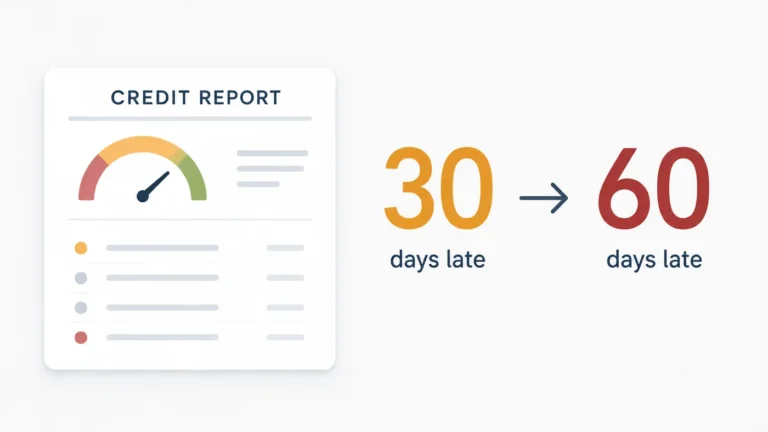
A 90-day late status means an account has remained delinquent through roughly three monthly payment cycles. Creditors commonly report delinquencies in categories such as 30, 60, 90, and 120 days late. FICO treats a 90-day delinquency as more severe than a 30-day delinquency.
It does not automatically mean the account has already been charged off or sold to a collection agency. Those events depend on the creditor, account type, contract, and how long the delinquency continues.
| Status | What it means | Priority |
|---|---|---|
| 30 days late | First commonly reported delinquency level | Get current before it progresses |
| 60 days late | Account has remained delinquent longer | Confirm the full catch-up amount |
| 90 days late | Serious delinquency | Contact the creditor and stop further progression |
| Later delinquency | The account remains unresolved | Confirm whether closure, collection activity, or charge-off has occurred |
If your account has not reached 90 days, compare the earlier stages in 30-day vs. 60-day late payments.
How can a 90-day late payment affect your credit score?
There is no fixed point loss. FICO says late-payment impact depends on how severe the delinquency is, how recent it is, how often late payments appear, and the rest of the credit file. Two people can have the same 90-day late event and experience different score changes.
Do not use the number of points lost to diagnose what happened. First verify that the 90-day status is accurate and check whether anything else changed on the report at the same time.
For the longer-term picture, see how long a late payment can affect a credit score.
What does a 90-day late payment look like on a credit report?

An account can later show as current while older 30-, 60-, or 90-day late entries remain in the payment history. When reviewing the report, check:
- the creditor and account;
- the exact month marked 90 days late;
- the sequence of 30/60/90-day reporting;
- the current status and past-due amount;
- the balance and date last updated.
What should you do today if the account is still 90 days late?
- Confirm the exact past-due amount. Ask what is required to bring the account current, not only what the next regular payment is.
- Ask the current account status. Is it open, restricted, closed, still with the original creditor, or handled by another company?
- Ask about available hardship options. If you cannot catch up in full, ask whether the creditor offers a temporary reduced payment, structured catch-up plan, or another account-specific option.
- Get any arrangement in writing. Confirm payment amount, due dates, duration, fees or interest, and whether the account will remain past due during the arrangement.
- Protect other required payments. Do not create a new delinquency on another account simply to make an aggressive catch-up payment here.

What if the 90-day late payment is wrong?
If the reported month, delinquency level, balance, status, or account ownership is inaccurate, document the specific problem before filing a dispute.
| Possible error | Evidence to compare |
|---|---|
| You were not 90 days late | Creditor payment history, statements, payment confirmations |
| Wrong month is marked 90 days late | Statements and payment history for that month and surrounding months |
| 90 days late should have been 30 or 60 | Full delinquency timeline from the creditor |
| Account is not yours | Account identifiers, creditor records, identity-theft documentation if relevant |
| Current status or balance is wrong | Recent statement, catch-up confirmation, repayment agreement |
If your records support an error, use the evidence-based process in how to dispute a late payment on your credit report. Do not dispute accurate information simply because it hurts your score.
Can a 90-day late account go to collections or charge-off?
It can eventually, but 90 days is not a universal deadline for either event. The creditor may continue handling the account, assign collection activity to another company, close or restrict the account, or later charge it off depending on the account and creditor. If the delinquency continues, see what can happen at 120 days late.
If another company contacts you, confirm the original creditor, current owner, amount claimed, and who is authorized to collect before paying. If the account later becomes a charge-off, see what a charge-off means on a credit report.
How long can a 90-day late payment stay on your credit report?
CFPB says negative payment-history information can generally remain on a credit report for up to seven years. Bringing the account current does not automatically delete an accurate historical late payment.
The reporting period and the scoring impact are different questions. A late payment can remain visible even though its impact on a particular score changes as it ages and as the rest of the credit file changes.
How to rebuild after a 90-day late payment

Once the account is current or you have an affordable arrangement, focus on the parts of the credit profile you can control:
- make every required payment on time;
- verify that the account’s current status updates accurately;
- keep revolving balances manageable;
- avoid unnecessary credit applications;
- check reports for real errors rather than filing broad disputes.
For a complete recovery framework, use how to rebuild credit after late payments.
Frequently asked questions
Is 90 days late considered serious?
Yes. FICO treats the severity of a delinquency as an important factor, and 90 days late is more severe than 30 or 60 days late.
Will paying the past-due amount remove the 90-day late payment?
No, not automatically. Bringing the account current can stop the current delinquency, but an accurate historical 90-day late payment can remain on the report.
Will getting current guarantee a score increase?
No. Getting current prevents the delinquency from continuing, but the score response depends on the scoring model and the rest of the credit file.
Should I make a partial payment if I cannot catch up?
First ask how the creditor will treat it. A partial payment can reduce the balance without bringing the account current.
Bottom line
If you are 90 days late on a payment, focus first on the current delinquency rather than the score. Confirm exactly what is past due, what would bring the account current, and whether an affordable hardship or repayment option exists.
Then verify that the credit report is accurate. Dispute only specific errors you can support with records. If the 90-day late payment is accurate, the most useful next step is to stop further delinquency and build a stronger recent payment history.
Related guides
- Late payments hub — delinquency stages, reporting, removal, and recovery.
- 30-day late payment vs. 60-day late payment — compare earlier delinquency stages.
- How to rebuild credit after late payments — practical steps once the account is stabilized.
For a broader look at your options, read how to address late or missed payments on a credit report. Disputing inaccurate reporting and asking for goodwill on accurate history are different processes.
Sources
- Consumer Financial Protection Bureau — How long information stays on a credit report
- Consumer Financial Protection Bureau — How to rebuild your credit
- Consumer Financial Protection Bureau — Accurate negative information
- FICO — How FICO considers late payments
- FICO — Payment history and FICO Scores
- AnnualCreditReport.com — Official credit-report access
Financial disclaimer
This article provides general U.S. educational information, not individualized legal, financial, lending, debt-management, or credit-repair advice. Creditor policies, account terms, state law, and scoring models can differ. No payment plan, deletion, or credit-score change is guaranteed.