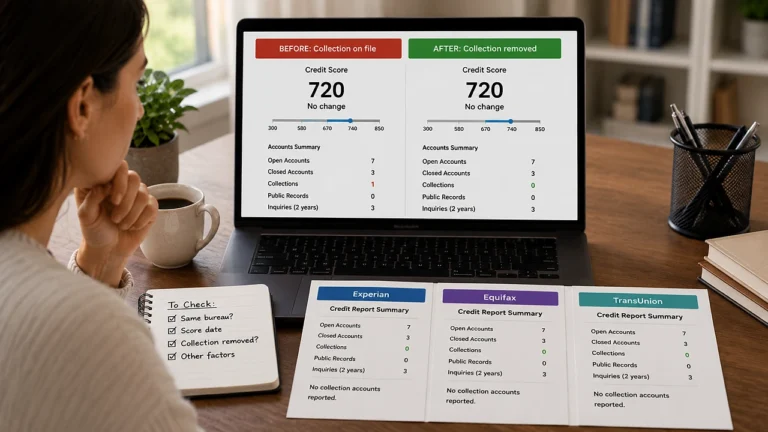
Paying off a collection can feel like the moment everything should finally be over. You handled the debt, the balance should be fixed, and your credit report should look cleaner. But then you check your report and the collection is still there. It may show a $0 balance. It may say paid, settled, or closed. But the account itself has not disappeared.
That is when the real confusion starts: can you remove paid collections from your credit report, or does a collection stay even after you pay it? Many people believe that paying a collection should automatically delete the negative mark. In reality, paying a collection and removing a collection are two different outcomes.
A paid collection may still appear on your credit report if the information is accurate. The balance may be updated to $0, but the collection account can still remain as part of your credit history. That does not always mean something is wrong. However, it also does not mean you have no options.
In some cases, a paid collection may be removed if it is reported incorrectly, duplicated, outdated, listed with the wrong balance, not updated as paid, unverifiable, or connected to certain medical debt reporting rules. The key is knowing the difference between an accurate paid collection that may stay and a reporting problem that you may be able to dispute.
This guide explains when paid collections can be removed, why a collection may stay after payment, how long it can remain on your credit report, what documents may help, and what steps you can take if the account is wrong or should no longer be reported.
- Quick answer: can you remove paid collections from your credit report?
- Do paid collections stay on your credit report?
- How long can a paid collection stay on your credit report?
- When can a paid collection be removed?
- The collection is inaccurate
- The paid collection still shows a balance
- The account is duplicated
- The dates are incorrect
- The collection does not belong to you
- What should the collection agency be able to verify?
- The account was paid but not updated correctly
- What to check after paying a collection
- The collection is a paid medical collection
- What to check with a medical collection
- Can you dispute a paid collection?
- How to remove a paid collection from your credit report
- Step 1: Check all three credit reports
- Step 2: Compare the collection details
- Step 3: Gather proof
- Step 4: Dispute incorrect information with the credit bureaus
- Step 5: Contact the collection agency
- Step 6: Ask for a goodwill deletion
- Step 7: Follow up and keep records
- What documents can help remove a paid collection?
- What if the paid collection is accurate?
- Does removing a paid collection improve your credit score?
- Common mistakes to avoid when trying to remove paid collections
- Assuming payment means automatic removal
- Disputing without proof
- Ignoring the original delinquency date
- Confusing paid, settled, and deleted
- Not checking all three credit bureaus
- Ignoring paid medical collection rules
- Sending the same weak dispute again and again
- Relying only on phone promises
- FAQ about removing paid collections from your credit report
- Can a paid collection be removed from my credit report?
- Does paying a collection remove it from your credit report?
- How long do paid collections stay on your credit report?
- Can I dispute a paid collection?
- Can you dispute a paid collection after paying?
- Will a paid collection hurt my credit score?
- Will removing a paid collection raise my credit score fast?
- Can a collection agency delete a paid collection?
- Are paid medical collections removed from credit reports?
- What should I do if a paid collection still shows a balance?
Quick answer: can you remove paid collections from your credit report?
Yes, you may be able to remove paid collections from your credit report, but paying the collection does not automatically delete it. In many cases, a paid collection can still remain on your credit report if the account is accurate. Payment may update the balance to $0 and change the status to paid, settled, or closed, but that is different from having the collection removed.
So, does paying a collection remove it from your credit report? Usually, no. Paying may update the account, but removal is more likely when there is a reporting problem. A paid collection may be removed if the account is inaccurate, duplicated, outdated, listed with the wrong balance, not updated as paid, unverifiable, or does not belong to you.
The smartest first step is to review your credit reports from Equifax, Experian, and TransUnion, compare the collection details, and gather proof of payment. If anything is wrong, you can dispute the inaccurate information and ask for correction or deletion. If the paid collection is accurate, removal is harder, but you may still ask the collection agency for a goodwill deletion.
Do paid collections stay on your credit report?
Yes, paid collections can stay on your credit report if the information is accurate. Paying the collection may update the balance to $0 and change the account status to paid, paid in full, settled, closed, or resolved, but it does not always remove the collection account from your report.
This can feel frustrating, especially if you expected the account to disappear after payment. But a credit report does not only show what you owe right now. It can also show past negative account history, including accounts that became seriously late and were sent to collections. That is why a paid collection may still appear even when you no longer owe the balance.
Paying a collection is still not pointless. A paid collection can look better than an unpaid collection because it shows the debt was handled. Some newer credit scoring models may also ignore paid collections or treat them more favorably than unpaid collections. However, if the collection has not been deleted, lenders may still see it when they review your credit report manually.
If you see a paid collection still on your credit report, check whether the balance, status, dates, and account details are being reported correctly. If the account shows a $0 balance, the status is accurate, the dates are correct, and the debt belongs to you, the paid collection may stay on your report for a period of time. But if it still shows a balance, appears as unpaid, has incorrect dates, is duplicated, or does not match your records, you may have a reason to dispute it.
How long can a paid collection stay on your credit report?
A paid collection can usually stay on your credit report for up to seven years from the original delinquency date. The original delinquency date is the date the account first became seriously late and was never brought current before it was sent to collections. This date matters because it usually controls when the collection should fall off your credit report.
If you are wondering how long do paid collections stay on your credit report, the key date to review is usually the original delinquency date, not the date you paid the collection. In most cases, paying or settling a collection does not restart the seven-year reporting period. The collection should not stay for another full seven years just because the balance was updated to $0.
A collection may show a recent date reported or date updated after payment, settlement, or dispute activity. That does not always mean the seven-year clock restarted. However, if the original delinquency date is changed incorrectly or the account suddenly looks newer than it really is, that may be a reporting problem worth disputing.
When you review a paid collection, check the original delinquency date, date opened, date assigned, date reported, date updated, and estimated removal date if your credit report shows one. These dates can mean different things, so do not assume every new date means the account was restarted.
Which collection dates matter most?
| Date on credit report | What it usually means | Why it matters |
|---|---|---|
| Original delinquency date | The date the account first became seriously late and was not brought current. | This is usually the key date for the seven-year reporting period. |
| Date reported | The date the collection agency last reported information to the credit bureau. | A recent reported date does not always mean the seven-year clock restarted. |
| Date updated | The date the account information was last updated. | This may change after payment, settlement, or dispute activity. |
| Estimated removal date | The date the credit bureau expects the collection to fall off your report. | This can help you understand when the item may disappear. |
If the paid collection is accurate, it may remain until the reporting period ends. If the dates are wrong, confusing, outdated, or make the account look newer than it should be, you may have a reason to dispute the date information with the credit bureaus.
When can a paid collection be removed?
A paid collection may be removed from your credit report when there is a specific reporting problem. Payment alone usually does not force a credit bureau or collection agency to delete the account. However, if the information is inaccurate, duplicated, outdated, incomplete, unverifiable, not updated correctly, or does not belong to you, you may have a stronger reason to dispute the collection and ask for correction or deletion.
The key is the difference between an accurate paid collection and a reporting error. If the collection is paid and accurate, removal may be difficult. You can still ask the collection agency for a goodwill deletion, but there is no guarantee. If the collection is paid but reported incorrectly, your dispute may be stronger.
Before you dispute a paid collection, review the full account details. Check the balance, status, original creditor, collection agency name, account number, dates, and whether the same debt appears more than once. A strong dispute should point to a clear problem, such as a wrong balance, incorrect status, duplicate reporting, wrong dates, unverifiable information, medical debt reporting issues, or a debt that does not belong to you.
When paid collection removal may be possible
| Possible reason | What to check |
|---|---|
| Wrong balance | The account still shows money owed after payment or settlement. |
| Wrong status | The account still appears unpaid, open, past due, or unresolved after payment. |
| Duplicate account | The same collection appears more than once in a misleading way. |
| Incorrect dates | The collection appears newer than it really is or has confusing date information. |
| Unverifiable account | The collector cannot verify the debt, balance, original creditor, or account details. |
| Not your debt | The account does not belong to you or does not match your records. |
| Paid medical collection | The collection is connected to a medical bill that has already been paid. |
Simple rule: If you can point to a specific reporting problem, you may have a stronger reason to dispute the paid collection. If the only reason is “I paid it,” removal may be harder.
The collection is inaccurate
A paid collection may be removed or corrected if the information on your credit report is inaccurate. This can include the wrong balance, wrong account status, wrong original creditor, wrong collection agency, wrong account number, incorrect dates, or payment details that do not match your records.
Accuracy matters because a paid collection should not be reported in a way that makes the debt look unpaid, newer than it really is, duplicated, or connected to the wrong person. Even if the collection itself is real, the way it appears on your credit report still needs to be correct.
For example, if you paid the collection but the account still shows as unpaid, that may be an accuracy problem. If the balance is not $0 after payment or settlement, that may also be worth disputing. The same is true if the account lists a creditor you do not recognize, reports dates that look wrong, or shows payment information that does not match your confirmation records.
When you dispute an inaccurate paid collection, be specific. Do not only write, “This collection is wrong.” Explain exactly what is inaccurate and ask the credit bureau to investigate, correct, or remove the inaccurate information if it cannot be verified.
It also helps to include proof. A bank statement, payment receipt, settlement letter, paid-in-full letter, confirmation email, or account statement can support your dispute. If you are challenging the creditor name, account number, dates, or ownership of the debt, include documents that show why the reported information does not match your records.
If the credit bureau or collection agency confirms that the information is wrong, the account may be updated. If the information cannot be corrected or verified, the paid collection may need to be removed from your credit report.
The paid collection still shows a balance
A paid collection may be worth disputing if your credit report still shows that you owe money after the debt was paid or settled. If you paid the collection in full, the balance should usually be updated to $0. If you settled the collection for less than the full amount, the account should accurately reflect the settlement instead of making it look like the full original balance is still unpaid.
This type of error can make the collection look more serious than it really is. A paid or settled collection should not continue to appear as unpaid, unresolved, or still owing the same balance. If the balance, status, or payment information does not match your records, that may be a reporting problem worth disputing.
For example, your credit report may show a collection balance of $800 even though you paid the account in full. Or it may show the full original balance after the collector accepted a settlement and confirmed the account was resolved. In either case, compare the credit report with your payment records before filing a dispute.
Useful proof may include a payment receipt, bank statement, settlement agreement, paid-in-full letter, confirmation email, or account statement from the collection agency. These documents can help show that the balance should be corrected, updated to $0, or reported according to the settlement terms.
When you dispute the balance, explain the issue clearly. State that the collection was paid or settled, identify the balance currently showing on your credit report, and explain what your records show. Then ask the credit bureau to investigate, correct the inaccurate balance, update the account status, or remove the inaccurate reporting if it cannot be verified.
The account is duplicated
A paid collection may be worth disputing if the same debt appears more than once in a misleading way. Duplicate collection reporting can make your credit report look worse than it should, especially if one paid or settled debt appears like two separate collection accounts.
This matters because duplicate reporting can create the impression that you had more collection problems than you actually did. Even if both entries relate to the same debt, a lender reviewing your credit report manually may see multiple negative accounts instead of one resolved collection.
However, not every similar-looking account is automatically a duplicate. Sometimes the original creditor and the collection agency may both appear on your credit report. The original creditor may report the account as charged off, sold, transferred, or closed, while the collection agency reports the collection account. That can be normal if the information is accurate, clearly reported, and not misleading.
Duplicate collection or normal reporting?
| What you see | What it may mean | Should you check it? |
|---|---|---|
| Original creditor shows charged off or transferred | This may be normal if the debt was sent or sold to collections. | Yes, check that the balance and status are accurate. |
| Collection agency reports the same debt | This may be normal if the agency is collecting or reporting the account. | Yes, compare the dates, balance, and account details. |
| The same collection appears twice with similar details | This may be duplicate reporting. | Yes, this may be worth disputing. |
| Two collection agencies show active balances for the same debt | This may make it look like you owe the same debt twice. | Yes, review and dispute if inaccurate. |
The problem is when the same collection appears twice as two separate collection accounts, shows two active balances for the same debt, or is reported by more than one collection agency in a way that makes it look like you owe the same debt multiple times. This can happen when an account is sold, transferred, updated incorrectly, or not properly changed after another agency starts reporting it.
To check for a duplicate paid collection, compare the original creditor, collection agency name, account number, balance, date opened, date assigned, original delinquency date, and account status. If the details are nearly identical and the report makes it look like two collections for one debt, you may have a reason to dispute the duplicate reporting.
When you file a dispute, explain that the account appears to be duplicated and identify which entries you believe refer to the same debt. Include proof of payment, settlement, transfer, account ownership, or any letters from the collection agency if you have them.
The dates are incorrect
A paid collection may be worth disputing if the dates on your credit report are wrong or make the account look newer than it really is. Dates matter because they can affect how long the collection appears on your credit report and how recent the negative account looks to lenders.
One of the most important dates is the original delinquency date. This is usually the date the account first became seriously late and was not brought current before it went to collections. In many cases, the credit reporting period is connected to that original delinquency date, not the date you paid or settled the collection.
Paying a collection may cause the account to show a new date reported or date updated. That does not always mean the collection has been restarted or re-aged. A date updated can simply mean the collection agency sent new information to the credit bureau after your payment, settlement, or dispute. However, if the original delinquency date changes incorrectly or the account suddenly appears much newer than it should, that may be a reporting problem.
If a collection is reported in a way that makes the debt look newer than it really is, people often call this re-aging. Not every updated date is re-aging, but an incorrect delinquency timeline should be reviewed carefully. The key question is whether the report shows an accurate timeline or makes an old collection look like a newer negative account.
To check for date problems, compare the original delinquency date, date opened, date assigned, date reported, date updated, and estimated removal date if shown. Also compare the dates across Equifax, Experian, and TransUnion. If one bureau reports very different dates from the others, or if the timeline does not match your records, you may have a reason to dispute the date information.
Which dates should you check?
| Date | What it usually means | Why it matters |
|---|---|---|
| Original delinquency date | The date the account first became seriously late and was not brought current. | This is usually the key date for the seven-year reporting period. |
| Date reported | The date the collection agency last reported information to the credit bureau. | A recent reported date does not automatically mean the clock restarted. |
| Date updated | The date the account information was last changed or updated. | This may change after payment, settlement, or dispute activity. |
| Estimated removal date | The date the bureau expects the collection to fall off your report. | This can help you understand when the collection may disappear. |
When you dispute incorrect dates, explain which date appears wrong and why. Include records that support your timeline, such as old statements, payment history, charge-off notices, collection letters, settlement documents, or older credit report copies showing earlier reporting.
The collection does not belong to you
A paid collection may be removed from your credit report if the debt does not belong to you. This is one of the strongest reasons to dispute a collection account because your credit report should not include debts connected to someone else. It does not matter whether the collection is paid, unpaid, settled, or closed. If the debt is not yours, it should not be reported as your account.This can happen because of a similar name, an old address, a mixed credit file, a data entry mistake, a family member’s account, or identity theft. Sometimes the account details may look close enough to be confusing, but the debt still does not belong to you.If you believe the collection does not belong to you, do not pay it just to make it go away. First, review the account details, request verification if needed, and dispute the information that does not match your records. Paying a debt that is not yours can make the situation more confusing if the account is later investigated.When you review the account, check the original creditor, collection agency name, account number, dates, balance, address history, and any personal details shown on the report. If the information does not match your records, you may have a strong reason to dispute the collection and ask for it to be corrected or removed.Your dispute should clearly state that the debt is not yours. Include proof that supports your identity and account history when possible, such as a copy of your ID, proof of address, creditor letters, account records, or identity theft documents if applicable.
Tip: If a paid collection does not belong to you, focus your dispute on identity, account ownership, and verification. Do not only say the account is wrong. Explain why it does not match your records. The collection agency cannot verify the account
A paid collection may be removed if the collection agency cannot verify the account information. Even after a collection is paid or settled, the information reported to the credit bureaus should still be accurate, complete, and connected to the correct person.Verification matters because a collection account should be supported by real account details. The collection agency should be able to confirm basic information such as the original creditor, account balance, account number, payment status, important dates, and whether the debt belongs to you. If the agency cannot verify those details, the reporting may need to be corrected or removed.
What should the collection agency be able to verify?
- Original creditor name
- Account number or account details
- Current balance or $0 balance after payment
- Payment status, such as paid, settled, or closed
- Important reporting dates
- Whether the account belongs to you
In this context, verification means the credit bureau or collection agency reviews whether the reported information is accurate. It does not mean the account must be deleted just because you paid it or asked questions about it. If the information is accurate and can be verified, the paid collection may remain on your credit report.However, if the details are missing, inconsistent, unsupported, or do not match your records, you may have a stronger reason to dispute the account. For example, the collection agency may report a paid collection but fail to confirm the original creditor, show a balance that does not match your payment records, list confusing dates, or report an account number you do not recognize.When you dispute the account, do not only ask for deletion.
The account was paid but not updated correctly
A paid collection may be worth disputing if the account was paid or settled, but your credit report was not updated correctly. Payment does not always make a collection disappear, but the account should not continue to look unpaid, unresolved, past due, or still owing the original balance if the debt has already been handled.
This can happen when the collection agency reports the payment late, reports incomplete information, or fails to update the account status with one or more credit bureaus. For example, one credit report may show the account as paid, while another still shows it as unpaid. Or the balance may be correct, but the status may still look open, past due, or unresolved.
After paying or settling a collection, check the balance, account status, payment date, settlement terms, and whether the account shows paid, paid in full, settled, closed, or resolved. The exact wording matters because your dispute may need to focus on the status, the balance, or both.
What to check after paying a collection
- Does the balance show $0 or the correct settled amount?
- Does the status say paid, paid in full, settled, closed, or resolved?
- Does the account still appear as unpaid, open, past due, or unresolved?
- Do all three credit reports show the same updated information?
- Do you have proof of payment or settlement if you need to dispute it?
Useful proof may include a payment receipt, bank statement, settlement agreement, paid-in-full letter, confirmation email, or account statement from the collection agency. These documents can help show that the account should be updated accurately.
If the account is still not updated after about 30 to 45 days, you can contact the collection agency and ask them to report the correct status to the credit bureaus. You can also dispute the inaccurate reporting directly with the credit bureau that is showing the wrong information.
When you dispute the issue, explain that the collection was paid or settled, but the account status has not been updated correctly. Ask for the payment status, balance, and account details to be investigated and corrected. If the inaccurate reporting cannot be verified, you may ask for the account to be removed.
The collection is a paid medical collection
A paid medical collection may be handled differently from a regular paid collection. Medical collections can come from hospital bills, doctor visits, emergency room bills, lab bills, dental bills, ambulance charges, or insurance billing problems. If the collection on your credit report is connected to medical care, review it carefully before assuming it should be treated like every other collection account.
What to check with a medical collection
| What to check | Why it matters |
|---|---|
| Was the medical collection paid? | Paid medical collections may be handled differently under current credit bureau reporting practices. |
| Was the original balance under $500? | Medical collections under $500 may not be reported the same way as larger unpaid medical collections. |
| Was it paid by insurance? | The account may need to be corrected if insurance resolved the bill but the collection still appears. |
| Was the bill adjusted by the provider? | A provider adjustment may change whether the balance is accurate. |
| Does the balance still show as unpaid? | A paid or resolved medical bill should not look like an active unpaid collection. |
This matters because the three major credit bureaus have changed how they report certain medical collection debts. Paid medical collection debt has generally been removed from U.S. consumer credit reports under those bureau reporting practices. Medical collection debt with an initial reported balance under $500 has also been removed from U.S. consumer credit reports. These changes are separate from the broader CFPB medical debt rule finalized in 2025, which was later vacated by a federal court.
Because of that, you should be careful with the wording. It is not accurate to say that all medical debt can never appear on a credit report. However, if a medical collection was paid, resolved by insurance, adjusted by the provider, or originally reported under $500, it may have a stronger reason to be disputed if it still appears on your report.
Before you dispute, confirm that the account is actually medical debt. Check the original creditor, provider name, collection agency, balance, dates, and payment status. Sometimes the name on the credit report may not clearly show that the debt came from a hospital, doctor, lab, ambulance company, dentist, or insurance-related bill, so compare the report with your medical bills, insurance statements, and collection letters.
If the medical collection was paid by you, paid by insurance, adjusted by the provider, or resolved through a settlement, gather proof before disputing it. Useful documents may include a payment receipt, insurance explanation of benefits, provider statement, settlement letter, paid-in-full letter, billing correction, or confirmation from the collection agency.
When you dispute a paid medical collection, explain that the account is medical debt and that it has already been paid, resolved, adjusted, or should not be reported under current credit bureau medical debt reporting practices. Ask the credit bureau to investigate the account and remove or correct any information that should no longer appear on your credit report.
Can you dispute a paid collection?
Yes, you can dispute a paid collection if the information on your credit report is inaccurate, incomplete, outdated, duplicated, unverifiable, not updated correctly, or does not belong to you. Paying a collection does not remove your right to challenge incorrect reporting.
However, a paid collection dispute should focus on a specific reporting problem. Simply saying, “I paid this collection, so remove it,” may not be enough if the account is accurate. A stronger dispute explains the exact issue, such as a wrong balance, wrong status, incorrect dates, duplicate reporting, or unverifiable account details.
Before you dispute, gather proof such as a payment receipt, bank statement, settlement agreement, paid-in-full letter, confirmation email, insurance records, collection letter, or older credit report showing different information.
How to remove a paid collection from your credit report
If you want to know how to remove a paid collection from your credit report, start by checking whether the account is being reported accurately. Paying a collection alone usually does not guarantee removal, but inaccurate, duplicated, outdated, unverifiable, medical, or incorrectly updated information may give you a stronger reason to dispute the account.
The process should be based on facts, not guessing. Before you contact a credit bureau or collection agency, review the account details, compare your reports, gather proof, and identify the exact problem you want corrected or removed.
Step 1: Check all three credit reports
Check your credit reports from Equifax, Experian, and TransUnion. A paid collection may appear differently on each report. One bureau may show a $0 balance, another may still show money owed, and another may report different dates or account details.
Look at the balance, status, original creditor, collection agency, account number, dates, original delinquency date, and estimated removal date if available. Save copies of your reports before you dispute so you have a clear record of what was reported.
Step 2: Compare the collection details
Compare the paid collection side by side across all three credit reports. Check whether the balance, status, creditor name, collection agency, account number, dates, and removal estimate match. If one bureau reports something differently, that may show where the error is.
If all three reports show the same accurate information, removal may be harder. But if one report shows a wrong balance, wrong status, incorrect dates, duplicate reporting, or account details that do not match your records, you may have a stronger reason to dispute the paid collection.
Step 3: Gather proof
Gather documents that support the exact problem. Useful proof may include a payment receipt, bank statement, settlement agreement, paid-in-full letter, confirmation email, account statement, insurance explanation of benefits, older credit report, proof of address, or identity theft documents if applicable.
Do not send original documents. Use copies and keep your own records. The strongest proof is the proof that matches the issue: payment proof for a wrong balance, timeline proof for wrong dates, and identity proof if the debt does not belong to you.
Step 4: Dispute incorrect information with the credit bureaus
If the paid collection is being reported incorrectly, dispute the specific error with the credit bureau showing the wrong information. Identify the account, explain what is wrong, state what your records show, and include supporting documents.
Do not only write, “Remove this collection.” A stronger dispute says exactly what needs to be corrected, such as the balance, payment status, dates, duplicate account, ownership issue, or unverifiable reporting. Ask the bureau to investigate, correct the information, or remove it if it cannot be verified.
Example: “I am disputing this paid collection because it is reporting an unpaid balance. This account was paid on April 8, and I have attached proof of payment. Please investigate and update the balance and payment status, or remove the inaccurate information if it cannot be verified.”
Step 5: Contact the collection agency
If the collection agency is the source of the wrong information, contact them and ask them to review the account. This may help if the paid collection still shows a balance, appears unpaid, has the wrong status, or was not updated correctly after payment or settlement.
Ask for written confirmation if the agency agrees to update, correct, or delete the account. A phone promise is hard to prove later. Save emails, letters, names of representatives, dates of calls, reference numbers, and any written response.
Step 6: Ask for a goodwill deletion
If the paid collection is accurate, a dispute may not remove it. In that case, you can ask the collection agency for a goodwill deletion. This is a polite request to remove the paid collection as a courtesy because the debt has been paid, settled, or resolved.
A goodwill deletion is not guaranteed and it is not a legal right. Keep the request short, calm, and specific. If the agency agrees, ask for written confirmation and later check Equifax, Experian, and TransUnion to confirm whether the account was actually removed.
Step 7: Follow up and keep records
After you file a dispute, contact the collection agency, or request a goodwill deletion, follow up. Credit report updates can take time, so check your reports again after about 30 to 45 days and compare the updated information with the copies you saved earlier.
If the account was corrected or removed, check all three credit reports. If the dispute was denied or the account remains unchanged, read the explanation and decide whether you need a stronger follow-up dispute with clearer proof.
What documents can help remove a paid collection?
Use this table as a quick checklist before you submit your dispute. The best documents are the ones that match the exact problem you want corrected.
Documents that may support a paid collection dispute
| Problem | Helpful documents |
|---|---|
| Wrong balance | Payment receipt, bank statement, paid-in-full letter, or account statement showing a $0 balance. |
| Wrong status | Settlement agreement, confirmation email, paid-in-full letter, or collection agency statement. |
| Incorrect dates | Older credit reports, account statements, payment history, charge-off notices, or collection letters. |
| Duplicate collection | Credit report copies, account numbers, transfer letters, settlement records, or collection agency letters. |
| Debt does not belong to you | ID, proof of address, creditor letters, account records, or identity theft report if applicable. |
| Paid medical collection | Medical bill, provider statement, insurance explanation of benefits, payment confirmation, or billing correction. |
| Unverifiable account | Collection letters, account statements, payment records, older reports, or documents showing inconsistent account details. |
Tip: Send copies of your documents, not originals, and keep a complete copy of everything you submit.
What if the paid collection is accurate?
If the paid collection is accurate, removing it from your credit report may be harder. A credit bureau may verify the account and keep it on your report if the balance, status, dates, creditor information, and account details are all correct. Paying the collection can update the account, but it does not automatically require deletion.This can be frustrating, especially if you paid the debt and expected your credit report to look clean right away. But an accurate paid collection may still remain until the credit reporting period ends. In many cases, that period is connected to the original delinquency date, not the date you paid the collection.An accurate paid collection on your credit report may not disappear immediately, but it is not permanent forever. It should eventually fall off your credit report when the reporting period ends. Until then, your goal is to make sure the account is reported correctly and that newer positive credit behavior starts to outweigh the old negative item.If the account is accurate, a dispute may not remove it. That does not mean you have no options. You can ask the collection agency for a goodwill deletion, especially if the debt has already been paid, settled, or resolved. A goodwill deletion is not guaranteed, but it may be worth trying when there is no clear reporting error to dispute.You can also focus on rebuilding your credit around the paid collection. Keep all current accounts paid on time, lower credit card balances, avoid unnecessary new applications, and continue checking your reports for errors. Over time, an older paid collection may matter less than newer positive credit behavior.The most important thing is to make sure the paid collection is at least being reported correctly. If it stays on your credit report, it should not still look unpaid, unresolved, duplicated, newer than it really is, or connected to the wrong person. Accuracy still matters, even when removal is not realistic right away.
Does removing a paid collection improve your credit score?
Removing a paid collection from your credit report may improve your credit score, but the impact is not the same for everyone. It depends on the credit scoring model, how old the collection is, whether the collection was already paid, and what else appears on your credit report.If the paid collection is deleted completely, your credit report may look cleaner because that negative collection account is no longer listed. This can be helpful, especially if the collection was recent, large, or one of the main negative items on your report.However, the score increase is not guaranteed. Some newer credit scoring models may ignore paid collections or treat them more favorably than unpaid collections. Older scoring models may still factor collections into the score differently. This means removing a paid collection could help more in some scoring models than others.The rest of your credit profile also matters. If you have several late payments, high credit card balances, charge-offs, or other negative accounts, removing one paid collection may not create a huge score jump. But if the paid collection is one of the only major negative items, deletion may have a more noticeable impact.If your score does not change much after removal, that does not always mean the deletion was useless. A cleaner credit report can still matter when lenders review your file manually, especially if the removed collection made your report look riskier than your current financial behavior.It is also important to remember that removing a paid collection is not the same as rebuilding your entire credit profile. Long-term credit improvement still comes from paying every account on time, keeping credit utilization low, avoiding unnecessary hard inquiries, and maintaining accurate credit reports.
Common mistakes to avoid when trying to remove paid collections
Trying to remove paid collections from your credit report can feel stressful, especially if you already paid the debt and expected the account to disappear. But acting too fast or disputing without a clear reason can weaken your case. The goal is to avoid random disputes and focus on accurate reporting, proof, and specific errors.
Assuming payment means automatic removal
One of the biggest mistakes is assuming that paying a collection automatically removes it from your credit report. Payment may update the balance to $0 and change the status to paid, settled, closed, or resolved, but it does not always delete the collection account. Paid and deleted are two different outcomes.
Disputing without proof
A dispute is usually stronger when you include documents that support your claim. If you say the balance is wrong, include proof of payment. If the status is wrong, include a paid-in-full letter, settlement agreement, or confirmation email. If the dates are wrong, include records that support the correct timeline. Do not rely only on a general statement that the collection should be removed.
Ignoring the original delinquency date
The original delinquency date is important because it usually affects when the collection should fall off your credit report. Do not assume that the date reported or date updated means the seven-year reporting period restarted. If the dates look wrong or make the paid collection appear newer than it really is, review them carefully before disputing.
Confusing paid, settled, and deleted
Paid means the debt was paid. Settled means the collector accepted payment under agreed terms, sometimes for less than the full balance. Deleted means the collection account was removed from your credit report. These terms are not the same. Confusing them can lead to wrong expectations and weak disputes.
Not checking all three credit bureaus
Another common mistake is checking only one credit report. A paid collection may be correct on one report and wrong on another. Check Equifax, Experian, and TransUnion separately before you dispute. If only one bureau is reporting the error, focus your dispute on that bureau. If all three are wrong, you may need to dispute with each one.
Ignoring paid medical collection rules
Ignoring paid medical collection rules can be a mistake because paid medical collections may be handled differently from regular paid collections. If the collection is connected to a hospital bill, doctor bill, lab bill, dental bill, ambulance charge, or insurance issue, check whether it has already been paid, resolved by insurance, adjusted by the provider, or reported under current medical debt reporting practices. A paid medical collection that still appears on your report may need a different dispute approach than a regular paid collection.
Sending the same weak dispute again and again
If your dispute is denied, do not keep sending the same vague dispute repeatedly. Read the response, identify why the account was verified or left unchanged, and improve your next dispute with clearer details or stronger documents. A stronger follow-up dispute should point to the exact balance, status, date, duplicate entry, ownership issue, medical debt issue, or unverifiable account detail that needs review.
Relying only on phone promises
If a collection agency says it will update, correct, or delete the account, ask for written confirmation. A phone promise is hard to prove if the account stays wrong on your credit report. Save emails, letters, confirmation numbers, and any documents connected to the update or deletion request.
FAQ about removing paid collections from your credit report
Can a paid collection be removed from my credit report?
Yes, a paid collection may be removed from your credit report if the information is inaccurate, duplicated, outdated, unverifiable, not updated correctly, or does not belong to you. Payment alone usually does not guarantee removal. If the account is accurate, it may stay on your report until the credit reporting period ends, but you can still ask the collection agency for a goodwill deletion.
Does paying a collection remove it from your credit report?
No, paying a collection does not automatically remove it from your credit report. Payment may update the balance to $0 and change the status to paid, paid in full, settled, closed, or resolved. However, that is different from deletion. A paid collection can still remain on your credit report if the information is accurate. If you see a paid collection still on your credit report, check whether the balance, status, dates, and account details are being reported correctly.
How long do paid collections stay on your credit report?
Paid collections can usually stay on your credit report for up to seven years from the original delinquency date. Paying or settling the collection usually does not restart the seven-year reporting period. If the dates on your report make the collection look newer than it really is, review the original delinquency date and consider disputing inaccurate date information.
Can I dispute a paid collection?
Yes, you can dispute a paid collection if you believe the account is being reported incorrectly. A strong dispute should focus on a specific problem, such as a wrong balance, wrong status, incorrect dates, duplicate reporting, unverifiable account details, medical debt reporting issues, or a debt that does not belong to you.
Can you dispute a paid collection after paying?
Yes, you can dispute a paid collection after paying if the information is inaccurate, incomplete, outdated, duplicated, unverifiable, or not updated correctly. The fact that you paid the collection does not remove your right to challenge incorrect reporting. However, your dispute should explain the exact error and include proof when possible.
Will a paid collection hurt my credit score?
A paid collection may still affect your credit score, but the impact depends on the scoring model and the rest of your credit report. Some newer credit scoring models may ignore paid collections or treat them more favorably than unpaid collections. Older models may still consider collections differently. Even if your score does not change much, a paid collection may look better than an unpaid one.
Will removing a paid collection raise my credit score fast?
Removing a paid collection may help your credit score, but a fast score increase is not guaranteed. The impact depends on the scoring model, how recent the collection is, whether you have other negative items, and how strong the rest of your credit profile is. If the paid collection is one of your only major negative items, deletion may have a more noticeable effect.
Can a collection agency delete a paid collection?
Yes, a collection agency may be able to request deletion of a paid collection from your credit reports, but it is not guaranteed. If the account is inaccurate, the agency may need to correct or remove wrong information. If the account is accurate, you can ask for a goodwill deletion, but the agency does not have to agree.
Are paid medical collections removed from credit reports?
Paid medical collections may be handled differently from regular paid collections. Under current credit bureau reporting practices, paid medical collection debt and medical collection debt under $500 have generally been removed from U.S. consumer credit reports. However, you should still check the details carefully. If a paid medical collection still appears, review the balance, status, provider information, insurance records, and whether the account should still be reported.
What should I do if a paid collection still shows a balance?
If a paid collection still shows a balance, compare your credit report with your payment records. Gather proof such as a receipt, bank statement, paid-in-full letter, settlement agreement, or confirmation email. Then dispute the incorrect balance with the credit bureau reporting the error and ask for the balance, payment status, or inaccurate reporting to be corrected.