How much will my credit score increase if I pay off debt

how much will credit score increase after paying off debt real example 620 to 645 Credit score

You paid off debt and expected your credit score to go up. That’s the moment most people wait for. You make the payment, feel responsible, and assume the system will reward you right away. How much will my credit score increase if I pay off debt? You paid off debt and expected your credit score to go up. That’s the moment most people wait for.

But then you check your score… and nothing really changed. Or it barely moved.

This is why people start asking: how much will my credit score increase after paying off debt? And even more important: will my credit score go up if I pay off debt at all?

The truth is simple. Your score doesn’t react to effort. It reacts to impact. Paying off debt can increase your credit score — sometimes by a lot — but only under the right conditions. In other cases, the increase is small, delayed, or doesn’t happen at all.

That’s where the confusion comes from. You did the “right” thing, but the result doesn’t match your expectation.

In this guide, you’ll see realistic point ranges, understand what actually drives your score after a payoff, and learn what to do next so your actions create visible results.

If you already paid off debt and your score didn’t move, don’t guess. Read why your credit score is not increasing to find what is holding your score back.

You paid off debt… and expected a big jump. But most people get this wrong.

Quick answer

Short answer: Your credit score can increase by 0–100+ points after paying off debt, depending on how much your credit utilization and overall profile improve.

If you’re asking how many points will my credit score increase or how much will my credit score go up after paying off debt, here is the real range based on how much your profile actually changes.

  • 0–20 points — small balance changes or already low utilization
  • 20–50 points — meaningful drop in credit card utilization
  • 50–100+ points — large payoff from high utilization (for example, going from maxed out cards to low balances)
  • 0 or temporary drop — if the change is too small, accounts are closed, or your credit mix shifts

Results are not guaranteed. Your credit score reacts to impact, not effort. The outcome depends on your credit utilization, payment history, and overall profile strength.

If you already paid off debt and your score didn’t move, read why your credit score is not increasing to understand what may be holding it back.

Most people expect the wrong result

Most people believe that paying off debt automatically increases their credit score. It doesn’t.

Your score does not react to effort. It reacts to risk. If your payment does not significantly improve your credit utilization, payment history, or overall credit profile, your score may not move at all.

This is exactly why many people feel confused after paying off debt. They expect a reward, but the system is only measuring how much safer they look to lenders.

If your score didn’t change, don’t guess. Read why your credit score is not increasing to find what is still holding it back.

The truth most people don’t expect

Here is the part most people do not expect: paying off debt does not guarantee a credit score increase. It can help a lot, especially if you lower high credit card balances, but your score does not rise just because you made a responsible move.

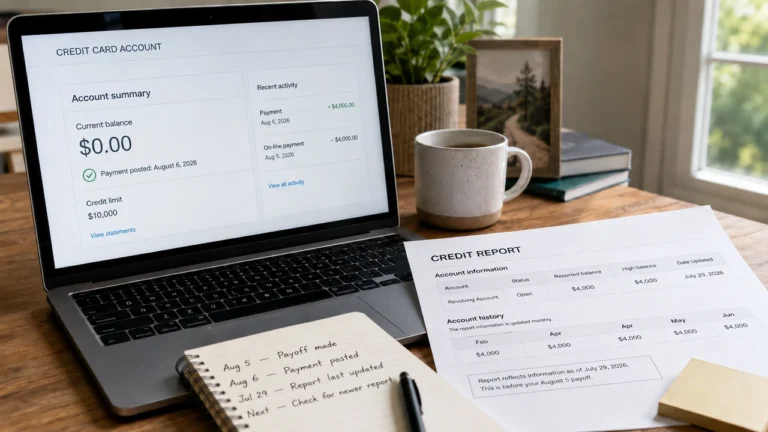
If you are wondering does paying off debt improve credit score immediately, the honest answer is: sometimes, but not always. Your score usually changes only after the lender reports your new balance to the credit bureaus. That means you may pay today, but your report may not show the lower balance until the next reporting cycle.

This is why many people search for why credit score didn’t change after paying off debt. The payment happened, but the credit report has not updated yet. Or the payoff was not big enough to change your utilization in a meaningful way. Or your profile still has other issues, like late payments, collections, thin credit history, or recent hard inquiries.

There is also one more frustrating twist: your score can sometimes drop after paying off debt. This may happen if an account closes, your credit mix changes, or an installment loan payoff leaves your profile with less active credit history.

So the real question is not only whether paying off debt helps. The real question is whether that payoff changes the factors your credit score actually measures.

What actually happens when you pay off debt

The impact of paying off debt on credit score depends on what kind of debt you paid and how much that payment changes your overall credit profile. Your score is not looking at the payment emotionally. It is looking at risk.

The biggest change usually happens with credit utilization after paying off debt. Credit utilization means how much of your available credit you are using. For example, if you have a $5,000 credit limit and a $4,000 balance, your utilization is very high. If you pay that balance down to $500, your profile suddenly looks much less risky.

This is why paying down credit cards can move a score faster than paying off many other types of debt. Credit cards are revolving accounts, and revolving utilization is one of the strongest short-term factors in many scoring models. When your reported balances drop, your score may react quickly once the new numbers reach the credit bureaus.

Installment loans work differently. A personal loan, auto loan, student loan, or mortgage has a fixed balance and fixed payment schedule. Paying one off can still help your overall financial picture, but it may not create the same fast score jump as lowering a high credit card balance. In some cases, paying off a loan can even cause a small temporary dip because the account becomes closed and your active credit mix changes.

This is also why how credit score is calculated after paying debt can feel confusing. The scoring model does not judge one action by itself. It looks at your whole file: payment history, credit utilization, account age, credit mix, new inquiries, derogatory marks, and how recently your lenders reported updated data.

So if you pay off debt and your score barely moves, it does not always mean the payment was useless. It may mean the payoff helped your finances more than your score right away. Or it may mean another factor is still holding your score down, such as late payments, collections, high balances on other cards, or a thin credit file.

The fastest visible score movement usually comes when you pay down high credit card balances and keep the accounts open. That lowers utilization while preserving available credit. But if you close accounts, lose available credit, or only pay a small amount compared with your total balances, the score impact may be much smaller.

If your goal is to improve your score, do not only ask whether debt was paid. Ask what changed on your credit report after the payment. Did your utilization drop? Did the account stay open? Did your lender report the new balance? Did the rest of your profile still look risky? Those answers explain why one person may gain 60 points while another person sees almost no movement.

How much your credit score can increase (real numbers)

If you’re trying to understand credit score increase after paying off debt or asking how many points will your credit score increase, the answer is not one fixed number. It depends on how much your credit profile actually changes after the payment.

Your score reacts to measurable shifts like lower utilization, improved risk, and updated balances. If the change is small, the score reaction is small. If the change is significant, the score can move much more.

Situation Expected increase
Small payment on low balance 0–10 points
Utilization 80% → 30% 20–50 points
Utilization below 10% 30–100+ points
Paying off collections Unpredictable
Paying off a loan Sometimes little or no change

A small payment on an already low balance usually leads to a minimal increase because your utilization was already healthy. The system does not see a major risk reduction, so the score barely moves.

When utilization drops from very high levels, such as 80% down to 30%, the impact becomes much stronger. This is because you move from a high-risk profile to a more acceptable range. That kind of shift is exactly what scoring models respond to.

If you push utilization even lower, below 10%, the effect can be even more noticeable. At that level, your profile signals very low credit risk, which is why some people see large increases.

Paying off collections is less predictable. In some cases, the score improves if the account is updated or removed. In other cases, the negative mark remains on your report, and the score does not change much. This is why disputes and documentation can matter more than simply paying the balance. You can learn how to handle this in how to dispute errors on your credit report.

Paying off a loan may not create a strong increase because installment debt affects your score differently. Once the loan is closed, you may even see a small temporary drop due to changes in your credit mix or reduced active accounts.

The key idea is simple. Your score does not reward the act of paying. It reacts to how much your overall profile improves. If your payment significantly reduces risk, you may see a noticeable increase. If it does not change your profile enough, the result will be small or delayed.

Real examples (what actually happens)

Real credit score changes make more sense when you look at specific situations. This is why questions like how much will my credit score increase if I pay off $1000, how much will my credit score increase if I pay off credit cards, or how much will my credit score increase after paying off a loan do not have one universal answer. The result depends on what that payment changes inside your credit report.

Example 1: You pay $1,000 on a maxed-out credit card

Let’s say you have a credit card with a $1,200 limit and a $1,150 balance. That card is almost maxed out, which makes your profile look risky. If you pay $1,000 and the new reported balance drops to $150, your utilization on that card falls dramatically.

In this situation, you may see a strong score increase, often around 25–45 points, and sometimes more if your overall profile is clean. The reason is simple: you moved from very high utilization to low utilization. That is one of the fastest changes a credit score can react to.

Example 2: You pay $1,000, but your total debt is still high

Now imagine you owe $12,000 across several credit cards and pay off $1,000. That payment is good for your finances, but your overall utilization may still be high. Your score may only increase a little because the risk picture did not change enough.

In this case, the increase might be closer to 0–15 points. That does not mean the payment was useless. It means your score needs a bigger utilization drop before it reacts strongly.

Example 3: You pay off all credit cards

If you pay off all credit cards and keep the accounts open, your score can improve a lot. This is especially true if your cards were close to maxed out before. Lower balances combined with open available credit can make your profile look much stronger.

But there is one important detail. If all cards report a $0 balance, some scoring models may not reward you as much as expected because there is no recent revolving activity showing. Many people do best when they keep utilization very low, such as under 10%, instead of letting high balances report.

If you want to understand the fastest ways to create visible movement, read how to improve your credit score fast.

Example 4: You pay off credit cards, but another card is still maxed out

This is where many people get frustrated. You may pay off two credit cards completely, but if one card is still near its limit, your score may not jump as much as you expected.

Why? Because scoring models can look at both total utilization and individual card utilization. One maxed-out card can still make your profile look risky, even if your total debt improved.

In this situation, the score increase may be moderate, not dramatic. You might see 10–30 points instead of the huge jump you expected.

Example 5: You pay off an installment loan

Paying off a personal loan, auto loan, or student loan can feel like a big financial win. And it is. But your credit score may not react the same way it would after paying down credit cards.

After paying off a loan, some people see little change. Others see a small temporary drop before the score stabilizes. This can happen because the account is no longer active, and your credit mix changes.

So if you ask how much will my credit score increase after paying off a loan, the realistic answer is: sometimes very little, and sometimes not right away. Loan payoff is often better for your debt load and monthly budget than for a fast score jump.

Example 6: You paid debt, but your score did not move

If your score did not move after paying debt, the most likely reason is that the new balance has not been reported yet, the change was too small, or another issue is holding your score down. Late payments, collections, new inquiries, or high balances on other accounts can all reduce the effect of your payoff.

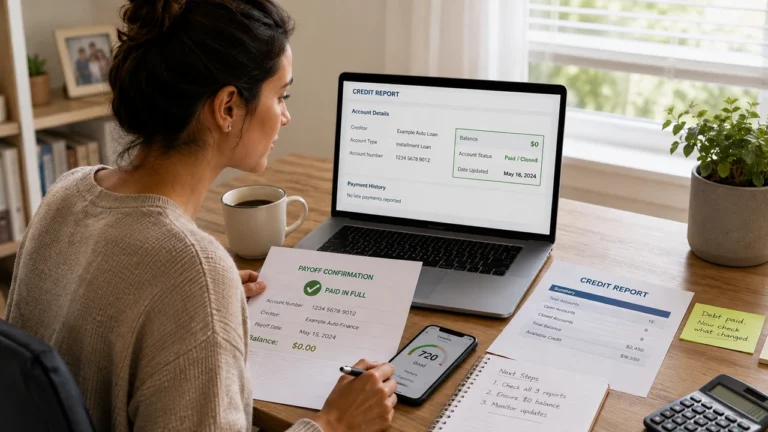
So do not judge the result too early. Check your credit report after the next reporting cycle and look at what actually changed. If your balance dropped, utilization improved, and no new negative marks appeared, your score may still move once the bureaus update the data.

Why your credit score may not increase

If you are asking why credit score didn’t change after paying off debt, the first thing to understand is this: your credit score only reacts when your credit report changes in a meaningful way. Paying debt is a good move, but the score needs to “see” a real improvement before it moves.

One common reason is that the change was too small compared with your total credit limits. For example, if you owe $9,000 across credit cards and pay off $300, that payment helps your finances, but it may not lower your credit utilization enough to create a visible score increase. The scoring model may still see your balances as high.

Another reason is that other negative factors are still holding your score down. If your report has late payments, collections, charge-offs, recent hard inquiries, or very new accounts, paying off one balance may not be enough to move the score much. Your profile improved in one area, but other risk signals are still there.

Timing also matters. You may pay a card today, but the lender may not report the new balance until after your next statement closing date. That means your credit report can still show the old balance for days or even weeks. This is why many people feel like nothing changed, even though the update simply has not reached the credit bureaus yet.

Statement date vs. payment date can also create confusion. If you pay after the statement closes, the higher balance may already be reported. To create faster visible movement, many people need to pay before the statement closing date, not only before the due date.

If your score is still stuck after balances update, do not keep guessing. Read why your credit score is not increasing to identify the real reason your score is not moving.

And if you see incorrect balances, accounts you do not recognize, wrong late payments, or outdated negative marks, the issue may be your credit report itself. In that case, read how to dispute errors on your credit report so you know what to check, what proof to collect, and how to challenge mistakes properly.

What type of debt matters most

Not all debt affects your score the same way. The impact depends on the type of account and how it changes key factors like credit utilization, payment history, and your overall risk profile.

Credit cards have the biggest and fastest impact. This is because they are revolving accounts, and your score closely tracks credit utilization — how much of your available credit you are using. When you pay down high credit card balances, your utilization drops, and your profile immediately looks less risky. That is why many people see noticeable score increases after lowering card balances, especially when utilization falls below 30% or even 10%.

Personal loans and auto loans have a more moderate impact. These are installment accounts with fixed balances and set payment schedules. Paying them down or off improves your financial situation, but it does not usually trigger the same fast score movement as lowering credit card utilization. In some cases, paying off a loan can even cause a small temporary dip because the account closes and your active credit mix changes.

Collections are more complex. Paying off a collection account does not always improve your score right away. In many cases, the negative mark remains on your credit report even after the balance is paid. What matters more is whether the account is updated, removed, or reported differently after payment. This is why simply paying collections is not always enough. If the account is inaccurate or outdated, you may need to take additional steps. You can learn how to handle this in how to dispute errors on your credit report.

The key idea is simple. If your goal is a faster score increase, focus first on the type of debt that directly affects utilization. That usually means credit cards. Other types of debt still matter, but they tend to influence your score more gradually.

How to maximize your score increase after paying off debt

If your goal is to improve credit score after paying off debt, do not stop at making the payment. The best way to increase credit score fast is to control how that payment shows up on your credit report and how it changes the factors your score actually measures.

Get utilization below 30% (ideally under 10%). This is the biggest lever. Your score reacts strongly when your credit utilization drops into healthier ranges. If you can, aim for under 30% across all cards and even lower on each individual card. The strongest results often happen when balances report under 10%.

Pay before the statement closing date. Most lenders report the balance that appears on your statement, not the balance after you make a payment later. If you pay after the statement closes, the higher balance may still be reported. To create faster visible movement, pay down balances before the statement date so lower utilization is what gets reported.

Keep accounts open to preserve available credit. Closing a card after paying it off can reduce your total available credit and increase your utilization ratio, even if your balances are low. Keeping accounts open (especially older ones) helps maintain a stronger profile and supports better long-term results.

Avoid new hard inquiries while optimizing. Opening new accounts or applying for credit can add hard inquiries and shorten your average account age. While you are trying to move your score up, keep your profile stable. Let the positive changes from lower balances work without adding new risk signals.

Let updated balances report and be patient with timing. Even if you did everything right, your score may not move until lenders send updated data to the credit bureaus. Give it one full reporting cycle, then check your report to confirm the new balances are reflected.

Focus on the whole profile, not just one payment. Lower balances help, but your score also depends on payment history, credit mix, account age, and any negative marks. If those areas are still weak, your increase may be limited. Fixing multiple factors at the same time usually leads to better results.

If you want a step-by-step plan that combines all of these actions, read how to improve your credit score fast and apply the methods that create the quickest visible impact.

What to do right now

If you want your credit score to actually move after paying off debt, do these steps in the right order.

  • Pay down credit cards below 30% (ideally under 10%) to lower your credit utilization fast
  • Keep accounts open so you don’t lose available credit and hurt your ratio
  • Avoid new credit applications while your score is stabilizing
  • Check your credit report after 30 days to confirm updated balances are reported

If you want a deeper plan, read how to improve your credit score fast and focus on the actions that create the fastest results.

How long it takes for your score to go up

If you are asking how quickly will my credit score go up after paying off debt, the realistic answer is usually 7 to 30 days after your lender reports the updated balance. Paying the debt is only the first step. Your credit score usually changes after the new information appears on your credit report.

In many cases, the first movement happens within one billing cycle. If your credit card issuer reports a much lower balance, your utilization may drop, and your score can update soon after the credit bureaus receive that data.

For stronger and more consistent movement, expect 30 to 60 days. This gives multiple accounts time to update and lets the scoring model reflect your new balances more clearly. If you paid down several cards, it may take more than one reporting cycle for everything to show correctly.

If you are wondering how long does it take for credit score to go up when deeper issues exist, the answer may be longer. Late payments, collections, charge-offs, recent hard inquiries, or a thin credit file can slow down progress even after debt is paid. In that case, the payoff helps, but it may not be enough by itself.

The key is to check your credit report, not just your score. Look for updated balances, lower utilization, and whether any negative marks are still present. If the report has not changed yet, the score may not change either.

If your score is moving slowly and you want a fuller timeline, read how long does it take to fix your credit score to understand what can change in 30 days, 60 days, 3 months, and beyond.

Before vs after (quick visual)

Here is a simple way to see what changes on your credit report after paying off debt. The biggest shift usually comes from credit utilization and how your overall risk is perceived.

Before After
High utilization Lower utilization
Higher risk profile Lower risk profile
Unstable score Stabilizing score

When balances drop, your profile looks less risky to scoring models. That is why lowering utilization often leads to faster movement. But the change is not always instant. Your score updates after lenders report new balances, and the impact depends on how much your overall profile improves.

What actually moves your score the most

Paying off debt helps, but it’s not the only lever. Your credit score is based on several moving parts, and some factors matter more than others. If you want a stronger increase, you need to understand what the score is really reacting to.

Credit utilization is usually the fastest factor you can influence. This applies to revolving accounts like credit cards. If your cards are close to maxed out, your profile looks risky. When you lower those balances, especially below 30% and ideally below 10%, your score may respond faster once the new balances are reported.

Payment history is one of the most important long-term factors. Paying down debt can help your utilization, but it cannot erase missed payments by itself. If your credit report has late payments, charge-offs, or collections, those negatives may continue to limit your score even after your balances improve.

Credit age and credit mix also matter. Older accounts can support a stronger profile because they show a longer borrowing history. Credit mix means the variety of accounts on your report, such as credit cards, loans, or a mortgage. This is why paying off a loan may not always create a big jump. It may lower your debt, but it can also close an active installment account.

The real goal is not just to pay debt. The goal is to make your whole profile look less risky. That usually means lower utilization, clean payment history, stable accounts, and fewer new hard inquiries.

If you want the fastest practical steps, read how to improve your credit score fast and focus on the actions that can create visible movement first.

Does paying off all debt increase your score

Many people ask will my credit score improve if I pay off all my debt or does paying off all debt increase your credit score. The honest answer is: often yes in the long term, but not always right away.

Paying off all debt usually improves your overall financial profile. You reduce risk, lower your balances, and remove pressure from your monthly budget. Over time, that can support a stronger credit score, especially if your credit utilization drops to low levels and you maintain on-time payments.

However, the change is not always immediate. Your score reacts when updated information appears on your credit report, and even then, the effect depends on what actually changed. If your balances were already low, paying everything off may not create a large visible increase.

There is also an important trade-off to understand. If you pay off all debt and close accounts, you may reduce your available credit and change your credit mix. This can sometimes lead to a small temporary dip or limit how much your score improves. In many cases, keeping accounts open with low or zero balances is better than closing them.

The key is balance. Paying off debt is a strong financial move, but your score improves the most when your profile shows low utilization, stable accounts, and consistent activity over time.

If your score did not increase after paying off debt, read why your credit score is not increasing to understand what may still be holding it back.

What affects how much your score increases

If you want to know what affects credit score increase after paying off debt, look at what actually changed on your credit report. The payment itself matters, but the score reacts to the result of that payment.

The size of the payoff vs. your credit limits is one of the biggest factors. Paying $500 on a card with a $600 limit can make a major difference because utilization drops sharply. Paying $500 across $20,000 in available credit may help less because the risk picture does not change as much.

Existing negatives can also limit the increase. Late payments, collections, charge-offs, recent hard inquiries, or very new accounts can keep your score from rising quickly even after your balances improve. Lower debt helps, but it does not erase every other risk factor.

The type of account matters too. Paying down credit cards usually has a faster impact because it lowers revolving utilization. Paying off installment loans, like auto loans or personal loans, may improve your debt load but may not create the same fast score jump.

Reporting timing can make the result feel delayed. Your lender may not report the new balance until the next statement cycle, and different credit bureaus may update at different times. That is why your score may change on one app before it changes on another.

The best way to judge your progress is to check your updated credit report, not just the score number. Look for lower reported balances, lower utilization, and fewer errors. If your report still shows old balances or wrong information, your score may not reflect the payoff yet.

How to know if your score is improving

To see real progress, do not rely on daily score swings. Focus on the signals your credit report is sending over time. The clearest sign is your credit utilization. Check your statements and reports to see if balances are going down relative to your limits. When utilization drops, your profile becomes less risky, and that is what scoring models respond to.

Next, track updates across bureaus. Your lenders report to Equifax, Experian, and TransUnion, but not always on the same day. It is normal to see changes on one bureau before the others. What matters is that updated, lower balances appear consistently across your reports.

Also watch for consistent upward movement, not daily jumps. Scores can fluctuate from day to day based on small changes, but a real improvement shows as a gradual upward trend over a few reporting cycles. If your balances are lower, payments are on time, and no new negatives appear, your score is moving in the right direction even if it does not jump overnight.

If you want a deeper checklist to track progress, read how to know if your credit score is improving and compare your report step by step.

How quickly will my credit score go up after paying off debt?

Usually within 7 to 30 days after lenders report updated balances, depending on your billing cycle.

Why did my credit score drop after paying off debt?

This can happen if an account was closed or your credit mix changed. The score often stabilizes after new data settles.

Will my credit score go back up after paying off a loan?

Yes, but it may take time. Installment loans affect your profile differently than credit cards.

When will my credit score go up after paying off debt?

Most people see changes within 30–60 days once updates are reported across bureaus.

What to do next

Paying off debt can help your score, but it is only one part of the bigger picture. If your score increased, your next job is to keep the momentum going. If it did not move yet, your next job is to find out what is still blocking it.

Do not keep guessing, checking your score every day, or making random payments without a plan. Focus on the factors that actually move the number: credit utilization, payment history, reporting timing, credit mix, and any negative marks that may still be on your report.

If you want a complete plan instead of guessing, start here: how to improve your credit score step by step. It will help you understand what to fix first, what can move your score faster, and what takes more time.

The goal is not just to pay off debt. The goal is to build a stronger credit profile that keeps improving over time.


Rate article
Fix My Money Life
Add a comment