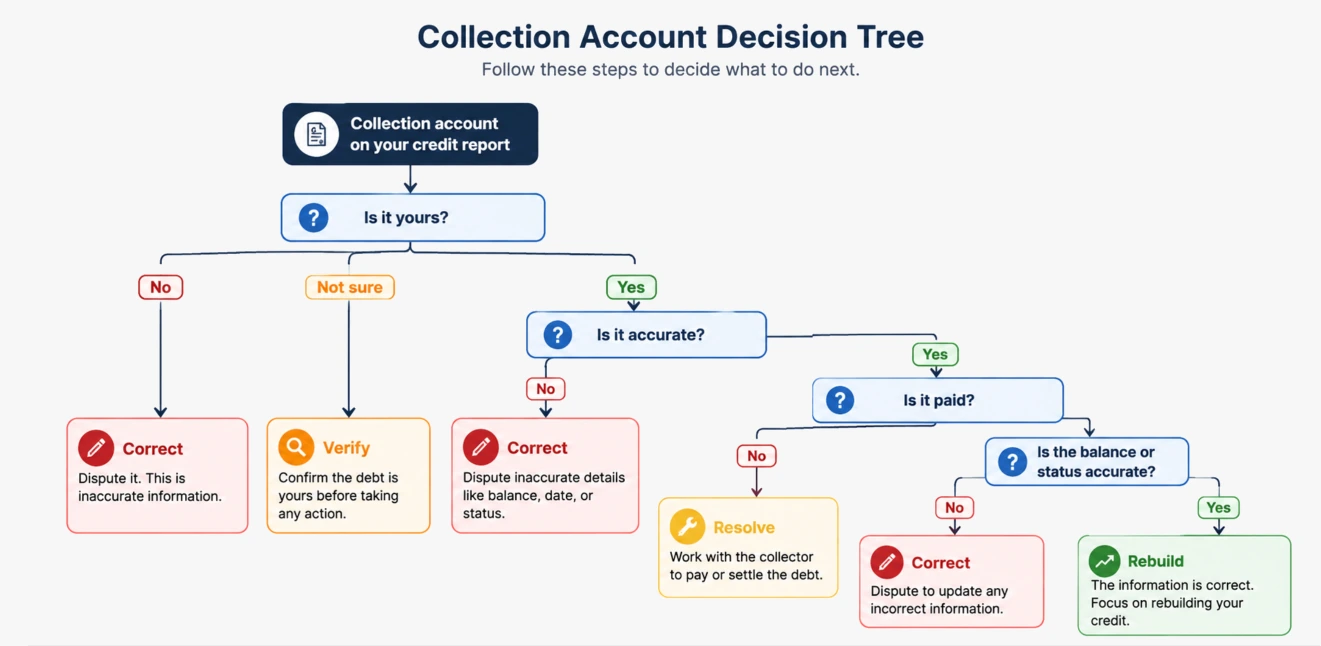
Seeing a collection account on your credit report can be stressful, especially if you are not sure who the company is, whether the balance is correct, or whether paying it will actually help your credit.
A collection account usually means a debt has been sent or assigned to a third-party collector, or sold to another company. But the details matter. Before you pay, settle, or dispute anything, first identify who is reporting the account, what balance is shown, what dates appear, and whether the same debt is listed elsewhere on your credit reports.
This guide will help you understand what to check, what common collection problems look like, and which next step makes sense for your situation.
What does a collection account mean?
A collection account is generally reported when a debt is being pursued by a collection agency or debt buyer rather than handled only as a normal account with the original creditor.
The original account may still appear on your credit report as well. That does not automatically mean the debt is being counted twice. The original creditor and the collection company can sometimes report different parts of the same debt history.
If you are dealing with an original-creditor account that was charged off, use our Charge-offs guide instead.
Start with the situation that matches yours
| If this is your situation | Read this next |
|---|---|
| You do not recognize the collection company | How to verify a debt collector |
| The same debt appears more than once | Can the same collection appear twice? |
| The original creditor and collector both show balances | Original creditor and collection agency both reporting a balance |
| You already paid, but a balance still appears | Paid collection still showing a balance |
| You are worried paying will restart the reporting period | Does paying restart the seven-year period? |
| You want to know whether a paid collection can be removed | Can you remove paid collections? |
| You want to know how your score may change after removal | How much can your score increase after removal? |
What to check before you pay or dispute a collection
Do not act only because a collector is contacting you or because a collection appears on your report. First build a clear picture of the account.
- Who is reporting it? Write down the collection company’s name and the original creditor.
- What balance is shown? Compare the credit-report balance with any letters, statements, payment records, or settlement offers you have.
- Which dates appear? Note the account dates, but do not assume every newer date means the underlying debt became new again.
- Does the same debt appear elsewhere? Look for the original creditor, another collector, or a second collection entry.
- Who currently owns or collects the debt? The company reporting a collection may be collecting for someone else or may own the account itself.
If the company or debt is unfamiliar, start with how to verify a debt collector before paying or sharing information.
Can the original creditor and a collection agency both appear?
Yes. In some cases the original creditor remains on the credit report while a separate collection account also appears. That is not automatically an error because the two entries may describe different parts of the same account history.
What matters is whether the balances, ownership information, account identifiers, and dates are being reported accurately. If both companies appear to report current balances, use our guide to an original creditor and collection agency both reporting a balance.
What if the same collection appears twice?
Two collection entries connected to the same underlying debt deserve a closer look, but they are not automatically duplicates. A debt may have moved from one collector to another, or a collector may have stopped reporting while another began.
Compare the company names, balances, dates, account numbers, and status of each entry. If you think the same debt is being reported inaccurately more than once, see can the same collection appear twice on your credit report?.
Can a collection agency keep adding interest?
A collection balance can sometimes change, but you should not assume every increase is automatically correct. The amount may depend on the underlying agreement, applicable law, and what the collector is permitted to add.
If your balance is increasing, compare the current amount with earlier statements and notices. Then read can a collection agency keep adding interest?.
What if the collection account date looks wrong?
Collection accounts can display several different dates, and they do not all mean the same thing. A collector’s date opened, update date, or assignment date is not necessarily the same as the date tied to the original delinquency.
If a newer date makes the account look newer than you expected, do not rely on that single field alone. Compare older credit reports and account records. See collection account date opened is wrong for what to check.
Should you pay the collection agency or the original creditor?
Before sending money, confirm who is authorized to accept payment and what will happen after payment. If the debt has been sold, the original creditor may no longer be the company you should pay. If a collector is working on behalf of the creditor, the situation can be different.
Use should you pay the collection agency or the original creditor? before choosing where to send payment.
Does paying a collection remove it from your credit report?
Not automatically. Payment can update the balance or status, but removal is a separate reporting issue. After paying, check your credit reports to make sure the account is updated accurately.
If you already paid and a balance still appears, see paid collection still showing a balance. If you are wondering whether the account can be removed, read can you remove paid collections from your credit report?.
Does paying a collection restart the seven-year reporting period?
People often worry that making a payment will make an old collection “new” again on their credit report. A newer payment or update date should not be confused with the underlying delinquency timeline used for credit reporting.
Because reporting dates can be easy to misread, check the actual account history before assuming a collection’s reporting period restarted. See does paying a collection restart the seven-year period?.
Debt validation and credit-report disputes are not the same thing
If you are unsure whether a collector has the right debt or the right amount, debt validation may be relevant. If the problem is inaccurate information on your credit report, a credit-report dispute addresses a different issue.
Use debt validation vs. credit report dispute to choose the right process. If you need to prepare a validation request, see our debt validation letter guide.
What if you want to settle the collection?
If the debt is valid and you are considering a settlement, focus on the terms in writing before sending payment. Confirm the amount, payment deadline, and what the collector agrees to do after the payment is received.
For a step-by-step approach, see how to negotiate a debt collection settlement in writing.
What happens to your credit score after a collection changes?
Paying or removing a collection does not guarantee a specific number of credit-score points. Your result depends on the scoring model and the rest of your credit profile.
If a collection was removed and your score did not move as expected, read collection removed but credit score did not increase. For a broader look at possible score changes, see how much your credit score may increase after a collection is removed.
If you have already paid the account, you may also want what happens to your credit score after paying off collections?.
A simple collection-account checklist
- Pull your current credit reports and identify every entry connected to the debt.
- Verify the collector and original creditor.
- Compare the reported balance with your own records.
- Check whether the same debt appears under another company name.
- Review the important dates instead of relying on one “date opened” field.
- Confirm who should receive payment before sending money.
- Get settlement terms in writing if you negotiate.
- If something is inaccurate, document the exact error before disputing it.
- Keep copies of letters, payment confirmations, settlement agreements, and credit reports.
Collections FAQ
Can the same debt appear under the original creditor and a collector?
Yes. The original account and the collection account can sometimes both appear because they represent different parts of the same debt history. Compare balances, ownership, account identifiers, and status before assuming the reporting is wrong.
Does paying a collection automatically delete it?
No. Payment and deletion are separate issues. Payment can update the balance or status without automatically removing accurate historical information.
Can a collection disappear and later come back?
It can happen in some situations, including when an account changes collectors or reporting changes. If this happened to you, see collection disappeared and came back.
What if a debt collector contacts my employer?
Workplace contact raises different privacy and collection-practice questions from ordinary credit reporting. See when debt collectors can contact your employer.
Where to go next
If the underlying account was charged off by the original creditor, visit the Charge-offs hub. If you believe a balance, date, status, ownership detail, or duplicate account is inaccurate, use our Credit reports & disputes guides.
If several debts are unaffordable at the same time, compare a debt management plan vs. debt settlement before choosing a broader debt-relief strategy.
Fix My Money Life provides educational information, not legal advice. Debt-collection and credit-reporting situations can vary by account and by state, so consider professional guidance when your situation involves a lawsuit, identity theft, garnishment, or a disputed debt.