In this guide
- Before negotiating, verify what you are settling
- Calculate an affordable settlement range
- Example: turn your budget into a proposal
- Debt settlement offer calculator
- Make a clear settlement proposal
- What the written settlement agreement should include
- Sample debt settlement offer letter: your first written proposal
- Collection settlement letter for confirming the offer
- Review the agreement before paying
- Pay through a verified method and preserve proof
- Check the account after the settlement
- Consider the tax effect of forgiven debt
- Negotiating directly vs. hiring a settlement company
- Frequently asked questions
- Sources and review
To negotiate a collection settlement, first verify the collector, the debt and the collector’s authority to settle it. Then calculate an amount you can actually pay, make a specific proposal and get every material term in writing before sending money. The written agreement should identify the account, state the settlement amount and deadlines, explain what happens to the remaining balance after successful payment, and describe any promised credit-report update. A collector does not have to accept your offer, and there is no universal percentage that guarantees a settlement.
This guide is for a consumer negotiating directly with a debt collector in the United States. It does not replace advice about a lawsuit, bankruptcy, taxes or state law.
Before negotiating, verify what you are settling
Do not begin with a dollar offer. Begin with the validation information and your own records. Confirm the collector’s identity, the current creditor, the account or reference number, the amount claimed and whether the collector is authorized to collect or owns the debt. Our guide to paying the collection agency or the original creditor explains why the payment recipient matters.
The CFPB recommends obtaining the debt information in writing before agreeing to pay or negotiate. If the amount, ownership or identity is genuinely in dispute, deal with that issue first. The debt validation letter template shows how to make a specific written request without inventing a dispute.
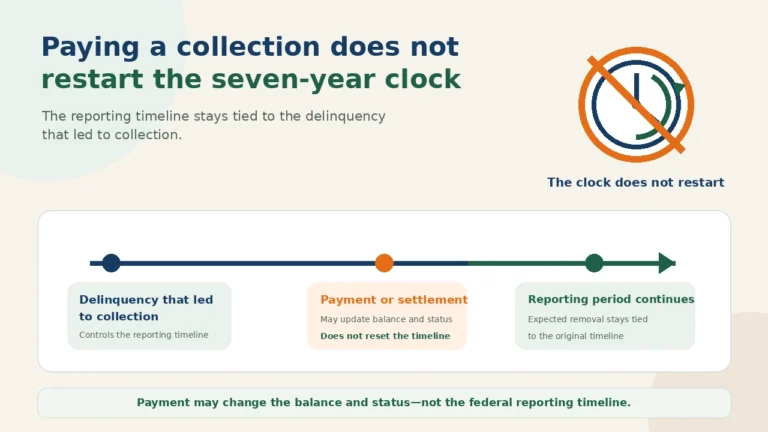
Also check the age of the debt. The federal credit-reporting period and a state’s deadline for filing a collection lawsuit are different. Before paying or acknowledging an old debt, review the separate reporting and statute-of-limitations timelines. State law can determine whether a payment or written acknowledgment affects a lawsuit deadline.
Should you negotiate now? A quick decision path
For debt collectors covered by the federal debt-collection rule, the validation notice generally gives an end date for a 30-day dispute period. A written dispute made within that period generally requires the collector to pause collection of the disputed amount until it responds with verification. A settlement offer is not the same as a debt dispute. Check the notice and your records before deciding which letter to send. The CFPB explains the notice and dispute timeline.
I do not recognize the debt or the amount is wrong
Check the validation information. If appropriate, dispute the specific claim or request missing information through the proper channel. Do not use a settlement offer as a substitute for a real dispute.
This may be an old or time-barred debt
Check the applicable state law before making any payment or written acknowledgment. Either may affect the lawsuit deadline in some states. Consider a local consumer-law attorney if you are unsure.
I received court papers
Respond by the court deadline and seek qualified legal help. Do not assume that discussing or proposing settlement pauses the case.
The debt and collector are verified and I can afford an offer
Set a maximum that protects essential bills and emergency savings. Make a specific proposal and obtain the complete settlement agreement in writing before paying.
Calculate an affordable settlement range
The right opening offer is not a percentage copied from a forum. It is an amount supported by your verified balance, available cash, essential expenses and a realistic fallback. The CFPB’s settlement guidance says to confirm the debt, calculate a realistic repayment plan and make a proposal. It also warns against paying more than you can afford.
- List take-home income. Use income that is reasonably available, not hoped-for overtime or a future tax refund.
- Protect essential expenses. Housing, food, utilities, transportation, insurance, current taxes and required support come before an old unsecured collection.
- Leave an emergency margin. A settlement that causes a new missed rent, utility or credit payment is not affordable.
- Choose a maximum. Decide the highest lump sum or monthly payment you can make before the negotiation starts.
- Set a lower opening proposal. Leave room to move, but use an amount you could actually deliver if accepted.
| Offer structure | What to verify | Main risk |
|---|---|---|
| Lump-sum settlement | One amount, payment date and exact treatment of the remaining balance | Draining emergency savings or paying before receiving the agreement |
| Short installment settlement | Each installment, final date, default terms and whether the balance remains frozen | One late payment voiding the discount or reviving the full claimed balance |
| Full-balance payment plan | Total amount, interest or fees, frequency and payoff date | A small payment that continues too long or allows charges to grow |
Example: turn your budget into a proposal
Assume a collector claims a hypothetical $4,800 credit card balance. Taylor has $2,600 in non-retirement savings but needs to keep $800 for an essential emergency reserve. That leaves at most $1,800 available for a lump-sum offer:
$2,600 savings − $800 reserve = $1,800 maximum available.
Taylor could open below $1,800 and increase only within that ceiling. If the collector rejects the lump sum, Taylor reviews monthly cash flow. Take-home pay is $4,200 and essential plus current required expenses total $3,500, leaving $700. Keeping $250 as a monthly buffer produces a maximum planned installment of $450:
$4,200 income − $3,500 expenses − $250 buffer = $450 maximum monthly payment.
These numbers are hypothetical, not a recommended settlement percentage. Taylor should not promise both the $1,800 lump sum and $450 monthly payments. The purpose of the calculation is to enter the conversation with a ceiling and a fallback, not to reveal every dollar available.

Debt settlement offer calculator
Use this budget check to compare a proposed one-time payment with money you can safely make available and to estimate a separate monthly payment ceiling. These are planning calculations, not recommended settlement percentages or predictions of what a collector will accept. The numbers stay in your browser; this tool does not ask for account numbers or transmit the amounts you enter.
Available lump-sum budget:
Estimated monthly payment budget:
Balance minus proposed offer: (only if your proposal is accepted as full settlement)
Budget check: The proposed offer fits under your estimated lump-sum ceiling.
Example values are hypothetical. Do not commit money needed for essentials. A collector can reject any offer. Forgiven debt may have tax consequences, and paying or acknowledging an old debt may have state-law consequences. Check the debt and the written agreement before paying.
Make a clear settlement proposal
Use the verified channel on the collector’s notice or website. You can negotiate by phone, but the final agreement should arrive in a form you can keep before payment. Keep the tone factual:
I am calling about reference [number]. I have reviewed the account and want to discuss resolving it. I can offer [amount] as [one payment / specified installments] if you are authorized to accept it as settlement of this account. Please send the complete proposed agreement in writing for my review before I make a payment.
If asked why you cannot pay the full amount, give a short, accurate explanation of the constraint. You do not need to provide a dramatic story or promise money that is not available. Ask the representative to repeat the total, dates and effect of successful completion. Take notes, including the date, time, representative’s name and any offer expiration date.
What the written settlement agreement should include
A debt settlement agreement in writing should be specific enough that a different employee can understand exactly what was promised. Check for all of the following:
- your name and the collector’s legal name;
- the current creditor and enough of the collector’s reference number to identify the account;
- the balance the collector says is due before the settlement;
- the exact settlement amount;
- whether the amount is one payment or installments, with every due date;
- the accepted payment method and where payment must be sent;
- whether interest and fees stop while an installment agreement is current;
- what counts as a missed or late payment and what happens if one occurs;
- a statement that successful completion satisfies or settles the specified account and explains what happens to the unpaid remainder;
- whether further collection, sale or transfer of the remaining balance will stop after successful completion;
- how the collector says it will update information it furnishes to credit reporting companies; and
- how and when you will receive a final confirmation or zero-balance statement.
Do not treat a verbal promise to delete accurate credit information as part of the deal unless it appears in the written agreement and the collector is actually agreeing to it. Payment or settlement normally concerns the debt balance; it does not automatically delete an accurate collection entry.
Sample debt settlement offer letter: your first written proposal
This is an initial offer, not an accepted agreement. Use it only after you have verified the collector, the claimed debt and the collector’s authority to settle it. If the debt is disputed, unusually old, or may be time-barred, resolve those questions and consider state-specific legal advice before sending a written offer or making a payment. A sentence saying you do not admit liability cannot override state law.
[Your name and mailing address]
[Date]
[Verified collection agency name and mailing address]
Re: Proposed settlement of reference [number]
To the settlement department:
I am writing to discuss a possible negotiated resolution of the account identified above. I propose to pay $[amount] [as a single payment by [date] / in the following installments: [amounts and dates]], provided the authorized debt owner agrees in writing that timely completion of those payments will settle the specified account.
Please send a written agreement confirming the exact total, the payment schedule, the treatment of any remaining balance after successful completion, any interest, fees or default provisions, and what information you will furnish to credit reporting companies. Please also explain how and when I will receive final written confirmation that the account has been resolved.
This is a proposal for your review. I will review the complete written terms before authorizing any payment. Please do not treat this letter as an accepted payment agreement or authorization to withdraw funds.
Sincerely,
[Your name]
Keep a copy and delivery record. Do not include a Social Security number or banking credentials. The collector may accept, reject or counter the proposal; do not exceed your preset affordability limit. For the consumer-protection steps, see the CFPB’s debt settlement guidance.
Collection settlement letter for confirming the offer
If the collector gives you terms by phone but has not sent a complete agreement, you can send a short confirmation request. Do not word it as though an agreement already exists if the collector has not accepted it.
[Your name and mailing address]
[Date]
[Collector’s legal name and address]
Re: Proposed settlement for reference [number]
On [date], I discussed a possible resolution of the account identified above with [representative, if known]. My proposed terms are [amount] paid [once on date / in listed installments].
Please send a written agreement stating the total settlement amount, all due dates, the effect of successful payment on the remaining balance, any default terms, how information will be updated with credit reporting companies, and how final completion will be confirmed. I will review the written terms before authorizing payment.
Sincerely,
[Your name]
This is a confirmation request, not a dispute letter and not proof that the collector accepted the offer. Keep a copy and delivery record.
Review the agreement before paying
Compare the written document with your notes. If a promised term is missing, ask for a corrected agreement. Do not rely on “the call was recorded” as a substitute for the document you can keep. The CFPB specifically advises consumers to get the repayment or settlement plan and the collector’s promises in writing before payment.
Watch for ambiguous phrases such as “payment toward the account” when you expected full settlement, a different account number, an undisclosed fee or a clause that restores the full balance after any minor delay. If a lawsuit is pending or a court deadline exists, do not assume negotiation pauses the case. Review the court papers and obtain legal help promptly.
Pay through a verified method and preserve proof
Use only the payment instructions in the final agreement or another independently verified channel. Confirm the amount before authorizing it. Keep a copy of the agreement, receipt, cleared-payment record and all correspondence. If paying installments, track each payment against the schedule and request written confirmation when the plan is complete.
Do not send original supporting records. Do not share online-banking credentials or security codes. If the collector requests a payment method that gives broader account access than you are comfortable with, ask whether a one-time payment or another traceable method is accepted.
Check the account after the settlement
- Obtain completion confirmation. Ask for a letter or statement showing that you completed the agreed settlement and what balance remains collectible.
- Check the collector’s records. Make sure collection attempts do not continue contrary to the agreement.
- Review your credit reports. Compare the balance and status with the agreement after the furnisher has had time to update.
- Correct actual inaccuracies. If the reported balance or status conflicts with the completed agreement, document the discrepancy and use the appropriate dispute process.
Our guide to what happens to your credit score after paying a collection explains why a $0 balance, deletion and a score change are three different outcomes. No collector can guarantee a particular score increase.
Consider the tax effect of forgiven debt
If part of a debt is canceled, there may be a federal tax consequence. The IRS says canceled debt is generally taxable unless an exception or exclusion applies. A creditor may send Form 1099-C, but the tax treatment depends on the facts; bankruptcy and insolvency are among the possible exclusions.
In the hypothetical $4,800 account settled for $1,800, the difference is $3,000. That subtraction identifies the amount forgiven under the agreement:
$4,800 claimed balance − $1,800 settlement = $3,000 forgiven.
It does not calculate taxable income or tax owed. Fees, interest, exclusions and individual circumstances may change the tax result. Keep the settlement agreement and any tax form, and consult a qualified tax professional when needed.
Negotiating directly vs. hiring a settlement company
Negotiating directly avoids a third-party service fee, but it does not guarantee acceptance. A nonprofit credit counselor may help you build a budget or consider a debt management plan. Review debt management plans versus debt settlement before paying a company.
The CFPB warns that settlement companies may charge expensive fees, may tell consumers to stop paying and cannot guarantee results. Stopping payments can add interest or fees, damage credit and leave you exposed to collection or a lawsuit. The CFPB also explains that certain advance fees are prohibited before a successful result, an agreement and a payment under that agreement.
Frequently asked questions
What percentage should I offer a debt collector?
There is no reliable universal percentage. Collectors have different policies, authority and information about the account. Base the proposal on the verified balance and what you can afford, then treat any counteroffer as a new cost to evaluate.
Should I pay before receiving the settlement letter?
No. Review the complete written agreement first. A payment made before the terms are documented may be treated only as a partial payment rather than completion of the settlement you expected.
Can I negotiate a settlement in installments?
You can propose installments, but the collector may decline. The agreement should list every amount and date, say whether charges stop, and explain the consequence of a late or missed installment.
Will a debt settlement remove the collection from my credit report?
Not automatically. The balance and status may be updated while an accurate collection remains. Dispute information only when it is inaccurate, incomplete or otherwise subject to a legitimate dispute.
Can a collector sue while I am negotiating?
Negotiation alone does not necessarily stop other lawful collection steps. If you receive court papers, respond according to the court deadline and seek legal advice; do not rely on an ongoing phone conversation.
Explore related guides on collections.
Sources and review
- CFPB: Required debt validation information and dispute timeline
- CFPB: How to negotiate a settlement with a debt collector
- CFPB: Know your rights when a debt collector calls
- CFPB: Risks of debt relief programs
- CFPB: Credit counseling and debt settlement compared
- IRS: Canceled debt and federal taxes
Sources checked October 11, 2026. This article provides general educational information for U.S. readers, not individualized financial, tax or legal advice. The names, budget and calculations are hypothetical.