In this guide
Quick answer: Debt validation addresses a debt collector’s claim and the information it must provide about the debt. A credit report dispute addresses inaccurate information appearing in a consumer report. The same debt can require both processes, but sending one request does not automatically complete the other. Identify the recipient, the exact issue, and each deadline separately. A validation request is not a guaranteed way to erase a debt, and a reporting correction does not by itself establish that no money is legally owed.
Two questions, two records
Start with the question you need answered. “Who is collecting this amount, and why do they say I owe it?” concerns the collection claim. “Why does my report show $900 when the correct reported balance should be $600?” concerns reporting accuracy.
The CFPB explains the validation information a debt collector generally must provide. Separately, its credit-report dispute guidance describes contacting reporting companies and the company that supplied inaccurate information.
| Issue | Starting recipient | Useful record |
|---|---|---|
| You do not recognize a collection claim. | The verified debt collector. | Validation notice and collection correspondence. |
| The amount in a collection notice is wrong. | The verified debt collector. | Notice, itemization, and relevant payment records. |
| A bureau report contains an inaccurate balance or ownership entry. | The affected bureau and information provider. | Report, exact disputed field, and supporting evidence. |
| The same problem appears in collection records and a report. | Each appropriate recipient through its own process. | Separate submissions and confirmation dates. |
What a validation notice helps you check
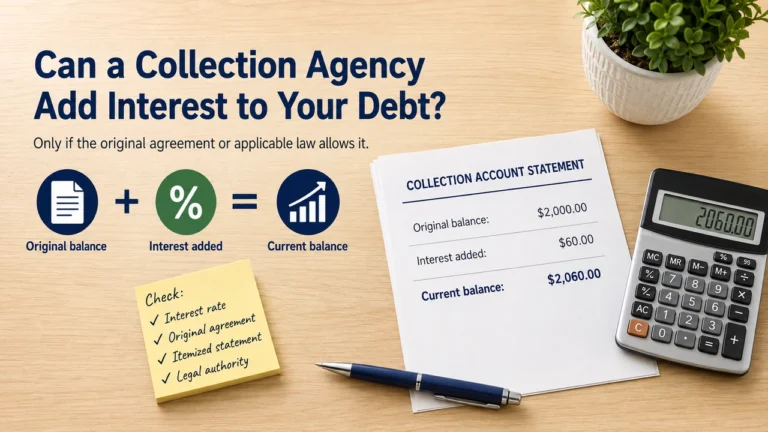
Look for the collector and creditor identities, an account identifier if available, the current amount, an itemization, and response instructions. If the claimed amount includes interest or fees you do not understand, use our guide to when a debt collector may charge interest or added amounts. Record the end date for the dispute period shown in the notice. Do not throw away the envelope or electronic delivery record if it helps establish when the notice arrived.
The CFPB describes a 30-day period to dispute the debt in writing. Under Regulation F’s dispute and original-creditor rules, a timely written dispute generally pauses collection of the debt or disputed portion until the collector sends verification. A timely written request for the original creditor’s name and address pauses collection of the debt until the required original-creditor response is sent. Follow the notice and applicable instructions; an informal phone conversation alone does not trigger these written-request protections.
The same rule says that not disputing a debt is not a legal admission that you owe it. However, missing the validation period can affect these collection-pause rights. A substantially repeated dispute without new, material information can also receive a duplicative-dispute response rather than a new verification. Keep your notice, submission, and delivery record together.
To prepare the actual request, use our debt validation letter template and mailing checklist. Adapt it to the specific collection issue and keep the sending record.
These federal collection rules concern covered debt collectors. The CFPB’s description of debt collectors helps explain who that includes. Do not assume every original creditor, business debt, or communication falls under an identical rule.
Workplace contact is a separate issue from verifying a debt or correcting a credit report. If a collector calls your job, see when debt collectors can contact your employer for the privacy limits and a letter to restrict workplace communications.
What a credit report dispute should identify
Obtain the actual bureau report and specify the incorrect entry. State what is wrong, why, and what the record should show. Use copies of evidence that addresses that particular fact. Our step-by-step reporting-dispute guide covers the process.
For example, a receipt showing a payment can support a balance question. It does not necessarily establish that the entire account never belonged to you. Our dispute-document checklist helps match the evidence to the claim rather than sending a large, unfocused document bundle.
For an auto-loan account, compare the payment history with the sale statement and any credits before choosing what to dispute. Our guide to repossession dates and credit reporting shows how to separate a timing question from an incorrect remaining balance.
If the error appears at multiple bureaus, track the affected reports separately. Keep the collector’s validation response with the collection file and the bureau’s investigation result with the reporting file. They may discuss the same account while resolving different questions.
Explore related guides on collections.
Do not confuse the two 30-day references
The validation period is about when you send a qualifying response after receiving collection information. The ordinary credit-bureau investigation period is about the bureau’s response after it receives a dispute. They are not one shared countdown.
The CFPB says bureau investigations generally take 30 days, with certain cases allowing up to 45. The deadline depends on the applicable circumstances. A collector is not required to delete a debt simply because you wrote “respond within 30 days” in your own letter.
Use a log with one row for each recipient: notice received, deadline stated, request sent, delivery confirmed, response received, and next action. Mark uncertain dates as questions to resolve instead of quietly treating them as confirmed.
Illustrative example: a payment is missing from two records
A collector sends a notice for $900. You have a record of a $300 payment that you believe should reduce the amount to $600. A credit report also shows $900 for the collection, with a reporting date that appears relevant to the payment.
First verify the collector and compare its itemization with your payment record. Send a specific written dispute through the appropriate collection process. Separately, review whether the bureau entry is inaccurate for its reporting date and dispute that entry with the proper recipients if supported.
Do not assume that the payment record proves every $900 entry is wrong without checking timing or allocation. Ask whether fees, interest, or payment application explain any difference. The objective is to reconcile the numbers, not choose the smallest one without evidence.
Two original wording examples
For the collector
I dispute the amount stated in your notice dated [date] for reference [identifier]. Your notice states [amount]. My records show [specific payment or discrepancy]. Please provide verification and explain the itemization and treatment of the attached record.
For the bureau and information provider
I dispute the [specific field] for [company and account identifier] on the report dated [date]. It shows [value]. I believe it should show [correction] because [specific reason]. The attached copy of [document] supports that correction.
Adapt these only to facts you can explain. Include the identification the verified recipient requires, protect sensitive information, and keep your copies. These examples are not substitutes for legal advice about deadlines, lawsuits, or state-law issues.
What happens after a response?
Keep your current payments on track while waiting for either process. Our 90-day action plan for rebuilding credit after collections shows how to organize report checks, payment protection, and follow-up without treating a dispute as a guaranteed score increase.
Read what was actually resolved. Did the collector explain the amount? Did the bureau change the balance, retain it, or request more information? Compare the response with the exact question you sent.
If the bureau reports that the item was verified as accurate after your credit dispute, check the specific reported field and consider requesting a description of its investigation. That bureau result does not by itself answer a separate debt-validation request to the collector.
If the debt is legitimate and you are deciding whom to pay, our collector-versus-original-creditor guide addresses payment-recipient questions. If both parties appear on the report, see original creditor and collector balances before assuming that every pair of entries is a duplicate.
Do not ignore court documents while waiting for correspondence. Court response deadlines are separate from both processes discussed here. If a lawsuit, old debt, or legal liability is involved, get help appropriate to your state and circumstances promptly.
By Claire Bennett, the editorial name used by the site’s founder and editor. Factual guidance checked against the linked official sources. Photo: Wesley Tingey / Unsplash.
Sources
- Regulation F: disputes and original-creditor requests
- CFPB: credit-report dispute investigation timelines
- CFPB: debt validation information
- CFPB: debt collectors
- CFPB: disputing credit report errors
Sources checked October 4, 2026. General educational information for U.S. readers; not individualized financial or legal advice. Examples are illustrative and do not predict credit scores or lending decisions.