In this guide
- How many points can your credit score increase after collection removal?
- What CFPB research found about medical collection removal
- Why there is no standard score increase
- How to measure your actual score change correctly
- Examples of what can happen after a collection is removed
- How long after collection removal should you check your score?
- What if the score does not increase at all?
- Can removing the last collection increase your score more?
- What should you focus on after the collection is gone?
- Frequently asked questions
- Sources
- Final thoughts
How much will your credit score increase after a collection is removed? There is no fixed or guaranteed number of points. A deleted collection can produce no visible score change, a modest increase, or a more noticeable improvement depending on the scoring model, the type and age of the collection, the bureau report being scored, and the rest of your credit file.
One useful benchmark comes from Consumer Financial Protection Bureau research on medical collections. In a study of removals that occurred from 2012 through 2020, consumers’ credit scores increased by about 25 points on average in the first quarter after their last medical collection was removed. That is a historical average for a specific group, not a prediction for nonmedical collections or for any individual credit file.
How many points can your credit score increase after collection removal?
There is no universal point value for deleting a collection. Credit-scoring models evaluate the entire credit report rather than assigning a public, fixed number of points to one deleted account.
| Credit-file situation | What may happen after deletion |
|---|---|
| The scoring model was already ignoring the collection | Little or no additional score change may be visible |
| Other collections, charge-offs, or recent late payments remain | Any benefit may be limited or difficult to isolate |
| The collection was the main serious negative item | A more noticeable increase may be possible, but it is not guaranteed |
| The collection was already old | The visible change may be smaller because older negative information may have had less influence immediately before deletion |
| The file has little positive credit history | The report becomes cleaner, but the score may remain relatively low |
| Another change happened at the same time | Higher card balances, a new late payment, or recent credit activity can offset or obscure the effect of the deletion |
The most useful way to measure the effect is to compare a score from the same credit bureau, same scoring model and version, and same provider before and after the collection disappears.
What CFPB research found about medical collection removal
The Consumer Financial Protection Bureau studied medical collection removals from 2012 through 2020. It found an average credit-score increase of approximately 25 points during the first quarter after a consumer’s last medical collection was removed.
The study also reported average increases of about 21 points for people with medical collections under $500 and 32 points for people with medical collections over $500.
These figures should not be treated as a promise. They describe historical averages in a medical-collection study. They do not establish what a nonmedical collection is worth in points, and they do not predict what will happen to one person’s FICO or VantageScore.
Why there is no standard score increase
1. Different scoring models treat collections differently
FICO and VantageScore do not treat every collection the same way, and even different versions from the same scoring company can behave differently.
| Scoring model | Relevant collection treatment | What deletion may mean |
|---|---|---|
| FICO Score 8 | Third-party collections with an original amount under $100 are disregarded | Deleting an account the model already disregarded may produce little or no extra change |
| FICO Score 9 | Third-party collections reported as paid in full are disregarded | Deleting a paid collection may add little or no further scoring benefit |
| FICO Score 10 suite | Third-party collections reported as paid in full are disregarded | The score may already have stopped counting a paid collection before deletion |
| VantageScore 3.0 and 4.0 | Paid collections are excluded; VantageScore also excludes medical collection information from these models | A deleted paid or medical collection may have already been ignored by the model |
This is one reason two consumers can have the same type of collection removed and see very different score changes.
Important qualifications: A third-party collection settled for less than the full amount can also be excluded by FICO Score 9 and FICO Score 10 when it is reported with a $0 balance. The original-amount-under-$100 exception applies to FICO Score 8, 9, and the 10 suite. These exceptions do not apply to first-party collections, and they do not erase a separate original-creditor charge-off. Check the account type and score version before interpreting the result. See FICO’s explanation of collection treatment.
2. Medical and nonmedical collections are not interchangeable
Medical debt has received special treatment in both credit reporting and modern scoring models. That means the CFPB’s medical-collection findings should not be applied directly to credit-card, utility, telecom, or other nonmedical collections.
3. Other negative information may still be affecting the score
Removing one collection does not remove a separate original-creditor charge-off, recent late payments, another collection, a repossession, a foreclosure, or other negative information that may remain on the report.
If the deleted collection was only one of several major negative items, the score may move less than expected.
4. The age of the collection matters
Negative information can have less influence as it becomes older. If a collection was already several years old, deleting it may produce less visible movement than removing a more recent major negative item, depending on the scoring model and the rest of the file.
5. Positive credit history still matters
Deleting a collection removes a negative tradeline, but it does not create positive payment history. It does not lower your card balances, make your accounts older, or add years of on-time payments.
A thin credit file can therefore look cleaner after deletion while still lacking enough positive history to support a much higher score.
6. Other changes can offset the deletion
A score is calculated from all report information available at that moment. If a collection disappears while a credit card reports a much higher balance, a new late payment appears, or a new account is opened, the final score can stay flat or even move in the opposite direction.
How to measure your actual score change correctly
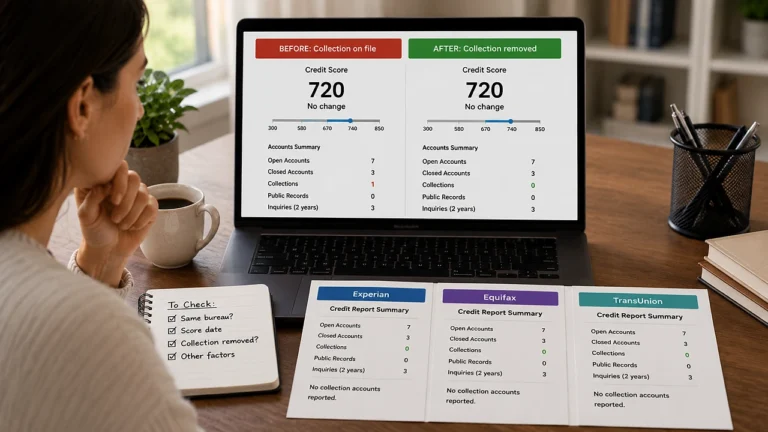
- Confirm the collection is truly gone. A collection that still appears as paid, settled, closed, or with a zero balance was updated, not necessarily deleted.
- Use the same credit bureau. Experian, Equifax, and TransUnion maintain separate credit reports. A deletion from one bureau does not automatically mean the other two reports changed.
- Check the score calculation date. A monitoring app may still show a score calculated before the deletion appeared on the updated report.
- Use the same scoring model and version. Do not compare a FICO Score 8 from one service with a VantageScore 3.0 from another and assume the difference came from the collection.
- Compare the whole report. Look for higher card balances, lower limits, new inquiries, new accounts, late payments, or other changes that occurred around the same time.
If the collection is gone but the number still did not move, use our step-by-step guide on why your credit score may not increase after a collection is removed.
Examples of what can happen after a collection is removed
Example 1: a paid collection was already ignored
A consumer has a paid third-party collection and checks a score model that disregards paid third-party collections. The tradeline is later deleted. The credit report is cleaner, but that score may show little or no additional increase because the model was already ignoring the collection.
Example 2: the collection was the main serious negative item
A consumer has otherwise established credit, low reported balances, and no recent late payments. Their only major derogatory item is deleted. A more noticeable score increase may be possible, but there is still no guaranteed point amount.
Example 3: a medical collection is removed
A consumer’s last medical collection disappears. Historical CFPB research found an average increase after this type of event, but a modern score may already exclude medical collection information depending on the scoring model. The historical average is therefore useful context, not a personal forecast.
Example 4: higher utilization offsets the benefit
A collection is deleted, but one credit card reports a much higher balance during the same reporting period. The collection removal improves one part of the file while the higher utilization affects another. The newly calculated score can remain unchanged.
How long after collection removal should you check your score?
There is no universal waiting period that guarantees a score change. First verify that the collection is absent from a current bureau report. Then check the date on the score you are viewing.
If the score was calculated before the updated report reflected the deletion, it is too early to evaluate the effect. If the score was calculated afterward and remains unchanged, simply waiting longer does not guarantee that points will appear later.
For a broader explanation of timing, see how often your credit score updates.
What if the score does not increase at all?
No score increase does not automatically mean the deletion failed. Check whether:
- the account is absent from the same bureau report used for the score;
- the score was calculated after the deletion;
- the scoring model already ignored the collection;
- an original-creditor charge-off or another derogatory account remains;
- reported balances or utilization increased;
- new credit activity occurred around the same time.
Do not file a new dispute solely because your score did not rise. A credit-report dispute should identify specific information that is inaccurate, incomplete, duplicated, or does not belong to you.
Can removing the last collection increase your score more?
Removing the last collection can be more meaningful than removing one of several collections because the file no longer contains any collection tradelines. But a larger increase is not guaranteed. A charge-off, late-payment history, high utilization, limited positive history, or a model that already ignored the collection can still keep the score from moving much.
What should you focus on after the collection is gone?
Once the deletion is confirmed and the remaining information is accurate, focus on the parts of the credit file you can actually control: on-time payments, manageable reported balances, avoiding unnecessary new credit, and maintaining older well-managed accounts.
If you are rebuilding after collection problems, see how to rebuild credit after collections.
Frequently asked questions
How many points will my credit score go up when a collection is deleted?
There is no fixed point value. Some people may see no immediate change, while others may see a more noticeable increase. The result depends on the scoring model, the collection, the bureau report, and the rest of the credit file.
Is a 25-point increase guaranteed after collection removal?
No. The approximately 25-point figure comes from CFPB research on consumers whose last medical collection was removed in a historical study. It is an average for that research population, not a guarantee for one person or for nonmedical collections.
Why did my score increase on one app but not another?
The apps may use different credit bureaus, scoring models, model versions, providers, or calculation dates. Compare like with like before attributing a change to the collection deletion.
Can my credit score stay the same after the last collection is removed?
Yes. The scoring model may already have ignored the account, other negative information may remain, positive history may be limited, or another credit change may offset the effect.
Can a score drop around the same time a collection is removed?
Yes, but that does not mean the deletion caused the drop. Check for other changes such as higher reported balances, a lower credit limit, a new inquiry, a new account, or a recent late payment.
Explore related guides on collections.
Sources
- Consumer Financial Protection Bureau — Consumer Credit and the Removal of Medical Collections from Credit Reports
- FICO / myFICO — How Do Collections Affect Your Credit?
- VantageScore — Consumer FAQs
Final thoughts
There is no reliable formula that turns a deleted collection into a guaranteed number of credit-score points. The strongest way to evaluate the result is to confirm the deletion, compare the same bureau and scoring model before and after it, and review the rest of the credit file for other changes.
A deleted collection can improve the information on your report even when the score does not immediately move. If your score stayed unchanged, the next step is diagnosis, not guessing: review the reasons a score may not increase after collection removal.