In this guide
- Why is a closed account still showing a balance?
- When is a balance on a closed account normal?
- When should a closed account show a $0 balance?
- What if the debt was sold to a collection agency?
- How long does it take for a paid closed account to update?
- How to tell whether the balance is outdated or incorrect
- What should a paid closed account look like?
- Does a closed account disappear after it is paid?
- Can a closed account with a balance affect your credit score?
- What if a closed credit card still shows a balance after you paid it?
- What if a paid loan still shows a balance?
- What if the balance belongs to a collection account?
- How to dispute a wrong balance on a closed account
- Should you dispute the account just because it is closed?
- Frequently asked questions
- Bottom line
- Sources and methodology
Quick answer: A closed account can still appear on your credit report, but whether it should still show a balance depends on what happened to the debt. If the account was fully paid before or when it closed, the balance should generally update to $0 after the creditor reports the payoff. If the account was closed while money was still owed, the balance can remain because closing an account does not erase the debt. If the creditor sold the debt, the original account should generally reflect the transfer appropriately, and a separate collection or debt-buyer account may also appear. If you paid the account and a recent report still shows money you do not owe, check the reporting date, contact the furnisher, and dispute inaccurate information if necessary. If the balance is not the problem but the closed account suddenly shows a new late-payment month, use the closed-account late-payment guide.
Why is a closed account still showing a balance?
“Closed” and “paid” do not mean the same thing.
An account can be closed because:
- you paid it off;
- you asked the lender to close it;
- the lender closed it;
- the account was charged off;
- the debt was transferred or sold; or
- the account was refinanced or replaced.
The balance depends on which of those happened.
When is a balance on a closed account normal?
You closed a credit card but still owe money
Closing a credit card does not cancel the balance. You still owe the remaining amount under the account terms, and the lender can continue reporting the balance as you pay it down. If a merchant later sends money back to that account, see what happens to a refund on a closed credit card.
If you are deciding whether to close another card, use our guide to closing a credit card and its effect on your credit score. It separates zero-balance closures from accounts that still have debt and includes a checklist for payments, rewards and confirmation.
A loan account closed with a remaining obligation
If a loan is closed for reasons other than full payoff, an outstanding balance can remain.
The account was charged off
A charge-off is an accounting action by the lender. It does not automatically mean the debt is forgiven. The account can remain closed with a balance if money is still legally owed.
See what a charge-off means on your credit report.
When should a closed account show a $0 balance?
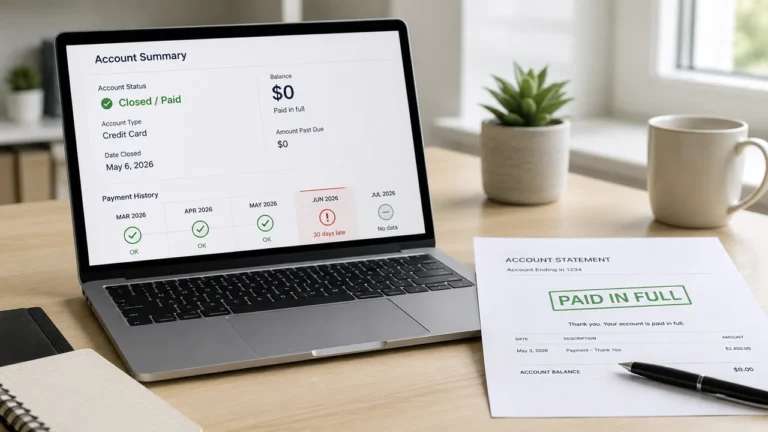
If you fully paid the account, the balance should generally update to $0 once the creditor reports the payoff.
Experian explains that a paid, closed revolving account should no longer show a balance after the update is reported.
If the account was settled and the creditor agreed that no further balance is due, the account should also reflect that outcome accurately.
What if the debt was sold to a collection agency?
If an original creditor sells the debt, the original account can remain on your report as historical information, while the new owner may report a separate collection account.
The original creditor should not continue reporting an amount it no longer owns as though it is still owed to that creditor.
Experian notes that when a debt is sold, the original account generally updates to show the transfer and no longer carries the outstanding amount owed to that original creditor.
If both the original creditor and collector appear to be reporting balances, see what to do when both the original creditor and collection agency report a balance.
How long does it take for a paid closed account to update?
Updates are not real-time.
Experian says lenders typically report around the end of a billing cycle, and account updates after payoff can take roughly 30 to 45 days.
That means a report can temporarily show the pre-payoff balance even though your lender already shows $0 internally.
Check the account’s “date updated” field before assuming the report is wrong.
How to tell whether the balance is outdated or incorrect
Compare three dates:
- the date you made the final payment;
- the creditor’s payoff or settlement confirmation date; and
- the “date updated” on your credit report.
If the report was last updated before you paid the account, the balance may simply be old data.
If the report was updated after the payoff and still shows money you do not owe, investigate further.
What should a paid closed account look like?
| Field | What to check |
|---|---|
| Status | Closed, paid, paid/closed, or similar wording that accurately reflects the account. |
| Current balance | $0 if the obligation was fully satisfied. |
| Past-due amount | Should not show an amount you no longer owe. |
| Payment history | Past history should remain accurate even after payoff. |
| Date updated | Should eventually reflect a post-payoff reporting cycle. |
Does a closed account disappear after it is paid?
No.
The CFPB says positive payment history may continue to be reported after a loan is paid off and after an account is closed. Experian says closed accounts in good standing can remain for up to 10 years.
So the fact that the account is still visible is not an error by itself.
Read how long paid-off debt can stay on your credit report for the reporting timeline.
Can a closed account with a balance affect your credit score?
It can.
Credit scores are calculated from the information on your credit reports. A remaining balance, delinquency history, charge-off, or other status can be considered by the scoring model.
The exact effect depends on the full credit profile and the scoring model. There is no universal number of points associated with a closed account showing a balance.
What if a closed credit card still shows a balance after you paid it?
First, verify that the payment fully cleared and that there was no trailing interest, fee, or transaction that posted after your final payment.
Then:
- download or save the final statement;
- check the creditor’s current balance;
- check the credit report update date;
- contact the card issuer if a normal reporting cycle has passed; and
- dispute the balance if the report contains newer but inaccurate information.
What if a paid loan still shows a balance?
The same process applies to auto loans, personal loans, mortgages, and other installment accounts.
Keep the payoff letter or final statement. If you paid the loan in full, a current balance should eventually reflect $0 after the lender reports the update.
If the account is an auto loan and your score also changed after payoff, see why paying off a car loan can change a credit score.
What if the balance belongs to a collection account?
If the collection was paid or settled, the collector should update the balance and status accurately.
If it still shows an amount due, see paid collection still showing a balance.
How to dispute a wrong balance on a closed account
The CFPB lists an incorrect current balance as a common credit-report error.
If you find one:
- gather the payoff letter, final statement, settlement agreement, or bank record;
- identify the exact account and incorrect field;
- dispute the error with the credit reporting company;
- also contact the company that furnished the information; and
- keep copies of everything you send and receive.
Use our credit report dispute guide for the step-by-step process.
Should you dispute the account just because it is closed?
No.
A closed account can legitimately remain on your report for years. Dispute only information that is actually inaccurate or incomplete.
Trying to remove accurate positive history can also remove information that contributes to your credit history length.
Frequently asked questions
Why does my closed credit card still have a balance?
If you closed the card before paying it off, the remaining debt can still be reported. If you already paid it in full, check whether the report simply has not updated yet.
Should a closed paid account have a zero balance?
Generally yes, once the payoff has been reported. A fully satisfied account should not continue showing money you do not owe.
Can a closed account still be in collections?
Yes. “Closed” describes the account status, not whether the debt was resolved. A delinquent closed account can still be collected.
Can a closed account hurt your credit?
It depends on the information associated with it. Positive closed accounts can remain helpful history, while delinquency, charge-off, or unpaid balances can be negative factors.
How long should I wait before disputing a paid balance?
First compare the payoff date with the account’s reporting date: an older snapshot may simply predate your payment. A typical reporting interval is not a mandatory waiting period before disputing a specific inaccuracy. You do not need the creditor’s agreement before using the CFPB’s bureau-and-furnisher dispute process. Identify the field you believe is wrong, explain the date mismatch, and include relevant payoff records.
Bottom line
A closed account showing a balance is not automatically wrong. If money is still owed, the balance can remain. If the account was fully paid or the debt was sold away from the original creditor, the reporting should accurately reflect that change.
Check the update date, keep payoff documentation, and dispute only specific inaccurate information.
Explore related guides on credit reports and disputes.
Sources and methodology
- CFPB: Common credit report errors
- CFPB: How long information stays on a credit report
- Experian: Closed credit card accounts on a credit report
- Experian: How quickly payoff updates can appear
This article is educational information, not individualized financial or legal advice.