- Quick evidence finder
- Are supporting documents required for a credit report dispute?
- Credit dispute evidence matcher: match the error to the right documents
- How to choose the best evidence for a credit report dispute
- What should you include with a credit report dispute?
- Credit dispute document checklist
- Example: how to organize attachments to a credit dispute
- How to organize credit dispute documents before you submit them
- Step 1: Keep your original documents
- Step 2: Put the disputed credit report item near the front
- Step 3: Label each piece of credit dispute evidence
- Step 4: Add one sentence explaining what each document shows
- Step 5: Put the documents in a logical order
- Step 6: Keep enough context visible
- Step 7: Save a complete dispute file
- How to submit credit dispute documents
- Before you submit: credit dispute document check
- What if you do not have supporting documents for a credit dispute?
- Where to get documents for a credit dispute
- Step 1: Identify the exact field you believe is wrong
- Step 2: Request records from the source that maintains them
- Step 3: Never create or alter “proof”
- Step 4: What if you still have no proof for the credit dispute?
- Do I have enough information to file a credit report dispute?
- How strong is your credit dispute evidence?
- What counts as proof in a credit dispute?
- Credit dispute evidence comparison
- What makes credit dispute evidence more useful?
- Credit dispute evidence relevance scorecard
- Can a bank statement support a credit dispute?
- Can a creditor letter support a credit dispute?
- Can screenshots be used in a credit dispute?
- Strong evidence does not guarantee deletion or correction
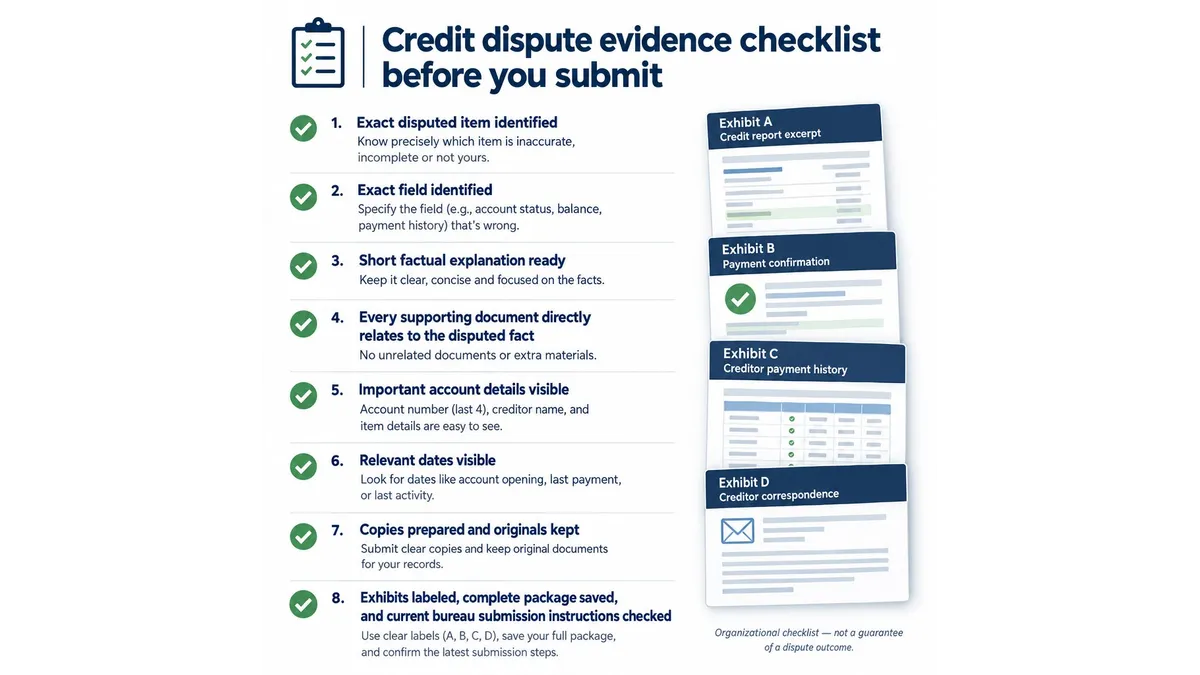
- Credit dispute evidence checklist before you submit
- 1. Did you identify the exact disputed item?
- 2. Did you identify the exact field that appears inaccurate or incomplete?
- 3. Can you explain why you believe the information is wrong?
- 4. Does every supporting document relate to the disputed fact?
- 5. Are the important account details visible?
- 6. Are the relevant dates visible?
- 7. Did you keep your original documents?
- 8. Did you label every attachment?
- 9. Does each exhibit have a clear purpose?
- 10. Did you remove unrelated paperwork?
- 11. Did you save the complete dispute package?
- 12. Did you check the credit bureau’s current submission instructions?
- Final credit report dispute documents checklist
- Is your credit dispute evidence package ready to submit?
- Frequently asked questions about credit report dispute documents
- What documents do I need to dispute a credit report?
- Do I need proof to dispute a credit report?
- Can I dispute a credit report without supporting documents?
- What documents should I send with a credit dispute?
- Should I send original documents with a credit dispute?
- Can a bank statement be used as evidence in a credit dispute?
- Can screenshots be used to support a credit report dispute?
- How many documents should I send with a credit dispute?
- Can I add supporting documents after submitting a credit dispute?
- What to do next
- Sources and editorial review
- Official sources used for this guide
- How we reviewed this guide
Quick evidence finder
Start with the type of error you found, then look for records that directly support the correction you are requesting.
| If the problem is… | Documents that may help |
|---|---|
| Late payment reported incorrectly | Payment confirmation, creditor payment history, canceled check, or other records showing when the payment was made or credited |
| Wrong account balance | Billing statement, account history, payoff statement, or creditor correspondence showing the balance |
| Paid debt still showing unpaid | Proof of payment, payoff statement, settlement confirmation, or zero-balance confirmation |
| Duplicate account | Copies of both credit report entries, account statements, account numbers, and creditor records that help show whether the entries refer to the same obligation |
| Account is not yours | Relevant identity records, creditor correspondence, account records, and identity-theft documentation if fraud is involved |
| Incorrect bankruptcy or court information | Relevant court orders, bankruptcy records, schedules, or other official records that show the correct information |
Not sure what field is wrong?
Start by learning how to read your credit report so you can identify the exact balance, payment status, date, account ownership, or other information you want investigated.
Are supporting documents required for a credit report dispute?
Supporting documents are not required for every credit report dispute, but relevant evidence can make the specific error easier to investigate. The most important step is to clearly identify the information you believe is inaccurate or incomplete, explain why it is wrong, and request an investigation. If you have records that directly support your position, include copies of those documents with your dispute.
If you are wondering whether you need proof to dispute a credit report, supporting documents are not required in every case. In other words, you may be able to dispute a credit report without supporting documents. However, documentation such as payment records, account statements, creditor correspondence, canceled checks, payoff records, or official court documents can help show why the reported information may be inaccurate or incomplete.
So, do you need documentation to dispute a credit report? Not necessarily in every case. But when you have relevant credit dispute supporting documents, they can give the credit bureau and the company that furnished the information clearer records to review during the investigation.
| Your situation | What to do |
|---|---|
| You have strong supporting documents | Attach copies of the records that directly support the specific balance, payment status, account ownership, date, or other fact you are disputing. Avoid adding unrelated paperwork just to make the dispute package larger. |
| You only have partial evidence | Include the most relevant documents you have and clearly explain what each record shows. A partial record may still be useful when it directly relates to the disputed information. |
| You do not have supporting documents yet | Identify the exact credit report error first. Then look for records from the creditor, lender, debt collector, bank, court, or other source that maintains the underlying information. You may also request account histories, payment records, payoff information, or other documents that could help verify the disputed fact. |
| You have an explanation but no independent record | Describe the disputed information as specifically as possible, including the account, date, balance, payment status, or other field you believe is wrong. If additional records become available, keep them with your dispute file and follow the credit bureau’s current procedures for submitting relevant information. |
| The information is accurate but negative | A credit report dispute is generally intended to address information you believe is inaccurate or incomplete. Negative information should not be disputed solely because it lowers your credit score if the information is otherwise accurate. |
Important: Supporting evidence does not guarantee that an account, late payment, collection, charge-off, or other item will be changed or removed. The purpose of the evidence is to help establish the specific factual issue you are asking the credit bureau to investigate.
The best supporting documents for a credit dispute are usually the records that directly address the exact information being challenged. For example, proof of payment may be relevant to an incorrectly reported late payment, while a payoff statement may be more useful when the reported balance or account status appears wrong.
If you already know which information is wrong but are not sure how to submit the dispute, follow our step-by-step guide on how to dispute errors on your credit report.
Credit dispute evidence matcher: match the error to the right documents
If you are wondering what evidence you need for a credit dispute, start with the exact information that appears to be inaccurate or incomplete. The best evidence for a credit report dispute is usually documentation that directly addresses the specific balance, payment status, account ownership, date, or other fact you want investigated.
Use the table below to match common credit report errors with documents that may support a credit report dispute. These examples can help you identify relevant credit report dispute evidence and choose credit dispute supporting documents that relate directly to the correction you are requesting. Supporting evidence does not guarantee that a credit bureau will change or remove an item.
Relevant evidence for a credit report dispute should connect as directly as possible to the information you believe is inaccurate or incomplete. The goal is not to prove that an account is negative or inconvenient, but to provide records that help establish why a specific reported fact may be wrong.
| Credit report problem | What you need to establish | Documents that may help | Next step |
|---|---|---|---|
| Late payment reported incorrectly | The reported payment date or payment status may be inaccurate. | Payment confirmation, creditor payment history, canceled check, relevant bank record, autopay record, or written creditor correspondence. | See how to dispute a late payment. |
| Wrong account balance | The balance shown on the credit report may not match the creditor’s underlying records for the relevant reporting period. | Billing statement, account history, payoff statement, lender correspondence, or another creditor record showing the relevant balance. | Compare the date on your supporting document with the reporting period shown on the credit report. |
| Paid account still reported as unpaid | The debt was paid, but the reported balance or account status may not reflect that payment correctly. | Payment receipt, payoff statement, zero-balance confirmation, canceled check, bank transaction record, or creditor letter confirming payment. | Identify whether the disputed field is the balance, account status, or payment history before choosing your evidence. |
| Paid collection still showing a balance | The collection was paid or settled, but the reported balance may still be inaccurate. | Collection agency receipt, settlement agreement, payment confirmation, relevant bank record, or written zero-balance confirmation. | See what to do when a paid collection is still showing a balance. |
| Duplicate account or collection | Two reported entries may represent the same underlying obligation rather than separate debts. | Copies of both credit report entries, account numbers, creditor statements, collection notices, transfer records, balances, and relevant account histories. | Learn how to dispute a duplicate account on your credit report. |
| Account is not yours | The account may belong to another consumer or may have been associated with your credit file incorrectly. | Relevant identity records, address history, creditor correspondence, account application records if available, and other records that help distinguish your information from the reported account. | Check whether the problem appears to involve a mixed file, creditor reporting error, or possible identity theft. |
| Account resulted from identity theft | The account or transaction may have resulted from identity theft or activity you did not authorize. | FTC Identity Theft Report, proof of identity, relevant credit report pages, creditor correspondence, fraudulent-account records, and a police report if one exists and is relevant. | Follow the appropriate identity-theft reporting and dispute process rather than treating the issue only as an ordinary account disagreement. |
| Closed account reported as open | The reported account status or closure information may be inaccurate. | Account closure confirmation, final billing statement, creditor account history, payoff statement, or written confirmation from the lender. | Compare the closure date and account status with the exact fields shown on the credit report. |
| Incorrect account or collection date | A specific reported date, such as a date opened or payment date, may not match the underlying records. | Account statements, creditor histories, collection notices, previous credit reports, payment records, or written correspondence showing the relevant date. | Identify the exact date field before disputing it because similar-looking dates can refer to different events. |
| Charge-off balance or status appears wrong | The reported balance, payment status, or account status may not match the creditor’s records. | Creditor statements, account history, settlement agreement, payoff confirmation, payment records, or written creditor correspondence. | If the account was paid but still shows a balance, see why a paid charge-off may still be showing a balance. |
| Bankruptcy information appears incorrect | The bankruptcy information on the credit report may differ from the relevant court record. | Bankruptcy schedules, discharge or dismissal documents, relevant court orders, docket records, or other official court documents that address the disputed information. | Compare the exact court record with the specific bankruptcy information being reported. |
| Credit inquiry appears unauthorized | You may need to determine whether the inquiry relates to an application, account review, transaction, or other activity you authorized. | Copy of the inquiry entry, creditor response, application records, account-opening documents, or identity-theft documentation when fraud is suspected. | Contact the company associated with the inquiry if you do not recognize why it accessed your credit file. |
Evidence rule: Do not choose a document simply because it is related to the account. Ask whether it directly helps establish the specific fact you are disputing. For example, a bank statement may show that a payment left your account, while a creditor payment history may provide additional context about when and how the payment was credited.
How to choose the best evidence for a credit report dispute
The best evidence for a credit report dispute is evidence that is specific, relevant, and easy to connect to the disputed information. A useful document should help answer a factual question such as: Was the payment made on time? What was the balance? Was the account paid or closed? Does the account belong to you? Is the reported date consistent with the underlying records?
When deciding what supporting documents you should send with a credit dispute, focus on relevance rather than volume. A small set of records that clearly addresses the disputed information is generally more useful than a large packet of unrelated paperwork.
In other words, the most useful documents to support a credit report dispute are not necessarily the documents that look the most official or contain the most pages. They are the records that most directly address the specific information you are challenging.
What should you include with a credit report dispute?
If you are wondering what you should include in a credit report dispute, focus on information that identifies the exact item you are challenging and documents that directly support the correction you are requesting. A well-organized dispute package can include a clear description of the error, the relevant credit report entry, supporting evidence, and enough account information to connect each document to the disputed item.
What documents you should send with a credit dispute depends on the type of error. You do not need to attach unrelated paperwork simply to make the file larger. The goal is to make it easy to understand what is being disputed, why you believe it is inaccurate or incomplete, and what each document shows.
If you are unsure what to send with a credit dispute letter, start with the disputed credit report entry, a short factual explanation of the problem, and documents that directly support the correction you are requesting.
| What to include | What it should show | Practical tip |
|---|---|---|
| 1. Clear identification of the disputed item | The creditor or furnisher name, relevant account identifier, disputed field, and the specific information you believe is inaccurate or incomplete. | Be specific. Instead of writing “this account is wrong,” identify the balance, payment status, date, ownership information, or other field you want investigated. |
| 2. Copy of the relevant credit report section | The exact account, collection, inquiry, public-record information, or other entry being disputed. | If you are mailing the dispute, consider marking or highlighting the disputed item on a copy of the relevant credit report page while keeping the original report for your records. |
| 3. Short factual explanation | Why you believe the reported information is inaccurate or incomplete and what information you want investigated. | Keep the explanation focused on facts. Avoid long background stories that do not help establish the specific reporting error. |
| 4. Supporting documents | Records that directly relate to the disputed balance, payment, account status, ownership, date, or other factual issue. | Examples may include payment confirmations, creditor statements, payoff records, settlement letters, canceled checks, relevant bank records, identity-theft documentation, or court records. |
| 5. Explanation of what each attachment shows | The connection between each document and the disputed information. | Label documents clearly, such as “Exhibit B — Payment confirmation showing payment credited March 12, 2026.” |
| 6. Identification information required for submission | Enough information for the credit bureau to identify you and locate the relevant credit file or account. | Check the credit bureau’s current instructions before submitting because identity-verification and document requirements can vary by bureau and submission method. |
| 7. Complete copy for your records | Everything you submitted, including the dispute explanation and supporting documents. | Keep the complete package together so you can compare it with the investigation result or use it if follow-up becomes necessary. |
Credit dispute document checklist
- Exact account or credit report item identified
- Specific balance, status, date, payment, ownership, or other field identified
- Short explanation of why the information appears inaccurate or incomplete
- Copy of the relevant credit report section when appropriate
- Supporting documents matched to the disputed fact
- Attachments labeled so their purpose is easy to understand
- Current bureau submission requirements checked
- Complete copy of the dispute package saved for your records
Example: how to organize attachments to a credit dispute
Exhibit A — Credit report excerpt
Shows the account and the specific payment status being disputed.
Exhibit B — Payment confirmation
Shows the account reference, payment amount, and transaction or credited date.
Exhibit C — Creditor account history
Shows how the creditor recorded the payment during the relevant reporting period.
Exhibit D — Creditor correspondence
Shows any written information from the creditor that directly relates to the disputed payment status.
Keep it relevant: If you are deciding what documents to attach to a credit dispute letter, choose records that directly support the factual issue being disputed. Sending a large amount of unrelated paperwork does not make a dispute stronger and can make the important evidence harder to identify.
What to include in a credit dispute letter or other dispute submission may also depend on how you file it. Once your evidence is organized, compare whether it makes more sense to dispute a credit report online or by mail and check the credit bureau’s current submission instructions before sending your documents.
How to organize credit dispute documents before you submit them
If you are wondering how to organize credit dispute documents, use a simple rule: each attachment should be easy to connect to one specific fact you are disputing. Keep your original records, organize copies in a logical order, label each attachment clearly, and save a complete copy of everything you submit.
Good organization does not make inaccurate information automatically disappear, but it can make your credit report dispute evidence easier to understand. When you prepare evidence for a credit dispute, focus on clarity, relevance, and a direct connection between the document and the disputed information.
The simplest way to organize credit dispute evidence is to connect each exhibit to one specific disputed fact. The person reviewing the dispute should be able to identify the reported information, find the document related to it, and understand what that document shows without having to sort through unrelated records.
Step 1: Keep your original documents
If you are asking should I send original documents with a credit dispute, generally keep your originals for your own records. When supporting documents are submitted by mail, use copies rather than giving up the only original of a payment record, creditor letter, settlement agreement, court document, or other important record.
The same principle answers another common question: should I send copies or originals with a credit dispute? Keep the original document safely stored and prepare a clear copy when a copy is appropriate under the credit bureau’s current submission instructions.
Step 2: Put the disputed credit report item near the front
Make it easy to identify exactly what you are challenging. A copy of the relevant credit report section can be labeled as your first exhibit and should show enough context to identify the account, collection, inquiry, or other disputed entry.
Exhibit A — Credit report excerpt
Account: Example Bank, ending 4321
Disputed field: March 2026 payment status
Reported information: 30 days late
Step 3: Label each piece of credit dispute evidence
When deciding how to label credit dispute evidence, use short, factual labels that identify what the document actually is. Avoid labels that assume the outcome of the investigation.
| Better label | Avoid |
|---|---|
| Exhibit B — March 2026 payment confirmation | Proof the credit bureau is wrong |
| Exhibit C — Creditor payment history | Proof they must delete the late payment |
| Exhibit D — Creditor letter dated April 4, 2026 | Evidence that guarantees removal |
Step 4: Add one sentence explaining what each document shows
A short evidence note can make supporting documents for a credit dispute easier to follow. Describe the factual information shown by the document rather than making a legal conclusion about what the bureau must do.
Exhibit B: Shows a $185 payment associated with account ending 4321 and a payment date of March 12, 2026.
Exhibit C: Shows how the creditor recorded the March 2026 payment in its account history.
Exhibit D: Shows the creditor’s written response concerning the payment status being disputed.
Step 5: Put the documents in a logical order
If you are learning how to prepare credit dispute documents or how to organize supporting documents for a credit dispute, arrange them so the reviewer can move from the disputed item to the evidence without having to guess how the records fit together.
| Order | Document | Example label | Purpose |
|---|---|---|---|
| 1 | Dispute explanation | Dispute statement | Identifies the exact information you want investigated. |
| 2 | Relevant credit report section | Exhibit A | Shows the disputed credit report entry. |
| 3 | Primary supporting record | Exhibit B | Provides the record most directly related to the disputed fact. |
| 4 | Secondary supporting record | Exhibit C | Adds relevant account, payment, balance, or date context. |
| 5 | Creditor or collector correspondence | Exhibit D | Shows relevant written information from the company involved. |
| 6 | Relevant official records, if applicable | Exhibit E | Supports disputes involving court, bankruptcy, or other official information when relevant. |
Step 6: Keep enough context visible
Do not crop or isolate a document so aggressively that the reviewer cannot tell what it is, which account it concerns, or which date, payment, balance, or status it shows. Useful credit dispute evidence should contain enough context to connect the record to the disputed information.
At the same time, follow the credit bureau’s current instructions regarding identification and document submission. Do not include unrelated records or unnecessary information simply because it is available.
Step 7: Save a complete dispute file
Before you submit credit dispute documents, save a complete copy of the package for your own records. This can be useful if you later need to compare what you submitted with the credit bureau’s investigation result or provide additional relevant information.
- Copy of your dispute statement or letter
- Copy of the relevant credit report section
- Copies of every supporting document
- List of exhibits and what each one shows
- Date and method of submission
- Submission confirmation or reference number, if provided
- Any later correspondence or investigation results
How to submit credit dispute documents
If you are unsure how to submit credit dispute documents, organize the records first and then check the current submission instructions for the credit bureau and filing method you plan to use. Online upload options, accepted file formats, identification requirements, mailing instructions, and other submission rules can differ, so verify the bureau’s current requirements before sending your evidence.
Before you submit: credit dispute document check
- Each document relates to a specific disputed fact.
- The disputed credit report item is easy to identify.
- Every supporting document has a clear label.
- Relevant dates, balances, payment details, and account context are visible.
- Each attachment has a clear purpose.
- Original documents are stored safely.
- A complete copy of the dispute package has been saved.
- Current credit bureau submission instructions have been checked.
Organization rule: More paperwork is not automatically better. A smaller, well-organized set of relevant documents can be easier to understand than a large file containing records that do not directly relate to the disputed information.
What if you do not have supporting documents for a credit dispute?
If you do not have supporting documents for a credit dispute, start by identifying the exact information you believe is inaccurate or incomplete. You may still be able to submit a dispute without supporting documents, but a specific factual explanation is more useful than a vague statement such as “this account is wrong.”
If you are wondering can I dispute a credit report without proof, the answer is generally yes: you do not necessarily need documentary proof to submit every dispute. However, relevant records can help the credit bureau and the company that furnished the information understand exactly what you believe is wrong and what should be investigated.
When you do not yet have proof for a credit dispute, look for records from the creditor, lender, debt collector, bank, court, or other source that maintains the underlying information. The goal is to find documentation that directly relates to the balance, payment status, account ownership, date, or other field you are challenging.
Where to get documents for a credit dispute
If you are trying to figure out where to get documents for a credit dispute or how to get proof for a credit report dispute, start with the organization most likely to hold the original record.
| What you are disputing | Where to look for records | Examples of records to request or review |
|---|---|---|
| Late payment | Creditor, lender, bank | Creditor payment history, billing statements, payment confirmations, relevant bank records, autopay enrollment or transaction records. |
| Wrong account balance | Creditor or lender | Billing statements, account history, payoff statement, balance confirmation, or creditor correspondence. |
| Paid account still showing unpaid | Creditor, lender, collector, bank | Payment receipt, payoff confirmation, zero-balance statement, settlement record, canceled check, or relevant bank transaction. |
| Collection account | Debt collector and, when relevant, the original creditor | Collection statements, settlement agreement, payment history, account notices, or written balance information. |
| Account is not yours | Creditor, credit bureau, identity-theft resources if fraud is suspected | Account-opening records if available, address information, identity records, creditor correspondence, and identity-theft documentation when applicable. |
| Wrong account or collection date | Creditor, collector, previous statements or reports | Account history, previous statements, collection notices, payment records, or earlier credit reports showing the relevant date. |
| Bankruptcy or court information | Relevant court | Court orders, bankruptcy schedules, discharge or dismissal records, or other relevant official court documents. |
| Inquiry you do not recognize | Company associated with the inquiry | Application records, account-opening information, creditor response, or identity-theft documentation if unauthorized activity is suspected. |
Step 1: Identify the exact field you believe is wrong
If you have no documents for a credit dispute yet, do not start by gathering random paperwork. First identify the exact account and field that appears inaccurate.
| Too vague | More specific |
|---|---|
| “This account is wrong.” | “The March 2026 payment status for Example Bank account ending 4321 is reported as 30 days late.” |
| “The balance is incorrect.” | “The credit report shows a $4,850 balance, while my creditor statement for the relevant period shows $2,150.” |
| “This collection should not be here.” | “I am disputing the reported balance on this collection account because my settlement records show the account was paid.” |
These examples are illustrative only. Use the actual information shown on your own credit report and the records from your own account.
Step 2: Request records from the source that maintains them
If you want to know how to get proof for a credit report dispute, identify who is most likely to have the underlying record and request or retrieve the relevant account information.
Creditor or lender:
Account history, payment history, billing statements, payoff records, account-status information, and relevant correspondence.
Debt collector:
Collection statements, settlement records, payment confirmations, balance information, and relevant collection notices.
Bank or payment provider:
Transaction history, canceled checks, payment confirmations, or other records showing a relevant payment transaction.
Court:
Relevant court orders, bankruptcy records, docket information, or other official records related to the disputed public-record information.
Identity-theft situation:
Follow the appropriate identity-theft process and collect the records relevant to the unauthorized account or transaction.
Step 3: Never create or alter “proof”
Important: Never alter, recreate, falsify, or misrepresent a document to make a credit report dispute appear stronger. Do not change dates, amounts, account information, screenshots, creditor correspondence, or other records. Your dispute should be based on information you genuinely believe is inaccurate or incomplete and on authentic records when they are available.
Step 4: What if you still have no proof for the credit dispute?
If you still do not have supporting documents, you can focus on making the dispute as specific and factual as possible. If you are asking how to dispute a credit report without proof, use the information you do have to identify exactly what should be investigated rather than making broad claims about the entire account.
- Identify the exact credit report entry and disputed field.
- State what information you believe is inaccurate or incomplete.
- Explain the factual reason you believe the information is wrong.
- Include any relevant information or records you already have.
- Follow the credit bureau’s current dispute instructions.
- Save a complete copy of what you submit.
- If additional records become available later, check the bureau’s current process for providing relevant additional information.
Do I have enough information to file a credit report dispute?
| Question | If yes | If no |
|---|---|---|
| Can you identify the exact account or credit report item? | Continue to the next question. | Review your report first so you can identify the correct tradeline, collection, inquiry, or other entry. |
| Can you identify the exact field that appears wrong? | Continue. | Compare the balance, date, payment status, account status, ownership information, or other relevant fields. |
| Can you explain why that specific information appears inaccurate or incomplete? | You have a factual basis to describe in the dispute. | Gather more information before making a broad or unsupported claim. |
| Do you know where the underlying records may exist? | Request or retrieve the relevant records. | Identify whether the creditor, collector, bank, court, or another source is likely to maintain them. |
| Do you already have relevant supporting records? | Organize and attach the records that directly relate to the disputed fact. | You may still be able to submit a specific dispute while continuing to look for relevant records. |
| Is the information accurate but simply negative? | A credit report dispute is generally not the appropriate tool merely because accurate information is unfavorable. | Continue evaluating the specific reporting error. |
Bottom line: You do not necessarily need documentary proof to submit every credit report dispute, but you should be able to identify the specific information you believe is inaccurate or incomplete and explain why. When relevant supporting records exist, locating and organizing them can make the factual basis of your dispute clearer.
If you are not yet sure which balance, payment status, date, or account detail is incorrect, start with our guide on how to read your credit report.
Once you have identified the exact error, follow the full process for how to dispute errors on your credit report.
How strong is your credit dispute evidence?
If you are trying to identify the best evidence for a credit report dispute, focus on how directly each document relates to the specific information you are challenging. A document can be useful when it identifies the correct account, covers the relevant date or reporting period, comes from a relevant source, and contains details that support the correction you are requesting.
There is no single document that counts as proof for every credit dispute. What makes credit dispute evidence strong or useful depends on the error. A creditor payment history may be especially relevant to a disputed late payment, while a payoff statement may be more useful when the dispute concerns an account balance or paid status.
Important: The terms “stronger” and “weaker” below describe how directly a document may relate to the disputed fact. They are not legal classifications, and no document guarantees a correction, deletion, or credit-score increase.
What counts as proof in a credit dispute?
If you are wondering what counts as proof in a credit dispute, there is no universal list that works for every type of credit report error. Useful supporting evidence generally comes from a source connected to the disputed information and includes specific details that help explain the change you are requesting.
For example, a record that identifies the account, relevant date, payment amount, balance, or account status may be more directly useful than a document that merely mentions the account without addressing the disputed field.
Credit dispute evidence comparison
| Evidence type | May be especially useful when… | Main limitation to check |
|---|---|---|
| Creditor account history | You are disputing payment history, balance, account status, or another field recorded by the creditor. | Make sure the record covers the date or reporting period involved in the dispute. |
| Written creditor or lender correspondence | The creditor has provided written information about the balance, payment, account status, closure, or other disputed fact. | The correspondence should clearly identify the relevant account and issue. |
| Payment confirmation | The dispute involves whether or when a payment was made. | A payment confirmation may show a transaction date but may not by itself establish when or how the creditor credited the payment. |
| Bank statement or transaction record | You need a record showing that a payment transaction occurred. | A bank transaction does not always show the creditor’s posting or credited date, so additional creditor records may provide useful context. |
| Canceled check | You are disputing whether a particular payment was made. | Check that the document contains enough information to connect the payment to the relevant account and period. |
| Payoff or zero-balance statement | The dispute concerns a balance, paid status, or whether an account was satisfied. | Compare the statement date with the reporting period you are challenging. |
| Settlement agreement or confirmation | You are disputing the balance or status of an account that was settled. | The document should identify the account and clearly show the relevant settlement terms or status. |
| Official court or bankruptcy record | The disputed information relates to a court proceeding or bankruptcy record. | The record must address the specific fact being disputed rather than simply showing that a case existed. |
| FTC Identity Theft Report and related records | The disputed account or transaction resulted from identity theft. | Identity-theft documentation is relevant to identity-theft situations, not ordinary disagreements about balances, payment dates, or account terms. |
| Screenshot or digital image | It preserves relevant account, payment, balance, or status information from an identifiable source. | A cropped or context-free image may be difficult to connect to the correct account, source, date, or disputed field. |
| Your written explanation | You need to identify what you are disputing and explain why you believe it is inaccurate or incomplete. | Your explanation identifies the issue, but it does not independently verify the underlying account records. |
What makes credit dispute evidence more useful?
When evaluating what is good evidence for a credit dispute, check whether the document answers the factual question behind your dispute rather than simply being related to the account.
- It identifies the correct account.
The creditor, collector, account identifier, or other identifying context should make it possible to connect the document to the disputed entry. - It covers the relevant date or reporting period.
A statement from a different month may not answer a dispute about the period actually shown on the credit report. - It comes from a relevant source.
Depending on the dispute, that might be a creditor, lender, debt collector, bank, court, or another organization connected to the underlying information. - It addresses the exact disputed field.
A document about an account balance does not automatically establish that a payment-status entry is inaccurate, and vice versa. - It can be understood without major assumptions.
Important dates, amounts, account context, and the source of the document should be reasonably clear.
Credit dispute evidence relevance scorecard
Use this quick check to evaluate whether a document is closely connected to your dispute. This is an editorial relevance tool, not a legal scoring system and not a prediction of whether your dispute will succeed.
Give yourself 1 point for each “yes”:
- Does the document identify the relevant account or creditor?
- Does it show the date or reporting period involved?
- Does it address the specific field you are disputing?
- Is the source of the document identifiable?
- Does it contain factual information that supports the correction you are requesting?
| Score | How to interpret it | What to do next |
|---|---|---|
| 4–5 yes answers | The document appears closely connected to the disputed fact. | Consider including it if it is accurate, authentic, and relevant to your dispute. |
| 2–3 yes answers | The document may provide useful context but may not tell the whole story by itself. | Look for another relevant record that addresses the missing account, date, or disputed-field information. |
| 0–1 yes answers | The document may be only indirectly related to the disputed fact. | Look for a record from a source closer to the underlying account information. |
Can a bank statement support a credit dispute?
A bank statement or transaction record can support a credit dispute when it contains information relevant to the issue you are challenging. For example, it may show that a payment transaction occurred on a particular date.
However, a bank statement may not show when the creditor actually credited or posted the payment. If the dispute concerns a reported late payment, combining the bank record with a creditor payment history or other creditor record may provide clearer context than relying on the bank statement alone.
Can a creditor letter support a credit dispute?
A creditor letter can be useful credit dispute evidence when it directly addresses the account and the information being challenged. For example, a creditor’s written confirmation that an account was paid, closed, or carried a particular balance may be relevant to a dispute about that same field.
Check that the correspondence clearly identifies the account, contains enough context to understand the statement, and relates to the reporting period involved.
Can screenshots be used in a credit dispute?
A screenshot or digital image may provide useful supporting context when the source, account, date, amount, status, or other relevant information is visible. Its usefulness depends on whether the reviewer can connect the image to the exact disputed information.
Avoid relying on a heavily cropped image that removes the source, account context, date, or other information needed to understand what the screenshot represents. Also check the credit bureau’s current document-submission rules before uploading digital evidence.
Strong evidence does not guarantee deletion or correction
No evidence guarantees a particular dispute outcome. Relevant documentation can make the factual issue clearer, but it does not mean that a credit bureau must automatically delete an account, remove a late payment, change a balance, or increase your credit score. The outcome depends on the information investigated and the facts of the specific dispute.
The practical goal is therefore not to collect the largest possible number of documents. It is to identify the records that most directly address the exact information you believe is inaccurate or incomplete.
Credit dispute evidence checklist before you submit
Use this credit dispute evidence checklist before submitting your dispute to make sure the information and supporting documents are organized around the exact credit report error you want investigated. A good credit report dispute checklist should help you confirm that each document has a clear purpose, important account details are visible, and you have kept a complete copy of your dispute package.
If you are wondering what you should check before submitting a credit dispute, focus on accuracy, relevance, and organization. This checklist does not predict whether your dispute will succeed, but it can help you catch missing information before you submit it.
1. Did you identify the exact disputed item?
Before submitting a credit dispute, make sure it is clear which account, collection, inquiry, payment entry, public-record item, or other credit report information you are challenging.
- Creditor, lender, collector, or furnisher identified
- Relevant account identifier included
- Credit bureau report entry identified
- Relevant reporting period identified when applicable
2. Did you identify the exact field that appears inaccurate or incomplete?
Avoid disputing an entire account when only one specific field appears wrong. Identify the exact information that you want investigated.
- Payment status
- Account balance
- Account status
- Date or reporting period
- Account ownership
- Collection balance
- Credit inquiry
- Other specific reported information
3. Can you explain why you believe the information is wrong?
Your explanation should focus on the specific factual difference between what appears on the credit report and what your records show.
| Too vague | More useful |
|---|---|
| “My credit report is wrong.” | “The March 2026 payment status for Example Bank account ending 4321 is reported as 30 days late.” |
| “The balance is incorrect.” | “The report shows a $4,850 balance, while my statement for the relevant reporting period shows $2,150.” |
These examples are illustrative only. Use the actual facts and records from your own credit report and accounts.
4. Does every supporting document relate to the disputed fact?
This is one of the most important items on a credit dispute document checklist. Each attachment should help explain or support the particular balance, payment status, date, ownership issue, or other information being challenged.
Quick relevance test: Ask, “If I removed this document, would the factual basis of my dispute become harder to understand?” If the answer is no, consider whether the document is actually necessary.
5. Are the important account details visible?
Before sending a credit dispute, check that relevant documents contain enough context to connect them to the disputed item.
- Creditor or account source is identifiable
- Relevant account information is visible
- Payment amount or balance is visible when relevant
- Account status is visible when relevant
- The document can be connected to the disputed credit report entry
6. Are the relevant dates visible?
Dates can be especially important when disputing a late payment, account balance, payoff, settlement, account closure, collection entry, or another time-sensitive credit report item.
Check that the document covers the same date or reporting period involved in the dispute. A document from a different period may provide context but may not directly address the information you are challenging.
7. Did you keep your original documents?
Keep original payment records, creditor correspondence, settlement agreements, court records, and other important documents in your own files. When submitting copies is appropriate, do not give up the only original you have.
8. Did you label every attachment?
Clear exhibit labels make the evidence easier to follow and help connect each document to your factual explanation.
Exhibit A — Credit report excerpt
Exhibit B — March 2026 payment confirmation
Exhibit C — Creditor payment history
Exhibit D — Creditor correspondence dated April 4, 2026
9. Does each exhibit have a clear purpose?
| Exhibit | Purpose |
|---|---|
| Exhibit A | Shows the exact information currently appearing on the credit report. |
| Exhibit B | Provides the primary record related to the disputed factual claim. |
| Exhibit C | Adds relevant creditor, account, payment, balance, or date context. |
| Exhibit D | Provides relevant written correspondence about the disputed information. |
10. Did you remove unrelated paperwork?
When deciding what to check before sending a credit dispute, remember that more documents do not automatically make a stronger dispute. Unrelated records can make the important evidence harder to identify.
Keep documents that directly relate to the information you believe is inaccurate or incomplete and remove material that does not help explain the factual issue.
11. Did you save the complete dispute package?
Before submitting a credit report dispute, save a complete copy of everything you plan to send or upload.
- Dispute statement or letter
- Relevant credit report excerpt
- All supporting documents
- Exhibit labels or evidence index
- Date of submission
- Submission method
- Confirmation or reference number, if provided
- Later correspondence and investigation results
12. Did you check the credit bureau’s current submission instructions?
Before submitting your documents, check the current requirements for the credit bureau and submission method you are using. Online upload options, accepted document formats, identification requirements, mailing addresses, and other procedures can change.
Final credit report dispute documents checklist
- Exact disputed account or item identified
- Exact disputed field identified
- Factual explanation written
- Supporting evidence matched to the disputed fact
- Relevant account information visible
- Important dates and reporting periods checked
- Original documents stored safely
- Every attachment clearly labeled
- Each exhibit has a specific purpose
- Unrelated documents removed
- Complete dispute package saved
- Current bureau submission instructions checked
Is your credit dispute evidence package ready to submit?
Use this simple readiness check after completing the credit report dispute documents checklist. It is an organizational tool only, not a legal test or a prediction of the outcome of your dispute.
| Checklist result | What it suggests | Next step |
|---|---|---|
| All 12 items checked | Your dispute package appears organized for a final review. | Verify the facts and current submission instructions before filing. |
| 9–11 items checked | Your package is close, but one or more organizational details may still need attention. | Review the missing checklist items before submitting when possible. |
| 6–8 items checked | Your evidence package may need clearer organization, documentation, or identification of the disputed fact. | Revisit the evidence matcher and document-organization steps above. |
| Fewer than 6 items checked | Important information or organization may still be missing. | Identify the exact error first and review which records could support it before submitting. |
Remember: Passing this credit dispute checklist does not mean that the disputed item will be corrected or removed. The checklist is designed to help you organize accurate, relevant information so the specific issue you are raising is easier to understand.
Once your evidence package is organized and you have completed your final review, compare whether you want to dispute a credit report online or by mail and follow the credit bureau’s current submission instructions.
Frequently asked questions about credit report dispute documents
What documents do I need to dispute a credit report?
The documents you need to dispute a credit report depend on the specific information you believe is inaccurate or incomplete. Relevant records may include payment confirmations, billing statements, creditor account histories, canceled checks, payoff or settlement records, creditor correspondence, identity-theft documentation, court records, or a copy of the credit report section showing the disputed item.
The most useful documents are usually those that directly address the particular balance, payment status, date, account ownership, or other field you are asking the credit bureau to investigate.
Do I need proof to dispute a credit report?
You do not necessarily need documentary proof to submit every credit report dispute. However, you should clearly identify the information you believe is inaccurate or incomplete and explain the factual reason for the dispute. If you have relevant supporting documents, including copies of those records can help make the issue easier to understand and investigate.
Can I dispute a credit report without supporting documents?
Yes, you may be able to dispute a credit report without supporting documents. The absence of a document does not automatically prevent you from submitting a dispute. Be as specific as possible about the account, disputed field, and reason you believe the information is inaccurate or incomplete.
If records may exist, consider checking with the creditor, lender, debt collector, bank, court, or other source that maintains the underlying information before or during the dispute process.
What documents should I send with a credit dispute?
Send documents that directly relate to the specific information you are challenging. For example, a payment confirmation or creditor payment history may be relevant to an incorrectly reported late payment, while a payoff statement or zero-balance confirmation may be more useful for a balance or paid-status dispute.
Avoid sending unrelated paperwork simply to make the dispute package larger. Relevance is more important than volume.
Should I send original documents with a credit dispute?
Keep your original records whenever possible. When submitting supporting documentation by mail, use copies rather than giving up the only original of a payment record, creditor letter, settlement agreement, court record, or other important document.
Also save a complete copy of the dispute package you submit, including your explanation and every attachment.
Can a bank statement be used as evidence in a credit dispute?
A bank statement or transaction record can be useful evidence when it directly relates to the issue being disputed. For example, it may show that a payment transaction occurred on a particular date.
However, a bank statement may not show when the creditor actually posted or credited the payment. For a late-payment dispute, a creditor payment history or other creditor record may provide additional context.
Can screenshots be used to support a credit report dispute?
Screenshots can provide supporting context when they clearly show the source, relevant account information, date, amount, payment status, balance, or other information connected to the disputed item.
A heavily cropped screenshot that removes the source, account context, or date may be much less useful. Check the credit bureau’s current document-submission requirements before uploading digital evidence.
How many documents should I send with a credit dispute?
There is no ideal number of documents for every credit report dispute. Send enough relevant information to make the disputed fact and your supporting records clear. One or two highly relevant documents may be more useful than a large packet of records that have little connection to the issue.
Before adding another attachment, ask whether it helps establish the specific balance, payment status, date, ownership issue, or other fact you are disputing.
Can I add supporting documents after submitting a credit dispute?
Procedures for providing additional supporting documents can vary by credit bureau and by the way the dispute was submitted. If you find new evidence after filing, check the credit bureau’s current instructions to determine how additional information can be provided and whether it can be associated with an existing dispute.
Remember: Supporting documents can help explain the factual basis of a credit report dispute, but no particular document or number of documents guarantees that an item will be corrected, deleted, or result in a higher credit score.
Sources and editorial review
This guide was reviewed against current consumer guidance from U.S. federal agencies, the nationwide credit bureaus, AnnualCreditReport.com, and the federal law governing credit-report disputes. We use primary sources whenever possible and avoid claims that a particular document, dispute strategy, or filing method guarantees deletion, correction, or a higher credit score.
Official sources used for this guide
- Consumer Financial Protection Bureau (CFPB) — How do I dispute an error on my credit report?
Guidance on identifying disputed information, explaining why it is inaccurate, providing supporting documents, keeping originals, and disputing information with credit reporting companies and furnishers.
View CFPB guidance
- Federal Trade Commission (FTC) — Disputing errors on your credit reports
Consumer guidance on disputing inaccurate or incomplete credit-report information, providing copies of supporting documents, and keeping records of dispute submissions.
View FTC guidance
- AnnualCreditReport.com — Filing a dispute
Official information about submitting disputes and examples of documents that may be relevant depending on the type of information being challenged, including creditor letters, identity-theft reports, bankruptcy records, and payment records.
View AnnualCreditReport.com dispute guidance
- Equifax — Documents needed for a credit report dispute
Equifax guidance explaining that the documentation needed for a dispute depends on the specific information being challenged.
View Equifax guidance
- Experian — Dispute credit report information
Experian’s current dispute guidance, including how supporting documentation may be provided and what to do when additional relevant information becomes available.
View Experian dispute guidance
- TransUnion — Credit Dispute Support Center
TransUnion guidance on disputes and supporting documents, including its recommendation that documents come from a relevant source and contain specific details related to the requested change.
View TransUnion dispute guidance
- IdentityTheft.gov — Federal identity-theft recovery resource
Federal Trade Commission resource for consumers dealing with accounts or transactions resulting from identity theft, including creation of an FTC Identity Theft Report and a personalized recovery plan.
Visit IdentityTheft.gov
- Fair Credit Reporting Act — 15 U.S.C. § 1681i
Federal law governing the reinvestigation of disputed information by consumer reporting agencies, including requirements concerning relevant information provided by consumers and investigation procedures.
Read 15 U.S.C. § 1681i
How we reviewed this guide
We compared consumer dispute guidance from the CFPB and FTC with current information published by Equifax, Experian, TransUnion, AnnualCreditReport.com, IdentityTheft.gov, and the applicable federal credit-reporting statute. We also reviewed the article for statements that could incorrectly imply that supporting documents guarantee deletion, correction, successful dispute results, or a specific credit-score increase.
Because credit bureau submission procedures, upload requirements, mailing addresses, and document rules can change, readers should verify the current instructions published by the credit bureau they plan to contact before submitting a dispute.
Written by: FixMyMoneyLife Editorial Team
Fact-checked: August 13, 2026
Last updated: August 13, 2026
Financial and legal disclaimer: This article is for general educational and informational purposes only and is not legal, financial, or credit-repair advice. Credit-report disputes depend on the facts of each case. Supporting documents do not guarantee that reported information will be corrected or removed, and a successful correction does not guarantee a particular change in your credit score. Review current instructions from the relevant credit bureau or government agency before submitting documents, and consider consulting a qualified attorney or other appropriate professional when you need advice about your specific situation.