In this guide
- How long does paid-off debt stay on your credit report?
- Why does paid-off debt stay on your credit report?
- How long do paid-off loans stay on your credit report?
- Does paying off a credit card remove it from your report?
- How long do late payments stay after the debt is paid?
- What about paid collections?
- What about paid charge-offs?
- Can a paid-off account help your credit?
- Why is paid-off debt still showing a balance?
- Can you remove a paid account from your credit report?
- Does paying off debt restart the seven-year clock?
- How to check whether a paid account is reporting correctly
- Frequently asked questions
- Bottom line
- Sources and methodology
Quick answer: A paid-off loan that was closed in good standing can remain on your credit report for up to 10 years. Paying off debt does not usually make the account disappear from your credit report immediately. A paid account can remain as part of your credit history. The Consumer Financial Protection Bureau says positive payment history may remain after a loan is paid off and even after the account is closed. Experian says accounts closed in good standing can generally remain for up to 10 years after closure, while negative information such as late payments is generally subject to shorter reporting periods, often seven years. The exact treatment depends on the type of account and whether the account was positive or delinquent. If you paid a debt and the report still shows a balance you no longer owe, that is different: use the closed-account balance checklist, check the last reporting date, and dispute inaccurate information if necessary.
How long does paid-off debt stay on your credit report?
There is no single answer for every type of debt because a credit report shows both positive and negative account history.
If an account was paid as agreed and closed in good standing, it can remain on your credit reports for years after payoff. Experian states that a positive closed account may remain for up to 10 years from the date it was closed.
If the account had late payments or became delinquent, those negative marks generally have their own reporting period. The CFPB explains that most negative information can generally be reported for up to seven years.
| Account situation | What may happen after payoff |
|---|---|
| Paid and closed in good standing | The account may remain on your credit report for up to 10 years. |
| Paid account with prior late payments | The account can remain, while late-payment information generally ages off under its own reporting period. |
| Paid collection or charge-off | Paying generally does not erase accurate history immediately. |
| Paid account still showing a wrong balance | Check the reporting date; if the balance is inaccurate, contact the furnisher and consider a dispute. |
Why does paid-off debt stay on your credit report?
Your credit report is a history, not just a list of money you currently owe.
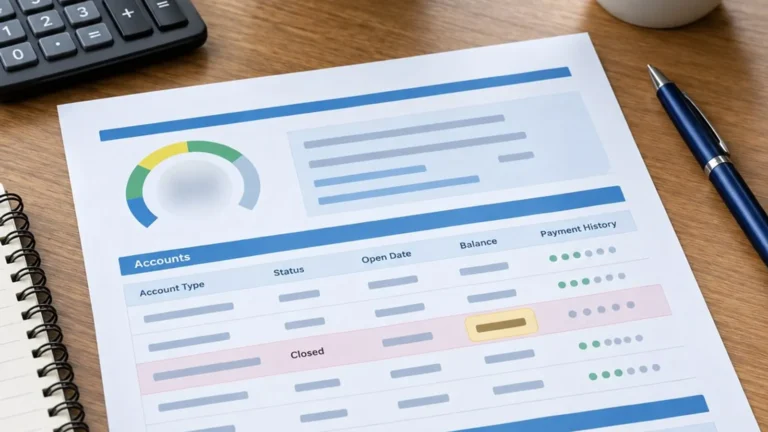
It can show:
- when an account was opened;
- the original loan amount or credit limit;
- payment history;
- whether the account was ever late;
- the current or final balance;
- the account status; and
- whether the account is open, closed, or paid.
A paid account can therefore remain useful historical information even after the debt itself is gone.
How long do paid-off loans stay on your credit report?
Yes. Paying off an auto loan, personal loan, student loan, mortgage, or other installment account does not automatically delete it.
A mortgage resolved after foreclosure needs a closer review of its payment history and final status. Our guide to foreclosure credit-report timelines explains why resolving a balance and removing the account’s negative history are separate questions.
If you are considering ending a credit-builder loan ahead of schedule, use the early payoff and payout checklist to compare the cash consequences separately from how a paid account remains on your reports.
If it was paid as agreed, the account may continue contributing to the age and history shown on your credit report while it remains there.
If your score changed after payoff, the reason is not necessarily that the account disappeared. A closed installment loan may remain on the report even though it is no longer active.
For auto debt specifically, read why your credit score can drop after paying off a car loan.
If the loan ended in repossession, the missed-payment history and any remaining sale balance need a separate review. See how long a repossession stays on your credit report for the relevant dates and a worked deficiency calculation.
Does paying off a credit card remove it from your report?
No. Paying a credit card to a $0 balance is not the same as closing the account, and neither action automatically removes the account from your credit report.
If the card remains open, the issuer can continue reporting the account. If the account is closed in good standing, it can remain as historical information.
For revolving accounts, also check whether the lower balance has been reported yet. If not, see why a credit report may not update immediately after a payment.
How long do late payments stay after the debt is paid?
Paying the balance does not normally reset the age of an accurate late payment or erase it immediately.
The CFPB states that negative information about account payment history can generally be reported for up to seven years. A late payment may therefore remain even after the account is paid and closed.
If the late payment is inaccurate, you can dispute it. If it is accurate, paying the debt does not create a right to have the history removed simply because the balance is now $0.
What about paid collections?
A collection account is different from an ordinary account closed in good standing.
Paying a collection can change the balance or status, but it does not necessarily cause the collection account to disappear from the report. How a paid collection affects a score also depends on the scoring model being used.
For the seven-year reporting issue, see whether paying a collection restarts the seven-year period.
What about paid charge-offs?
A charge-off means the creditor treated the debt as a loss for accounting purposes. It does not mean the consumer automatically stopped owing the debt.
If a charge-off is later paid or settled, the account should report the updated balance and status accurately, but the charge-off history does not necessarily vanish.
If the balance is already resolved and your goal is deletion, see how to remove a paid charge-off from your credit report, including when to dispute an error and when a goodwill request may be appropriate.
If a paid charge-off still shows money owed, read what to do when a paid charge-off still shows a balance.
Can a paid-off account help your credit?
If your main concern is what to do next, use our credit recovery checklist after paying off debt. It covers checking the payoff, correcting errors, and rebuilding while accurate older accounts remain on your report.
A positive closed account can still be part of your credit history while it remains on the report. FICO considers factors including payment history, length of credit history, amounts owed, credit mix, and new credit.
That does not mean every paid account will raise your score. Scores can change when an account closes because the active composition of your credit file changes.
The useful distinction is this:
- Reporting: whether the account remains on your credit report.
- Scoring: how a particular scoring model uses the information.
An account can remain on the report but affect the score differently after closure.
Why is paid-off debt still showing a balance?
If you recently paid off a credit card, use our guide to when a credit card payoff reaches your report and score. A delay in updating the balance is different from how long the account stays on your report.
If the account simply remains on the report, that can be normal. If it still shows a balance you no longer owe, investigate.
Start with these steps:
- Check the date you made the final payment.
- Check the account’s “date updated” or similar field.
- Confirm that the payment fully satisfied the amount due.
- Save the payoff confirmation or final statement.
- Contact the lender if a normal reporting cycle has passed.
- Dispute the balance if newer reporting is factually inaccurate.
Do not dispute an accurate account merely because you want it removed. Disputes are for inaccurate or incomplete information.
Can you remove a paid account from your credit report?
You can challenge information that is inaccurate, incomplete, or does not belong to you. But an accurate paid account can generally remain for the applicable reporting period.
The CFPB advises consumers to dispute specific errors with the credit reporting company and the company that furnished the information.
Use our guide to disputing credit report errors if you find a factual problem.
Does paying off debt restart the seven-year clock?
For negative credit-reporting periods tied to delinquency, simply paying the debt does not normally create a brand-new seven-year reporting period for the original delinquency.
Do not confuse the credit-reporting period with a state statute of limitations for a lawsuit. Those are different legal concepts, and state-law limitation periods can involve separate rules.
How to check whether a paid account is reporting correctly
Get your reports from AnnualCreditReport.com and compare the account across Equifax, Experian, and TransUnion.
Check:
- current balance;
- account status;
- date closed;
- date updated;
- payment history;
- past-due amount; and
- whether the account belongs to you.
If you need help understanding the fields, see how to read your credit report.
Frequently asked questions
How long does a paid loan stay on your credit report?
A loan closed in good standing can generally remain on a credit report for up to 10 years after closure. Negative information associated with the account can have different reporting periods.
Does paying off debt remove it from your credit report?
No. Paying the debt updates the balance and status, but the account history can remain.
Why is a paid account still on my credit report after seven years?
If the account was positive and closed in good standing, it may remain longer than seven years. The seven-year rule is commonly associated with negative information, not all credit history.
Should a paid-off account show a zero balance?
If the debt was fully paid, the current balance should generally update to $0 after the lender reports the payoff. If a recent report still shows an amount you do not owe, investigate the reporting.
Can paying off debt lower your credit score?
It can in some situations because closing an active account changes the information used by scoring models. A score change does not mean paying off the debt was financially harmful.
Bottom line
Paid-off debt can remain on your credit report long after the balance reaches $0. Positive accounts closed in good standing may remain for up to 10 years, while negative information generally follows its own reporting limits.
Focus on whether the account is accurate, not merely whether it is still visible. If the balance, status, or payment history is wrong, document the error and use the formal dispute process.
Explore related guides on credit reports and disputes.
Sources and methodology
- CFPB: How long information stays on a credit report
- Experian: How long negative and positive items can remain
- FICO: What is in a FICO Score
- AnnualCreditReport.com
Reviewed against current CFPB, Experian, and FICO consumer guidance. This article is educational and is not individualized financial or legal advice.