In this guide
- What should you check next?
- What does a charge-off mean on your credit report?
- What does a charge-off look like on a credit report?
- Decode your charge-off: tap each field
- What does your report show?
- Who owns the debt now?
- Do you still owe a charged-off debt?
- How can a charge-off affect your credit?
- How long can a charge-off stay on your credit report?
- What if the charge-off information is wrong?
- Should you pay a charged-off account?
- Use this six-step charge-off action plan
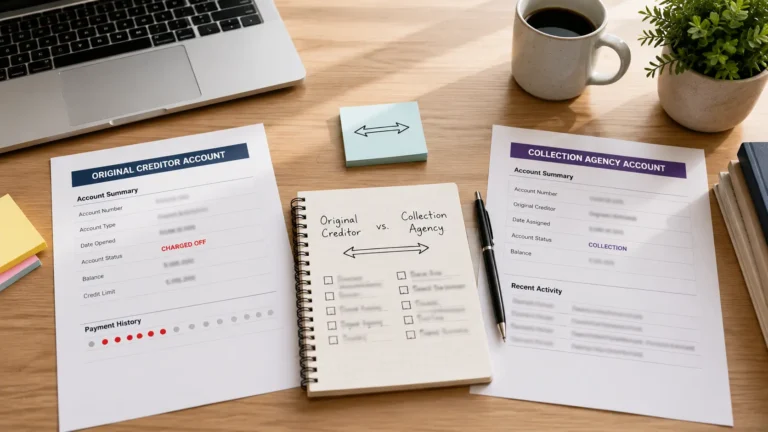
- How is a charge-off different from a collection?
- Charge-off: true or false?
- Your next 10 minutes
- Mistakes to avoid
- Your charge-off action checklist
- What to read next
- Frequently asked questions
- Bottom line
- Related negative credit report entries
- Sources
What does a charge-off mean? A charge-off on your credit report means a creditor treated a seriously delinquent account as a loss for accounting purposes. It does not usually mean the debt was forgiven, erased, or that you no longer owe it. The original creditor may still own the debt, or another company may now own or collect it.
If you are trying to understand how severe delinquency can lead into this status, see how a 120-day late account differs from a charge-off.
If you find a charge-off, do not automatically pay it and do not automatically dispute it. First verify whose account it is, who owns the debt now, what balance is being reported, whether the dates are accurate, and whether a separate collection account is connected to the same debt. Start with charge-off vs. collection, then check whether the debt was sold if ownership is unclear. If the debt is valid and you are deciding how to resolve it, compare settled charge-off vs. paid in full. For the full topic cluster, use the Charge-offs hub.
What should you check next?
Use your credit report and account records. This checker does not decide whether information is legally accurate; it helps you identify the next fact to verify.
What does a charge-off mean on your credit report?
A creditor generally charges off an account after a period of serious delinquency and records the unpaid account as a loss for accounting purposes. The account is no longer being treated like a normal account in good standing.
That accounting step does not automatically cancel a valid debt. The creditor may keep the debt, sell it, transfer it, or use another company to collect it. That is why the word charge-off alone is not enough to tell you who should receive payment today.
What does a charge-off look like on a credit report?
Look at the account details rather than only the label. Depending on the bureau, you may see fields for the creditor, balance, past-due amount, account status, payment history, date updated, and delinquency information. If the same charge-off keeps receiving a new update date, see why a charge-off can be reported every month and which fields should stay consistent.

Decode your charge-off: tap each field
These are the fields that usually tell you more than the word charge-off by itself.
Balance
Shows the amount currently reported on that tradeline. Compare it with statements, payment records, or settlement documents. A $0 balance can mean paid, settled, sold, or transferred—it does not by itself explain which one happened.
Account status
Look for wording such as charged off, paid charge-off, settled, closed, or transferred. The status should fit what actually happened to the account.
Date Updated
This usually tells you when the account information was most recently reported or refreshed. A recent update date is not the same thing as a new date of first delinquency.
Date of First Delinquency
This is the key timeline field for the continuous delinquency that led to the charge-off. If it appears newer than on an older report, save both reports and investigate the difference.
Creditor / owner
The company reporting the original account is not always the company that owns or collects the debt today. Check for sale, transfer, or collection information before paying anyone.
Collection account
A separate collection or debt-buyer tradeline can appear in connection with the same underlying debt. Compare names, balances, account identifiers, and ownership before assuming duplicate reporting.
What does your report show?
$2,400 balance
The original creditor may still be reporting an amount owed. Verify the number and confirm who owns the debt before sending payment.
$0 balance
The debt may have been paid, settled, sold, or transferred. Look for a related collection or debt-buyer account and review your records.
Paid charge-off
The balance may be resolved while the historical charge-off remains. Confirm that the current balance and status match your payoff records.
Charge-off + collection
Both can appear in connection with the same underlying debt. Compare ownership and balances to understand which company currently reports the amount owed.
The original creditor may still be reporting an amount owed. Verify the amount against your records and confirm whether that company still owns the debt before sending payment. If the amount keeps changing, see why your charge-off balance may keep increasing and how to reconcile the difference.
A $0 balance can mean the debt was paid, settled, sold, or transferred. It does not automatically mean the original charge-off disappears. Check for a collection or debt-buyer account and review who owns the debt now.
An original charge-off and a separate collection account can both appear in connection with the same underlying debt. That does not automatically mean you owe the debt twice. Compare ownership, balances, account numbers, and dates. See charge-off vs. collection.
The current balance and status should accurately reflect what happened. If you paid or settled the account and it still shows money currently owed, see what to do when a paid charge-off still shows a balance. If the reporting is accurate but you are wondering whether the charge-off can be deleted, see whether a paid charge-off can be removed.
Who owns the debt now?
Answer three questions. This does not establish legal ownership; it tells you what to verify before paying anyone.
Do you still owe a charged-off debt?
Often, yes. A charge-off does not usually forgive a valid debt. What changes is how the creditor accounts for it and, sometimes, who owns or collects it.
| What you see | What to verify |
|---|---|
| Charge-off with an unpaid balance | Whether the original creditor still owns the debt and whether the balance is accurate |
| Charge-off with $0 balance | Whether it was paid, settled, sold, or transferred |
| Charge-off plus collection | Who owns the debt now and which account reports the current balance |
| Account you do not recognize | Ownership, identity information, and whether the entry is actually yours |
How can a charge-off affect your credit?
A charge-off is serious negative credit information and typically follows months of missed payments. There is no universal number of points that a charge-off will cost because the effect depends on the rest of the credit file and the scoring model being used.
By the time the account reaches charge-off status, earlier late payments may already have affected the score. Do not assume that paying the charge-off will produce a particular point increase. Instead, first verify that the balance and status update correctly after any resolution. For the score-specific impact, see how paying a charge-off may affect your credit score.
How long can a charge-off stay on your credit report?
Under federal credit-reporting law, charge-offs generally fall under a seven-year reporting period tied to the delinquency that immediately preceded the charge-off, with the statutory 180-day calculation. A later payment, sale, or account update does not by itself create a new reporting period.
For the timeline and the date to compare on your reports, use how long a charge-off stays on your credit report. If your concern is that the same charge-off keeps receiving new monthly updates, see whether a charge-off can be reported every month and which fields actually matter.
What if the charge-off information is wrong?
Dispute the specific inaccurate field, not the account merely because it is negative. Useful errors to check include:
- the account is not yours;
- the balance does not match your records;
- the status does not reflect a payment or settlement;
- the delinquency dates appear inconsistent with older reports;
- the same tradeline appears to be duplicated;
- a paid or settled account still reports an incorrect current balance.
Before disputing, save a copy of the report and the documents that support the correction you are requesting. For the process, see how to dispute credit-report errors.
Should you pay a charged-off account?
Do not send money until you have verified the debt, amount, and current owner or collector. If a debt collector is involved, review the validation information it provides and compare it with your own records.
If the debt is older, the statute of limitations for a lawsuit is a separate issue from the credit-reporting period and can vary by state and type of debt. In some situations, a payment or acknowledgment can affect the limitations period, so consider qualified legal advice before acting on an old debt if you are unsure about the rule that applies.
Use this six-step charge-off action plan
- Verify the account. Make sure it belongs to you.
- Read the actual fields. Check balance, status, payment history, and important dates.
- Identify who owns or collects the debt now.
- Compare the report with your records. Save statements, notices, settlement agreements, and payment confirmations.
- Separate an actual error from accurate negative history.
- Take the action that matches the problem. Verify, dispute, pay, settle, or monitor based on documented facts.

How is a charge-off different from a collection?
A charge-off usually describes the original creditor’s treatment of the delinquent account. A collection account is separate reporting from a collector or debt buyer if that company reports the debt.

Charge-off: true or false?
Use this 60-second check to catch the most common misunderstandings.
Your next 10 minutes
- Open all three credit reports. Use AnnualCreditReport.com.
- Find the charge-off on each report. Write down the balance, status, Date Updated, delinquency date, and reporting company.
- Look for a separate collection or debt-buyer account.
- Compare the report with your own records. Save statements, notices, payment confirmations, and settlement documents.
- Save a PDF or screenshot. Keep a dated copy before anything changes.
- Choose the next path. Verify ownership, document an error, review payment options, or monitor the account based on what you found.
Mistakes to avoid
- Assuming “charged off” means forgiven.
- Paying before verifying who owns or collects the debt.
- Disputing accurate negative information only because it hurts your credit.
- Assuming payment automatically deletes the charge-off.
- Ignoring a wrong balance, status, or delinquency date.
- Accepting a settlement without keeping the terms in writing.
- Throwing away payment confirmations and final statements.
Your charge-off action checklist
Before you pay, dispute, settle, or contact a collector, use this checklist to make sure you have verified the account, balance, status, ownership, supporting documents, and what changed on your credit reports.

What to read next
If you found a charge-off on your credit report, the right next step depends on what the account is doing now. Use these guides to keep moving in the right direction.
- If you want the deeper comparison, read charge-off vs. collection.
- If the debt was sold or transferred, review charged-off account vs. sold account.
- If the charge-off still shows a balance after payment, see paid charge-off still showing a balance.
- If you think the reporting is wrong, learn how to dispute errors on your credit report.
- If the debt went to collections, read how to rebuild credit after collections.
Frequently asked questions
Does a charge-off mean I no longer owe the debt?
No. A charge-off is an accounting and reporting status; it does not automatically forgive or erase a valid debt.
Can a charge-off and a collection both appear on my credit reports?
Yes. The original creditor may report the charged-off account while a collection agency or debt buyer reports a separate collection related to the same underlying debt. Compare ownership, balances, dates, and status before assuming either entry is wrong.
Should I pay a charge-off immediately?
First verify that the account is yours, who currently owns or collects the debt, the reported balance, and whether the information is accurate. Payment can change the balance or status, but it does not automatically delete accurate negative history.
Can I dispute a charge-off just because it hurts my credit?
No. A dispute should identify information you believe is inaccurate, incomplete, duplicated, too old to report, or not yours.
Bottom line
A charge-off means the creditor treated a seriously delinquent account as a loss; it does not automatically erase a valid debt. Your next step depends on the facts shown on the report: whether the account is yours, who owns the debt now, what balance is reported, whether a collection also appears, and whether the account information is accurate.
Start with verification. Then act on the actual problem—not on the word charge-off alone.
Related negative credit report entries
For related questions, these detailed guides explain the next steps:
Sources
Sources checked October 5, 2026.
- Consumer Financial Protection Bureau — How long information stays on a credit report
- Consumer Financial Protection Bureau — How to dispute an error
- Consumer Financial Protection Bureau — Removing accurate negative information
- Consumer Financial Protection Bureau — Debt validation information
- Federal Trade Commission — Debt collection FAQs
- 15 U.S.C. § 1681c — Credit-reporting periods
- AnnualCreditReport.com — Federally authorized credit reports
Educational note: This article provides general U.S. credit-reporting and debt information and is not individualized legal, financial, debt-settlement, or credit-repair advice.