In this guide
- Download the free debt validation letter template
- Before you write: check the notice and the deadline
- Debt validation letter template
- What to include in your letter
- Example: dispute the missing payment, not an invented problem
- Where to send a debt validation letter
- Keep proof of what you sent and when
- What happens after the collector receives your request?
- What if 30 days have already passed?
- A validation request does not replace a court response
- Frequently asked questions
- Other debt collection situations
- Sources and review
A debt validation letter is a written request you send to a debt collector to dispute a collection claim, ask for verification, or request the original creditor’s name and address. Identify the collector’s reference number, state exactly what you dispute, and send the request through the verified address or accepted electronic channel. Keep a copy and proof of sending. For the federal collection-pause protections discussed below, act within the validation period shown in the notice.
This guide includes a debt validation letter template, instructions for adapting it, and a mailing checklist. Here, “letter” means your response to the collector. The validation notice is the information the collector provides to you. Neither document automatically cancels a debt or removes a collection from a credit report.
Download the free debt validation letter template
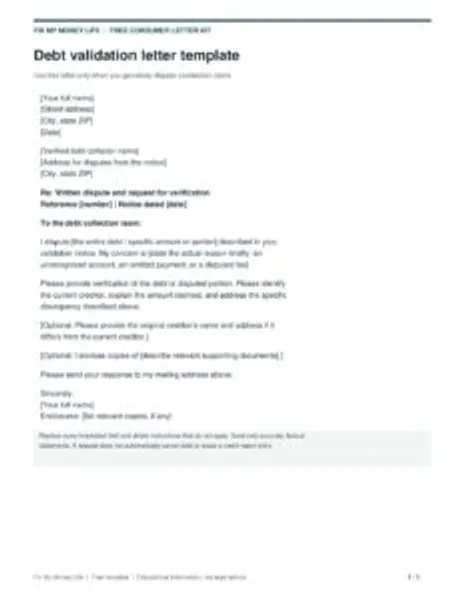
Choose your format: printable PDF or editable Word (.docx). Both include a dispute-letter sample, a separate original-creditor information request, and a mailing checklist with a place to record your submission details. Edit the Word file before sending, or print the PDF and fill it in by hand.
Download printable PDF
Download editable Word (.docx)
Want to adapt the wording on this page? Go to the copyable letter below and replace the bracketed fields before you send anything.
Which letter do you need?
| Your situation | Use this | Next step |
|---|---|---|
| You genuinely dispute the debt, a payment, or a fee. | Debt dispute and verification request (PDF page 1) | Describe the exact issue and include copies of supporting records if useful. |
| You only want to know who the original creditor was. | Original-creditor information request (PDF page 2) | Ask for the name and address without claiming the amount is wrong. |
| Your credit report contains an inaccurate collection entry. | A separate credit-report dispute | Read debt validation vs. a credit-report dispute to choose the correct recipient. |
These are original educational samples, not official government forms or personal legal advice. They do not erase a debt or pause collection automatically; relevant protections depend on the facts, the collector, and the timing of the request.
Before you write: check the notice and the deadline
Find the collector’s name, the creditor, the reference number, the amount claimed and the response deadline. The CFPB explains the information a validation notice generally must contain, including an itemization and the end date for the dispute period.
Under Regulation F’s definition of the validation period, the period ends 30 days after you receive, or are assumed to receive, the validation information. The notice states an end date. Do not simply count 30 days from the date printed at the top of the letter. Save the envelope or electronic delivery record, and raise any apparent date problem promptly without postponing your response.
These rules concern covered debt collectors collecting consumer debts. The CFPB’s explanation of the FDCPA notes that it generally does not cover an original creditor collecting its own debt and does not cover business debts. State laws may provide additional protections.
Debt validation letter template
Use this original template for a collection you genuinely dispute. Replace every bracketed field, delete instructions that do not apply, and describe only facts you know. If you want only the original creditor’s name and address, use the shorter request below instead of asserting a dispute you do not have.
[Your name]
[Your mailing address]
[City, state and ZIP code]
[Date]
[Debt collector’s name]
[Address for disputes shown in the verified notice]
Re: Request for verification — reference [number], notice dated [date]
To the debt collection team:
I dispute [the entire debt / the following amount or part of the debt: describe it] identified in your notice. [Briefly explain what you know, such as an unfamiliar account, a payment missing from the amount claimed, or an incorrect balance.]
Please provide verification of the debt or disputed portion. Please explain the amount you are claiming, identify the creditor to whom you say the debt is owed, and provide information that addresses the specific issue described above.
[If wanted: Please also provide the name and address of the original creditor if it is different from the current creditor.]
[If applicable: I am enclosing copies of the following records supporting my dispute: list each document and explain its relevance.]
Please send your response to the mailing address above.
[Your name]
Keep the reference number the collector uses; do not invent an account number. A clear request is more useful than a long list of legal phrases copied from an unfamiliar form. You can also compare the different sample-letter options provided by the CFPB before choosing the request that matches your situation.
If you only need the original creditor’s information
Use the same identifying details and address, then make the request specific:
Please provide the name and address of the original creditor for the debt identified by reference [number] in your notice dated [date], if that creditor is different from the current creditor.
You can request this information without pretending the entire balance is wrong. Keep a copy and record when you sent it.
What to include in your letter
| Include | Make it specific |
|---|---|
| Your name and return address | Use information that lets the verified collector identify the correspondence and reply. |
| The collector’s reference and notice date | Match the request to the actual collection notice. |
| The debt or portion disputed | State whether the issue is ownership, the amount, a payment, or another identified fact. |
| Your request | Ask for verification, an explanation of the discrepancy, and original-creditor details if needed. |
| Relevant supporting copies | Label each record and connect it to the issue in one sentence. |
You do not need to turn the letter into a complete account history. For a missing payment, identify the payment date, amount and the record showing it. For an unfamiliar debt, say that you do not recognize the account and ask for information that identifies the obligation and why it is attributed to you.
The FTC’s debt-collection guidance recommends reviewing the validation information and requesting written verification when you do not owe or recognize the claim. Do not state that a debt is identity theft, already paid, or not yours unless that accurately describes your concern.
Avoid including bank-login details, payment-card information or unrelated financial records. If additional identity verification is requested, confirm the recipient and use its secure process. Do not send sensitive information to an unverified email address just because it appears in an urgent message.
Example: dispute the missing payment, not an invented problem
Hypothetical example: Jordan receives a collection notice listing a $1,200 starting balance and $40 in fees, for a total of $1,240. Jordan has a receipt for a $200 payment made after the itemization date that does not appear in the notice.
If the starting balance and fees are otherwise correct and that payment applies to this account, the reconciliation would be:
$1,200 + $40 − $200 = $1,040.
The letter could say: “I dispute the amount shown in your notice because it does not appear to include my $200 payment dated [date]. Please verify the balance and explain how that payment was applied. A copy of my payment confirmation is enclosed.”
That wording identifies a checkable difference. It does not claim the whole account belongs to someone else or assume the fee is valid simply because it appears in the notice. If Jordan also disputes the $40 fee, the letter should identify that separate issue and request its basis.
Keep the evidence focused. A receipt for a different account, or a payment made after the notice’s stated balance date, might require a different explanation. Compare account identifiers and dates before deciding what correction to request.
Where to send a debt validation letter
Send it to the verified debt collector handling the claim, using the dispute or response address in its notice. There is no single nationwide address for debt validation letters. The correct destination depends on the collector and its instructions.
Do not assume that a payment-processing address is also the right address for disputes. If the notice is unclear, independently contact the company to confirm the response address. Our guide to verifying a debt collector explains how to check the company before sending documents.
Keep these recipients separate:
- The collector: receives your collection dispute or original-creditor request.
- A credit bureau: handles a separate dispute about information in its report.
- The original creditor: may help locate records, but contacting it does not automatically submit your request to the collector.
For a reporting problem, see debt validation versus a credit-report dispute. Sending this template to a bureau does not turn it into a properly directed validation request.
Can you send a debt validation letter by email or online?
Regulation F’s official interpretation recognizes a written request sent through an electronic channel the collector accepts for consumer communications, such as an email address or portal. It also recognizes mailing a letter or returning the notice’s response form.
Use the collector’s verified instructions. An outgoing email alone does not establish that an arbitrary address was an accepted channel. Save the exact submission, attachments, confirmation number and timestamp. If a portal limits the text, check whether you can upload the complete request and retain what was submitted.
Keep proof of what you sent and when
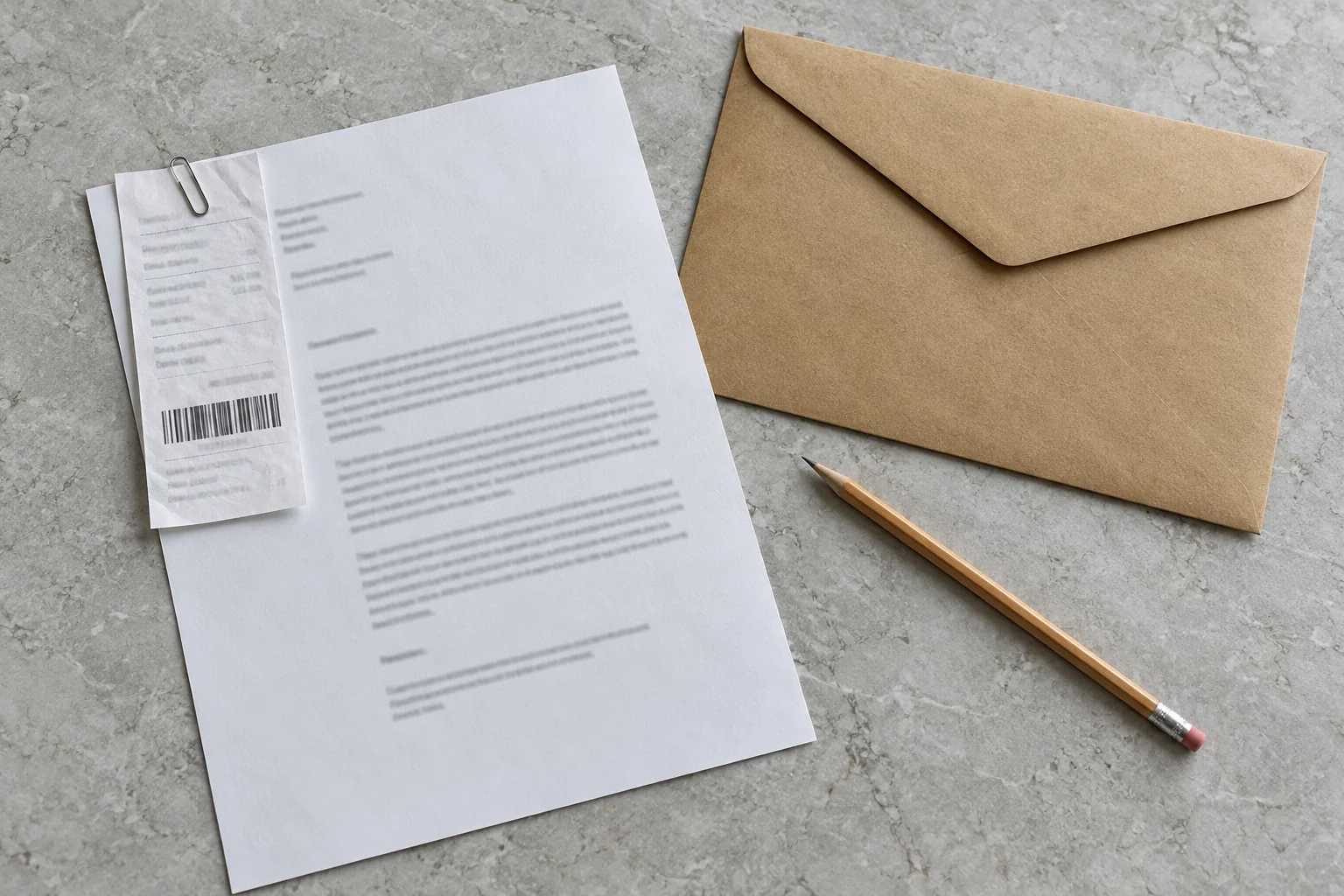
The CFPB recommends keeping records and considering certified mail with a return receipt. Keep original supporting documents and send copies. For an electronic request, retain the equivalent submission records.
Before mailing, save one complete copy of the packet: the final letter and every attachment. A delivery receipt helps establish delivery, but does not by itself show which pages were inside the envelope. Keep both kinds of evidence.
- Check the collector’s name, address and reference number against the notice.
- Remove unused template options and confirm that every statement is accurate.
- Save the signed or completed letter and the attachment copies.
- Send promptly within the applicable period and retain the mailing or submission record.
- Save delivery confirmation separately when it becomes available.
- Log the response and compare it with your original request.
If mail is returned or a portal submission fails, keep the failure record, verify the destination and address the problem promptly. Do not assume a failed delivery automatically extends your deadline.
What happens after the collector receives your request?
Under Regulation F § 1006.38, receiving a written dispute submitted within the validation period generally requires the collector to pause collection of the debt or disputed portion until it sends verification or a copy of a judgment. A timely written original-creditor request has a separate pause until the required response is sent. The rule also addresses duplicative disputes.
Read the response against the problem you identified. Does it address the missing payment, explain the amount, identify the account, or provide the requested original-creditor information? Receiving a packet is a reason to review it, not a reason to assume every question was answered.
If the information resolves the concern and you are considering payment, first confirm whether to pay the collector or the original creditor. A request for verification is separate from negotiating an amount or authorizing a payment.
If the response leaves a specific discrepancy, identify what remains unresolved and preserve any new supporting evidence. Repeatedly sending the same template without addressing the earlier response is unlikely to make the issue clearer.
Does the collector have to respond within 30 days?
Do not confuse your validation period with a universal 30-day deadline for the collector to answer. The collection-pause rule above ties renewed collection to the required response; it does not promise automatic cancellation after 30 days of silence. Writing your own deadline into a letter does not create a deletion right.
What if 30 days have already passed?
You can still ask for information or explain a genuine error. The CFPB’s guidance on responding to collectors encourages asking for needed information even after that period. However, do not assume a late request triggers the same federal collection pause as a timely written request.
Missing the validation period is not, by itself, a legal admission that you owe the debt. It also does not make ignoring the account a good strategy. Keep the notice, explain the specific concern, and distinguish that request from any separate credit-report or court deadline.
A validation request does not replace a court response
If you receive a summons or lawsuit, a letter to the collector is not an answer filed with the court. The FTC advises responding to a debt-collection lawsuit by the required deadline, even if you believe the debt is wrong. Seek legal help promptly for that situation.
For an old debt, avoid casually adding promises to pay or admissions of liability to a template. The CFPB explains that payments or acknowledgments can affect limitation periods in some states. Whether a particular statement has that effect depends on the applicable law and facts. A generic sentence claiming to “reserve all rights” is not a substitute for advice about an old debt.
Frequently asked questions
Is a debt verification letter different from a debt validation letter?
People use these terms inconsistently. Focus on who is sending the document and what it requests. The collector provides validation information; you can send a written dispute requesting verification. State the request clearly instead of relying on the document’s title.
Will a debt validation letter remove a collection from my credit report?
It does not automatically remove the entry. If the report contains inaccurate information, identify the reporting error and follow the credit-report dispute process. Resolving a collection question and correcting a bureau entry can require separate follow-up.
Do I have to use a paid template or hire a company?
You can prepare your own accurate request or use an appropriate official sample. Paying for impressive legal wording does not change the underlying facts, the recipient or the deadline. Individual legal help may be appropriate when a lawsuit, an old debt or an unclear legal issue is involved.
Should I send the same letter to all three credit bureaus?
This template is addressed to a debt collector. Send a separate, specific reporting dispute to each affected bureau if its report contains an error. Do not send sensitive documents to extra recipients merely because a generic checklist says to mail everyone.
If the collector is also contacting your workplace, a validation request alone does not communicate your workplace restrictions. Use the separate workplace-contact letter and employer privacy guide to give accurate contact instructions while you address the claim.
Explore related guides on collections.
Other debt collection situations
For related questions, these detailed guides explain the next steps:
Sources and review
Sources reviewed October 11, 2026. This guide uses the linked CFPB regulations and consumer guidance and FTC materials. The letter template, mailing checklist and numerical example were prepared for this guide. The example is hypothetical. General educational information for U.S. readers; not individualized financial or legal advice.