In this guide
- Does your credit score update daily, weekly, or monthly?
- When do credit scores update?
- Why your score may not change right after you make a payment
- Is once a month a good rule of thumb?
- A realistic credit score update timeline
- Why the score in your app can look “stuck”
- Why your Experian, Equifax, and TransUnion scores may update differently
- How to find the last update date on your credit report
- What if only one credit bureau updates?
- When should you check after a specific credit event?
- Should you wait, verify, or investigate?
- Can you make your credit score update faster?
- When should you contact the creditor?
- Credit score update checklist
- Frequently asked questions
- Your next step
- Related guides
- Sources
Your credit score can change whenever the information in your credit report changes, potentially more than once a month. Most lenders report account updates roughly monthly, on their own schedules. The score you see in an app may refresh daily, weekly, or monthly. There is no single day when everyone’s credit score updates. For the separate question of lender-to-bureau timing, see how often credit reports update.
To check whether a recent payment has reached your score, compare the reported balance, the account’s reporting date, and the score’s calculation date. A payment appearing in your bank app does not mean it has reached your credit report yet. If you are asking how long broader credit improvement can take, use the credit-score recovery timeline.
Does your credit score update daily, weekly, or monthly?
These schedules describe different things. A daily score refresh does not mean your card issuer sends a new balance every day.
| What is updating? | Usual timing | What to check |
|---|---|---|
| Your lender’s account information | Commonly once per monthly reporting cycle; dates vary by account | The balance, status, and date reported for that account |
| Your credit report | As information is received and processed; different accounts can update on different days | The relevant account entry at the bureau used for your score |
| A newly calculated credit score | Uses the report available when that score is requested | The scoring model, bureau, and calculation date |
| The number displayed in an app | The provider’s refresh schedule, which can be daily, weekly, or monthly | The score’s own date and the current terms of your specific service |
FICO explains when a score is calculated; Experian explains creditors’ separate reporting schedules. These are different from how often an app retrieves and displays a score.
When do credit scores update?
Your score can change whenever the credit report data used to calculate it changes. In practice, that can mean several score changes in a month if multiple accounts report at different times.
| What changed? | When it may show up | Why timing varies |
|---|---|---|
| Credit card balance | Often after the issuer’s regular monthly reporting cycle | Each issuer has its own reporting date, often tied to the billing cycle |
| Loan payment or payoff | Often within the next reporting cycle | The lender has to send the updated balance or status to the bureau first |
| Credit report dispute result | After the bureau updates the disputed item | The score cannot reflect the change until the underlying report changes |
| New account or inquiry | After it is added to the report | Different lenders and bureaus may receive information at different times |
| Collection or charge-off update | After the furnisher sends new account information | Collectors and creditors may have different reporting schedules |
An updated report does not guarantee a different score. A new calculation can return the same number, because a scoring model weighs the entire credit file.
Why your score may not change right after you make a payment
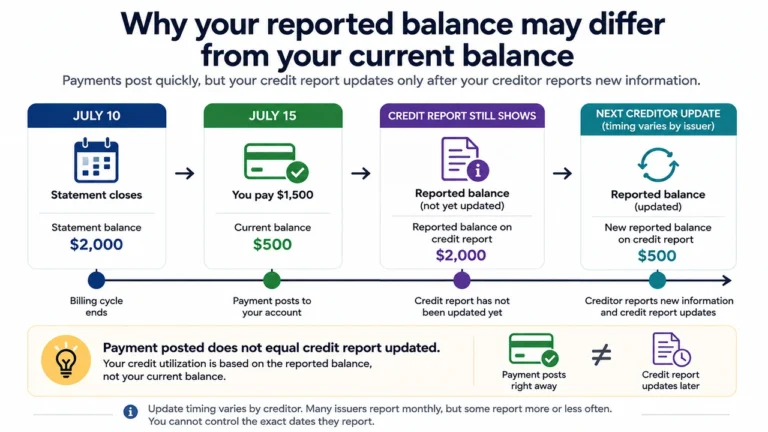
Paying a balance today does not automatically change the balance in your credit reports today. Your lender first records the payment, then reports updated account data to one or more credit bureaus. Only after that information is incorporated into the report can a score calculation use it.
This is especially important with credit cards. The balance used in a score is generally the balance that was reported to the credit bureau, not necessarily the balance currently visible in your bank or card app. If you are trying to understand the timing, read credit card statement date vs. due date.
If you recently paid a card down or paid it off, see how long after paying off a credit card your score may update.

Is once a month a good rule of thumb?
It is a useful rule of thumb for the account data, not a promise about the score itself. Many creditors report account information monthly, but different accounts can report on different days. That means your reports can change several times during a month.
For example, imagine you have three credit cards:
- Card A reports on the 4th.
- Card B reports on the 15th.
- Card C reports on the 27th.
If all three balances change, the data behind your score could change three separate times during the month. A score pulled after each update could therefore be different.
A realistic credit score update timeline
Illustrative example, not a promised timeline: Suppose you pay a credit card down from $2,400 to $300 on September 3. The payment posts to your card account on September 4, but your credit report still shows the old $2,400 balance and a last-updated date from August 28.
At that point, there is nothing for a newer score to react to yet because the report still contains the old balance. Now suppose the issuer sends updated information on September 12 and your report shows the $300 balance on September 13. A score calculated from that newer report can now use the lower balance.
| Date | What happened | What it means |
|---|---|---|
| September 3 | You make the payment | Your bank account changes, but the credit report may still be old |
| September 4 | The card issuer posts the payment | Your card account is current, but the bureau may not have new data yet |
| September 13 | The credit report shows the lower balance | A score based on that report can now reflect the updated balance |
| After September 13 | Your score provider refreshes or a lender pulls a new score | You can compare the newer score with the updated report |
Compare the same bureau and scoring model before judging the result. If a report update and a score have the same calendar date, the dates alone do not prove which happened first. Confirm that the lower balance is present in the report used for that score, or check the provider’s next refresh.
Why the score in your app can look “stuck”
If you are considering a paid alert service just to check for updates, compare it with free reports first: free vs. paid credit monitoring explains what a subscription can and cannot add.
- The lender’s reporting schedule. The creditor decides when it sends account data.
- The credit bureau’s file update. The bureau has to receive and incorporate that data.
- The app’s refresh schedule. A monitoring service may refresh your report or score daily, weekly, monthly, or only when it detects a change.
So a lender may already have reported a new balance while the score shown in one app still reflects an earlier snapshot.
If your score has not moved even though several accounts have updated, first compare the score date, bureau, and scoring model. A newer report does not necessarily mean the score shown in every app has refreshed at the same time.
Why your Experian, Equifax, and TransUnion scores may update differently
The three major credit bureaus do not necessarily receive identical information on the same day. A lender may report to all three, only some of them, or report at slightly different times. The underlying reports can therefore differ.
Scores can also differ because a lender or app may use a different scoring model or a different version of the same model. So seeing two different numbers does not automatically mean one is wrong.
How to find the last update date on your credit report
When you are waiting for a score change, look at the account entry on the credit report rather than the score first. You can review your reports from Experian, Equifax, and TransUnion through AnnualCreditReport.com, the federally authorized source for free credit reports. The exact label varies by bureau, but you are looking for the most recent account update or reporting date.
- Reported balance. Does it match the newer balance you expected?
- Account status. Does it show current, paid, closed, or another status that matches reality?
- Payment status. Is the account being reported as on time?
- Date updated or date reported. Is that date after the payment or other event you are waiting on?
If the report still shows the old balance and an old reporting date, the score is not the problem yet. You are still waiting for the underlying credit-report data to change.
What if only one credit bureau updates?
Do not assume something is wrong just because Experian, Equifax, and TransUnion do not change on the same day. First compare the account entry on each report separately.
For example, if Experian already shows a $300 balance but TransUnion still shows $2,400, a score based on Experian data may update before a score based on TransUnion data. The next step is to confirm whether the lender reports to both bureaus and whether the older report simply has not received the next update yet.
If one bureau continues to show information that appears inaccurate after the creditor says it has already furnished the correct data, save the account statement, payment confirmation, and any written response from the creditor before deciding whether a credit-report dispute is appropriate.
When should you check after a specific credit event?
After paying down a credit card
First check whether the new balance has appeared on your credit report. If the old balance is still there, the score has not yet had a chance to reflect the new utilization. See how credit utilization affects your score.
After paying off a loan or other debt
How long does it take for your credit score to update after paying off debt? The lender first has to report the new balance or paid/closed status, and the bureau must incorporate it. Look for the lender’s next reporting cycle, then a score calculated from the updated report. Monthly reporting is a useful expectation, not a guaranteed deadline measured from the day you paid.
First verify that the credit report shows the new $0 balance or updated status. Then compare a score calculated after that report update. Do not assume the score must increase immediately: paying off an installment loan can change several scoring factors at the same time.
If the report itself still has not changed, see why your credit report may not be updating. If your score fell after a payoff, see why a credit score can drop after paying off debt. If you want to know how long the paid account can remain visible, read how long paid-off debt stays on your credit report.
After a credit report dispute
The relevant event is the credit bureau changing the report, not the day you submitted the dispute. Once the report is corrected, a newly calculated score can use the corrected information.
For a more specific timeline, see how long after a dispute a credit score can update.
After a collection is paid or removed
First verify that the collection’s balance or status has actually changed on the report. A payment alone does not guarantee a specific score increase, and different scoring models can treat collection accounts differently.
Should you wait, verify, or investigate?
| What you see | What it usually means | What to do next |
|---|---|---|
| The report still shows the old balance and an old update date | The new information may not have been furnished yet | Wait. Check again after the next account update |
| The report has a newer date but still shows an unexpected balance | There may be new charges, interest, fees, a returned payment, or incorrect reporting | Verify. Compare the report with your statement and ask the creditor what it most recently furnished |
| The report is correct but the score shown is older than the report update | The score provider may not have refreshed yet | Wait for a newer score. Compare the score date with the report-update date |
| The report is correct and the score is newer, but the number did not change as expected | Other parts of the credit file or the scoring model may be offsetting the change | Investigate. Check utilization, new accounts, inquiries, late payments, and whether you are comparing the same score model |
Can you make your credit score update faster?
Repeatedly opening an app does not make a lender report sooner. Ask the creditor when it last sent your balance and when it expects to report again. An earlier update is not guaranteed.
If you are applying for a mortgage and a documented payment or correction has not appeared, ask your mortgage lender whether rapid rescoring is appropriate. TransUnion explains that the lender must request this service; you cannot order it yourself. It can shorten the reporting wait, but it cannot erase accurate negative history or guarantee a higher score.
When should you contact the creditor?
Contact the creditor when the report appears to contain newer information but the account details still do not match your records. Do not start by asking for a score change; ask what account information the creditor actually furnished.
“My credit report shows a balance of $2,400 with an update date of September 13, but my statement shows a $300 balance after a payment posted on September 4. Can you confirm the balance and status your company most recently reported to the credit bureaus, and the date it was sent?”
Save the representative’s response, any case number, and written confirmation. You do not need to wait for another monthly cycle to dispute an actual error. The CFPB explains how to dispute inaccurate information with the credit reporting company and the furnisher. A routine reporting delay and a factually incorrect entry call for different responses.
Credit score update checklist
- Confirm the payment or account change actually posted.
- Check the reported balance on the relevant credit report.
- Check the report’s latest update or reporting date.
- Compare Experian, Equifax, and TransUnion separately when the issue matters.
- Confirm the score date is later than the report update you are waiting on.
- Confirm you are comparing the same bureau and, when possible, the same scoring model.
- Look for another change that may offset the expected improvement, such as higher utilization on another card, a new inquiry, a new account, or a late payment.
- If the report appears inaccurate, gather statements, payment records, and creditor correspondence before taking the next step.

If you are unsure what actually changed, start with how to read your credit report step by step.
Frequently asked questions
What day of the month does your credit score update?
There is no universal update day, including the first of the month. Check each account’s reporting date and your score provider’s refresh schedule. Your payment due date is not necessarily either of those dates.
Does a daily score update mean my score must change every day?
No. A refreshed score can stay the same. The provider may have retrieved newer information without a change large enough to alter that score, or the relevant account may still show its previous reported balance.
Does your credit score update every 30 days?
Not on a fixed 30-day schedule. Many lenders report account information about once a month, but each account can have a different reporting date. A score can change whenever the underlying report data changes and a new score is calculated.
Can your credit score change more than once a month?
Yes. If several creditors report updates on different days, the data in your report can change several times in the same month.
Why did my balance update but my score stay the same?
A score is based on the entire credit profile, not one balance alone. The change may have been too small to move that particular scoring model, or another change in the report may have offset it.
Why does one credit app update faster than another?
Apps can use different bureaus, scoring models, and refresh schedules. The score shown in one service may therefore update before another.
Does checking my own score make it update?
No. Checking your own credit report or score does not force lenders to send new information to the credit bureaus, and checking your own credit does not hurt your credit scores. Whether you see a newer score depends on the provider’s refresh schedule and whether the underlying credit-report data has changed.
Your next step
There is no universal credit-score update day. The practical sequence is: a lender or other furnisher updates your credit report, the bureau incorporates the new information, and a score calculated afterward can reflect that change. For many accounts, reporting happens roughly monthly, but the exact timing depends on the creditor, bureau, and score service.
For a concrete example of why two score apps can differ, see Credit Karma vs. Experian: bureau data and score models.
Related guides
- Credit score guides — understand score changes, utilization, reporting, and recovery.
- Credit reports & disputes — check reporting details and what to do when information is wrong.
- Why is my credit report not updating? — use this when the underlying report still shows old information.
- Why did my credit score go up when nothing changed? — see how routine report updates and account aging can move a score.
If two services show different numbers, compare their model, bureau, and calculation date using our guide to different scores across apps and bureaus. A newer display and a different model are separate reasons a comparison may not be like for like.
Sources
- TransUnion — Credit report updates and rapid rescoring
- Consumer Financial Protection Bureau — How to dispute a credit report error
- Consumer Financial Protection Bureau — What is a credit report?
- Consumer Financial Protection Bureau — Does requesting my credit report hurt my credit score?
- Experian — How often is a credit report updated?
- myFICO — Do FICO Scores change that much over time?
This article is for educational purposes and does not provide legal, credit-repair, or financial advice. Credit-score results depend on the scoring model and the information in your individual credit reports.