In this guide
- How to dispute a duplicate account on your credit report
- When two accounts are not actually duplicates
- Compare the two tradelines before you dispute
- Use this duplicate-account decision tree
- Example: one loan reported as two active accounts
- What documents help prove a duplicate?
- Dispute the duplicate with the bureau and the furnisher
- Online or by mail?
- How long does a duplicate-account dispute take?
- What to verify after the dispute
- Will removing a duplicate raise your credit score?
- Special cases that need a different approach
- Duplicate-account worksheet
- Frequently asked questions
- Bottom line
- Sources
- Financial and legal disclaimer
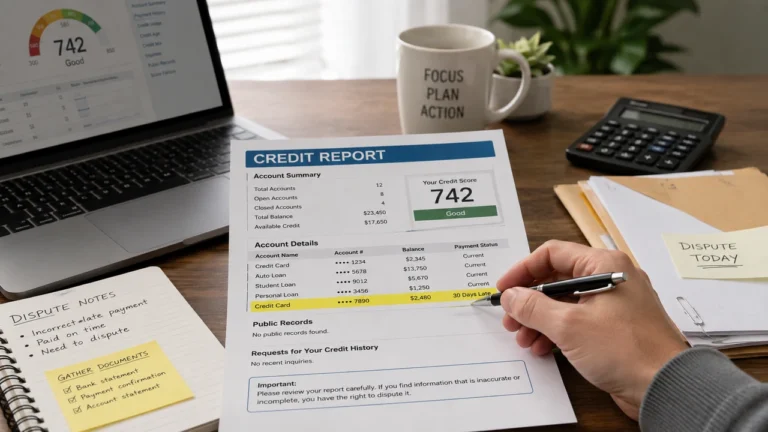
A duplicate account on your credit report is an error when one account is listed more than once as separate obligations. Compare both entries, identify the incorrect account or fields, then dispute the error with each credit bureau showing it and the company that supplied the information. You can do this yourself for free.
Two related entries can also be accurate after a loan transfer, refinance, card replacement, or collection. This guide helps you tell the difference, document the problem, and write a specific dispute using the sample letter below.
Quick rule: Do not dispute both entries automatically. Determine which tradeline is accurate, which field is wrong, and exactly what should be corrected or removed.
How to dispute a duplicate account on your credit report
- Save the report before changing anything. Keep the version showing both entries.
- Compare the tradelines field by field. Check account numbers, dates, balances, payment history, status, and responsibility.
- Look for a legitimate reason for two entries. Transfer, refinance, replacement card, collection, or separate student loans can explain similar accounts.
- Identify the exact error. Decide whether the problem is a duplicate tradeline, wrong balance, wrong status, repeated delinquency, or another specific field.
- Gather documents that prove the correction. Use statements, transfer letters, payoff records, account histories, or other records tied directly to the issue.
- Dispute with each bureau that shows the error and with the furnisher.
- Track the investigation and verify the updated report. Do not judge the result only by your credit score.
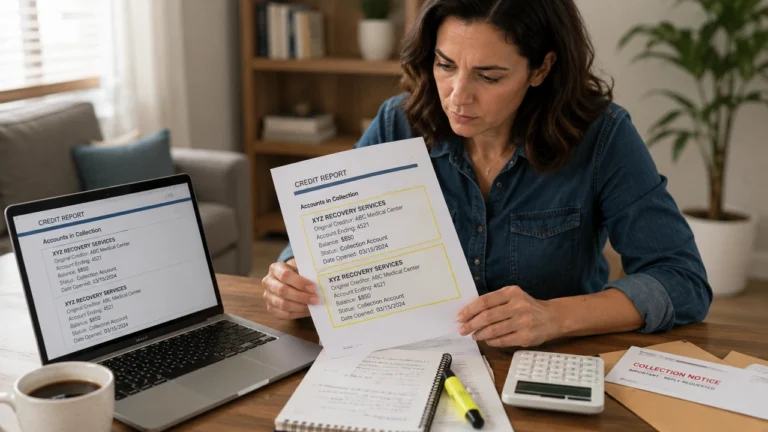
If you need the general dispute process first, see how to dispute errors on your credit report. If the possible duplicate is specifically two collection tradelines tied to the same debt, use the separate guide on the same collection appearing twice before filing a generic duplicate-account dispute.
When two accounts are not actually duplicates
The same account appearing once on each of your three credit reports is not a duplicate. Equifax, Experian, and TransUnion maintain separate files. Review each report on its own; do not add together balances from three bureaus. Obtain your reports through AnnualCreditReport.com. If a monitoring app shows repeated alerts or combines bureau data, confirm that the duplicate exists on the underlying bureau report.
The CFPB lists the same debt appearing more than once, sometimes under different names, as a common credit-report error. But two entries connected to the same borrower are not automatically inaccurate.
| What you see | Could be legitimate? | What to verify |
|---|---|---|
| Old servicer + new servicer | Yes | Old account should reflect the proper transferred/closed status and balance |
| Old loan + refinanced loan | Yes | Old obligation should show the payoff/closed status accurately |
| Replacement card + old card number | Possibly | Was a new legal account opened, or only a card number replaced? |
| Original creditor + collection agency | Possibly | Ownership, balances, and reporting roles |
| Two tradelines with same opening date, balance and history | Potential duplicate | Whether there is only one underlying obligation |
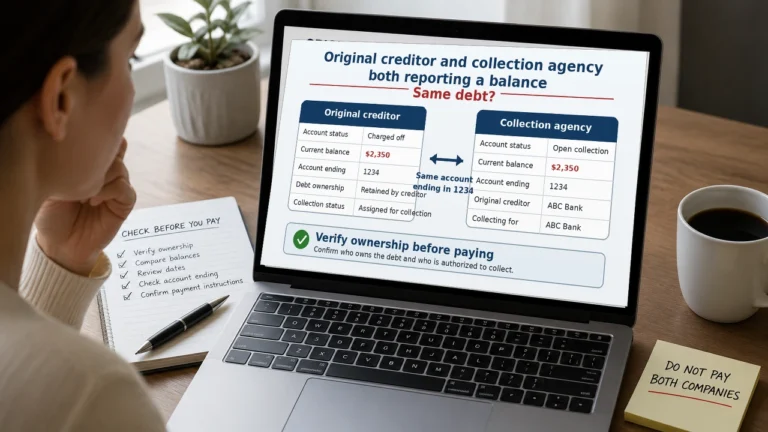
If an original creditor and collector both appear, do not use a generic duplicate dispute before checking ownership and balances. See when an original creditor and collection agency both report the same debt.
Compare the two tradelines before you dispute
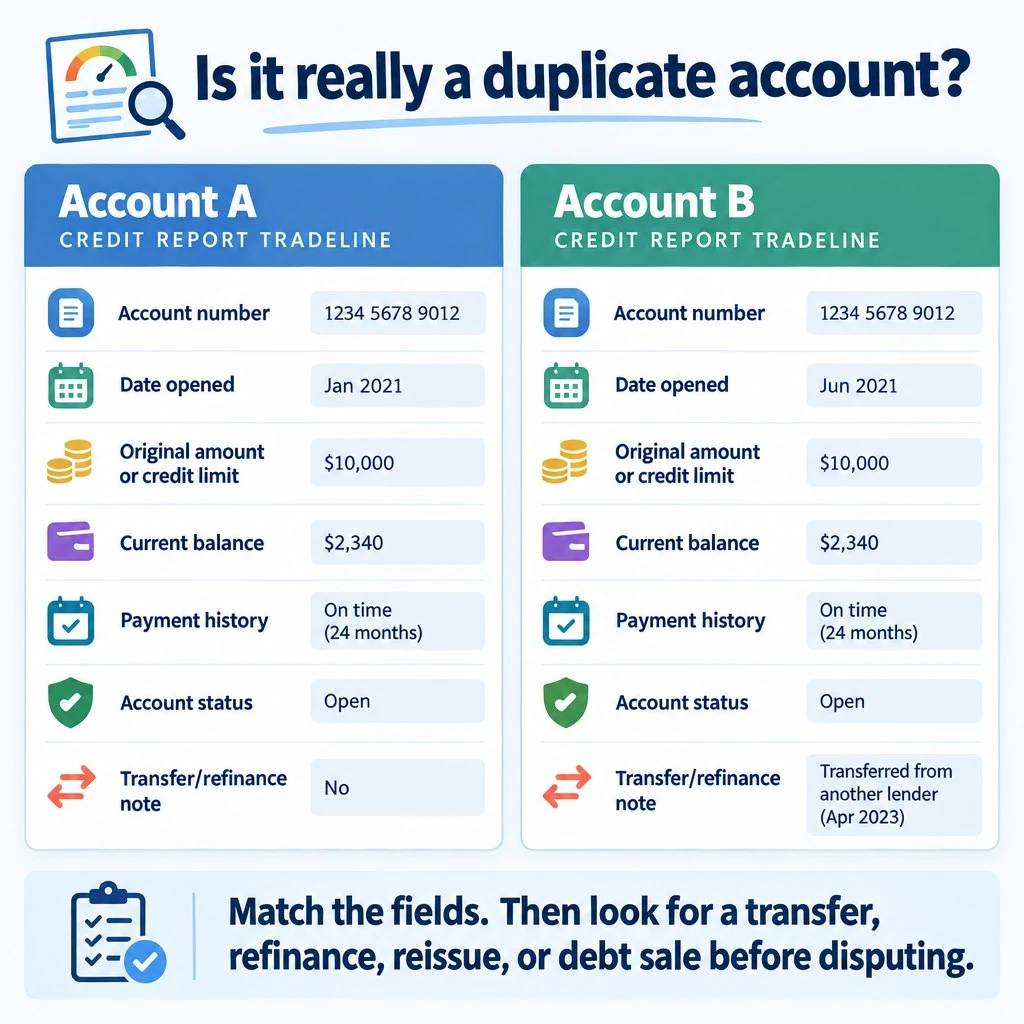
Write down the details for both entries:
- creditor or furnisher name;
- partial account number;
- date opened;
- original balance or credit limit;
- current balance;
- payment history by month;
- account status;
- responsibility — individual, joint, or authorized user;
- last-updated date;
- comments such as transferred, sold, closed, or paid.
The stronger the match across account number, opening date, balance, and payment history — with no legitimate transfer or refinance explaining it — the stronger the reason to investigate a true duplicate.
If the report fields are confusing, use our step-by-step credit-report guide.
Use this duplicate-account decision tree
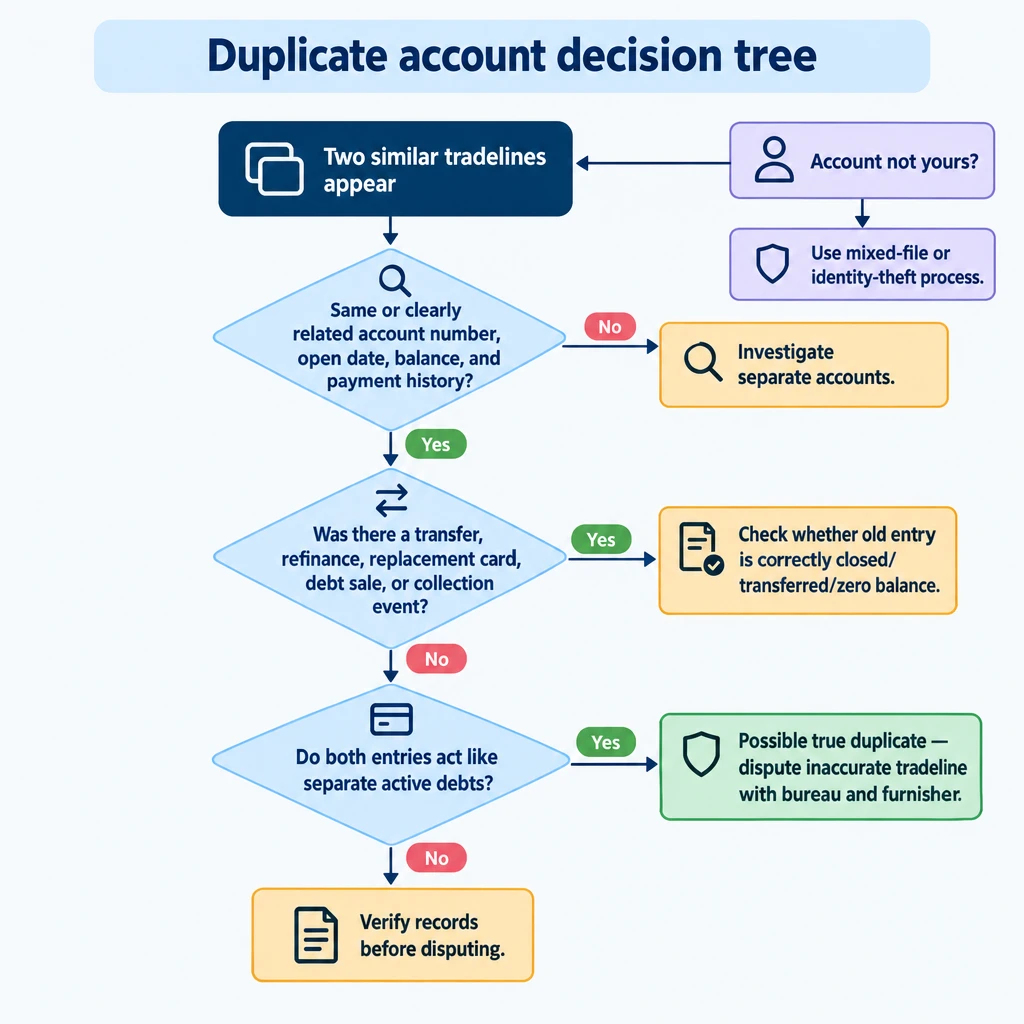
- Do both entries describe the same underlying debt? If no, they are not duplicates.
- Is there a transfer, refinance, reissue, or sale that explains the second entry? If yes, check whether the status and balance are reported correctly.
- Do both entries report the same balance or delinquency as separate active obligations? If yes, investigate further.
- Can your lender or servicer confirm which tradeline should be active? Save that confirmation.
- Can you state the exact correction in one sentence? If not, gather more information before filing.
Example: one loan reported as two active accounts
Illustrative example, not a real customer case. Your lender confirms that you have one personal loan with a $1,200 balance and no transfer or refinance. One bureau report lists:
| Field | Entry A | Entry B |
|---|---|---|
| Account ending | 4821 | 4821 |
| Opened | March 15, 2024 | March 15, 2024 |
| Balance | $1,200 | $1,200 |
| Status | Open installment loan | Open installment loan |
| Payment history | Matches lender records | Repeats the same history |
What makes this worth disputing: the lender’s records support one obligation, while the report presents two active accounts. Those displayed balances add to $2,400 even though the documented balance is $1,200. That arithmetic illustrates the reporting problem; it does not predict how a scoring model or lender will process the entries.
Identify both entries and attach the statement plus the lender’s confirmation. Ask the bureau to investigate and remove the redundant entry while preserving accurate account history. Matching last four digits alone are not proof: compare the other fields and supporting records too.
Different outcome: if Entry A instead identifies an old servicer, shows a transferred status and $0 balance, and Entry B shows the current servicer and $1,200, the two entries may accurately document a transfer. Check the transfer notice before requesting deletion.
What documents help prove a duplicate?
Use the smallest set of records that directly explains the relationship between the two tradelines:
- credit report pages showing both entries;
- account statements;
- loan or card opening documents;
- servicing-transfer notices;
- refinance payoff statements;
- card replacement or reissue notices;
- creditor letters confirming closure or transfer;
- payment history from the lender or servicer;
- collection validation records when a collection is involved.
Keep originals and submit copies. For a broader evidence checklist, see what documents can support a credit-report dispute.
Dispute the duplicate with the bureau and the furnisher
FTC and CFPB guidance says inaccurate credit-report information should be disputed with the credit reporting company and the business that supplied the information, known as the furnisher.
With the bureau, identify the exact tradeline on that report. With the furnisher, explain how its reporting created or maintained the duplicate.
Sample letter to dispute a duplicate account
Replace every bracketed field and describe only facts your records support. This example is for a bureau dispute about one redundant entry; adapt the correction request if a balance or status is the actual error.
[Your full name]
[Your mailing address]
[Date]
[Credit bureau name and current dispute address]
Subject: Duplicate account dispute — report [confirmation number and date]
I am requesting an investigation of an apparent duplicate account on my credit report.
Entry A: [furnisher name, account identifier as shown, report page].
Entry B: [furnisher name, account identifier as shown, report page].
These entries appear to describe one account, not two separate obligations. They share [specific matching details]. My [statement, account agreement, or lender confirmation] shows [the facts that demonstrate the duplication].
Please investigate the relationship between these entries and remove the redundant entry [identify it], while retaining the accurate account information. I am disputing the duplication, not requesting removal of accurate payment history.
I have enclosed copies of [list supporting records] and marked both entries on the attached report pages. Please send me the investigation results and an updated report reflecting any corrections.
[Your name and signature, if mailed]
Enclosures: [report pages and supporting documents]
Follow the bureau’s current identification requirements and save a copy of the completed letter and attachments. For a separate letter to the furnisher, name the affected bureau and ask it to investigate its reporting and send any correction to the bureaus that received the inaccurate data.
Avoid requests such as “delete all negative information.” If the accurate tradeline includes a real late payment, do not claim the late payment never happened. Dispute only the duplicate reporting.
Online or by mail?
Either method can work. Online filing can be convenient for a simple duplicate with a few clear documents. Mail can be useful when you need a side-by-side explanation, transfer documentation, or a detailed correction request.
Whichever method you use, save the submission text, attachments, confirmation number, and delivery or receipt record. For the tradeoffs, see online vs. mail credit-report disputes.
Where to submit the dispute
Use the current mailing instructions on the bureau’s official site or your report if you choose mail. Send the furnisher’s dispute to its designated dispute address. If only one bureau shows the duplicate, dispute with that bureau and the furnisher; check the other reports for their own errors.
How long does a duplicate-account dispute take?
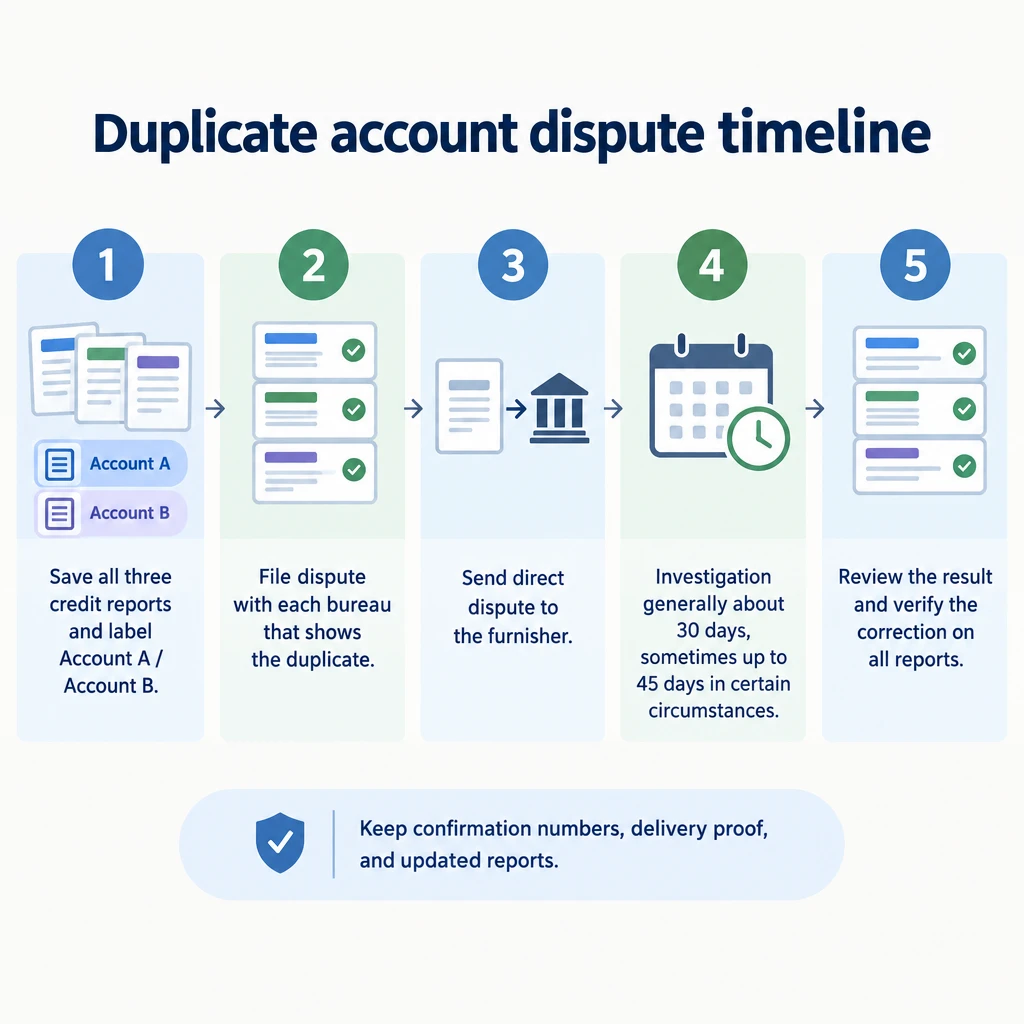
A credit reporting company generally must investigate a dispute within 30 days after receiving it. CFPB guidance says some investigations can take up to 45 days, including certain cases involving a free annual credit report or additional relevant information submitted during the original investigation period. Written results generally must be sent within five business days after the investigation is completed.
Furnishers generally must also investigate direct disputes and respond within 30 days of receiving them. If a furnisher determines that information it provided is inaccurate, it must correct the information and notify the credit reporting companies to which it furnished the incorrect data.
If the bureau does not respond when expected, see what to check when a credit bureau did not respond within 30 days.
What to verify after the dispute
Do not stop when the portal says “completed.” Download a new report and confirm:
- the inaccurate duplicate is gone or corrected;
- the legitimate tradeline remains;
- the balance is correct;
- the account status is correct;
- accurate payment history was not removed by mistake;
- the same duplicate is not still present at another bureau.
If the result says the item was verified, review what the bureau actually investigated before repeating the same claim. See what “verified as accurate” means after a dispute.
Will removing a duplicate raise your credit score?
It can, but no specific result is guaranteed. A duplicate may affect score-relevant information if it repeats a revolving balance, delinquency, collection, charge-off, or other account data. But credit scoring does not work by assigning a fixed penalty to each tradeline and then refunding a fixed number of points when one is deleted.
The first measure of success is whether the credit report became accurate. Any score effect depends on the scoring model and the rest of your credit file.
Special cases that need a different approach
The duplicate account is not yours
If neither entry belongs to you, the issue may involve identity theft or a mixed file rather than ordinary duplicate reporting. Look for unfamiliar names, addresses, accounts, or other mismatched identity information. If identity theft is involved, use the FTC’s IdentityTheft.gov recovery process.
The same collection appears twice
An original creditor and a collector are not automatically duplicate accounts. If the creditor sold the debt, its original account should show a zero balance, while the buyer may report the outstanding balance. Hiring an agency to collect without selling the debt is a different arrangement. Confirm ownership before assuming that two reported balances prove a duplicate. Experian explains reporting after a debt is sold.
Collection ownership can change, so two collector names require a separate analysis of ownership, balances, and dates. Use our guide on whether the same collection can appear twice.
One entry is closed and one is open
This can be correct after a transfer, refinance, or card reissue. Check whether the closed account has the correct balance and historical status before requesting deletion.
Duplicate-account worksheet
| Field | Tradeline A | Tradeline B |
|---|---|---|
| Creditor/furnisher | ____________ | ____________ |
| Partial account number | ____________ | ____________ |
| Date opened | ____________ | ____________ |
| Original amount / limit | ____________ | ____________ |
| Current balance | ____________ | ____________ |
| Account status | ____________ | ____________ |
| Payment history matches? | Yes / No | Yes / No |
| Transfer/refinance/reissue event? | ____________ | ____________ |
| Which entry should remain? | ________________________________ | |
| Exact correction requested | ________________________________ | |
Frequently asked questions
Can the same account legally appear twice?
Two entries connected to the same underlying debt can sometimes be accurate after a transfer, refinance, card replacement, or collection event. The question is whether each tradeline accurately describes its role and status.
Should I dispute both duplicate entries?
Usually not. Identify which entry is accurate and which field or tradeline is wrong. Ask for one precise correction.
Can a duplicate account hurt my credit score twice?
There is no universal “double penalty.” But duplicated balances or negative history can distort the file and may affect scoring or underwriting. Correct the inaccurate reporting rather than trying to calculate a fixed point loss.
What if the bureau says the duplicate is verified?
Read the result against your original request: did the investigation address the relationship between both entries, or only verify a balance? Contact the furnisher for an explanation and submit new relevant evidence if available. A notice that an entry was verified does not explain by itself why a second entry is accurate.
If the issue remains unresolved, review the CFPB’s current credit-reporting complaint requirements. Dispute with the bureau first and follow the portal’s instructions about pending disputes and the 45-day threshold. Keep the report, submission receipt, evidence, and investigation response together.
Bottom line
To dispute a duplicate account on your credit report, first prove that the two entries represent one obligation rather than two legitimate reporting events. Compare the tradelines, identify the exact inaccurate field, gather records that support one correction, dispute with every bureau showing the problem and the furnisher, and verify the updated report afterward.
Do not dispute accurate negative information simply because it hurts your score. The goal is an accurate credit file, not a guaranteed deletion or point increase.
Sources
CFPB guidance specifically addresses debts listed multiple times and recommends disputing the error with the bureau and the company that furnished it. Additional references:
- Consumer Financial Protection Bureau — Common credit-report errors
- Consumer Financial Protection Bureau — How to dispute a credit-report error
- Consumer Financial Protection Bureau — Credit-report dispute timing
- Federal Trade Commission — Disputing errors on your credit reports
- Federal Trade Commission — Fair Credit Reporting Act
More on this topic: Browse all credit report and dispute guides.
Financial and legal disclaimer
This article provides general U.S. educational information about credit reporting and disputes. It is not individualized legal, financial, lending, or credit-repair advice. No dispute outcome, deletion, or credit-score change is guaranteed.