In this guide
- How many points can a 30-day late payment drop your credit score?
- Why can the same 30-day late payment affect two people differently?
- My score dropped 30, 50, 80, or 100 points. Is that possible?
- What if your credit score was around 700, 750, or 800?
- Does your first late payment hurt your credit score more?
- Does a $20 late payment hurt less than a $2,000 late payment?
- When does a 30-day late payment start affecting your credit score?
- Will the same late payment drop all three credit scores by the same amount?
- Check your observed credit score change
- Before calculating your loss: can these two credit scores actually be compared?
- How do you know how many points a late payment actually cost you?
- 30-day late payment score-drop worksheet
- Decision tree: did the late payment really cause your score drop?
- Four examples: which situation looks most like yours?
- What if you have not reached 30 days late yet?
- What if the 30-day late payment is already on your credit report?
- Does a 60- or 90-day late payment hurt more?
- Will paying the late payment give you the lost points back?
- Choose your next step
- Frequently asked questions
- The bottom line
- Related guides
- Sources and methodology
Written by Claire Bennett, Founder & Editor of Fix My Money Life | Reviewed against official source material | Last reviewed Aug. 8, 2026
A 30-day late payment has no fixed credit-score penalty. In five illustrative FICO Score 9 profiles, the simulated loss ranged from 17 to 83 points. These are examples from a 2019 FICO publication—not an average, a minimum or maximum, or a prediction for your score.
To investigate your own drop, compare scores from the same model and credit bureau, then check what changed in the underlying report.
Start here: FICO point-loss examples · Check your score drop · Download the audit worksheet.
How many points can a 30-day late payment drop your credit score?
FICO published simulations showing how five different FICO Score 9 profiles could react to the same event: missing a payment by 30 days.
| Starting FICO Score 9 | After a 30-day late payment | Approximate simulated drop |
|---|---|---|
| 607 | 570–590 | 17–37 points |
| 669 | 625–645 | 24–44 points |
| 710 | 645–665 | 45–65 points |
| 736 | 685–705 | 31–51 points |
| 793 | 710–730 | 63–83 points |
Source: FICO’s 2019 consumer credit activity illustration, page 1; limitations on page 2. The five starting scores and simulated outcomes were checked against the original PDF on October 1, 2026. The drop ranges are subtraction from those published outcomes, not an average, a current population study, or a prediction for everyone with the same starting score.
Do not use these numbers as a score-loss calculator. A person with a 710 score is not guaranteed to lose 45–65 points, and someone with a 793 score is not guaranteed to lose 63–83 points. FICO says the impact of a credit action depends heavily on the consumer’s starting credit profile.
This is why the question “How many points does one late payment drop your credit score?” does not have one universal answer.
Why can the same 30-day late payment affect two people differently?
A FICO Score is not calculated by taking your current score and subtracting a standard late-payment penalty.
Instead, the score evaluates information in the credit file at a particular point in time. FICO says late-payment information is considered using factors including:
- Recency: how recently the late payment occurred.
- Severity: how far behind the account became.
- Frequency: how often late payments occurred.
The rest of the file matters too. Credit card utilization, balances, account history, new credit activity, inquiries, and other negative information may all be different from one consumer to another.
That is why even two people with similar starting scores can experience different results.
Why a thin credit file can make the drop larger
In FICO’s illustration, the 710 profile has just two accounts and two years of credit history. FICO explains that this leaves less positive history to cushion a missed payment. The starting number alone cannot predict the loss: a higher starting score does not always produce a larger drop.
Model limitation: The table uses FICO Score 9. It is not a penalty schedule for FICO Score 8, mortgage scores, or VantageScore. Check the model named by your score provider before comparing its result with these examples.
My score dropped 30, 50, 80, or 100 points. Is that possible?
If your credit score dropped after a late payment appeared, use this table before assuming the entire change came from that one account.
| Observed decline | What the FICO examples show | What to check next |
|---|---|---|
| About 30 points | A decline around 30 points falls within several published FICO example ranges. | Confirm the late payment appears and compare the same scoring model and bureau. |
| About 50 points | A roughly 50-point drop also falls within several FICO examples. | Check balances, utilization, inquiries, and account changes. |
| About 80 points | Yes. FICO’s 793 profile fell approximately 63–83 points. | Check whether this was the first serious negative item on an otherwise clean file. |
| About 100 points | A consumer may observe a change around this size, but FICO does not publish a universal 100-point penalty for one 30-day late payment. | Audit the entire credit report before assigning all 100 points to one event. |
| More than 100 points | The number alone does not identify the cause. | First verify that the two scores are actually comparable. |
What a roughly 50-point drop can mean
Yes. A roughly 50-point decline falls within several of FICO’s published examples. For instance, the example profile starting at 710 fell to 645–665 after the simulated 30-day late payment.
But 50 points should not be treated as the standard penalty for everyone.
What a roughly 80-point drop can mean
Yes. FICO’s high-scoring example started at 793 and fell to 710–730 after a 30-day late payment, an approximate decline of 63–83 points.
This is one reason a first late payment on otherwise strong credit can feel surprisingly severe.
Can a 30-day late payment cause a 100-point credit score drop?
You may observe a credit score that is around 100 points lower after a late payment appears, but that does not prove the late payment alone caused all 100 points.
If your score dropped around 100 points, check whether any of these changed at the same time:
- credit card balances;
- overall or individual-card utilization;
- credit limits;
- another late payment;
- a collection or charge-off;
- a new account;
- a hard inquiry;
- an account closure;
- the scoring model or credit bureau being viewed.
What if your credit score was around 700, 750, or 800?
People frequently search for the late-payment impact based on their starting score. FICO’s simulations provide useful benchmarks, but they should never be treated as guaranteed predictions.
How much can a late payment hurt a 700 credit score?
FICO’s closest published example starts at 710. After a simulated 30-day late payment, that profile fell to 645–665, an approximate decline of 45–65 points.
This does not mean everyone with a score around 700 will lose 45–65 points. The rest of the credit profile matters.
How much can a late payment hurt a 750 credit score?
FICO’s closest example starts at 736. That profile fell to 685–705, an approximate decline of 31–51 points.
Again, this is a benchmark from one illustrative profile, not an official penalty for someone with a 750 score.
How much can a late payment hurt an 800 credit score?
FICO’s closest published example starts at 793. After a 30-day late payment, the simulated score fell to 710–730, an approximate decline of 63–83 points.
An excellent score therefore does not make someone immune to a large decline when a significant new delinquency appears.
Does your first late payment hurt your credit score more?
A first recent delinquency on an otherwise clean credit file can have a substantial impact because it introduces serious negative payment-history information where none was previously reported.
FICO’s examples make this easy to see:
| Example profile | 607 profile | 793 profile |
|---|---|---|
| Previous delinquency | Yes | None |
| Recent charge-off | Yes | None |
| After 30-day late | 570–590 | 710–730 |
| Approximate decline | 17–37 points | 63–83 points |
The lower-score profile already reflected substantial negative information. The 793 profile had no reported previous delinquency, so the new late payment represented a much larger change.
This helps answer another common question: Why did one late payment drop my score so much? Sometimes the answer is that your credit file was previously very clean.
Does a $20 late payment hurt less than a $2,000 late payment?
You cannot calculate the credit score impact from the overdue dollar amount alone.
FICO’s public guidance emphasizes characteristics such as recency, severity, and frequency of delinquency information. There is no published formula saying:
- $20 late = 10 points;
- $500 late = 40 points;
- $2,000 late = 80 points.
However, balances can affect other scoring factors separately. If a missed credit card payment occurs while the balance and utilization on that card rise significantly, your observed score decline may reflect both changes.
When does a 30-day late payment start affecting your credit score?
A late payment can affect a credit score once the delinquency has been reported and is included in the credit report used to calculate that score. Reaching 30 days past due does not necessarily mean every credit score you view changes at that exact moment.
TransUnion explains that lenders generally report a missed payment when it reaches about 30 days past due. Creditors also typically update account information on a monthly cycle, so the new delinquency may not appear on a bureau report immediately on day 30.
This distinction is important:
- Your lender may consider you late before 30 days.
- You may owe a late fee before anything appears on your credit reports.
- The credit-score impact generally requires the delinquency to be present in the report data used to calculate that score.
If you are currently behind but have not yet reached 30 days past due, see what happens when a payment is less than 30 days late.
Will the same late payment drop all three credit scores by the same amount?
One account, three report snapshots
Same hypothetical account: ABC Bank Card
Compare the account information and reporting dates, not just the bureau names.
30-day late payment shown.
The update is present in this snapshot.
30-day late payment shown.
The update is present in this snapshot.
Late-payment update not yet shown.
Check the creditor’s reported date.
No. You should not expect a 30-day late payment to produce the exact same point change across Experian, Equifax, and TransUnion.
There are several reasons.
- A lender may report account information to the bureaus at different times.
- Not every lender necessarily furnishes identical information to all three bureaus.
- Your underlying reports may already contain different account data.
- You may be looking at different versions of a FICO Score or a completely different scoring model.
- The scores may have been calculated on different dates.
FICO explains that substantial differences among bureau-based FICO Scores are often driven by differences in the underlying credit-report data. The CFPB likewise notes that consumers have many credit scores because different formulas, reporting sources, products, and dates can be used.
Example: A lender reports a new 30-day late payment to TransUnion first. Your TransUnion-based score changes, but your Experian report still shows the account as current. An Experian-based score would not yet be reacting to a delinquency that is not in its underlying report.
This is why the safest before-and-after measurement uses the same score model, same bureau, and similar timing.
Check your observed credit score change
This is not a FICO simulator. Compare two scores and identify the next report-checking step. The result cannot isolate how many points were caused by a late payment.
No name, Social Security number or account number is needed. This tool itself makes no network requests, saves no entries in browser storage, and uses no cookies. A downloaded audit stays wherever you save it.
Method: later score minus earlier score; no predictive score formula. A comparable score change still does not prove causation. General U.S. educational information, not individualized financial or legal advice.
References: FICO on score changes; CFPB on different scores; CFPB on reporting errors.
Before calculating your loss: can these two credit scores actually be compared?
Compare a score change, not two different score products
Useful comparison: the same model and bureau, calculated on two recorded dates.
Experian-based FICO Score 8
754
Experian-based FICO Score 8
686
Observed change: 686 − 754 = −68 points. Review all report changes; this does not isolate a late-payment penalty.
Experian-based FICO Score 8 → Experian-based VantageScore 3.0.
The bureau is the same, but the scoring model changed. A difference between those numbers does not measure a late-payment point loss.
This is one of the most important checks in the article.
If one app shows 760 and another shows 690, you cannot automatically conclude that a late payment cost you 70 points.
Credit score comparison checker
| Comparison | Useful? | Why |
|---|---|---|
| Experian FICO Score 8 → Experian FICO Score 8 | Yes | Same model and same bureau create a much cleaner comparison. |
| TransUnion FICO Score 8 → TransUnion FICO Score 8 | Yes | Useful when the dates are reasonably close. |
| Experian FICO → TransUnion FICO | No | The underlying bureau information may differ. |
| FICO Score → VantageScore | No | Different scoring models are being compared. |
| Credit Karma score → lender FICO | No | The model, bureau, or both may differ. |
| Same FICO model and bureau one month apart | Best practical comparison | You can then investigate what changed in the underlying report. |
| Same score several months apart | Use caution | Other report information may have changed during the gap. |
If the report itself is confusing, start with our guide on how to read and compare your credit report.
How do you know how many points a late payment actually cost you?
Find the late month, not just the current account status
ABC Bank Card — hypothetical account
Current account status: Current
Historical late payment: April — 30 days late
| Month | Reported history |
|---|---|
| January | OK |
| February | OK |
| March | OK |
| April | 30 days late |
| May | Current |
Separate score comparison: earlier score 754; later score 686; observed change −68 points. Use the same model and bureau and record both calculation dates. This example does not assign all 68 points to the late payment.
You cannot reverse-engineer a proprietary scoring model, but you can perform a much better before-and-after diagnosis than simply subtracting two numbers.
The 6-step late-payment score-drop audit
Step 1: record your old score
Write down the score, date, scoring model, and credit bureau.
Step 2: record your new score
Use the same scoring model, same bureau, and preferably the same score provider.
Step 3: confirm the late payment actually appears
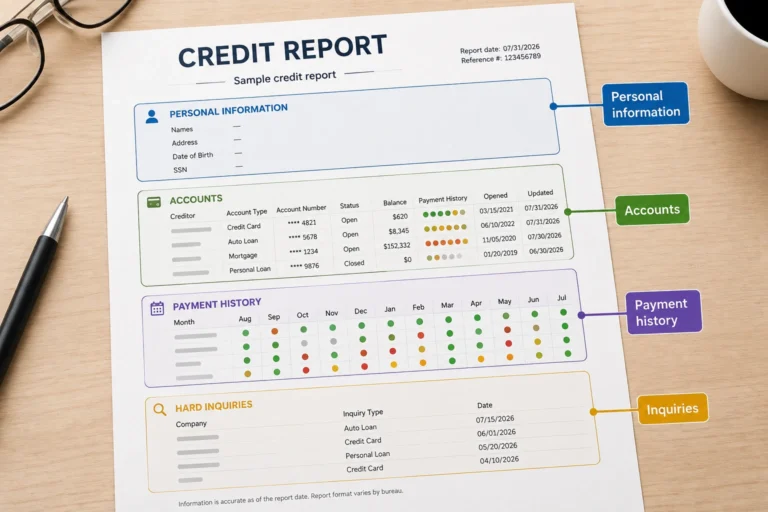
Check the payment history on the credit report underlying that score.
If the delinquency is not on that bureau’s report, it cannot explain that particular score calculation.
Step 4: compare balances and utilization
Check total revolving balances, individual card balances, credit limits, and utilization before and after.
Step 5: look for other report changes
Check for:
- another late payment;
- a collection or charge-off;
- a new account;
- a hard inquiry;
- an account closure;
- a lower credit limit;
- an old account disappearing;
- another meaningful status or balance update.
Step 6: calculate the observed score change
| Previous score | 754 |
|---|---|
| New score | 686 |
| Observed change | −68 points |
If the late payment is the only significant new negative item you can identify, it may be reasonable to conclude that it played a major role.
The careful wording is:
“My credit score declined 68 points after the 30-day late payment appeared.”
Not:
“FICO deducted exactly 68 points for my late payment.”
30-day late payment score-drop worksheet
Use this worksheet with your own before-and-after information.
Save a fillable copy to compare your scores and record your next steps.
Download the fillable score audit
Fillable PDF · 2 pages. Download and open in a PDF reader to complete the fields, then save a copy. Keep completed copies private.
| What to compare | Before | After |
|---|---|---|
| Credit score | __________ | __________ |
| Scoring model | __________ | __________ |
| Credit bureau | __________ | __________ |
| Score date | __________ | __________ |
| 30-day late showing? | Yes / No | Yes / No |
| Total card balances | $__________ | $__________ |
| Overall utilization | __________% | __________% |
| New inquiry? | Yes / No | Yes / No |
| New account? | Yes / No | Yes / No |
| Credit limit decreased? | Yes / No | Yes / No |
| Another negative item? | Yes / No | Yes / No |
Observed score change: __________ points
Most important new negative change: ______________________________
Other material changes: ______________________________
Decision tree: did the late payment really cause your score drop?
1. Does the 30-day late payment appear on the report used for this score?
- No → It cannot explain this particular score calculation yet.
- Yes → Continue.
2. Are you comparing the same scoring model?
- No → Do not calculate a late-payment point loss from these scores.
- Yes → Continue.
3. Are both scores based on the same bureau?
- No → The underlying data may differ.
- Yes → Continue.
4. Did balances or utilization change significantly?
- Yes → More than one scoring factor changed.
- No → Continue.
5. Did an inquiry, new account, collection, another delinquency, or account closure appear?
- Yes → Do not assign the entire decline to the late payment.
- No → The late payment is the clearest major new negative change you have identified.
Four examples: which situation looks most like yours?
Example 1: 780 → 702 and almost nothing else changed
Hypothetical example.
The consumer compares the same FICO model and bureau. Utilization moves only from 8% to 9%, no new accounts or inquiries appear, and one new 30-day late payment is added.
Observed decline: 78 points.
Interpretation: The late payment is the clearest major new negative change, and the 78-point decline also falls within FICO’s published high-score example.
Example 2: 742 → 650, but utilization jumped too
Hypothetical example.
The consumer has a new 30-day late payment, but credit card utilization also rises from 8% to 74%.
Observed decline: 92 points.
Interpretation: It would be misleading to say the late payment alone cost exactly 92 points because more than one important factor changed.
Example 3: 705 → 670 after several credit events
Hypothetical example.
A late payment, a hard inquiry, and a new credit card all appear during the same period.
Observed decline: 35 points.
Interpretation: You cannot reliably divide those 35 points among the three events using publicly available scoring information.
Example 4: the late payment is on the wrong bureau
Hypothetical example.
The consumer sees a delinquency on TransUnion but is viewing an Experian-based score. Experian does not show the late payment.
Interpretation: That TransUnion late payment cannot explain the Experian-based score at that moment.
What if you have not reached 30 days late yet?
If you are behind but have not yet reached a reported 30-day delinquency, your immediate question is different from the one this article answers.
Check the original due date, determine the amount required to bring the account current, and contact the lender promptly if you cannot catch up.
Call script: find out exactly where your account stands
“Hi, I’m calling about account ending in [last four digits]. My payment due date was [date]. Can you tell me exactly how many days past due the account is, the amount required to bring it current, and whether a 30-day delinquency has already been furnished to Experian, Equifax, or TransUnion?”
Write down the date and time of the call, the representative’s name or ID if provided, the amount needed to bring the account current, and what the representative tells you about credit reporting.
What if the 30-day late payment is already on your credit report?
If it is accurate
Focus on bringing the account current if possible and preventing the delinquency from becoming more severe.
Do not assume that paying it will automatically erase the historical late payment or restore a specific number of points. If the late payment was accurate but resulted from a one-time problem and the account is now current, you can also review whether a goodwill letter for a late payment is worth trying.
If it appears inaccurate
Identify the specific factual error before disputing it.
Useful supporting evidence may include:
- bank statements;
- payment confirmations;
- account statements;
- online payment-history screenshots;
- autopay confirmations;
- lender correspondence;
- a copy of the credit report showing the disputed month.
The CFPB advises consumers to explain what is incorrect and provide supporting documents when disputing inaccurate information. For the full process, see how to dispute an inaccurate late payment.
Call script: the reported late payment may be wrong
“My credit report shows a 30-day late payment for [month/year], but my records show that I paid on [date]. I have [bank statement/payment confirmation/account statement] supporting that date. Can you review the payment history for that month and tell me what payment status and date your company furnished to the credit bureaus?”
Does a 60- or 90-day late payment hurt more?
Generally, a more severe delinquency can have a greater negative impact. FICO specifically identifies severity as an important late-payment characteristic.
Its published simulations also show this clearly. The example profile starting at 793 fell to 710–730 after a 30-day late payment but to 660–680 after a 90-day late payment.
For the separate severity question, read 30-day late payment vs. 60-day late payment.
Will paying the late payment give you the lost points back?
Not necessarily, and there is no guaranteed point rebound.
Bringing the account current can prevent the delinquency from becoming more severe, but it does not automatically erase accurate historical payment information.
The CFPB states that negative payment-history information can generally remain on a credit report for up to seven years. There is no trustworthy recovery formula promising a particular number of points after three months, six months, or one year.
For that separate intent, read how long a late payment affects your credit score.
Choose your next step
Use the six-step audit and worksheet above to record what changed. Then choose the guide that matches the problem:
- The account is still past due: check when a missed payment reaches your credit report and contact the creditor about bringing the account current.
- The late mark is gone but your score has not recovered: investigate why removing a late payment may not increase your score.
- The late mark is accurate: follow a longer-term plan to rebuild credit after late payments.
Frequently asked questions
How many points does a 30-day late payment drop your credit score?
There is no fixed penalty. In five published FICO Score 9 examples, approximate declines after one 30-day late payment ranged from about 17 to 83 points. Your result can differ because your full starting credit profile matters.
Can one late payment drop your credit score 50 points?
Yes. A roughly 50-point decline falls within several published FICO simulation ranges, but it is not a standard penalty.
Can one late payment drop your credit score 80 points?
Yes. FICO’s example starting at 793 fell to 710–730 after a simulated 30-day late payment, an approximate decline of 63–83 points.
Can a 30-day late payment cause a 100-point drop?
You may observe a score change around 100 points, but FICO does not publish a universal 100-point penalty for one 30-day late payment. Check for other credit-report changes before attributing the entire decline to that one item.
When does a 30-day late payment affect your credit score?
It can affect a score once the delinquency is reported and is present in the credit report used to calculate that score. Lenders generally report missed payments after they reach about 30 days past due, but account updates are commonly furnished on reporting cycles rather than instantly on day 30.
Will a late payment affect Experian, Equifax, and TransUnion scores the same way?
Not necessarily. The three bureaus may receive account updates at different times or contain different underlying information, and the scores you are viewing may also use different scoring models or dates.
Does your first late payment hurt more?
A first recent delinquency on an otherwise clean credit file can cause a substantial change because it adds significant negative payment-history information where none previously existed. The exact result still depends on the full credit profile.
Does the amount of a late payment affect your credit score?
You cannot determine the score impact from the past-due dollar amount alone. FICO emphasizes characteristics including recency, severity, and frequency of delinquency information.
The bottom line
There is no universal answer to how many points a 30-day late payment will drop your credit score. FICO’s own Score 9 simulations range from an approximate 17–37-point decline for one profile to 63–83 points for another.
If your own score dropped, do not rely on a generic internet average. Compare the same scoring model, same credit bureau, and the underlying credit reports. Confirm that the late payment was actually reported, check when the score was calculated, and audit balances, utilization, inquiries, accounts, and other negative information. That gives you a much more useful diagnosis than assuming one late payment automatically costs 30, 50, 80, or 100 points.
Related guides
- Late payments hub — reporting, score impact, disputes, and recovery.
- 30-day vs. 60-day late payment — understand how deeper delinquency differs.
- Can a payment less than 30 days late affect your credit? — what happens before the 30-day reporting threshold.
For a broader look at your options, read how to address late or missed payments on a credit report. Disputing inaccurate reporting and asking for goodwill on accurate history are different processes.
Sources and methodology
FICO / myFICO — How credit actions impact FICO Scores
FICO / myFICO — Changing the Score: five FICO Score 9 consumer profiles
FICO / myFICO — How FICO considers late payments
FICO / myFICO — Why FICO Scores can differ across credit bureaus
Consumer Financial Protection Bureau — Understand your credit score
Consumer Financial Protection Bureau — How long does information stay on my credit report?
Consumer Financial Protection Bureau — How do I dispute an error on my credit report?
TransUnion — How long late payments stay on your credit report and when they are generally reported
TransUnion — How to read your credit report and understand account update timing
Methodology note: Point-loss figures in this article are calculated directly from the ranges in FICO’s published FICO Score 9 simulations. FICO states that the examples are illustrative and should not be relied upon as predictions of an individual consumer’s FICO Score. All additional consumer scenarios in this article are hypothetical and are provided only to demonstrate how to analyze a score change.
Financial disclaimer: This article is for educational purposes only and does not constitute legal, financial, or credit-repair advice. Credit scoring formulas are proprietary, consumers can have multiple credit scores, and results vary by scoring model, credit bureau, reporting date, and individual credit profile.