In this guide
- Quick answer
- When does the 7-year clock start on a charge-off?
- Seven years vs. seven years plus 180 days
- Example: how to estimate when a charge-off may fall off
- Does anything restart the charge-off reporting clock?
- How long does a paid charge-off stay on your credit report?
- Why is my charge-off still on my credit report after 7 years?
- Three-bureau charge-off comparison worksheet
- What happens after a charge-off falls off your credit report?
- Credit reporting period vs. statute of limitations
- Frequently asked questions
- Related guides
- Sources
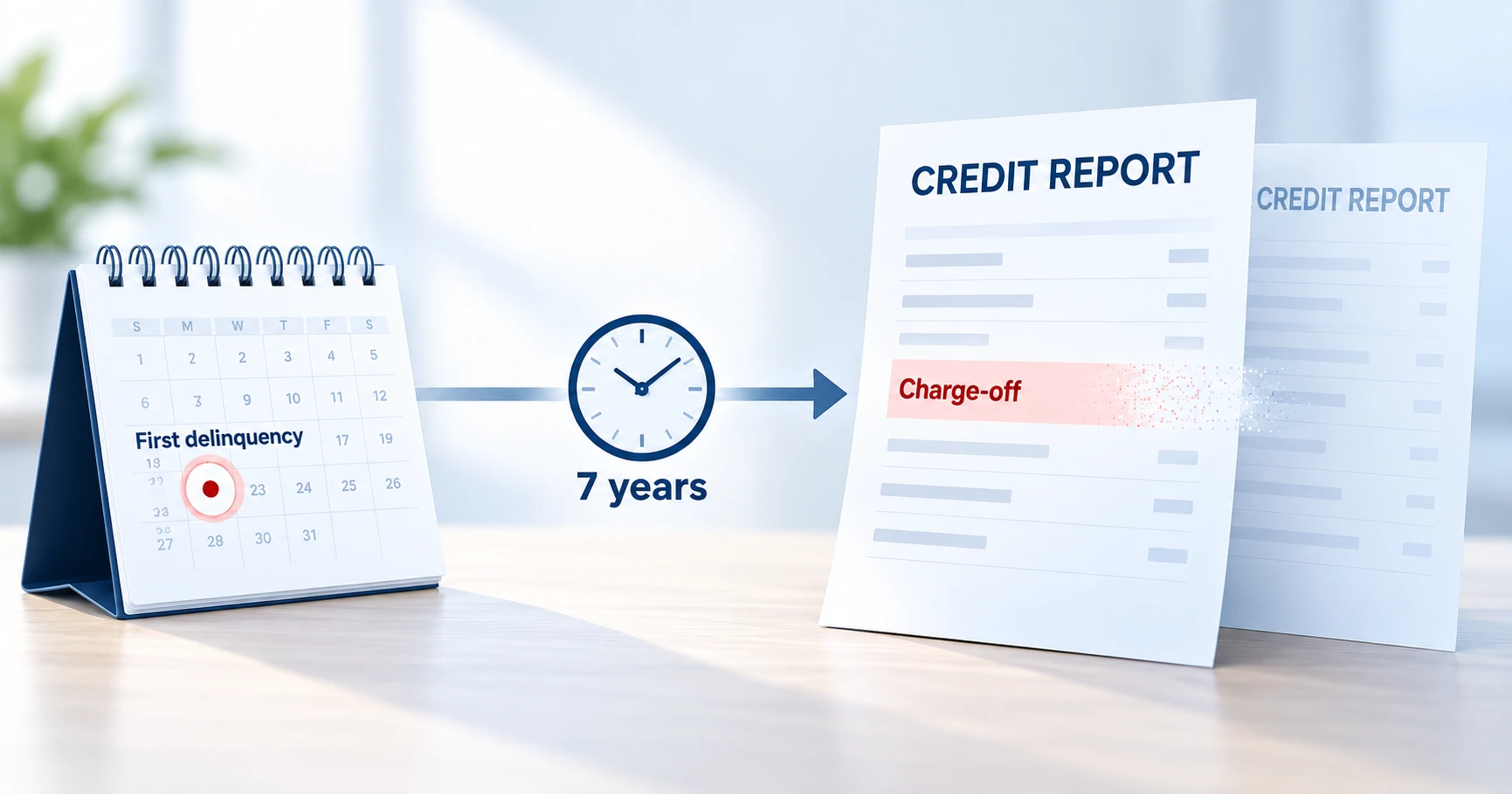
A charge-off generally stays on your credit report for about seven years from the date of first delinquency—the first missed payment in the continuous delinquency that led to the charge-off. If you are unsure what the status itself means, start with what a charge-off means on your credit report. The later charge-off date usually does not start a new seven-year reporting period.
Paying or settling the debt, disputing the account, having the debt sold or transferred, or seeing a recent account update does not restart the federal credit-reporting period. Under the Fair Credit Reporting Act’s technical calculation, a charge-off may remain for up to approximately seven years plus 180 days from the beginning of the delinquency that immediately preceded the charge-off. If you are deciding how to resolve the balance, compare settled charge-off vs. paid in full. If the balance itself is changing, see why your charge-off balance may be increasing and how to verify the added amount. For related charge-off reporting guides, browse the Charge-offs hub.
Quick answer
| Question | Answer |
|---|---|
| How long does a charge-off stay on your credit report? | Generally about seven years, subject to the FCRA calculation described below |
| When does the 7-year clock start? | Usually from the delinquency that led to the charge-off |
| Does the charge-off date start a new 7-year period? | No |
| Does paying or settling a charge-off restart the reporting period? | No |
| Does a recent “date updated” restart the reporting period? | No — see how monthly charge-off updates work |
| Can a charge-off stay longer than 7 years? | The technical FCRA reporting window may extend to approximately seven years plus 180 days from the beginning of the qualifying delinquency |
If you first need to understand the account status itself, see what a charge-off means on your credit report. If you are deciding whether payment changes the reporting outcome, see what paying a charge-off can change and whether a paid charge-off can be removed. Otherwise, use the steps below to identify the relevant delinquency date and estimate when the account may fall off your credit reports.
When does the 7-year clock start on a charge-off?
The reporting timeline is generally tied to the delinquency that immediately preceded the charge-off. In practical terms, that usually means the first missed payment in the continuous delinquency after which the account was never brought fully current.
The later charge-off date does not start a new seven-year period. Under the Fair Credit Reporting Act, the seven-year period begins after a 180-day period measured from the start of the delinquency that immediately preceded the charge-off.
Example: first delinquency vs. charge-off date
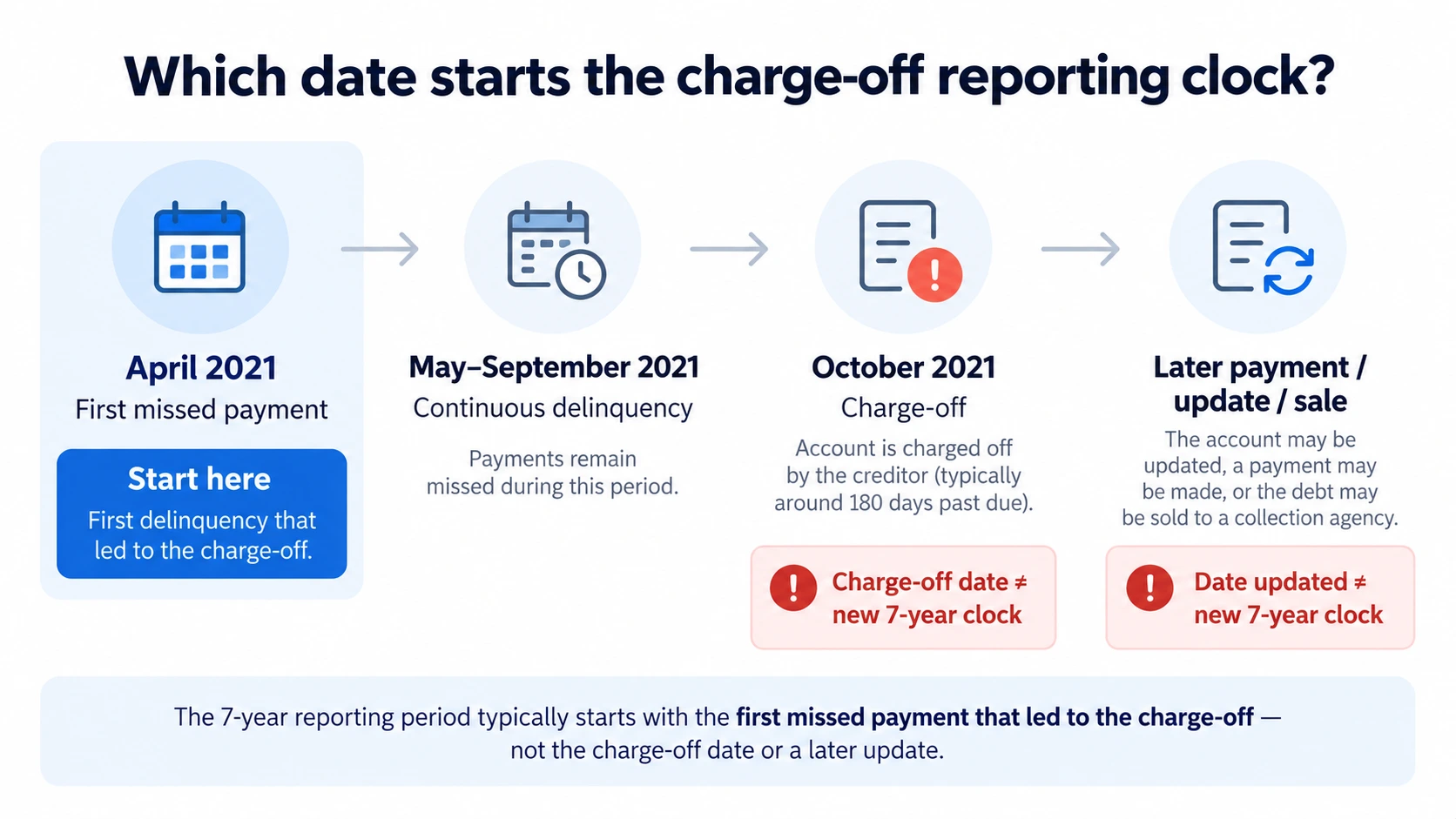
Suppose you missed your April 2021 payment and never brought the account current. The creditor charged off the account in October 2021.
| Account event | Example date | Does it control the reporting timeline? |
|---|---|---|
| First missed payment | April 2021 | Generally yes |
| Account remains continuously delinquent | May–September 2021 | Shows that the April delinquency was not cured |
| Account charged off | October 2021 | No, it does not create a new seven-year period |
| Account later paid, sold, disputed, or updated | Later date | No, these events do not create a new federal reporting period |
What if you became current and defaulted again?
An earlier missed payment does not necessarily control forever. If you missed a payment, later brought the account fully current, and then defaulted again, the later continuous delinquency may be the one that matters.
For example, if you missed a payment in February, brought the account current in April, and then stopped paying again in September without becoming current before the charge-off, the September delinquency would generally be the relevant starting point.
Which date should you look for on your credit report?
| Date or field | How to use it |
|---|---|
| Date opened | Shows when the account began; it usually does not control charge-off removal |
| Last payment date | Can help reconstruct the account history, but it does not control removal by itself |
| Date updated | Shows recent reporting activity; it is not automatically a new delinquency date |
| Charge-off date | Shows when the creditor classified the account as a loss; it usually occurs after the controlling delinquency |
| Date sold or transferred | Shows later ownership activity; it does not start a new reporting period |
| Date of first delinquency | Generally the key date for the charge-off reporting timeline |
| Estimated removal date | Use it as the bureau’s current estimate and compare it with the underlying account history |
If you are not sure where these fields appear, see how to read your credit report and find the relevant account dates.
Seven years vs. seven years plus 180 days
A charge-off is commonly described as staying on your credit report for about seven years, but the Fair Credit Reporting Act uses a more technical calculation. For a charged-off account, the seven-year period begins after a 180-day period measured from the start of the delinquency that immediately preceded the charge-off.
This can create a maximum reporting window of approximately seven years plus 180 days from the beginning of that delinquency. The extra 180 days are part of the federal calculation; they are not an automatic extension that every charge-off will use in practice.
Example: how the 180-day period affects the timeline
| Timeline point | Example date | What it means |
|---|---|---|
| Continuous delinquency begins | January 2020 | The delinquency that eventually leads to the charge-off begins |
| Approximate seven-year point | January 2027 | A useful reference point when estimating the reporting timeline |
| Possible outer reporting window | Around July 2027 | Approximately seven years plus 180 days from the beginning of the qualifying delinquency |
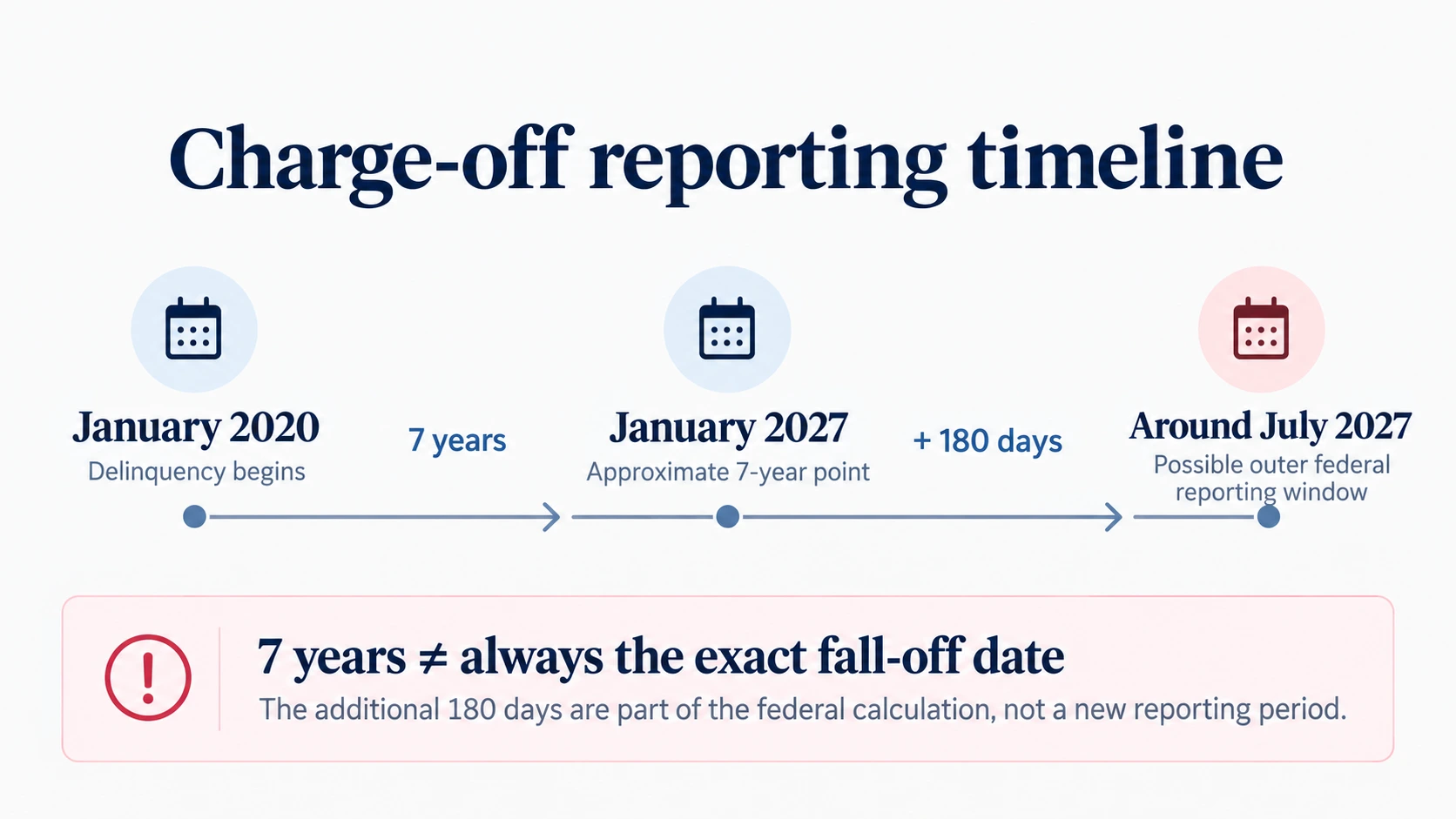
What this means: A charge-off that still appears shortly after the seven-year anniversary of the delinquency is not automatically being reported too long. Check the possible seven-years-plus-180-days window before concluding that the information is obsolete.
Can a charge-off stay on your credit report longer than 7 years?
Yes, the technical FCRA calculation can allow a reporting period extending beyond the seven-year anniversary. That is why a charge-off does not necessarily disappear on the exact date seven years after the first missed payment.
Do charge-offs fall off exactly after seven years?
Not necessarily. When estimating when the account should stop appearing, use the delinquency that led to the charge-off rather than the later charge-off date or a recent update date.
Example: how to estimate when a charge-off may fall off
To estimate when a charge-off may fall off your credit report, identify the first missed payment in the continuous delinquency that led to the charge-off. Then compare that date with the charge-off date, any recent update date, and the estimated removal date shown on your report.
Hypothetical credit report example
| Credit report field | Example | How to use it |
|---|---|---|
| Creditor | ABC Bank | Identifies the original account |
| Date of first delinquency | January 2020 | Main date for estimating the reporting timeline |
| Charge-off date | July 2020 | Shows when the account was charged off, not a new seven-year starting date |
| Date updated | August 2026 | Shows recent reporting activity, not a new delinquency |
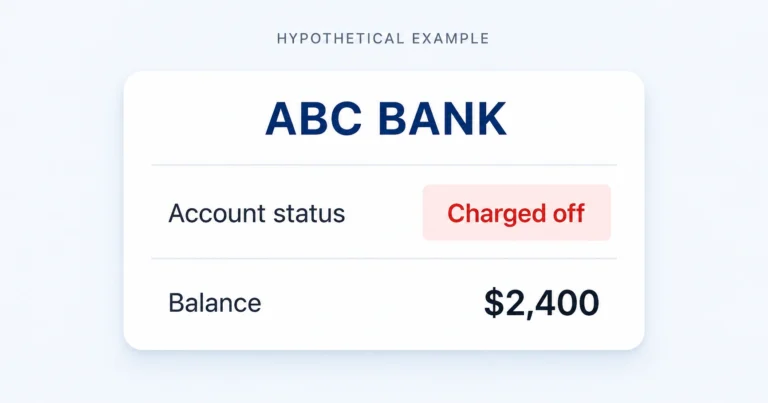
| Current balance | $2,400 | Relevant to the amount being reported, not the start of the reporting period |
| Account status | Charge-off | Shows how the creditor currently reports the account |
| Estimated removal date | June 2027 | Compare it with the delinquency timeline |
Work through the timeline
- January 2020: The continuous delinquency begins.
- July 2020: The account is charged off. This does not start another seven-year reporting period.
- January 2027: The account reaches the approximate seven-year point.
- Around July 2027: The possible outer federal reporting window is reached when the additional 180 days are included.
Result: The June 2027 estimated removal date in this hypothetical example falls within the approximate reporting window based on the January 2020 delinquency. The August 2026 update does not move the reporting period to August 2033.
What if the account was brought current?
The calculation changes if an earlier delinquency was cured. Suppose you missed a payment in January 2020, brought the account fully current in March, then stopped paying again in September and remained delinquent until the account was charged off.
| Account event | Example date | How it affects the timeline |
|---|---|---|
| Earlier missed payment | January 2020 | Would generally not control the later charge-off because the account was subsequently brought current |
| Account brought fully current | March 2020 | Ends the earlier continuous delinquency |
| New continuous delinquency begins | September 2020 | Generally becomes the relevant starting point for the later charge-off |
| Account charged off | March 2021 | Does not create a separate seven-year reporting period |
Before estimating your own fall-off date, check whether the account was ever brought fully current between missed payments. Using a delinquency that was later cured can make your estimate too early.
Does anything restart the charge-off reporting clock?
No. Paying, partially paying, settling, disputing, verifying, selling, transferring, or routinely updating a charge-off does not restart the federal credit-reporting period.
If the account was brought fully current and you later defaulted again, a later continuous delinquency may become relevant. That is not the old reporting period restarting; it is a separate later delinquency.
What happens to the reporting period after each account event?
| Account event | Does it restart the reporting period? | What may change on the report? |
|---|---|---|
| Pay the balance in full | No | Balance and payment status may be updated |
| Make a partial payment | No | The reported balance may change |
| Settle the debt | No | Balance and settlement status may change |
| File a dispute | No | The account may be marked as disputed while it is reviewed |
| Information is verified | No | The account may receive a newer update date |
| Debt is sold or transferred | No | The company owning or reporting the debt may change |
| Balance or status is updated | No | The balance, status, or date updated may change |
| Charge-off is reported in another month | No | The date updated may become more recent |
| Account was brought fully current and later defaulted again | A later delinquency may control | The later continuous delinquency may become relevant to a later charge-off |
Key distinction: A recent “date updated” is not the same as a new date of first delinquency. Do not add another seven years simply because an old charge-off received a newer update date.
Why does my old charge-off show a recent update date?
A creditor or other company furnishing the account may continue reporting changes to the balance, status, or other account information. That can create a recent update date without changing the delinquency that controls the federal reporting timeline.
If the account continues to receive monthly updates, see whether a charge-off can be reported every month and which dates, balances, and status information you should compare for accuracy.
How long does a paid charge-off stay on your credit report?
A paid charge-off can generally remain on your credit report until the original reporting period tied to the delinquency that led to the charge-off ends. Paying the account does not start a new seven-year reporting period or automatically delete the charge-off.
What changes after you pay a charge-off?
| Account status | What it means | Does the original reporting timeline change? |
|---|---|---|
| Unpaid charge-off | The account remains charged off and may still show an amount owed | No |
| Paid charge-off | The charged-off balance has been paid, and the balance and status should reflect the payment | No |
| Settled charge-off | The creditor accepted an agreed amount to resolve the debt, and the account may be reported as settled | No |
| Deleted charge-off | The tradeline no longer appears on that credit report | The account is no longer being reported on that report |
Example: paying a charge-off years later
Suppose the continuous delinquency began in May 2021, the account was charged off in November 2021, and you paid the full balance in February 2025.
| Account event | Example date | Effect on the reporting timeline |
|---|---|---|
| Continuous delinquency begins | May 2021 | Generally controls the reporting timeline |
| Account is charged off | November 2021 | Does not create a new seven-year period |
| Balance is paid | February 2025 | Does not restart the reporting period |
| Approximate seven-year point | May 2028 | Still based on the original continuous delinquency |
Result: Paying the charge-off in February 2025 may change the balance and status, but it does not move the start of the reporting period to 2025.
Does paying a charge-off remove it from your credit report?
No, not automatically. Paying the debt can resolve the balance without deleting accurate negative account history before the applicable reporting period ends.
If you have already resolved the balance and want to understand the legitimate options that may apply, see whether a paid charge-off can be removed early.
Why is my charge-off still on my credit report after 7 years?
A charge-off that still appears after the approximate seven-year point is not automatically being reported incorrectly. First confirm that you counted from the delinquency that led to the charge-off, check the possible additional 180-day reporting window, and determine whether an earlier delinquency was ever cured.
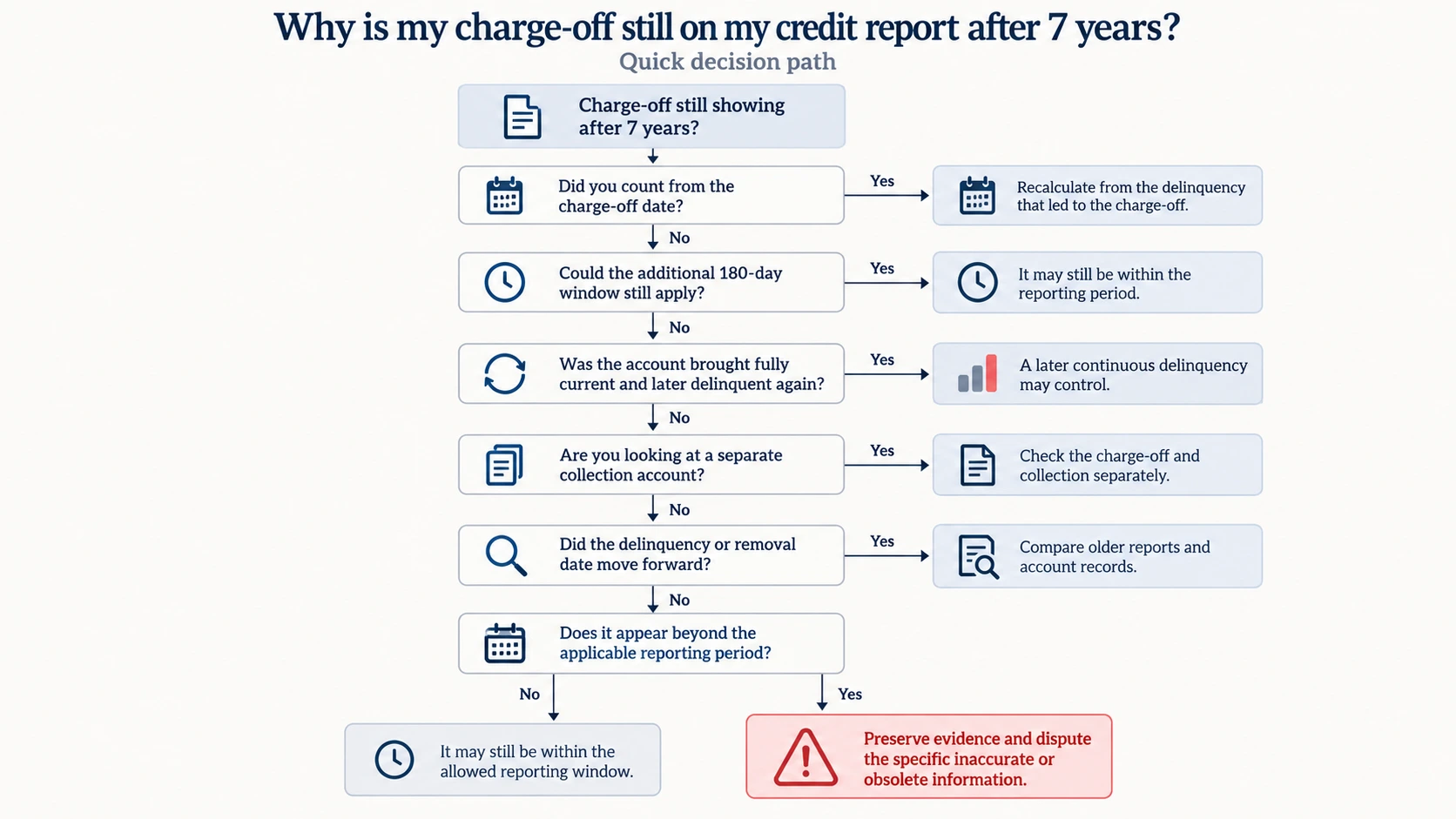
Use this decision path to find the reason
1. Did you count seven years from the charge-off date?
Yes: Recheck the timeline using the first missed payment in the continuous delinquency that led to the charge-off.
No: Continue to the next check.
2. Could the account still be within the possible additional 180-day reporting window?
Yes: The account may still be within the applicable federal reporting period. Compare your estimate with any estimated removal date shown on your reports.
No: Continue to the next check.
3. Was the account brought fully current and then delinquent again?
Yes: A later continuous delinquency may be the relevant starting point. Review the payment history and identify the delinquency that actually led to the charge-off.
No: Continue to the next check.
4. Are you looking at a separate collection account?
Yes: The original creditor account and a collection account are separate tradelines. See the difference between a charge-off and a collection account before assuming that the original charge-off is the entry still being reported.
No: Continue to the next check.
5. Did the delinquency timeline or estimated removal date move forward?
Yes: Compare the current report with older reports, statements, payment records, and collection notices. A later payment, settlement, dispute, sale, transfer, or routine update does not by itself create a new federal reporting period.
No: Continue to the final check.
6. Does the account appear to remain beyond the applicable reporting period?
Yes: Identify the exact information that appears inaccurate or obsolete, save the records supporting the correct timeline, and follow the process for disputing inaccurate or obsolete credit report information.
No: The account may still be within the applicable reporting period.
Evidence to save before disputing the reporting date
- □ Current Equifax credit report
- □ Current Experian credit report
- □ Current TransUnion credit report
- □ Older credit reports showing an earlier delinquency or estimated removal date
- □ Account statements showing payment history
- □ Payment records showing whether the account was ever brought fully current
- □ Charge-off or collection notices showing relevant dates
- □ Records supporting when the continuous delinquency began
Do not dispute a charge-off simply because it is negative. A factual dispute should identify a specific problem, such as an inaccurate delinquency date, obsolete reporting, an incorrect balance or status, duplicate information, or another supported error.
Three-bureau charge-off comparison worksheet
Compare the same charge-off across Equifax, Experian, and TransUnion before deciding that a date, balance, status, or reporting timeline is wrong. Record what each report shows, then compare those entries with your own statements, payment records, notices, and older credit reports.
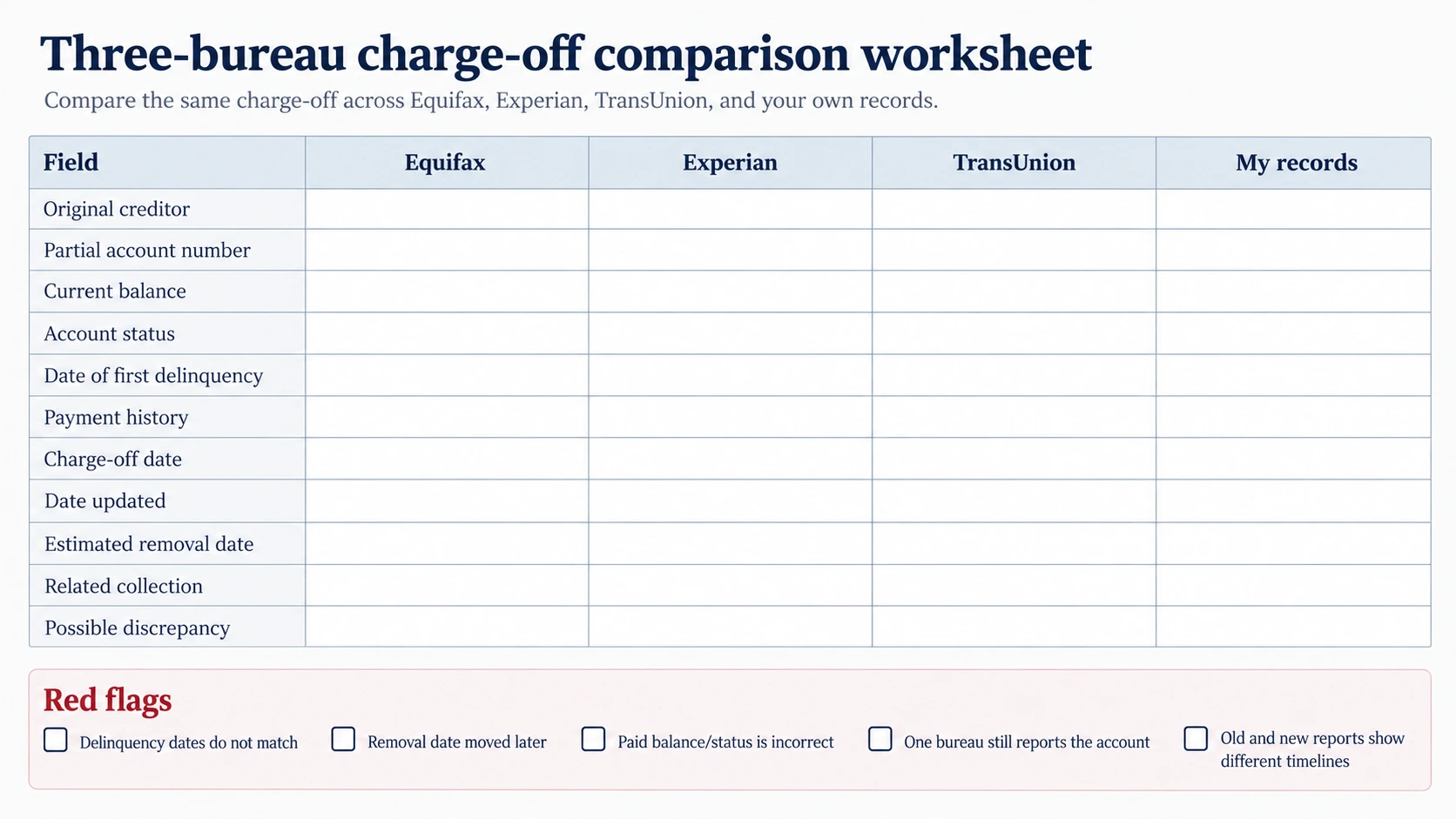
| What to compare | Equifax | Experian | TransUnion | Your records |
|---|---|---|---|---|
| Original creditor | ||||
| Partial account number | ||||
| Current balance | ||||
| Account status | ||||
| Date of first delinquency, if shown | ||||
| Payment history | ||||
| Charge-off date | ||||
| Date updated | ||||
| Estimated removal date, if shown | ||||
| Related collection account | ||||
| Possible discrepancy |
Red flags to check more closely
- □ The delinquency timeline differs between reports
- □ One report shows a substantially later estimated removal date
- □ A newer report shows a later delinquency or removal date than an older copy
- □ A recent update date appears to be confused with the original delinquency date
- □ A paid charge-off shows a balance or status that does not match your records
- □ A debt sale or transfer appears alongside a later delinquency timeline
- □ The original creditor account and a related collection account show inconsistent information
- □ The charge-off appears to remain beyond the expected reporting window
What to do with the results
| What you find | What to check next |
|---|---|
| All three reports show a consistent timeline | Compare the reported dates with your payment history and older account records before assuming there is an error |
| Only one bureau shows a different delinquency or removal date | Save that report along with the other two and any records supporting the earlier timeline |
| All three show a later delinquency date than your older records | Check whether the account was ever brought fully current and later became delinquent again |
| The estimated removal date moved later | Compare the newer report with older copies and check whether the underlying delinquency timeline also changed |
| A paid charge-off shows the wrong balance or status | Compare the report with payment confirmations, settlement documents, and account statements |
| The account appears beyond the applicable reporting period | Save the reports and records supporting the correct timeline before disputing the specific information you believe is inaccurate or obsolete |
Important: A difference between credit reports does not automatically prove that one report is wrong. Credit bureaus may display account information differently. Focus on material facts such as the delinquency timeline, balance, status, ownership, and estimated removal date.
What happens after a charge-off falls off your credit report?
When a charge-off reaches the end of its applicable reporting period, the tradeline should stop appearing on the affected standard consumer credit report. Its removal does not automatically cancel the debt or guarantee a credit score increase.
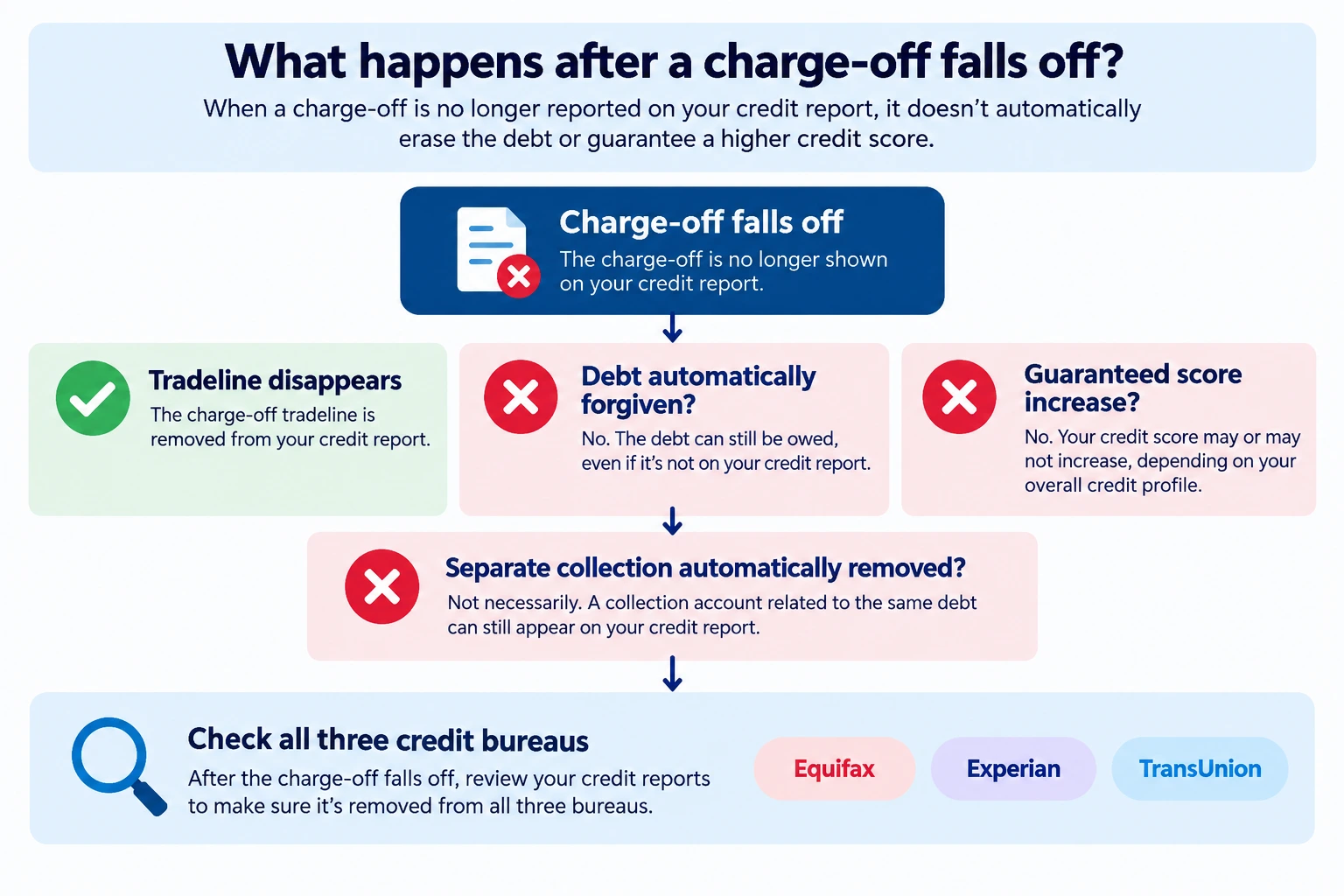
| What changes | What it means |
|---|---|
| The charge-off tradeline disappears | The account should no longer appear as a charge-off on that credit report |
| The debt itself | Removal from a credit report does not automatically forgive or cancel the underlying debt |
| Your credit score | Your score may change, but the amount cannot be predicted from the removal alone |
| A related collection account | A separate collection tradeline must be checked separately |
| Your remaining credit history | Other negative information, balances, payment history, account age, and recent activity may still affect your credit profile |
What should you check after the charge-off disappears?
- □ Confirm that the charge-off is no longer shown on your Equifax report
- □ Confirm that it is no longer shown on your Experian report
- □ Confirm that it is no longer shown on your TransUnion report
- □ Check whether a separate collection account related to the same debt remains
- □ Make sure an obsolete balance, status, or duplicate tradeline did not remain
- □ Save updated copies of all three reports
- □ Do not assume removal will produce a specific credit score increase
Example: the charge-off disappears from only two reports
Suppose a charge-off reaches its expected removal period in June 2027. In July, Equifax and Experian no longer show the account, but TransUnion still reports it.
| Credit report | What you see | What to check |
|---|---|---|
| Equifax | Charge-off no longer appears | Save a copy of the updated report |
| Experian | Charge-off no longer appears | Save a copy of the updated report |
| TransUnion | Charge-off still appears | Compare its delinquency and estimated removal dates with older reports and account records |
Result: Do not assume the charge-off has been removed everywhere just because it disappeared from one or two reports. Check all three separately.
Will your credit score go up when a charge-off falls off?
It may, but there is no guaranteed number of points. The effect depends on the scoring model and the rest of your credit profile, including other negative information, credit utilization, payment history, account age, and recent activity.
Credit reporting period vs. statute of limitations
The credit-reporting period and the statute of limitations are separate timelines. A charge-off falling off your credit report does not automatically erase the debt or determine whether a lawsuit to collect it would still be timely.
| Timeline | What it controls | What happens when it ends |
|---|---|---|
| Credit-reporting period | How long negative account information may generally appear on consumer credit reports | The charge-off should no longer be reported once the applicable reporting period has expired |
| Statute of limitations | How long a lawsuit to collect the debt may be legally available | A lawsuit may become time-barred, depending on applicable law, the type of debt, and other circumstances |
| Underlying debt | Whether the creditor or collector still claims money is owed | The debt does not automatically disappear simply because credit reporting ends or the statute of limitations expires |
Why the two timelines may end on different dates
The charge-off reporting period is governed by federal credit-reporting law, while the statute of limitations for a debt generally depends on applicable state law and the type of obligation. The two periods therefore may end on different dates.
Do not use the seven-year credit-reporting rule as a statute-of-limitations calculator. The date a charge-off disappears from your credit report does not tell you by itself whether a lawsuit over the debt would still be timely.
Can debt still be collected after a charge-off falls off?
Possibly. Removing a charge-off from your credit report does not automatically cancel the underlying debt. Whether legal action to collect it is still available depends on the applicable statute of limitations and other legal rules.
If a debt is time-barred, federal law generally prohibits a debt collector covered by the Fair Debt Collection Practices Act from suing or threatening to sue to collect it. That does not mean every other form of communication or collection activity is automatically prohibited.
What should you check before paying or responding to an old charge-off?
- Identify who is contacting you. Confirm the current creditor or collector, original creditor, account involved, and amount being claimed.
- Identify the type of debt. The applicable statute of limitations can vary by the type of obligation and governing law.
- Review the account history. Gather statements, payment records, collection notices, and documents showing relevant dates.
- Do not rely on the credit-report removal date. A charge-off falling off your reports does not establish the deadline for filing a collection lawsuit.
- Check the legal effect before making a payment or acknowledging an old debt. In some states, certain actions can affect the statute-of-limitations analysis.
If you receive a lawsuit over an old charge-off, do not ignore it because the account has already disappeared from your credit report. Whether the lawsuit is timely is a separate legal question from whether the debt may still be reported.
Frequently asked questions
Does paying a charge-off restart the reporting period?
No. Paying or settling a charge-off does not create a new federal credit-reporting period. The relevant timeline remains tied to the delinquency that led to the charge-off.
Does the charge-off date start the seven-year clock?
Usually no. The reporting period is generally tied to the delinquency that immediately preceded the charge-off, not simply to the later accounting date when the creditor charged the account off.
Can a charge-off stay longer than seven years?
The Fair Credit Reporting Act uses a technical calculation that can extend beyond a simple seven-year shorthand. The article explains how the additional 180-day component works.
Does the debt disappear when the charge-off falls off the report?
No. Credit reporting and the legal enforceability or existence of a debt are separate issues. The statute of limitations is also a different timeline.
Related guides
- Charge-offs hub — reporting timelines, balances, payments, and removal questions.
- Can a charge-off be reported every month? — understand routine updates versus a changed delinquency date.
- Can a paid charge-off be removed? — what payment changes and what it does not.
Sources
- 15 U.S.C. § 1681c — Requirements relating to information contained in consumer reports — Federal law governing how long certain negative information, including charge-offs, may be reported and how the reporting period is calculated.
- Consumer Financial Protection Bureau — How long does information stay on my credit report? — Consumer guidance on how long negative information may remain on a credit report.
- Federal Trade Commission — Amason staff advisory opinion (February 15, 2000) — Historical staff guidance on the delinquency date and later payments, sales, or disputes; read alongside the statute.
- Federal Trade Commission — Johnson staff advisory opinion (August 31, 1998) — Historical staff guidance on the commencement of delinquency; read alongside the statute.
- Consumer Financial Protection Bureau — How do I dispute an error on my credit report? — Steps for disputing inaccurate information with credit reporting companies.
- Consumer Financial Protection Bureau — Can debt collectors collect a debt that’s several years old? — Guidance on old and time-barred debts and why the statute of limitations is separate from credit reporting.
- Consumer Financial Protection Bureau — Regulation F, § 1006.26 — Federal rules addressing collection of time-barred debt.
- AnnualCreditReport.com — The federally authorized website for obtaining credit reports from Equifax, Experian, and TransUnion.
Reviewed for accuracy: September 2026
Disclaimer: This article is for general educational purposes only and is not legal, financial, or credit-repair advice. Credit-reporting rules, statutes of limitations, and debt-collection rights can depend on the facts of your account and the law that applies to your situation.