In this guide
- Why can your credit score drop after paying off a car loan?
- How much can your credit score drop after paying off a car?
- How long after paying off a car loan does your credit score update?
- What should a paid-off auto loan show on your credit report?
- What should you do if your score dropped after paying off your car?
- Should you take out another loan to bring your credit score back up?
- Will your credit score go back up after paying off a car loan?
- What if the paid-off car loan is reported incorrectly?
- Example: you paid off your only car loan and your score fell
- Frequently asked questions
- Bottom line
- Sources and methodology
Quick answer: Yes, your credit score can drop after you pay off a car loan, even though paying off the loan is financially positive. An auto loan is an installment account. When it is paid in full, the account usually reports a $0 balance and closes. That can change the mix of active credit on your reports and, in some FICO score profiles, remove the scoring benefit associated with having an active installment loan that has been substantially paid down. The payoff may also reach the credit bureaus at the same time as another change, such as a higher credit card balance or a new inquiry. A lower score after payoff does not mean you should borrow again just to rebuild your score. First confirm that the auto loan is reporting correctly, then review the rest of your credit reports for other changes.
Why can your credit score drop after paying off a car loan?
A car loan is an installment loan. You borrow a fixed amount and repay it over a set period through scheduled payments. While the loan is open, your credit report shows both the original loan amount and the remaining balance. As you pay the loan down, the remaining balance becomes smaller relative to the amount originally borrowed.
FICO explains that its scoring models can consider how much of an installment loan has been paid down. A heavily paid-down active installment loan can look different to the scoring model from having no active installment loan at all. If your car loan was your only active installment account, paying it off can therefore change the information used to calculate your score.
This does not mean paying off the car was a mistake. A credit score is one financial metric. Eliminating a required monthly payment, avoiding future interest, and owning the vehicle free of the loan can matter more than preserving a particular score configuration.
1. Your active installment loan closed
This is one reason revolving and installment credit work differently: repaying a car loan normally ends that borrowing agreement, while repaying a credit card can restore its available limit.
The most direct reason is that the auto loan changed from an open installment account with a remaining balance to a paid, closed installment account with a $0 balance.
FICO states that paying off the last active installment loan can cause a FICO Score to decrease for some consumers. Its scoring research distinguishes between an installment loan that is still active and substantially paid down and a profile with no active installment loans.
If you still have another active installment account, such as a mortgage, student loan, or personal loan, the effect may be different because your credit profile still contains active installment debt. Your exact result depends on the rest of the information in your credit file and on the scoring model being used.
2. Your credit mix changed
Credit scoring models can consider whether you have experience managing different types of credit. Revolving accounts, such as credit cards, operate differently from installment accounts, such as auto loans and mortgages.
When an auto loan closes, the historical account can remain on your credit report, but it is no longer an active installment loan. That changes the current structure of your credit profile.
Do not respond by opening a new loan solely to restore your “credit mix.” FICO itself cautions against applying for a new type of credit just for scoring purposes. A new loan can create a hard inquiry, add new debt, and introduce a new account with little payment history.
3. Another change happened at about the same time
The car payoff may not be the only event affecting your score.
Compare your credit reports before and after the score change, if you have both versions. Look for:
- a higher reported credit card balance;
- a lower credit limit;
- a new hard inquiry;
- a newly opened credit account;
- a late payment;
- a collection account;
- a change in the status of another account; or
- an error in the information being reported.
If your revolving balances increased around the same time, credit utilization may have changed too. Auto loans are not included in the standard revolving utilization calculation, but credit cards are. See our guide to how credit utilization affects your credit score if card balances also changed.
4. You may be comparing different credit scores
You do not have only one credit score. Different lenders and consumer apps may use different scoring models, different versions of a model, and data from different credit bureaus.
For example, an auto lender may use a FICO Auto Score, while a consumer app may show a different FICO Score or a VantageScore. Even two scores calculated with the same general model can differ if one is based on Experian data and another on TransUnion data.
When you are investigating a change, compare the same score model, bureau, and source over time when possible. Otherwise, you may attribute a difference between two scores to the car payoff even though the scores were never directly comparable.
How much can your credit score drop after paying off a car?
There is no reliable number of points that applies to everyone.
You may see online claims that paying off a car loan causes a specific 10-, 20-, 30-, or 50-point decrease. Those figures should not be treated as a rule. Credit scoring models evaluate the entire credit file, so two people who both pay off their last auto loan can have different results.
The effect may depend on factors such as:
- whether the car loan was your only active installment loan;
- how much of the loan had already been paid down;
- your credit card utilization;
- your payment history;
- the age of your accounts;
- recent inquiries and newly opened accounts;
- other negative or positive information in your credit reports; and
- which scoring model calculated the score.
If your score dropped 30 points after paying off a car, do not assume that “30 points” is the standard payoff penalty. Instead, use the change as a reason to inspect the underlying reports.
How long after paying off a car loan does your credit score update?
Your score cannot reflect the payoff until the updated account information reaches the credit report used to calculate that score.
Experian says lenders typically report account updates around the end of a billing cycle, and it can take roughly 30 to 45 days for a paid account to be reflected in a credit report. Timing varies by lender and bureau.
That means there are two separate events:
- You pay off the car loan. Your lender records the payoff.
- The lender reports the update. A credit bureau receives new information showing the balance and status.
Your credit score can then be recalculated using the updated report data. For more detail, see how often your credit score updates.
If the payoff happened only a few days ago and your report still shows the old balance, that alone does not prove there is an error. Check the account’s “date updated” or similar field before taking action.
What should a paid-off auto loan show on your credit report?
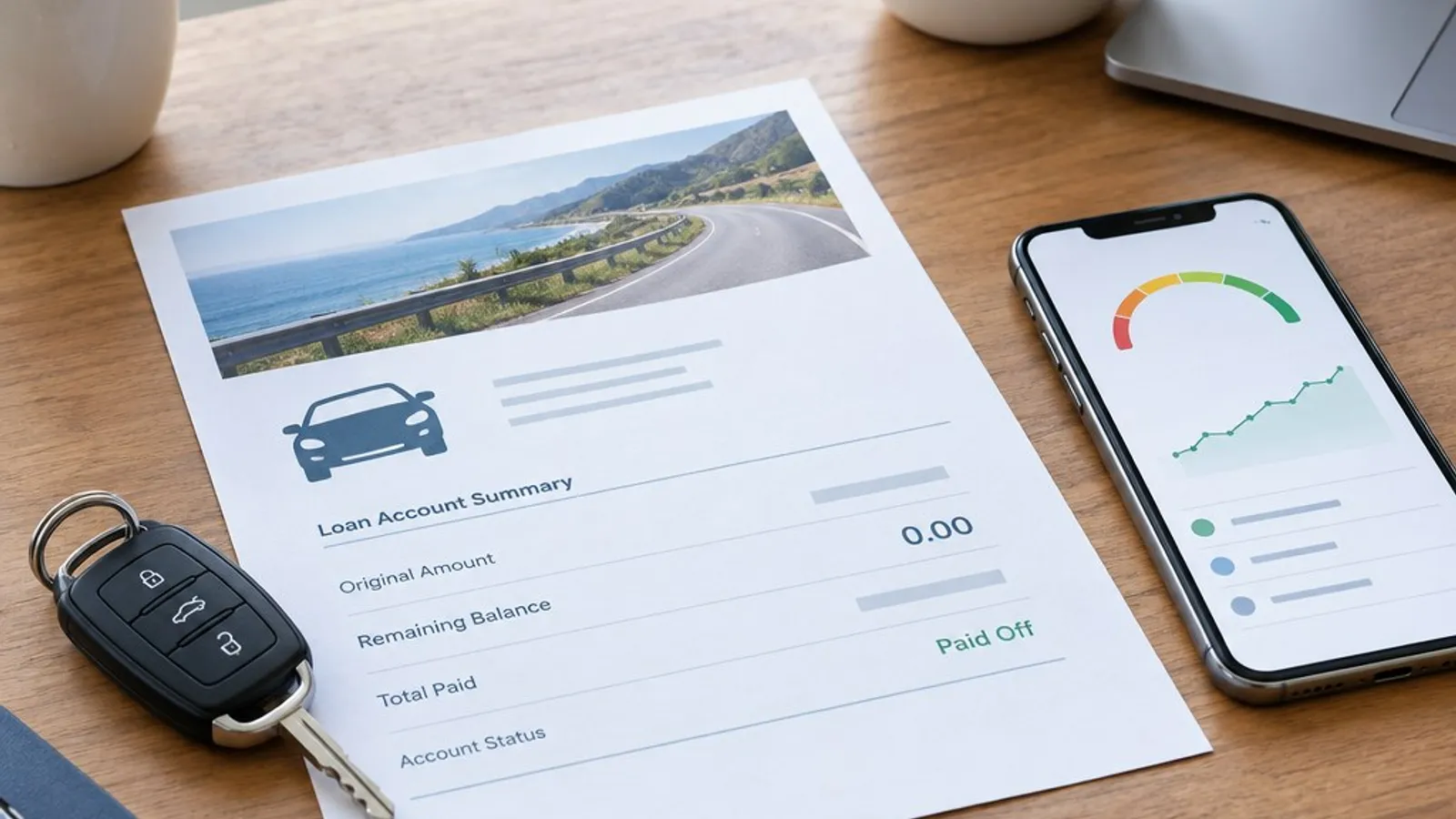
After the lender reports the payoff, a fully paid auto loan should generally show a $0 current balance and a status indicating that the account is paid and/or closed, depending on the bureau’s terminology.
If the payoff came from refinancing, you also have a replacement loan to consider. Read does refinancing a car loan hurt your credit score? for the differences between an outright payoff and a refinance, including the new account, inquiry and payment switch.
The account does not need to disappear just because you paid it off. The Consumer Financial Protection Bureau notes that positive payment history can remain on a credit report after a loan is paid and closed.
Check these fields on each of your three reports:
| Field | What to check after payoff |
|---|---|
| Current balance | Should reflect $0 after the payoff update is reported. |
| Account status | Should accurately reflect that the loan is paid/closed. |
| Payment history | Past payments should be reported accurately. |
| Date updated | Helps you determine whether the bureau has received post-payoff information. |
| Ownership | The account should belong to you and match your records. |
You can obtain your reports from AnnualCreditReport.com, the federally authorized source for free reports from Equifax, Experian, and TransUnion. Checking your own reports through that service does not hurt your credit scores.
If you are not sure what the fields mean, use our step-by-step guide to reading a credit report.
What should you do if your score dropped after paying off your car?
Step 1: Confirm the payoff is actually reporting
Find the auto loan on all three credit reports. Compare the current balance, status, and date updated with your payoff confirmation.
If the report was last updated before you made the final payment, the bureau may simply be showing older information.
Step 2: Check whether this was your only active installment loan
Review the other open accounts on your reports. If you no longer have any active auto, mortgage, student, or personal installment loans, the closure of your car loan may have changed the installment portion of your credit profile.
That is a scoring explanation, not a reason to borrow again.
Step 3: Review your credit card balances and limits
Look at the balances and limits actually reported to the bureaus. A higher revolving balance or a reduced limit can raise utilization and affect a score around the same time as the car payoff.
Do not rely only on what your banking app shows today. The balance on your credit report may reflect an earlier reporting date.
Step 4: Look for unrelated changes
Scan the full report for new inquiries, new accounts, late payments, collections, or account-status changes. If the decrease seems unexplained after the car payoff, our guide to why your credit score dropped for no obvious reason gives you a broader troubleshooting checklist.
Step 5: Make sure you are comparing like with like
Write down:
- the score source;
- the scoring model, if shown;
- the credit bureau used;
- the date the score was calculated; and
- the old and new score.
This prevents you from comparing a FICO Score based on one bureau with a VantageScore based on another and assuming the difference came from the payoff.
Should you take out another loan to bring your credit score back up?
Usually, taking on debt solely to try to recover points is not a sensible response.
A new loan may involve interest, fees, a hard inquiry, and a new account. The financial cost can outweigh any scoring benefit. FICO specifically advises consumers to consider the risk versus reward before adding credit simply to change the credit mix.
If you actually need financing for a legitimate reason, evaluate it based on the cost and your financial needs. But do not keep an auto loan open and pay interest only because you are afraid that closing it could change your score.
If your reports are accurate and the only major change was the payoff, keep your remaining accounts current, avoid unnecessary applications, and manage revolving balances responsibly. See how to fix your credit score after paying off debt for the broader after-payoff process.
Will your credit score go back up after paying off a car loan?
It can, but there is no guaranteed recovery date or number of points.
FICO notes that a score decrease after paying off an installment loan should not necessarily be viewed as permanent. Credit scores are dynamic: they change as lenders report new balances, payments, account activity, inquiries, and other information.
If you continue paying remaining accounts on time and keep revolving debt manageable, your credit profile continues to develop. But no one can accurately promise that your score will recover by a specific amount or on a specific date.
The more useful question is whether the information on your credit reports is accurate and whether your current credit behavior supports your broader financial goals.
What if the paid-off car loan is reported incorrectly?
A score decrease by itself is not a valid reason to dispute an account. Dispute only information that is actually inaccurate or incomplete.
The CFPB recommends checking for errors such as an incorrect current balance, an account incorrectly shown as open, or inaccurate payment-status information. If you find a specific error, you can dispute it with the credit reporting company and with the lender that furnished the information.
Keep copies of documents that support your position, such as:
- the payoff confirmation;
- the final loan statement;
- bank records showing the final payment;
- the title or lien-release documentation, if relevant; and
- copies of the credit report showing the disputed information.
For a broader payoff troubleshooting process, read why a credit score can drop after paying off debt.
Example: you paid off your only car loan and your score fell
Suppose you had one auto loan with an original balance of $25,000. You had gradually paid it down to $800, then made the final payment.
Before payoff, your report showed an active installment loan with a very small remaining balance relative to the original amount. After payoff, the lender reported a $0 balance and the account closed. You had no mortgage, student loan, or other active installment loan.
If a FICO Score then decreased, one possible explanation is the change from a substantially paid-down active installment loan to no active installment loan. But you should still check the rest of the report. If a credit card also reported a much higher balance that month, the score change may reflect more than one factor.
The correct response is not automatically to finance another vehicle. Confirm the reporting, identify all changes, and make decisions based on your finances rather than chasing a particular score.
Frequently asked questions
Why did my credit score go down after paying off my car?
Paying off a car loan closes an active installment account. In some FICO score profiles, losing the last active installment loan or changing the amount of installment debt being actively repaid can contribute to a lower score. Other credit-report changes may also have happened at the same time.
Does paying off a car loan hurt your credit?
It can cause a score decrease in some situations, but that does not mean paying off the loan was financially harmful. You eliminate the debt and future required payments. The scoring impact depends on your overall credit profile.
How much does a credit score drop after paying off a car?
There is no standard number of points. The result varies by credit file and scoring model. Claims that every consumer will lose a specific number of points are not reliable.
Why did my FICO Score drop after paying off my auto loan?
FICO says paying off an installment loan can lower a score when the payoff changes the installment-loan information in the credit profile, particularly when the account was the last active installment loan.
How long does it take for a paid-off car loan to show on a credit report?
Reporting timing varies. Experian says lenders typically report around the end of a billing cycle, and it can take roughly 30 to 45 days for a paid account update to appear. Check the report’s update date and contact the lender if the payoff remains missing beyond the expected reporting cycle.
Bottom line
If your credit score dropped after you paid off a car loan, start with the data behind the score. Confirm that the lender reported a $0 balance and paid/closed status, check whether the loan was your last active installment account, review credit card utilization and other recent changes, and make sure you are comparing the same type of credit score over time.
A payoff-related score decrease does not mean you should take on new debt. If the credit report is accurate, focus on maintaining healthy credit behavior. If the report contains a factual error, document the problem and use the formal dispute process.
Explore related guides on credit scores.
Sources and methodology
- FICO: Can paying off installment loans cause a FICO Score to drop?
- FICO: Why did my FICO Score drop after paying off a loan?
- FICO: How owing money can impact your credit score
- Experian: How quickly will paying off an account affect my credit score?
- CFPB: Common credit report errors
- CFPB: How to dispute an error on your credit report
- CFPB: How long information stays on a credit report
- AnnualCreditReport.com
Reviewed against official FICO, CFPB, Experian, and federally authorized credit-report resources. This article is for educational purposes and is not individualized financial advice.