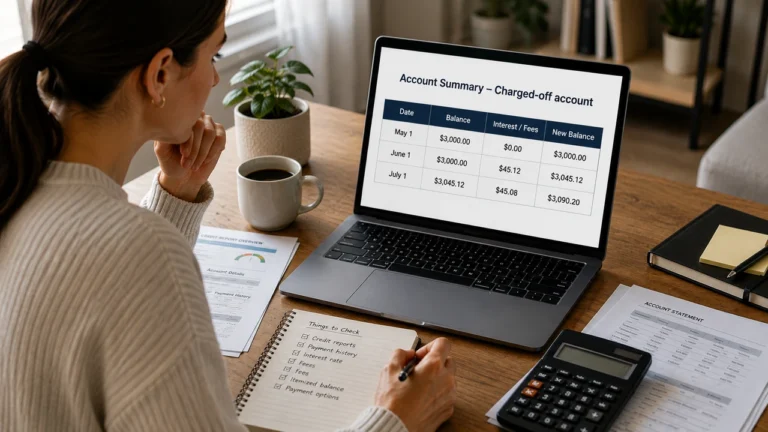
Can a collection agency charge interest? Yes, but only when the original agreement authorizes it or applicable law permits it. A collector cannot create a new interest rate or add unsupported fees simply because the debt was assigned, sold, or charged off.
Quick answer: A collection agency may be allowed to keep adding interest, but only if the original agreement authorizes it or applicable law permits it. A collector generally cannot create a new interest rate, add unexplained fees, or increase your balance simply because the debt was transferred or sold.
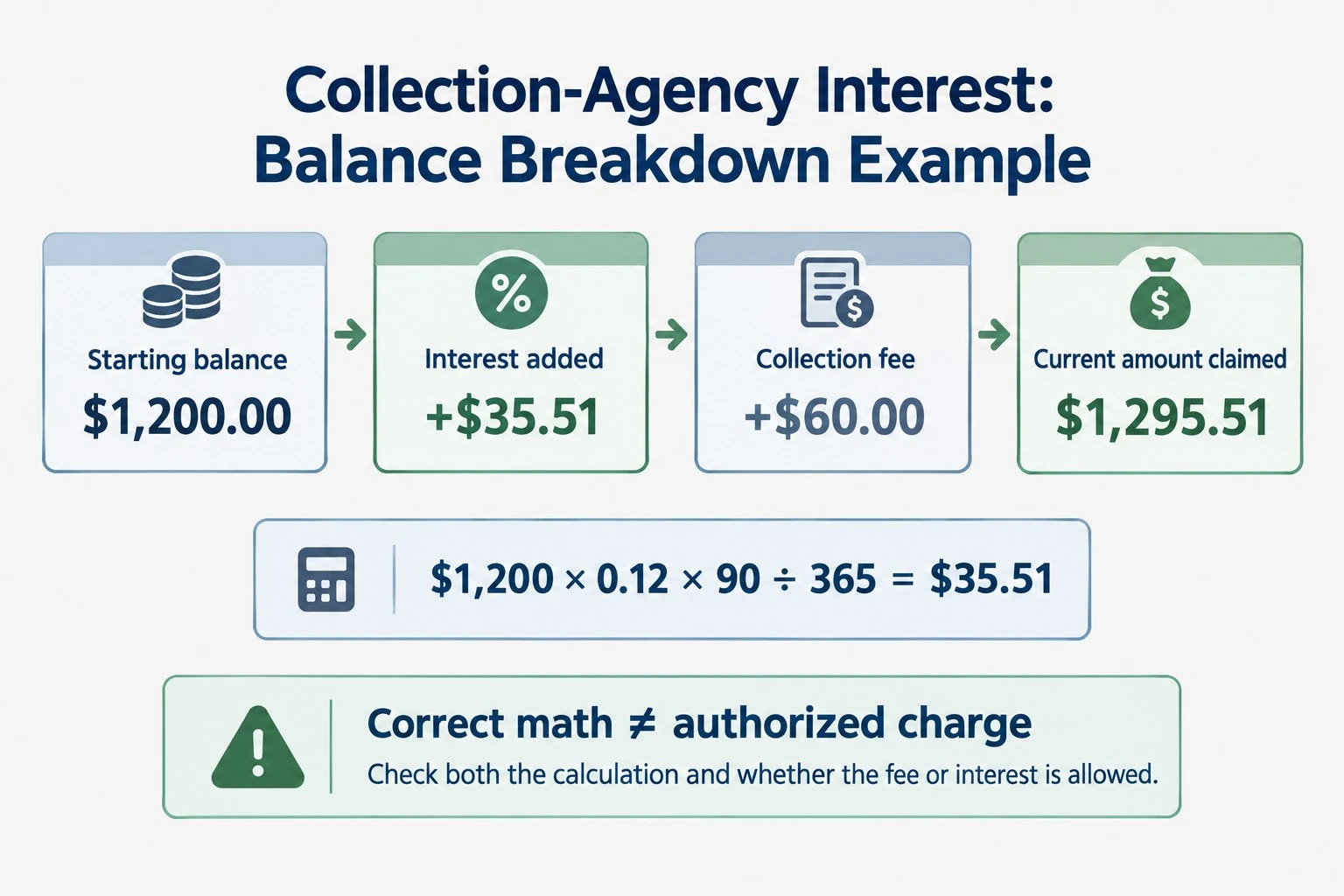
If your collection balance keeps increasing, ask for an itemized statement showing the starting balance, interest rate, interest added, fees, payments, and credits. Then compare those amounts with the original agreement and the collector’s validation notice.
The most important question is not whether a collection agency can ever charge interest. It is whether this particular collector has a valid contractual or legal basis for every additional dollar it is demanding.
- Can a collection agency legally charge interest?
- Check these three details before accepting the balance
- Why does my collection balance keep increasing?
- Review the increased balance more closely if:
- Example of an increasing collection balance
- How to verify interest added by a collection agency
- Step 1: Find the itemization date
- Step 2: Record the starting and current balances
- Step 3: Identify the interest rate and calculation period
- Step 4: Separate interest from fees
- Step 5: Confirm every payment and credit
- Step 6: Reconcile the current balance
- Use this collection interest worksheet
- Example: find the unexplained difference
- What to request from the collection agency
- What should you do if the collection interest appears incorrect?
- Step 1: Identify the exact problem
- Step 2: Request an itemized account history
- Step 3: Send the request in writing
- Sample request for an itemized interest calculation
- Step 4: Compare the collector’s response with your records
- Step 5: Dispute inaccurate credit reporting separately
- Step 6: Escalate an unresolved problem when necessary
- Can you negotiate or stop collection interest?
- Four ways to negotiate collection interest
- Ask to freeze future interest
- Ask to reduce accrued interest
- Compare a settlement with a payment plan
- Questions to ask before accepting an agreement
- Get every promise in writing before paying
- Written agreement checklist
- Check the age of the debt before paying
- Can a collection agency charge more than the original debt?
- Can a collection agency double your debt?
- Example of a balance higher than the original debt
- Question the higher balance if:
- Does interest continue after a debt is sold or charged off?
- What should transfer to the new collector?
- Compare the account before and after the transfer
- What if the original creditor stopped adding interest?
- Review the transferred debt more closely if:
- Can a collection agency charge interest on medical debt?
- Verify the correct medical balance before checking interest
- Check whether surprise-billing protections apply
- How to check interest on a medical collection
- Question medical collection interest if:
- Frequently asked questions about collection interest
- Can a collection agency add interest every month?
- Can a debt collector change the interest rate?
- Does disputing a debt stop interest?
- Does making a payment stop collection interest?
- Can interest continue during a collection payment plan?
- Can a collection agency charge a payment or convenience fee?
- The bottom line
Can a collection agency legally charge interest?
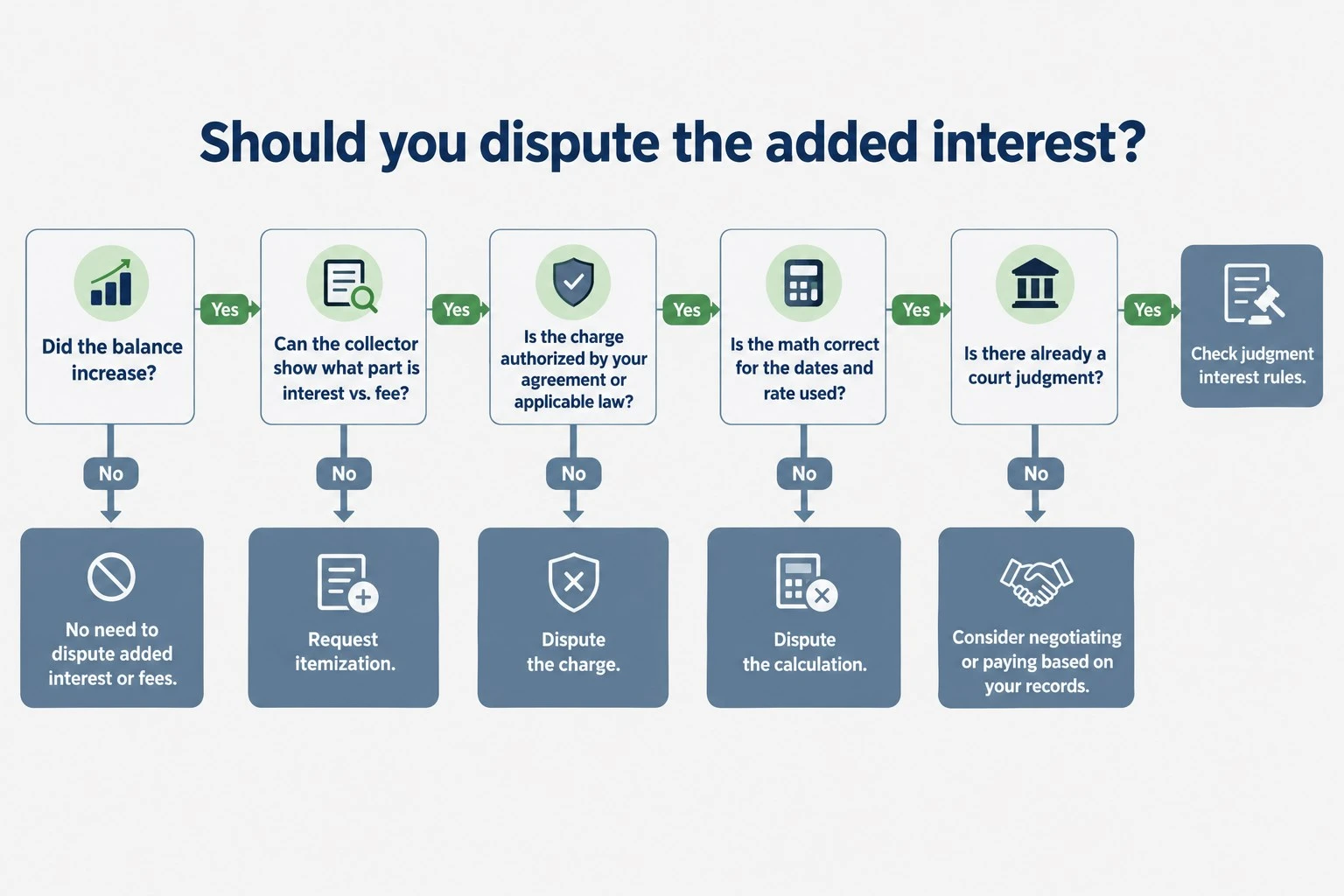
A collection agency may charge interest only when the original agreement authorizes it or applicable law permits it. A collector generally cannot create a new interest rate or add unexplained charges simply because the account was transferred, assigned, or sold.
The amount shown in a collection letter is not automatically correct. Before accepting a higher balance, check the original contract, the interest rate being used, the dates included in the calculation, and any state-law limits that may apply.
| Situation | May interest be added? | What to check |
|---|---|---|
| The original agreement allows interest after default | Possibly | The contractual rate, default terms, and applicable law |
| State law expressly permits interest | Possibly | The permitted rate and calculation method |
| The collector continues an existing contractual rate | Requires verification | Whether the rate still applies after default or collection |
| The collector creates a new interest rate | Major red flag | Written contractual or legal authority for the new rate |
| The collector cannot explain the increased balance | Not automatically valid | The starting balance, rate, dates, payments, credits, and fees |
| A court entered a judgment | Different rules may apply | The judgment and applicable post-judgment interest law |
Check these three details before accepting the balance
- The interest rate: Ask what annual, monthly, or daily rate is being used.
- The legal authority: Ask which contract provision or law permits the interest.
- The calculation: Request an itemized statement showing the starting balance, interest, fees, payments, and credits.
If the original creditor still owns the account, the issue may be slightly different. Review why a charge-off balance may keep increasing before assuming that a third-party collection agency added the interest.
Even when interest is allowed, the rate, dates, payments, credits, and final calculation can still be wrong. The next step is to verify every dollar included in the current collection balance.
This information is educational and is not legal advice. Contract terms and state laws may provide different rights, limits, or protections.
Why does my collection balance keep increasing?
Your collection balance may keep increasing because of interest, authorized fees, court-related charges, or adjustments involving payments and credits. However, a higher balance is not automatically accurate. A debt collector should be able to explain where the increase came from and show how the current amount was calculated.
Compare the balance on the itemization date with the amount the collector claims you owe today. The difference should be supported by clearly identified interest, fees, payments, credits, or other legally permitted adjustments.
| Possible reason | What it means | What to verify |
|---|---|---|
| Contractual interest | Interest may continue under the original agreement. | The rate, accrual dates, and contract provision authorizing it |
| Interest permitted by law | Applicable law may permit interest even when additional review is required. | The legal authority, permitted rate, and calculation method |
| Collection fees | Certain fees may be added when the agreement or applicable law permits them. | The description, amount, and authority for each fee |
| Court judgment | Court costs or post-judgment interest may affect the balance. | The judgment, court records, and applicable interest rules |
| Missing payment or credit | A payment, adjustment, or credit may not have been applied correctly. | Receipts, bank records, settlement terms, and the account ledger |
| Calculation error | The collector may have used the wrong rate, dates, or starting balance. | A complete itemized calculation from the itemization date |
| Unsupported charge | The increase appears without a clear contractual or legal explanation. | Written documentation supporting every additional amount |
Example of an increasing collection balance
Suppose the balance on the itemization date was $2,500. The collector later adds $75 in interest and $25 in authorized fees, while applying a $100 payment.
$2,500 + $75 + $25 − $100 = $2,500
If the collector instead claims that the current balance is $2,650, the numbers do not match the stated adjustments. That does not automatically prove a violation, but it gives you a specific reason to request a detailed account history and calculation.
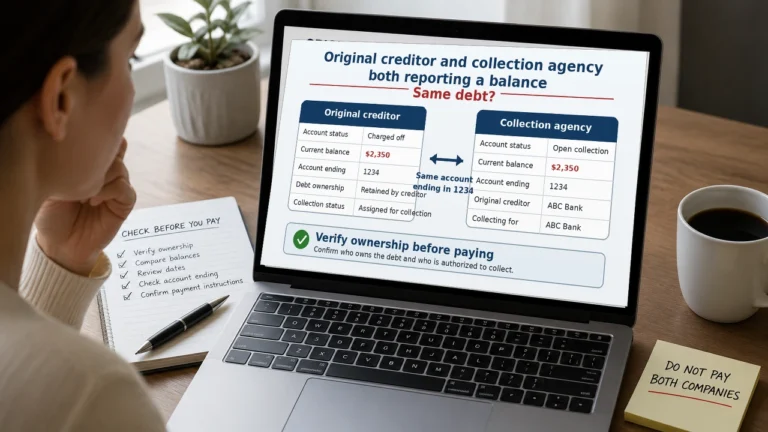
If the amounts reported by the original creditor and collector are different, review what it means when the creditor and collection agency both report a balance.
Identifying a possible reason is only the first step. Next, verify every dollar added to the account by comparing the itemization date, interest rate, calculation period, fees, payments, credits, and current balance.
Sources: CFPB Regulation F validation notice requirements and CFPB rules on interest, fees, and other added amounts. This content is educational and is not legal advice.
How to verify interest added by a collection agency
To verify collection agency interest, start with the balance on the itemization date and rebuild the account from there. Identify the interest rate and calculation period, separate interest from fees, confirm every payment and credit, and compare your result with the current balance. Even when a collection agency can charge interest, the amount still needs to be supported and mathematically consistent.
Step 1: Find the itemization date
Look for the date the collector uses as the starting point for the itemized balance. Depending on the account, the notice may use a last statement date, charge-off date, last payment date, transaction date, or judgment date. Write down both the date and the balance shown for that date.
Step 2: Record the starting and current balances
Place the balance on the itemization date next to the current amount the collector says you owe. The difference between those two figures must be explained by interest, fees, payments, credits, or another supported adjustment. Do not try to judge the account from the current total alone.
Step 3: Identify the interest rate and calculation period
Ask what annual, monthly, or daily rate was used, when interest began accruing, and which dates are included. Then compare that information with the original agreement and any legal authority the collector provides. A rate shown in an online portal or collection letter is not, by itself, an explanation of how the amount was calculated.
Step 4: Separate interest from fees
Interest and fees should not be combined into one unexplained increase. List each category separately and ask what authorizes every fee. Under Regulation F, validation information generally itemizes the current amount by reflecting interest, fees, payments, and credits since the itemization date.
Step 5: Confirm every payment and credit
Compare the collector’s account history with bank statements, receipts, settlement confirmations, and written credits. A payment posted late, applied to the wrong account, or omitted from the ledger can make the balance appear higher than it should be.
Step 6: Reconcile the current balance
Starting balance + interest + authorized fees − payments − credits = current balance
The collector’s total should be reproducible. If you cannot start with the itemization balance and reach the amount currently claimed, note the exact difference and request a more detailed explanation.
Use this collection interest worksheet
| Balance detail | Amount or information |
|---|---|
| Itemization date | |
| Balance on that date | $ |
| Interest rate and calculation period | |
| Interest added | $ |
| Fees added | $ |
| Payments applied | $ |
| Credits applied | $ |
| Collector’s current balance | $ |
| Your calculated balance | $ |
| Unexplained difference | $ |
Example: find the unexplained difference
Assume the balance on the itemization date was $3,000. The collector added $120 in interest and $30 in fees, then applied a $200 payment and a $25 credit.
$3,000 + $120 + $30 − $200 − $25 = $2,925
If the collector claims the current balance is $3,075, the difference is $150. That difference does not automatically prove a legal violation, but it gives you a specific amount to question and request documentation for.
What to request from the collection agency
- The balance and date used as the itemization starting point
- The interest rate and dates included in the calculation
- The amount of interest added since the itemization date
- A description and basis for every fee
- A record of all payments and credits
- The agreement provision or law authorizing the added interest
- A calculation showing how the collector reached the current balance
You can also compare the collection amount with the account information reported by the credit bureaus. First, make sure you understand how to read the balance fields on your credit report.
If the numbers do not match or the collector cannot identify the authority for the added interest, request an itemized explanation in writing before deciding how to respond.
Sources: CFPB Regulation F, § 1006.34 and CFPB Regulation F, § 1006.22. This content is for educational purposes and is not legal advice.
What should you do if the collection interest appears incorrect?
If the interest or current collection balance appears incorrect, identify the exact amount, rate, fee, payment, credit, or date you are questioning. Do not send a vague statement saying only that the balance is wrong. Request an itemized account history and ask the collection agency to explain the contractual or legal authority for every added amount.
A specific written request gives the collector a clear issue to review and helps you preserve a record of the dispute. For example, you might explain that the collector claims you owe $3,075, while the itemized amounts provided add up to $2,925, leaving an unexplained difference of $150.
Step 1: Identify the exact problem
Compare the collector’s current balance with the calculation you completed in the previous section. Determine whether the possible error involves:
- an incorrect starting balance;
- an interest rate that does not match the original agreement;
- interest calculated for the wrong dates;
- an unexplained collection fee;
- a missing payment or credit;
- a balance that does not match a written settlement or payoff agreement; or
- a mathematical difference that the collector has not explained.
Step 2: Request an itemized account history
Ask the collection agency to provide enough information to show how it reached the current balance. Your request should include:
- the itemization date and the balance on that date;
- the interest rate used;
- the dates covered by the interest calculation;
- the total amount of interest added;
- a description of every fee;
- all payments and credits applied to the account;
- the current balance calculation; and
- the agreement provision or applicable law authorizing the interest and fees.
Step 3: Send the request in writing
Include your name, the collection agency’s account or reference number, the specific amount you are questioning, and a brief explanation of the problem. Use an official communication method provided by the collector and keep a copy of everything you send.
Save delivery confirmation, portal screenshots, emails, letters, account statements, and any response from the collector. These records may help establish what information you requested and how the collector answered.
Sample request for an itemized interest calculation
Subject: Request for an itemized balance calculation
I am requesting an itemized explanation of the amount you claim I owe. Please provide the balance on the itemization date, the interest rate used, the dates covered by the calculation, the amount of interest added, each fee charged, all payments and credits applied, and the current balance.
Please also identify the provision of the original agreement or applicable law that authorizes the interest and any other added amounts.
I am specifically questioning [describe the disputed amount, rate, fee, payment, credit, or date]. My records show [briefly explain your calculation or supporting information]. Please review the account and provide a written response explaining the difference.
Sincerely,
[Your name]
[Account or reference number]
Replace every bracketed section before sending the request. Do not include unnecessary personal information, bank account numbers, passwords, or original documents that you cannot replace.
Step 4: Compare the collector’s response with your records
Review whether the response identifies the interest rate, calculation dates, fees, payments, credits, and authority for the added amounts. A response that simply repeats the current balance without explaining the calculation may not resolve your question.
| If you find this problem | Request this information |
|---|---|
| The interest rate is unclear | The rate, effective date, calculation method, and authority for using it |
| The balance does not add up | A complete calculation from the itemization date to the current balance |
| A payment or credit is missing | The payment history, account ledger, and date each amount was applied |
| A fee is unexplained | The fee description and contractual or legal basis |
| A completed settlement is not reflected | The settlement terms, payment history, and updated remaining balance |
| The credit report shows the wrong balance | An investigation and correction of the specific reported information |
Step 5: Dispute inaccurate credit reporting separately
A request sent to the collection agency about its calculation is not always the same as a dispute sent to a credit bureau. If the collector reports an inaccurate balance, payment status, or account detail to Equifax, Experian, or TransUnion, follow the process for how to dispute an error on your credit report.
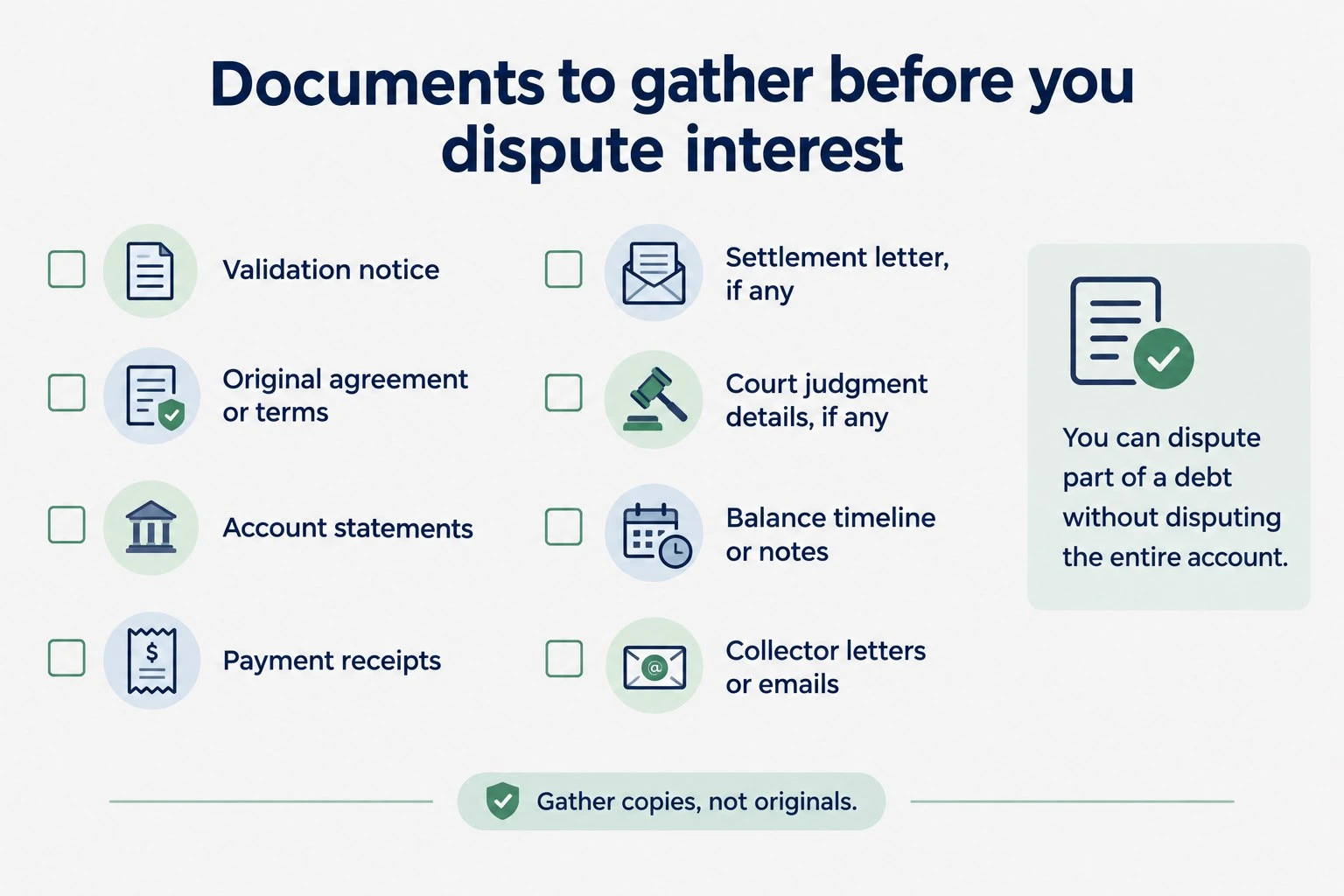
Include evidence that directly supports the correction you are requesting. Useful records may include the original agreement, collection notice, itemized account history, payment receipts, bank statements, settlement confirmation, and the credit report page showing the disputed information. Review the full checklist of documents that can support your credit report dispute.
Step 6: Escalate an unresolved problem when necessary
If the collection agency does not explain the disputed amount or the problem remains unresolved, you may consider submitting a complaint to the Consumer Financial Protection Bureau, contacting the appropriate state regulator or attorney general, or speaking with a consumer law attorney.
A complaint or legal consultation does not guarantee that interest will be removed. Keep your request focused on the unsupported amount, missing information, or inaccurate reporting and preserve copies of all communications.
If the collector confirms that the interest is authorized and the balance is calculated correctly, you can then decide whether to pay the account, negotiate a settlement, or request that interest stop during a payment plan.
Sources: CFPB guidance on debt validation information and Regulation F, § 1006.34. This content is for educational purposes and is not legal advice.
Can you negotiate or stop collection interest?
You can ask a collection agency to reduce accrued interest, stop future interest, accept a settlement, or set up a payment plan. The collector does not have to accept your proposal, so verify the debt and current balance before negotiating. If an agreement is reached, get every term in writing before making the first payment.
The lowest monthly payment is not always the best deal. A small payment may provide temporary relief while interest continues to increase the balance. Before agreeing, ask how your payments will be applied and exactly how much you will owe after the final scheduled payment.
Four ways to negotiate collection interest
| Option | Possible benefit | Main risk | What to get in writing |
|---|---|---|---|
| Interest freeze | Prevents the balance from growing while you follow the agreement | Interest may restart after a missed or late payment | The freeze date, duration, conditions, and treatment of missed payments |
| Interest reduction | Reduces the amount needed to resolve the account | The collector may require a larger or faster payment | The amount waived and the new confirmed balance |
| Lump-sum settlement | May resolve the account for less than the current balance | Requires money by a firm deadline and may leave unclear terms if the agreement is incomplete | The settlement amount, deadline, interest treatment, and remaining balance after payment |
| Payment plan | Spreads payments over a longer period | Interest or fees may continue and slow the reduction of the balance | The payment amount, schedule, interest rate, fees, and projected final balance |
Ask to freeze future interest
An interest freeze stops additional interest from increasing the collection balance while the agreement remains in effect. Ask whether the freeze begins immediately, lasts until the final payment, and remains permanent after the account is completed.
Also ask what happens if a payment is late. Some agreements may allow interest to resume or cancel the arrangement after a missed payment. Do not assume that a payment plan automatically stops collection interest.
Ask to reduce accrued interest
A collector may be willing to waive part of the interest that has already been added, especially as part of a larger repayment or settlement proposal. Make a specific offer based on an amount you can realistically pay rather than asking the collector to “lower the debt” without clear terms.
For example, you could ask the collector to accept the principal balance plus part of the accrued interest, waive the remaining interest, and confirm that no additional interest will be added before the agreed payment date.
Compare a settlement with a payment plan
A lump-sum settlement may reduce the total amount, while a payment plan may make the monthly cost easier to manage. The better option depends on the written terms, not just the advertised payment amount.
Before choosing, calculate the total cost of the payment plan. A $100 monthly payment may sound affordable, but it may not reduce the debt quickly if interest and fees continue to accrue.
Questions to ask before accepting an agreement
- What is the exact balance as of today?
- Will interest continue during the payment plan?
- Will any additional collection or payment fees be added?
- How much accrued interest will be waived?
- Is the agreed amount a full settlement or only a payment toward the full balance?
- How will each payment be applied to principal, interest, and fees?
- What will the remaining balance be after the final payment?
- What happens if a payment is late or missed?
- When will the account be considered resolved?
- Will the collector provide written confirmation after the agreement is completed?
Get every promise in writing before paying
The written agreement should identify the collection agency, the account or reference number, the confirmed balance, the amount you will pay, the payment dates, and whether existing or future interest will be waived.
It should also explain how fees will be handled, what happens after a missed payment, whether any balance will remain, and what the collector considers full completion of the agreement.
Written agreement checklist
- Collector’s legal name
- Account or reference number
- Confirmed balance before the agreement
- Settlement amount or total payment-plan cost
- Payment amounts and due dates
- Amount of interest being waived
- Whether future interest and fees will stop
- Consequences of a late or missed payment
- Balance remaining after the final payment
- How the collector will confirm completion
Keep the written agreement, payment receipts, bank records, and final confirmation. If you complete the agreement but the account still reports money owed, review what to do when a paid collection still shows a balance.
Do not agree to a monthly amount that leaves no room for housing, utilities, food, transportation, insurance, and other essential expenses. A realistic agreement is more useful than a larger payment you are likely to miss.
Sources: CFPB guidance on negotiating with a debt collector, CFPB guidance on older debts, and FTC debt collection FAQs. This content is for educational purposes and is not legal advice.
Can a collection agency charge more than the original debt?
A collection agency may sometimes collect more than the original debt when authorized interest, permitted fees, court costs, or other lawful amounts have been added. However, the collector cannot increase the balance without a contractual or legal basis. Every added amount should be traceable to an itemized calculation.
The fact that a collection balance is higher than the original debt does not automatically mean the amount is valid or invalid. The important question is whether the collector can explain the starting balance, interest rate, calculation period, fees, payments, credits, and current amount claimed.
| Why the balance may be higher | When it may apply | What to verify |
|---|---|---|
| Contractual interest | The original agreement allows interest to continue after default or collection. | The rate, calculation dates, and contract provision |
| Interest permitted by law | Applicable law authorizes interest on the debt. | The legal basis, rate limit, and calculation method |
| Authorized fees | A specific fee is permitted by the agreement or applicable law. | The fee description, amount, and authority |
| Court costs | A lawsuit resulted in court-approved costs or other amounts. | The court record and judgment |
| Post-judgment interest | A court entered a judgment and applicable law allows interest to accrue. | The judgment date, applicable rate, and current calculation |
| Missing payment or credit | A payment, settlement amount, or adjustment was not applied correctly. | Receipts, bank records, settlement terms, and the account ledger |
| Unsupported increase | The collector provides a higher total without a clear explanation. | A complete itemization and written authority for each added amount |
Can a collection agency double your debt?
A collection balance can become substantially larger over time, especially when authorized interest continues for several years. However, a balance that has doubled is not automatically correct. The collector should still be able to show exactly how the account moved from the original balance to the current amount.
Ask for the original balance, interest rate, accrual dates, fees, court-related amounts, payments, and credits. A debt buyer or collection agency does not receive an automatic right to create a new balance simply because it purchased or received the account.
Example of a balance higher than the original debt
Suppose the original collection balance was $4,000. Over time, the collector adds $800 in authorized interest and applies an $80 credit.
$4,000 + $800 − $80 = $4,720
In this example, the current balance is higher than the original debt, but the increase can be reconstructed. If the collector instead claims that you owe $5,100, the additional $380 requires an explanation.
Do not compare only the original debt with the current balance. Reconstruct the account from the itemization date and confirm that every increase and reduction is documented. A higher collection balance may be permitted, but it should not be an unexplained number.
This content is for educational purposes and is not legal advice. Contract terms, court orders, and state laws may affect which interest, fees, and other amounts can be collected.
Does interest continue after a debt is sold or charged off?
Interest does not automatically stop or become valid simply because a debt is charged off, assigned to a collection agency, or sold to a debt buyer. Whether interest may continue depends on the original agreement, applicable law, the account history, and any court judgment. A transfer of the debt does not, by itself, authorize a collector to create a new interest rate or add unsupported fees.
Charge-off, assignment, and sale are different account events. Understanding which event occurred can help you determine who owns the debt, where the current balance came from, and whether interest was added before or after the transfer.
| Account event | What it means | What happens to interest |
|---|---|---|
| Charge-off | The creditor treats the account as unlikely to be collected for accounting purposes, but the unpaid debt may still be collected or sold. | Charge-off does not automatically determine whether interest must stop. Check the agreement, law, and account history. |
| Assignment to a collection agency | The original creditor may still own the account while another company collects it. | Any interest or fees still must be authorized by the agreement or permitted by law. |
| Sale to a debt buyer | Ownership of the debt transfers to another company that may collect it directly or use another collector. | The sale itself does not authorize a new rate, new fee, or unexplained increase. |
These events are often confused. Before comparing balances, review the difference between a charge-off and a collection.
What should transfer to the new collector?
The account information provided to a debt buyer or collection agency should allow the current amount to be traced back to the prior balance. That history may include the balance at transfer, applicable interest rate, payments, credits, settlement adjustments, and authorized fees.
A collector may not collect interest, fees, or other charges unless the amount is authorized by the agreement that created the debt or permitted by applicable law. Buying the account does not give a debt buyer broader collection rights merely because it paid for the debt.
Compare the account before and after the transfer
| What to compare | Why it matters |
|---|---|
| Final balance from the original creditor | Establishes the amount immediately before assignment or sale. |
| Collector’s starting balance | Shows whether an unexplained amount appeared during the transfer. |
| Interest rate before and after transfer | Reveals whether the rate changed and whether the change has a stated basis. |
| Interest accrual dates | Helps identify newly added or retroactive interest. |
| Payments and credits | Confirms that earlier adjustments followed the account. |
| Fees added after transfer | Helps identify new charges that require contractual or legal authority. |
What if the original creditor stopped adding interest?
If the original creditor stopped adding interest before the account was sold, review any later interest carefully. A period with no interest does not, by itself, prove that all future interest is prohibited, but the collector should explain the rate, dates, calculation, and authority for adding it.
Pay particular attention to retroactive interest covering months or years when the creditor’s statements showed no increase. Ask for a complete account history rather than accepting a single current balance.
Sources: CFPB guidance on collection interest and fees and FTC debt collection FAQs. This content is for educational purposes and is not legal advice. Contract terms, court orders, and state laws may affect whether interest can continue.
Can a collection agency charge interest on medical debt?
A collection agency may add interest to medical debt only when the amount is authorized by the agreement creating the debt or permitted by applicable law. Before accepting the balance, confirm that insurance payments, provider adjustments, financial assistance, discounts, payments, and credits have been applied correctly. The collector should not demand interest on medical charges that you are not legally required to pay.
Medical debt often requires more investigation than a typical collection account because the patient’s responsibility may change after the original bill is issued. An insurance company may process or reprocess the claim, a provider may correct a billing code, or financial assistance may reduce the amount owed.
Verify the correct medical balance before checking interest
| What to verify | Why it matters |
|---|---|
| Original provider bill | Shows the services and charges used as the starting point. |
| Explanation of benefits | Shows what insurance paid, denied, adjusted, or assigned to the patient. |
| Final patient responsibility | Identifies the amount the provider says remained after insurance processing. |
| Financial assistance | Charity care or another assistance program may reduce or eliminate the balance. |
| Provider adjustments | Discounts, corrected claims, and negotiated reductions may change the amount sent to collections. |
| Interest rate and dates | Shows when interest started, which rate was used, and how the added amount was calculated. |
| Fees, payments, and credits | Helps prevent collection of unsupported fees or amounts already paid. |
Check whether surprise-billing protections apply
Some medical charges may be limited by the No Surprises Act or applicable state law. Federal protections cover many emergency services, certain non-emergency services provided by out-of-network professionals at in-network facilities, and out-of-network air ambulance services.
When these protections apply, the patient generally should not be billed more than the permitted cost-sharing amount. A collector should not use an excessive or prohibited medical charge as the starting point for calculating interest.
How to check interest on a medical collection
- Request an itemized bill from the medical provider.
- Compare the bill with your insurance explanation of benefits.
- Confirm the final amount assigned as patient responsibility.
- Check whether financial assistance, discounts, or billing corrections were applied.
- Ask the collector for the interest rate, accrual dates, and authority for charging interest.
- Verify every payment, insurance payment, adjustment, and credit.
- Identify and question the exact amount that does not match your records.
Start by contacting both the medical provider and the collection agency. The provider may have information about insurance processing, financial assistance, or corrected billing that the collector’s records do not yet reflect.
Sources: CFPB advisory opinion on medical debt collection and CMS guidance on medical billing rights and the No Surprises Act. This content is for educational purposes and is not legal advice. Medical billing protections and interest rules may vary by state and account type.
Frequently asked questions about collection interest
Can a collection agency add interest every month?
A collection agency may add interest each month only when the original agreement or applicable law authorizes it. Monthly increases should follow a specific interest rate and calculation method. The collector should be able to identify the starting balance, rate, dates covered, interest added, fees, payments, credits, and current balance.
A balance that rises every month is not automatically incorrect, but the increase should not be arbitrary. Ask for an itemized account history if the statements do not show how the collector calculated the new amount.
Can a debt collector change the interest rate?
A debt collector cannot create a new interest rate simply because it received or purchased the account. Any rate change must have a contractual or legal basis and must comply with applicable law.
Compare the rate used by the collector with the original agreement and the account history. Question the balance if the rate increased after the debt was transferred, if the collector cannot identify when the change occurred, or if no explanation is provided.
Does disputing a debt stop interest?
Disputing a debt does not automatically stop interest from accruing. A timely written dispute may require the collector to pause collection activity on the disputed debt until it provides verification, but that does not necessarily freeze contractually or legally authorized interest.
Ask the collector whether the balance will continue to increase during the review. Record the balance on the date of your dispute so you can identify any interest or fees added afterward.
Does making a payment stop collection interest?
Making one payment does not automatically stop collection interest. Interest may continue unless the collector agrees to freeze it or the debt is paid in full under terms that resolve the account.
Before paying, ask how the payment will be applied. Depending on the agreement and applicable law, some or all of the payment may be applied to interest or fees before reducing the principal balance. Get any interest-freeze agreement in writing.
Can interest continue during a collection payment plan?
Interest may continue during a payment plan unless the written agreement says that it will stop. A low monthly payment can be misleading if a large part of each payment is offset by new interest and fees.
For example, if the balance is $3,000, the monthly payment is $75, and $40 in interest and authorized fees is added each month, the balance falls by only $35 after that payment.
$75 payment − $40 in new interest and fees = $35 balance reduction
Ask for the total payment-plan cost, the interest rate, any additional fees, and the projected balance after the final scheduled payment. Do not evaluate the agreement by the monthly payment alone.
Can a collection agency charge a payment or convenience fee?
A collection agency generally cannot charge a pay-to-pay or convenience fee unless the original agreement expressly authorizes it or applicable law affirmatively permits it. This may include fees for paying by phone, online, debit card, or another payment method.
Ask whether a no-fee payment option is available and request the contractual or legal basis for the charge. A third-party payment processor does not automatically make an otherwise unauthorized fee valid.
Sources: CFPB guidance on collection interest and fees, CFPB guidance on disputed debts, and CFPB guidance on pay-to-pay fees. This content is for educational purposes and is not legal advice. Contract terms and state laws may affect the result.
The bottom line
A collection agency can add interest only when the original agreement or applicable law permits it. A collector cannot create a new interest rate, add unexplained fees, or increase the balance simply because the debt was charged off, assigned, or sold.
Before paying, negotiating, or disputing the amount, confirm four details:
- Find the itemization date and the balance reported on that date.
- Verify the interest rate, calculation period, and authority for charging interest.
- Confirm that every payment, credit, adjustment, and settlement amount was applied.
- Request a written explanation for any difference between the itemized calculation and the current balance.
If you enter a settlement or payment plan, confirm whether interest and fees will continue. Get the payment amount, due dates, interest treatment, missed-payment terms, and remaining balance in writing before sending money.
This content is for educational purposes and is not legal advice. Contract terms, court orders, and federal and state laws may affect whether interest or fees can be collected.