In this guide
- Charge-off balance increase checker
- Six reasons your charge-off balance may keep increasing
- Can interest or fees continue after a charge-off?
- Worksheet: reconcile the charge-off balance
- Worked example: $4,000 becomes $4,520
- What to request from the creditor or collector
- What if the debt was sold or transferred?
- What if you made a payment but the balance still increased?
- Should you pay, request records, or dispute?
- How to dispute a wrong charge-off balance
- Does an increasing balance restart the seven-year reporting period?
- How can you stop a charge-off balance from increasing?
- What not to do
- Frequently asked questions
- Related guides
- Sources
- Financial and legal disclaimer
If you see your charge-off balance increasing every month, interest or permitted fees may still be accruing, but an increase can also come from a missing payment or credit, a transfer adjustment, different reporting dates, or inaccurate information. If you need the underlying account-status definition first, see what a charge-off means. A charge-off does not erase the debt or automatically freeze the amount owed.
Do not assume the increase is valid or invalid from the pattern alone. Reconstruct the balance from documents, identify the exact amount that remains unexplained, and ask for the calculation behind that amount.
If the balance itself is not increasing and only the account’s Date Updated keeps changing, see whether a charge-off can be reported every month. For the full set of related guides, use the Charge-offs hub.
Updated October 4, 2026: added a monthly-interest example, clarified sold-debt reporting, and distinguished balance-record requests from time-sensitive debt disputes.
Received a collection notice? Check its dispute deadline now. If you question the debt or an added amount, do not let the validation period expire while waiting for a complete account history. See the debt-validation step below.
Quick rule: Similar monthly increases may suggest recurring interest. A sudden jump may point to a fee, adjustment, missing credit, or transfer issue. In either case, verify the math before paying or disputing.
Charge-off balance increase checker
Use a starting balance and current balance from the same account, then enter changes between those two dates. Every field is required: enter 0 only when you have confirmed there was no amount in that category. If a figure is unknown, request the records first.
Other balance increases? This six-field checker does not include a separate field for positive adjustments. Use the full balance worksheet below when an adjustment increases the balance. Do not enter it as a credit, because credits are subtracted.
This checker reconciles the numbers you enter. It does not decide whether the debt is valid or whether interest or fees are legally authorized.
Six reasons your charge-off balance may keep increasing
First compare the same field on the same account. The historical amount charged off, the current balance, and a payoff quote as of a later date are not interchangeable. Compare two dated current balances before concluding that new charges were added.
| Possible reason | What it can look like | What to verify |
|---|---|---|
| 1. Continuing interest | Repeated increases between reporting dates | The authorized rate, balance used, days covered, and calculation method |
| 2. Added fees or costs | A one-time jump or a separately itemized charge | Each fee and the agreement or law relied on to collect it |
| 3. A missing or reversed payment or credit | The balance rises or fails to fall after you pay | Posting date, account number, returned payments, and settlement credits |
| 4. An adjustment during a sale or transfer | The new company’s opening amount differs from the previous balance | Both dated balances and the transactions explaining the difference; a sale alone does not justify an increase |
| 5. Different reporting dates | One bureau or monitoring app shows more than another | The update dates and account identifiers before treating the difference as new debt |
| 6. Incorrect reporting or an unsupported charge | The balance conflicts with your records or the itemization does not explain it | The particular amount you question and available supporting records |
A pattern is a clue, not proof. A regular increase can resemble interest even when the rate or calculation is wrong. A balance that updates monthly without changing is a reporting update, not a monthly increase in the amount owed.
Can interest or fees continue after a charge-off?
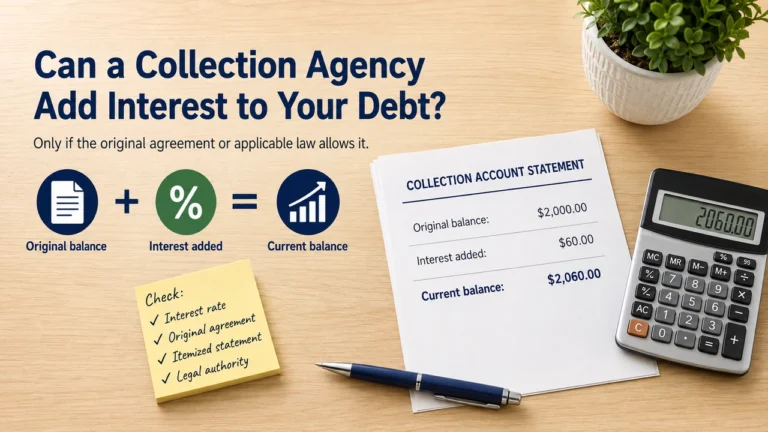
Yes, sometimes. Charging off a debt does not automatically freeze interest. For a covered debt collector, CFPB Regulation F § 1006.22(b) prohibits collecting added amounts unless the agreement creating the debt expressly authorizes them or the law permits them. State law can also affect what may be charged.
The federal debt-collection rules generally do not cover an original creditor collecting its own debt. That distinction does not make every creditor charge valid: request the terms and legal basis that apply to that account.
Ask for the starting amount, interest rate, calculation dates, payment history, and authority for each fee. If a court judgment exists, check its terms and applicable judgment-interest rules rather than assuming the old credit-card rate applies. For the collector-specific rules, see when a collection agency can charge interest.
Example: why a $4,000 balance could rise by about $59 in 30 days
Suppose $4,000 is subject to an authorized 18% annual simple-interest rate for 30 days, using a 365-day year. Assume no compounding, payments, fees, or other adjustments during that period. These are hypothetical terms, not a rate that automatically applies after charge-off.
$4,000 × 0.18 × 30 ÷ 365 = $59.18 in interest.
The balance would become $4,059.18. If a $40 payment were credited only at the end of that period, it would leave $4,019.18—still $19.18 above the starting balance. A payment credited earlier could change the interest calculation.
Use the actual account method for an audit. Different day counts, rates, compounding, payment dates, or interest-bearing amounts produce different results. Matching this example does not establish that your charges are authorized.
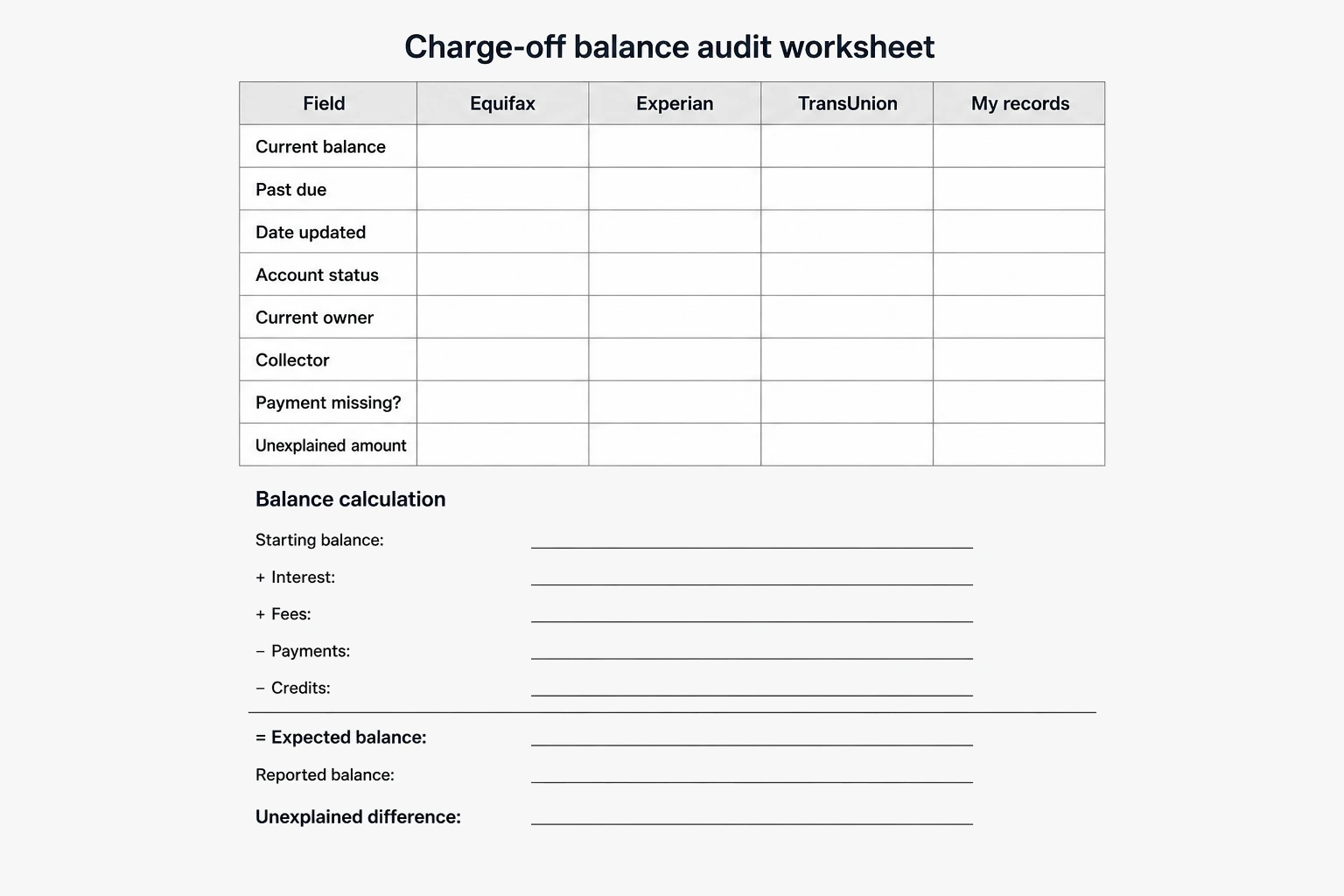
Worksheet: reconcile the charge-off balance
Record the starting date and ending date, then use only transactions between them. Do not add interest or fees that were already included in the starting balance. An adjustment can increase or decrease the total; keep those directions separate.
Starting balance + interest + fees − payments − credits ± adjustments = expected balance
| Balance component | Amount | Document to check |
|---|---|---|
| Starting balance | $_____ | Statement / prior report / account history |
| Interest added | +$_____ | Rate and calculation provided by creditor/collector |
| Fees or costs | +$_____ | Account agreement / itemization / court record if applicable |
| Payments | −$_____ | Payment confirmation / bank record |
| Credits or refunds | −$_____ | Settlement, refund, or account-credit record |
| Other adjustments | ±$_____ | Written account history |
| Expected balance | $_____ | Compare with amount reported or claimed |
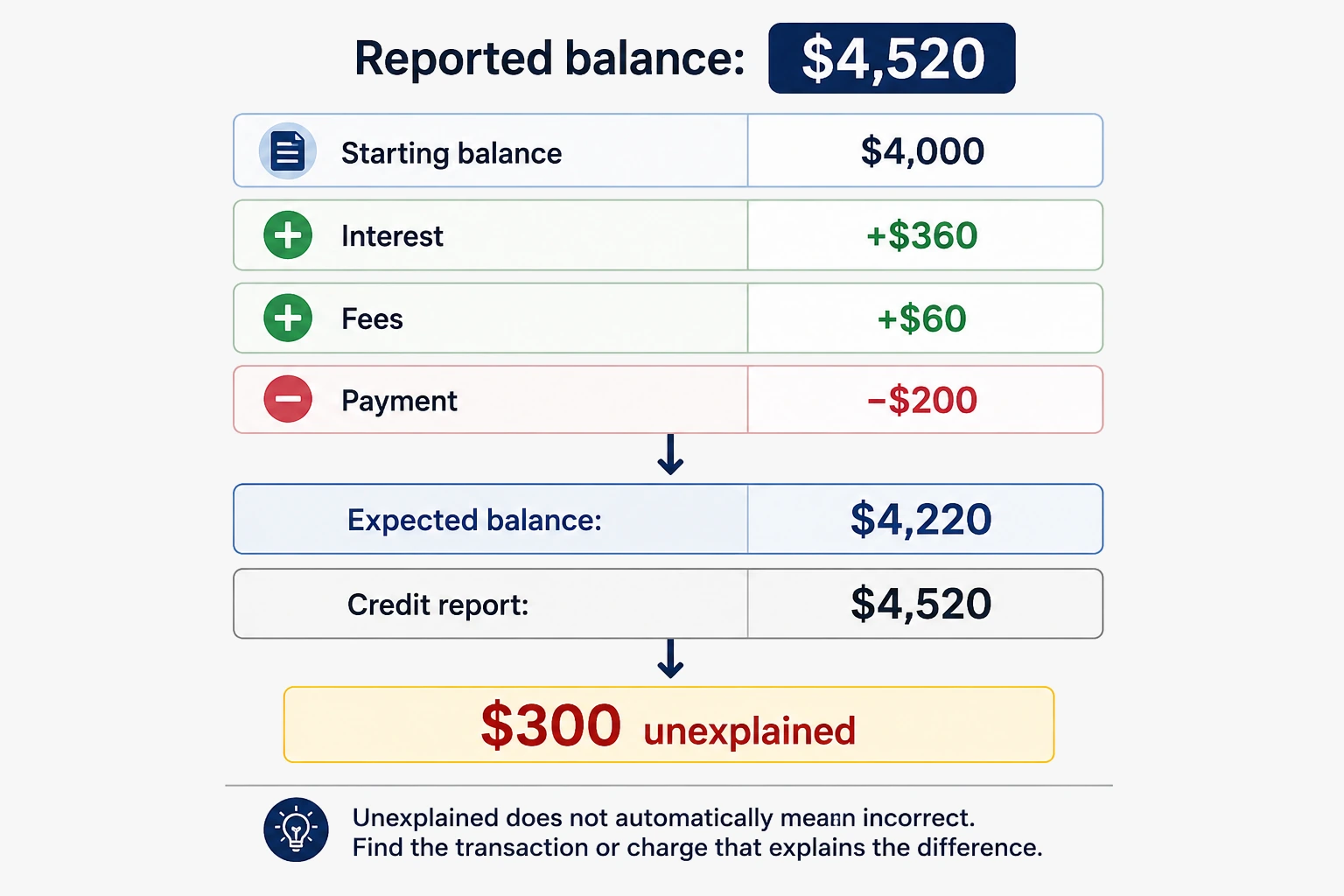
Worked example: $4,000 becomes $4,520
Suppose your records show:
- starting balance: $4,000;
- documented interest: +$360;
- documented fees: +$60;
- documented payment: −$200.
The balance your records support is:
$4,000 + $360 + $60 − $200 = $4,220
If the reported balance is $4,520, there is a $300 difference that still needs an explanation. That does not automatically prove the report is wrong; it tells you exactly what amount to investigate.
What to request from the creditor or collector
Ask for a dated calculation you can compare with your statements, credit reports, and payment receipts. Specify the two balances you are comparing and request:
- the starting amount and date, including any earlier interest or fees already in that amount;
- interest added afterward, its rate, calculation method, and dates;
- each fee or cost and the agreement or law used to support it;
- payments, credits, refunds, and adjustments, with posting dates;
- the current amount claimed and who owns or is collecting the debt.
Under Regulation F’s validation-notice rules, a covered collector generally must provide an itemization reflecting interest, fees, payments, and credits since a specified reference date. That starting figure may already include earlier charges.
Do not miss the validation deadline while requesting records
If you dispute the debt or part of its amount, submit a written dispute within the validation period shown on the notice, generally 30 days after receipt. Once a covered collector receives a timely written dispute, it generally must pause collection of the disputed amount until it sends verification or a copy of a judgment. See CFPB Regulation F § 1006.38.
State what you question and why, using the records you have. You do not need to finish this worksheet first. Use the notice’s response instructions or an electronic channel the collector accepts, and retain proof of submission. A general request for records is not necessarily a dispute. A collection pause does not itself freeze lawful interest, cancel the debt, or require an answer within a universal 30-day deadline.
What if the debt was sold or transferred?
Find out whether ownership changed. An original creditor can hire a collection agency while keeping ownership, or sell the debt to a buyer. Those situations can produce different credit-report entries.
When the original creditor sells the debt, its current balance should update to $0; the new owner may report the amount owed separately. The historical charge-off can remain. Experian explains this balance change after a debt sale. A collector working for the creditor does not necessarily mean a sale occurred.
Compare the seller’s closing records with the buyer’s opening records. Ask which interest, fees, payments, or adjustments explain any difference. If the original creditor continues to show an increasing current balance after a confirmed sale, request an explanation and dispute information you believe is inaccurate.
Two related entries do not automatically mean you owe twice. See charge-off vs. collection to check ownership and the role of each account.
What if you made a payment but the balance still increased?
First determine what the payment was supposed to do. A partial payment can leave a remaining balance, and interest or other authorized charges may continue afterward. If you are deciding whether resolving the account may help your score, see how paying a charge-off may affect your credit score.
Check whether the payment:
- posted to the correct account;
- was completed rather than returned or reversed;
- was credited in the full amount;
- was applied according to the agreement;
- was part of a written settlement or payoff.
If you completed a payoff or settlement but the account still shows a balance, see what to do when a paid charge-off still shows a balance.
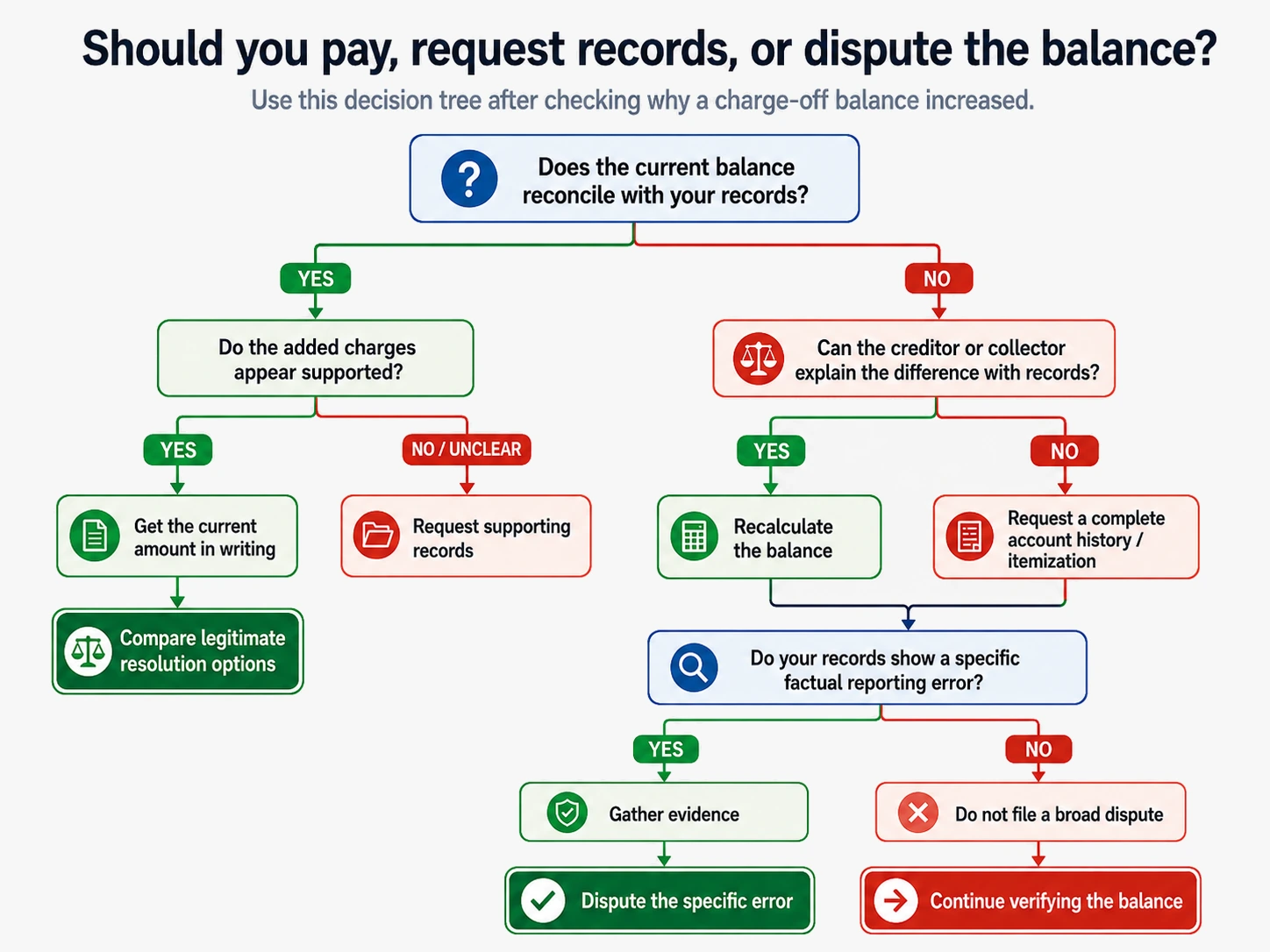
Should you pay, request records, or dispute?
If the debt is old: check the applicable lawsuit limitation period before making a payment or acknowledging the debt. The CFPB explains that these actions can restart that period in some states. Get state-specific legal guidance if needed. This is a separate question from the credit-reporting period discussed below.
| What you found | Best next step |
|---|---|
| Balance fully reconciles and charges appear supported | Compare legitimate payment or settlement options |
| Part of the balance is still unexplained | Request a written calculation; if you dispute the amount, also protect any validation deadline |
| A payment or credit is missing | Gather proof and ask how it was applied |
| An interest charge or fee lacks support | Ask for the calculation and contractual/legal basis |
| Your documents show a specific reporting error | Dispute that specific inaccurate information with evidence |
| You cannot identify who owns or collects the debt | Confirm ownership and payment authority before sending money |
How to dispute a wrong charge-off balance
If you believe the reported balance is inaccurate or incomplete, identify the entry, explain the suspected error, and include relevant records you have. You can question an unexplained amount without inventing a replacement balance. A debt-validation dispute with a collector and a credit-report dispute serve different purposes.
For a missing payment, wording could be:
My credit report dated [date] shows a current balance of $4,800 for account ending [digits]. My records show a $500 payment posted on June 12 that I believe was not credited. Assuming no other transactions or charges, that payment would reduce the balance to $4,300. Please investigate the payment and current balance, correct any inaccurate information, and explain the result. I have attached copies of my payment records.
Replace the example with facts that match your situation. Follow the CFPB’s guidance on disputing with the credit reporting company and the furnisher. The full submission process is in our credit-report dispute guide. Keep copies and review the investigation results.
Does an increasing balance restart the seven-year reporting period?
No, not by itself. A higher balance, newer update date, monthly reporting, or later sale/transfer does not create a new delinquency for the federal reporting period.
The reporting timeline for a charged-off account is tied to the delinquency that led to the charge-off, not to each later balance update. Do not confuse a recent “date updated” with the original delinquency timeline. If the account keeps refreshing month after month, use this guide to monthly charge-off reporting to compare the update date with the date of first delinquency, balance, status, and expected removal timeline.
How can you stop a charge-off balance from increasing?
The next step depends on whether the additions are authorized. A dispute addresses an error; a payment arrangement addresses a verified debt. Neither a small payment nor a request for records automatically stops future interest.
- Challenge an amount you believe is wrong. Identify the missing credit, unsupported fee, or incorrect calculation and use the appropriate dispute process.
- Ask about freezing or waiving charges. For a verified debt, ask the authorized creditor or collector whether it will stop future interest or waive fees. Acceptance is not guaranteed.
- Get precise written terms. The CFPB recommends obtaining the agreement before paying. For installments, ask how payments will be applied and whether interest continues. For a settlement, confirm that completing the terms satisfies the entire debt and whether missed payments undo concessions.
- Use a dated payoff quote. Confirm when a full-payoff amount expires and when payment must arrive. After a completed payoff or settlement, retain confirmation and check the updated current balance.
For an old debt, review the state-law issue discussed above before paying or acknowledging it. If you receive court papers, meet the court’s deadline; a dispute letter does not replace a court response.
What not to do
- Do not assume every post-charge-off increase is illegal.
- Do not assume every added amount is valid just because it appears on a statement or report.
- Match the dispute to the problem. Question a specific charge when that is the issue; dispute ownership if the account is not yours.
- Do not send money before confirming who owns the debt and who is authorized to accept payment.
- Do not confuse a newer update date with a restarted seven-year reporting period.
Frequently asked questions
Can a charge-off keep accruing interest?
It can when the interest is authorized by the agreement creating the debt or permitted by applicable law. If a debt collector is involved, Regulation F limits collection of unauthorized interest, fees, charges, and expenses.
Why do the three credit bureaus show different balances?
They may have received updates on different dates, or one report may contain inaccurate information. Compare the full account entry and update dates before deciding which amount is wrong.
Should I dispute the balance just because it increased?
An increase alone does not prove an error. If you believe the amount is wrong or do not recognize the debt, explain what you dispute and request verification. Do not miss a collector’s validation deadline while trying to obtain every document or calculate an exact replacement balance.
Does paying part of a charge-off stop the balance from increasing?
Not necessarily. A partial payment can leave a remaining balance, and authorized interest or fees may continue depending on the agreement and law.
Related guides
- Charge-offs hub — reporting, balance, payment, and removal guides.
- Can a charge-off be reported every month? — what monthly reporting can mean.
- Can a collection agency charge interest? — how to check whether added interest or fees are authorized.
Sources
- Consumer Financial Protection Bureau — Regulation F § 1006.22
- Consumer Financial Protection Bureau — Regulation F § 1006.34
- Consumer Financial Protection Bureau — How to dispute a credit-report error
- Federal Trade Commission — Fair Credit Reporting Act
Financial and legal disclaimer
This article provides general U.S. educational information about credit reporting and debt collection. It is not individualized legal, financial, debt-settlement, or credit-repair advice. Contract terms and applicable state law can affect interest, fees, and collection rights.