In this guide
- Quick answer: how long does a late payment affect your credit score?
- Late payment action timeline: what to do at each stage
- How long do missed or late payments stay on your credit report?
- Does a late payment affect your credit score for the full seven years?
- How much can a late payment hurt your credit score?
- Can your credit score recover before the late payment falls off?
- What should you do after a late payment?
- How to prevent another late payment
- Frequently asked questions about late payments and credit scores
- Sources
- Financial disclaimer
- About this article
Quick answer: how long does a late payment affect your credit score?
A late payment can stay on your credit report for up to seven years, but that does not mean it will affect your credit score with the same strength for the entire seven-year period.
The impact depends on factors such as how recent the late payment is, whether the account was 30, 60, or 90 days late, whether you have other missed payments, and the rest of your credit profile. Your credit score may begin to recover before the late payment falls off your credit report.
If the account is still past due, the first priority is to bring it current if you can and prevent the delinquency from becoming more severe. If the late payment was reported incorrectly, check the payment month, delinquency level, account status, and creditor information against your records before taking action. If the information is accurate, focus on avoiding another missed payment and building stronger recent payment history.
Late payment action timeline: what to do at each stage
Your next step depends on how far past due the account is. Use the timeline below to identify your situation and what to do before the problem becomes more serious.
| Your situation | What it may mean | What to do now |
|---|---|---|
| 1–29 days late | The account generally has not yet reached the 30-day delinquency category commonly reported to the credit bureaus. Your lender may still charge a late fee or apply other consequences under your account terms. | Pay the past-due amount as soon as possible and confirm that the payment posted. See what happens when a payment is less than 30 days late. |
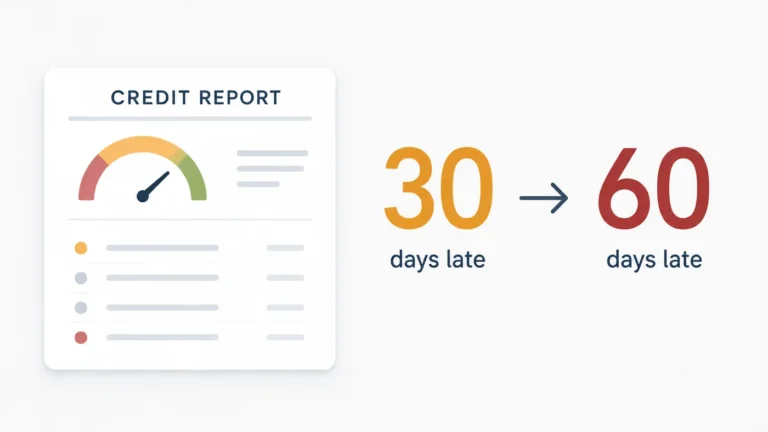
| 30 days late | The creditor may report the account as 30 days past due to the credit bureaus. A reported late payment can affect your credit score. | Bring the account current if you can. Then check your credit reports and verify the payment month, creditor, account status, and reported delinquency. |
| 60 days late | The account has remained past due for another billing cycle, making the delinquency more serious than a single 30-day late payment. | Contact the creditor and ask for the amount required to bring the account current. If you cannot pay it immediately, ask whether repayment or hardship options are available. Compare a 30-day late payment vs. a 60-day late payment. |
| 90 days late or more | The account is seriously delinquent, and the situation can become more difficult if it remains unpaid. | Contact the creditor promptly. Confirm the account status, the amount needed to bring it current, and any available repayment or hardship options. Read what to do if you are 90 days late on a payment. |
| The late payment looks wrong | The payment date, delinquency status, account details, or other reported information may be inaccurate. | Compare the credit report entry with your account statements, bank records, and payment confirmations. Save the records that show when and how the payment was made. |
| The late payment is accurate | An accurate late payment requires a different approach from a reporting error. | Bring the account current if it is still past due, prevent another missed payment, and focus on building stronger recent payment history. |
How long do missed or late payments stay on your credit report?
Missed payments that become reportable late payments can generally stay on your credit report for up to seven years. If you are searching “how long do missed payments stay on a credit report,” the key distinction is that a payment that is only a few days late may not yet be reported as a 30-day delinquency, while a reported 30-, 60-, or 90-day late payment can remain in the account’s payment history for years. The amount of time a late payment remains on your credit report is not the same as the amount of time it will have its strongest effect on your credit score.
Bringing the account current does not immediately remove an accurate late payment. Your account can return to current status while an earlier 30-, 60-, or 90-day late payment remains in its payment history.
When do late payments fall off your credit report?
Late-payment history generally stops being reported after the applicable reporting period, which can be up to seven years. Paying the past-due balance later does not make an accurate late-payment entry disappear immediately.
For example, suppose your credit report shows a 30-day late payment for March 2026 and you brought the account current in April 2026. If that March delinquency remains for the full reporting period, you would generally expect it to age off around 2033 rather than starting a new seven-year period from the date you caught up.
How to check when a late payment should fall off
Start with the payment-history section for the account. Identify the month marked late and compare it with your statements and payment records. Do not rely only on the current balance or the date you later brought the account current.
- Payment-history month: Confirm which month is marked late.
- Delinquency level: Check whether the account is shown as 30, 60, or 90 days past due.
- Current account status: If you caught up, make sure the account now shows the correct status.
- Creditor and account details: Confirm that the account belongs to you and the identifying information is correct.
- Reports from different bureaus: Compare the information on your available credit reports for inconsistent dates or payment history.
If you are not sure where these details appear, use our guide to read your credit report before deciding whether anything needs to be corrected.

Does a late payment affect your credit score for the full seven years?
Not necessarily with the same strength. A late payment can remain on your credit report for up to seven years, while its effect on your credit score can change as the delinquency gets older and newer information is added to your credit file.
For FICO Scores, factors such as how recent, severe, and frequent late payments are can matter. A recent 90-day delinquency is different from an isolated 30-day late payment that happened several years ago and was followed by consistent on-time payments.
Why an older late payment may matter less
Suppose you had one 30-day late payment two years ago, brought the account current, and have paid every account on time since then. The late payment may still appear on your credit report, but your file now contains two additional years of more recent payment behavior.
There is no universal month when a late payment suddenly stops affecting every credit score. Consumers can have multiple credit scores, and lenders may use different scoring models and versions.
A late payment reaching the end of its reporting period does not guarantee a visible score increase. If it has disappeared but your score is unchanged, use this checklist for an old late payment removed with no score increase to compare the bureau, score date, and other account changes.
What can make the impact more serious
- Severity: A 60- or 90-day delinquency is more serious than a single 30-day late payment.
- Recency: A newly reported late payment can matter more than an older delinquency.
- Frequency: Repeated missed payments can be more concerning than an isolated late payment.
- The rest of your credit file: Other negative information and recent account activity can affect your score at the same time.
The seven-year reporting period therefore should not be treated as seven years of an identical credit-score penalty.
How much can a late payment hurt your credit score?
There is no single number of points that a late payment will cost everyone. The impact depends on your overall credit profile, how late the payment became, how recent it is, whether you have other late or missed payments, and the credit scoring model being used.
| Factor | Why it matters |
|---|---|
| How late the payment was | A 60- or 90-day delinquency is more serious than a single 30-day late payment because the account remained past due longer. |
| How recent the late payment is | A newly reported late payment can affect a credit profile differently from an older late payment that is still listed on the report. |
| How many late payments you have | One isolated late payment is different from a pattern of repeated missed payments. |
| Your credit profile before the late payment | Two people with the same delinquency can experience different score changes because the rest of their credit files may be very different. |
| Other recent credit changes | Higher revolving balances, new accounts, hard inquiries, collections, or other negative information can affect your score at the same time. |
Why the same 30-day late payment can affect two people differently
Suppose two consumers each receive a new 30-day late payment. One had years of on-time payments and no other negative information. The other already had recent delinquencies and high credit card balances. The same 30-day late-payment status does not mean both consumers will lose the same number of points because their overall credit profiles are different.
That is why claims that every 30-day late payment causes a fixed score drop should be treated carefully. If you are trying to understand that specific situation, see the factors that can affect how many points a 30-day late payment may cost.
What to check if your score dropped after a late payment
- Check the delinquency level. Confirm whether the account is reported as 30, 60, or 90 days late.
- Check the reported month. Make sure the late payment appears in the correct payment-history period.
- Look for other recent changes. Review balances, new accounts, hard inquiries, collections, and other negative information that changed around the same time.
- Compare the account information. Make sure the balance, account status, and late-payment history are accurate on the credit reports where the account appears.
Can your credit score recover before the late payment falls off?
Yes. Your credit score can begin to recover while a late payment is still on your credit report. You do not necessarily have to wait until the entry ages off before your credit profile starts improving.
There is no universal recovery timeline. The result depends on how serious and recent the late payment is, whether you have additional delinquencies, what other information is in your credit file, and the scoring model being used.
What recovery can look like in different situations
| Situation | What matters next |
|---|---|
| One 30-day late payment | Bring the account current, avoid another missed payment, and continue adding newer on-time payment history. |
| Several late payments | Stopping the pattern matters. Identify accounts that are still past due and prevent additional delinquencies. |
| A 60- or 90-day late payment | The delinquency is more serious, so bringing the account current and preventing it from becoming more severe should be the immediate priority. |
| The account is current but the late payment remains | Keep the account in good standing and avoid adding new negative information while the old delinquency ages. |
What to focus on while your credit recovers
- Keep every account current. A new late payment can add another negative event while the older one is still on your report.
- Make future payments on time. This adds newer payment history to your credit file.
- Watch revolving balances. Credit card utilization can affect your score separately from the late payment.
- Check for new negative information or errors. Additional delinquencies, collections, or inaccurate reporting can affect your credit profile.
If the late payment is accurate and cannot be removed, use a structured plan to rebuild credit after late payments instead of waiting for the entry to disappear.
What should you do after a late payment?
Start by answering two questions: is the account still past due, and is the late payment reported correctly? Those answers determine whether you should bring the account current, correct an error, consider a goodwill request, or focus on rebuilding.
| Your situation | What to check | What to do next |
|---|---|---|
| The account is still past due | Check the current balance, past-due amount, due date, and account status. | Contact the creditor and ask for the amount needed to bring the account current. If you cannot pay the full amount, ask whether payment arrangements or hardship options are available. |
| You paid on time, but the payment is reported late | Compare the reported payment month with your bank statement, payment confirmation, and account statement. | Save the records that support your position. If the information is inaccurate, follow the steps to dispute an inaccurate late payment. |
| The late-payment date or severity is wrong | Check whether the account is reported as 30, 60, or 90 days late and compare that status with your actual payment history. | Gather statements, payment records, and creditor correspondence that show the correct date or delinquency level before requesting a correction. |
| The late payment is accurate and happened once | Confirm that the account is now current and review whether you otherwise have a strong payment history with the creditor. | You may consider asking the creditor for a goodwill adjustment. See when a goodwill letter for a late payment may make sense. Removal is not guaranteed. |
| The late payment is accurate and cannot be removed | Make sure there are no additional reporting errors and identify any accounts that remain past due. | Do not dispute accurate information simply because it hurts your score. Keep your accounts current and build stronger recent payment history. |

Use this decision path
- Is the account still past due? If yes, find out what you need to pay to bring it current and prevent the delinquency from becoming more severe.
- Is the late payment reported correctly? Compare the payment month, 30-, 60-, or 90-day status, balance, and account status with your records.
- If something is wrong, do you have evidence? Save statements, payment confirmations, bank records, and creditor correspondence that support the correction.
- If the late payment is accurate, was it an isolated mistake? A goodwill request may be worth considering, but removal is not guaranteed.
- If the accurate information remains, what can you control now? Prevent additional missed payments and continue building positive payment history.
What evidence should you save if the late payment looks wrong?
- bank statements showing when the payment was made;
- online payment confirmations or transaction numbers;
- account statements showing the due date and payment received;
- emails or letters from the creditor about the payment;
- screenshots of relevant account activity;
- copies of the credit reports showing the late-payment entry.
If you are not sure whether the information is actually removable, review the difference between correcting an error and trying to remove a late payment from your credit report.
How to prevent another late payment
The best way to prevent another late payment is to use a payment system that does not depend on remembering every due date manually. Set up automatic payments or reminders, then confirm that each payment is actually received and posted.
Set up autopay and verify that it works
If your lender offers autopay, consider scheduling at least the required payment amount. Check the payment date, the account being charged, and the amount that will be withdrawn.
Do not assume autopay will keep working indefinitely. A payment can fail because of insufficient funds, a changed bank account or payment method, or a problem with the payment authorization. Check the account after the scheduled payment date to make sure the payment posted successfully.
If an automatic payment has already caused a problem, see what to do when autopay fails and causes a late payment.
Use two payment reminders
Set one reminder several days before the due date and another on or just before the due date. The first gives you time to move money or fix a payment problem. The second reminds you to confirm that the payment was actually submitted or scheduled.
Recheck your payment settings after an account change
- Payment account: Confirm that the correct bank account or payment method is linked.
- Autopay status: Make sure automatic payments are still enabled.
- Payment amount: Verify that the scheduled amount covers the required payment.
- Payment date: Check when the payment is scheduled to be processed.
- Payment status: Confirm afterward that the creditor received and posted the payment.
Contact the creditor before the account falls further behind
If you already know you may not be able to make the required payment, contact the creditor before the account becomes more delinquent. Ask how much is due, when the payment must be received, and whether repayment or hardship options are available. Available options depend on the creditor and your situation.
Use a simple monthly payment check
| When | What to check |
|---|---|
| Several days before the due date | Check the amount due, due date, payment method, and available balance. |
| On or before the due date | Confirm that the payment has been submitted or scheduled correctly. |
| After the scheduled payment date | Verify that the payment posted and that the account shows the expected status. |
| After changing banks or payment methods | Recheck autopay instead of assuming the previous setup still works. |

Paying before the last possible day gives you more time to catch a failed payment, move money, or correct a payment-setting problem before it turns into another missed payment.
Frequently asked questions about late payments and credit scores
How long do missed payments stay on your credit report?
Reported missed payments can generally stay on your credit report for up to seven years. If a missed payment is reported as a 30-, 60-, or 90-day delinquency, bringing the account current does not immediately remove that payment-history entry. Its effect on your credit score can change as the delinquency gets older and newer information is added to your credit file.
What happens if you are 31 days late on a payment?
Once an account reaches the 30-day past-due stage, the creditor may report it as 30 days late to the credit bureaus. Bring the account current as soon as possible if you can, then check your credit reports to see whether the delinquency was reported and whether the payment month and status are correct.
Can one late payment ruin your credit score?
One late payment can hurt your credit score, especially if it is recent and your previous payment history was strong, but it does not permanently ruin your credit. The effect depends on the severity and recency of the delinquency, the rest of your credit file, and the scoring model being used.
Will paying the account remove the late payment?
No. Bringing the account current can prevent the delinquency from becoming more severe, but it does not automatically remove an accurately reported late payment from your credit report. After paying, check that the balance and current account status update correctly.
What if you have three late payments on your credit report?
Three late payments can be more significant than one isolated mistake, but there is no fixed credit-score penalty that applies to everyone. Check which accounts are still past due, how late each payment was, when each delinquency occurred, and whether every reported entry is accurate. Bring past-due accounts current where possible and focus first on preventing any additional missed payments.
Explore related guides on late payments.
Sources
This article was researched using U.S. consumer protection resources and authoritative credit reporting and credit scoring sources.
- Consumer Financial Protection Bureau: How long does information stay on my credit report?
- Consumer Financial Protection Bureau: How do I dispute an error on my credit report?
- FICO: How FICO considers different categories of late payments
- FICO: Payment history and credit scores
- Federal Trade Commission: Fixing your credit FAQs
- AnnualCreditReport.com: Official site for free credit reports
- Experian: How long do late payments stay on a credit report?
- TransUnion: How long do late payments stay on your credit report?
Financial disclaimer
This article is for educational and informational purposes only. It is not financial, legal, credit repair, or tax advice, and it does not guarantee any specific credit score change, credit report result, or outcome with a creditor or credit bureau.
Credit reporting and credit scoring results depend on your individual credit history, the information in your credit files, the scoring model being used, and the lender reviewing your credit. If you are dealing with a serious credit reporting error, debt collection issue, identity theft, or legal dispute, consider contacting a qualified consumer law attorney, nonprofit credit counselor, or the appropriate consumer protection agency.
About this article
Written by: Claire Bennett, Founder & Editor of Fix My Money Life
This article helps U.S. consumers understand how long a late or missed payment can remain on a credit report, how its effect on a credit score can change over time, and what steps to take based on whether the account is still past due, reported incorrectly, or already current.
Financial claims in this article are based on consumer protection guidance, credit reporting resources, and credit scoring information from sources including the Consumer Financial Protection Bureau, Federal Trade Commission, FICO, and nationwide credit bureaus.