In this guide
- Documents that may support a credit report dispute
- Are supporting documents required?
- What should you include in a credit dispute package?
- How to organize your evidence
- Copies or originals?
- What if you have no proof yet?
- Which evidence is most useful?
- Special cases
- Credit dispute document checklist
- Frequently asked questions
- Bottom line
- Related guides
- Sources
- Financial and legal disclaimer
What documents do I need to dispute a credit report? The documents you need depend on the exact information you believe is inaccurate or incomplete. Useful evidence can include payment confirmations, creditor statements, bank records, payoff or settlement letters, account histories, identity-theft documents, and relevant court records.
The goal is not to send as much paperwork as possible. Send copies of records that directly support the specific fact you are disputing, keep your originals, and save a complete copy of everything you submit. See the Credit reports & disputes hub for related guides on filing and reviewing disputes.
If you are contacting the lender or other company that supplied the disputed entry, use our direct dispute letter template for a lender to pair your evidence with a precise correction request and the appropriate dispute address.
Quick rule: First identify the exact account and field that is wrong. Then choose the smallest set of documents that directly supports the correction you are requesting.
Documents that may support a credit report dispute
CFPB guidance says a mailed dispute should clearly identify each error, explain why it is wrong, request a correction or removal, include the relevant portion of the credit report, and include copies — not originals — of documents that support your position.
FTC guidance says the same basic thing: identify the disputed item, state the facts, explain why you dispute it, ask for a correction, include supporting copies when available, and keep records of what you sent.
| If the problem is… | Documents that may help | What the evidence should show |
|---|---|---|
| Late payment reported incorrectly | Payment confirmation, creditor payment history, bank record, canceled check, autopay record | When the payment was made and credited |
| Wrong account balance | Billing statement, account history, payoff statement, creditor correspondence | The correct balance for the relevant reporting period |
| Paid account still showing unpaid | Payment receipt, payoff letter, settlement confirmation, zero-balance statement | That the account was paid or settled |
| Duplicate account | Both credit-report entries, account statements, transfer records, account numbers | Whether two entries represent one obligation |
| Account is not yours | Identity records, creditor correspondence, account records, identity-theft documentation when applicable | That the account does not belong to you |
| Wrong account or collection date | Statements, account history, prior reports, collection notices | The correct date tied to the specific field |
| Bankruptcy or court information is wrong | Court orders, bankruptcy schedules, discharge or dismissal records | The official court record |

Are supporting documents required?
Not every dispute requires documentary proof before you can submit it. But you should still be able to identify the exact information you believe is inaccurate or incomplete and explain why.
If relevant documents exist, include the ones that directly address the issue. A specific dispute with two useful records is usually clearer than a large package full of unrelated material.
If you do not yet have supporting documents, first identify the exact field that appears wrong. Then request records from the source most likely to hold the underlying information: the creditor, lender, collector, bank, court, or another relevant company.
What should you include in a credit dispute package?
- Your identification and contact information required by the bureau or furnisher.
- The exact account or item being disputed.
- The exact field that appears wrong — balance, payment status, date, account ownership, status, or another specific item.
- A short factual explanation of why you believe the information is inaccurate or incomplete.
- A copy of the relevant credit-report section, with the disputed item clearly identified when appropriate.
- Copies of supporting documents tied directly to the disputed fact.
- A clear correction request.
- A complete copy of the package for your own records.
If you need the full filing process, see how to dispute errors on your credit report.
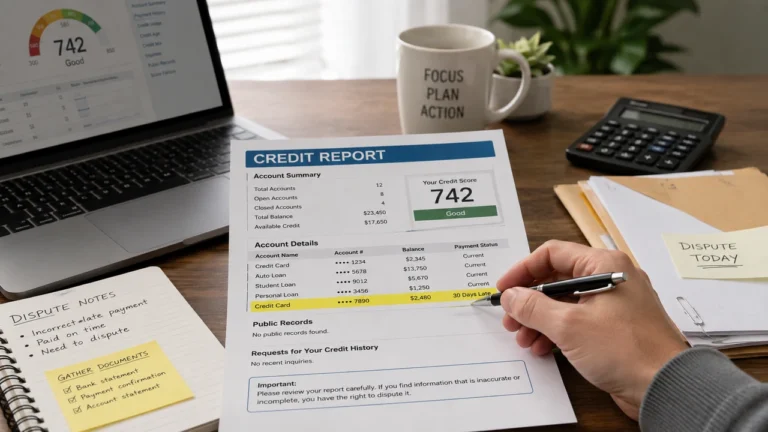
Example credit report entry
This fictional example shows why a dispute should identify the exact field you believe is inaccurate rather than challenging an entire account without specifying the problem.


How to organize your evidence
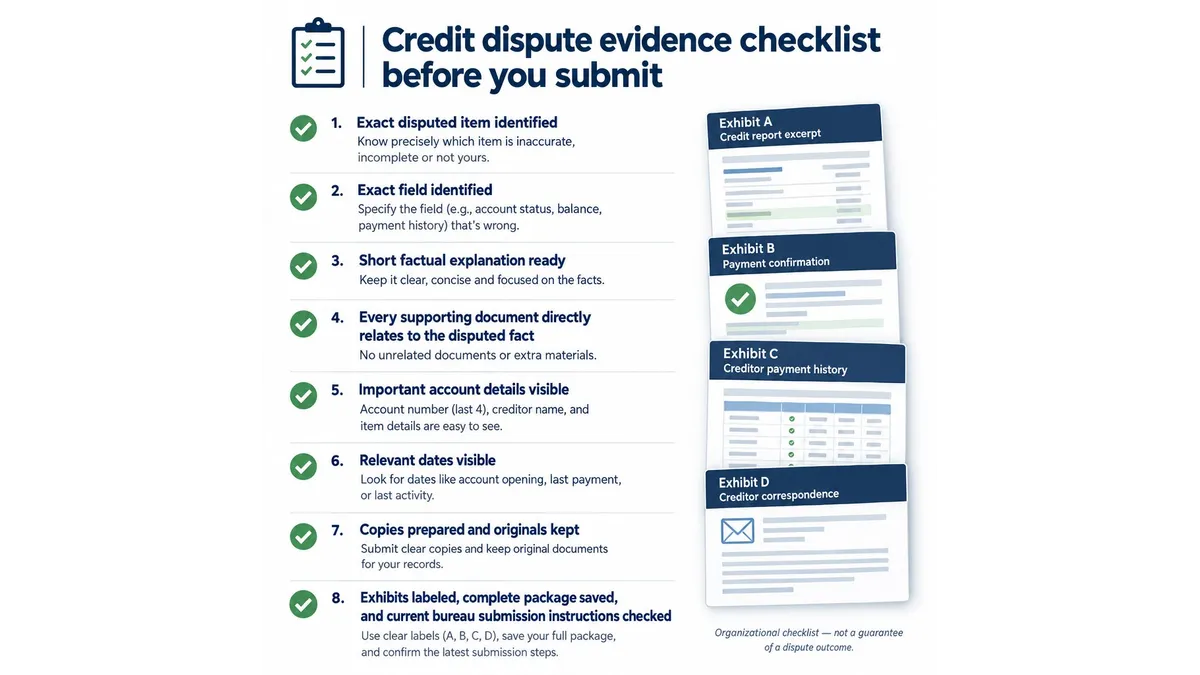
Use a simple exhibit structure so each document has a clear purpose.
Exhibit A — Credit report excerpt
Shows the exact account and field being disputed.
Exhibit B — Primary supporting record
Shows the fact most directly connected to the dispute, such as a payment confirmation or payoff record.
Exhibit C — Secondary supporting record
Adds context, such as a creditor account history or bank record.
Exhibit D — Creditor or collector correspondence
Shows relevant written information from the company involved.
Use factual labels. For example, “March 2026 payment confirmation” is better than “proof the bureau is wrong.”
Copies or originals?
Keep your originals. CFPB and FTC guidance both recommend submitting copies of supporting documents rather than giving up original records.
Before sending anything, make sure the copy still shows enough context to identify the source, account, date, amount, and disputed field. Avoid cropping a document so aggressively that it becomes impossible to understand.
What if you have no proof yet?
You can still make the dispute specific. Avoid vague claims such as “this account is wrong.” Instead, identify the exact item:
- “March 2026 is reported as 30 days late, but I believe the payment was credited before the account reached that status.”
- “The report shows a $4,850 balance, but the creditor statement for the same reporting period shows $2,150.”
- “This collection balance still appears after the settlement shown in the attached agreement and payment confirmation.”
Then look for records from the company that maintains the underlying data. Never alter, recreate, falsify, or misrepresent documents to make a dispute look stronger.
Which evidence is most useful?
The best evidence is the evidence that answers the factual question behind the dispute.
If you submitted supporting records but the bureau retained the item, read what happens after a credit dispute is verified as accurate. The examples show how to compare the result with your evidence and request an explanation of the verification procedure.
| Evidence type | Especially useful for | Main limitation |
|---|---|---|
| Creditor account history | Payment history, status, balance | Must cover the relevant period |
| Payment confirmation | Whether a payment was initiated or received | May not prove how the creditor credited it |
| Bank record | Showing a transaction occurred | May not prove the creditor posting date |
| Payoff or zero-balance statement | Paid status or balance disputes | Check the date against the reporting period |
| Settlement agreement | Settled balance or status | Must identify the account and terms clearly |
| Court record | Bankruptcy or court information | Must address the specific reported fact |
| Identity Theft Report | Identity-theft accounts | Not relevant to ordinary account disagreements |
Special cases
Late payment
Use records that show the due date, payment date, and creditor posting or payment history. If that is your issue, see how to dispute an inaccurate late payment.
Duplicate account
Save both tradelines and compare the account numbers, dates, balances, status, and transfer history. See how to dispute a duplicate account.
Paid collection still showing a balance
Use the settlement or payment agreement, payment confirmation, collector receipt, and any zero-balance confirmation. See what to do when a paid collection still shows a balance.
Identity theft
If the account resulted from identity theft, use the appropriate identity-theft process rather than treating it as an ordinary balance dispute. CFPB directs consumers to IdentityTheft.gov for identity-theft recovery steps.
Credit dispute document checklist
- □ I identified the exact account or report item.
- □ I identified the exact field that appears wrong.
- □ I can explain in one or two sentences why it appears inaccurate or incomplete.
- □ Each supporting document directly relates to that fact.
- □ I am sending copies, not originals.
- □ The source, date, account, and relevant information are visible.
- □ I labeled each attachment clearly.
- □ I saved a complete copy of the dispute package.
- □ I checked the bureau’s current submission instructions.
Frequently asked questions
Can I dispute a credit report without proof?
Yes, you can submit a dispute even if you do not yet have every supporting document. But you should identify the exact information you believe is inaccurate or incomplete and explain why. Relevant records can make the issue easier to investigate.
Should I send original documents?
No. CFPB and FTC guidance recommend sending copies of supporting documents and keeping your originals.
Should I send a bank statement?
Only if it directly supports the disputed fact. A bank statement can show that a transaction occurred, but it may not prove how or when the creditor credited the payment.
Do more documents make a dispute stronger?
Not automatically. Relevant documents are more useful than volume. A smaller package with clear evidence is usually easier to understand.
Should I dispute accurate negative information?
No. A credit report dispute is for information you believe is inaccurate or incomplete. Do not dispute accurate negative information simply because it hurts your credit.
Bottom line
The best documents for a credit report dispute are the records that directly address the exact information you want corrected. Identify the field first, match the evidence to that field, submit copies rather than originals, and save a complete record of what you sent.
The goal is an accurate credit report — not the largest dispute package and not a guaranteed deletion or score increase.
Related guides
- Credit reports & disputes hub — report errors, dispute steps, evidence, timelines, and results.
- How to dispute errors on your credit report — use the documents in a step-by-step dispute.
- Dispute online or by mail? — compare submission methods before sending your evidence.
Sources
- Consumer Financial Protection Bureau — How to dispute an error on your credit report
- Federal Trade Commission — Disputing errors on your credit reports
- Federal Trade Commission — Sample letter to credit bureaus
- Federal Trade Commission — Understanding your credit
Financial and legal disclaimer
This article provides general U.S. educational information about credit reporting and disputes. It is not individualized legal, financial, lending, or credit-repair advice. No document guarantees a correction, deletion, or credit-score change.