In this guide
- Find your next credit move
- What is the best way to fix your credit score fast?
- Step 1: check all three credit reports before changing anything
- Step 2: protect on-time payments and stop active delinquencies
- Step 3: lower high reported credit card utilization when it makes financial sense
- Step 4: correct real credit-report errors with evidence
- Step 5: wait for the report data to update before judging the score
- A one-cycle plan to improve your credit without creating new problems
- Come back after your next report update: what actually changed?
- Quick credit fixes to avoid
- When there may be no fast credit-score lever
- Frequently asked questions
- Choose what to do after this page
- About this guide
- Sources
- Financial disclaimer
Want to improve your credit score fast? Start with the problem you can actually change—not a promise of “100 points in 30 days.” A payment due tomorrow, a nearly maxed-out card, and an incorrect late-payment entry need three different responses. The wrong quick fix can cost money without helping your credit.
Your first move: protect any payment at risk, then review your reports for high card balances or specific errors. Use the table below to choose one action. After the relevant lender update or dispute response, come back to the recheck worksheet to see whether the underlying data changed. A higher score is possible, not guaranteed.
Find your next credit move
Two minutes here can save you from the wrong credit “quick fix.” Choose what appears on your report, calculate card utilization if it applies, and save a private starting point to check later. None of these steps promises a particular score increase.
Choose your situation to get a focused first action, what to verify, and the right supporting guide.
Calculate your credit utilization on this page
Enter reported balances and limits, not account numbers. If you only know the live app balance, the next credit report may show a different figure. This calculator does not predict FICO points.
Enter a reported card balance and a positive limit to calculate.
Method: add balances, add limits, then divide totals. Example: $900/$1,000 and $100/$9,000 = 10% overall, although the first card alone is 90%. The 30% and 10% examples are arithmetic reference points, not score thresholds. Pay essentials and required bills first.
Save your starting point and compare it after reporting
First, enter your reported card balances and limits in the calculator above. Save that total as your starting point. When your issuer next updates the credit report, return, replace the numbers with the newly reported figures, and compare. You can also download a CSV copy.
No baseline saved yet.
Once the updated figures appear on your credit report, choose “Compare with new figures.”
Privacy: this widget does not send your inputs to our server. Saving uses this browser’s local storage only, so a shared device may expose saved totals to other users; clearing browser data can erase them. No account numbers, names, Social Security numbers or documents are needed. A CSV can be saved privately as your own backup. A balance change is not a guaranteed score change.
What is the best way to fix your credit score fast?
Start with the most urgent issue in your own file. FICO identifies several scoring factors, including payment history and amounts owed; their effect depends on the rest of your credit history. Preventing another missed payment deserves priority over chasing a utilization target.
| What you find | First action | What to expect |
|---|---|---|
| A payment is due soon | Cover at least the required payment by the due date | Prevents a new problem; does not promise an immediate increase |
| An account is currently past due | Ask the creditor what brings it current and by when | Bringing the account current can prevent worsening delinquency; accurate prior late payments may remain |
| High reported card balances | Pay down balances using money available after essential costs and required payments | Lower utilization can appear after reporting; the score effect varies |
| A documented reporting error | Dispute the specific field with supporting records | Investigation may lead to correction, deletion, or verification; quick deletion is not guaranteed |
| Accurate negative history or a thin file | Maintain on-time payments and let positive history develop | Often needs time rather than a fast intervention |
Only ten minutes? Protect payments that are due, identify one reported problem, and use the in-page action selector to choose a verifiable next step. Do not chase a score target before checking your report.
Step 1: check all three credit reports before changing anything
Start with the underlying reports. Use AnnualCreditReport.com to get free weekly online reports from Equifax, Experian, and TransUnion. Checking your own report does not hurt your score.
Important: these free credit reports do not include a free credit score. The CFPB explains the difference; your credit card issuer may offer a free score separately. For useful before-and-after tracking, compare the same bureau and scoring model when possible, rather than assuming scores from two different apps are directly comparable.
For each account, record the reported balance, credit limit if applicable, payment status, payment history, and last-updated date. Compare the same account across the three bureaus.

Step 2: protect on-time payments and stop active delinquencies
Protect payment history before small optimization tactics. Payment history is a major FICO scoring factor, so preventing a new late payment generally deserves priority over chasing a small utilization change. If an account is already past due, contact the creditor and ask what amount is required to bring the account current and by what date.
FICO commonly describes reported late payments in 30-, 60-, 90-, and later-day categories. If you have missed a due date but have not yet reached a reported 30-day delinquency, bringing the account current promptly may help you avoid a 30-day late from being reported, depending on the creditor’s reporting. A late fee or other account consequence can still occur before a late payment reaches the credit reports.
For more detail on timing, see when a missed payment can show up on your credit report.
Call script for a past-due account
“My account is past due and I want to bring it current. What is the exact amount I need to pay, and by what date, to restore the account to current status? If I cannot pay the full catch-up amount today, what hardship or repayment options are available?”
Bringing an account current does not erase accurate late-payment history that was already reported. The goal is to stop the account from becoming more delinquent while protecting the rest of your budget.
Step 3: lower high reported credit card utilization when it makes financial sense
High reported revolving balances are one of the report fields you can change directly. FICO’s amounts-owed guidance explains why using a large share of available revolving credit can matter. Paying down a card changes the inputs; the dollar amount alone does not predict a score increase.
There is no utilization percentage that guarantees a particular score. Keep money for rent, food, utilities, insurance, taxes, and required payments before using extra cash to reduce a card balance.
Check each card and your total utilization
FICO considers overall utilization and high utilization on individual revolving accounts. For ordinary credit cards with reported limits, calculate each card separately, then divide the sum of balances by the sum of limits. Do not average the individual percentages.
| Card | Reported balance ÷ limit | Utilization |
|---|---|---|
| Card A | $900 ÷ $1,000 | 90% |
| Card B | $100 ÷ $9,000 | About 1.1% |
| Both cards together | $1,000 ÷ $10,000 | 10% |
A low total does not hide a nearly maxed-out card. In this hypothetical example, an $800 payment to Card A would leave $100 on A and $100 on B: A would be at 10%, and the total would be $200 ÷ $10,000 = 2%, once those balances are reported. This assumes unchanged limits, no interest or fees added, and no new charges. It is a calculation, not a prediction of points.
What if you have only $200 available?
Using the same two-card example, paying $200 toward Card A would lower its balance from $900 to $700. Its individual utilization would be 70%, and the combined balance would be $800 on $10,000 in limits, or 8% overall—if the payment is reflected in the next reported balances and no other amounts change. That is real arithmetic progress, even though it tells us nothing certain about score points. Never sacrifice a required payment or essential expense to chase a ratio.
Try it without leaving this article: Open the calculator above, enter the balance and limit for each card, and check individual and total utilization. You can then save a starting point for your next credit-report update. The 30% and 10% examples are illustrative—not magic scoring thresholds.
Wondering whether to pay before the statement closes? See statement date vs. due date. The required due-date payment always comes first.
Most FICO versions assess utilization from the latest reported account data. FICO 10T also considers trends over 24 months or longer. A recent payoff does not make every scoring model disregard earlier balance patterns.
Reported balance matters more than the number in your card app
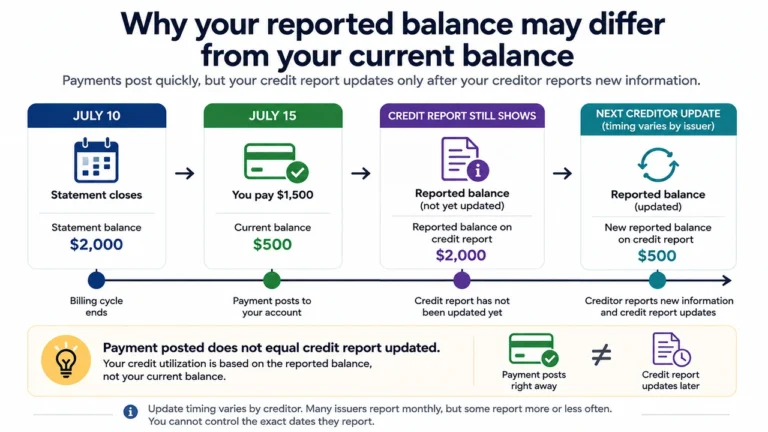
Your current card balance and the balance currently on your credit report can be different. FICO notes that the report typically reflects the balance last furnished by the lender, often around a monthly statement. Ask your issuer when it normally reports account information instead of assuming every issuer uses the same date.
Our guide to how credit utilization works explains those mechanics in more detail.
Step 4: correct real credit-report errors with evidence
A legitimate dispute addresses information you have a specific reason to believe is inaccurate or incomplete. CFPB guidance explains how to dispute errors with the bureau and the company that furnished the information. A focused dispute should identify the account, explain the exact problem, state what should be corrected, and include copies of supporting documents.
| Possible error | Evidence to compare | What to dispute |
|---|---|---|
| Wrong balance | Statements, payment records, payoff confirmation | The exact balance field |
| Late payment you believe is incorrect | Due date, payment confirmation, bank record, creditor record | The specific month/status |
| Closed account shown as open | Closure confirmation or final statement | The account status |
| Account does not belong to you | Identity and account records; identity-theft documentation when applicable | Ownership/account identity |
| Duplicate entry | Account numbers, creditor names, balances, dates, ownership history | The specific duplicate reporting |
Do not dispute an accurate collection, charge-off, or late payment simply because it is hurting your score. The FTC warns that companies promising to remove accurate, current negative information or telling consumers to dispute information they know is accurate are red flags.
If you confirm an error, follow our guide on how to dispute credit-report errors with supporting statements, payment confirmations, and account records.
Set a realistic follow-up date. The CFPB says credit bureaus generally investigate within 30 days of receiving a dispute, with up to 45 days allowed in some circumstances; notification of the results generally follows within five business days after the investigation is completed. These are investigation rules, not promises of deletion or a faster score increase.
Want to keep evidence, dates, and outcomes organized? Print the seven-step credit-report checklist and tracking worksheet. If an account is unfamiliar and may involve identity theft, start with IdentityTheft.gov rather than waiting for a routine score update.
Step 5: wait for the report data to update before judging the score
A score cannot react to a change that has not reached the credit report used to calculate it. Experian explains that creditors usually report monthly on their own schedules; dates can differ between bureaus. A daily app refresh does not mean a lender reported a new balance that day.
After you pay down a card, bring an account current, or correct an error, first check whether the relevant balance, limit, status, payment history, or date actually changed on the report.
- You take an action. For example, you make a payment or complete a dispute.
- The creditor or furnisher updates its records.
- New information is furnished to one or more credit bureaus.
- The bureau report reflects the newer data.
- A score calculated from that report can then evaluate the updated information.
FICO calculates a score when it is requested, using the report information available then. Compare the same bureau and model when tracking progress, and record the calculation date. First confirm that the balance or status actually changed.
Ask your issuer when it normally reports and whether the payment has posted. After the expected reporting date, compare the new report with your receipt. If a balance still appears wrong, ask about the delay before treating normal reporting lag as an error.
What if a mortgage deadline is close?
Ask your mortgage lender whether a rapid rescore is appropriate. The lender requests an expedited update using evidence of an account change; you cannot order it yourself. It may take a few days after complete documentation is submitted, with payment processing and document preparation adding time. Confirm the lender’s expected timing and the score it will use before deciding what to pay. This process does not erase accurate negative history or guarantee a higher score or mortgage approval.
A one-cycle plan to improve your credit without creating new problems
Before changing anything, note the report date, total card balances, total credit limits, and the specific issue you want to address. Make the required payments first; use extra cash for optional paydowns only if the budget allows. Save your starting utilization above, then return after the lender next reports. For actual credit-report mistakes, preserve the bureau notice and dispute evidence separately.
Come back after your next report update: what actually changed?
Return after your lender updates the report or your dispute investigation finishes. Compare the same underlying field before and after instead of refreshing your score every day. If you use the in-page tracker, your saved starting utilization will still be available on this browser unless site data has been cleared. Ask your issuer when it generally reports; there is no universal 30-day promise.
Your recheck is interactive: Compare updated reported balances and limits with your saved starting numbers. The tracker can download a CSV for your private records. For payment-status changes or disputes, use the printable credit-report checklist to record the response.
- If the report now shows the change: record it, then check a new score from the same bureau and model when available. A corrected field can be progress even if the score stays flat.
- If the lender has not reported the new balance yet: confirm the payment posted and ask when the lender last furnished data. Do not automatically dispute normal reporting lag.
- If a specific error remains after an investigation: read the bureau’s explanation and compare it with your evidence before deciding the next step.
Need a deeper before-and-after log? Use the credit-improvement tracking guide. If you paid off a credit card and the report still shows the old balance, see when a card payoff reaches your credit score.
Quick credit fixes to avoid
Before opening, closing, or changing an account, identify the problem it would solve and the costs it would create.
- Do not dispute every negative item. Dispute specific inaccurate or incomplete information, not accurate history.
- Do not carry interest-bearing debt to “build credit.” Paying interest is not required to establish payment history.
- Do not open several cards solely to lower utilization. New applications and new accounts introduce additional score factors and financial risk.
- Do not close an old card solely because you expect a score boost. Closing revolving credit can reduce available credit and may raise utilization if balances remain.
- Do not pay a credit-repair company for guaranteed deletions or point increases. Accurate current negative information cannot legally be removed just because it is unfavorable.
- Do not use a “new credit identity.” The FTC warns that schemes involving false identifying information are scams and can create serious legal problems.
When there may be no fast credit-score lever
If your reports are accurate, your revolving balances are already manageable, all accounts are current, and the main issue is recent negative history or a short credit history, time may be the missing ingredient. CFPB’s rebuilding guidance explains that consistent repayment takes time to establish.
In that situation, focus on keeping accounts current, avoiding unnecessary applications, reducing debt at a sustainable pace, and allowing positive history to develop.
Frequently asked questions
Can I improve my credit score in 30 days?
It is possible for report information and a score to change within 30 days, but it is not guaranteed. A lower card balance, a corrected error, or an updated account status must first reach the credit report used for the score calculation.
What is usually the fastest legitimate credit-score action?
If high revolving utilization is the main problem, lowering reported balances is a direct way to change scoring data in most FICO versions. If an account is actively past due, stopping further delinquency should take priority. The right action depends on the issue you can verify, not a universal trick.
Is 30% credit utilization the target?
Thirty percent is a commonly cited guideline, not a scoring cliff or guaranteed target. FICO says lower utilization is generally less risky than higher utilization, while the effect depends on the rest of the credit file. Do not spend or move money solely to hit an arbitrary percentage.
Will paying off a collection automatically raise my score?
No. FICO 9 and the FICO 10 suite disregard eligible third-party collections reported as paid in full; older models may still consider them. This special treatment does not extend to first-party collections. Payment and deletion are different events.
Paid medical collections and medical collections with an initial reported balance under $500 are excluded under the nationwide credit bureaus’ reporting policies. Lowering an existing collection’s current balance below $500 does not itself meet that initial-balance rule. These bureau policies should not be confused with the CFPB’s separate, broader 2025 medical-debt regulation, which a federal court vacated on July 11, 2025. For reporting exceptions and next steps, read whether you can remove paid collections from your credit report.
Should I pay before my statement date or by the due date?
Make the required payment by its due date. An optional earlier payment may reduce the balance used for the next report if your issuer reports around statement closing, but reporting schedules differ. Paying early does not replace meeting a due-date obligation. See the statement-date and due-date guide for a worked example.
Why did I pay down a card but see no score increase?
First confirm whether the lower balance reached the report used for the new score. If it did, compare the same bureau and scoring model and check for other changes, such as a new balance, lower credit limit, late payment, or a different calculation date. Scores do not respond identically for every borrower.
Does checking my own credit report lower my score?
No. CFPB and AnnualCreditReport.com state that checking your own credit report does not affect your credit score.
How do I clean up my credit fast?
Start with specific errors in the underlying reports: a wrong balance, incorrect late-payment month, account that is not yours, or an actual duplicate. Match each dispute to evidence. “Cleaning up” a report does not mean removing accurate negative information on demand.
Can I raise my credit score 100 points in 30 days?
No method can promise that result for every credit file. What changes, when it is reported, and the scoring model determine the outcome. Focus on a documented balance, status, or error correction instead of buying a guaranteed point increase.
Illustrative photographs: featured image by Towfiqu barbhuiya / Unsplash; in-article image by Jakub Żerdzicki / Unsplash.
Choose what to do after this page
Before you leave: if utilization is your priority, save your current reported balances so you can compare later. If an account is genuinely wrong, follow the printable evidence checklist. If your report is accurate but your credit history needs more time, use the long-term improvement plan instead of searching for a guaranteed point increase.
About this guide
Source review: October 13, 2026. This guide checks CFPB dispute timelines, FICO utilization guidance, and FTC credit-repair warnings. Its original in-page action selector, utilization calculator, and saved comparison use illustrative arithmetic; they do not calculate or predict a credit score. Claire Bennett is an editorial name used by Fix My Money Life, not a claimed professional credential. This guide addresses U.S. credit reports, and none of its steps guarantees a score increase.
Sources
- Consumer Financial Protection Bureau — How to rebuild your credit
- Consumer Financial Protection Bureau — How to dispute an error on your credit report
- AnnualCreditReport.com — Free weekly credit reports
- FICO — What is in your FICO Score
- FICO — Amounts owed and credit utilization
- Federal Trade Commission — Spot scams when fixing your credit
- Consumer Financial Protection Bureau — Credit-report dispute investigation timing
- Consumer Financial Protection Bureau — Free reports versus free credit scores
- TransUnion — Credit-report collection policies
- Consumer Financial Protection Bureau — Status of the 2025 medical-debt rule
Financial disclaimer
This article provides general U.S. financial and credit information, not individualized financial, legal, credit-repair, or tax advice. Credit-score results vary by scoring model, bureau data, lender, and the rest of your credit profile. No action described here guarantees a specific score increase or update date.