In this guide
- Your 10-minute action plan
- First, determine how late the payment became
- Use this failed-payment decision table
- Step 1: make the required payment
- Step 2: save evidence before changing the settings
- Step 3: diagnose why autopay did not go through
- What if autopay failed but you had enough money?
- What if the money left your bank account but the payment was not credited?
- What if this was the final payment on an auto loan?
- Step 4: contact the creditor
- Use this case log
- Copy-and-use written investigation request
- Can you dispute a late payment caused by autopay?
- Dispute or goodwill: which route fits?
- When is a goodwill request more appropriate?
- What if the late fee was waived but the late payment remains?
- What if the creditor refuses to correct the account?
- Will a failed autopay hurt your credit score?
- Three examples of failed autopay
- How to check whether the late payment was reported
- How to prevent another failure
- Common mistakes to avoid
- Frequently asked questions
- Bottom line
- Related guides
- Sources
- Disclaimer
- Author and review information
If autopay failed and caused a late payment, first confirm whether the payment failed, is still pending, or will be retried. Ask the creditor what amount and payment method would bring the account current, then act promptly using funds you can safely make available. Before sending a replacement payment, check whether the original debit could still be collected so you do not pay twice unintentionally. Preserve the setup and payment records and ask the creditor to investigate the failure. A payment that is only a few days late may trigger a fee, but it generally is not reported as a 30-day late payment until the account reaches at least 30 days past due. If a late payment already appears on your credit report, determine whether the failure resulted from a creditor processing error, a bank rejection, insufficient funds, an expired payment method, or an incomplete setup. That evidence determines whether you should request a correction, file a credit report dispute, or ask for a goodwill adjustment. If the underlying problem is affordability rather than a one-time autopay failure, see how a credit card hardship program can affect your credit score. For related timing and recovery guides, see the Late payments hub.
Your 10-minute action plan
Minutes 1–2: Check the due date and calculate how many days past due the account became.
Minutes 3–4: Check whether the original debit is pending or will be retried. Confirm with the creditor what amount remains due before making a replacement payment.
Minutes 5–6: Screenshot the scheduled date, amount, payment status, and linked funding account.
Minutes 7–8: Download the statement, payment history, and relevant bank records.
Minutes 9–10: Contact the creditor, request an investigation, and obtain a case number.
Check the original debit before paying again. Do not delay a confirmed undisputed payment while the failure is investigated. If funds were withdrawn but not credited, use the trace and billing-error steps below rather than automatically paying twice.
First, determine how late the payment became
The payment due date, the date a late fee may be charged, and the date a creditor may report a delinquency are not necessarily the same.
| Account status | What may happen | Best immediate action |
|---|---|---|
| 1–29 days past due | A late fee or other account consequence may apply, but the account generally has not reached the 30-day credit-reporting category. | Pay immediately, request a fee waiver, and confirm that the account is current. |
| 30–59 days past due | The creditor may report a 30-day late payment to one or more credit bureaus. | Bring the account current, investigate the failed payment, and review your credit reports. |
| 60 days or more past due | A more serious delinquency level may be reported. | Ask exactly how much is required to bring the entire account current before another late-payment level is reached. |
For a closer look at the first reporting threshold, read what happens when a payment is less than 30 days late.
These are general reporting timelines, not permission to delay payment. A creditor may impose fees or other account consequences before the payment reaches 30 days past due. Some products may follow different reporting schedules, so review your account agreement and ask the creditor how it reports delinquency.
Use this failed-payment decision table
| Your situation | Best next step | Why |
|---|---|---|
| The payment is less than 30 days late | Pay and confirm the account is current | You may still be able to prevent a reportable 30-day delinquency. |
| The creditor confirms that it failed to process a valid scheduled payment | Request a written correction | The creditor should review whether its account records or credit reporting are inaccurate. |
| The money left your bank account, but the creditor did not post the payment | Request a payment trace | This may be a payment-crediting or billing-error problem rather than a failed withdrawal. |
| The payment was completed on time but reported late | Request a correction and dispute if necessary | Your records may show that the reported status is wrong. |
| The bank rejected the withdrawal | Obtain the rejection reason | The return code may identify a funding, account-information, or bank-restriction problem. |
| Insufficient available funds caused the failure | Pay and consider goodwill | The resulting late payment may be accurate even though it was unintentional. |
| The setup was incomplete or began later | Correct the setup and consider goodwill | An enrollment problem does not automatically make the reported payment history inaccurate. |
| This was a final, payoff, balloon, or adjusted loan payment | Confirm whether manual payment was required | The final amount may not have been included in the regular recurring-payment schedule. |
| The cause is still unknown | Request processing records before disputing | You need evidence showing what happened and what information was reported incorrectly. |

Step 1: make the required payment
After checking for a pending or retried debit, pay the confirmed amount still due using funds you can safely make available. If money already left your bank account, request a payment trace before paying again. Keep paying undisputed amounts; follow the credit card billing-error procedure below for a disputed missing payment credit.
Ask the creditor how much is required to:
- cover the missed payment;
- pay any amount that became due afterward;
- bring the entire account current;
- avoid reaching the next delinquency level.
Do not assume that resubmitting the original scheduled amount will bring the account current. If another billing cycle has started, more than one payment may now be due.
If money has already left your bank account, do not automatically submit a duplicate payment. Ask the creditor to trace the original transaction and confirm what amount, if any, remains undisputed and due.
Step 2: save evidence before changing the settings
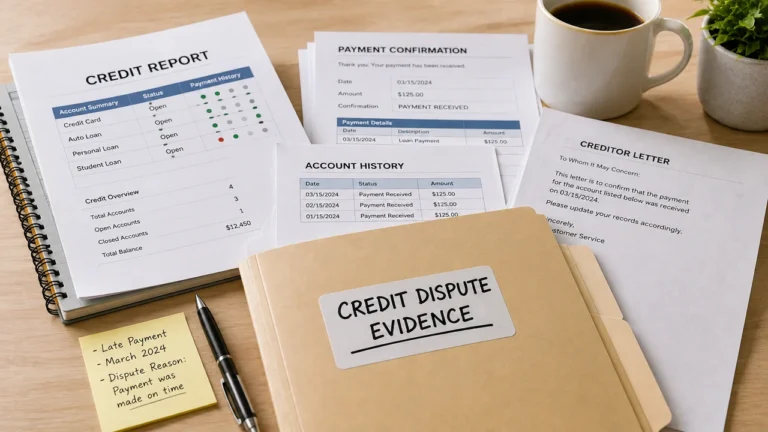
Before turning automatic payments off, reconnecting the bank account, or changing the scheduled date, take screenshots of the existing settings. A screenshot taken today may not prove that the payment was properly scheduled for the missed billing cycle, so preserve the original enrollment confirmation when available.
Evidence checklist
- Autopay enrollment confirmation and effective date
- Screenshot of the scheduled payment date and amount
- Last four digits of the linked funding account
- Monthly statement showing the due date
- Creditor payment history
- Bank statement covering the withdrawal period
- Available-balance information, when relevant
- Bank transaction showing that money was withdrawn
- Payment confirmation or reference number
- Failed-payment email, text, or account notification
- Screenshot of any error message
- Notice about a servicing or account change
- Call notes and case numbers
- Written investigation result
- Credit report page showing the late payment

Send copies rather than original records. Review the broader list of documents that can support a credit report dispute before submitting a formal claim.
If you are resetting your payment system after the problem is resolved, review our guide to using credit card autopay safely.
Step 3: diagnose why autopay did not go through
If your autopay did not go through, do not automatically assume that the creditor or bank was responsible. Compare the scheduled payment, withdrawal attempt, available balance, linked account information, and any rejection code.
| What the evidence shows | What it may indicate | What to request next |
|---|---|---|
| No withdrawal attempt appears in the bank records | The creditor or processor may not have submitted the payment | Ask for the authorization and processing log |
| An ACH return or rejection code exists | The bank rejected the withdrawal | Ask the creditor and bank to explain the code |
| Money left the bank account, but no payment appears on the creditor account | The payment may have been delayed, misapplied, or credited to the wrong account | Request a payment trace using the amount, date, and reference number |
| The enrollment confirmation begins next billing cycle | The setup did not cover the missed due date | Confirm the effective date and correct the schedule |
| The linked funding information is outdated | The withdrawal may have been sent to a closed or incorrect account | Update the information and confirm the next payment |
| A stored card or payment method expired or was replaced | The saved credentials may no longer be valid | Update the payment method and verify the next scheduled date |
| The payment was completed before 30 days, but a 30-day late mark appears | The payment date or reported delinquency may be inaccurate | Request a correction and preserve proof of the payment date |
| Automatic payments disappeared after a servicing transfer | The transfer or platform migration may have affected the instructions | Request enrollment records from the old and new servicer |
| The final loan payment differed from the regular monthly amount | The recurring-payment system may not have included the final payment | Ask whether a manual final or payoff payment was required |
Possible creditor or processor problems
- the scheduled instruction was never submitted;
- automatic payments were disabled during an account migration;
- the wrong amount was requested;
- the payment was credited to the wrong account or date;
- the payment instruction was canceled without your request;
- a processing outage interrupted the transaction.
Possible bank-account problems
If the issuer first accepted a payment and then reversed it, use the returned credit card payment checklist. Confirm the bank’s return reason, make a valid replacement payment, and check for multiple penalty fees based on the same event.
- insufficient available funds;
- a closed, frozen, or restricted account;
- incorrect routing or account information;
- a rejected electronic debit;
- a deposit that was not yet available;
- another transaction that reduced the available balance.
Possible setup problems
- the enrollment was started but not completed;
- the first automatic payment began the following month;
- the withdrawal date was scheduled after the due date;
- only a partial amount was selected;
- the minimum payment did not cover an existing past-due balance;
- a replacement or refinanced account required new enrollment;
- a saved payment method expired or was replaced;
- the final payment was excluded from the recurring schedule.
If autopay failed without notification, ask what alerts were generated, where they were sent, and whether your contact preferences were active for that billing cycle.
What if autopay failed but you had enough money?
If autopay failed but you had enough money, ask the creditor for the exact date, time, amount, and result of every attempted withdrawal. Compare that information with the balance available at that time—not only the ending balance shown on a monthly statement.
Possible explanations include:
- the creditor never submitted the withdrawal;
- incorrect bank information was used;
- the bank rejected the debit for another reason;
- a recent deposit had not yet become available;
- the payment was scheduled for a different date;
- the enrollment did not apply to that billing cycle.
Ask for any ACH return code or internal failure code. A vague statement that the payment “declined” may not identify the actual cause.
What if the money left your bank account but the payment was not credited?
If the withdrawal appears in your bank records but the creditor does not show the payment, treat this differently from a payment that was never attempted. Save the bank transaction, payment confirmation, statement, and reference number. Ask the creditor to search for a delayed, misapplied, duplicated, or incorrectly credited payment.

Provide the creditor with:
- the withdrawal date and exact amount;
- the last four digits of the originating account;
- the transaction or confirmation number;
- the account to which the payment should have been applied;
- the statement that failed to reflect the payment.
Special rule for credit card accounts
If a credit card payment does not appear on the statement, contact the issuer promptly. To use the federal billing-error procedure, make sure the creditor receives your written notice at its designated billing-inquiries address no later than 60 days after it transmitted the first statement showing the alleged error. For a missing payment credit, count from the statement on which that credit should have appeared. These timing rules are in Regulation Z, section 1026.13(b)(1); do not count only from when you later opened or read the statement. Use an electronic notice only through a method the issuer expressly accepts for billing-error notices.
Follow the billing-error instructions on the statement. The billing-inquiries address is generally different from the address used to send payments.
After a timely written notice, you generally do not have to pay the disputed amount or related charges while the billing dispute is pending. You must continue paying undisputed amounts according to the account agreement.
A credit card billing-error notice is different from a credit report dispute. The first addresses the creditor’s billing or payment-crediting records. The second addresses information appearing on a consumer report.
What if this was the final payment on an auto loan?
Do not assume that a regular recurring-payment instruction automatically covers a final, payoff, balloon, or adjusted loan payment. The final amount may differ from the normal monthly payment and may require manual action.
If a final payment was missed:
- Check the contract, payoff statement, and recent account notices.
- Ask whether the final amount was excluded from recurring payments.
- Ask when and how the servicer notified you that manual payment was required.
- Request removal of any fee caused by inadequate notice or a servicing error.
- Ask whether late-payment information was furnished to a credit bureau.
- Request a written correction if the reporting is inaccurate.
Do not use an estimated payoff amount. Ask the servicer for the exact amount and the date through which that figure is valid.
Step 4: contact the creditor
Use the customer service number on your statement or the creditor’s official website. Ask the representative to review the historical processing records, not only the current account settings.
Copy-and-use call script
“I had an automatic payment scheduled for this account, but it did not process correctly. I have now made the required payment, or the funds have already left my bank account. Please review the enrollment date, effective date, scheduled amount, withdrawal date, linked funding account, processing records, payment-posting records, and any rejection or return code. Please also confirm whether the account was reported late to Equifax, Experian, or TransUnion. If the problem resulted from a processing or servicing error and the resulting reporting is inaccurate, I am requesting that the account and every affected credit report be corrected. Please provide the investigation result in writing.”
Questions to ask before ending the call
- Was the payment instruction active for the missed billing cycle?
- When did the enrollment become effective?
- Was a withdrawal actually submitted?
- What date, time, and amount were used?
- Which funding account or payment method was used?
- Was a rejection or return code recorded?
- If the money was withdrawn, where was the payment applied?
- Was the instruction canceled, suspended, or changed?
- Was a failure warning sent?
- Was the account reported late, and to which bureaus?
- Will any related late fee be waived?
- Will inaccurate payment history be corrected?
- When will the decision be provided in writing?
- What is the case number?
Use this case log
Keep a record of every contact, especially if different representatives provide conflicting explanations.
| Date and time | Department | Representative | Case number | Explanation | Promised next step |
|---|---|---|---|---|---|
| ____________ | ____________ | ____________ | ____________ | ________________________ | ________________________ |
Copy-and-use written investigation request
Subject: Request to investigate failed or improperly credited automatic payment
[Your full name]
[Your mailing address]
[City, state, ZIP code]
[Phone number]
[Email address]
[Date]
Re: Account ending in [last four digits]
To whom it may concern:
I am requesting an investigation into an automatic payment that did not process or was not properly credited to the account listed above.
The payment was due on [due date]. My records show that a payment was scheduled for [scheduled payment date] in the amount of [$ amount] from the funding account ending in [last four digits]. I discovered the problem on [date discovered].
[Choose the sentence that applies:]
- The withdrawal did not occur, and I made a replacement payment of [$ amount] on [date paid].
- The funds were withdrawn on [withdrawal date], but the payment does not appear to have been credited correctly.
Please provide:
- the date the automatic-payment enrollment became effective;
- the scheduled payment date and amount;
- whether and when a withdrawal was submitted;
- any rejection, return, or failure code;
- the account and date to which any received payment was credited;
- whether the payment instruction was canceled or changed;
- whether the account was reported late to any credit reporting company.
If your investigation determines that the payment was not processed or credited correctly because of a creditor, servicer, or payment-processing error, please correct the account, reverse any related charge where required, and notify every credit reporting company that received inaccurate information.
Please send the investigation results and any correction confirmation in writing.
Sincerely,
[Your name]
Enclosures: [List copies of the documents included]
Do not include a complete bank account number in ordinary correspondence unless the creditor’s secure process specifically requires it. Use only the information needed to locate the account.
Can you dispute a late payment caused by autopay?
You can dispute a late payment when you have a specific reason to believe the reported information is inaccurate or incomplete. A missed payment because autopay failed does not automatically make the resulting credit reporting wrong.
A dispute may be appropriate when:
- the payment was made on time but reported late;
- the account did not reach 30 days past due;
- the wrong month was marked late;
- the wrong delinquency level was reported;
- the payment was credited to the wrong account or date;
- the creditor confirmed a processing error but did not correct the reporting;
- the creditor agreed to update the account but the error remains.
A dispute is usually not appropriate when:
- the linked account had insufficient available funds;
- incorrect bank information was entered;
- the enrollment was never completed;
- the first scheduled payment had not yet begun;
- the account accurately reached 30 or more days past due;
- you simply want accurate negative information removed.
Identify the account, disputed month, reported status, reason it is inaccurate, and exact correction requested. Attach copies of records that directly support the claim.
If the reporting is inaccurate, follow the complete process for disputing a late payment on your credit report.
Dispute or goodwill: which route fits?
| Question | Credit report dispute | Goodwill request |
|---|---|---|
| Is the reported information inaccurate? | Yes, or there is a specific reason to believe it is | No—the reporting may be accurate |
| What is the goal? | Investigate and correct a specific error | Request voluntary consideration |
| Best route after a confirmed creditor error? | Usually correction or dispute | Usually not the primary route |
| Best route after insufficient funds or an incomplete setup? | Usually not appropriate if the reporting is accurate | May be appropriate |
| Must the creditor approve the request? | It must investigate an appropriate dispute, but the outcome is not guaranteed | No |
| Is removal guaranteed? | No | No |
When is a goodwill request more appropriate?
A goodwill request may be more appropriate when the late payment is accurate but resulted from an isolated mistake or unusual circumstance.
Examples include:
- the funding account did not have enough available money;
- the connected account had been closed or changed;
- the enrollment was incomplete;
- you misunderstood when the first payment would begin;
- an expired or replaced payment method was not updated;
- the failure was an isolated event and the account is now current;
- you previously maintained a strong payment history.
A goodwill adjustment is voluntary. The creditor is not required to remove an accurately reported late payment, and approval cannot be guaranteed.
If the reporting is accurate, learn how to request a goodwill adjustment without falsely disputing correct information.
What if the late fee was waived but the late payment remains?
If you still need to ask about a credit card fee, see how to request a late-fee waiver. It explains what to say, how to verify the credit, and when a billing-error correction is the appropriate route.
A waived late fee and corrected credit reporting are separate outcomes. A creditor may remove a fee as a customer-service courtesy while continuing to believe that the reported delinquency is accurate.
Ask whether:
- the fee was waived only as a courtesy;
- the investigation identified a processing or posting error;
- the creditor believes the reported payment history is accurate;
- every bureau that received incorrect information will be updated.
If the creditor confirms an error but does not correct the reporting, save that confirmation as supporting evidence.
What if the creditor refuses to correct the account?
- Request the decision in writing.
- Compare the explanation with your payment and bank records.
- Identify the exact credit report information you believe is inaccurate.
- Dispute the error with each bureau displaying it.
- Attach copies of your strongest supporting records.
- Keep proof of submission and delivery.
- Review the written investigation result.
- Submit additional information only if it materially strengthens the dispute.
A credit reporting company generally has 30 days to investigate a dispute. Certain circumstances may extend the period to 45 days. It generally has five business days after completing the investigation to notify you of the results.
If the account is verified without a satisfactory explanation, review what to do if your credit dispute is denied.
If a documented reporting error remains unresolved and causes substantial financial harm, consider consulting a qualified consumer law attorney about your specific circumstances.
Will a failed autopay hurt your credit score?
The technical payment failure itself generally is not listed as a separate credit report item. The potential score impact comes from a resulting delinquency reported by the creditor.
No universal formula can predict how many points a score will lose. FICO evaluates late payments using factors that include:
- severity: whether the payment was reported 30, 60, 90, or more days late;
- recency: how recently the delinquency occurred;
- frequency: whether it was isolated or part of a pattern;
- the rest of the information in the consumer’s credit file.
An accurately reported late payment can generally remain on a credit report for up to seven years. Paying the account can bring it current, but it does not automatically erase accurate earlier payment history.
Learn how long a late payment may affect your credit score and why the result differs among credit profiles.
Three examples of failed autopay
Example 1: discovered after 11 days
A credit card payment was due on July 1. The scheduled withdrawal failed, but the cardholder noticed the problem on July 12 and paid immediately.
The cardholder should preserve the records, request an investigation and fee waiver, confirm that the account is current, and monitor the credit reports. The account has not yet reached 30 days past due.
Example 2: discovered after 35 days
A payment was due on July 1, but the cardholder did not discover the failed withdrawal until August 5. The account may have reached the 30-day delinquency category.
The cardholder should bring the account current, request the processing history, check all three credit reports, and determine whether correction, dispute, or goodwill matches the evidence.
Example 3: money withdrawn but not posted
A $250 credit card payment left the checking account on July 1, but the card statement did not show the payment and later included a late fee.
The cardholder should request a payment trace, preserve the bank transaction and reference number, and send a timely written billing error notice. This is potentially a payment-crediting problem, not merely a failed withdrawal.
How to check whether the late payment was reported
Review your reports from Equifax, Experian, and TransUnion through AnnualCreditReport.com, the federally authorized source for free credit reports. Free online reports are currently available weekly.
Check:
- the month marked late;
- whether the account shows 30, 60, or 90 days past due;
- the current account status;
- the reported balance;
- the date the creditor last updated the account;
- whether the information differs among the three reports.
How to prevent another failure
If a layoff has made your bank balance less predictable, review our credit protection plan after losing your job. Check upcoming withdrawals against available cash and contact the creditor if a payment will be unaffordable.
- Confirm when the first scheduled payment begins.
- Enable successful-payment and failed-payment alerts.
- Create a calendar reminder to verify that every payment cleared.
- Review the linked account after changing banks or account numbers.
- Update expired or replaced payment methods.
- Review the setup after refinancing or a servicing transfer.
- Ask whether a final or payoff payment must be made manually.
- Keep enough available funds in the funding account.
- Save the original enrollment confirmation.
- Do not assume a failed payment will be retried.
Common mistakes to avoid
- Waiting for the investigation before paying.
- Submitting a duplicate payment after money was already withdrawn.
- Changing the settings before taking screenshots.
- Assuming automatic enrollment proves creditor fault.
- Using a monthly ending balance as proof of available funds at the processing time.
- Assuming a final loan payment is included in autopay.
- Disputing without identifying a specific error.
- Confusing a fee waiver with a credit reporting correction.
- Paying someone who promises guaranteed deletion.
Frequently asked questions
What should I do if my credit card autopay failed?
Contact the card issuer promptly, preserve the payment settings and records, and check whether the original debit is pending, will be retried, or already left your bank account. Confirm what remains due before paying again; request a payment trace if funds were withdrawn but not credited. Ask whether a withdrawal was attempted, why it failed, whether the account reached 30 days past due, and whether late-payment information was sent to a credit bureau.
Can an autopay failure cause a 30-day late payment?
Yes. If the required payment is not made and the account reaches at least 30 days past due, the creditor may report a 30-day delinquency. Having an automatic payment enabled does not by itself prevent late reporting.
What if autopay failed but I had enough money?
Ask for the exact withdrawal date, time, amount, and rejection or return code. Compare that information with the available balance at the attempted processing time.
What if the money left my bank account but the creditor did not credit it?
Save the transaction, confirmation, statement, and reference number, then ask the creditor to trace the payment. For a credit card billing error, make sure the issuer receives your written notice through its designated billing-error channel no later than 60 days after it transmitted the first statement that should have shown the payment. See the Regulation Z explanation above; the deadline is not measured from when you later read the statement.
Can I dispute a late payment caused by autopay?
You can dispute it when you have a specific reason to believe the reported information is inaccurate. Examples include a timely payment reported as late, an incorrect month, the wrong delinquency level, or a confirmed processing error.
Does the creditor have to remove the late payment?
The creditor or credit reporting company must investigate an appropriate dispute and correct information found to be inaccurate. Automatic-payment enrollment alone does not guarantee removal. An accurately reported late payment generally does not have to be deleted.
Is the final loan payment always included in autopay?
No. A final, payoff, balloon, or adjusted payment may differ from the regular monthly amount and may require manual payment. Check the payoff statement and confirm the process with the servicer.
Should I file a dispute or send a goodwill request?
Use a dispute when the reported information is inaccurate. Consider goodwill when the late payment is accurate but resulted from an isolated mistake or unusual circumstance. Neither route guarantees removal.
Will the creditor automatically retry the payment?
That depends on the creditor and account terms. Never assume another withdrawal will occur. Check the account and make a manual payment when necessary.
Bottom line
If an automatic payment fails, check the original payment status and confirm what remains due before making a replacement payment. If funds were withdrawn but not credited, request a payment trace and review the applicable billing-error procedure. Preserve the settings, obtain the processing records, calculate how many days past due the account became, and check your credit reports when necessary.
If money was withdrawn but not credited, request a payment trace and use the credit card billing-error procedure when applicable. If the evidence shows inaccurate credit reporting, request a correction and use the dispute process. If the failure resulted from insufficient funds, outdated payment information, or incomplete enrollment, the reporting may be accurate and a goodwill request may be the better route.
The goal is not to file as many disputes as possible. It is to identify what happened and use the process that matches the evidence.
Related guides
- Late payments hub — late-payment reporting, corrections, prevention, and recovery.
- How to dispute a late payment — use this when the reported delinquency is factually wrong.
- Goodwill letter to remove a late payment — an option when the late payment is accurate but caused by an isolated mistake.
For a broader look at your options, read how to address late or missed payments on a credit report. Disputing inaccurate reporting and asking for goodwill on accurate history are different processes.
Sources
- Consumer Financial Protection Bureau: How do I dispute an error on my credit report?
- Consumer Financial Protection Bureau: How long does it take to repair an error on a credit report?
- Consumer Financial Protection Bureau: What should I do if my payment does not show on my credit card statement?
- Consumer Financial Protection Bureau: Auto loan final-payment servicing failures
- Federal Trade Commission: Fixing your credit FAQs
- AnnualCreditReport.com
- myFICO: How FICO considers late payments
- Experian: When do late payments get reported?
Disclaimer
This content is for educational purposes only and is not individualized financial, legal, tax, or credit repair advice. Credit reporting and billing-error outcomes depend on the account type, account agreement, payment authorization, creditor records, applicable deadlines, credit bureau investigation, federal and state law, and the facts of each situation. FixMyMoneyLife does not guarantee late-payment removal, a particular credit score change, or the outcome of a correction request, billing dispute, credit report dispute, goodwill request, or complaint. Consider contacting the creditor, credit reporting company, bank, or a qualified consumer law professional for guidance about your circumstances.
Author and review information
Claire Bennett — Founder & Editor, Fix My Money Life
Last reviewed: August 8, 2026
This article is part of the FixMyMoneyLife credit score education library. It was created to help consumers diagnose a failed or improperly credited automatic payment, preserve relevant evidence, determine whether resulting credit reporting is accurate, and choose an appropriate next step without relying on guaranteed deletion claims or unsupported credit score promises.