Paid collection still showing a balance: what to do

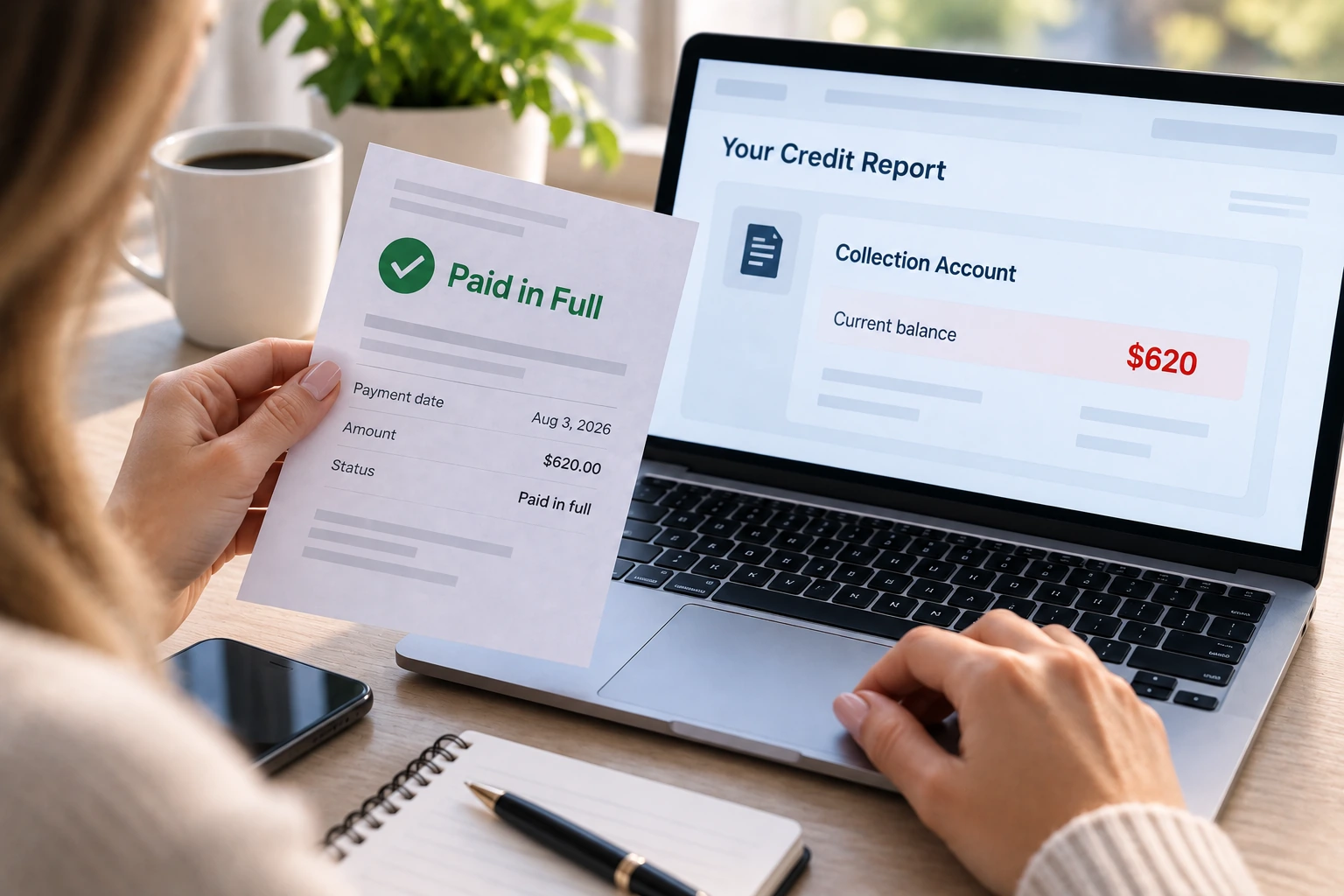
Woman comparing a paid-in-full confirmation with a collection balance still showing on her credit report Credit score

You paid a collection account, but your credit report still says you owe money. The collector may not have completed its next reporting cycle, one bureau may not have processed the update, or the account may have been reported incorrectly. You may also be looking at the original balance instead of the current balance. If the payment or final settlement fully resolved the debt, the current balance should generally be updated to $0, although the collection account itself may remain on your credit report. If you find a paid collection still showing a balance, confirm that the payment cleared and review the payoff or settlement terms. Then compare the current balance and account status on all three credit reports. If the old amount remains after one or two reporting cycles, contact the collection agency in writing and dispute the specific error with every bureau still reporting it.
Contents
  1. Quick answer
  2. Should a paid collection show a zero balance?
  3. How long does it take for a paid collection to update?
  4. Make sure you are reading the correct balance
  5. Why is a paid collection still showing money owed?
  6. What to do if a paid collection still shows a balance
  7. Step 1: Review the payoff or settlement terms
  8. Step 2: Confirm that the payment cleared
  9. Step 3: Save all three credit reports
  10. Step 4: Contact the collection agency in writing
  11. Step 5: Dispute the balance with each affected credit bureau
  12. Step 6: Send a direct dispute to the collector
  13. Step 7: Review the investigation results
  14. What if the collector confirms a zero balance but the bureau does not update?
  15. Documents that can support a paid collection dispute
  16. Documents showing that the debt was fully resolved
  17. Documents showing that the payment was completed
  18. Documents showing the credit reporting error
  19. Records showing that you submitted the dispute
  20. Sample credit bureau dispute wording
  21. If the collection was paid in full
  22. If the collection was settled for less than the full balance
  23. Common scenarios and what to do next
  24. What if the incorrect balance is verified?
  25. Will correcting the balance remove the collection?
  26. Will correcting the balance improve your credit score?
  27. Mistakes to avoid
  28. Frequently asked questions
  29. Can a paid collection remain on your credit report?
  30. Should a settled collection show a $0 balance?
  31. Can you dispute a collection after paying it?
  32. What if only one credit bureau still shows the balance?
  33. What if the collector says it already sent the update?
  34. Why is a paid collection still showing as unpaid?
  35. What documents should you attach to a paid collection dispute?
  36. Does paying a collection restart the credit reporting period?
  37. How long does a credit report dispute take?
  38. Final thoughts
  39. Sources

Quick answer

A collection paid in full should generally show a $0 current balance. The same is generally true when a collector accepts a smaller amount as full settlement of the entire debt. The collection account itself may remain on your credit reports, and its status may appear as “paid,” “settled,” or “paid for less than the full balance.”

Before assuming there is an error, confirm that the payment cleared and that your payoff or settlement agreement resolved the full debt. Also make sure you are looking at the current balance rather than the original balance, which may remain as historical information.

A paid collection may take one to two months—or roughly one or two reporting cycles—to update. This is a practical estimate, not a guaranteed legal deadline. If the current balance is still incorrect after that period, compare all three credit reports, request a zero-balance letter from the collector, and dispute the error with each bureau still reporting money owed.

Should a paid collection show a zero balance?

Usually, yes. The Consumer Financial Protection Bureau explains that a paid collection includes an account paid in full or an account for which the collector accepted less than the full amount as final settlement of the entire debt. Once the payment or completed settlement is reported, the current balance should generally be $0.

This does not necessarily mean the collection account will disappear from your credit reports. It may remain as a historical account with a status such as “paid,” “settled,” or “paid for less than the full balance.” The exact wording can vary by credit bureau and data furnisher.

What happened Expected current balance after the update Possible reporting status
Paid in full $0 Paid, paid in full, or closed
Final settlement completed $0 Settled or paid for less than the full balance
Partial payment without a final settlement Remaining unpaid amount Open or collection
Active payment plan Remaining unpaid amount Open or collection
Payment completed but not yet reported Old balance may temporarily remain Previous status may remain until the next update
Payment returned or reversed Some or all of the amount may remain due Open, unpaid, or collection

Important: A credit report may continue to display the original balance as historical information even after the current balance becomes $0. Check which field you are reading before assuming the account was reported incorrectly.

For example, suppose a collector says you owe $1,200 and accepts a payment of $700. The current balance should become $0 only if the collector agreed that the $700 payment would settle the entire debt. If there was no final settlement agreement, the remaining $500 may still be accurate.

Before making a settlement payment, get the terms in writing and confirm that the agreed amount will fully resolve the account and leave no remaining balance due.

How long does it take for a paid collection to update?

A collection account usually does not update on the same day your payment clears. The collection agency must apply the payment, update its internal records, and report the new balance and account status to the credit bureaus. Equifax, Experian, and TransUnion may receive or process the update on different dates, so one report may change before the others.

Experian says it can take one to two months for a paid collection to update on your credit reports. This is a practical reporting estimate, not a guaranteed legal deadline. A delay during the first reporting cycle does not automatically mean the collector or credit bureau reported the account unlawfully.

A collection account not updated after payment may already show the payment in the collector’s internal records while one or more credit reports continue to display the previous balance. Confirm that the payment cleared, ask when the collector last reported the account, and check whether the update was sent to all three bureaus.

Time since payment Reasonable next step
A few business days Confirm that the payment cleared and was applied to the correct account.
Less than 30 days Ask the collector when it normally reports account updates.
30 to 60 days Review all three credit reports and request written confirmation or a zero-balance letter.
More than 60 days If the current balance is still wrong, consider filing a dispute with supporting documents.

Do not confuse a normal reporting delay with a dispute investigation deadline. After you file a credit report dispute, the credit reporting company generally has 30 days to investigate. The investigation may take up to 45 days in certain circumstances, including when you submit relevant additional information during the original investigation period.

If you file a dispute, save the submission confirmation and note the expected completion date. When the investigation ends, review the updated report rather than relying only on a message saying the account was “updated.” Check the current balance, payment status, and last-reported date separately.

Make sure you are reading the correct balance

Before assuming that a paid collection was reported incorrectly, make sure you are looking at the right field. Credit report layouts vary, and the same account may display several different amounts, dates, and status labels.

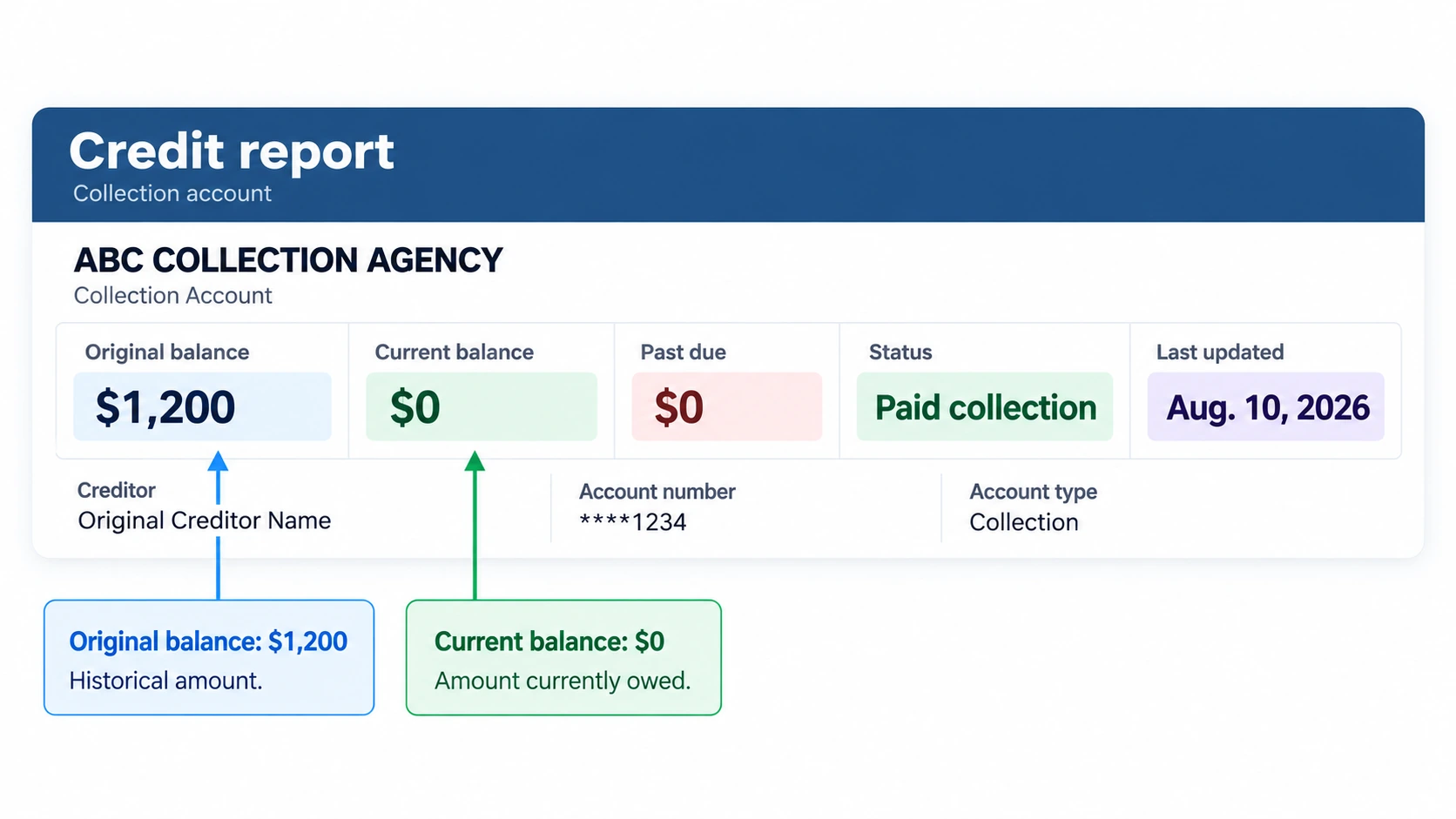
Original balance of $1,200 compared with a current balance of $0 on a paid collection account

  • Original balance: the amount originally placed for collection.
  • Current balance: the amount the credit report says you currently owe.
  • Amount past due: the amount currently reported as delinquent, if that field is shown.
  • Account status: whether the account is reported as paid, settled, open, closed, or in collection.
  • Date updated or last reported: the most recent date the company reporting the account supplied information to the credit bureau.

An original balance of $1,200 can remain visible as historical information even when the current balance is correctly reported as $0. The presence of the original balance alone does not mean that you still owe the debt.

A possible reporting error exists when the current balance or amount past due continues to show money owed after a completed payoff or final settlement. The account status may also be inaccurate if the collection still appears unpaid even though the current balance has been reduced to $0.

Review the collection on all three credit reports because one bureau may update before the others. Compare:

  • the collection agency or company reporting the account;
  • the partial account number;
  • the current balance;
  • the amount past due, if listed;
  • the account status;
  • the date updated or last reported.
Credit bureau Current balance Status What it may mean
Equifax $0 Paid collection The payment appears to have been reported correctly.
Experian $780 Collection The previous balance may not have been updated.
TransUnion $0 Paid collection The payment appears to have been reported correctly.

In this example, the problem appears limited to Experian. Save copies of all three reports, but focus the credit bureau dispute on the report that still shows the incorrect $780 current balance.

You can request your reports through AnnualCreditReport.com, the official website for free credit reports. Checking your own reports does not affect your credit scores. Our guide on how to read your credit report explains how to review balances, account status, reporting dates, and the company supplying the information.

Why is a paid collection still showing money owed?

Several issues can cause a paid collection to continue showing a balance. Some are temporary reporting delays, while others may indicate that the payment, settlement, ownership, or account status was reported incorrectly.

  • The next reporting cycle has not occurred. The payment may appear in the collector’s internal records before the updated balance reaches the credit bureaus.
  • The payment was applied to the wrong account. Compare the partial account number on your receipt, settlement letter, and credit report.
  • The settlement was not reported correctly. The collector may have posted the payment without updating the remaining balance to $0 or changing the account status to settled.
  • The payment did not resolve the entire debt. A partial payment normally reduces the balance but does not eliminate it unless the collector agreed in writing that the payment would settle the full account.
  • One bureau has not received or processed the update. Equifax, Experian, and TransUnion maintain separate credit files, so the same collection may update on different dates.
  • The payment was returned or reversed. A failed bank transfer, returned check, disputed card payment, or chargeback may leave some or all of the balance due.
  • The debt was sold, assigned, or transferred. Confirm which company owned the debt when you paid, which company received the payment, and which company is currently reporting the collection.
  • The payoff or settlement terms were misunderstood. Review the written agreement to confirm whether the payment represented a full payoff, a final settlement, or only one payment toward the balance.

The original creditor and the collection company may both appear on your credit report. That alone does not prove that the same debt is being reported incorrectly twice. The original account may remain as part of the account’s history, while the collector reports a separate collection tradeline.

However, review the ownership, current balance, account status, and date updated on both entries. If the original creditor sold the debt, its entry generally should not continue to show money currently owed to that creditor. If the collection was paid in full or resolved through a final settlement, the collection account should generally show a $0 current balance after the update.

Do not focus only on the presence of two tradelines. The important question is whether either company is inaccurately reporting that money remains due. Compare the partial account numbers, current balances, statuses, ownership information, and last-reported dates before deciding what to dispute.

If the balance is still wrong, gather your payment receipt, bank statement, payoff or settlement agreement, and any zero-balance letter from the collector. Then dispute the specific balance or status error with each credit bureau reporting it and with the company that supplied the inaccurate information.

What to do if a paid collection still shows a balance

Seven steps to dispute a paid collection balance reported incorrectly

Step 1: Review the payoff or settlement terms

Find the payoff letter, settlement agreement, email, or secure message. Confirm that the document identifies the correct account and states that the agreed payment will fully resolve the debt. Look for wording such as “paid in full,” “full satisfaction of the debt,” “settlement in full,” or “no further amount will be due.”

Do not assume that every reduced payment was a final settlement. If the agreement confirms only a partial payment or does not clearly waive the remaining amount, the balance still being reported may be legitimate.

Step 2: Confirm that the payment cleared

Verify the payment date, amount, recipient, payment method, and account number. Save supporting documents such as:

  • a bank or card statement showing the completed payment;
  • a copy of a canceled check;
  • a money-order receipt;
  • a receipt issued by the collection agency;
  • an email or electronic payment confirmation.

Make sure the payment was not returned, reversed, charged back, or applied to a different account. Resolve a failed or misdirected payment before disputing the credit report.

Step 3: Save all three credit reports

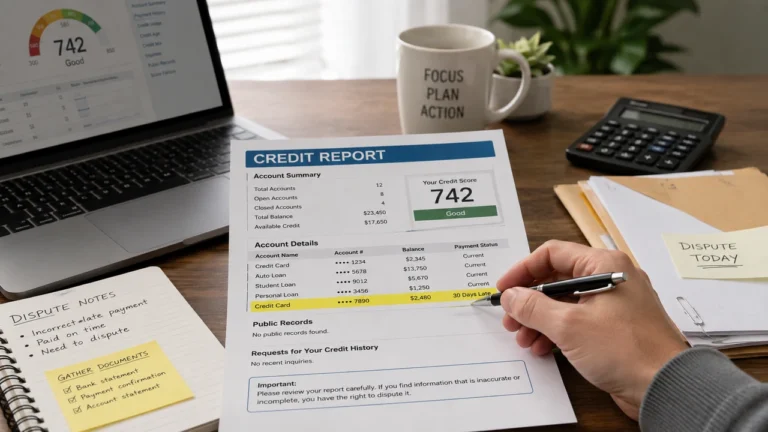
Download or print the complete credit report from each bureau before the information changes. Save the report date, report number or confirmation number, and the page containing the collection account.

For each report, record:

  • the name of the collection agency;
  • the partial account number;
  • the original balance;
  • the current balance;
  • the amount past due, if shown;
  • the account status;
  • the date updated or last reported.

Do not rely only on a credit-monitoring dashboard. A third-party app may summarize the account or omit the field that explains why the balances appear different.

Step 4: Contact the collection agency in writing

You can call the collection agency first, but follow up in writing so that you have a record of your request. Identify the account and explain that your credit report continues to show money owed even though the account was paid or settled.

Ask the collector for:

  • written confirmation that the account was paid or finally settled;
  • a paid-in-full or zero-balance letter;
  • an itemized account ledger showing the payment and remaining balance;
  • the date and details of its most recent credit reporting update;
  • the credit bureaus to which it supplied the account information;
  • written confirmation that it will correct any inaccurate balance or status.

Keep notes from telephone calls, including the date, time, representative’s name, and what was discussed. Send copies of supporting documents and retain the originals.

Step 5: Dispute the balance with each affected credit bureau

To dispute a paid collection balance, identify the exact information that is incorrect and provide evidence showing that the payoff or final settlement resolved the account.

File a separate dispute with every credit bureau that still reports the incorrect balance. You do not need to dispute the account with a bureau that already reports the current balance correctly as $0.

Include:

  • your identifying and contact information;
  • the credit report or confirmation number, if available;
  • the collection agency’s name and partial account number;
  • the current balance being reported;
  • the correct current balance;
  • the payment or settlement date;
  • a clear explanation of why the information is inaccurate;
  • the exact correction you are requesting;
  • a copy of the report page with the error circled or highlighted;
  • copies of the settlement agreement, payment proof, and zero-balance letter.

The CFPB recommends explaining what is wrong, why it is wrong, and what correction you want, while including copies of documents supporting your position. Our complete guide explains how to dispute errors on your credit report.

The collection account ending in 1234 shows a current balance of $780. I paid the account in full on June 2, 2026, as shown by the enclosed payment confirmation and zero-balance letter. The correct current balance is $0, and the account should no longer be reported as unpaid. Please investigate and correct the current balance and payment status.

Keep a copy of each dispute, every attachment, and the submission or delivery confirmation. If mailing the dispute, consider using a trackable delivery method.

Step 6: Send a direct dispute to the collector

You may also dispute the information directly with the collection agency that furnished it. Regulation V generally requires a furnisher to reasonably investigate qualifying direct disputes involving information such as the principal balance, current payment status, payment date, and payment amount.

Send the dispute to:

  • the furnisher address listed on your credit report;
  • an address the collector specifically designates for credit reporting disputes; or
  • an appropriate business address when no designated dispute address has been provided.

Your direct dispute should identify the account, specify the exact information being challenged, explain why it is inaccurate, state the requested correction, and include enough supporting documentation for the collector to investigate.

A furnisher may decline to investigate a direct dispute that does not contain sufficient information, falls within an applicable exception, or substantially repeats a previously investigated dispute without providing relevant new information. Avoid sending a generic statement such as “This account is wrong” without identifying the incorrect balance or attaching supporting evidence.

Step 7: Review the investigation results

A credit reporting company generally has 30 days to investigate a dispute. The period may extend to 45 days in certain circumstances, such as when you provide relevant additional information during the original investigation period. After completing the investigation, the bureau generally has five business days to notify you of the results.

Do not rely only on a notice saying that the account was “updated” or “verified.” Compare the investigation result and revised report with the copies you saved before filing the dispute.

Verify each of the following separately:

  • the current balance;
  • the amount past due;
  • the payment or settlement status;
  • the date updated or last reported;
  • the company currently furnishing the information.

If a furnisher determines that the information it reported was inaccurate, it must provide the necessary correction to each credit reporting company to which it supplied the inaccurate information.

Save the investigation results and revised reports in case the old balance reappears. If the error remains, review the explanation carefully and determine whether you can provide relevant evidence that was not included in the original dispute.

You may also ask the credit bureau to add a brief statement explaining the unresolved dispute to your credit file. A CFPB complaint may be another option after the bureau dispute is no longer pending or more than 45 days have passed since it was submitted.

What if the collector confirms a zero balance but the bureau does not update?

Ask the collection agency for a written letter confirming that the account has a $0 current balance and stating whether it was paid in full or resolved through a final settlement. Ideally, the letter should identify the collection agency, the partial account number, the payment or settlement date, the current balance, and the account status.

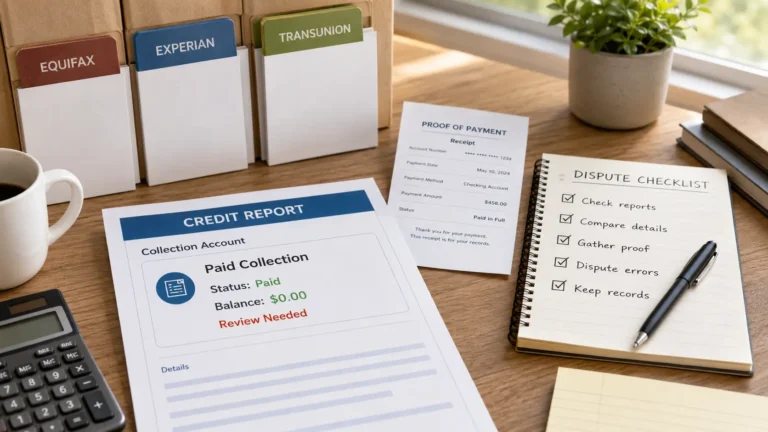
Zero-balance letter compared with an incorrect $780 collection balance on a credit report

Also ask whether the collector has reported the corrected balance and status to the credit bureaus. Request the date of the most recent update, the bureaus that received it, and written confirmation of what information was supplied.

Attach the zero-balance letter, proof of payment, the payoff or settlement agreement, and a copy of the relevant credit report page to your dispute. Circle or highlight the incorrect entry and clearly identify:

  • the collection agency;
  • the partial account number;
  • the incorrect current balance;
  • the correct current balance;
  • the payment or settlement date;
  • the account status that should be corrected.

The collection agency’s attached letter confirms that the account ending in 1234 was resolved and has a current balance of $0. However, my credit report continues to show a current balance of $780 and a status of “Collection.” Please investigate and correct the current balance to $0 and update the account status to reflect the completed payment or settlement.

Focus the dispute on the inaccurate balance and status. Do not request deletion of the entire collection account unless you have a separate factual or legal basis for challenging its presence.

If the credit bureau verifies the old balance again, compare its investigation results with the documents you submitted. Ask the collector for an itemized account ledger and send a direct dispute to the collector if you have not already done so. Request a written explanation of its investigation and confirmation that any necessary correction was sent to every credit bureau to which it reported the inaccurate information.

Do not simply resubmit an identical dispute. Submit another dispute only when you can provide relevant new evidence, correct missing information, or explain the reporting error more precisely. Save the original report, dispute confirmation, investigation results, collector correspondence, and updated report for your records.

Documents that can support a paid collection dispute

No single document will always prove both that you made a payment and that the payment fully resolved the collection. The strongest evidence package usually combines the written payoff or settlement terms, proof that the agreed payment cleared, and confirmation that the account now has a $0 balance.

Documents showing that the debt was fully resolved

  • Payoff or settlement agreement: a letter, email, or secure message stating that the agreed payment would satisfy or settle the entire debt.
  • Paid-in-full or zero-balance letter: written confirmation from the collector showing a current balance of $0.
  • Collector account ledger: an itemized record showing the payment, any adjustments, and no remaining amount due.
  • Collector correspondence: emails, letters, or secure messages confirming that the account was paid or finally settled.

Documents showing that the payment was completed

  • Payment receipt or confirmation: a document showing the payment date, amount, recipient, and confirmation number.
  • Bank or card statement: a statement showing that the payment cleared rather than remaining pending or being reversed.
  • Canceled check: a copy showing that the collector deposited or processed the payment.
  • Money-order receipt: the receipt and, when available, proof that the money order was cashed.

Important: Proof that you paid a reduced amount does not by itself prove that the entire debt was settled. When the payment was less than the full balance, include the written agreement confirming that the collector accepted that amount as final settlement.

Documents showing the credit reporting error

  • The relevant credit report page: circle or highlight the incorrect current balance, amount past due, or account status.
  • Reports from the other bureaus: these may help show that the account was already updated to $0 elsewhere.
  • The collector’s zero-balance confirmation: use it to compare the collector’s records with the balance still shown on the report.

Records showing that you submitted the dispute

  • A copy of the dispute letter or online submission: save the exact explanation and list of attachments.
  • Submission or confirmation number: keep the number provided by the credit bureau or collector.
  • Proof of delivery: retain tracking information, a certified-mail receipt, or a return receipt for a mailed dispute.

Send clear copies rather than your only original documents. Make sure the collector’s name, partial account number, payment date, payment amount, and relevant balance remain visible. You may redact unrelated transactions and information that is not needed to investigate the dispute.

Before submitting your evidence, review our checklist of documents that can support a credit report dispute.

Sample credit bureau dispute wording

Use the version that accurately describes how the collection was resolved. Replace every bracketed item with information from your credit report and supporting documents.

If the collection was paid in full

Reason for dispute: Incorrect current balance and payment status

I am disputing the current balance and payment status reported for the collection account furnished by [collection agency name], account ending in [last four digits], on my [credit bureau name] credit report dated [report date or confirmation number].

The report shows a current balance of $[incorrect amount]. I paid this account in full on [payment date]. The attached payment confirmation and [paid-in-full or zero-balance letter] show that the payment cleared and that no balance remains due.

Please investigate and correct the current balance from $[incorrect amount] to $0. Please also update the payment status to accurately reflect that the account was paid in full.

I am disputing the current balance and payment status, not the historical existence of the collection account.

If the collection was settled for less than the full balance

Reason for dispute: Incorrect current balance and settlement status

I am disputing the current balance and account status reported for the collection account furnished by [collection agency name], account ending in [last four digits], on my [credit bureau name] credit report dated [report date or confirmation number].

The report shows a current balance of $[incorrect amount]. On [settlement date], the collection agency agreed in writing to accept $[settlement amount] as final settlement of the entire account. The attached settlement agreement, proof of the completed payment, and [zero-balance letter, if available] show that the settlement was completed and that no balance remains due.

Please investigate and correct the current balance from $[incorrect amount] to $0. Please also update the account status to accurately reflect the completed settlement.

I am disputing the current balance and settlement status, not the historical existence of the collection account.

Attach a copy of the credit report page with the incorrect balance circled or highlighted. Include copies of the documents supporting the dispute, such as the payoff or settlement agreement, proof that the payment cleared, and a paid-in-full or zero-balance letter. Keep the original documents for your records.

Do not describe an account as “paid in full” when the collector accepted less than the full amount as final settlement. Also, do not request deletion of the entire collection unless you have a separate factual or legal basis for challenging its presence.

Common scenarios and what to do next

Use these examples to distinguish a normal reporting delay from an accurate remaining balance or a possible credit reporting error. Review the written agreement, payment records, current balance, account status, and last-reported date before deciding what action to take.

Situation Likely explanation Best next step
Paid 10 days ago, but the previous balance remains The reporting update may still be pending Confirm that the payment cleared and ask the collector when it normally reports account updates.
Paid more than 60 days ago, but the current balance remains The update may not have been sent, received, or processed correctly Request a zero-balance letter and dispute the incorrect balance with each bureau still reporting it.
Completed a final settlement, but the unpaid difference remains The settlement may not have been reported correctly Submit the written settlement agreement, proof of payment, and any zero-balance confirmation.
Made one payment under an active payment plan The remaining balance may be accurate Compare the reported balance with the payment plan and the collector’s itemized account ledger.
Paid less than the full amount without a written final settlement The unpaid portion may still be due Review the agreement and ask the collector whether the payment was accepted as final settlement or only as a partial payment.
Two bureaus show $0, but one still shows $900 One credit file may not have received or processed the corrected information Save all three reports and dispute the $900 current balance with the affected bureau.
The collector confirms $0, but a bureau still shows $780 The collector’s records and the credit report do not match Attach the zero-balance letter, proof of payment, and the report page to a focused dispute.
The original balance is $900, but the current balance is $0 The original balance may be historical information rather than money currently owed Confirm that the current balance and amount past due are both $0 before assuming there is an error.
The payment was returned, reversed, or charged back Some or all of the balance may still be due Resolve the failed payment and obtain updated payment confirmation before disputing the report.

Remember: These examples are practical starting points, not automatic legal conclusions. A paid collection or a completed final settlement should generally be reflected with a $0 current balance, but the collection account itself may remain on the credit report.

A one-to-two-month update period is a practical reporting estimate rather than a guaranteed federal deadline. If the balance remains incorrect after that period, document the discrepancy and challenge the specific current balance or account status rather than requesting deletion without a separate basis.

What if the incorrect balance is verified?

A result stating that the account was “verified,” “confirmed,” or “updated” does not necessarily mean that every reported field is accurate. Compare the investigation results with the credit report you saved before filing the dispute and with the documents showing how the collection was resolved.

  1. Review the investigation results carefully. Check whether the bureau explains what was investigated and whether the collector confirmed the balance, status, payment date, or another field.
  2. Compare every relevant field. Verify the current balance, amount past due, account status, ownership, partial account number, and date updated. One field may have changed while another remains incorrect.
  3. Ask the collector for an itemized ledger and written explanation. Request a complete accounting of the original balance, payments, adjustments, settlement credit, and any amount the collector claims remains due.
  4. Request information about the bureau’s reinvestigation procedure. Ask how the dispute was investigated and request the name, address, and telephone number of the furnisher contacted during the investigation, when available.
  5. Send a direct dispute to the collector. If you disputed only with the credit bureau, separately challenge the current balance and payment status with the collection agency that supplied the information.
  6. Submit another bureau dispute only when it adds value. Include relevant new evidence, correct information missing from the original submission, or explain the error more precisely. Do not simply resend an identical dispute without additional support.
  7. Ask for a statement of dispute. If the disagreement remains unresolved after a dispute submitted to the credit reporting company, you may ask for a brief statement explaining the dispute to be included in your credit file and noted or summarized in future reports.
  8. Consider additional help when the error persists. A consumer-law attorney, legal aid organization, or state attorney general may help when a well-documented reporting error remains unresolved or causes a credit denial, higher costs, housing problems, or other significant harm.

Keep the original credit report, dispute submission, delivery confirmation, investigation results, collector correspondence, itemized ledger, and every updated report. These records can help show what was reported, what evidence was provided, and whether the information changed after the dispute.

For a CFPB complaint involving inaccurate or incomplete information reported by a credit reporting company, first submit the dispute directly to that company. Under the CFPB’s current complaint instructions, you may proceed when the dispute is no longer pending or when more than 45 days have passed since it was filed. Include the most important dates, balances, investigation results, and supporting documents in the complaint.

Will correcting the balance remove the collection?

For most non-medical collection accounts, no. Correcting an inaccurate current balance to $0 does not automatically remove an otherwise accurate collection from your credit reports. A balance correction changes the amount reported as currently owed; deletion removes the entire collection tradeline. These are separate outcomes.

After the correction, the account may remain with a $0 current balance and a status such as “paid,” “paid in full,” or “settled.” Accurate negative information generally cannot be removed simply because the debt was later paid or settled. However, you may have grounds to dispute the collection itself if it does not belong to you, appears more than once, contains inaccurate dates, or is otherwise reported incorrectly.

Medical collections are an important exception. Paid medical collection debt is generally no longer included on U.S. consumer credit reports under the reporting policies of Equifax, Experian, and TransUnion.

Read our guide to whether a paid collection can be removed from your credit report

Will correcting the balance improve your credit score?

It may improve your credit score, but an increase is not guaranteed. First, the corrected $0 balance must appear on the credit report used to calculate the score. The result then depends on the scoring model, the age and type of the collection, and the rest of the information in your credit file.

Some newer scoring models ignore paid collection accounts. For example, FICO Score 9 disregards paid third-party collections, while VantageScore models introduced since 2013 ignore paid collections. A score calculated with another model may respond differently, even when the same credit report shows a $0 balance.

The correction may therefore cause your score to increase, remain nearly unchanged, or update later. It can still be valuable even without an immediate score increase because your report will no longer inaccurately state that money remains due, and a lender reviewing the report can see that the debt was resolved.

Do not rely on a promised number of points. After the correction is completed, review the updated report and read what happens to your credit score after paying off collections.

Mistakes to avoid

A paid collection balance dispute can fail when the wrong field is challenged, the evidence does not prove that the debt was fully resolved, or the request does not clearly identify the correction needed. Avoid these common mistakes:

  • Confusing the original balance with the current balance.
    The original balance may remain as historical information even when the current balance is correctly reported as $0. Confirm which field still shows money owed before filing a dispute.
  • Assuming any partial payment should reduce the balance to $0.
    A reduced payment normally eliminates the remaining balance only when the collector agreed that it would settle the entire debt. Keep the written settlement terms.
  • Disputing the account before confirming that the payment cleared.
    A pending, returned, reversed, or misdirected payment may leave the reported balance accurate. Verify the payment date, recipient, amount, and account number first.
  • Using proof of payment without proof of final settlement.
    A receipt or bank statement proves that money was paid, but it may not prove that the payment resolved the entire account. For a reduced settlement, include both the settlement agreement and proof that the agreed payment cleared.
  • Relying only on telephone conversations.
    A phone call may help identify the problem, but it provides limited evidence. Follow up in writing and request a paid-in-full or zero-balance letter.
  • Checking only one credit report.
    The collection may show a $0 balance on one report and an old balance on another. Compare the account information on all three reports before deciding where to dispute.
  • Relying only on a credit-monitoring app.
    A monitoring service may omit the original balance, amount past due, reporting date, or furnisher details. Review the complete credit reports whenever possible.
  • Sending original documents.
    Submit clear copies of your settlement agreement, payment records, collector correspondence, and credit report page. Keep the originals in your records.
  • Demanding deletion without identifying the inaccurate field.
    Correcting the current balance and deleting the entire collection are separate issues. Identify the exact balance, status, or date that is wrong and state the correction you want.
  • Submitting a vague dispute.
    Statements such as “This account is incorrect” may not give the bureau or collector enough information to investigate. Include the collector’s name, partial account number, incorrect balance, correct balance, payment date, and supporting evidence.
  • Repeating the same unsupported dispute.
    Do not repeatedly submit an identical dispute after the information is verified. Add relevant new evidence, correct missing information, or explain the discrepancy more precisely.
  • Failing to save the original reports and dispute records.
    Keep the reports showing the error, copies of everything submitted, confirmation numbers, delivery records, investigation results, and revised reports.
  • Expecting a guaranteed credit score increase.
    Correcting the balance improves the accuracy of your credit file, but the score impact depends on the scoring model and the rest of your credit history. No specific increase can be guaranteed.

The strongest dispute is focused on one verifiable error and supported by documents that prove both what happened and what should be corrected.

Frequently asked questions

Can a paid collection remain on your credit report?

Yes. A paid collection may remain on your credit report after its current balance is corrected to $0. Updating the balance and deleting the historical collection account are separate actions. If the collection is otherwise accurate, payment alone does not necessarily require its immediate removal.

Should a settled collection show a $0 balance?

Generally, yes, when the collector accepted the agreed payment as final settlement of the entire debt. The account status may appear as “settled,” “paid for less than the full balance,” or similar wording, but the current balance should generally be $0.

If you made only a partial payment without a final settlement agreement, the unpaid amount may still be accurate.

Can you dispute a collection after paying it?

Yes. You can dispute inaccurate or incomplete information even after paying or settling the collection. This may include an incorrect current balance, amount past due, payment status, payment date, payment amount, ownership information, or account number.

Consider disputing the error with both the affected credit reporting company and the collection agency that supplied the information. Clearly identify the incorrect field, explain why it is wrong, request a specific correction, and include copies of supporting documents.

What if only one credit bureau still shows the balance?

One credit file may not yet have received or processed the collector’s updated information. Save copies of all three reports and dispute the incorrect balance with the bureau that still reports money owed.

Include proof that the account was paid or finally settled. The reports already showing a $0 balance may be useful comparison records, but the payoff or settlement documents remain the primary evidence.

What if the collector says it already sent the update?

Ask the collector for the date of the update, the bureaus that received it, and confirmation of the exact current balance and status that were reported. Also request a paid-in-full or zero-balance letter.

Attach that documentation, proof of payment, and the relevant credit report page to your dispute with each bureau still showing the old balance.

Why is a paid collection still showing as unpaid?

The collector may not have completed its next reporting cycle, one credit bureau may not yet have received or processed the update, or the payment may have been returned, applied to another account, or reported incorrectly.

Confirm that the payment cleared and fully resolved the debt. Then compare the current balance, amount past due, account status, partial account number, and last-reported date on all three credit reports.

What documents should you attach to a paid collection dispute?

The strongest evidence package generally includes:

  • the payoff or final settlement agreement;
  • proof that the agreed payment cleared;
  • a paid-in-full or zero-balance letter;
  • the credit report page showing the incorrect balance;
  • relevant correspondence or an itemized account ledger.

Send copies rather than your only original documents. If the collector accepted less than the full balance, include written proof that the reduced amount was accepted as final settlement of the entire debt.

Does paying a collection restart the credit reporting period?

Generally, no. Paying, settling, transferring, or disputing a collection does not restart the federal credit reporting period. That period is generally tied to the delinquency that led to the collection, not the later payment date or the date the debt was transferred to another company.

Payment may update the current balance and account status, but it should not create a new delinquency date that keeps the collection on your credit report longer.

How long does a credit report dispute take?

A credit reporting company generally has 30 days after receiving a dispute to complete its investigation. The investigation may take up to 45 days in certain circumstances, including when you provide relevant additional information during the original investigation period.

After completing the investigation, the credit reporting company generally has five business days to notify you of the results. Review the updated report carefully because a result described as “updated” does not necessarily mean that every balance and status field was corrected.

Final thoughts

If a paid collection still shows money owed, first confirm that the payment cleared and fully resolved the debt. Make sure you are reading the current balance rather than the original balance, and determine whether the account was paid in full, finally settled, or only partially paid.

A collection paid in full or resolved through a completed final settlement should generally be updated to a $0 current balance. However, correcting the balance does not automatically remove an otherwise accurate collection account from your credit reports.

Compare the account on all three reports and allow reasonable time for the collector’s update to be processed. If the current balance remains inaccurate, save copies of the reports, gather the payoff or settlement agreement, proof of payment, and any zero-balance letter. Then contact the collector in writing and dispute the specific balance or status error with each affected credit bureau.

After the correction, review the updated reports carefully to confirm that the current balance, amount past due, and payment status are all accurate. Then focus on the broader steps for rebuilding credit after collections.

Sources

Written and fact-checked by: Fix My Money Life Editorial Team

Last reviewed: July 28, 2026

Financial disclaimer: This article is for general educational purposes and is not financial or legal advice. Results depend on the facts of each account, the information supplied to each bureau, applicable law, and the scoring model used. Consider consulting a qualified consumer-law attorney or financial professional about your situation.

Rate article
Fix My Money Life