In this guide
- What is a furnisher direct dispute?
- Which errors can you dispute directly with a creditor?
- Where should you send a direct dispute?
- Build a direct-dispute package the lender can investigate
- Direct dispute letter template you can copy
- Can you file a direct dispute online?
- How long does a lender have to respond?
- What if the lender calls the dispute frivolous or irrelevant?
- Verify the result and choose the next step
- Frequently asked questions
- Sources and review
To dispute a credit report error directly with a lender, send a specific written dispute to the company’s designated credit-reporting dispute address. Identify the account and the exact information you believe is wrong, explain why, include relevant supporting copies, and keep proof of delivery. The lender generally must investigate a qualifying dispute and report the result within 30 days after receiving it.
This is a direct dispute with a creditor, also called a furnisher direct dispute. It addresses information the company supplied to a credit bureau. It does not replace a separate dispute with each bureau showing the error, and it is not a request to erase accurate negative history.
Need a letter for your lender? Jump to the free direct-dispute letter template. Before you send it, find the correct dispute address and gather the report entry and records showing the specific error. Keep a copy of everything you submit.
If a legitimate account never appeared on a bureau’s report at all, first follow our missing-account reporting checklist. A lender may not furnish that account to the bureau; confirm the reporting arrangement before treating the absence as an error for a formal dispute.
What is a furnisher direct dispute?
A furnisher is the company that provides account information to a consumer reporting agency. Depending on the entry, that might be a lender, card issuer, loan servicer, or debt collector.
A bureau dispute goes to Experian, Equifax, TransUnion, or another reporting company. A direct dispute goes to the business responsible for furnishing the entry. The CFPB recommends addressing both the reporting company and the furnisher when correcting credit-report errors.
Use our complete credit-report dispute process for the bureau side. This guide focuses on choosing the right company, delivering a qualifying direct notice, and checking its response.
Lender vs. credit bureau: where should you dispute?
They investigate different parts of the reporting process. For account information that is genuinely inaccurate or incomplete, the CFPB advises contacting both the furnisher and every credit bureau showing the error.
| What you found | Where to act |
|---|---|
| Wrong balance, payment status, account dates, or account responsibility | Send a specific direct dispute to the furnisher and dispute the inaccurate entry with each affected bureau. |
| Only incorrect personal details or an unfamiliar credit inquiry | Start with the reporting bureau and the source of the information. These issues are generally excluded from the furnisher’s direct-dispute duty under Regulation V. |
| An account opened through identity theft | Dispute account liability with the furnisher and affected bureaus, and follow the recovery steps at IdentityTheft.gov. |
For other problems, use the specific rule and address below before sending a lender-directed notice. A dispute is for inaccurate or incomplete information, not an automatic way to remove accurate negative history.
Which errors can you dispute directly with a creditor?
The direct-dispute rule covers account liability, account terms, payment performance, and other reported information about your relationship with that furnisher. The FTC’s guidance for furnishers describes these categories and their investigation duties.
| Reported issue | A specific question to investigate |
|---|---|
| Account responsibility | Does the company incorrectly identify you as liable, jointly liable, or an authorized user? |
| Balance, limit, or payment terms | Does the reported figure conflict with the records for the same account and reporting period? |
| Payment history | Is a particular payment month, amount, or date recorded incorrectly? |
| Opening, closing, or current status | Which date or status conflicts with the company’s confirmation or account history? |
First check the reporting date. A balance reported before a recent payment is not necessarily inaccurate. Compare records from the same period before describing a difference as an error.
Important exceptions to the direct-dispute rule
Regulation V, section 1022.43, excludes disputes solely about identifying details, employer names, credit inquiries, fraud or active-duty alerts, and another furnisher’s information. Public-record information is also generally excluded, with an exception when supplied by a furnisher that has an account or other relationship with you.
The identifying-information exception does not exclude a dispute about whether you are liable for an account. An account opened through identity theft is different from a misspelled address. For identity theft, use the recovery steps at IdentityTheft.gov as well.
The rule also has an exception when the furnisher reasonably believes the dispute was submitted or prepared by, or uses a form supplied by, a credit repair organization covered by the rule. A paid letter service does not guarantee an investigation or deletion. These exceptions concern this direct-dispute requirement; they do not establish that the reported information is accurate.
Where should you send a direct dispute?
Do not assume the payment address or a general customer-service inbox is the credit-reporting dispute address. Apply this address check under section 1022.43(c):
- Check the credit report. Look for the furnisher’s address supplied on the report for your account.
- Check the company’s designated instructions. It may specify a direct-dispute address in writing or through qualifying electronic delivery. Use that clearly identified channel and save the instructions.
- If neither address has been specified and provided, the rule permits the notice at any business address of the furnisher. Verify that it belongs to the company that supplied the entry.
If a brand, servicer, or collector name is unfamiliar, identify who furnished the disputed entry before mailing. When two companies report separate entries, explain each company’s own reporting issue rather than asking one to investigate information furnished only by the other.
A useful question for customer service is: “What is your designated address for a written direct dispute about information your company furnished to a credit reporting agency?” Record the answer and its source. A phone conversation can help you find the channel, but keep a written record of the dispute itself.
The FTC’s sample letter to an information provider recommends certified mail with a return receipt and keeping copies. The delivery record documents receipt; it does not prove the disputed entry is wrong.
Build a direct-dispute package the lender can investigate
Under the rule, your notice needs enough information to identify the account, the specific disputed information and your reason, plus supporting documentation or information reasonably required to substantiate the dispute. Make each attachment answer a particular question.

- Identify yourself and the account: provide the contact and account details needed to locate the relationship, using the verified dispute channel.
- Identify the report: name the bureau, report date, account entry, and field you are disputing. Include the relevant report excerpt.
- Describe the conflict: explain what was reported, what you believe is correct, and why.
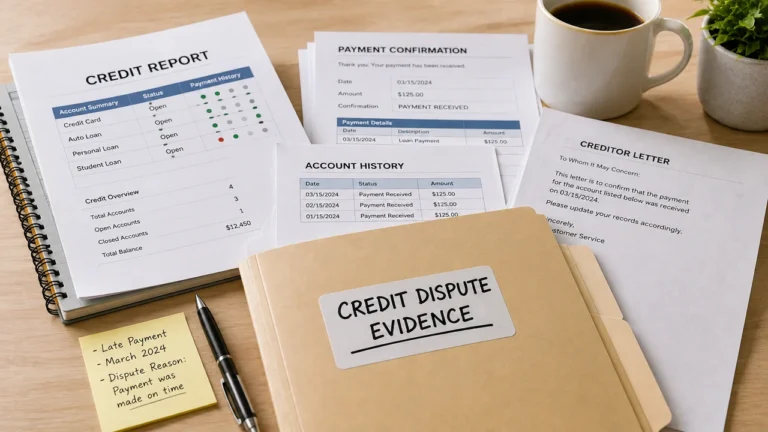
- Attach relevant copies: use statements, payment histories, payoff confirmations, court records, or other evidence that fits your actual issue. Keep originals.
- Request a specific correction: state the field or status to investigate and ask for the result. Do not demand removal of an otherwise accurate account when only its balance is wrong.
- Retain the complete package: save the letter, attachments, address instructions, delivery evidence, and any case number together.
Our credit dispute document guide helps match evidence to different errors. Avoid unrelated pages, but do not crop out the dates or account context needed to understand your evidence.
Example: distinguish a timing difference from a balance error
Hypothetical scenario: A report shows a $1,240 loan balance as of September 1. You paid $1,240 on September 9. That payment alone does not show that the September 1 balance was wrong.
Now suppose the company confirms a zero balance in a September 18 payoff letter, yet an entry reported as of September 30 still shows $1,240. You have a concrete discrepancy to ask it to investigate. First check that both documents concern the same account and that the later amount is a current balance rather than an original loan amount.
A focused explanation could read:
“The current-balance field for this loan is $1,240 on the attached report, with a September 30 reporting date. Your September 18 payoff confirmation states that no balance remains. Please investigate the difference and correct the current balance to $0 if the payoff records are confirmed. The report excerpt and payoff confirmation are attached.”
Add your identifying information and the correct recipient details to your own notice. This original example is an organizational aid, not a required form or a claim about your account. A balance correction would not, by itself, erase accurate earlier late payments.
Direct dispute letter template you can copy
Use this editable example when you have identified a specific error in information a lender or other furnisher reported. Replace every bracketed field with your own facts. Send it to the company’s verified direct-dispute address, not automatically to its payment address. This is an original example, not an official form or a guarantee that an entry will be removed.
[Date]
[Your name]
[Your mailing address]
[City, state, ZIP code]
[Your preferred contact information]
[Lender or furnisher name]
[Verified direct-dispute mailing address]
Subject: Direct dispute of inaccurate credit reporting — [account identifier]
To the credit reporting disputes department:
I am disputing information your company furnished about my [type of account] to [name each affected credit bureau]. The attached credit report dated [report date] lists [the exact field, amount, status, or payment-history month] as [reported information].
I believe this information is inaccurate or incomplete because [explain the specific conflict and relevant dates]. My [statement, payment confirmation, account history, or other record] dated [date] shows [what the document establishes].
Please investigate this specific item, review the enclosed records, and correct [the exact field or status] to [requested accurate information] if your investigation confirms the discrepancy. Please send me the results of your investigation. If the reported information is inaccurate, please notify the consumer reporting agencies to which you furnished it and provide the necessary correction.
Enclosed are copies of: [relevant credit report excerpt]; [supporting statement or payment record]; [other directly relevant evidence].
Sincerely,
[Your name]
Before sending: compare the documents’ reporting dates, name the disputed field precisely, and attach copies rather than originals. Include only the identifying information needed to locate your account, through a verified channel; do not post sensitive account details or your Social Security number in a public form. Save the completed letter, attachments, and delivery record. You can also compare this example with the FTC sample dispute letter to the business that furnished the information and the CFPB’s official sample-letter resources.
Prefer a printable government guide? Download the CFPB’s two-page direct dispute guide (PDF). It includes a checklist of what to provide and a link to the agency’s editable letter. Use the version that best fits your facts; neither is a required form.
Can you file a direct dispute online?
Some companies provide a secure credit-reporting dispute process. Confirm that it accepts this kind of notice, lets you explain the issue and provide documents, and gives you a record you can retain. Do not assume that a transaction-dispute button or a general chat reaches the credit-reporting team.
If the channel cannot capture the facts and attachments, use the designated mailing route. Save the exact wording and uploads if filing electronically. Our online-versus-mail comparison covers bureau submissions; check the lender’s separate instructions for a direct dispute.
How long does a lender have to respond?
A qualifying direct dispute generally requires investigation and a report of the result within 30 days of receipt. Section 1022.43(e) ties that deadline to the period in FCRA section 611(a)(1). Up to 15 additional days can apply when relevant additional information arrives during the original period, subject to the statute’s limits. It is not an automatic 45-day allowance for every dispute.
The lender must reasonably investigate and review the relevant information you supplied. If it finds its reporting inaccurate, it must promptly notify each reporting agency to which it furnished the inaccurate information and provide the necessary correction.
Use separate dates for mailing, delivery, later evidence, and the response. Start your tracking from documented receipt rather than the day you drafted the letter. If a representative cites an extension, ask for its basis and the expected response date. Mailing delays and investigation time are different.
A missed deadline on your calendar is a reason to follow up and preserve evidence, not a promise that the entire account will automatically disappear. Continue handling payment obligations separately; a credit-report accuracy dispute is not a general payment suspension.
What if the lender calls the dispute frivolous or irrelevant?
That is different from investigating and deciding the information is accurate. Section 1022.43(f) permits a reasonable frivolous-or-irrelevant determination in specified situations, including insufficient information, an applicable exception, or a substantially identical dispute already handled under the relevant requirements.
The rule requires notice within five business days after the determination, explaining why and identifying information needed to investigate. A prior dispute is not treated as substantially the same under that provision when you provide relevant notice information not previously supplied to the furnisher.
Read the reason before responding. If the company could not identify the account, add the missing identifier. If it overlooked new evidence, identify that document and when you supplied it. Changing the letter’s wording without adding relevant information does not necessarily resolve the issue.
Verify the result and choose the next step
| Response | Your follow-up |
|---|---|
| Correction promised | Save the result, identify the corrected field and affected bureaus, then compare updated reports with the earlier copies. |
| Information retained | Compare the explanation with your evidence. Identify any specific unresolved fact or new relevant record. |
| No clear response | Verify delivery, the qualifying notice, and applicable timing. Follow up with those records and request the result. |
The FTC explains that continued reporting of disputed information must include notice of the dispute. A dispute notation is not the same as correcting the balance or payment status. Check the underlying entry.
If a documented problem remains, our guide to what to do after a denied credit dispute explains evidence-based follow-up, complaint options, and when legal help may be useful. For a complaint about the lender’s handling, review the CFPB complaint instructions and attach the timeline, notice, proof of receipt, response, and unresolved error. Complaints about a credit bureau have separate prior-dispute requirements.
Frequently asked questions
Do you have to pay to dispute with a creditor?
No fee is required for the correction process. You may choose to pay postage for a delivery record. Paying a third-party service does not guarantee removal or a higher score.
Can you dispute after paying or closing the account?
An accuracy issue can concern an earlier account relationship, including a reported closure date or payment history. Identify the specific reported error and supporting records; payment or closure alone does not make the whole history inaccurate.
Will a successful direct dispute raise your credit score?
No particular increase is guaranteed. First verify that the inaccurate field was corrected. A correction can matter to the accuracy of your file without producing a visible score change.
Explore related guides on credit reports and disputes.
Sources and review
Sources checked October 12, 2026. This guide uses the current Regulation V direct-dispute rule, the FCRA, and the linked CFPB and FTC guidance. The payoff scenario, sample explanation, letter template, and organizational checklists are original educational illustrations.
General educational information for U.S. readers, not individualized legal or financial advice. The facts, type of dispute, and applicable law determine your rights.