In this guide
- 30-day vs. 60-day late payment: quick comparison
- What does a 30-day late payment mean?
- What does a 60-day late payment mean?
- What happens if you pay on the 31st day?
- What a 30-day and 60-day late payment can look like on a credit report
- What should you do based on how late the payment is?
- If I pay today, what happens?
- One-payment mistake: paying once may not make you current
- What to say when you call your creditor about a late payment
- How late payments progress from 30 to 60 to 90 days
- How do 30-day and 60-day late payments affect your credit score?
- How long do 30-day and 60-day late payments stay on your credit report?
- What if the 30-day or 60-day late payment is wrong?
- What if the late payment is accurate?
- Frequently asked questions
- Sources
- Financial disclaimer
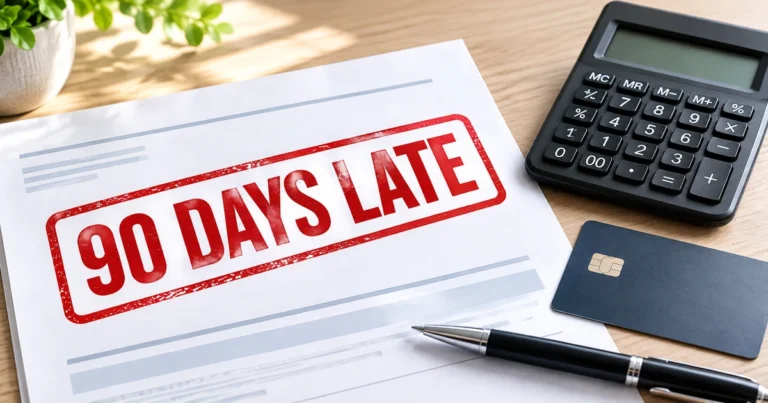
The main difference in a 30-day late payment vs 60-day late payment is how far the account has progressed into delinquency. A 60-day late payment is generally more serious because the account remained past due longer, while a 30-day late payment is the earlier delinquency stage.
Both can hurt your credit if reported. FICO says late payments are evaluated in part by their severity, recency, and frequency, so there is no universal point loss for either a 30-day or 60-day late payment.
If the account is still past due, the most useful action is to confirm the exact amount required to bring it current before it progresses to another delinquency stage.
Quick rule: 1–29 days late → act before the 30-day reporting stage. 30–59 days late → prevent progression to 60 days. 60–89 days late → contact the creditor promptly and prevent progression to 90 days.
30-day vs. 60-day late payment: quick comparison
| What to compare | 30 days late | 60 days late |
|---|---|---|
| Delinquency stage | First commonly reported late-payment category | Account remained delinquent into the next category |
| Severity | Negative if reported | Deeper and generally more serious delinquency |
| Credit-score impact | Can hurt; no fixed point loss | Can cause additional damage; no fixed point loss |
| Immediate priority | Prevent 60-day delinquency | Prevent 90-day delinquency |
| Best question to ask | “What exact amount will bring me current?” | “Can I still bring the account current, and what options exist if I cannot catch up in full?” |
What does a 30-day late payment mean?
A 30-day late payment means the account has reached at least 30 days past due. Experian and TransUnion both note that lenders generally report missed payments once they are at least 30 days past due, although the exact bureau-update date can vary by lender and reporting cycle.
That is different from being only a few days late. A payment that is 1–29 days past due can still trigger a late fee or other account consequences, but it generally has not yet reached the 30-day credit-reporting category.
If you are still under 30 days late, see what happens when a payment is less than 30 days late.
What does a 60-day late payment mean?
A 60-day late payment means the account was not brought current after the 30-day stage and remained delinquent long enough to reach the next reporting category.
This matters because FICO considers the severity of negative information, and TransUnion notes that when an account rolls from 30 days past due to 60 days past due, another score decline may occur. The exact effect still depends on the rest of the credit file and the scoring model.
If the account is already 60–89 days late, the goal is to prevent it from reaching the next stage. See what happens at 90 days late if the delinquency continues.
What happens if you pay on the 31st day?
If your payment is 31 days past due, the account has already crossed the 30-day delinquency threshold and may be reported as 30 days late. Paying at that point can still help prevent the account from becoming more delinquent, but it does not guarantee that an accurate 30-day late payment will stay off your credit reports.
What matters is how many days the account is actually past due, not the calendar date when you make the payment. Creditors also report on their own schedules, so a 30-day late status may not appear on your credit report on the exact day the account crosses the threshold.
If you are around the 30-day mark, ask the creditor three questions: How many days past due is the account today? Has a 30-day late status already been reported? What exact amount will bring the account current?
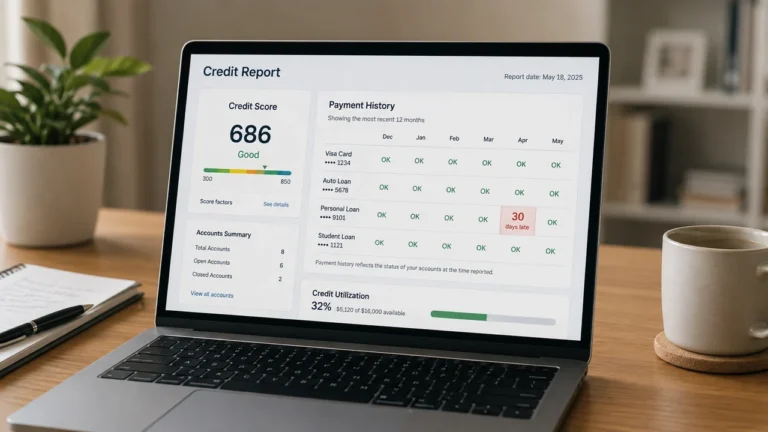
What a 30-day and 60-day late payment can look like on a credit report

When checking your report, compare the month, delinquency level, balance, current status, and payment history with your own statements and payment confirmations. The account can later become current while the earlier 30-day or 60-day history remains.
What should you do based on how late the payment is?
Your next step depends mainly on how many days past due the account is. If the account is still delinquent, focus first on preventing it from reaching the next late-payment stage.
| How late is the account? | What to do now |
|---|---|
| 1–29 days late | Contact the creditor, confirm the amount needed to bring the account current, and pay as soon as possible if you can. The immediate goal is to prevent the account from reaching the 30-day delinquency stage. |
| 30–59 days late | Ask exactly how many days past due the account is and how much you must pay to bring it current. Confirm whether your planned payment will stop the account from progressing to 60 days late. |
| 60–89 days late | Contact the creditor promptly. Ask for the exact catch-up amount and whether a repayment or hardship option is available if you cannot pay the full past-due amount. The goal is to prevent the account from reaching 90 days late. |
| 90 days late or more | Ask the creditor for the current account status, total amount past due, and available options for resolving the delinquency. Do not assume that making one regular payment will bring the account current. |
If a late payment is already on your credit report
If the information appears accurate: focus on bringing the account current and preventing additional late payments rather than disputing correct negative information.
If the information appears inaccurate: compare the reported month, delinquency level, payment dates, and account status with your statements, bank records, and payment confirmations before deciding whether to dispute it.
If you are not sure whether it is accurate: verify the dates and account history first. A 30-day notation followed by a 60-day notation in a later reporting period may reflect the same account becoming progressively more delinquent rather than an error.

If I pay today, what happens?
What changes after a payment depends on how far behind the account is and whether the amount you send is enough to cure the delinquency.
| If you pay… | What may happen | What to confirm first |
|---|---|---|
| The full catch-up amount | The account may become current if the creditor applies the payment as expected. | Ask for the exact amount required to bring the account current today. |
| One regular monthly payment | The balance falls, but the account may remain delinquent if you are more than one payment behind. | Ask whether one regular payment is enough to cure the past-due status. |
| A partial catch-up payment | The past-due balance may shrink while the delinquency continues. | Ask how much will remain past due and what status the account will show afterward. |
| After the account is already current | The current status can remain current, but an accurate historical 30- or 60-day late entry may still appear. | Verify the updated balance and current status on the account and later on your credit reports. |
The safest question to ask before paying: “If I pay this amount today, will my account be current afterward? If not, exactly how much will still be past due?”
One-payment mistake: paying once may not make you current
Common mistake: assuming one normal monthly payment automatically fixes a two-payment-behind account.
Example: you missed two $250 payments and are $500 behind. You send $250. Your balance is lower, but you may still be past due because another missed amount remains.
Before paying, ask: “If I make this payment today, will the account be current afterward?”
Before making a catch-up payment, ask:
- How many days past due is the account today?
- What exact amount will bring it current?
- If I pay $___ today, what will the account status be afterward?
- How much, if anything, will remain past due?
- If I cannot catch up in full, is a hardship or repayment option available?
What to say when you call your creditor about a late payment
When you call your creditor, focus on three things: how late the account is, the exact amount needed to bring it current, and what the account status will be after your payment is applied. If you are already behind by more than one payment, do not assume that paying the regular monthly amount will automatically make the account current.
Late payment call script
“Hi, I’m calling about my account ending in [last four digits]. I want to confirm the current past-due status and what I need to do to bring the account current.
How many days past due is the account today?
What exact amount do I need to pay to bring the account current?
If I pay that amount today, will the account be current after the payment is applied?
Has the account already been reported as 30 days late, 60 days late, or another delinquency status to any credit bureau?
If I cannot pay the full past-due amount today, are any repayment or hardship options available for this account?
If I make a partial payment, how much will remain past due and what will the account status be afterward?
Can you provide a confirmation number or written details of any payment arrangement we make today?”
Keep a record of the conversation. Save the date and time, representative information, confirmation number, payment receipt, and any written arrangement so you can compare those records with your account history later if needed.
How late payments progress from 30 to 60 to 90 days

The reporting sequence can move from 30 to 60 to 90 days late if the account remains unpaid or is not brought current. The visible bureau update may not appear on the exact day the account crosses a threshold because creditors report on their own schedules.
How do 30-day and 60-day late payments affect your credit score?
Both a 30-day and a 60-day late payment can hurt your credit score, but a 60-day late payment represents a deeper level of delinquency. The exact score impact cannot be predicted from the number of days late alone.
FICO considers factors such as the severity, recency, and frequency of late payments. Two people can therefore have the same reported delinquency and experience different score changes because the rest of their credit files differ.
If you want a closer look at the first delinquency stage, see how many points a 30-day late payment could cost you.
If the account is still past due, preventing it from progressing is more useful than trying to predict an exact score drop. Confirm the amount needed to bring the account current and what the account status will be after the payment is applied.
How long do 30-day and 60-day late payments stay on your credit report?
Accurately reported 30-day and 60-day late payments can generally remain on your credit report for up to seven years. Bringing the account current does not automatically erase the earlier late-payment history.
The fact that a late payment remains on a credit report does not mean it will affect every credit score in the same way for the entire reporting period. Scoring depends on the information in your credit file and the scoring model being used.
For the full reporting timeline, see how long a late payment can affect your credit score.
What if the 30-day or 60-day late payment is wrong?
If the reported month, delinquency level, balance, current status, or account ownership is inaccurate, gather records that support the specific correction.
| Possible error | What to compare |
|---|---|
| Wrong month marked late | Statements and payment history for that period |
| Reported as 60 days late but never reached that stage | Due dates, payment dates, creditor payment history |
| Balance or current status is wrong | Recent statement and catch-up confirmation |
| Account is not yours | Account identifiers and identity-theft records if relevant |
CFPB says consumers have the right to dispute inaccurate information with the credit reporting company and the company that furnished the information. See how to dispute an inaccurate late payment. Do not dispute accurate negative information solely because it hurts your credit.
What if the late payment is accurate?
If the 30-day or 60-day late payment is accurate, focus first on stopping the active delinquency. Once the account is current, verify the updated status and protect every future due date.
Accurate negative payment history can generally remain on a credit report for up to seven years. Bringing the account current does not automatically erase the historical late-payment entry.
For the recovery phase, use how to rebuild credit after late payments.
Frequently asked questions
Can the same account show both a 30-day and a 60-day late payment?
Yes. If an account remains past due, its payment history can reflect different delinquency stages in different reporting periods. For example, an account may be reported as 30 days late for one month and 60 days late for a later month if it was not brought current.
Does bringing the account current remove the earlier late payment?
No, not automatically. Bringing the account current can stop the delinquency from progressing, but it does not make an accurately reported earlier late payment inaccurate. The account may show a current status while still showing the previous 30-day or 60-day late payment in its payment history.
Can a late payment appear on one credit report but not the others?
Yes. Creditors may not furnish the same account information to every credit bureau, and reports can also update at different times. If a late payment appears on only one report, compare the creditor name, account details, reported month, delinquency level, and current status before deciding that the entry is incorrect.
What if one credit report says 60 days late and another says 30 days late?
First check whether the two reports show the same reporting period and when each report was last updated. A 30-day notation for one month and a 60-day notation for a later month may simply reflect the account becoming more delinquent. If the bureaus show different delinquency levels for the same period, compare both reports with your statements, payment confirmations, and the creditor’s account history, then ask the creditor what status it furnished for that period.
Explore related guides on late payments.
For a broader look at your options, read how to address late or missed payments on a credit report. Disputing inaccurate reporting and asking for goodwill on accurate history are different processes.
Sources
- FICO — How FICO considers categories of late payments
- TransUnion — Late-payment reporting and delinquency stages
- Experian — When late payments get reported
- Consumer Financial Protection Bureau — How long information stays on a credit report
- Consumer Financial Protection Bureau — How to dispute a credit-report error
- Consumer Financial Protection Bureau — Accurate negative information on credit reports
- Consumer Financial Protection Bureau — Why some accounts may not appear on every credit report
Financial disclaimer
This article provides general U.S. educational information and is not individualized legal, financial, lending, or credit-repair advice. Creditor policies, reporting schedules, account terms, and scoring models can differ.