In this guide
- What does “too few accounts currently paid as agreed” mean?
- Can you get this message with no late payments?
- What does “paid as agreed” mean on a credit report?
- Why would FICO say you have too few accounts paid as agreed?
- Does this mean you need more credit cards?
- How do you fix “too few accounts paid as agreed”?
- What if you only have one credit card?
- What if you have many accounts but still see this message?
- Can this reason statement lower your score by a specific number of points?
- Frequently asked questions
- Bottom line
- Sources and methodology
Quick answer: “Too few accounts currently paid as agreed” is a credit-score reason statement. It does not automatically mean you are late on your bills. FICO explains that payment history includes the number of accounts being paid as agreed, while score reason statements can flag a file when the model sees too few accounts with positive current payment information. That can happen because you have a very thin credit file, because some accounts have recent delinquencies, or because only a small number of accounts are actively reporting. Do not open several new accounts just to remove the message. First review your credit reports, confirm every account and payment status is accurate, and keep existing accounts in good standing.
What does “too few accounts currently paid as agreed” mean?
The phrase is not a collection notice or a statement that you definitely failed to pay. It is a score factor or reason statement explaining one factor that kept a particular credit score from being higher.
FICO says its payment-history category considers several pieces of information, including the number of accounts that are being paid as agreed.
In practice, the message can appear when the credit file contains:
- very few credit accounts overall;
- very few accounts with recent reported activity;
- recently missed payments on one or more accounts;
- a short credit history; or
- a mix of accounts that gives the model limited current positive payment data.
Can you get this message with no late payments?
Yes.
A consumer can have a clean payment history and still receive a “too few accounts paid as agreed” reason statement if the file is thin or has limited recent payment information.
That is why you should not interpret the message as proof that there is a delinquency. Check the underlying reports.
If all of your accounts show on-time payments, the reason statement may simply be telling you that the scoring model has relatively little positive account history to work with.
What does “paid as agreed” mean on a credit report?
An account paid as agreed generally means the account is being handled according to the terms of the credit agreement, including making required payments on time.
FICO describes accounts in good standing as accounts where payments have been made on time and the terms of the agreement have been met.
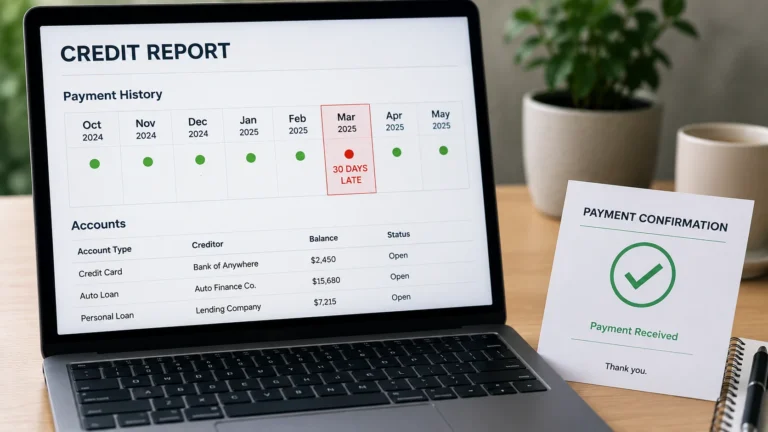
Review these fields:
- account status;
- payment history;
- past-due amount;
- current balance;
- date updated; and
- whether the account is open or closed.
If you are not sure how to read those fields, use our credit report reading guide.
Why would FICO say you have too few accounts paid as agreed?
1. Your credit file is thin
If you have only one or two accounts, the model has less information showing how you manage multiple credit obligations over time.
That does not mean you should immediately open several new cards. A thin file can improve naturally as your existing accounts age and continue reporting positive information. If you already pay rent, you can also check whether your rental payments can be reported before taking on new debt just to add an account.
2. You recently opened your first accounts
Even if your payments have been perfect so far, a recently established credit file contains limited history.
Length of credit history is a separate FICO category, and newer files can also have fewer accounts with established positive payment patterns.
3. Some accounts have late-payment history
If you have several accounts but some are delinquent, fewer accounts may currently qualify as being paid as agreed.
FICO says payment history is the largest category in a typical FICO Score calculation and considers the severity, recency, and frequency of late payments.
If a late payment was reported inaccurately, review how to dispute a late payment on your credit report.
4. You have very little recent account activity
An older account can remain on your report but provide little recent activity. Some score reason statements distinguish between the number of accounts in the file and the number with recent payment information.
If you already have an open credit card, occasional ordinary use followed by on-time payment can keep the account active. You do not need to carry interest-bearing debt for this purpose.
5. Your report may contain an error
If you know you have multiple active accounts in good standing but the score message seems inconsistent, inspect all three credit reports.
Possible errors include:
- an account incorrectly marked late;
- a current account shown as closed;
- an incorrect past-due amount;
- a missing account update; or
- an account belonging to someone else.
Do not dispute a score reason statement itself. Dispute the inaccurate credit-report information behind it.
Does this mean you need more credit cards?
No.
A score reason statement is not a recommendation to apply for more debt.
Opening several accounts can create new hard inquiries, reduce the average age of your accounts, and add new obligations. FICO specifically notes that opening multiple credit accounts in a short period can represent greater risk, especially for consumers with shorter histories.
If you have one or two useful accounts that you can manage responsibly, time and positive payment history may be more helpful than chasing a reason statement.
How do you fix “too few accounts paid as agreed”?
Start with the cause shown in your reports. Our step-by-step credit improvement plan explains how to prioritize current payments, reported balances and genuine errors before considering another account.
Step 1: Review all three credit reports
Use AnnualCreditReport.com to check the data reported by Equifax, Experian, and TransUnion.
Make a simple list of every account and note:
- open or closed status;
- current balance;
- payment status;
- last reported date;
- any late-payment history; and
- whether you recognize the account.
Step 2: Bring past-due accounts current if possible
If the message is tied to delinquent accounts, the most important step is stopping new late payments.
FICO says getting and staying current is one of the key ways to improve payment history over time.
Step 3: Keep existing accounts in good standing
Continue making required payments on time. Positive history becomes more meaningful as it accumulates.
Do not miss a payment while trying to optimize smaller score factors.
Step 4: Avoid unnecessary applications
Do not apply for multiple cards simply to increase the number of accounts paid as agreed.
If you genuinely need another credit product, evaluate the cost and usefulness first. Credit should solve a financial need, not merely change one score reason statement.
Step 5: Give the file time
Credit scores are dynamic. As accounts age, payments continue to report, and old negative information becomes less recent, the factors shown with a score can change.
See how to know if your credit score is improving without focusing on a single daily movement.
What if you only have one credit card?
If one credit card is your entire credit history, the file may simply be thin.
You can still build credit with one responsibly managed account. Pay on time, keep the account open if it remains useful and affordable, and let history develop.
There is no universal number of cards you must have for a good credit score.
What if you have many accounts but still see this message?
Quantity alone does not guarantee that every account is helping.
Check whether:
- some accounts are closed;
- some have no recent activity;
- some contain delinquency history;
- authorized-user accounts are being treated differently by the model; or
- the score source is using a different bureau than the report you checked.
Also remember that a reason statement identifies one factor relative to that specific score. It does not tell you the entire scoring calculation.
Can this reason statement lower your score by a specific number of points?
No reliable point value can be assigned to the phrase.
FICO Scores use the entire credit report, and the importance of each category can vary by consumer profile. A person with a thin file can react differently to the same account change than someone with a long, established history.
Avoid claims that opening one account will add a guaranteed number of points.
Frequently asked questions
Does “too few accounts paid as agreed” mean I have late payments?
Not necessarily. It can also appear when you have very few accounts or limited recent positive payment information. Check the reports to see whether any account is actually delinquent.
How many accounts should be paid as agreed?
There is no universal target that guarantees a particular FICO Score. The scoring model evaluates the entire credit file, not one fixed account-count rule.
Should I open another credit card to fix this?
Not solely for the reason statement. New credit can create inquiries and reduce average account age. Open credit only when it makes sense for your financial needs.
Can a closed account count as paid as agreed?
A closed account can remain part of your credit history, but score reason statements may focus on current or recent account information. The effect depends on the scoring model and the rest of your file.
What if the message is wrong?
The message itself is not something you dispute. Review the underlying credit report and dispute specific inaccurate account information if you find it.
Bottom line
“Too few accounts currently paid as agreed” usually means the scoring model sees too little positive current payment information relative to the rest of your profile. That can be caused by a thin file, recent delinquencies, or limited recent activity.
Do not respond by opening a pile of new accounts. Check your reports, correct errors, keep current accounts in good standing, and allow positive history to build.
Explore related guides on credit scores.
Sources and methodology
- FICO: How payment history impacts a credit score
- FICO: What is in a FICO Score
- FICO: What is on a credit report
- AnnualCreditReport.com
This article explains a general score reason statement and is not a promise that any specific action will raise a score by a particular amount.