
In this guide
- Does paying rent build credit?
- Does being on an apartment lease build credit?
- Which credit scores can use reported rent?
- What has to happen before rent can affect a credit score?
- When rent reporting may be most useful
- How rent reporting works
- How to check whether your rent is already being reported
- Credit reports and tenant screening reports are not the same thing
- How to choose a rent-reporting service
- Can past rent payments be added?
- How long does rent reporting take to show up?
- How much can rent reporting raise your credit score?
- What if rent appears but your score does not increase?
- Can rent reporting hurt your credit?
- What if your rent is reported incorrectly?
- Frequently asked questions
- Does Flex Rent report to the credit bureaus?
- Bottom line
- Related guides
- Sources
- Financial disclaimer
Yes, paying rent can help build credit — but only when the payment history is actually reported to a consumer reporting company and the scoring model being used can consider that rental data. Paying your landlord on time does not automatically create a credit tradeline, and rent reporting does not guarantee that every credit score you have will increase.
If rent is already being reported, verify which bureau receives it, whether the payment history is accurate, and whether the score you are watching uses that bureau’s data. If rent is not being reported, ask your landlord or property manager about rent reporting before paying for a third-party service.
Reviewed against CFPB and Experian guidance. Source review: September 17, 2026.
Quick rule: Reported rent can become useful credit data. Unreported rent usually cannot affect a standard credit score simply because you paid it on time.
Does paying rent build credit?
It can. CFPB says positive rental payments can help build credit and suggests asking your landlord whether they participate in a rental reporting program. But rent payment history is not automatically added to every credit report, and different reporting programs may send data to different bureaus.
That means two renters can make the same monthly payment and have different credit outcomes:
- Renter A: the landlord or reporting service furnishes rent payment history to a credit reporting company.
- Renter B: the landlord keeps payment records but does not furnish them to a consumer reporting company.
The payment behavior may be the same. The credit-report data is not.
Does being on an apartment lease build credit?
Not by itself. Being named on a lease does not guarantee that positive rent payments will appear on your Equifax, Experian, or TransUnion credit reports. What matters is whether the landlord, property manager, rent-reporting service, or eligible reporting program actually furnishes the payment history.
If the lease exists but no rent data reaches the credit report, the lease alone generally gives a scoring model no positive rental-payment history to use. If the payments are reported, then the effect depends on the bureau and scoring model being used.
Which credit scores can use reported rent?
VantageScore says all of its scoring models use rent and utility payment information when that data is reported to the three nationwide credit reporting agencies. FICO also says reported rental data is included in its newer models, including FICO Score 9, FICO Score 10, and FICO Score 10T.
| Scoring model | Can reported rent be considered? |
|---|---|
| FICO Score 9 | Yes, when rental history is reported to the credit bureaus. |
| FICO Score 10 / 10T | Yes, reported rental data can be included. |
| Older mortgage FICO Scores 5 / 4 / 2 | myFICO says reported rent is not considered by these older mortgage scores. |
| VantageScore models | VantageScore says its models can use reported rent and utility data. |
That is why “my rent is on my report” and “the score my lender uses will react to it” are not the same statement. Different lenders can use different scoring models and different bureau data, so reported rent does not guarantee that every score or lending decision will change.
Sources: myFICO on adding rent to credit reports and VantageScore lender FAQs on rent and utility payments.
For electricity, gas and water, see when utility bills affect your credit score. That guide separates regular payment reporting, Experian Boost, specialty utility reports and collections, with a checklist for final bills after moving.
What has to happen before rent can affect a credit score?
- You make the rent payment.
- A landlord, property manager, reporting service, or eligible bureau feature verifies the payment.
- The data is furnished to one or more consumer reporting companies.
- The rental information appears in the credit file used for the score.
- The scoring model being used is able to consider that rental data.
If one of those steps is missing, do not assume the score will change.
When rent reporting may be most useful
Rent reporting can be more useful when it adds meaningful payment history to a thin or young credit file. It may matter less for someone who already has many years of well-managed credit accounts.
| Your situation | Potential value | What to verify |
|---|---|---|
| Very little credit history | Potentially useful | Which bureau receives the rent data and whether the score used can consider it |
| One or two young accounts | May add useful payment history | Whether rental data actually appears on the report |
| Long, established credit history | May add less new information | Whether the fee is worth the reporting coverage |
| Recent late payments or high card balances | Rent reporting is secondary | Fix active problems first |
| Rent is sometimes late | Use caution | Whether the program can report late or delinquent payments |
If you are also working on broader credit issues, use our step-by-step credit improvement plan.
How rent reporting works
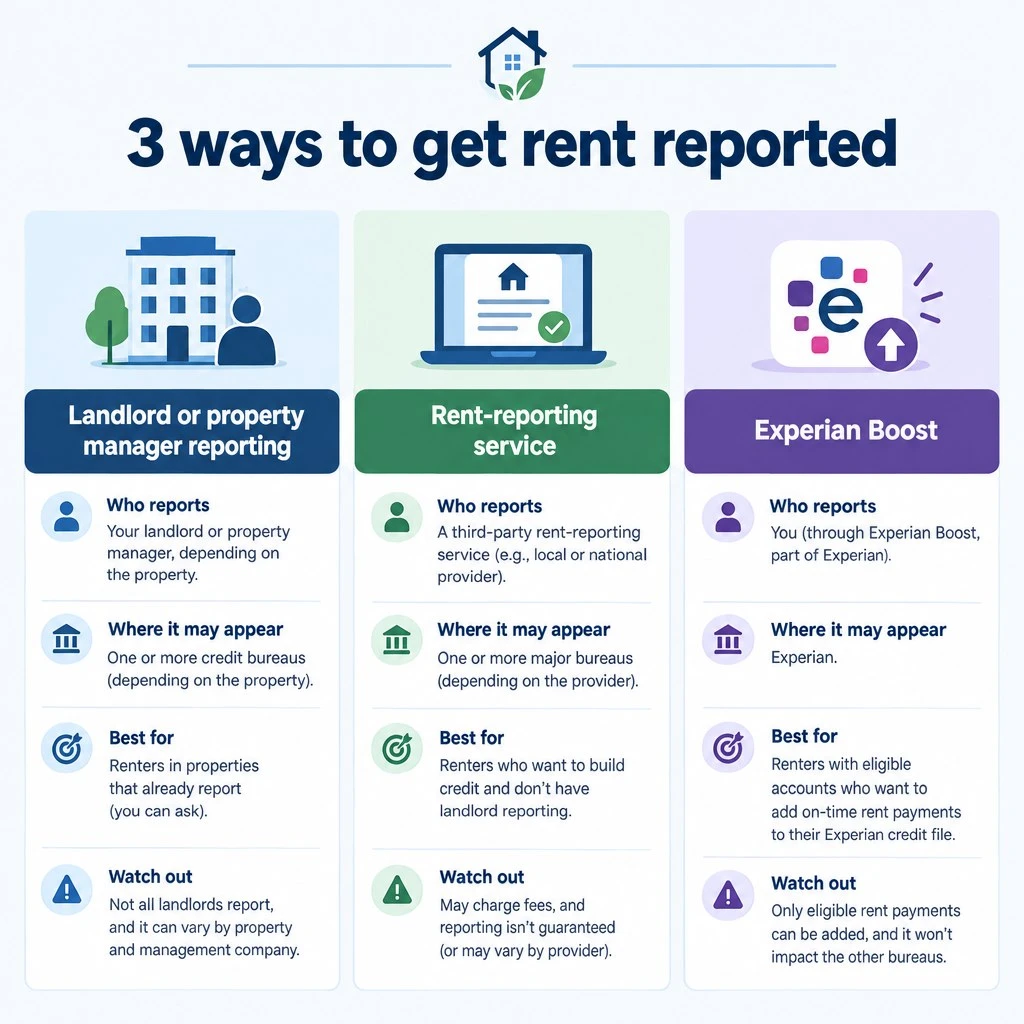
Rent reporting can reach a consumer report in several ways.
1. Your landlord or property manager reports rent
Some landlords and property managers participate in rent-reporting programs. Before enrolling, ask which bureaus receive the data, whether late payments can be reported, whether historical payments can be added, and whether there is a tenant fee.
2. You use a renter-initiated reporting service
Some services verify your lease and payments through bank transactions, rent portals, landlord confirmation, or other records, then furnish eligible payment history to one or more bureaus. Coverage varies, so “reports to the credit bureaus” is not specific enough — ask which bureaus.
3. You use an eligible Experian feature
Experian Boost can add certain eligible residential rent payments to an Experian credit file. Experian also states that not all rent payments qualify and that not all lenders use Experian data or scores affected by Boost. So this is not the same as adding rent to all three nationwide credit reports.
How to check whether your rent is already being reported
Before paying for anything, check your credit reports. Look for your landlord, property manager, reporting service, or another rental tradeline that matches your lease and address.
Review:
- reporting company name;
- rental address;
- start date;
- payment history;
- amount reported;
- current status;
- move-out or end date when applicable.
If you need help interpreting account-level fields, see how to read your credit report step by step.
Credit reports and tenant screening reports are not the same thing
CFPB explains that tenant screening reports are separate consumer reports used by landlords and property managers. They may include rental history, credit information, eviction-related information, employment verification, and other screening data.
Experian RentBureau is one example of a specialty consumer reporting company that collects rental payment information. CFPB notes that some positive rental data from RentBureau can also be included in Experian standard credit reports.
If a landlord takes adverse action based on a tenant screening report, federal law generally gives you rights to learn which reporting company supplied the report and to request a copy and dispute inaccurate information.
Use our tenant screening error checklist to request the report, match each disputed entry to evidence, and ask whether the landlord can reconsider with corrected information.
How to choose a rent-reporting service
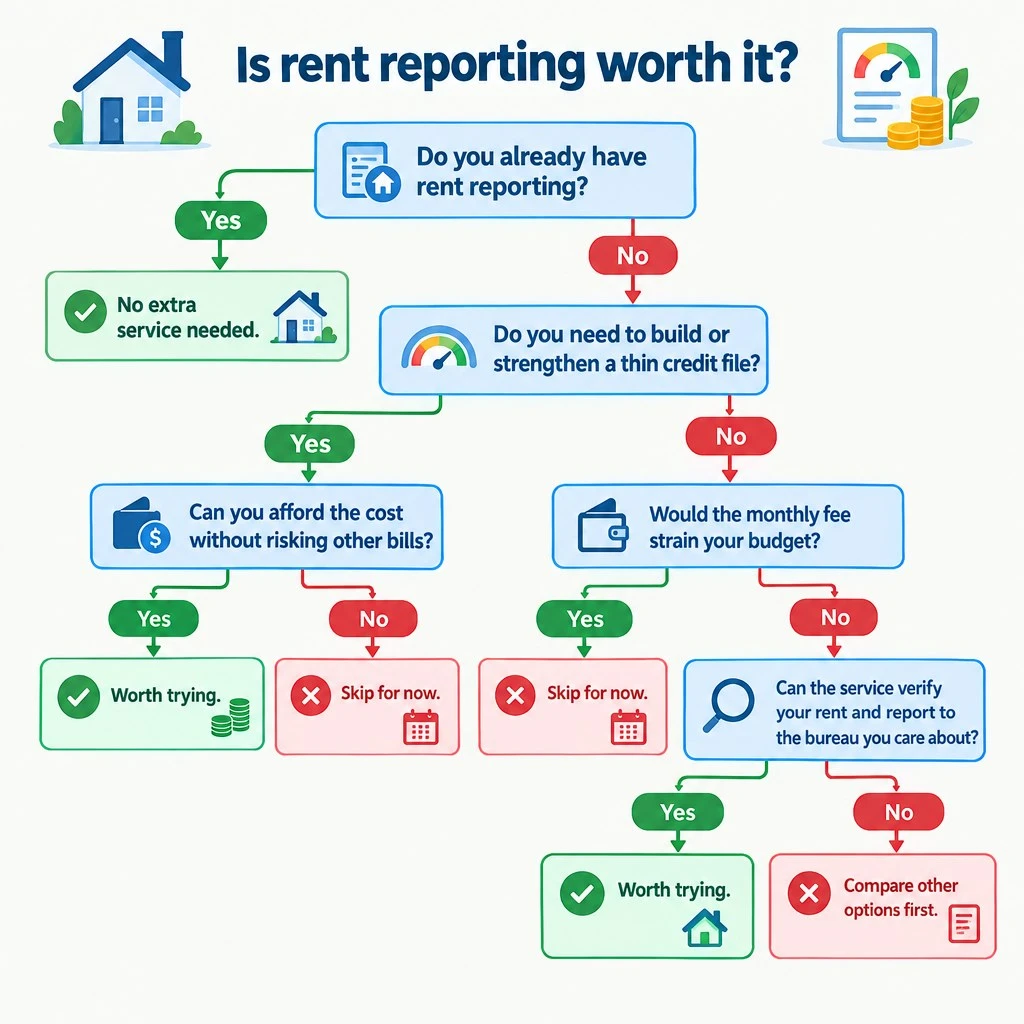
Do not choose a service based on a promised score increase. Compare what it actually reports.
- Bureau coverage: Equifax, Experian, TransUnion, or some combination?
- Historical reporting: Can prior months be added?
- Verification method: Bank transactions, portal, landlord confirmation, or another method?
- Late-payment policy: Positive-only reporting or full payment history?
- Total cost: Enrollment fee + monthly fee + historical-reporting fee.
- Error process: How do you correct a wrongly reported month?
- Cancellation: What happens when you move or stop the service?
Can past rent payments be added?
Sometimes. Some programs can verify and report prior rental history, while others report only after enrollment. The number of months available, bureau coverage, verification requirements, and fees vary by service.
Possible evidence for historical reporting can include a lease, rent ledger, bank statements, payment-portal records, canceled checks, or receipts.
How long does rent reporting take to show up?
There is no universal timeline. The process can include enrollment, identity verification, lease verification, payment verification, the reporting service’s furnishing cycle, and bureau processing.
If the expected reporting cycle passes and the rent still does not appear, ask:
- Was my enrollment approved?
- Was my lease verified?
- Was this payment eligible?
- When was the data furnished?
- Which bureau received it?
Then check the actual report rather than relying only on a score dashboard.
How much can rent reporting raise your credit score?
No provider can responsibly guarantee a specific point increase for your individual credit file. Results depend on the bureau, scoring model, amount of existing credit history, and other changes in the report.
A better way to measure whether reporting worked is to ask whether the rental tradeline appeared and whether the payment history is accurate. Score movement is a separate question.
What if rent appears but your score does not increase?
Check whether the score you are viewing uses the same bureau where the rent appears. Also check whether other factors changed at the same time, such as higher card balances, a new inquiry, or a new account.
If the score still seems stuck after the report has updated, see why your credit score may not be increasing.
Can rent reporting hurt your credit?
Potentially, depending on the program. Some reporting arrangements focus on positive payments, while others may report late or delinquent rent. Unpaid rent may also reach consumer reports through a collection account even if positive monthly rent was never reported.
Before enrolling, ask exactly how late, partial, split, or missed payments are handled.
What if your rent is reported incorrectly?
Identify the exact field that is wrong, gather records that support the correction, and dispute inaccurate information with the reporting company and furnisher when appropriate. Do not dispute an accurate rental entry simply because it is negative.
Useful evidence may include the lease, rent ledger, bank records, portal receipts, canceled checks, move-in or move-out records, or landlord correspondence. Our guide to documents that support a credit-report dispute explains how to organize that evidence.
Frequently asked questions
Does paying rent automatically build credit?
No. The payment normally must be reported to a consumer reporting company before it can become part of a credit file used for scoring.
Can my landlord report rent to the credit bureaus?
Yes, some landlords and property managers participate in rent-reporting programs. Ask which bureaus receive the data and whether tenant enrollment is required.
Can Experian boost add rent?
Eligible residential rent payments can be added to an Experian credit file through Experian Boost when its requirements are met. Not all rent payments qualify, and the effect is limited to Experian-based data and scores that use the added information.
Does late rent hurt credit?
It can. CFPB says rental payment and related debt-collection information can appear in consumer reports. The exact reporting path depends on the landlord, service, collection activity, and consumer reporting company.
Is rent reporting worth paying for?
It depends on the cost, bureau coverage, whether your file is thin, and whether the service can verify your payments. Do not pay mainly because of a promised score increase.
Does Flex Rent report to the credit bureaus?
Checked October 1, 2026: Flex describes Rent Reporting as an optional membership feature that reports on-time rent payments to Equifax, Experian, and TransUnion. Its rent-reporting instructions say the feature is turned on automatically for members who split rent, but is not available for the separate pay-in-full plan. Check your own plan and app settings; “included” does not mean the overall Flex service is free.
Flex also says it reports rent payments on the 21st of each month and that it can take up to 30 days for an on-time rent payment to appear. Because product terms can change, verify the current settings and bureau coverage inside the Flex app before relying on the feature.
Bottom line
Paying rent can help build credit when the payment history is actually reported and the scoring model used can consider it. Before enrolling in a service, check whether rent is already being reported, identify which bureaus will receive the data, understand whether late payments can also be reported, and calculate the real cost.
Judge the service first by whether accurate rental data reaches the intended credit report — not by a guaranteed number of score points.
Related guides
- Credit score guides — learn how different types of reported information can affect a credit profile.
Sources
- Consumer Financial Protection Bureau — Does late rent affect my credit score?
- Consumer Financial Protection Bureau — Experian RentBureau
- Consumer Financial Protection Bureau — Tenant screening reports
- Experian — Boost disclosure
- Experian — What is RentBureau?
Financial disclaimer
This article provides general U.S. financial and credit information, not individualized financial, legal, lending, or credit-repair advice. Rent-reporting availability, bureau coverage, scoring impact, and fees vary by provider and credit profile. No service or payment history guarantees a specific credit-score increase.