In this guide
- Does a refund count toward your minimum payment?
- How does a credit card refund appear on your account?
- What if the refund arrives before or after the statement closes?
- Will a refund reduce your credit card autopay?
- Do you still need to pay the statement balance to avoid interest?
- What if a refund leaves a negative credit card balance?
- What if the purchase was on an installment plan?
- What should you do if the refund never arrives?
- Frequently asked questions
A credit card refund usually does not count as a payment toward your minimum amount due. A merchant refund can lower the balance you owe without satisfying the payment requirement already shown on your statement. Make the required payment by its due date unless your issuer confirms that the amount has changed or that nothing remains due.
The key is to check three separate numbers: your current balance, your remaining minimum payment, and the amount needed to avoid purchase interest. A return receipt alone does not tell you any of those. This guide covers U.S. consumer credit cards and ordinary merchant refunds. If the account was already closed, use our guide to a refund sent to a closed credit card to trace the money and request any remaining credit balance.
Before you skip or reduce a payment: confirm that the refund has posted, check the remaining minimum due, and review any scheduled automatic withdrawal. A promised refund is not a posted credit.
Does a refund count toward your minimum payment?
Generally, no. A refund reverses all or part of a purchase; a payment is money you send to repay your card account. Both can reduce your balance, but the issuer may treat them differently when deciding whether you met the monthly payment requirement.
For example, the Capital One customer agreement says returns and other credits reduce the account balance without changing the minimum payment amount. Check the agreement for your own card rather than assuming that every credit works like a payment.
A refund larger than your minimum payment does not automatically cover that minimum. Also, satisfying the minimum and avoiding interest are different goals. Our guide to minimum payment versus statement balance explains the difference.
Example: an $800 bill and a $200 refund
Suppose your statement closes with an $800 balance, a $35 minimum payment, and a due date on the 25th. A $200 merchant refund posts on the 12th. Assume there are no other purchases, fees, interest, or payments.
- Original statement balance: $800.
- Posted refund: $200.
- Current balance after the refund: $600.
- Minimum still required: $35 if your issuer has not adjusted or satisfied it.
The mistake would be reasoning that $200 is more than $35, so the bill is paid. Instead, check the remaining minimum in the account. If it is still $35, pay that amount by the deadline at a minimum. Separately, confirm how much you must pay to preserve an available purchase grace period; paying only $35 generally will not accomplish that.
How does a credit card refund appear on your account?
A merchant refund usually appears as a credit linked to the original purchase or merchant. It can reduce an unpaid balance or create a credit balance if you already paid the account. Chase explains how returns appear on card statements.
Look for the actual posted transaction, not just a retailer’s email. Your store receipt proves the merchant accepted or processed a return; your card account shows whether the credit has reached the issuer. A store gift card or store credit does not reduce your credit card bill.
Keep the return receipt, refund amount, original purchase date, and merchant reference number together. If the return was mailed, keep tracking and delivery confirmation as well.
What if the refund arrives before or after the statement closes?
Timing changes which balance reflects the credit. Experian’s guidance on pending returns explains that a refund posted within the billing cycle can reduce the upcoming statement balance. Once a statement is issued, a later credit may change your current balance without changing the payment figures on that statement.
| Refund timing | Your next step |
|---|---|
| Posted before the statement closes | Check that the credit is included in the new statement. Pay the amount that statement requires. |
| Posted after closing but before the due date | Check the remaining minimum, any adjusted amount needed to avoid interest, and scheduled autopay. |
| Still pending when payment is due | Do not treat the expected refund as money already credited. Meet your payment obligation by the deadline. |
| Posted after you paid the account in full | Check for a negative balance. You can ask the issuer to return the remaining credit balance. |
The closing date and payment deadline serve different purposes. Use our explanation of the credit card statement date versus due date if you are unsure which one you are looking at.
In the $800 example, a $200 credit posted before closing could produce a $600 statement balance. If it posts after closing, the issued statement can still show $800 while the current balance shows $600. The same subtraction does not mean the two situations have identical payment requirements.
Will a refund reduce your credit card autopay?
Do not assume it will. The effect depends on your issuer, the payment option you selected, the type of credit, and when it posts. Check the scheduled withdrawal amount after the refund appears.
Rules for extra payments are not necessarily rules for refunds. For instance, Capital One’s AutoPay guidance says an additional payment made before processing reduces an upcoming minimum-payment or statement-balance automatic payment. That guidance specifically discusses payments, so it should not be treated as a promise that every merchant refund reduces autopay in the same way.
- Open the scheduled payment details. Record the amount, date, and funding account.
- Check the remaining minimum due. Do not rely only on the lower current balance.
- Ask about the refund. Confirm whether it changes the upcoming withdrawal and whether an adjustment deadline applies.
- Check again after any manual payment. Avoid an unintended second withdrawal without leaving the bill unpaid.
- Verify completion. Make sure the required payment actually posted.
If an automatic withdrawal already failed, follow the steps for an autopay failure and possible late payment. A refund does not automatically fix a failed bank payment.
Do you still need to pay the statement balance to avoid interest?
Do not simply subtract an expected refund from the amount you planned to pay. If the refund has not posted, it has not reduced your balance. If it has posted, check how your issuer applies it to the amount required to avoid purchase interest.
Your account may display an updated remaining statement balance or another payment figure. Confirm what that number means for your card, especially if you carry a balance, have a promotional offer, or use an installment plan. The current balance can also include new purchases from the next billing cycle.
If your card provides a purchase grace period and you meet its conditions, paying the required amount in full by the due date can avoid interest on eligible purchases. Our guide to how a credit card grace period works explains why making only the minimum is different.
A later refund does not automatically erase interest or fees already charged. If you cannot afford the required payment while waiting, contact the issuer before the due date to discuss options rather than assuming the return pauses the bill.
What if a refund leaves a negative credit card balance?
For the next steps, see what to do if you overpay your credit card. The guide explains how to request a credit balance refund, track its delivery and avoid another unnecessary payment.
A negative balance means the issuer owes you money on the account. It is not a new debt or an increase in your approved credit limit.
Suppose you paid the $800 bill in full and then received the $200 refund, with no other account activity. The resulting balance would be −$200. You can leave that credit to offset future purchases or ask for the remaining money back; you do not need to buy something just to use it.
Under Regulation Z, section 1026.11, when a covered credit balance exceeds $1, the issuer must refund the remaining credit balance within seven business days after receiving your written request. Issuers may also accept phone or electronic requests. New charges can reduce the amount available to return.
Request a credit balance refund through the issuer’s official channel and confirm the delivery method. This is different from taking a cash advance.
What if the purchase was on an installment plan?
Read the plan’s refund rules. A refund applied to a specific plan can change its balance and future installment amount, which is different from assuming a refund pays an ordinary card minimum.
For example, Chase Pay Over Time at checkout says eligible purchase refunds typically apply to the plan balance and reduce the monthly plan payment. Check the updated plan and total card payment due; do not apply that product-specific rule to every installment service or card.
If you closed the account or replaced the original card before the return, use our guide to getting a refund on a closed credit card. It explains how to trace the credit and recover any money the issuer owes you.
What should you do if the refund never arrives?
Ask the merchant for the processing date, amount, payment method, and any refund reference. Check that the money was returned to the card rather than issued as store credit. Give the issuer the records needed to trace the missing credit.
If the transaction becomes a billing-error dispute, that is a separate process with notice deadlines and payment protections. Read how a credit card charge dispute affects your payments and credit. Waiting for a voluntary refund does not automatically give you the same rights as a properly filed billing-error notice.
Explore related guides on credit cards and utilization.
Frequently asked questions
Does a refund count as a payment if it is bigger than the minimum?
Generally, no. The amount of the credit does not change its classification. Check the remaining minimum due rather than comparing the refund with the original minimum.
What if the refund brings the balance to zero?
Check whether the issuer now shows nothing due. If the current balance is zero or negative but a minimum payment still appears, ask the issuer to reconcile the figures before the deadline. Do not assume you must send money on an account with no remaining payment obligation.
Does a credit card refund help your credit score?
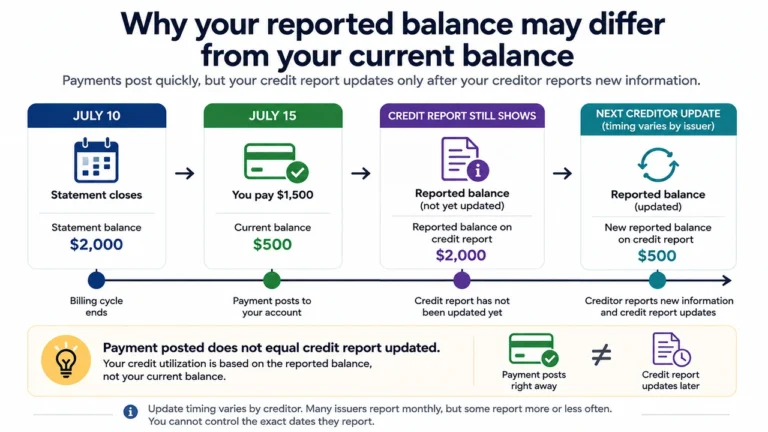
A lower reported balance can reduce utilization, but it does not guarantee a score increase. FICO explains that reported balances and utilization matter; the balance in your app may differ from the one on your credit report. Learn more about how credit utilization works.
Is a provisional credit the same as a merchant refund?
No. A provisional credit during a dispute is temporary and may be reversed under the applicable rules. Read the issuer’s case notice before treating that credit as a final refund or changing your payment.
Ask your issuer: “My refund of [amount] posted on [date]. What minimum payment remains due, what amount must I pay to avoid purchase interest, and how much will my next automatic payment withdraw?” Save the answer with your return receipt.
Sources checked October 7, 2026. This guide uses the linked Capital One, Chase, Experian, CFPB, and FICO materials. Dollar amounts and dates in the examples are hypothetical. Educational information for U.S. consumers, not individualized financial or legal advice. Your card agreement and current account details determine your payment obligations.