In this guide
- Identify the record behind the message
- Create a small case file before making calls
- If a creditor reported the account incorrectly
- If Social Security’s records are incorrect
- Track the corrections separately
- If the error persists
- What if the deceased flag is corrected but your application still fails?
- Sources
If your credit report says you are deceased when you are alive, ask which record triggered the flag before sending the same documents everywhere. An individual account can contain a mistaken deceased notation, or Social Security’s records can incorrectly mark your Social Security number as belonging to a deceased person. These situations need different corrections. Contact the affected credit bureau and the company reporting the error; if Social Security is the source, contact your local SSA office. Keep written confirmation of each correction and recheck the actual report before assuming access has been restored.
Identify the record behind the message
A rejected online identity check, a missing score, and a deceased indicator are not interchangeable. If you only have an access error, start with why a credit report cannot be retrieved. Ask the bureau or lender for the exact wording instead of guessing from a generic rejection screen.
Experian distinguishes an account-level deceased notation from an SSA-related indicator. An account error can arise in a relationship involving a deceased spouse or cosigner. That does not mean every part of the surviving person’s credit file should be treated as deceased. Ask whether the issue concerns a named account or the identifying record for the entire file.
| Evidence available | Who to contact | Confirmation to request |
|---|---|---|
| A particular account is marked deceased | The reporting creditor and affected bureau | Correction of that account’s deceased status and reporting. |
| The bureau identifies an SSA deceased indicator | Local Social Security office, then affected bureaus | SSA correction notice and subsequent bureau confirmation. |
| Only a generic report-access failure | The report provider’s support team | Exact failure reason and an alternative identity-verification route. |
| Different people appear to be combined | Each affected bureau and relevant furnishers | Investigation of all mismatched identifiers and accounts. |
Create a small case file before making calls
Save the denial message, report reference, date, and any account name shown. Add the phone number you used, the department reached, and a short summary after each conversation. Obtain numbers from the institution’s official website or a verified statement rather than from unsolicited messages offering to “reactivate” your identity.
Prepare a private chronology: the first date you saw the error, which organizations saw it, what each said about its source, and what documents each requested. This chronology is useful if one institution says the correction must begin elsewhere. It prevents a new representative from treating every call as a new, unexplained problem.
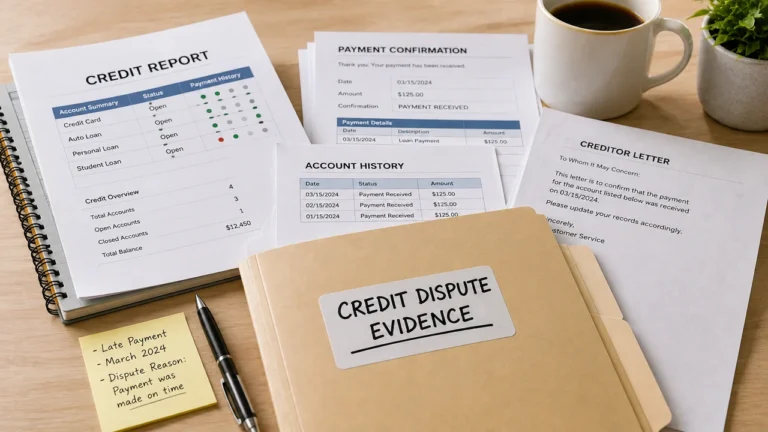
Do not attach a large collection of unrelated documents to every request. Use our guide to matching documents to a credit dispute to separate proof of identity from proof of the reporting error. Keep originals under your control except where an official agency specifically requires you to present them.
If a creditor reported the account incorrectly
Contact the creditor’s credit-reporting or account-support department. Ask whether its own record marks you as deceased, which bureaus received that information, and how it will correct the next transmission. Also follow each affected bureau’s instructions for verifying that you are alive and disputing the incorrect notation.
Experian’s published process asks for a letter stating that you are alive, along with your full name, current mailing address, Social Security number, and date of birth. It accepts documentation through its official upload route or by mail and may request a notarized identity-verification letter. Use the official instructions and upload link to submit those sensitive details securely.
TransUnion says to contact it by phone or submit an online dispute for an incorrect deceased status. Follow each affected bureau’s procedure; one company’s documentation checklist does not establish another company’s requirements.
Illustrative call script: “I am alive, but [report or notice] shows a deceased notation associated with [account]. Is that status in your own records? Please identify the department that can investigate it, the documents you need, and how I will receive written confirmation that corrected information was sent to the credit bureaus.”
If another account holder died, describe that relationship accurately. You are asking to correct your own status, not to remove an accurate record concerning someone else’s death or to change legal responsibility for a joint debt.
Sample letter for an incorrect deceased notation
Use this original example as a starting point for a private bureau submission. Add the identity fields and documents that the recipient’s current instructions require.
Re: Incorrect deceased notation — report reference [number], dated [date].
I am alive. My credit report incorrectly identifies me as deceased in [specific entry or account]. Please investigate and correct this notation. The enclosed [list of relevant documents] supports my identity and the requested correction. Please send me the investigation results and tell me how to obtain the corrected report.
[Full name, current mailing address, date, and signature]
This example is for correcting your own status. Use the institution’s separate deceased-customer process if you are handling a relative’s estate. Submit sensitive identifiers through the bureau’s verified channel; do not publish the completed letter.
If Social Security’s records are incorrect
SSA instructs people incorrectly listed as deceased to visit a local office promptly with identification. Its requirements differ from ordinary credit-bureau document packets: SSA asks for current original documents or copies certified by the issuing agency, and says ordinary photocopies and notarized copies are not accepted for this purpose. Consult its current identification list and office information before traveling.
When SSA corrects its record, request the offered “Erroneous Death Case – Third Party Contact” notice. Keep it available for organizations that need evidence of the correction. Presenting documentation to SSA does not prove that every bank, insurer, or credit bureau has already updated its separate system.
Create a recipient list rather than repeatedly mailing your only original notice. Ask each organization what version it accepts and how to submit it securely. Follow the bureau’s own identity-verification instructions in addition to supplying evidence that SSA corrected the death report.
Track the corrections separately
An illustrative case: a borrower learns that a shared account was marked deceased after a family member died. The creditor confirms the mistake and agrees to correct its reporting. The borrower should still check the affected bureau’s result. A creditor’s promise to transmit an update is not the same as confirmation that the report is corrected.
For an SSA error, the order may instead be SSA correction, written notice, bureau verification, and lender recheck. Neither illustration provides a guaranteed timeline. Ask about the next expected step and record a follow-up date rather than making repeated new applications while the same flag remains.
- Source of the flag confirmed?
- Required documents accepted by the correct organization?
- Written correction received?
- Each affected credit report rechecked?
- Lender or other organization told how to obtain updated information?
If the error persists
Compare each response with the precise issue you reported. If the bureau corrected an account but a separate identity flag remains, explain that distinction in your follow-up. Our credit-report dispute guide covers organizing a specific unresolved error; reading the full report helps confirm what actually changed.
If the situation threatens access to essential services or causes significant financial harm, consider help from a consumer-law attorney or legal aid organization. Keep notices, expenses, and dates. No paid “credit repair” promise can substitute for correcting the institution that supplied the erroneous record.
What if the deceased flag is corrected but your application still fails?
Ask the lender which report date and reporting company it used. A fresh bureau report and a lender’s earlier application record can describe different points in time. Before submitting another application, ask whether the existing application can be reviewed with the corrected information and whether a new credit inquiry would be required.
Use a separate completion check for each organization:
- Source: the creditor or SSA has confirmed the underlying correction.
- Bureau: the affected report no longer shows the erroneous deceased indicator.
- Lender: the reviewer has identified the information currently preventing the application from proceeding.
In an illustrative case, the identity problem is corrected but the lender then identifies an unrelated income-document requirement. The next task is that requirement, rather than reopening a resolved deceased-status dispute. Keep the correction evidence in case another institution later encounters the old record. This checklist is a way to isolate the remaining problem, not a promise that correction results in approval.
Explore related guides on credit reports and disputes.
Sources
- Experian: mistakenly reported as deceased
- Social Security: correcting an erroneous death report
- TransUnion: credit dispute questions
Updated October 6, 2026. Product terms and submission procedures can change; confirm the current instructions with the relevant organization.
Claire Bennett is the site’s editorial name, as explained on our author page.
Educational information only, not individualized financial or legal advice. Examples are illustrative; results depend on your circumstances.
Photo: Wesley Tingey / Unsplash. Illustrative photograph; not a customer story or testimonial.