In this guide
- Why paying the statement may leave a final charge
- A timeline makes the question easier to answer
- Illustrative calculation: an estimate, not an account audit
- Rule out other reasons for the balance
- A payoff call script
- Keep reviewing the account after payment
- What if the interest charge is a billing error?
- Separate the card bill from the credit report
- Sources
Quick answer: If you were carrying an interest-bearing balance, interest may have accrued between the statement date and the day the issuer received your payoff. That remaining charge is often called residual or trailing interest and can appear on a later statement. Compare the interest period, APR, payment posting date, and any new transactions before assuming the charge is wrong. Ask the issuer for the amount needed to bring the account to zero and how to confirm that no further interest remains.
Why paying the statement may leave a final charge
A statement is a snapshot at the end of a billing cycle. If interest continues accruing afterward, paying the number printed on that snapshot may not include every charge through the date your payment arrives.
The CFPB explains that when you carry a balance, interest generally continues until the card company receives payment. The agreement determines the account’s rules. “I paid the statement in full” and “all interest through the payoff date was included” are therefore different claims.
This is especially relevant after revolving debt, not simply because you use a credit card. If your purchases qualified for a grace period and you met all its conditions, ask why any purchase interest was assessed. The CFPB’s grace-period guidance helps distinguish those situations.
A timeline makes the question easier to answer
| Event | What to record | Question it answers |
|---|---|---|
| Statement closes | Date and balance. | What amount was captured in the bill? |
| Payoff is requested or sent | Date, method, and amount. | What did you intend to pay? |
| Payment is received and posted | Confirmation and effective date. | When did the issuer recognize the payment? |
| Next statement arrives | Interest, fees, new transactions, and remaining amount. | What created the new balance? |
Our statement-date and due-date guide explains why the statement closing date and payment deadline are different. Keep both dates; knowing only that you paid “before the due date” may not explain interest on previously carried debt.
Illustrative calculation: an estimate, not an account audit
Assume, purely for illustration, that $1,000 accrues simple daily interest at 24% APR for ten additional days, using a 365-day divisor. The estimate is $1,000 × 0.24 ÷ 365 × 10, or about $6.58.
An actual card may use a different balance method, daily balances, rounding, transaction rates, or other contractual details. Do not use this simplified figure to declare your bill correct or incorrect. Its purpose is to show how a charge can develop after a statement is produced even without another purchase.
Ask the issuer to identify the balance and dates used in its calculation. A clear explanation should connect the charge to your records. “That is just interest” is not enough information for you to reconcile the bill.
Rule out other reasons for the balance
If the balance included an ATM withdrawal or another cash-equivalent transaction, check the cash advance interest and credit guide. Its separate APR and lack of a purchase grace period can help explain why interest continues.
- A later purchase: check for activity after the statement date.
- A recurring subscription: see whether it charged after the payment.
- A fee: identify the fee type and the term that applies.
- A returned payment: confirm that the bank payment actually cleared.
- A promotional balance: check its expiration and interest conditions.
- A posting issue: compare the amount and effective date with your confirmation.
Do not group all of these under residual interest. The action needed for an incorrect payment posting is different from canceling a recurring subscription or asking about a valid charge on a previously carried balance.
A payoff call script
I paid [amount] on [date], and a later statement shows [charge]. Please identify the transaction type, balance, APR, and dates used to calculate it. What amount would bring the account to zero as of [intended payment date]? How should I make that payment, and when should I check for any remaining accrued interest?
Use the verified account channel and keep the answer with your payment record. If the issuer provides a payoff amount tied to a date, record that date. Paying a different amount or paying later can change the result.
Ask whether new purchases would accrue interest while the grace period is unavailable. Consider how to avoid adding further activity while you reconcile the payoff, while still maintaining a practical way to cover essential expenses.
Keep reviewing the account after payment
A zero balance displayed one day is useful information, but review the next statement as well. Check for accrued charges, returns, subscriptions, and any amount due. If you stop using the card, make sure that does not also mean you stop reading its statements.
Do not cancel every payment safeguard immediately after a payoff. First understand whether another amount may be due and how the issuer will handle it. Also check scheduled withdrawals so you do not unintentionally make a duplicate payment.
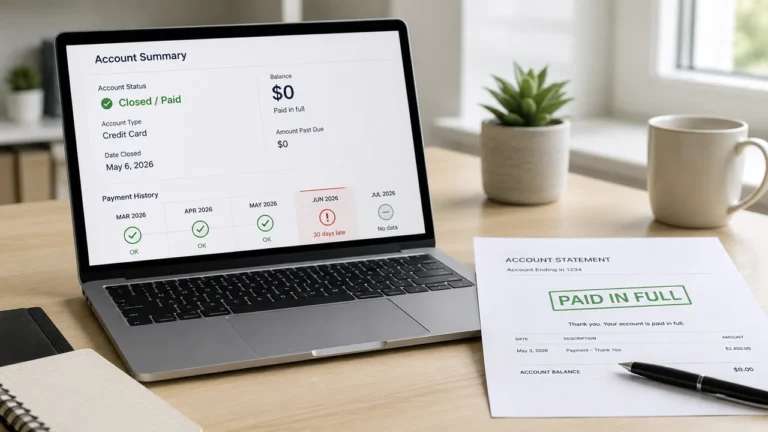
If the account is closed, the remaining billing questions still need attention. Our guide to late payments reported on closed accounts explains why closing an account does not necessarily erase an unpaid obligation.
What if the interest charge is a billing error?
Contact the issuer promptly, preserve the statement, and explain the specific discrepancy. For example, identify a payment that was credited on a different date from your confirmation or an APR that does not match the applicable agreement.
The Regulation Z billing-error rule generally requires your written notice to reach the issuer’s designated billing-inquiries address no later than 60 days after the issuer sent the first statement showing the alleged error. Use an electronic route only if the issuer’s billing-rights notice says it accepts notices that way. Keep delivery evidence. A casual support message should not be assumed to satisfy every requirement.
In the notice, identify your account and the alleged error: the charge amount, date, and why it appears incorrect. Attach copies of relevant statements and payment confirmations and keep the originals.
For a qualifying, timely billing-error notice, Regulation Z permits you to withhold the disputed amount and related charges while the issuer resolves the error. Continue paying undisputed amounts on time. The issuer cannot report you delinquent solely for withholding the disputed amount during that process; this does not protect an unrelated unpaid minimum or automatically erase earlier accurate late reporting.
Under the resolution deadlines, the issuer generally must acknowledge the notice within 30 days unless it resolves the matter sooner, and finish within two complete billing cycles, no later than 90 days after receipt. Save the receipt date and track those deadlines.
Separate the card bill from the credit report
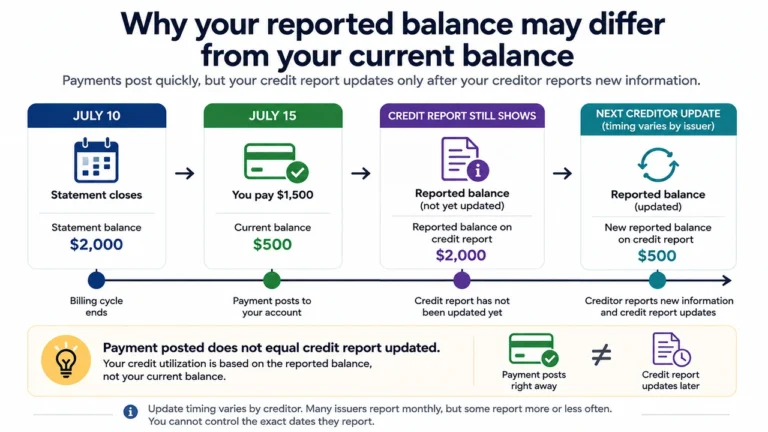
An issuer’s current balance and a bureau’s reported balance can update on different schedules. Our guides to score updates after a card payoff and credit reports that have not updated address that reporting issue.
First resolve what the issuer says is actually owed. Then, if a later report contains inaccurate information for the relevant period, investigate that reporting entry with the account records. A bureau dispute is not a substitute for asking the issuer to explain a current interest calculation.
By Claire Bennett, the editorial name used by the site’s founder and editor. Factual guidance checked against the linked official sources. Photo: laura adai / Unsplash.
Explore related guides on credit cards and utilization.
Sources
- Regulation Z: billing-error notices and resolution
- CFPB: interest after a balance payment
- CFPB: credit card grace periods
- CFPB: credit card billing disputes
Sources checked October 13, 2026. General educational information for U.S. readers; not individualized financial or legal advice. Examples are illustrative and do not predict credit scores or lending decisions.